lock Seat Ibiza ST 2016 Repair Manual
[x] Cancel search | Manufacturer: SEAT, Model Year: 2016, Model line: Ibiza ST, Model: Seat Ibiza ST 2016Pages: 252, PDF Size: 5.56 MB
Page 166 of 252
Operation
The selector lever lock is released as follows: – Switch the ignition on.
– Press and hold the brake pedal and press
the sel ect
or l ev
er lock on the left of the se-
lector lever at the same time ››› Fig. 170.
The warning lamp on the instrument panel
lights up when the brake pedal should be ap-
plied. This is essential when the selector lev-
er is taken from the P or N positions.
Level lock only engages with the vehicle sta-
tionary at a speed of up to 5 km/h (3 mph).
At speeds of over 5 km/h (3 mph) the selec-
tor lever lock is automatically deactivated in
position N.
The selector lever lock is not engaged if the
selector lever is moved quickly through posi-
tion N (e.g. when shifting from R to D). This
makes it possible, for instance, to “rock” the
vehicle backwards and forwards if it is stuck
in snow or mud. The selector lever lock en-
gages automatically if the brake pedal is not
depressed and the lever is in position N for
more than about 1 second. Selecting gears manually with Tip-
tronic mode*
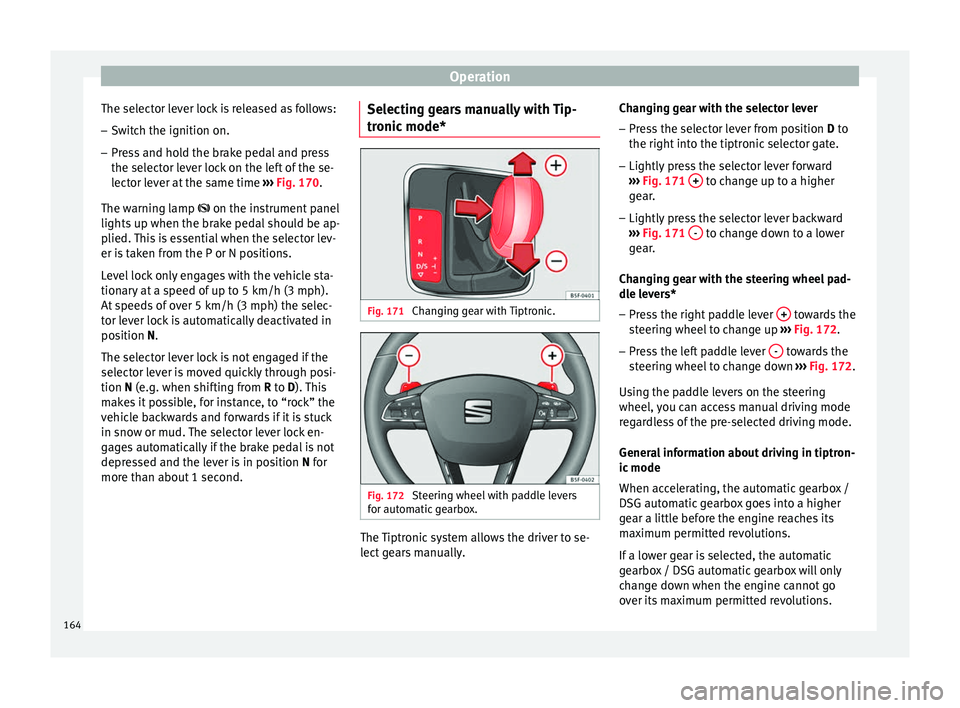
Fig. 171
Changing gear with Tiptronic. Fig. 172
Steering wheel with paddle levers
f or aut
omatic
gearbox. The Tiptronic system allows the driver to se-
l
ect
ge
ars manually. Changing gear with the selector lever
– Press the selector lever from position D to
the right into the tiptr
onic selector gate.
– Lightly press the selector lever forward
››› Fig. 171
+ to change up to a higher
g e
ar .
– Lightly
press the selector lever backward
››› Fig. 171
- to change down to a lower
g e
ar .
Ch
anging gear with the steering wheel pad-
dle levers*
– Press the right paddle lever + towards the
s t
eerin g wheel
to change up ››› Fig. 172.
– Press the left paddle lever - towards the
s t
eerin g wheel
to change down ››› Fig. 172.
Using the paddle levers on the steering
wheel, you can access manual driving mode
regardless of the pre-selected driving mode.
General information about driving in tiptron-
ic mode
When accelerating, the automatic gearbox /
DSG automatic gearbox goes into a higher
gear a little before the engine reaches its
maximum permitted revolutions.
If a lower gear is selected, the automatic
gearbox / DSG automatic gearbox will only
change down when the engine cannot go
over its maximum permitted revolutions.
164
Page 167 of 252
Driving
If “tiptronic” is selected whilst the vehicle is
in motion and the aut om
atic g
earbox / DSG
automatic gearbox is in third gear and selec-
tor lever position D, “tiptronic” mode will
then also be in third gear.
Changing gears in the normal or sport pro-
gramme using the steering wheel paddle lev-
ers
If the paddle levers ››› Fig. 172 are used in
the normal or sport programme, the system
switches temporarily to “tiptronic” mode. To
exit “Tiptronic” mode again, press the right
paddle lever + towards the steering wheel
f or ap
pro
ximately one second. You will also
leave “tiptronic” mode if the paddle levers
are not moved for a certain time. Note
● The gear p a
ddle levers on the steering
wheel can be operated with the selector lever
in any position and with the vehicle in mo-
tion. Driving tips
The gearbox changes gear ratios automatical-
ly
a
s the
vehicle moves.
Starting
– Start the engine with the selector lever in
position P
or N. Driving
– Press and hold the brake pedal.
– Holding down the lock button (button on
the selector lev
er), select R or D.
– Release the lever and wait a little for the
gearbox
to engage the gear (a slight move-
ment can be felt).
– Release the brake and press the accelerator
››› in Selector lever positions on
p ag
e 163 .
St
opping briefly
– If stopping for a short time, keep the vehi-
cle st
ationary by pressing the foot brake
hard to prevent the vehicle moving back-
wards on a slope or “creeping” forwards,
e.g. at traffic lights. The selector lever does
not need to be put into the positions P or N
for this.
– Do not press the accelerator.
Parking
– Pr
ess and hold the brake pedal until the ve-
hicle come
s to a standstill ››› in Selector
l ev
er po s
itions on page 163.
– Apply the handbrake.
– By pressing the lock button down, move
the selector lev
er to P and release the lock
button. Driving up and down hills
–
Press the selector lever from position “D”
to the right into the tiptr
onic selector gate.
– Lightly press the selector lever back to
chang
e down.
Holding the car on a hill
– The brake must be always pressed down to
prevent the
vehicle from “rolling back-
wards” ››› in Selector lever positions on
p ag
e 163 . Do not
try to prevent the vehicle
from “rolling backwards” by increasing the
engine speed while a range of gears is se-
lected.
Starting the vehicle up hills
– Apply the handbrake.
– With a selected gear, accelerate slowly and
at the same time, rel
ease the handbrake.
The steeper the slope, the lower the needed
gear. This increases the braking effect of the
engine. For example, when driving down a
very steep slope in third gear. If the engine
brake effect is not enough, the vehicle will
speed up. The automatic gearbox automati-
cally changes up to prevent the engine over-
revving. Use the foot brake to reduce speed
and change into 3rd gear using Tiptronic*
››› in Selector lever positions on page 163.
Y our
vehic
le has an automatic interlock
which prevents the selector lever from being »
165
Technical data
Advice
Operation
Emergencies
Safety
Page 189 of 252
Towing bracket device and trailer
Tyre pressure
Set ty
re pr
essure to the maximum permissi-
ble pressure shown on the sticker on the in-
side of the fuel tank flap. Set the tyre pres-
sure of the trailer tyres in accordance with the
trailer manufacturer's recommendations.
Exterior mirrors
Check whether you can see enough of the
road behind the trailer with the standard rear
vision mirrors. If this is not the case, you
should have additional exterior mirrors fitted.
Both exterior mirrors should be mounted on
hinged extension brackets. Adjust the mirrors
to give sufficient vision to the rear. WARNING
Never transport people in a trailer. This could
res u
lt in fatal accidents. Note
● Tow in
g a trailer places additional demands
on the vehicle. We recommend additional
services between the normal inspection inter-
vals if the vehicle is used frequently for tow-
ing a trailer.
● Find out whether special regulations apply
to tow
ing a trailer in your country. Ball coupling of towing bracket*
The ball coupling is provided with instruc-
tions on fittin
g and r
emoving the ball cou-
pling of the towing bracket. WARNING
The towing bracket ball coupling must be
stor ed sec
urely in the luggage compartment
to prevent them being flung through the vehi-
cle and causing injury. Note
● By l a
w, the ball coupling must be removed
if a trailer is not being towed if it obscures
the number plate. Driving tips
Driving with a trailer always requires extra
c
ar
e.
W eight
distribution
The weight distribution of a loaded trailer
with an unladen vehicle is very unfavourable.
However, if this cannot be avoided, drive ex-
tra slowly to allow for the unbalanced weight
distribution. Speed
The stabi
lity of the vehicle and trailer is re-
duced with increasing speed. For this reason,
it is advisable not to drive at the maximum
permissible speed in an unfavourable road,
weather or wind conditions. This applies es-
pecially when driving downhill.
You should always reduce speed immediately
if the trailer shows the slightest sign of snak-
ing. Never try to stop the “snaking” by in-
creasing speed.
Always brake in due course. If the trailer has
an overrun brake, apply the brakes gently at
first and then, firmly. This will prevent the
jerking that can be caused by locking of trail-
er wheels. Select a low gear in due course
before going down a steep downhill. This en-
ables you to use the engine braking to slow
down the vehicle.
Reheating
At very high temperatures and during pro-
longed slopes, driving with a low gear and
high engine speed; always monitor whether
the excessive coolant temperature gauge is
activated ››› page 207.
187
Technical data
Advice
Operation
Emergencies
Safety
Page 195 of 252
Care and maintenance
– Rin se the
vehic
le thoroughly with water.
– Dry the vehicle surface gently with a cha-
mois le
ather.
– In cold temperature, dry the rubber seals
and their surf
aces to prevent them from
freezing. Apply silicone spray to the rubber
seals.
After washing the vehicle – After washing, avoid sudden and sharp
braking. “Dr
y” the brakes by braking sever-
al times. WARNING
● Wash y
our vehicle with the ignition switch-
ed off.
● Protect your hands and arms from cuts on
sharp metal
edges when cleaning the under-
body, the inside of the wheel housings etc.
Risk of injury.
● Water, ice and salt on the brake system can
reduce brak
ing effectiveness. Risk of acci-
dent. CAUTION
● Never remo v
e dirt, mud or dust if the vehi-
cle surface is dry. Never use a dry cloth or
sponge for cleaning purposes. This could
scratch the paintwork or glass on your vehi-
cle. ●
Washin g the
vehicle in low temperatures:
when washing the vehicle with a hose, do not
direct water into the lock cylinders or the
gaps around the doors, rear lid, or sunroof.
Risk of freezing. For the sake of the environment
To protect the environment, the vehicle
shou ld be w a
shed only in specially provided
wash bays, to prevent toxic, oil-laden waste
water from entering the sewer system. In
some places, washing vehicles outside wash
bays is prohibited. Note
Do not wash the vehicle in direct sunlight. Washing the vehicle with a high pres-
s
ur
e c l
eaner Be particularly careful when using a high
pr
e
ss
ure cleaner!
– Always observe the instructions for the
high-press
ure cleaner, particularly those
concerning the pressure and the spraying
distance.
– Increase the spraying distance for soft ma-
terials
and painted bumpers. –
Do not use a high pre
ssure cleaner to re-
move ice or snow from windows
››› page 194.
– Never use concentrated jet nozzles (“rotat-
ing jets”) ››
› .
– After washing, avoid sudden and sharp
br ak
ing. “Dr
y” the brakes by braking sever-
al times ››› page 152. WARNING
● Never wa sh ty
res with a concentrated jet
(“rotating nozzle”). Even at large spraying
distances and short cleaning times, damage
can occur to the tyres. This may cause an ac-
cident.
● Water, ice and salt on the brake system can
reduce brak
ing effectiveness. Risk of acci-
dent. CAUTION
● Do not use w at
er hotter than +60 °C
(+140 °F). This could damage the vehicle.
● To avoid damage to the vehicle, keep a suf-
ficient dis
tance from sensitive materials such
as flexible hoses, plastic, soundproofing ma-
terial, etc. This also applies to bumpers pain-
ted in the colour of the bodywork. The closer
the nozzle is to the surface, the greater the
wear on the material. 193
Technical data
Advice
Operation
Emergencies
Safety
Page 197 of 252
Care and maintenance
painted surfaces are not suitable to clean
w indo
ws
because they are soiled with wax
deposits which could smear the windows.
If possible, use a de-icing spray to remove
ice. If you use an ice scraper, push it in one
direction only without swinging it.
Use window cleaner or a silicone remover to
clean rubber, oil, grease and silicone depos-
its off.
Wax deposits can only be removed with a
special cleaner available at your Technical
Service. Wax deposits on the windscreen
could cause the wiper blades to judder. Add-
ing a window cleaner that dissolves wax to
the windscreen washer fluid prevents wiper
blades from juddering, but wax deposits are
not removed. CAUTION
● Never use w arm or hot
water to remove
snow and ice from windows and mirrors. This
could cause the glass to crack!
● The heating element for the rear window is
located on the inner side of
the window. To
prevent damage, do not put stickers over the
heating elements on the inside of the win-
dow. Cleaning windscreen wiper blades
Clean wiper blades improve visibility. 1. Use a soft cloth to remove dust and dirt
from the w
inds
creen wiper blades.
2. Use window cleaner to clean the wind- screen w
iper blades. Use a sponge or a
cloth to remove stubborn dirt.
Care of rubber seals If rubber seals are well looked after, they will
not freez
e so quic
kly.
1. Use a soft cloth to remove dust and dirt from the rubber seal s.
2.
Apply a specialist care product to the rub-
ber seals.
The rubber strip
s on the doors, windows, etc.
will remain pliable and last longer if they are
treated with a suitable rubber care product
from time to time (for example silicone
spray).
Caring for rubber seals will also prevent pre-
mature ageing and leaks. The doors will be
easier to open. If rubber seals are well looked
after, they will not freeze so quickly in winter.
Door lock cylinder The door lock cylinders can freeze up in win-
t
er
. T
o de-ic
e the lock cylinders you should only
use spra
y with lubricating and anti-corrosive
properties.
Cleaning chrome parts 1. Clean chrome parts with a damp cloth.
2. Polish chrome parts with a soft, dry cloth.
If this
doe
s not provide satisfying results, use
a specialist chrome cleaning product.
Chrome cleaning products will remove stains
from the surface. CAUTION
To prevent scratching chrome surfaces:
● Never use an abrasive cleaning product on
chrome.
● Do not c
lean or polish chrome parts in a
sandy or dus
ty environment. Steel wheel rims
–
Clean steel wheel rims regularly using a
sep ar
at e s
ponge.
Use an industrial cleaner to remove brake
dust. Any damage to the paint on steel wheel
rims should be repaired before starting to
rust. »
195
Technical data
Advice
Operation
Emergencies
Safety
Page 201 of 252
Checking and refilling levels
Checking and refilling levels
R ef
uel lin
g
Refuelling Read the additional information carefully
›››
p
age 41
The tank flap is released manually and is lo-
cated at the rear of the vehicle on the right.
The tank holds approximately 45 litres.
Opening the fuel tank cap
– Lift the lid.
– Hold the cap firmly with one hand, then in-
sert the k ey
into the lock and rotate 180° to
the left.
– Unscrew the cap, turning it anticlockwise.
Closin
g the fuel tank cap
– Screw the tank cap to the right until it
“clicks”.
– T
urn the key in the lock, without releasing
the cap, cloc
kwise through 180°.
– Remove the key and close the flap until it
clicks
into place. The tank cap is secured
with an anti-loss attachment
If the automatic filler nozzle is operated cor-
rectly, it will switch itself off as soon as the tank is “full”. Never attempt to fill beyond
this point, as
this will fill the expansion
chamber. Fuel may leak out if ambient condi-
tions are warm.
The correct fuel grade for your vehicle is giv-
en on a sticker on the inside of the fuel tank
flap. WARNING
● Fuel i s
highly flammable and can cause se-
rious burns and other injuries.
–Never smoke or come into contact with
sparks when filling the fuel tank of the
vehicle or a spare fuel canister with fuel.
This is an explosion hazard.
– Follow legal requirements for the use of
spare fuel canisters.
– For safety reasons we do not recommend
carrying a spare fuel canister in the vehi-
cle. The canister could be damaged in an
accident and leak.
● If, in exceptional circumstances, you have
to carry
a spare fuel canister, please observe
the following:
–Never fill the spare fuel canister inside
the vehicle or on it. An electrostatic
charge could build up during filling, caus-
ing the fuel fumes to ignite. This could
cause an explosion. Always place the
canister on the ground to fill it.
– Insert the fuel nozzle into the mouth of
the canister as far as possible. –
If the sp ar
e fuel canister is made of met-
al, the filling nozzle must be in contact
with the canister during filling. This
helps prevent an electrostatic charge
building up.
– Never spill fuel in the vehicle or in the
luggage compartment. Fuel vapours are
explosive. Danger of death. CAUTION
● Fuel s pi
lls should be removed from the
paintwork immediately.
● Never run the tank completely dry. Irregular
fuel sup
ply can cause misfiring. As a result,
unburnt fuel could enter the catalytic convert-
er and cause damage.
● When filling the fuel tank after having run it
complet
ely dry on a vehicle with a diesel en-
gine the ignition must be switched on for at
least 30 seconds before starting the engine.
Subsequently, when you start the engine it
may take longer than normal to start firing
(up to one minute). This is due to the fact that
the fuel system has to purge itself of air be-
fore starting. For the sake of the environment
Do not try to put in more fuel after the auto-
matic fi l
ler nozzle has switched off, this may
cause the fuel to overflow if it becomes warm. 199
Technical data
Advice
Operation
Emergencies
Safety
Page 204 of 252
Advice
are under constant development. SEAT pro-
v ide
s a c
onstant flow of information to Tech-
nical Services concerning modifications. For
this reason, we recommend you have service
fluids and consumables replaced by a Techni-
cal Service. Please observe the relevant in-
structions ››› page 190. The engine compart-
ment of the vehicle is a hazardous area ››› .
WARNING
All work on the engine or in the engine com-
partment, e. g. c
hecking and refilling fluids,
involves the danger of injury and burns, acci-
dents and even fire.
● Never open the bonnet if you see steam,
smoke or cool
ant escaping from the engine
compartment. Otherwise, there is a risk of
sustaining burns. Wait until no more steam or
coolant is emitted, then allow the engine to
cool before carefully opening the bonnet.
● Switch off the engine and remove the key
from the ignition.
● Apply
the handbrake and move the gear
lever to neutr
al or selector lever to position P.
● Keep children away from the vehicle.
● Never touch hot engine parts. There is a
risk of b
urns.
● Never spill liquids on a hot engine or on a
hot exhau
st gas system. This is a fire hazard.
● Avoid causing short-circuits in the electri-
cal sy
stem, particularly at the points where
the jump leads are attached ›››
page 52.
The battery could explode. ●
Never touc h the r
adiator fan. It is tempera-
ture controlled and could start automatically,
even when the engine has been switched off
and the key removed from the ignition!
● Never cover the engine with additional in-
sulatin
g materials such as a blanket. Risk of
fire!
● Do not unscrew the cap on the coolant ex-
pansion t
ank when the engine is hot. If the
coolant is hot, the cooling system will be
pressurised!
● Protect face, hands and arms by covering
the cap with a lar
ge, thick cloth to protect
against escaping coolant and steam.
● Always make sure you have not left any ob-
jects, suc
h as cleaning cloths or tools, in the
engine compartment.
● If you have to work underneath the vehicle,
you must
use suitable stands additionally to
support the vehicle, there is a risk of acci-
dent!. A hydraulic jack is insufficient for se-
curing the vehicle and there is a risk of injury.
● If any work has to be performed when the
engine is s
tarted or with the engine running,
there is an additional, potentially fatal, safety
risk from the rotating parts, such as the drive
belts, alternator, radiator fan, etc., and from
the high-voltage ignition system. You should
also observe the following:
– Never touch the electrical wiring of the
ignition system.
– Ensure that jewellery, loose clothing and
long hair do not get trapped in rotating
engine parts. Danger of death. Before starting any work remove jewellery, tie
back
and c
over hair, and wear tight-fit-
ting clothes.
– Never accelerate with a gear engaged
without taking the necessary precau-
tions. The vehicle could move, even if the
handbrake is applied. Danger of death.
● If work has to be carried out on the fuel
system or on el
ectrical components, you
must observe the following safety notes in
addition to the above warnings:
– Always disconnect the battery from the
on-board network. The vehicle must be
unlocked when this is done, otherwise
the alarm will be triggered.
– Do not smoke.
– Never work near naked flames.
– Always have a fire extinguisher on hand. WARNING
If the bonnet is not correctly closed, it could
sudden ly
open while driving leaving the driv-
er without visibility. This could result in a se-
rious accident.
● After closing the bonnet, always check that
it is pr
operly secured by the locking mecha-
nism in the lock carrier piece. The bonnet
must be flush with the surrounding body pan-
els.
● While driving, if you notice that the bonnet
is not c
orrectly closed then stop immediately
and close it correctly. 202
Page 205 of 252
Checking and refilling levels
●
Only open and c lo
se the bonnet when there
is nobody within its range. CAUTION
When topping up service fluids, make sure
not to mi s
take them. Using the wrong fluids
could cause serious malfunctions and engine
damage! For the sake of the environment
Service fluids leaks are harmful to the envi-
ronment. F or thi
s reason you should make
regular checks on the ground underneath
your vehicle. If you find spots of oil or other
fluids, have your vehicle inspected in a speci-
alised workshop. Opening the bonnet
Read the additional information carefully
› ›
›
p
age 10
The bonnet is released from inside the vehi-
cle.
Before opening the bonnet ensure that the
windscreen wipers are in rest position. WARNING
Hot coolant can scald! ●
Never open the bonnet if
you see steam,
smoke or coolant escaping from the engine
compartment.
● Wait until no more steam, smoke or coolant
is emitted fr
om the bonnet, then carefully
open the bonnet.
● When working in the engine compartment,
alway
s observe the safety warnings
››› page 201. Closing the bonnet
–
Slightly lift the bonnet.
– Release the bonnet stay and replace it in its
sup
por t
.
– At a height of approximately 30 cm let it fall
so it locks.
If
the bonnet does not close, do not press
downwards. Open it again and let it fall as
mentioned above. WARNING
If the bonnet is not closed properly, it could
open while y
ou are driving and completely
obscure your view of the road. Risk of acci-
dent.
● After closing the bonnet, always check that
it is pr
operly secured. The bonnet must be
flush with the surrounding body panels. ●
If y ou notic
e that the bonnet latch is not se-
cured when the vehicle is moving, stop the
vehicle immediately and close the bonnet
properly. Risk of accident. 203
Technical data
Advice
Operation
Emergencies
Safety
Page 211 of 252
Checking and refilling levels
CAUTION
Do not top up the expansion tank with cool-
ant fluid if it i
s empty! Air could enter the
cooling system. In this case, stop driving.
Seek specialist assistance. Otherwise, there
is a risk of engine damage. CAUTION
The original additives should never be mixed
with coo l
ants which are not approved by
SEAT. Otherwise, you run the risk of causing
severe damage to the engine and the engine
cooling system.
● If the fluid in the expansion tank is not pur-
ple but
is, for example, brown, this indicates
that the G13 additive has been mixed with an
inadequate coolant. The coolant must be
changed as soon as possible if this is the
case! This could result in serious faults and
engine damage. For the sake of the environment
Coolants and additives can contaminate the
envir onment
. If any fluids are spilled, they
should be collected and correctly disposed
of, with respect to the environment. Brake fluid
Chec k
in g the br
ake fluid level Read the additional information carefully
›››
p
age 43
The position of the brake fluid reservoir is
shown in the corresponding engine compart-
ment illustration ››› page 204. The brake fluid
reservoir has a black and yellow cap.
The brake fluid level drops slightly when the
vehicle is being used as the brake pads are
automatically adjusted as they wear.
However, if the level goes down noticeably in
a short time, or drops below the “MIN” mark,
there may be a leak in the brake system. A
display on the instrument panel will warn you
if the brake fluid level is too low ›››
page 100. WARNING
Before opening the bonnet to check the brake
fluid level, r e
ad and observe the warnings
››› page 201. Changing the brake fluid
The Maintenance Programme indicates brake
fluid c
h
an g
e intervals.
We recommend that you have the brake fluid
changed by a Technical Service. Before opening the bonnet, please read and
follo
w the warnings ››› in safety notes for
w ork
in the en gine c
ompartment on
page 201 in section “Safety notes for work-
ing in the engine compartment”.
In the course of time, brake fluid becomes
hygroscopic and absorbs water from the am-
bient air. If the water content in the brake flu-
id is too high, the brake system could cor-
rode. This also considerably reduces the boil-
ing point of the brake fluid. Heavy use of the
brakes may then cause a vapour lock which
could impair the braking effect.
Be sure to always use the correct brake fluid.
Only use brake fluid that expressly meets the
VW 501 14 standard.
You can buy VW 501 14 standard brake fluid
in a SEAT dealership or a SEAT Official Serv-
ice. If none is available, use only high-quality
brake fluid that meets DIN ISO 4925 CLASS 4
standards, or USA Standards FMVSS 116 DOT
4.
Using any other kind of brake fluid or one
that is not of a high quality may affect opera-
tion of the brake system and reduce its effec-
tiveness. Never use a brake fluid if the con-
tainer does not state that it complies with VW
501 14, DIN ISO 4925 CLASS 4 standards, or
USA standards FMVSS 116 DOT 4. »
209
Technical data
Advice
Operation
Emergencies
Safety
Page 212 of 252
Advice
WARNING
Brake fluid is poisonous. Old brake fluid im-
pairs the br
aking effect.
● Before opening the bonnet to check the
brake fluid lev
el, read and observe the warn-
ings ››› page 201.
● Brake fluid should be stored in the closed
original c
ontainer in a safe place out of reach
of children. There is a toxic risk.
● Perform the brake fluid change according to
the Maintenanc
e Programme. Heavy use of
the brakes may cause a vapour lock if the
brake fluid is left in the brake system for too
long. This would seriously affect the effec-
tiveness of the brakes and the safety of the
vehicle. This may cause an accident. CAUTION
Brake fluid damages the vehicle paintwork.
Wipe off an y
brake fluid from the paintwork
immediately. For the sake of the environment
The brake pads and brake fluid must be col-
lected and di s
posed of according the applica-
ble regulations. The SEAT Technical Service
network has the necessary equipment and
qualified personnel for collecting and dispos-
ing of this waste material. Windscreen washer reservoir
Top
pin g up the w
indscreen washer
reservoir water Read the additional information carefully
›››
p
age 43
The windscreen washer and the headlight
washers are supplied with fluid from the
windscreen washer fluid container in the en-
gine compartment. The container holds ap-
prox. 3 litres; in vehicles with headlight
washers* it holds approx. 4.5 litres.
The tank is in the engine compartment.
Plain water is not enough to clean the wind-
screen and headlights. We recommend that
you always add a product to the windscreen
washer fluid. Approved windscreen cleaning
products exist on the market with high deter-
gent and anti-freeze properties, these may be
added all-year-round. Please follow the dilu-
tion instructions on the packaging. WARNING
Any work carried out in the engine compart-
ment or on the engine mu s
t be carried out
cautiously.
● When working in the engine compartment,
alway
s observe the safety warnings
››› page 201. CAUTION
● Never put r
adiator anti-freeze or other addi-
tives into the windscreen washer fluid.
● Always use approved windscreen cleansing
products di
luted as per instructions. If you
use other washer fluids or soap solutions,
the tiny holes in the fan-shaped nozzles
could become blocked. Vehicle battery
Symbol s
and warnings on handling
the battery Read the additional information carefully
› ›
›
p
age 43
Wear eye protection
Battery acid is extremely corrosive. Wear protec-
tive gloves and eye protection!
Fires, sparks, open flames and smoking are pro-
hibited!
A highly explosive mixture of gases is released
when the battery is under charge.
Keep children away from acid and batteries!
210