maintenance Seat Leon 5D 2005 Owner's manual
[x] Cancel search | Manufacturer: SEAT, Model Year: 2005, Model line: Leon 5D, Model: Seat Leon 5D 2005Pages: 280, PDF Size: 8.46 MB
Page 221 of 280

If and when219
Safety First
Operating instructions
Tips and Maintenance
Te c h n i c a l D a t a
Wheel covers*
The wheel covers must be removed for access to the wheel
boltsRemoving
– Remove the wheel cover using the spanner and the hook*.
– Hook this into one of the cut-outs of the wheel cover.
– Put the box spanner over the wheel cover hook and lever gently and carefully to avoid damage to the paintwork.
Fitting
– Fit the wheel cover onto the wheel rim by pressing it firmly. Put pressure initially on the point of the cut-out for the valve. Then
press the wheel cover onto the steel rim so that it engages all
round.
Loosening the wheel bolts
The wheel bolts must be loosened before raising the vehicle.Loosening
–Fit the box spanner as far as it will go over the wheel bolt.
– Grasp the box spanner by the end turn it about one full turn to the left ⇒ fig. 147 .
Tightening
– Fit the box spanner as far as it will go over the wheel bolt.
– Grasp the box spanner close to the end and turn the bolt to the right until it is secured.
– An adapter is required to unscrew or tighten the anti-theft wheel bolts.
Fig. 147 Changing the
wheel: Loosening the
wheel bolts
leon_ingles Seite 219 Donnerstag, 20. Oktober 2005 12:14 12
Page 223 of 280

If and when221
Safety First
Operating instructions
Tips and Maintenance
Te c h n i c a l D a t a
a large and stable base, if necessary. On a hard, slippery surface (such as
tiles) use a rubber mat or similar to prevent the jack from slipping.
WARNING
•
Take all precautions so that the base of the jack does not slip. Failure to
do so could result in an accident.
•
The vehicle can be damaged if the jack is not applied at the correct
jacking points. There is also a risk of injury since the jack can slip off
suddenly if it is not properly engaged.
Removing and fitting the wheel
For removal and fitting the wheel, the following tasks must be
completed.Change the wheel as described below after loosening the wheel
bolts and raising the vehicle with the jack. Removing a wheel
– Unscrew the bolts using the
hexagonal tool in the handle of the
screwdriver (vehicle tool) and place them on a clean surface
⇒ fig. 150.
Fitting a wheel
– Screw in the wheel bolts and tighten them lightly using the hexagonal socket in the screwdriver handle.
The wheel bolts should be clean and turn easily. Before fitting the spare
wheel, inspect the condition of the wheel and hub mounting surfaces. These
surfaces must be clean before fitting the wheel.
The hexagonal socket in the screwdriver handle makes it easier to turn the
wheel bolts when they are loose. The reversible screwdriver blade should be
removed when the tool is used for this purpose.
If tyres with a specific direction of ro tation are fitted, note the direction of
rotation.
Note
Do not use the hexagonal socket in the screwdriver handle to loosen or
tighten the wheel bolts.
Fig. 150 Wheel change:
Hexagon socket in screw-
driver handle to turn the
wheel bolts after they
have been loosened
leon_ingles Seite 221 Donnerstag, 20. Oktober 2005 12:14 12
Page 225 of 280

If and when223
Safety First
Operating instructions
Tips and Maintenance
Te c h n i c a l D a t a
Notes for the proper use of the air compressor are included in an additional
instruction leaflet.
WARNING
•
Do not attempt to repair a puncture with the sealing compound if the
tyre has been damaged by driving the car after the tyre has lost its air.
•
Always observe warnings and follow instructions concerning
compressor and sealing compound carefully.
•
Do not drive faster than 80 km/h, avoid heavy acceleration, hard
braking and fast cornering.
•
Tyres which have been repaired with sealing compound are only suit-
able for temporary use over a short period. Therefore, please drive carefully
to the next available qualified workshop.For the sake of the environment
Used sealing compound containers should be disposed of at a proper facility.
Note
Seek professional assistance if the repair of a tyre puncture is not possible
with the sealing compound.Preparation work
Certain steps must be taken before repairing a tyre.– If you have a flat tyre or puncture, park the vehicle as far away
from the flow of traffic as possible.
–Apply the handbrake firmly. – Engage the first gear
, of put the selector lever to position P.
– All passengers should leave the vehicle. They should wait in a
safe area (for instance behind the roadside crash barrier).
– C h e ck w h e t h e r a r e p a i r i s p o s s i b l e u s i n g t h e Ty r e M o b i l i t y S y s t e m “General info rmation and safety notes”.
– Unscrew inflation cap from the affected wheel.
– Take the tyre repair kit out of the luggage compartment.
WARNING
Put the hazard warning lights on and place the warning triangle in position.
This is for your own safety and also warns other road users.
Caution
Take special care if you have to repair a tyre on a gradient.
Note
Please observe legal requirements when doing so.Tyre repair
The following sections describe the procedures for repairing
a tyre.Using the sealing compound
– The instructions on the container give detailed information on
how to use the sealing compound.
leon_ingles Seite 223 Donnerstag, 20. Oktober 2005 12:14 12
Page 227 of 280

If and when225
Safety First
Operating instructions
Tips and Maintenance
Te c h n i c a l D a t a
Fuse cover underneath the steering wheel
– Switch off the ignition and the component concerned.
– Identify the fuse for the failed component ⇒page 226.
– Take the plastic clip from inside the fuse cover, fit it onto the blown fuse and pull the fuse out.
– Replace the blown fuse (which will have a melted metal strip) with a new fuse of the same ampere rating.
Fuse cover in engine compartment
– Switch off the ignition and the component concerned.
– Prise off the fuse cover in the engine compartment by pressing the tabs towards the centre of the cover ⇒page 224, fig. 153 .
– Identify the fuse for the failed component ⇒page 226.
– Take the plastic clip from inside the fuse cover (at left-hand end of the dash panel), fit it onto the blown fuse and pull the fuse out.
– Replace the blown fuse (which will have a melted metal strip) with a new fuse of the same ampere rating.
– Carefully fit the fuse cover back on to ensure no water can enter the fuse box.The individual electrical circuits are pr otected by fuses. The fuses are located
behind a cover at the left-hand end of the dash panel and on the left-hand
side of the engine compartment.
The electric windows are protected by circuit breakers. These reset automat-
ically after a few seconds when the overload (caused for example by frozen
windows) has been corrected. Colour coding of fuses
WARNING
Never “repair” damaged fuses and never replace them with fuses with a
higher rating. Failure to comply could re
sult in fire. This could also cause
damage to other parts of the electrical system.
Note
•
If a newly replaced fuse blows again after a short time, the electrical
system must be checked by a qualified workshop as soon as possible.
•
If you replace a fuse with a stronger fuse, you could cause damage to
another location in the electrical system.
•
Always keep some spare fuses in the vehicle. These are available from
official Service. Colour
Amperes
light brown 5
red 10
blue 15
yellow 20
natural (white) 25
green 30
orange 40
red 50
white 80
blue 100
grey 150
violet 200
leon_ingles Seite 225 Donnerstag, 20. Oktober 2005 12:14 12
Page 229 of 280

If and when227
Safety First
Operating instructions
Tips and Maintenance
Te c h n i c a l D a t a
22
Heater 40
23 Door control unit 30
24 Cigarette lighter 25
25 Cable control unit 25
26 12 V power sockets 30
27 FSI capacity gauge control unit, fuel relay, EKP 1.6 relay 15
28 Comfort system control unit (without autolock 4F8) 25
29 Flowmeter, engine 10
30 Prewired 20
31 Vacuum pump 20
32 Door control unit 30
33 Sunroof 30
34 Comfort system control unit (autolock 4 K3) 25
35 Alarm sensor, horn 5
36 Headlight washer system 20
37 Seats 30
38 Engine 10
39 Automatic gearbox 20
40 Heater 40
41 Tailgate, power 15
42 Cable control unit 15
43 Trailer control unit 15
44 Trailer control unit 20
45 Trailer control unit 15
Number
Electrical equipment Amperes
leon_ingles Seite 227 Donnerstag, 20. Oktober 2005 12:14 12
Page 231 of 280

If and when229
Safety First
Operating instructions
Tips and Maintenance
Te c h n i c a l D a t a
11
Vacant
12 Gateway 5
13 Petrol injection module supply
25
Diesel injection module supply 30
14 Coil 20
15 Engine T71 / 20 FSI
5
Pump relay 10
16 ADS pump 30
17 Horn 15
18 Vacant
19 Clean 30
20 Vacant
21 Lambda probe 15
22 Brake pedal, speed sensor 5
23 Engine 1.6, main relay (relay n° 100)
5
T 71 diesel EGR 10
2.0 D2L High-pressure fuel pump 15
24 ARF, change valve 10
25 Right lighting 40
26 Left lighting 40
1.6 SLP engine 40
1.9 TDI Glow plug relay 50
28 KL15 40
Number
Electrical equipment Amperes
leon_ingles Seite 229 Donnerstag, 20. Oktober 2005 12:14 12
Page 233 of 280

If and when231
Safety First
Operating instructions
Tips and Maintenance
Te c h n i c a l D a t a
Bulb changeGeneral notesBefore changing any bulb first turn off the equipment concerned.
Do not touch the bulb glass. Fingerprints vaporise in the heat, causing a
reduction in the bulb life and condensation on the mirror surface, thus
reducing efficiency.
A bulb should only be replaced by one of the same type. The type is inscribed
on the bulb, either on the glass part or on the base.
It is highly recommended to keep a box of spare bulbs in the vehicle. At the
very least, the bulbs that most affect road safety should have spares in the
vehicle.
Main headlights
Dipped beam - H7
Full lights - H1
Front side ligths - W5W
Indicator - PY21W
Xenon headlights
19)
Dipped beam and full lights - D1S
20)
Light burst and additional full lights - H1
Front side lights - W5W
Indicators - PY21W Fog lights
Fog lights - H3
Fixed rear light
Stop/Rear side lights - P21W
21)
Indicator - P21W
Rear tailgate light
Fog light (driver side) - P21W
Reverse gear light (passenger side) - P21W
Rear side lights - W5W
Indicator
Side indicator - W5W
Registration plate light
Registration plate light - C5W
Note
•
Due to the difficulty in accessing the lamps, these must be changed by an
Authorised Service Centre. However, the following is a description of how to
change the bulbs except for the fog lights and interior bulbs.
19)For these type of headlights, the bulbs must be changed by an Authorised Service
Centre, given that complex elements of the vehicle must be removed and that the au-
tomatic control system must be reset.20)Xenon bulbs discharge emit 2.5 times as much light flux and have a useful life five
times greater than halogen bulbs.
21)Electronically controlled single filament bulb for Stop/Side bulbs. If the bulb blows
it will not work or Stop position.
leon_ingles Seite 231 Donnerstag, 20. Oktober 2005 12:14 12
Page 235 of 280
If and when233
Safety First
Operating instructions
Tips and Maintenance
Te c h n i c a l D a t a
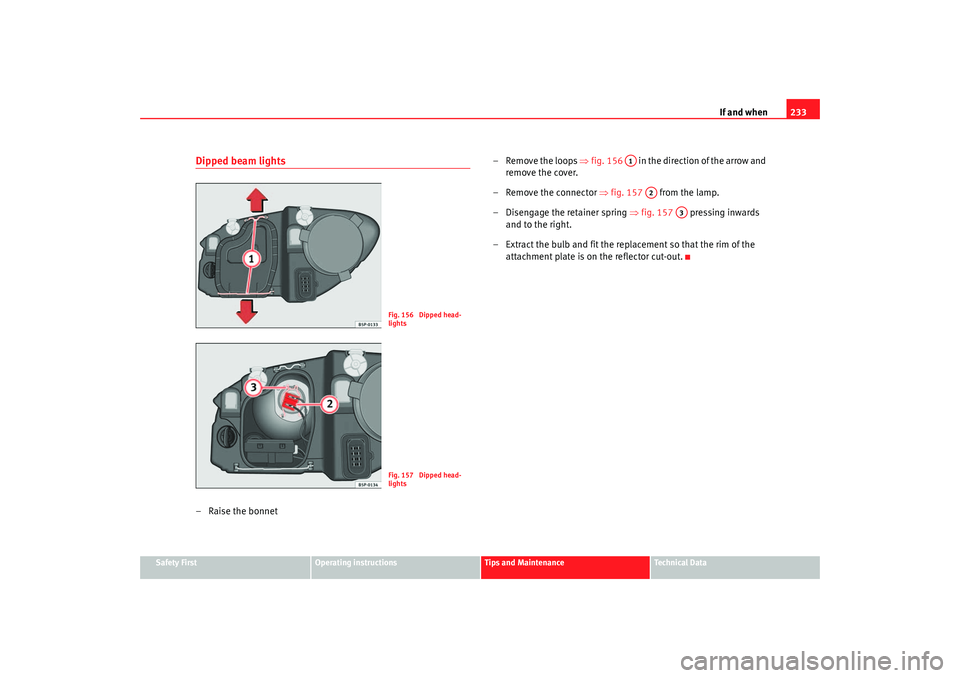
Dipped beam lights–Raise the bonnet – Remove the loops
⇒fig. 156 in the direction of the arrow and
remove the cover.
– Remove the connector ⇒fig. 157 from the lamp.
– Disengage the retainer spring ⇒fig. 157 pressing inwards
and to the right.
– Extract the bulb and fit the repl acement so that the rim of the
attachment plate is on the reflector cut-out.
Fig. 156 Dipped head-
lightsFig. 157 Dipped head-
lights
A1
A2
A3
leon_ingles Seite 233 Donnerstag, 20. Oktober 2005 12:14 12
Page 237 of 280
If and when235
Safety First
Operating instructions
Tips and Maintenance
Te c h n i c a l D a t a
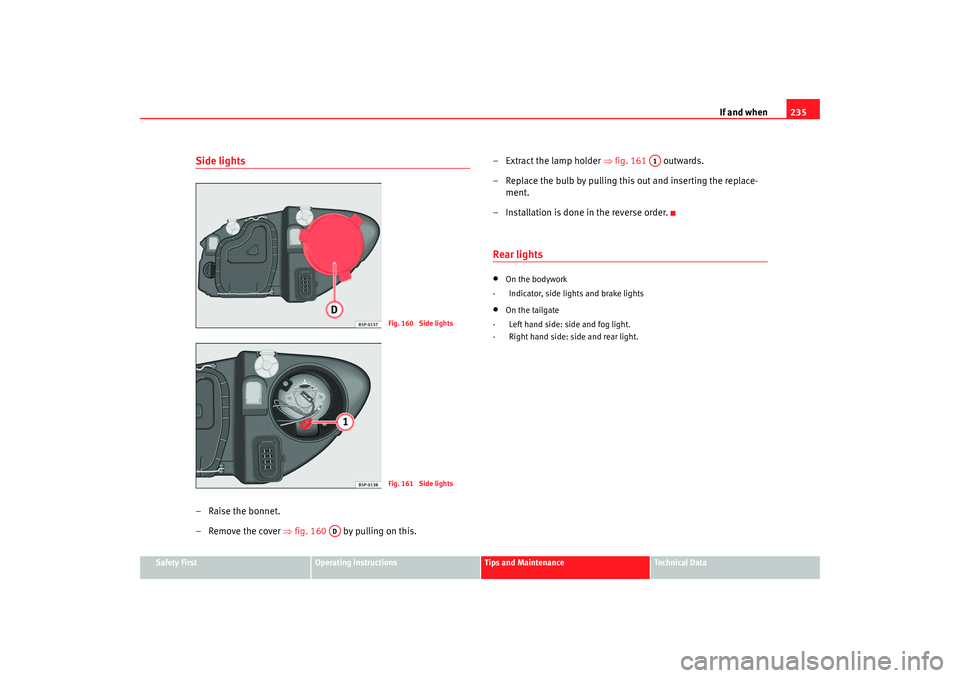
Side lights–Raise the bonnet.
– Remove the cover ⇒fig. 160 by pulling on this. – Extract the lamp holder
⇒fig. 161 outwards.
– Replace the bulb by pulling this out and inserting the replace- ment.
– Installation is done in the reverse order.
Rear lights•
On the bodywork
- Indicator, side lights and brake lights
•
On the tailgate
- Left hand side: side and fog light.
- Right hand side: side and rear light.
Fig. 160 Side lightsFig. 161 Side lights
AD
A1
leon_ingles Seite 235 Donnerstag, 20. Oktober 2005 12:14 12
Page 239 of 280
If and when237
Safety First
Operating instructions
Tips and Maintenance
Te c h n i c a l D a t a
– Take the lampholder out pressing on the securing pins and
extract it outwards ⇒ page 236, fig. 164.
– Replace the faulty lamp, rotating it to the left and outwards.
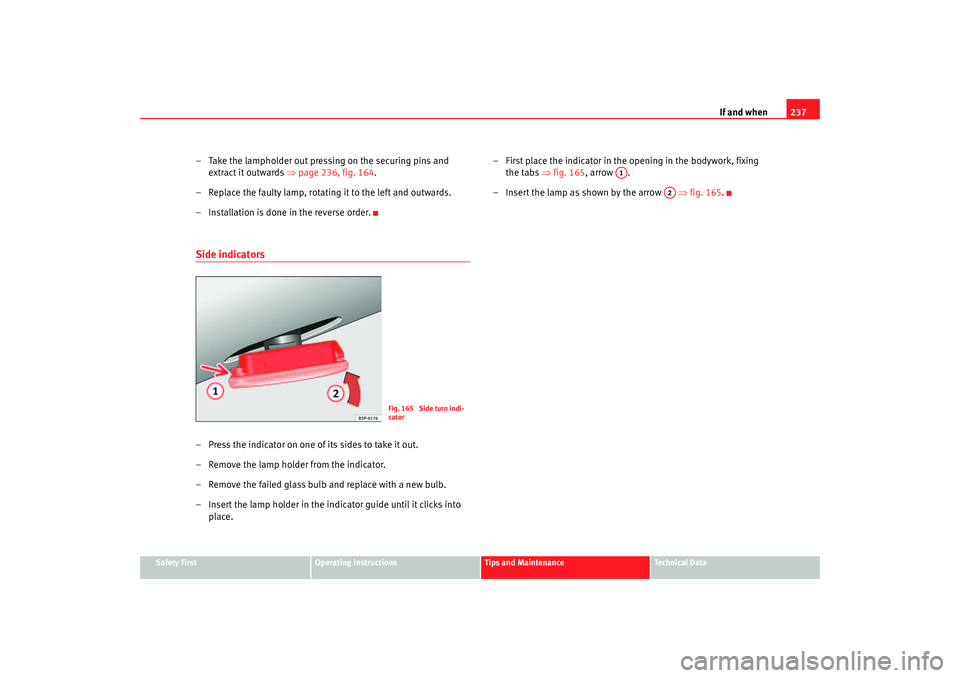
– Installation is done in the reverse order.Side indicators– Press the indicator on one of its sides to take it out.
– Remove the lamp holder from the indicator.
– Remove the failed glass bulb and replace with a new bulb.
– Insert the lamp holder in the indicator guide until it clicks into place. – First place the indicator in the opening in the bodywork, fixing
the tabs ⇒fig. 165, arrow .
– Insert the lamp as shown by the arrow ⇒fig. 165 .
Fig. 165 Side turn indi-
cator
A1
A2
leon_ingles Seite 237 Donnerstag, 20. Oktober 2005 12:14 12