maintenance Seat Leon 5D 2005 Owner's Guide
[x] Cancel search | Manufacturer: SEAT, Model Year: 2005, Model line: Leon 5D, Model: Seat Leon 5D 2005Pages: 280, PDF Size: 8.46 MB
Page 43 of 280

Airbag system41
Safety First
Operating instructions
Tips and Maintenance
Te c h n i c a l D a t a
Safety notes on the operation of the side airbag system
I f a i r b a g s a re u s e d c o r r e c t l y , t h e y c a n c o n s i d e ra b l y re d u c e t h e
risk of injury in side impact collisions.
WARNING
•
If you do not wear a seat belt, if you lean forward, or are not seated
correctly while the vehicle is in motion , you are at greater risk of injury
should the side airbag system be triggered in an accident.
•
In order for the side airbags to provide their maximum protection, the
prescribed sitting position must alwa ys be maintained with seat belt
fasten while travelling.
•
Occupants of the outer seats must never carry any objects or pets in the
deployment space between them and th e airbags, or allow children or
other passengers to travel in this position. It is also important not to attach
any accessories (such as cup holders) to the doors. This would impair the
protection offered by the side airbags.
•
The built-in coat hooks should be used only for lightweight clothing. Do
not leave any heavy or sharp-edged objects in the pockets.
•
Great forces, such as hard blows or kicks, must not be exerted upon the
backrest bolster because the system may be damaged. In this case the side
airbags would not be triggered.
•
Under no circumstances should protective covers be fitted over the
driver seat or front passenger seat unless the covers have been expressly
approved for use in your vehicle. Because the airbag deploys from the side
of the backrest, the use of non-approved seat covers would obstruct the
side airbag seriously reducing the airbag's effectiveness ⇒page 186,
“Accessories, parts replacement and modifications”.
•
Any damage to the original seat uphol stery or around the seams of the
side airbag units must be repaired immediately by a qualified workshop.
•
The airbags provide protection for one accident only, if they have been
deployed they must be replaced.
•
When children assume an incorrect sitting position, they expose them-
selves to an increased risk of injury in the event of an accident. This is
particularly the case if the child is travelling on the front passenger seat
and the airbag system is triggered in an accident; this could have critical
consequences including serious injury or death ⇒page 47, “Child safety”.
•
Any work on the side airbag system or removal and installation of the
airbag components for other repairs (such as removal of the front seat)
should only be performed by a qualif ied workshop. Otherwise, a fault may
be introduced into the operation of the airbag system.
•
Do not attempt to modify components of the airbag system in any way.
•
The side and head airbags are managed through sensors located in the
interior of the front doors. To ensure the correct functioning of the side and
head airbags neither the doors nor the door panels should be modified in
any way (e.g. fitting loudspeakers). If the front door is damaged in any way,
this may affect the correct working of the system. All work carried out on
the front door must be made in a qualified workshop.WARNING (continued)
leon_ingles Seite 41 Donner stag, 20. Oktober 2005 12:14 12
Page 45 of 280

Airbag system43
Safety First
Operating instructions
Tips and Maintenance
Te c h n i c a l D a t a
•
during a frontal collision,
•
during a rear-end collision,
•
if the vehicle rolls,
•
or during a minor frontal collision.
WARNING
If a fault should occur in the airbag system, have the system checked imme-
diately by a qualified workshop. Otherw ise there is a danger that during a
collision, the system may fail to trigger, or not trigger correctly.Function of curtain airbags
Fu ll y i n fl a ted a i rb ag s redu ce t h e r i s k o f h ea d o r ch est i n ju r y i n
a side collision.
During some side collisions the curtain airbag is triggered on the impact side
of the vehicle ⇒fig. 24.
In certain types of accident the front, side and curtain airbags may be trig-
gered together.
When the system is triggered, the airbag is filled with propellant gas. In the
process, the curtain bag covers the side windows and door pillars.
In order to provide the desired extra protection in an accident, the airbags
have to deploy extremely rapidly (within fractions of a second). A fine dust
may develop when the airbag deploys. Th is is normal and is no indication
that there was a fire in the vehicle.
The fully deployed airbags cushion the movement of the front occupants and
help to reduce the risk of injury to the upper body.
The special design of the airbag allows the controlled escape of the propel-
lant gas when an occupant puts pressure on the bag. Thus, the head and
chest are surrounded and protected by the airbag.Safety notes on the operation of the curtain airbag system
If you use airbags correctly, they can considerably reduce the
risk of injury in many kinds of accident.
WARNING
•
In order for the curtain airbags to provide their maximum protection,
the prescribed sitting position must al ways be maintained with seat belt
fasten while travelling.
•
For safety reasons, the head air bag must be disconnected in those
vehicles fitted with a passenger compartment separation screen. See an
Authorised Service Centre to make this adjustment.
Fig. 24 Deployed curtain
airbags
leon_ingles Seite 43 Donner stag, 20. Oktober 2005 12:14 12
Page 47 of 280

Airbag system45
Safety First
Operating instructions
Tips and Maintenance
Te c h n i c a l D a t a
Deactivating airbags*Disabling front passenger airbag
If you fit a rear-facing child seat to the front passenger seat,
the front passenger airbag must be de-activated.
When the passenger airbag is deactivated, this means that only the
frontal airbag is deactivated. All the other airbags in the vehicle
remain functional.
Disabling front passenger airbag
– Switch off ignition.
– Turn the ignition switch in the key operated switch in the glove box to the position OFF ⇒ fig. 25 .
– Check that the warning lamp “PASSENGER AIRBAG OFF” in the dash panel ⇒fig. 26 remains lit ⇒when the ignition is
switched on.
Enabling front passenger airbag
– Switch off ignition.
– Turn the ignition switch in the key-operated switch in the glove box to the position ON ⇒ fig. 25 .
Fig. 25 In the glove box
there is key switch for
disabling and enabling
the airbags on the front
passenger side
Fig. 26 Warning lamp for
deactivated passenger
airbag in centre console
leon_ingles Seite 45 Donner stag, 20. Oktober 2005 12:14 12
Page 49 of 280

Child safety47
Safety First
Operating instructions
Tips and Maintenance
Te c h n i c a l D a t a
Child safetyBrief introductionIntroduction
Statistics show that children are generally safer on the rear
seat than on the front passenger seat.We recommend that children under 12 years of age be transported on the rear
seats. Children travelling on the rear seat must use a child restraint system or
the seat belts provided, depending on their age, height and weight. For
safety reasons, the child restraint system should be installed in the centre of
the rear seat or behind the front passenger's seat.
The physical principles involved and the forces acting in a collision apply to
children just as much as adults ⇒page 21, “Why wear seat belts?”.
But unlike adults, children do not have fully developed muscle and bone
structures. This means that children are subject to a greater risk of injury.
To reduce this risk, children must always use special child restraint systems
when travelling in the vehicle.
We recommend the use of child safety products from the SEAT Genuine Acces-
sories Program including systems for all ages made by “Peke”
1).
These systems have been especially designed and approved, complying with
the ECE-R44. regulation.
Follow the manufacturer's instructions and observe any statutory require-
ments when installing and using child seats. Always read and observe
⇒ page 48, “Safety notes on using child seats”. We recommend that you include the manufacturer's directions for child seat
use in the vehicle wallet and always keep them in the vehicle.
1)Not for all countries
leon_ingles Seite 47 Donner
stag, 20. Oktober 2005 12:14 12
Page 51 of 280

Child safety49
Safety First
Operating instructions
Tips and Maintenance
Te c h n i c a l D a t a
Child seatsCategorisation of child seats into groups
Use only child seats that are officially approved and suitable
for the child.Child seats are covered by the European standard ECE R 44 (issued by the
Economic Commission of Europe).
The child seats are grouped into 5 categories:
Group 0: up to 10 kg
Group 0+ : up to 13 kg
Group 1: from 9 to 18 kg
Group 2: from 15 to 25 kg
Group 3: from 22 to 36 kg
Child seats that have been tested and approved under the ECE R 44 standard
bear the test mark on the seat (the letter E in a circle with the test number
below it).
Group 0 and 0+ child seats
A suitable child seat and a corr ectly adjusted seat belt can
help to protect your child.Group 0: For babies from about 9 months old and 10 kg in weight the most
suitable seats are those appearing in the illustratio n ⇒ fig. 27.
Group 0+: For babies from about 18 months old and 13 kg in weight the most
suitable seats are those ap pearing in the illustration.
Follow the manufacturer's instructio ns and observe any statutory require-
ments when installing and using child seats.
We recommend that you include the manufacturer's directions for child seat
use in the vehicle wallet and always keep them in the vehicle.
WARNING
Read and always observe information and warnings concerning the use of
child seats ⇒ in “Safety notes on using child seats” on page 48.
Fig. 27 A group 0 rear-
facing child seat fitted on
the rear seat.
leon_ingles Seite 49 Donner stag, 20. Oktober 2005 12:14 12
Page 53 of 280

Child safety51
Safety First
Operating instructions
Tips and Maintenance
Te c h n i c a l D a t a
WARNING
•
The shoulder part of the seat belt mu st lie approximately on the centre
of the shoulder, never across the neck or the arm. The seat belt must lie
close to the torso. The lap belt part must lie across the pelvis, not across the stomach, and always fit closely. Pull the belt tight if necessary to take
up any slack ⇒
page 24, “Seat belts”.
•
Read and always observe information and warnings concerning the use
of child seats ⇒ in “Safety notes on using child seats” on page 48.
Securing child seatsWays to secure a child seat
A child seat can be secured differently on th e rear seat and on the front passenger seat.You can secure a child seat to the rear seat or front passenger seat in the
following ways:
•
Child seats in groups 0 to 3 can be secured with a seat belt.
•
Group 0, 0+ and 1 child seats with the “ISOFIX” system can be secured to
the “ISOFIX” retaining rings without seat belts ⇒ page 52.
U: Suitable for approved universal retention systems for use with this age group (universal retention systems, ar e those that can be fitted using the
standard adult safety belt)
*: Move the passenger seat as far back as possible, to the highest setting and always turn the airbag off. L: Suitable for anchored retention systems using the “ISOFIX” anchors.WARNING (continued)
Weight class
Weight Seat locations
Front passenger Rear outerRear centre
Group 0 <10 kgU*U/L U
Group 0+ <13 kgU*U/L U
Group 1 9-18 kgU*U/L U
Group 2 / 3 15-36 kgU*UU
leon_ingles Seite 51 Donnerstag, 20. Oktober 2005 12:14 12
Page 55 of 280

53
Safety First
Operating instructions
Tips and Maintenance
Te c h n i c a l D a t a
leon_ingles Seite 53 Donnerstag, 20. Oktober 2005 12:14 12
Page 57 of 280
Cockpit55
Safety First
Operating instructions
Tips and Maintenance
Te c h n i c a l D a t a
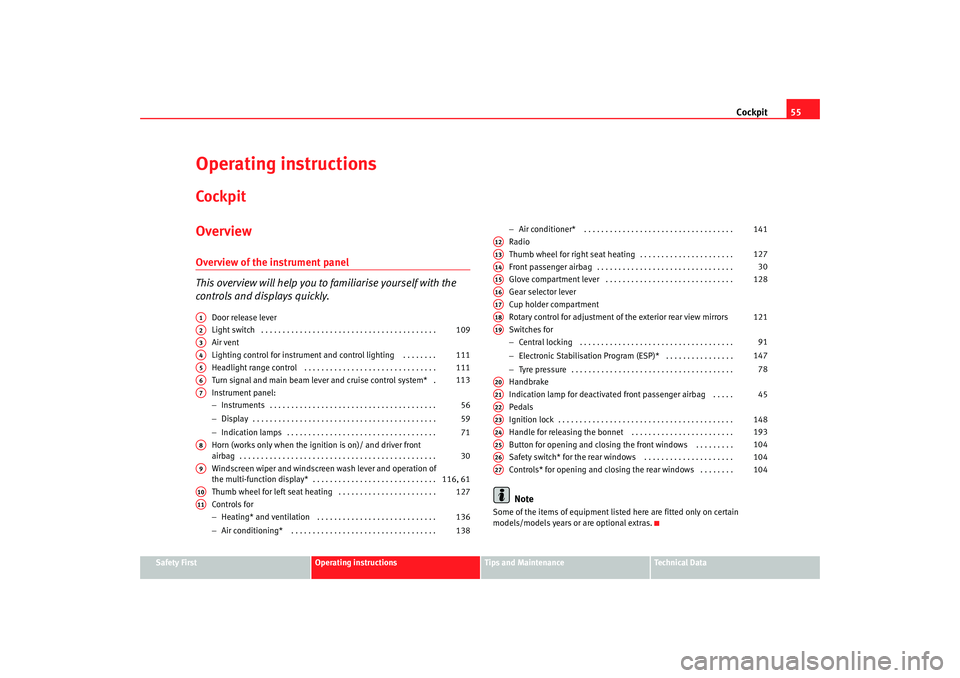
Operating instructionsCockpitOverviewOverview of the instrument panel
This overview will help you to familiarise yourself with the
controls and displays quickly.
Door release lever
Light switch . . . . . . . . . . . . . . . . . . . . . . . . . . . . . . . . . . . . . . . . .
Air vent
Lighting control for instrument and control lighting . . . . . . . .
Headlight range control . . . . . . . . . . . . . . . . . . . . . . . . . . . . . . .
Turn signal and main beam lever and cruise control system* .
Instrument panel:
− Instruments . . . . . . . . . . . . . . . . . . . . . . . . . . . . . . . . . . . . . . .
− Display . . . . . . . . . . . . . . . . . . . . . . . . . . . . . . . . . . . . . . . . . . .
− Indication lamps . . . . . . . . . . . . . . . . . . . . . . . . . . . . . . . . . . .
Horn (works only when the igni tion is on)/ and driver front
airbag . . . . . . . . . . . . . . . . . . . . . . . . . . . . . . . . . . . . . . . . . . . . . .
Windscreen wiper and windscreen wash lever and operation of
the multi-function display* . . . . . . . . . . . . . . . . . . . . . . . . . . . . .
Thumb wheel for left seat heating . . . . . . . . . . . . . . . . . . . . . . .
Controls for
− Heating* and ventilation . . . . . . . . . . . . . . . . . . . . . . . . . . . .
− Air conditioning* . . . . . . . . . . . . . . . . . . . . . . . . . . . . . . . . . . −
Air conditioner* . . . . . . . . . . . . . . . . . . . . . . . . . . . . . . . . . . .
Radio
Thumb wheel for right seat heating . . . . . . . . . . . . . . . . . . . . . .
Front passenger airbag . . . . . . . . . . . . . . . . . . . . . . . . . . . . . . . .
Glove compartment lever . . . . . . . . . . . . . . . . . . . . . . . . . . . . . .
Gear selector lever
Cup holder compartment
Rotary control for adjustment of the exterior rear view mirrors
Switches for
− Central locking . . . . . . . . . . . . . . . . . . . . . . . . . . . . . . . . . . . .
− Electronic Stabilisation Program (ESP)* . . . . . . . . . . . . . . . .
− Tyre pressure . . . . . . . . . . . . . . . . . . . . . . . . . . . . . . . . . . . . . .
Handbrake
Indication lamp for deactivated front passenger airbag . . . . .
Pedals
Ignition lock . . . . . . . . . . . . . . . . . . . . . . . . . . . . . . . . . . . . . . . . .
Handle for releasing the bonnet . . . . . . . . . . . . . . . . . . . . . . . .
Button for opening and closing the front windows . . . . . . . . .
Safety switch* for the rear windows . . . . . . . . . . . . . . . . . . . . .
Controls* for opening and closing the rear windows . . . . . . . .
Note
Some of the items of equipment listed here are fitted only on certain
models/models years or are optional extras.
A1A2
109
A3A4
111
A5
111
A6
113
A7
56
59
71
A8
30
A9
116, 61
A10
127
A11
136
138 141
A12A13
127
A14
30
A15
128
A16A17A18
121
A19
91
147 78
A20A21
45
A22A23
148
A24
193
A25
104
A26
104
A27
104
leon_ingles Seite 55 Donner stag, 20. Oktober 2005 12:14 12
Page 59 of 280
Cockpit57
Safety First
Operating instructions
Tips and Maintenance
Te c h n i c a l D a t a
Fuel gauge
and reserve indicator
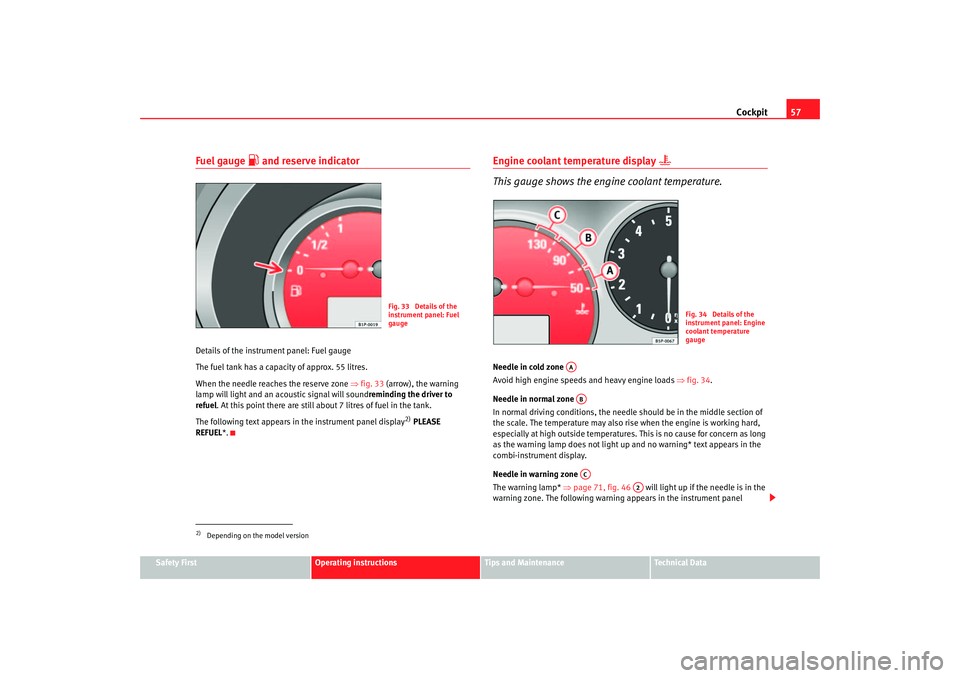
Details of the instrument panel: Fuel gauge
The fuel tank has a capacity of approx. 55 litres.
When the needle reaches the reserve zone ⇒fig. 33 (arrow), the warning
lamp will light and an acoustic signal will sound reminding the driver to
refuel . At this point there are still about 7 litres of fuel in the tank.
The following text appears in the instrument panel display
2) PLEASE
REFUE L*.
Engine coolant temperature display
This gauge shows the engine coolant temperature.
Needle in cold zone
Avoid high engine speeds and heavy engine loads ⇒fig. 34.
Needle in normal zone
In normal driving conditions, the needle should be in the middle section of
the scale. The temperature may also rise when the engine is working hard,
especially at high outside temperatures. This is no cause for concern as long
as the warning lamp does not light up and no warning* text appears in the
combi-instrument display.
Needle in warning zone
The warning lamp* ⇒page 71, fig. 46 will light up if the needle is in the
warning zone. The following warning appears in the instrument panel
2)Depending on the model version
Fig. 33 Details of the
instrument panel: Fuel
gauge
Fig. 34 Details of the
instrument panel: Engine
coolant temperature
gauge
AAABAC
A2
leon_ingles Seite 57 Donnerstag, 20. Oktober 2005 12:14 12
Page 61 of 280

Cockpit59
Safety First
Operating instructions
Tips and Maintenance
Te c h n i c a l D a t a
Digital display in the instrument panelDisplay (without warning or information texts)
The display in the instrument panel shows, amongst other
things, the mileage and trip recorder as well as the selector
lever position.
Digital clock display ⇒page 58
Distance display or service interval display ⇒page 60
Selector lever position display for the automatic gearbox*.
Display for the gears in Tiptronic mode (automatic gearbox)*. The
selected gear appears in the display field with a light background
⇒ fig. 36 .
Fig. 35 Detail of the
instrument panel: Screen
with various displays
Fig. 36 Detail of instru-
ment panel: Display with
Tiptronic gear selection
A1A2A3A4
A5
leon_ingles Seite 59 Donner stag, 20. Oktober 2005 12:14 12