airbag off Seat Leon 5D 2006 Maintenance programme
[x] Cancel search | Manufacturer: SEAT, Model Year: 2006, Model line: Leon 5D, Model: Seat Leon 5D 2006Pages: 292, PDF Size: 8.86 MB
Page 46 of 292

Airbag system
44Deactivating airbags*Disabling front passenger airbag
If you fit a rear-facing child seat to the front passenger seat,
the front passenger airbag must be deactivated.
When the passenger airbag is deactivated, this means that only the
frontal airbag is deactivated. All the other airbags in the vehicle
remain functional.
Disabling front passenger airbag
– Switch off ignition.
– Turn the ignition switch in the key operated switch in the glove box to the position OFF ⇒ fig. 25 .
– Check that the warning lamp “AIRBAG OFF” in the dash panel ⇒fig. 26 remains lit ⇒ when the ignition is switched on.
Enabling front passenger airbag
– Switch off ignition.
– Turn the ignition switch in the key-operated switch in the glove box to the position ON ⇒fig. 25 .
Fig. 25 In the glove box
there is key switch for
disabling and enabling
the airbags on the front
passenger side
Fig. 26 Warning lamp for
deactivated passenger
airbag in centre console
leon_ingles Seite 44 Donner stag, 24. August 2006 1:56 13
Page 47 of 292

Airbag system45
Safety First
Operating instructions
Tips and Maintenance
Te c h n i c a l D a t a
– Check that the warning lamp in the dash panel does ⇒page 44,
fig. 26 not light up when the ignition is switched on ⇒.
WARNING
•
The driver is responsible for the proper position of the key-operated
switch.
•
You should deactivate the front passenger airbag only if you have to use
a rear-facing child seat in exceptional cases. ⇒ page 46, “Child safety”.
•
For those vehicles that do not include a key lock switch to turn the
airbag off, an Authorised Service Centre must be consulted.
•
Never install a child seat facing backwards (or rear-facing) on the front
passenger seat unless the front passenger airbag has been disabled. This
represents a risk of fatal injuries to th e child! However, if it is necessary in
exceptional circumstances to transport a child in a rear-facing child seat on
the front passenger seat, you must always disable the front passenger
airbag.
•
As soon as the child seat is no longer needed on the front passenger
seat, enable the front passenger airbag again.
•
Only deactivate the passenger airbag when the ignition is off, other-
wise a fault may occur in the airbag system, this will create a danger that
in case of an accident, the airbag do es not deploy properly or does not
deploy at all.
•
When the passenger airbag is deactivated, if the warning lamp is not
continuously lit up when the front passenger airbag is disabled, there may
be a fault in the airbag system:
−Have the airbag system inspected immediately by a qualified work-
shop.
− Do not use a child seat on the front passenger seat! The front
passenger airbag could be triggered despite the fact that there is a fault
in the system and, as a result, a child could sustain serious or fatal inju-
ries. −
It is not certain whether the fron t passenger airbag will deploy
during an accident! Inform your passengers of this.
•
When using the ignition key to activate / deactivate the passenger front
airbag, only the passenger front airbag will be activated / deactivated. The
side airbag and head airbag on the passenger side will remain active.WARNING (continued)
leon_ingles Seite 45 Donner stag, 24. August 2006 1:56 13
Page 49 of 292

Child safety47
Safety First
Operating instructions
Tips and Maintenance
Te c h n i c a l D a t a
Safety notes on using child seats
Proper use of child seats substantially reduces the risk of
injury in an accident!As the driver, you are responsible for any children you transport in
your vehicle.
– Protect your children by properly using appropriate child seats
⇒page 48.
– Always ensure that the belt webbing is properly positioned according to the instructions prov ided by the manufacturer of the
child seat.
– When travelling, do not allow children to distract you from traffic.
– Take breaks regularly during long trips. Take a break at least every two hours.
WARNING
•
Never install a child seat facing backwards (or rear-facing) on the front
passenger seat unless the front passenger airbag has been disabled. This
represents a risk of fatal injuries to the child! However, if it is necessary, in
exceptional cases, to transport a child in the front passenger seat, the front
passenger airbag must always be disabled ⇒page 44, “Deactivating
airbags*”. If the passenger seat has a height adjustment option, move it to
the highest position.
•
For those vehicles that do not include a key lock switch to turn the
airbag off, an Authorised Service Centre must be consulted.
•
All passengers, especially children, must assume the proper sitting
position and be properly belted in while travelling.
•
Never hold children or babies on your lap, this can result in potentially
fatal injuries to the child!
•
Never allow a child to be transported in a vehicle without being properly
secured, or to stand up or kneel on a seat while travelling. In an accident,
the child could be flung through the vehicle, causing possibly fatal injuries
to themselves and other occupants.
•
If children assume an improper sitting position when the car is moving,
they expose themselves to greater risk of injury during a sudden braking
manoeuvre or in an accident. This is particularly the case if the child is trav-
elling on the front passenger seat and the airbag system is triggered in an
accident; this could have consequences including serious injury or death.
•
A suitable child seat can protect your child!
•
Never leave a child unsupervised in a child seat or alone in the vehicle.
•
Depending on weather conditions, it may become extremely hot or cold
inside the vehicle. This can be fatal.
•
Children who are less than 1.5 metres tall must not wear a normal seat
belt without a child restraint system, as this could cause injuries to the
abdominal and neck areas during a sudden braking manoeuvre or in an
accident.
•
Do not allow the belt webbing to become twisted or jammed, or to rub
on any sharp edges.
•
Incorrectly worn seat belts can cause injuries even in a minor collision
or sudden braking manoeuvres.
•
The seat belt provides maximum protection only when the belt web is
properly positioned ⇒page 24, “Seat belts”.
•
Only one child may occupy a child seat ⇒page 48, “Child seats”.WARNING (continued)
leon_ingles Seite 47 Donner stag, 24. August 2006 1:56 13
Page 76 of 292
Cockpit
74
WARNING
•
Failure to observe warning lamps and warning messages can result in
serious personal injury or damage to your vehicle.
•
The risk of an accident increases if your vehicle breaks down. Use a
warning triangle to draw the attention of other road users to your
stationary vehicle so that it does not represent a danger.
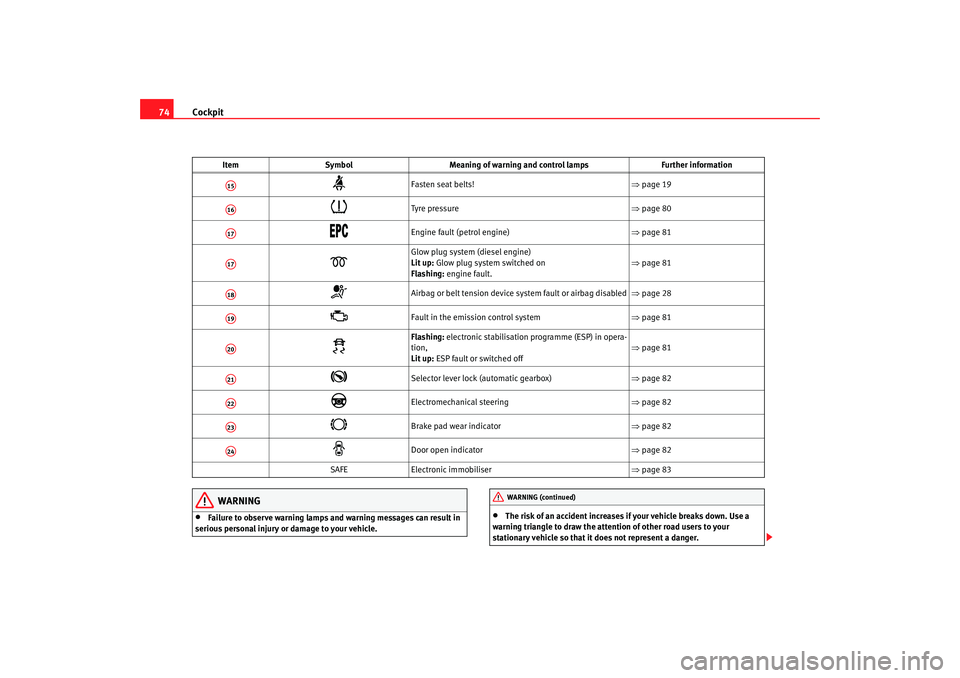
Fasten seat belts! ⇒page 19
Tyre pressure ⇒page 80
Engine fault (petrol engine) ⇒page 81
Glow plug system (diesel engine)
Lit up: Glow plug system switched on
Flashing: engine fault. ⇒
page 81
Airbag or belt tension device system fault or airbag disabled ⇒page 28
Fault in the emission control system ⇒page 81
Flashing: electronic stabilisation programme (ESP) in opera-
tion,
Lit up: ESP fault or switched off ⇒
page 81
Selector lever lock (automatic gearbox) ⇒page 82
Electromechanical steering ⇒page 82
Brake pad wear indicator ⇒page 82
Door open indicator ⇒page 82
SAFE Electronic immobiliser ⇒page 83
Item
Symbol Meaning of warning and control lamps Further information
A15A16A17A17A18A19A20A21A22A23A24
WARNING (continued)
leon_ingles Seite 74 Donnerstag, 24. August 2006 1:56 13
Page 97 of 292

Unlocking and locking95
Safety First
Operating instructions
Tips and Maintenance
Te c h n i c a l D a t a
will be activated. The indicator will be
turned off as will be the alarm for those
vehicles fitted with one.
Unlocking the boot
See ⇒page 100 and ⇒page 104.
Locking system for involuntary unlocking
This is an anti-theft system and will avoid situations where
the vehicle is opened unintentionally.The vehicle will be re-locked automatically, if it is unlocked and neither the
boot nor any of the doors are opened within 30 seconds. This function
prevents the vehicle from remaining unlocked if the unlocking button is
pressed by mistake.Automatic speed dependent locking and unlocking system*
This is a safety system to prevent access to the vehicle from
the exterior when the vehicle is in transit (for example, when
stopped at a traffic light).Locking
The doors and the boot are automatically locked when vehicle speed exceeds
15 km/h.
If the vehicle is stopped and one of the doors is opened, when the vehicle
moves off again and exceeds a speed of 15 km/h the unlocked door(s) will be
locked once more. Unlocking
The driver's door automatically unlocks when the key is removed from the
ignition.
Each door may be unlocked and opened
from the interior (for example when
a passenger gets out). For this, simply operate the lever on the inside of the
door.
WARNING
When the vehicle is in motion, the inte rnal door release levers should not
be operated, this could cause a door to open.Emergency unlocking systemThe entire vehicle is unlocked if the airbags are triggered during an accident,
except for the boot. It is possible to lock the vehicle from inside using the
central locking, after turning the ignition of f and back on again.
If the doors must be locked from the outside, see “Manually locking the
doors”.
leon_ingles Seite 95 Donner stag, 24. August 2006 1:56 13
Page 128 of 292

Seats and stowage
126Seats and stowageThe importance of correct seat adjustmentProper seat adjustment optimi ses the level of protection
offered by seat belts and airbags.Your vehicle has five passenger places, two individual front seats and three
places on the rear seat. Each seat is equipped with a three-point seat belt.
The driver seat and front passenger seat can be adjusted in many ways to suit
the physical requirements of the vehicl e occupants. The correct seat position
is very important for:•
fast and easy operation of all controls on the instrument panel,
•
relaxed posture that does not cause drowsiness,
•
safe driving ⇒page 7,
•
and to ensure that the seat belts and airbag system provide maximum
protection ⇒page 19.
WARNING
•
If the driver and passengers assume improper sitting positions, they
may sustain critical injuries.
•
Never transport more people than there are seats available in the
vehicle.
•
Every occupant in the vehicle must properly fasten and wear the seat
belt belonging to his or her seat. Children must be protected with an appro-
priate child restraint system ⇒page 46, “Child safety”.
•
The front seats and all head restraints must always be adjusted to body
size and the seat belt must always be properly adjusted to provide you and
your passengers with optimum protection.
•
Always keep your feet in the foot well when the vehicle is moving; never
rest them on the dash panel, out of the window or on the seat. This also
applies to passengers. An incorrect sitting position exposes you to an
increased risk of injury in the event of a braking manoeuvre or an accident.
If the airbag is triggered, you could sustain severe injuries due to an incor-
rect sitting position.
•
It is important for the driver and front passenger to maintain a distance
of at least 25 cm from the steering wh eel or dash panel. Failure to respect
the minimum distance means that the airbag will not protect you. Risk of
fatal injury. The distance between the driver and the steering wheel or
between the front passenger and the dash panel should always be as great
as possible.
•
Adjust the driver or front passenger seat only when the vehicle is
stationary. Otherwise your seat could move unexpectedly while the vehicle
is moving. This could increase the risk of an accident and therefore injury.
In addition, while adjusting your seat, you will assume an incorrect sitting
position. Risk of fatal accidents.
•
Special guidelines apply to installing a child seat on the front
passenger seat. When installing a chil d seat, observe the warning note in
the ⇒page 46, “Child safety”.WARNING (continued)
leon_ingles Seite 126 Donnerstag, 24. August 2006 1:56 13
Page 153 of 292

Driving151
Safety First
Operating instructions
Tips and Maintenance
Te c h n i c a l D a t a
•
Adjust the driver seat or steering wheel so that there is a distance of at
least 25 cm between the steering wheel and your chest ⇒page 150,
fig. 113 . If you fail to observe the minimum distance, the airbag will not
protect you. Risk of fatal injury.
•
If your physical constitution prevents you from maintaining the
minimum distance of 25 cm, contact an Authorised Service Centre. The
Authorised Service Centre will help you decide if special specific modifica-
tions are necessary.
•
If you adjust the steering wheel so th at it points towards your face, the
driver airbag will not protect you prop erly in the event of an accident. Make
sure that the steering wheel points towards your chest.
•
When driving, always hold the steering wheel with both hands on the
outside of the ring at the 9 o'clock and 3 o'clock positions. Never hold the
steering wheel at the 12 o'clock position, or in any other manner (e.g. in
the centre of the steering wheel, or on the inside of the rim). In such cases,
you could receive severe injuries to the arms, hands and head.
SafetyElectronic stabilisation programme (ESP)*
ESP helps make driving safer in certain situations.The Electronic Stabilisation Program (ESP ) contains the electronic differential
lock (EDL) and the traction control system (TCS). The ESP function works in
conjunction with the ABS. Both warning la mps will light up if the ESP or ABS
systems are faulty.
The ESP is started automatically when the engine is started.
In specific circumstances where you requ ire less traction, you can switch off
the ESP by pressing button ⇒fig. 114 .
For example:•
when driving with snow chains,
•
when driving in deep snow or on loose surfaces,
WARNING (continued)
Fig. 114 Detail of the
centre console: ESP
button
leon_ingles Seite 151 Donnerstag, 24. August 2006 1:56 13
Page 190 of 292

Cleaning and caring for your vehicle
188Cleaning the engine compartment
Take special care when cleaning the engine compartment.Anti-corrosion treatment
The engine compartment and the surface of the power unit are given anti-
corrosion treatment at the factory.
Good corrosion protection is particularl y important in winter when the car is
frequently driven on salted roads. To prevent the salt corroding the vehicle,
the entire engine compartment should be thoroughly cleaned before and
after the salting period.
Your Authorised Service Centre is able to provide the correct cleaning and
preserving products and has the necessary equipment. For this reason, we
recommend having this work performed by them.
The anti-corrosion protection is usually removed if the engine compartment
is cleaned with grease removing solutions, or if you have the engine cleaned.
If this job is carried out, you should ensure that all surfaces, seams, joints and
components in the engine compartmen t are given anti-corrosion treatment
afterwards.
WARNING
•
When working in the engine compartment, always observe the safety
warnings ⇒ page 198.
•
Switch off the engine, apply the parking brake firmly and always
remove the key from the ignitio n before you open the bonnet.
•
Allow the engine to cool before you clean the engine compartment.
• Do not c l ean the underside of vehicle wheel arches without protecting
your hands and arms. You may cut your self on sharp-edged metal parts.
Failure to comply could result in injury.
•
Moisture, ice and salt on the brakes may affect braking efficiency. Risk
of accident. If possible, avoid sudden braking immediately after washing
the vehicle.
•
Never touch the radiator fan. It is temperature-controlled and could
start automatically, even when the key is removed from the ignition!For the sake of the environment
Fuel, grease and oil deposits could be removed when the engine is washed.
The polluted water must be cleaned in an oil separator. For this reason,
engine washing should be carried out only by a qualified workshop or a suit-
able filling station.Care of the vehicle interiorCleaning plastic parts and the dash panel– Use a clean, damp cloth to clean plastic parts and the dash panel.
– If this does not provide satisfactory results, use a special solvent-free plastic cleaning product.
WARNING
Never clean the dash panel and surface of the airbag module with cleaners
containing solvents. Solvents cause the surface to become porous. If the
airbag inflates, disintegrating plastic parts can cause substantial injuries.
WARNING (continued)
leon_ingles Seite 188 Donnerstag, 24. August 2006 1:56 13
Page 193 of 292

Accessories, parts replacement and modifications191
Safety First
Operating instructions
Tips and Maintenance
Te c h n i c a l D a t a
Accessories, parts replacement and modificationsAccessories and partsAlways consult an Authorised Service Centre before
purchasing accessories and parts.Your vehicle is designed to offer a high standard of active and passive safety.
Before purchasing accessories and parts, and before making technical
changes to your car, we recommend that you consult your Authorised Service
Centre.
SEAT dealerships will be happy to provide you with the latest information
about the use, legal requirements and recommendations from the manufac-
turer regarding accessories and parts.
We recommend you use only SEAT Approved Accessories
® and SEAT
Approved Spare Parts
®. This way, SEAT can guarantee that the product in
question is suitable, reliable and safe. Authorised Service Centres have the
necessary experience and facilities to ensure that parts are installed correctly
and professionally.
Despite continuous observation of the market, SEAT is not able to assess the
reliability, safety and suitability of parts not approved by SEAT. For this reason
SEAT cannot assume responsibility for any non-genuine parts used, even if
these parts have been approved by an official testing agency or are covered
by an official approval certificate.
Any equipment subsequently installed which has a direct effect on the
vehicle and/or the way it is driven (e.g. cruise control system or electronically-
controlled suspension) must be approved by SEAT for use in your vehicle and
bear the e mark (the European Union's authorisation symbol).
If any additional electrical components are fitted which do not serve to
control the vehicle itself (for instance a refrigerator box, laptop or ventilator fan, etc.), these must bear the
CE mark (European Union manufacturer
conformity declaration).
WARNING
Accessories, for example telephone holders or drink holders, should never
be fitted on the covers of, or within the working range of, the airbags. If
they are, there is a danger of resulting injury if the airbag is triggered in an
accident.ModificationsModifications must always be carried out according to our
specifications.Unauthorised modifications to the electr onic components or software in the
vehicle may cause malfunctions. Due to the way the electronic components
are linked together in networks, other systems may be affected by the faults.
This can seriously impair safety, lead to excessive wear of components, and
also invalidate your vehicle registration documents.
SEAT Authorised Service Centres cannot be held liable for any damage
caused by modifications and/or work performed incorrectly.
For this reason, we recommend that all work should be performed by an
Authorised Service Centre using genuine and SEAT
® approved parts and
accessories .
leon_ingles Seite 191 Donnerstag, 24. August 2006 1:56 13
Page 283 of 292

Index281
Index
AABS . . . . . . . . . . . . . . . . . . . . . . . . . . . . . . . . . . . 170
Warning lamp . . . . . . . . . . . . . . . . . . . . . . . . . 78
Accessories . . . . . . . . . . . . . . . . . . . . . . . . . . . . 191
Acoustic signal . . . . . . . . . . . . . . . . . . . . . . . . . . 20
Acoustic warning . . . . . . . . . . . . . . . . . . . . . . . . 152
Adjusting the seat belt height . . . . . . . . . . . . . . 27
Air conditioner* 2C-Climatronic* . . . . . . . . . . . . . . . . . . . . . . 145
Air conditioning system General notes . . . . . . . . . . . . . . . . . . . . . . . . 149
Air conditioning* . . . . . . . . . . . . . . . . . . . . . . . . 142
Air recirculation mode 2C-Climatronic . . . . . . . . . . . . . . . . . . . . . . . 148
Manual air conditioner . . . . . . . . . . . . . . . . 144
Airbag covers . . . . . . . . . . . . . . . . . . . . . . . . . . . . 36
Airbag system . . . . . . . . . . . . . . . . . . . . . . . . . . . 30 Curtain airbags . . . . . . . . . . . . . . . . . . . . . . . 41
front airbags . . . . . . . . . . . . . . . . . . . . . . . . . . 34
Side airbags . . . . . . . . . . . . . . . . . . . . . . . . . . 37
Warning lamp . . . . . . . . . . . . . . . . . . . . . . . . . 31
Airbags Care . . . . . . . . . . . . . . . . . . . . . . . . . . . . . . . . 32
Disposal . . . . . . . . . . . . . . . . . . . . . . . . . . . . . 32
Safety notes . . . . . . . . . . . . . . . . . . . . . . . . . . 32
Alarm system Switching off . . . . . . . . . . . . . . . . . . . . . . . . 102 Alterations to the vehicle . . . . . . . . . . . . . . . . . 191
Alternator
Warning lamp . . . . . . . . . . . . . . . . . . . . . . . . . 79
Ambient temperature display . . . . . . . . . . . . . . . 63
Anti-freeze . . . . . . . . . . . . . . . . . . . . . . . . . . . . . 205
Anti-lock brake system . . . . . . . . . . . . . . . . . . . 170 Warning lamp . . . . . . . . . . . . . . . . . . . . . . . . . 78
Anti-theft alarm system . . . . . . . . . . . . . . . . . . . 102 Switching off . . . . . . . . . . . . . . . . . . . . . . . . 102
Anti-theft wheel bolts . . . . . . . . . . . . . . . . . . . . 226
Apple iPod connector . . . . . . . . . . . . . . . . . . . . 136
Aquaplaning . . . . . . . . . . . . . . . . . . . . . . . . . . . 217
Ashtray* . . . . . . . . . . . . . . . . . . . . . . . . . . . . . . . 134
Aspects to take into account before starting the vehicle . . . . . . . . . . . . . . . . . . . . . . . . . . . . . . 8
Automatic anti-dazzle interior mirror* Activating the anti-dazzle function . . . . . . 123
Deactivating anti-dazzle function . . . . . . . . 123
Automatic car washes . . . . . . . . . . . . . . . . . . . . 183
Automatic gearbox / DS G automatic gearbox . 157
Automatic lighting . . . . . . . . . . . . . . . . . . . . . . . 112
Automatic mode 2C-Climatronic . . . . . . . . . . . . . . . . . . . . . . . 146
Automatic wiper/wash function for the rear window 122
Auxiliary audio connection: AUX-IN . . . . . . . . . 136
BBall coupling . . . . . . . . . . . . . . . . . . . . . . . . . . . 179
BAS . . . . . . . . . . . . . . . . . . . . . . . . . . . . . . . . . . . 169
Battery Changing . . . . . . . . . . . . . . . . . . . . . . . . . . . 214
Charging . . . . . . . . . . . . . . . . . . . . . . . . . . . . 214
Winter conditions . . . . . . . . . . . . . . . . . . . . 212
Before starting the vehicle . . . . . . . . . . . . . . . . . . 8
Belt tension device Disposal . . . . . . . . . . . . . . . . . . . . . . . . . . . . . 28
Warning lamp . . . . . . . . . . . . . . . . . . . . . . . . 31
Belt tension devices . . . . . . . . . . . . . . . . . . . . . . 28
Biodiesel . . . . . . . . . . . . . . . . . . . . . . . . . . . . . . 197
Bonnet . . . . . . . . . . . . . . . . . . . . . . . . . . . . . . . . 200
Brake assist system . . . . . . . . . . . . . . . . . . . . . 169
Brake fluid . . . . . . . . . . . . . . . . . . . . . . . . . . . . . 211 Changing . . . . . . . . . . . . . . . . . . . . . . . . . . . 211
Warning lamp . . . . . . . . . . . . . . . . . . . . . . . . 64
Brake pad wear indicator* Indicator . . . . . . . . . . . . . . . . . . . . . . . . . . . . . 82
Brake pads . . . . . . . . . . . . . . . . . . . . . . . . . . . . . 173
Brake servo . . . . . . . . . . . . . . . . . . . . . . . 169, 173
Brake system . . . . . . . . . . . . . . . . . . . . . . . . . . . 211 Warning lamp . . . . . . . . . . . . . . . . . . . . . . . . 77
Brakes . . . . . . . . . . . . . . . . . . . . . . . . . . . . . . . . 173
Braking distance . . . . . . . . . . . . . . . . . . . . . . . . 173
leon_ingles Seite 281 Donnerstag, 24. August 2006 1:56 13