warning Seat Leon 5D 2007 Owner's manual
[x] Cancel search | Manufacturer: SEAT, Model Year: 2007, Model line: Leon 5D, Model: Seat Leon 5D 2007Pages: 302, PDF Size: 9.14 MB
Page 194 of 302
Cleaning and caring for your vehicle
192•
Protect your hands and arms from cuts on sharp metal edges when
cleaning the underbody, the inside of the wheel housings etc. Risk of
injury.
•
Moisture, ice and salt on the brakes may affect braking efficiency. Risk
of accident.Caution
•
Never attempt to remove dirt, mud or dust if the surface of the vehicle is
dry. Never use a dry cloth or sponge fo r cleaning purposes. This could scratch
the paintwork or glass on your vehicle.
•
Washing the vehicle in low temperatures: if the vehicle is rinsed with a
hose, do not direct the water into the lock cylinders or the gaps around the
doors, luggage compartment, or bonnet. Otherwise there is a risk of malfunc-
tion.For the sake of the environment
In the interests of environmental protection, the car should be washed only
in specially provided wash bays. This prevents toxic, oil-laden waste water
entering the sewerage system. In some districts, washing vehicles anywhere
else may be prohibited.
Note
Do not wash the vehicle in direct sunlight.
Washing the car with a high pressure cleaner
Be particularly careful when using a high pressure cleaner!– Always observe the instructions for the high-pressure cleaner, particularly those concerning the pressure and the spraying
distance .
– Increase the spraying distance for soft materials and painted bumpers.
– Do not use a high pressure cleaner to remove ice or snow from windows ⇒page 193.
– Never use concentrated jet nozzles or so-called “dirt blasters” ⇒ .
– If possible, avoid sudden braking directly after washing the vehicle. You must “dry” the brakes by applying the brakes care-
fully several times ⇒page 176.
WARNING
•
Never wash tyres with a concentrated jet or cylindrical jet (“rotating
nozzle”). Even at large spraying distanc es and short cleaning times, visible
and invisible damage can occur to the tyres. This may cause an accident.
•
Moisture, ice and salt on the brakes may affect braking efficiency. Risk
of accident.Caution
•
Do not use water hotter than 60°C. This could damage the car.
•
To avoid damage to the vehicle, maintain a sufficient distance from sensi-
tive materials for example: flexible hoses, plastic, sound proofing, etc. This is
WARNING (continued)
leon ingles.book Seite 192 Dienst ag, 11. September 2007 1:47 13
Page 197 of 302
Cleaning and caring for your vehicle195
Safety First
Operating instructions
Tips and Maintenance
Te c h n i c a l D a t a
If this does not provide satisfying results, use a specialist
chrome cleaning
product . Chrome cleaning products will re move stains and coatings from the
surface.
Caution
To prevent scratching chrome surfaces:•
Never use an abrasive care product on chrome.
•
Do not clean or polish chrome parts in a sandy or dusty environment.
Steel wheels– Clean steel wheels regularly using a separate sponge.Use an industrial cleanser to remove brake dust. Any damage to the paint on
steel wheels should be repaired before the metal starts to rust.
WARNING
•
Never wash tyres with a cylindrical jet. Even at large spraying distances
and short cleaning times, visible and invisible damage can occur to the
tyres. This may cause an accident.
•
Moisture, ice and salt on the brakes may affect braking efficiency. Risk
of accident. If possible, avoid sudden braking immediately after washing
the vehicle. You must “dry” the brakes by applying the brakes carefully
several times ⇒ page 176, “Braking effect and braking distance”.
Cleaning alloy wheelsEvery two weeks
– Wash salt and brake dust from alloy wheels.
– Use an acid free detergent to clean the wheels.
Every three months
– Apply a hard wax compound to the wheels.Alloy wheels require regular attention to preserve their appearance. It is
important to remove road salt and brake dust by washing the wheels at
regular intervals, otherwise the finish will be impaired.
Always use an acid-free detergent for alloy wheels.
Car polish or other abrasive agents should not be used. If the protective
coating is damaged, e.g. by stone impact, the damaged area should be
repaired immediately.
WARNING
•
Never wash tyres with a cylindrical jet. Even at large spraying distances
and short cleaning times, visible and invisible damage can occur to the
tyres. This may cause an accident.
•
Moisture, ice and salt on the brakes may affect braking efficiency. Risk
of accident. If possible, avoid sudden braking immediately after washing
the vehicle. You must “dry” the brakes by applying the brakes carefully
several times ⇒ page 176, “Braking effect and braking distance”.
leon ingles.book Seite 195 Dienst ag, 11. September 2007 1:47 13
Page 198 of 302
Cleaning and caring for your vehicle
196Underbody sealant
The underside of the vehicle is coated to protect it from corro-
sion and damage.The protective coating could be damaged when driving. We recommend that
the protective coating under the body and on the running gear should be
checked, and reinstated if necessary, before and after the winter season.
We recommend that repair work and addi tional anti-corrosion work is carried
out by your Authorised Service Centre.
WARNING
Do not apply underseal or anti-corros ion coatings to the exhaust pipes,
catalytic converter or the heat shield s on the exhaust system. The heat of
the exhaust system or the engine could cause them to ignite! This is a fire
hazard.Cleaning the engine compartment
Take special care when cleaning the engine compartment.Anti-corrosion treatment
The engine compartment and the surface of the power unit are given anti-
corrosion treatment at the factory.
Good corrosion protection is particularl y important in winter when the car is
frequently driven on salted roads. To prevent the salt corroding the vehicle,
the entire engine compartment should be thoroughly cleaned before and
after the salting period.
Your Authorised Service Centre is able to provide the correct cleaning and
preserving products and has the necessary equipment. For this reason, we
recommend having this work performed by them. The anti-corrosion protection is usually removed if the engine compartment
is cleaned with grease removing solutions, or if you have the engine cleaned.
If this job is carried out, you should ensure that all surfaces, seams, joints and
components in the engine compartmen
t are given anti-corrosion treatment
afterwards.
WARNING
•
When working in the engine compartment, always observe the safety
wa rnin
gs ⇒ page 204.•
Switch off the engine, apply the parking brake firmly and always
remove the key from the ignition before you open the bonnet.
•
Allow the engine to cool before you clean the engine compartment.
•
Do not clean the underside of vehicle, wheel arches without protecting
your hands and arms. You may cut your self on sharp-edged metal parts.
Failure to comply could result in injury.
•
Moisture, ice and salt on the brakes may affect braking efficiency. Risk
of accident. If possible, avoid sudden braking immediately after washing
the vehicle.
•
Never touch the radiator fan. It is temperature-controlled and could
start automatically, even when the key is removed from the ignition!For the sake of the environment
Fuel, grease and oil deposits could be removed when the engine is washed.
The polluted water must be cleaned in an oil separator. For this reason,
engine washing should be carried out only by a qualified workshop or a suit-
able filling station.
leon ingles.book Seite 196 Dienst ag, 11. September 2007 1:47 13
Page 199 of 302
Cleaning and caring for your vehicle197
Safety First
Operating instructions
Tips and Maintenance
Te c h n i c a l D a t a
Care of the vehicle interiorCleaning plastic parts and the dash panel– Use a clean, damp cloth to clean plastic parts and the dash
panel.
– If this does not provide satisfactory results, use a special solvent-free plastic cleaning product.
WARNING
Never clean the dash panel and surface of the airbag module with cleansers
containing solvents. Solvents cause th e surface to become porous. If the
airbag inflates, disintegrating plastic parts can cause substantial injuries.
Caution
Cleaning products which contain solvents will damage the material.Cleaning wooden trim*– Clean the wooden trim with a clean cloth moistened with water.
– If this does not provide satisfactory results, use a gentle soap
solution.
CautionCleaning products which contain solvents will damage the material.
Cleaning cloth seat covers and fabric trimCloth seat covers and fabric trim on the doors, headlining etc. can be cleaned
with a special interior cleanser or with dry foam and a soft brush.Cleaning leather*Normal cleaning
– Moisten a cotton or woollen cloth with water and wipe over the leather surfaces.
Cleaning stubborn stains
– More stubborn dirt can be removed using a mild soap solution (pure liquid soap; two tablespoons diluted in one litre of water)
and a cloth.
– Do not let the water soak through the leather or soak into the seams.
– Then wipe off with a soft, dry cloth.
Leather care
– The leather should be treated regularly (about twice a year) with a special leather-care product, which is available from your
Authorised Service Centre.
– Apply these products very sparingly.
– Then wipe off with a soft, dry cloth.
leon ingles.book Seite 197 Dienst ag, 11. September 2007 1:47 13
Page 200 of 302
Cleaning and caring for your vehicle
198SEAT does everything possible to preserve the special qualities of leather, as
a natural product. Because of the natural properties of the specially selected
hides employed, the finished leather has a certain sensitivity to grease and
dirt, etc. so a degree of care is required in everyday use and when looking
after the leather.
Dust and grit in the pores and seams can scratch and damage the surface. If
the vehicle is left standing in the sun for long periods, the leather should be
protected against direct sunlight to pr event it from fading. However, slight
colour variations in high-quality natural leather are normal.
Caution
•
Do not use solvents, wax polish, shoe cream, spot removers or similar
products on leather.
•
To avoid damage, stubborn stains should be removed by a qualified
workshop.
Cleaning seat belts
A dirty belt may stop the seat belt working properly.Keep the seat belts clean and check all seat belts regularly.
Cleaning seat belts
– Carefully pull the dirty seat belt right out and leave it out.
– Clean the dirty seat belts with a gentle soap solution.
– Allow the seat belt fabric to dry.
– Do not roll up the seat belt until it is dry.
If large stains form on the belts the belt will not retract correctly into the auto-
matic belt retractor.
WARNING
•
Do not use chemical cleaning agents on the seat belts, as this can
impair the strength of the webbing. Ensure that the belts do not come into
contact with corrosive fluids.
•
Check the condition of all seat belts at regular intervals. If you notice
that the belt webbing, fittings, retrac tor mechanism or buckle of any of the
belts is damaged, the belt must be replaced by a specialist workshop.
•
Do not attempt to repair a damaged seat belt yourself. The seat belts
must not be removed or modified in any way.Caution
After cleaning, allow seat belts to dr y completely before rolling them up.
Otherwise the belt retractors could become damaged.
leon ingles.book Seite 198 Dienst ag, 11. September 2007 1:47 13
Page 201 of 302

Accessories, parts replacement and modifications199
Safety First
Operating instructions
Tips and Maintenance
Te c h n i c a l D a t a
Accessories, parts replacement and modificationsAccessories and partsAlways consult an Authorised Service Centre before
purchasing accessories and parts.Your vehicle is designed to offer a high standard of active and passive safety.
Before purchasing accessories and parts, and before making technical
changes to your car, we recommend that you consult your Authorised Service
Centre.
SEAT dealerships will be happy to provide you with the latest information
about the use, legal requirements and recommendations from the manufac-
turer regarding accessories and parts.
We recommend you use only SEAT Approved Accessories
® and SEAT
Approved Spare Parts
®. This way, SEAT can guarantee that the product in
question is suitable, reliable and safe. Authorised Service Centres have the
necessary experience and facilities to ensure that parts are installed correctly
and professionally.
Despite continuous observation of the market, SEAT is not able to assess the
reliability, safety and suitability of parts not approved by SEAT. For this reason
SEAT cannot assume responsibility for any non-genuine parts used, even if
these parts have been approved by an official testing agency or are covered
by an official approval certificate.
Any equipment subsequently installed which has a direct effect on the
vehicle and/or the way it is driven (e.g. cruise control system or electronically-
controlled suspension) must be approved by SEAT for use in your vehicle and
bear the e mark (the European Union's authorisation symbol).
If any additional electrical components are fitted which do not serve to
control the vehicle itself (for instance a refrigerator box, laptop or ventilator fan, etc.), these must bear the
CE mark (European Union manufacturer
conformity declaration).
WARNING
Accessories, for example telephone holders or drink holders, should never
be fitted on the covers of, or within the working range of, the airbags. If
they are, there is a danger of resulting injury if the airbag is triggered in an
accident.ModificationsModifications must always be carried out according to our
specifications.Unauthorised modifications to the electr onic components or software in the
vehicle may cause malfunctions. Due to the way the electronic components
are linked together in networks, other systems may be affected by the faults.
This can seriously impair safety, lead to excessive wear of components, and
also invalidate your vehicle registration documents.
SEAT Authorised Service Centres cannot be held liable for any damage
caused by modifications and/or work performed incorrectly.
For this reason, we recommend that all work should be performed by an
Authorised Service Centre using genuine and SEAT
® approved parts and
accessories .
leon ingles.book Seite 199 Dienst ag, 11. September 2007 1:47 13
Page 202 of 302
Accessories, parts replacement and modifications
200
WARNING
Incorrectly performed modifications or other work on your vehicle can lead
to malfunctions and cause accidents.Roof aerial*The vehicle may be fitted with a foldable* and anti-theft* aerial that may be
positioned parallel to the roof.
To fold down
Unscrew the rod, position parallel to the roof and tighten once again.
To return to working position
Continue in the reverse order to that given in the previous instruction.
Caution
If an automatic car wash tunnel is u sed, before entering the tunnel, put the
aerial down parallel to the roof and do not tighten to avoid damage.Mobile telephones and radiotelephonesFirst consult your Authorised Service Centre if you wish to use a mobile tele-
phone or a two-way radio with a transmitting power in excess of 10 watts.
Here you will receive information conc erning the technical possibilities for
retrofitting this equipment.
Mobile telephones and two-way radios should be fitted only by a qualified
workshop, for example an Authorised Service Centre.
WARNING
•
Always concentrate primarily on driving. If you are distracted while
driving you could have an accident.
•
Never attach the telephone mounti ngs to the surfaces covering the
airbag units or within the range of the ai rbags, danger of injury if the airbag
is triggered.Note
Please observe the operating instructions of your mobile telephone / two-way
radio.
leon ingles.book Seite 200 Dienst ag, 11. September 2007 1:47 13
Page 203 of 302
Checking and refilling levels201
Safety First
Operating instructions
Tips and Maintenance
Te c h n i c a l D a t a
Checking and refilling levelsRefuellingThe fuel cap cover opens automatically with the central
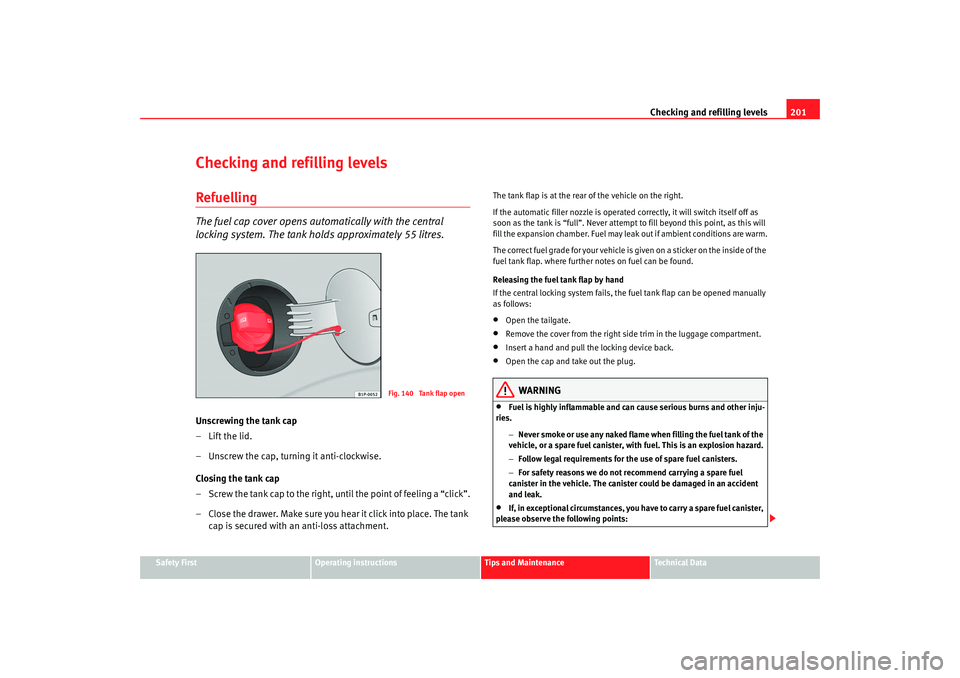
locking system. The tank holds approximately 55 litres.Unscrewing the tank cap
– Lift the lid.
– Unscrew the cap, turning it anti-clockwise.
Closing the tank cap
– Screw the tank cap to the right, until the point of feeling a “click”.
– Close the drawer. Make sure you hear it click into place. The tank
cap is secured with an anti-loss attachment.
The tank flap is at the rear of the vehicle on the right.
If the automatic filler nozzle is operated correctly, it will switch itself off as
soon as the tank is “full”. Never attempt to fill beyond this point, as this will
fill the expansion chamber. Fuel may le ak out if ambient conditions are warm.
The correct fuel grade for your vehicle is given on a sticker on the inside of the
fuel tank flap. where further notes on fuel can be found.
Releasing the fuel tank flap by hand
If the central locking system fails, the fuel tank flap can be opened manually
as follows:•
Open the tailgate.
•
Remove the cover from the right side trim in the luggage compartment.
•
Insert a hand and pull the locking device back.
•
Open the cap and take out the plug.
WARNING
•
Fuel is highly inflammable and can cause serious burns and other inju-
ries.
−Never smoke or use any naked flame when filling the fuel tank of the
vehicle, or a spare fuel canister, with fuel. This is an explosion hazard.
− Follow legal requirements for the use of spare fuel canisters.
− For safety reasons we do not recommend carrying a spare fuel
canister in the vehicle. The canister could be damaged in an accident
and leak.
•
If, in exceptional circumstances, you have to carry a spare fuel canister,
please observe the following points:
Fig. 140 Tank flap open
leon ingles.book Seite 201 Dienst ag, 11. September 2007 1:47 13
Page 204 of 302

Checking and refilling levels
202
− Never fill the spare fuel canister inside the vehicle or on it. An elec-
trostatic charge could build up during filling, causing the fuel fumes to
ignite. This may be fatally explosive. Always place the canister on the
ground to fill it.
− Insert the fuel nozzle into the mouth of the canister as far as
possible.
− If the spare fuel canister is made of metal, the filling nozzle must be
in contact with the canister during filling. This helps prevent an electro-
static charge building up.
− Never spill fuel in the vehicle or in the luggage compartment. Fuel
vapours are explosive. Danger of death.Caution
•
Fuel spills should be removed from the paintwork immediately.
•
Never run the tank completely dry. An irregular fuel supply could cause
misfiring. As a result, unburnt fuel could enter the catalytic converter and
cause damage.For the sake of the environment
Do not try to put in more fuel after the automatic filler nozzle has switched off;
this may cause the fuel to overflow if it becomes warm.
PetrolPetrol types
The correct petrol types are listed on a sticker inside the fuel
tank flap.Only unleaded petrol, corresponding to the standard DIN EN 228, may be
used for vehicles with catalytic converters (EN = “European Standard”).
Fuel types are differentiated by the octane rating, e.g: 91, 95, 98 RON (RON
= “Regulation Octane Number, unit for determining the knock resistance of
petrol”). You may use petrol with a higher octane number than the one recom-
mended for your engine. However, this has no advantage in terms of fuel
consumption and engine power. If, in exceptional circumstances, the correct
octane rating is not available:•
For engines which require Premium unleaded petrol (95 RON) the
following is valid: Regula r unleaded fuel with 91 RON can also be used. This
can, however, result in a slight loss of power under certain driving conditions.
•
For engines which require Premium unleaded petrol (98 RON) the
following is valid: Premium unleaded fuel with 95 RON can also be used. This
can, however, result in a slight loss of power under certain driving conditions.
– If premium unleaded petrol is not available, the engine can be run on
regular unleaded petrol with 91 RON as an “emergency measure”. In this
case only use moderate engine speeds and a light throttle. Avoid using full
throttle. Fill up with premium petrol as soon as possible.Caution
•
Petrol that follows EN 228 may be mixed with small quantities of ethanol.
However, the so-called “bioethanol fuels” available at commercial establish-
ments with reference E50 or E85, which contain a high percentage of ethanol,
may not be used, as they will damage the fuel system.
WARNING (continued)
leon ingles.book Seite 202 Dienst ag, 11. September 2007 1:47 13
Page 207 of 302

Checking and refilling levels205
Safety First
Operating instructions
Tips and Maintenance
Te c h n i c a l D a t a
6. Raise the bonnet ⇒page 206.You should not do any work in the engine compartment unless you know
exactly how to carry out the jobs and have the correct tools! Have the work
carried out by a qualified workshop if you are uncertain.
All service fluids and consumables, e.g. coolant, engine oil, spark plugs and
batteries, are being constantly developed. SEAT provides a constant flow of
information to the Authorised Service Centres concerning modifications. For
this reason we recommend that you have service fluids and consumables
replaced by an Authorised Service Centre. Please observe the relevant
instructions ⇒page 199. The engine compartment of any motor vehicle is a
hazardous area ⇒.
WARNING
All work on the engine or in the engine compartment, e.g. checking and
refilling fluids, involves the danger of injury and scalding as well as the risk
of accident or fire.•
Never open the bonnet if you see steam, smoke or coolant escaping
from the engine compartment. Otherwis e, there is a risk of sustaining
burns. Wait until no more steam or coolant is emitted, then allow the
engine to cool before carefully opening the bonnet.
•
Switch off the engine and remove the key from the ignition.
•
Apply the handbrake and move the gear stick to neutral or selector
lever to position P.
•
Keep children away from the vehicle.
•
Never touch hot engine parts. There is a risk of burns.
•
Never spill liquids on a hot engine or on a hot exhaust gas system. This
is a fire hazard.
•
Avoid causing short-circuits in the electrical system, particularly at the
points where the jump leads are attached ⇒page 256. The battery could
explode.
•
Never touch the radiator fan. It is temperature controlled and could
start automatically, even when the engine has been switched off and the
key removed from the ignition!
•
Do not unscrew the cap on the expansion tank when the engine is hot.
If the coolant is hot, the cooling system will be pressurised!
•
Protect face, hands and arms by covering the cap with a large, thick
cloth to protect against escaping coolant and steam.
•
Always make sure you have not left any objects, such as cleaning cloths
and tools, in the engine compartment.
•
If you have to work underneath the vehicle, you must use suitable
stands additionally to support the vehicle, there is a risk of accident!. A
hydraulic jack is insufficient for securi ng the vehicle and there is a risk of
injury.
•
If any work has to be performed when the engine is started or with the
engine running, there is an additional, potentially fatal, safety risk from the
rotating parts, such as the drive belts, alternator, radiator fan, etc., and
from the high-voltage ignition system. You should also observe the
following points:
−Never touch the electrical wiring of the ignition system.
− Ensure that jewellery, loose cl othing and long hair do not get
trapped in rotating engine parts. Danger of death. Before starting any
work remove jewellery, tie back and cover hair, and wear tight-fitting
clothes.
− Always think carefully about pressing the accelerator if a gear is
engaged in either an automatic or manual gearbox. The vehicle could
move, even if the handbrake is applied. Danger of death.
•
If work has to be carried out on the fuel system or on electrical compo-
nents, you must observe the following sa fety notes in addition to the above
warnings:
−Always disconnect the battery. The vehicle must be unlocked when
this is done, otherwise the alarm will be triggered.WARNING (continued)
leon ingles.book Seite 205 Dienst ag, 11. September 2007 1:47 13