oil level Seat Leon 5D 2007 User Guide
[x] Cancel search | Manufacturer: SEAT, Model Year: 2007, Model line: Leon 5D, Model: Seat Leon 5D 2007Pages: 302, PDF Size: 9.14 MB
Page 212 of 302

Checking and refilling levels
210Oil level in area
- Oil can be topped up. The indicated oil level should be after the zone
Oil level in area
- Oil must be topped up. The indicated oil level should be found, after , in zone
Depending on how you drive and the conditions in which the car is used, oil
consumption can be up to 0.5 L/1000 km. Oil consumption is likely to be
higher for the first 5000 km. For this re ason the engine oil level must be
checked at regular intervals, preferably when filling the tank and before a
journey.
WARNING
Any work carried out in the engine compartment or on the engine must be
carried out cautiously.•
When working in the engine compartment, always observe the safety
warnings ⇒ page 204.Caution
If the oil level is above the area do not start the engine. This could result
in damage to the engine and catalytic converter. Contact an Authorised
Service Centre.
Topping up engine oil
Top up gradually with small quantities of oil.
Before opening the bonnet, read and observe the warnings ⇒ in
“Safety instructions on working in the engine compartment” on
page 204.
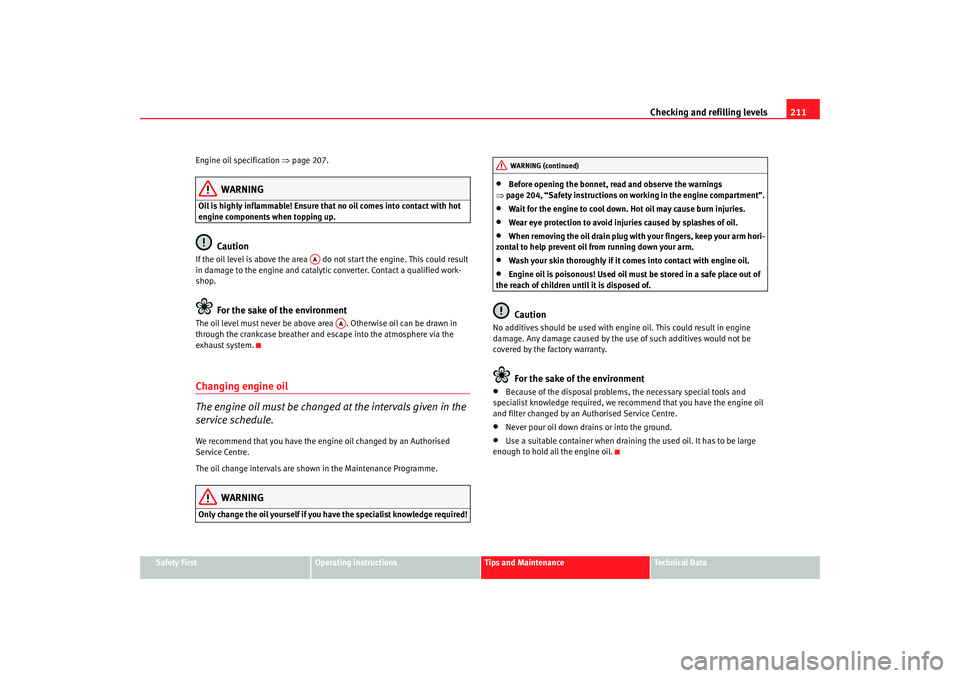
– Unscrew cap from oil filler opening ⇒fig. 145 .
– Top-up oil in small amounts, using the correct oil.
– To avoid over-filling with engine oil, you should top-up using small quantities, wait a while and check the oil level before
adding any more oil.
– As soon as the oil level is in area , carefully close the cap.The position of the oil filler opening is shown in the corresponding engine
compartment diagram ⇒ page 266.
AB
AA
AC
AA
AA
Fig. 145 In the engine
compartment: Engine oil
filler cap
AB
leon ingles.book Seite 210 Dienst ag, 11. September 2007 1:47 13
Page 213 of 302
Checking and refilling levels211
Safety First
Operating instructions
Tips and Maintenance
Te c h n i c a l D a t a
Engine oil specification
⇒page 207.
WARNING
Oil is highly inflammable! Ensure that no oil comes into contact with hot
engine components when topping up.
Caution
If the oil level is above the area do not start the engine. This could result
in damage to the engine and catalytic converter. Contact a qualified work-
shop.
For the sake of the environment
The oil level must never be above ar ea . Otherwise oil can be drawn in
through the crankcase breather and escape into the atmosphere via the
exhaust system.Changing engine oil
The engine oil must be changed at the intervals given in the
service schedule.We recommend that you have the engine oil changed by an Authorised
Service Centre.
The oil change intervals are shown in the Maintenance Programme.
WARNING
Only change the oil yourself if you have the specialist knowledge required!
•
Before opening the bonnet, read and observe the warnings
⇒ page 204, “Safety instructions on wo rking in the engine compartment”.
•
Wait for the engine to cool down. Hot oil may cause burn injuries.
•
Wear eye protection to avoid injuries caused by splashes of oil.
•
When removing the oil drain plug with your fingers, keep your arm hori-
zontal to help prevent oil from running down your arm.
•
Wash your skin thoroughly if it comes into contact with engine oil.
•
Engine oil is poisonous! Used oil must be stored in a safe place out of
the reach of children until it is disposed of.Caution
No additives should be used with engine oil. This could result in engine
damage. Any damage caused by the use of such additives would not be
covered by the factory warranty.
For the sake of the environment
•
Because of the disposal problems, the necessary special tools and
specialist knowledge required, we recommend that you have the engine oil
and filter changed by an Authorised Service Centre.
•
Never pour oil down drains or into the ground.
•
Use a suitable container when draining the used oil. It has to be large
enough to hold all the engine oil.
AA
AA
WARNING (continued)
leon ingles.book Seite 211 Dienst ag, 11. September 2007 1:47 13
Page 214 of 302

Checking and refilling levels
212CoolantCoolant specifications
Coolant is a mixture of water and at least 40% coolant addi-
tive.The cooling system must be filled with a mixture of water and at least 40 % of
our coolant additive G 12+ or an addi tive with the specification TT-VW 774 F
(it is dyed purple). This mixture gives the necessary frost protection down to
-25°C and protects the alloy parts of the cooling system against corrosion. It
also prevents scaling and raises the boiling point of the coolant.
The concentration of coolant must always be at least 40% - even if frost
protection is not required.
If greater frost protection is required in very cold climates, the proportion of
the antifreeze additive G 12+ can be increased. However, the percentage of
coolant additives should not exceed 60%, as this would reduce the frost
protection. It would also reduce th e cooling effect. A mixture with 60%
coolant additive will give frost protection to approx. -40°C.
WARNING
•
The coolant additive is toxic. There is a toxic risk. Always keep the
coolant additive in the original container which should be stored out of the
reach of children. The same applies to coolant which you have drained off.
•
The coolant additive G 12+ must be added in sufficient quantities to
provide anti-freeze protection at the coldest ambient temperatures that
can be expected. At extremely cold ambient temperatures, the coolant
could freeze, causing the vehicle to breakdown. As the heater would also
not work in this situation, there is a risk of suffering exposure!
Caution
•
Other additives may give considerably inferior corrosion protection. The
resulting corrosion in the cooling syst em can lead to a loss of coolant,
causing serious damage to the engine.
•
The coolant additive G 12+ (purple) can be mixed with the additive G 12
(red) or G 11. Never mix G12 (red colour) with G 11.
Checking the coolant level and topping up
The correct coolant level is important for fault-free func-
tioning of the engine cooling system.Before opening the bonnet, read and observe the warnings ⇒ in
“Safety instructions on working in the engine compartment” on
page 204.
Fig. 146 In the engine
compartment: Coolant
expansion tank cap
leon ingles.book Seite 212 Dienst ag, 11. September 2007 1:47 13
Page 217 of 302
Checking and refilling levels215
Safety First
Operating instructions
Tips and Maintenance
Te c h n i c a l D a t a
Changing the front windscreen wiper blades
If the windscreen wiper blades are in perfect condition, you
will benefit from an improved visibility. Damaged wiper
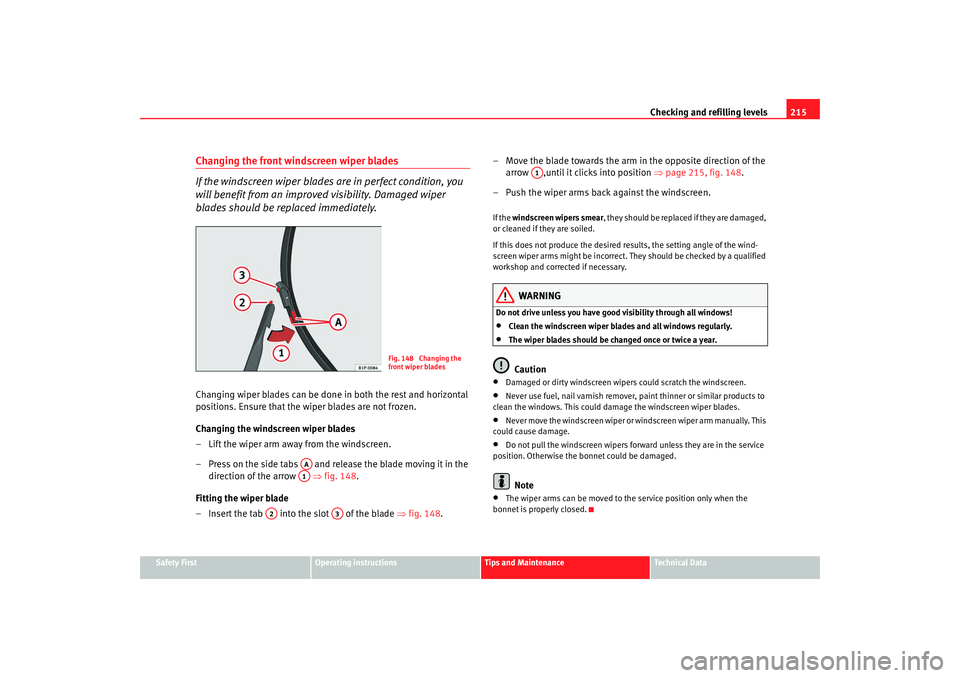
blades should be replaced immediately.Changing wiper blades can be done in both the rest and horizontal
positions. Ensure that the wiper blades are not frozen.
Changing the windscreen wiper blades
– Lift the wiper arm away from the windscreen.
– Press on the side tabs and release the blade moving it in the direction of the arrow ⇒ fig. 148.
Fitting the wiper blade
– Insert the tab into the slot of the blade ⇒fig. 148. – Move the blade towards the arm in the opposite direction of the
arrow ,until it clicks into position ⇒page 215, fig. 148 .
– Push the wiper arms back against the windscreen.
If the windscreen wipers smear , they should be replaced if they are damaged,
or cleaned if they are soiled.
If this does not produce the desired results, the setting angle of the wind-
screen wiper arms might be incorrect. Th ey should be checked by a qualified
workshop and corrected if necessary.
WARNING
Do not drive unless you have good visibility through all windows!•
Clean the windscreen wiper blades and all windows regularly.
•
The wiper blades should be changed once or twice a year.Caution
•
Damaged or dirty windscreen wipers could scratch the windscreen.
•
Never use fuel, nail varnish remover, paint thinner or similar products to
clean the windows. This could damage the windscreen wiper blades.
•
Never move the windscreen wiper or wi ndscreen wiper arm manually. This
could cause damage.
•
Do not pull the windscreen wipers forw ard unless they are in the service
position. Otherwise the bonnet could be damaged.Note
•
The wiper arms can be moved to the service position only when the
bonnet is properly closed.
Fig. 148 Changing the
front wiper blades
AAA1
A2
A3
A1
leon ingles.book Seite 215 Dienst ag, 11. September 2007 1:47 13
Page 218 of 302
Checking and refilling levels
216Changing the rear wiper blade
A good rear wiper blade is essential for clear rear vision.
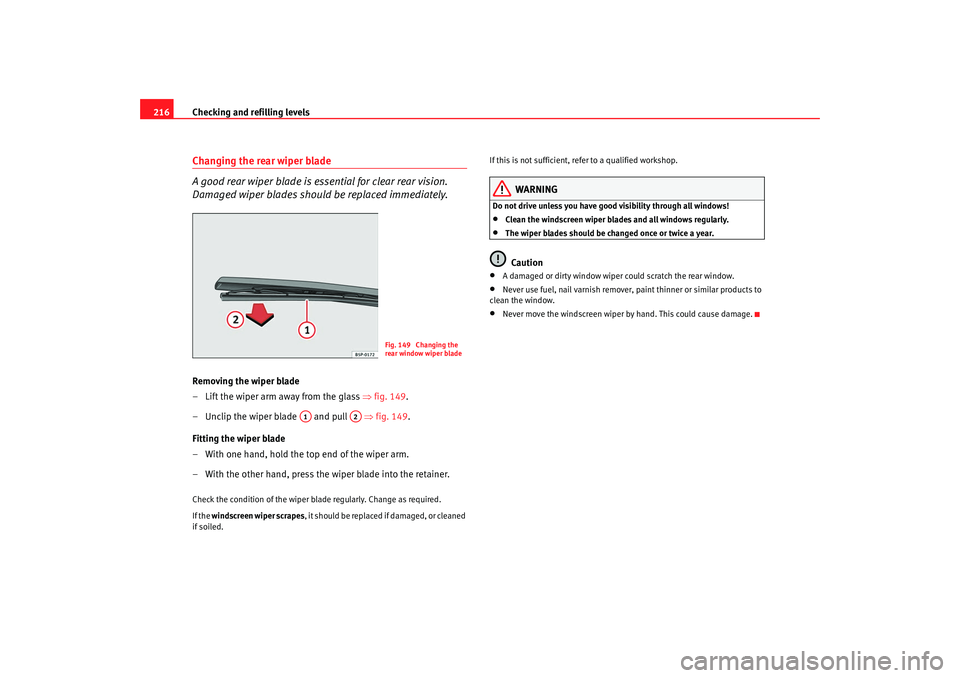
Damaged wiper blades should be replaced immediately.Removing the wiper blade
– Lift the wiper arm away from the glass ⇒fig. 149 .
– Unclip the wiper blade and pull ⇒fig. 149 .
Fitting the wiper blade
– With one hand, hold the top end of the wiper arm.
– With the other hand, press the wiper blade into the retainer.Check the condition of the wiper blade regularly. Change as required.
If the windscreen wiper scrapes , it should be replaced if damaged, or cleaned
if soiled. If this is not sufficient, refer to a qualified workshop.
WARNING
Do not drive unless you have good visibility through all windows!•
Clean the windscreen wiper blades and all windows regularly.
•
The wiper blades should be changed once or twice a year.Caution
•
A damaged or dirty window wiper could scratch the rear window.
•
Never use fuel, nail varnish remover,
paint thinner or similar products to
clean the window.
•
Never move the windscreen wiper by hand. This could cause damage.
Fig. 149 Changing the
rear window wiper blade
A1
A2
leon ingles.book Seite 216 Dienst ag, 11. September 2007 1:47 13
Page 219 of 302
Checking and refilling levels217
Safety First
Operating instructions
Tips and Maintenance
Te c h n i c a l D a t a
Brake fluidChecking the brake fluid level
The brake fluid is checked at the intervals given in the service
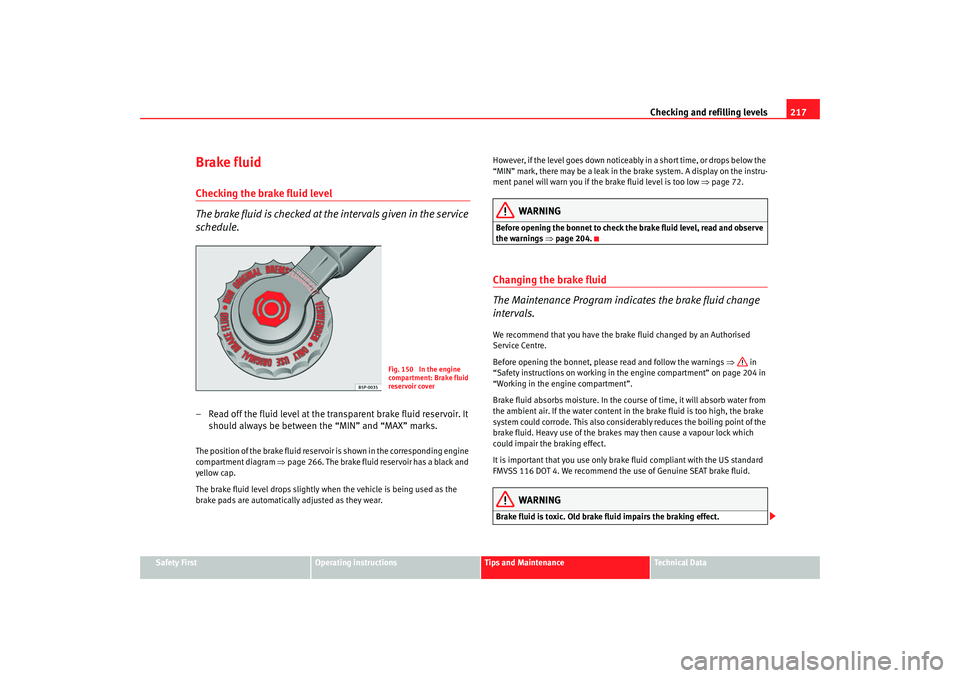
schedule.– Read off the fluid level at the transparent brake fluid reservoir. It
should always be between the “MIN” and “MAX” marks.The position of the brake fluid reservoir is shown in the corresponding engine
compartment diagram ⇒page 266. The brake fluid reservoir has a black and
yellow cap.
The brake fluid level drops slightly when the vehicle is being used as the
brake pads are automatically adjusted as they wear. However, if the level goes down noticeably in a short time, or drops below the
“MIN” mark, there may be a leak in the brake system. A display on the instru-
ment panel will warn you if the brake fluid level is too low
⇒page 72.
WARNING
Before opening the bonnet to check the brake fluid level, read and observe
the warnings ⇒ page 204.Changing the brake fluid
The Maintenance Program indicates the brake fluid change
intervals.We recommend that you have the brake fluid changed by an Authorised
Service Centre.
Before opening the bonnet, please read and follow the warnings ⇒ in
“Safety instructions on working in the engine compartment” on page 204 in
“Working in the engine compartment”.
Brake fluid absorbs moisture. In the course of time, it will absorb water from
the ambient air. If the water content in the brake fluid is too high, the brake
system could corrode. This also considerably reduces the boiling point of the
brake fluid. Heavy use of the brakes may then cause a vapour lock which
could impair the braking effect.
It is important that you use only brake fluid compliant with the US standard
FMVSS 116 DOT 4. We recommend the use of Genuine SEAT brake fluid.
WARNING
Brake fluid is toxic. Old brake fluid impairs the braking effect.
Fig. 150 In the engine
compartment: Brake fluid
reservoir cover
leon ingles.book Seite 217 Dienst ag, 11. September 2007 1:47 13
Page 268 of 302

Technical data
266Te c h n i c a l d a t aChecking fluid levelsFrom time to time, the levels of the different fluids in the
vehicle must be checked. Never fi ll with incorrect fluids, to do
so may cause serious damage to the engine.
Radiator expansion tank
Windscreen washer fluid reservoir
Engine oil filler cap
Engine oil dipstick
Brake fluid reservoir
Vehicle battery (underneath the cover)
The checking and replenishment of the service fluids are carried out on the
components mentioned above. These operations are described in the
⇒ page 204. Overview
Further explanations, instructions and restrictions on the technical data are
contained as of
⇒page 261.
Fig. 184 Diagram for the
location of the various
elements
A1A2A3A4A5A6
leon ingles.book Seite 266 Dienst ag, 11. September 2007 1:47 13
Page 294 of 302

Index
292Brake servo . . . . . . . . . . . . . . . . . . . . . . . . 171, 176
Brake system . . . . . . . . . . . . . . . . . . . . . . . . . . . 217
Brake servo . . . . . . . . . . . . . . . . . . . . . . . . . 174
Brakes . . . . . . . . . . . . . . . . . . . . . . . . . . . . . 174
Warning lamp . . . . . . . . . . . . . . . . . . . . . . . . 77
Brakes . . . . . . . . . . . . . . . . . . . . . . . . . . . . . . . . 176
Braking distance . . . . . . . . . . . . . . . . . . . . . . . . 176
Bulb changes general notes . . . . . . . . . . . . . . . . . . . . . . . 246
Bulb defect warning lamp . . . . . . . . . . . . . . . . . . . . . . . . . 77
Buzzer . . . . . . . . . . . . . . . . . . . . . . . . . . . . 118, 154CCar care Exterior . . . . . . . . . . . . . . . . . . . . . . . . . . . . . 191
Car care products . . . . . . . . . . . . . . . . . . . . . . . 190
Catalytic converter . . . . . . . . . . . . . . . . . . . . . . 178
CD loader* . . . . . . . . . . . . . . . . . . . . . . . . . . . . . 134
Central locking . . . . . . . . . . . . . . . . . . . . . . . . . . 93 Automatic speed dependent locking and un-locking system* . . . . . . . . . . . . . . . . . . . . . 95
Emergency unlocking system . . . . . . . . . . . . 95
Locking system for invo luntary unlocking . . 95
Selective unlocking system* . . . . . . . . . . . . 94
Unlocking system* . . . . . . . . . . . . . . . . . . . . 95
Central locking button Central locking . . . . . . . . . . . . . . . . . . . . . . . 97
unlocking . . . . . . . . . . . . . . . . . . . . . . . . . . . . 97
Centre console with drinks holder . . . . . . . . . . 132 Cetane number . . . . . . . . . . . . . . . . . . . . . . . . . 203
Changing gear
See Manual gearbox . . . . . . . . . . . . . . . . . . 158
Changing the lamps Main headlight lamps . . . . . . . . . . . . . . . . . 247
rear lights . . . . . . . . . . . . . . . . . . . . . . . . . . 250
Changing the main headlight lamps dipped beam lights . . . . . . . . . . . . . . . . . . . 248
main beam lights . . . . . . . . . . . . . . . . . . . . 249
Side lights . . . . . . . . . . . . . . . . . . . . . . . . . . 250
turn signal lamps . . . . . . . . . . . . . . . . . . . . 247
Changing the rear light lamps Position light, fog ligh t and rear light on the
tailgate . . . . . . . . . . . . . . . . . . . . . . . . . . . 251
Changing the rear lights Indicator, side and brake lights on the bodywork . . . . . . . . . . . . . . . . . . . . . . . . . 251
luggage compartment lights . . . . . . . . . . . 253
Chassis number . . . . . . . . . . . . . . . . . . . . . . . . 262
Checking . . . . . . . . . . . . . . . . . . . . . . . . . . . . . . 219
Checking battery electrolyte level . . . . . . . . . . 219
Checking engine oil level . . . . . . . . . . . . . . . . . 209
Child safety . . . . . . . . . . . . . . . . . . . . . . . . . . . . . 46
Child seat . . . . . . . . . . . . . . . . . . . . . . . . . . . . . . . 48 Categorisation in groups . . . . . . . . . . . . . . . 48
Group 1 . . . . . . . . . . . . . . . . . . . . . . . . . . . . . 49
Group 2 . . . . . . . . . . . . . . . . . . . . . . . . . . . . . 49
Group 3 . . . . . . . . . . . . . . . . . . . . . . . . . . . . . 49
Groups 0 and 0+ . . . . . . . . . . . . . . . . . . . . . . 48
Safety notes . . . . . . . . . . . . . . . . . . . . . . . . . . 47
Securing . . . . . . . . . . . . . . . . . . . . . . . . . . . . . 51 Child seats
ISOFIX and Toptether systems . . . . . . . . . . . 52
on the front passenger seat . . . . . . . . . . . . . 31
Cigarette lighter* . . . . . . . . . . . . . . . . . . . . . . . 136
Cleaning alloy wheels . . . . . . . . . . . . . . . . . . . . 195
Cleaning and caring for your vehicle . . . . . . . . 190
Cleaning chrome . . . . . . . . . . . . . . . . . . . . . . . . 194
Cleaning cloth seat covers . . . . . . . . . . . . . . . . 197
Cleaning dash panel . . . . . . . . . . . . . . . . . . . . . 197
Cleaning engine compartment . . . . . . . . . . . . . 196
Cleaning fabric trim . . . . . . . . . . . . . . . . . . . . . 197
Cleaning leather . . . . . . . . . . . . . . . . . . . . . . . . 197
Cleaning plastic parts . . . . . . . . . . . . . . . . . . . . 197
Cleaning seat belts . . . . . . . . . . . . . . . . . . . . . . 198
Cleaning steel wheels . . . . . . . . . . . . . . . . . . . . 195
Cleaning windows . . . . . . . . . . . . . . . . . . . . . . . 193
Cleaning wooden trim . . . . . . . . . . . . . . . . . . . . 197
Climatic* . . . . . . . . . . . . . . . . . . . . . . . . . . . . . . 144
Climatronic General notes . . . . . . . . . . . . . . . . . . . . . . . 151
Clock . . . . . . . . . . . . . . . . . . . . . . . . . . . . . . . . . . 58
Clothes hook . . . . . . . . . . . . . . . . . . . . . . . . . . . 134
Cockpit . . . . . . . . . . . . . . . . . . . . . . . . . . . . . . . . . 55
Control Light switches . . . . . . . . . . . . . . . . . . . . . . . 112
Control lamps . . . . . . . . . . . . . . . . . . . . . . . . . . . 72
Control lighting . . . . . . . . . . . . . . . . . . . . . . . . . . 55
Controls Electric windows . . . . . . . . . . . . . . . . . . . . . 106
leon ingles.book Seite 292 Dienst ag, 11. September 2007 1:47 13
Page 296 of 302

Index
294Engine coolant . . . . . . . . . . . . . . . . . . . . . . . . . 212
Engine fault
Warning lamp . . . . . . . . . . . . . . . . . . . . . . . . 81
Engine management Warning lamp . . . . . . . . . . . . . . . . . . . . . . . . 81
Engine oil . . . . . . . . . . . . . . . . . . . . . . . . . . . . . . 207 Changing . . . . . . . . . . . . . . . . . . . . . . . . . . . 211
Checking level . . . . . . . . . . . . . . . . . . . . . . . 209
Oil properties . . . . . . . . . . . . . . . . . . . . . . . . 208
Specifications . . . . . . . . . . . . . . . . . . . . . . . 207
Topping up . . . . . . . . . . . . . . . . . . . . . . . . . . 210
Engine oil dipstick . . . . . . . . . . . . . . . . . . . . . . . 209
Engine oil pressure Warning lamp . . . . . . . . . . . . . . . . . . . . . 64, 78
Environment . . . . . . . . . . . . . . . . . . . . . . . . . . . 183
Environmental friendliness . . . . . . . . . . . . . . . 184
Environmental tip Avoiding pollution . . . . . . . . . . . . . . . . . . . . 202
ESP . . . . . . . . . . . . . . . . . . . . . . . . . . . . . . . . 81, 173
Example of menu use Open the configuration menu . . . . . . . . . . . 67
Program a speed limit warning . . . . . . . . . . 67
To activate and deactivate the speed limit warning . . . . . . . . . . . . . . . . . . . . . . . . . . . . 68
Examples of menu use Open the main menu . . . . . . . . . . . . . . . . . . 67
Open the winter tyres menu . . . . . . . . . . . . . 67
To close the winter tyres menu . . . . . . . . . . . 68
Exhaust gasses purification system . . . . . . . . 178
Exterior mirrors . . . . . . . . . . . . . . . . . . . . . . . . . 193
FFastening rings . . . . . . . . . . . . . . . . . . . . . . . . . . 17
Fire extinguisher . . . . . . . . . . . . . . . . . . . . . . . . 138
First-aid kit . . . . . . . . . . . . . . . . . . . . . . . . . . . . . 138
Floor mats . . . . . . . . . . . . . . . . . . . . . . . . . . . . . . 16
Fog lights . . . . . . . . . . . . . . . . . . . . . . . . . . . . . . 112
folding table* . . . . . . . . . . . . . . . . . . . . . . . . . . 133
Foot brake Warning lamp . . . . . . . . . . . . . . . . . . . . . . . . 82
Front airbags . . . . . . . . . . . . . . . . . . . . . . . . . . . . 34 Description . . . . . . . . . . . . . . . . . . . . . . . . . . 34
Function . . . . . . . . . . . . . . . . . . . . . . . . . . . . . 35
Safety notes . . . . . . . . . . . . . . . . . . . . . . . . . . 37
Front drinks holders . . . . . . . . . . . . . . . . . . . . . 135
Front interior light Switching off . . . . . . . . . . . . . . . . . . . . . . . . 118
Switching on . . . . . . . . . . . . . . . . . . . . . . . . 118
Front passenger airbag deactivation . . . . . . . . . 44
Front reading lights . . . . . . . . . . . . . . . . . . . . . . 119
Front seat adjustment Lumbar support . . . . . . . . . . . . . . . . . . . . . . 130
Fuel Diesel . . . . . . . . . . . . . . . . . . . . . . . . . . . . . . 203
Petrol . . . . . . . . . . . . . . . . . . . . . . . . . . . . . . 202
Fuel level Indicator . . . . . . . . . . . . . . . . . . . . . . . . . . . . . 57
Fuel reserve . . . . . . . . . . . . . . . . . . . . . . . . . . . . . 75 Warning . . . . . . . . . . . . . . . . . . . . . . . . . . . . . 64
Fuel Tank Opening the fuel tank flap . . . . . . . . . . . . . 201 Fuel tank
See Fuel reserve . . . . . . . . . . . . . . . . . . . . . . 75
Fuel: save . . . . . . . . . . . . . . . . . . . . . . . . . . . . . . 183
Fuses . . . . . . . . . . . . . . . . . . . . . . . . . . . . . . . . . 239
GG 12 . . . . . . . . . . . . . . . . . . . . . . . . . . . . . . . . . . 212
Gear shift pattern . . . . . . . . . . . . . . . . . . . . . . . 158
General overview of the engine compartment 266
Glove compartment . . . . . . . . . . . . . . . . . . . . . 132
Glow plug system . . . . . . . . . . . . . . . . . . . . . . . 157 Warning lamp . . . . . . . . . . . . . . . . . . . . . . . . 81HHandbrake . . . . . . . . . . . . . . . . . . . . . . . . . . . . . 164Warning lamp . . . . . . . . . . . . . . . . . . . . 77, 164
Hazard warning lights . . . . . . . . . . . . . . . . . . . . 116
head restraints Adjusting . . . . . . . . . . . . . . . . . . . . . . . 128, 129
adjustment of the head restraint angle . . . 129
Removing . . . . . . . . . . . . . . . . . . . . . . . . . . . 129
head restraints, correct adjustment . . . . . . . . . 13 In-use and non-use positions . . . . . . . . . . . 14
Headlight flasher . . . . . . . . . . . . . . . . . . . . . . . 117
Headlight range control . . . . . . . . . . . . . . . . . . 115
Headlights . . . . . . . . . . . . . . . . . . . . . . . . . . . . . 112 Driving abroad . . . . . . . . . . . . . . . . . . . . . . . 180
Fog lights . . . . . . . . . . . . . . . . . . . . . . . . . . . 112
Headlight washer system* . . . . . . . . . . . . . 124
leon ingles.book Seite 294 Dienst ag, 11. September 2007 1:47 13