maintenance Seat Leon 5D 2009 User Guide
[x] Cancel search | Manufacturer: SEAT, Model Year: 2009, Model line: Leon 5D, Model: Seat Leon 5D 2009Pages: 304, PDF Size: 7.72 MB
Page 206 of 304
Cleaning and caring for your vehicle
204Vehicle interior maintenancePlastic parts and dash panel cleaning– Use a clean, damp cloth to clean plastic parts and the dash
panel.
– If this does not provide satisfactory results, use a special solvent-free plastic cleaning product.
WARNING
Never clean the dash panel and the airbag module surface with cleansers
containing solvents. Solvents cause the surface to become porous. If the
airbag triggered, disintegrating plastic parts could cause substantial inju-
ries.
Caution
Cleaning products which contain solvents will damage the material.Wooden trim cleaning*– Clean the wooden trim with a water-moistened clean cloth.
– If this does not provide satisfactory results, use a gentle soap
solution.
CautionCleaning products which contain solvents will damage the material.
Cleaning the radio and climate controlsTo clean the radio and/or climate controls, use a soft damp cloth. For more
resistant dirt, a neutral soap solution may be used.Cloth seat covers and fabric trim cleaningCloth seat covers and fabric trim on the doors, headlining etc. can be cleaned
with a special interior cleanser or with dry foam and a soft brush.Leather cleaning*Normal cleaning
– Moisten a cotton or woollen cloth with water and wipe over the leather surfaces.
Cleaning stubborn stains
– More stubborn dirt can be removed using a mild soap solution (pure liquid soap; two tablespoons diluted in one litre of water)
and a cloth.
– Do not let the water soak through the leather or soak into the seams.
– Then wipe off with a soft, dry cloth.
Leather maintenance
– The leather should be treated twice a year with a special leather- care product, available in your Authorised Service Centre.
Leon_EN.book Seite 204 Dienstag, 8. September 2009 5:25 17
Page 215 of 304

Checking and refilling levels213
Safety First
Controls and equipment
Practical tips
Technical Data
The safety of the LPG system guarantees operation without risk. The following
safety measures have been adopted:
•The LPG tank has a solenoid valve which closes automatically when the
engine is switched off (ignition off) or when running on petrol.•A solenoid type main valve disconnects the supply of gas to the engine
compartment when the engine is switched off or running on petrol.•A safety valve in the LPG tank with pipes to the outside prevents the gas
from entering the vehicle compartment.•All anchorage points and materials have been designed to ensure the
maximum possible levels of safety.
The condition of the LPG system should be checked regularly to guarantee
safe driving conditions ⇒ . These checks are included in the Maintenance
Programme.WARNING
•If there is a smell of gas or a suspected leak, stop the vehicle immedi-
ately and switch off the ignition. Open the doors to ventilate the vehicle. Do
not carry on driving! Take the vehicle to a qualified workshop and have the
fault repaired.•Immediately extinguish any cigarettes and remove from the vehicle any
objects which might produce a spark or cause a fire, and switch off imme-
diately if gas is smelt or a leak is detected.•LGP tanks are subject to pressure and must be checked regularly. The
owner of the vehicle must check that these services are performed
correctly.•When parking the vehicle in a closed area (for example in a garage),
make sure that there is adequate ventilation, either natural or mechanical,
to neutralise the LPG in the event of a leak.
PetrolPetrol types
The recommended fuel types are listed on a sticker inside the
fuel tank flap.Only unleaded petrol, corresponding to the standard DIN EN 228, may be
used for vehicles with catalytic converters (EN = “European Standard”).
Fuel types are differentiated by the octane rating, e.g: 91, 95, 98 RON (RON
= “Regulation Octane Number, unit for determining the knock resistance of
petrol”). You may use petrol with a higher octane number than the one recom-
mended for your engine. However, this has no advantage in terms of fuel
consumption and engine power.
The correct fuel type for your vehicle is given in the technical table for the
engine. Section “Technical Data”
Caution
•Petrol that follows EN 228 may be mixed with small quantities of ethanol.
However, the so-called “bioethanol fuels” available at commercial establish-
ments with reference E50 or E85, which contain a high percentage of ethanol,
may not be used, as they will damage the fuel system.•Even one tankful of leaded fuel would permanently impair the efficiency
of the catalytic converter.•High engine speed and full throttle can damage the engine when using
petrol with an octane rating lower than the correct grade for the engine.For the sake of the environment
Just one full tank of leaded fuel would seriously impair the efficiency of the
catalytic converter.
Leon_EN.book Seite 213 Dienstag, 8. September 2009 5:25 17
Page 216 of 304

Checking and refilling levels
214Petrol additives
Petrol additives improve the quality of the petrol.The quality of the petrol influences running behaviour, performance and
service life of the engine. For this reason, you should use good quality petrol
containing additives. These additives will help to prevent corrosion, keep the
fuel system clean and prevent deposits from building up in the engine.
If good quality petrol with additives is not available or engine problems occur,
the required additives must be added during refuelling.DieselDiesel*Diesel fuel must correspond to DIN EN 590 (EN = “European standard”). It
must have a cetane number (CN) of at least 51. The cetane number indicates
the ignition quality of the diesel fuel.
Notes on filling with fuel ⇒page 208.Biodiesel*The biodiesel fuel must comply with the DIN EN 14.214 (FAME) Standard.•Biodiesel is a methyl ester obtained from rapeseed oil.•DIN is the German abbreviation for “ Deutsches Institut für N ormung e.V.”,
the German standards institute.•EN means European Norm.•FAME is the English abbreviation for “ Fatty Acid Methyl Ester”. Your Authorised Service Centre can also be consulted to know if the vehicle
has been prepared for biodiesel use.
Things to note about RME fuel (biodiesel)
•The performance of a vehicle using biodiesel maybe somewhat reduced.•Fuel consumption of a vehicle using biodiesel may be slightly higher.•RME fuel is resistant to the cold down to approx. -10°C.•At temperatures below -10°C, we recommend using winter diesel fuel.•Your vehicle is designed to be refuelled with up to a maximum of 7%
blended biodiesel in accordance with standard DIN 51628.Caution
•RME fuel can damage the fuel system in vehicles which are not suitably
adjusted.•If you decide to use biodiesel in your vehicle, please use only RME fuel
which is DIN E 14,214 compliant.•If you use biodiesel that does not meet the required standard, the fuel
filter could become clogged.Note
•In case of low exterior temperatures and a fuel biodiesel percentage of
higher than 50%, an increase in gas emission may occur during operation of
the independent heating.•The fuel filter may become clogged when fu el is changed to biodiesel. For
this reason, we recommend you that, when having run 300 or 400 km after a
fuel change, the fuel filter change must also be done. Also note the instruc-
tions in the Inspection and Maintenance plan.•If the vehicle is to remain parked for more than about two weeks, we
recommend filling the fuel tank with biodiesel and driving about 50 km in
order to avoid damage to the injection system.
Leon_EN.book Seite 214 Dienstag, 8. September 2009 5:25 17
Page 223 of 304
Checking and refilling levels221
Safety First
Controls and equipment
Practical tips
Technical Data
– Unscrew cap from oil filler opening ⇒fig. 146 ..
– Top-up oil in small amounts, using the correct oil.
– To avoid over-filling with engine oil, you should top-up using small quantities, wait a while and check the oil level before
adding any more oil.
– As soon as the oil level is in area , carefully close the cap.The position of the oil filler opening is shown in the corresponding engine
compartment diagram ⇒page 273.
Engine oil specification ⇒page 218.
WARNING
Oil is highly inflammable! Ensure that no oil comes into contact with hot
engine components when topping up.
Caution
If the oil level is above the area do not start the engine. This could result
in damage to the engine and catalytic converter. Contact a qualified work-
shop.
For the sake of the environment
The oil level must never be above area . Otherwise oil can be drawn in
through the crankcase breather and escape into the atmosphere via the
exhaust system.
Changing engine oil
The engine oil must be changed at the intervals given in the
service schedule.We recommend that you have the engine oil changed by an Authorised
Service Centre.
The oil change intervals are shown in the Maintenance Programme.
WARNING
Only change the oil yourself if you have the specialist knowledge required!•Before opening the bonnet, read and observe the warnings
⇒ page 215, “Safety instructions on working in the engine compartment”.•Wait for the engine to cool down. Hot oil may cause burn injuries.•Wear eye protection to avoid injuries caused by splashes of oil.•When removing the oil drain plug with your fingers, keep your arm hori-
zontal to help prevent oil from running down your arm.•Wash your skin thoroughly if it comes into contact with engine oil.•Engine oil is poisonous! Used oil must be stored in a safe place out of
the reach of children until it is disposed of.Caution
No additives should be used with engine oil. This could result in engine
damage. Any damage caused by the use of such additives would not be
covered by the factory warranty.
For the sake of the environment
•Because of the disposal problems, the necessary special tools and
specialist knowledge required, we recommend that you have the engine oil
and filter changed by an Authorised Service Centre.
AB
AA
AA
Leon_EN.book Seite 221 Dienstag, 8. September 2009 5:25 17
Page 230 of 304

Checking and refilling levels
228However, if the level goes down noticeably in a short time, or drops below the
“MIN” mark, there may be a leak in the brake system. A display on the instru-
ment panel will warn you if the brake fluid level is too low ⇒ page 75.
WARNING
Before opening the bonnet to check the brake fluid level, read and observe
the warnings ⇒page 215.Changing the brake fluid
The Maintenance Program indicates the brake fluid change
intervals.We recommend that you have the brake fluid changed by an Authorised
Service Centre.
Before opening the bonnet, please read and follow the warnings ⇒ in
“Safety instructions on working in the engine compartment” on page 215 in
“Working in the engine compartment”.
Brake fluid absorbs moisture. In the course of time, it will absorb water from
the ambient air. If the water content in the brake fluid is too high, the brake
system could corrode. This also considerably reduces the boiling point of the
brake fluid. Heavy use of the brakes may then cause a vapour lock which
could impair the braking effect.
It is important that you use only brake fluid compliant with the US standard
FMVSS 116 DOT 4. We recommend the use of Genuine SEAT brake fluid.
WARNING
Brake fluid is poisonous. Old brake fluid impairs the braking effect.
•Before opening the bonnet to check the brake fluid level, read and
observe the warnings ⇒page 215.•Brake fluid should be stored in the closed original container in a safe
place out of reach of children. There is a toxic risk.•Complete the brake fluid change according to the Maintenance
Program. Heavy use of the brakes may cause a vapour lock if the brake fluid
is left in the system for too long. This would seriously affect the efficiency
of the brakes and the safety of the vehicle. This may cause an accident.Caution
Brake fluid could damage the paintwork. Wipe off any brake fluid from the
paintwork immediately.
For the sake of the environment
Brake fluid must be drained and disposed of in the proper manner observing
environmental regulations.
WARNING (continued)
Leon_EN.book Seite 228 Dienstag, 8. September 2009 5:25 17
Page 232 of 304

Checking and refilling levels
230•If the vehicle is left standing in cold conditions for a long period, protect
the battery from frost. If it “freezes” it will be damaged.Checking the electrolyte level
The electrolyte level should be checked regularly in high-
mileage vehicles, in hot countries and in older batteries.– Open the bonnet and open the battery cover at the front ⇒ in
“Safety instructions on working in the engine compartment” on
page 215 ⇒ in “Warnings on handling the battery” on
page 229.
– Check the colour display in the "magic eye" on the top of the battery.
– If there are air bubbles in the window, tap the window gently until they disperse.The position of the battery is shown in the corresponding engine compart-
ment diagram ⇒page 273.
The “magic eye” indicator, located on the top of the battery changes colour,
depending on the charge state and electrolyte level of the battery.
There are two different colours:•Black: correct charge status.•Transparent/clear yellow: the battery must be replaced. Contact a
specialist workshop.
Charging and changing the vehicle battery
The battery is maintenance-free and is checked during the
inspection service. All work on the vehicle battery requires
specialist knowledge.If you often drive short distances or if the vehicle is not driven for long
periods, the battery should be checked by a qualified workshop between the
scheduled services.
If the battery has discharged and you have problems starting the vehicle, the
battery might be damaged. If this happens, we recommend you have the
vehicle battery checked by an Authorised Service Centre where it will be re-
charged or replaced.
Charging the battery
The vehicle battery should be charged by a qualified workshop only, as
batteries using special technology have been installed and they must be
charged in a controlled environment.
Replacing a vehicle battery
The battery has been developed to suit the conditions of its location and has
special safety features.
Genuine SEAT batteries fulfil the maintenance, performance and safety spec-
ifications of your vehicle.
WARNING
•We recommend you use only maintenance-free or cycle free leak-proof
batteries which comply with the standards T 825 06 and VW 7 50 73. This
standard applies as of 2001.•Before starting any work on the batteries, you must read and observe
the warnings ⇒ in “Warnings on handling the battery” on page 229.
Leon_EN.book Seite 230 Dienstag, 8. September 2009 5:25 17
Page 271 of 304

General notes on the technical data269
Safety First
Controls and equipment
Practical tips
Technical Data
Te ch n i c a l D a t aGeneral notes on the technical dataOutstanding informationImportant considerations
All data in the official vehicle documents take precedence
over this data.All data provided in this manual are valid for the standard model in Spain. The
vehicle data card included in the Maintenance Programme or the vehicle
registration documents shows which engine is installed in the vehicle.
The figures may be different depending on if additional equipment is fitted,
for different models, for special vehicles and for other countries. Abbreviations used in this paragraph of the Technical Data
Abbrevia-
tion
Meaning
kW
Kilowatt, engine power measurement.
bhp
Brake horse power, formerly used to denote engine power
at rpm
Revolutions per minute - engine speed.
Nm
Newton metres, unit of engine torque.
l/100 km
Fuel consumption in litres per 100 km.
g/km
Carbon dioxide emissions in grams per km travelled.
CO2
Carbon dioxide
CN
Cetane number, indication of the diesel combustion power.
RON
Research octane number, indication of the knock resistance
of petrol.
Leon_EN.book Seite 269 Dienstag, 8. September 2009 5:25 17
Page 272 of 304
General notes on the technical data
270Vehicle identification data
The most important data are given on the type plate and the
vehicle data sticker.Vehicles for certain export countries do not have a type plate.
Type plate
The type plate is located on the left rib inside the engine compartment.
Vehicle identification number
The vehicle identification number (chassis number) can be read from outside
the vehicle through a viewer in the windscreen. This is located on the left-
hand side of the vehicle in the lower area of the windscreen. It is also located
on the right hand side of the engine compartment. Vehicle data
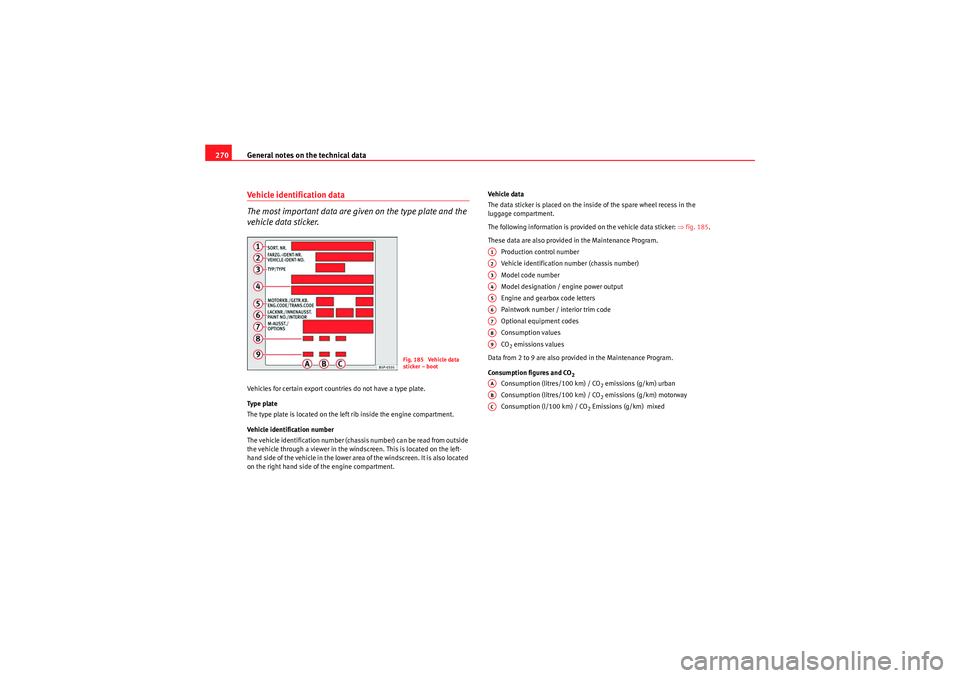
The data sticker is placed on the inside of the spare wheel recess in the
luggage compartment.
The following information is provided on the vehicle data sticker:
⇒fig. 185 .
These data are also provided in the Maintenance Program. Production control number
Vehicle identification number (chassis number)
Model code number
Model designation / engine power output
Engine and gearbox code letters
Paintwork number / interior trim code
Optional equipment codes
Consumption values
CO
2 emissions values
Data from 2 to 9 are also provided in the Maintenance Program.
Consumption figures and CO
2
Consumption (litres/100 km) / CO
2 emissions (g/km) urban
Consumption (litres/100 km) / CO2 emissions (g/km) motorway
Consumption (l/100 km) / CO
2 Emissions (g/km) mixed
Fig. 185 Vehicle data
sticker – boot
A1A2A3A4A5A6A7A8A9AAABAC
Leon_EN.book Seite 270 Dienstag, 8. September 2009 5:25 17
Page 299 of 304

Index297
HHandbrake . . . . . . . . . . . . . . . . . . . . . . . . . . . . . 171
Warning lamp . . . . . . . . . . . . . . . . . . . . 81, 171
Hazard warning lights . . . . . . . . . . . . . . . . . . . . 116
head restraints Adjusting . . . . . . . . . . . . . . . . . . . . . . 130, 131
adjustment of the head restraint angle . . . 131
Removing . . . . . . . . . . . . . . . . . . . . . . . . . . . 131
head restraints, correct adjustment . . . . . . . . . . 13 In-use and non-use positions . . . . . . . . . . . . 14
Headlight flashers . . . . . . . . . . . . . . . . . . . . . . . 118
Headlight range control . . . . . . . . . . . . . . . . . . 115
Headlights Driving abroad . . . . . . . . . . . . . . . . . . . . . . . 192
Fog lights . . . . . . . . . . . . . . . . . . . . . . . . . . . 111
Headlight washer system* . . . . . . . . . . . . . 125
Heated front seats . . . . . . . . . . . . . . . . . . . . . . . 133
Heated window 2C-Climatronic . . . . . . . . . . . . . . . . . . . . . . . 150
Heating . . . . . . . . . . . . . . . . . . . . . . . . . . . . . . . . 143
High pressure cleaners . . . . . . . . . . . . . . . . . . . 199
Hill-start aid . . . . . . . . . . . . . . . . . . . . . . . . . . . . 172
Horn . . . . . . . . . . . . . . . . . . . . . . . . . . . . . . . . . . . 53IIdentification number . . . . . . . . . . . . . . . . . . . . 270
Ignition key . . . . . . . . . . . . . . . . . . . . . . . . . . . . 157
Ignition lock . . . . . . . . . . . . . . . . . . . . . . . . . . . . 157 Indicators
indication lamp . . . . . . . . . . . . . . . . . . . . . . . 78
Information texts in the display . . . . . . . . . . . . . 64
Instrument and switch lighting . . . . . . . . . . . . . 115
Instrument lighting . . . . . . . . . . . . . . . . . . . . . . . 53
Instruments . . . . . . . . . . . . . . . . . . . . . . . . . . . . . 55
Interior lights . . . . . . . . . . . . . . . . . . . . . . . . . . . 119
Intermittent wipe, windscreen . . . . . . . . . . . . . 122
ISOFIX system . . . . . . . . . . . . . . . . . . . . . . . . . . . 49
JJump leads . . . . . . . . . . . . . . . . . . . . . . . . . . . . . 263
Jump-starting . . . . . . . . . . . . . . . . . . . . . . . . . . . 263KKeys . . . . . . . . . . . . . . . . . . . . . . . . . . . . . . . . . . . 99LLeather cleaning . . . . . . . . . . . . . . . . . . . . . . . . 204
Lights . . . . . . . . . . . . . . . . . . . . . . . . . . . . . . . . . 111
Load compartment in the boot See Luggage compartment . . . . . . . . . . . . . . 16
Locker . . . . . . . . . . . . . . . . . . . . . . . . . . . . . . . . . 135
Locks . . . . . . . . . . . . . . . . . . . . . . . . . . . . . . . . . 201
LPG . . . . . . . . . . . . . . . . . . . . . . . . . . . 58, 161, 210
LPG system Driving . . . . . . . . . . . . . . . . . . . . . . . . . . . . . 161
Filler neck adapter . . . . . . . . . . . . . . . . . . . . 212 Level indicator . . . . . . . . . . . . . . . . . . . . . . . . 58
Refuelling . . . . . . . . . . . . . . . . . . . . . . . . . . . 210
Luggage compartment . . . . . . . . . . . . . . . . . . . . 16 See also Luggage compartment . . . . . . . . . . 16
Luggage compartment cover . . . . . . . . . . . . . . 141
MMain beam . . . . . . . . . . . . . . . . . . . . . . . . 111, 118
Main beam headlights Indicator lamp . . . . . . . . . . . . . . . . . . . . . . . . 79
Main headlight lamps . . . . . . . . . . . . . . . . . . . . 255
Maintenance airbags . . . . . . . . . . . . . . . . . . . . . . . . . . . . . . 31
Manual gearbox . . . . . . . . . . . . . . . . . . . . . . . . . 165
Manual mode 2C-Climatronic . . . . . . . . . . . . . . . . . . . . . . . 152
MEDIA-IN connector . . . . . . . . . . . . . . . . . . . . . . 139
MFD . . . . . . . . . . . . . . . . . . . . . . . . . . . . . . . . . . . . 61
Mileage display . . . . . . . . . . . . . . . . . . . . . . . . . . 60
Mirrors Exterior mirrors, electrical . . . . . . . . . . . . . . 126
Interior mirror . . . . . . . . . . . . . . . . . . . . . . . . 125
Make-up mirrors . . . . . . . . . . . . . . . . . . . . . 121
Mobile telephones and radiotelephones . . . . 207
Multi-function display . . . . . . . . . . . . . . . . . . . . . 61NNumber of seats . . . . . . . . . . . . . . . . . . . . . . . . . 19
Leon_EN.book Seite 297 Dienstag, 8. September 2009 5:25 17
Page 300 of 304

Index
298OObservations . . . . . . . . . . . . . . . . . . . . . . . . . . . 192
Octane number . . . . . . . . . . . . . . . . . . . . . . . . . 213
Oil . . . . . . . . . . . . . . . . . . . . . . . . . . . . . . . . . . . . \
218
Oil change . . . . . . . . . . . . . . . . . . . . . . . . . . . . . 221
Oil properties . . . . . . . . . . . . . . . . . . . . . . . . . . . 219
One-touch opening and closing
Electric windows . . . . . . . . . . . . . . . . . . . . . 107
Opening and locking . . . . . . . . . . . . . . . . . . . . 104
Overview Control lamps . . . . . . . . . . . . . . . . . . . . . . . . 75
Dash panel . . . . . . . . . . . . . . . . . . . . . . . . . . . 53
Instruments . . . . . . . . . . . . . . . . . . . . . . . . . . 55
Warning lamps . . . . . . . . . . . . . . . . . . . . . . . 75PPaintworkPolishing . . . . . . . . . . . . . . . . . . . . . . . . . . . 200
Parking . . . . . . . . . . . . . . . . . . . . . . . . . . . . . . . . 172
Parking lights . . . . . . . . . . . . . . . . . . . . . . . . . . 118
Parking system . . . . . . . . . . . . . . . . . . . . . . . . . 173
Parking system plus . . . . . . . . . . . . . . . . . . . . . 174
Parts . . . . . . . . . . . . . . . . . . . . . . . . . . . . . . . . . . 206
Parts replacement . . . . . . . . . . . . . . . . . . . . . . . 206
Pedals . . . . . . . . . . . . . . . . . . . . . . . . . . . . . . . . . 16
Petrol . . . . . . . . . . . . . . . . . . . . . . . . . . . . . . . . . 213 Driving abroad . . . . . . . . . . . . . . . . . . . . . . . 192
Petrol additives . . . . . . . . . . . . . . . . . . . . . . . . . 214
Petrol engines, starting . . . . . . . . . . . . . . . . . . 158 Physical principles of a frontal collision . . . . . . 20
Plastic parts . . . . . . . . . . . . . . . . . . . . . . . . . . . . 200
Plastic parts cleaning . . . . . . . . . . . . . . . . . . . . 204
Pollen filter . . . . . . . . . . . . . . . . . . . . . . . . . . . . 153
Power steering . . . . . . . . . . . . . . . . . . . . . . . . . . 187
Power steering system
warning light . . . . . . . . . . . . . . . . . . . . . . . . . 82
Products for vehicle maintenance . . . . . . . . . . 197
RRadio frequency remote control Changing the battery . . . . . . . . . . . . . . . . . 101
Radio navigation Steering wheel controls audio + telephone version . . . . . . . . . . . . . . 89
audio version . . . . . . . . . . . . . . . . . . . . . . . . . 89
Radio wave remote control . . . . . . . . . . . . . . . . 100
Rain sensor* . . . . . . . . . . . . . . . . . . . . . . . . . . . 123
Rear fog light Indication lamp . . . . . . . . . . . . . . . . . . . . . . 111
Warning lamp . . . . . . . . . . . . . . . . . . . . . . . . 78
Rear interior lights . . . . . . . . . . . . . . . . . . . . . . 120
Rear lights . . . . . . . . . . . . . . . . . . . . . . . . . . . . . 258
Rear reading lights . . . . . . . . . . . . . . . . . . . . . . 120
Rear seat bench . . . . . . . . . . . . . . . . . . . . . . . . . 134
Rear window heating Heating element wires . . . . . . . . . . . . . . . . 201
Rear window wiper . . . . . . . . . . . . . . . . . . . . . . 124
Rear-view mirror . . . . . . . . . . . . . . . . . . . . . . . . 125
Recommended gear display . . . . . . . . . . . . . . . . 60 Refuelling . . . . . . . . . . . . . . . . . . . . . . . . . . . . . 208
Registration light . . . . . . . . . . . . . . . . . . . . . . . 262
Remote control key
Buttons . . . . . . . . . . . . . . . . . . . . . . . . . . . . 100
Synchronising . . . . . . . . . . . . . . . . . . . . . . . 101
Removing and fitting the wheel . . . . . . . . . . . . 246
Repairs airbags . . . . . . . . . . . . . . . . . . . . . . . . . . . . . . 31
Replacement keys . . . . . . . . . . . . . . . . . . . . . . . . 99
Rev counter . . . . . . . . . . . . . . . . . . . . . . . . . . . . . 57
Reverse gear Manual gearbox . . . . . . . . . . . . . . . . . . . . . 165
Roll-back function Sliding/tilting roof . . . . . . . . . . . . . . . . . . . 110
Windows . . . . . . . . . . . . . . . . . . . . . . . . . . . 107
Roof aerial* . . . . . . . . . . . . . . . . . . . . . . . . . . . . 207
Roof carrier* . . . . . . . . . . . . . . . . . . . . . . . . . . . 141
Rubber seals . . . . . . . . . . . . . . . . . . . . . . . . . . . 201
Running in Engine . . . . . . . . . . . . . . . . . . . . . . . . . . . . . 188
SSafe driving . . . . . . . . . . . . . . . . . . . . . . . . . . . . . . 7
Safety . . . . . . . . . . . . . . . . . . . . . . . . . . . . . . . . . . . 8
Safety equipment . . . . . . . . . . . . . . . . . . . . . . . . . 7
Safety instructionsCoolant temperature . . . . . . . . . . . . . . . . . . . 78
Safety notes Airbags . . . . . . . . . . . . . . . . . . . . . . . . . . . . . . 31
Belt tension devices . . . . . . . . . . . . . . . . . . . 27
Leon_EN.book Seite 298 Dienstag, 8. September 2009 5:25 17