handbrake Seat Leon 5D 2011 User Guide
[x] Cancel search | Manufacturer: SEAT, Model Year: 2011, Model line: Leon 5D, Model: Seat Leon 5D 2011Pages: 302, PDF Size: 4.17 MB
Page 219 of 302
217
Checking and refilling levels
operational to approx. -24°C, provided you use winter-grade diesel which is
safe to -15°C.
However, if the fuel has waxed to such an extent that the engine will not
start at temperatures of under -24°C, simply place the vehicle in a warm
place for a while.
CAUTION
Do not mix fuel additives (thinners or similar products) with diesel fuel.
Working in the engine compartment Safety instructions on working in the engine compartment
Any work carried out in the engine compartment or on the
engine must be carried out cautiously.
Before starting any work on the engine or in the engine compart-
ment:
1. Switch off the engine and remove the key from the ignition.
2. Apply the handbrake.
3. Move the gear lever to neutral or the selector lever to position P.
4. Wait for the engine to cool down.
5. Keep children away from the vehicle.
6. Raise the bonnet ⇒ page 219. You should not do any work in the engine compartment unless you know ex-
actly how to carry out the jobs and have the correct tools! Have the work car-
ried out by a specialised workshop if you are uncertain.
All service fluids and consumables, e.g. coolant, engine oil, spark plugs
and batteries, are under constant development. SEAT provides a constant
flow of information to the Authorised Service Centres concerning modifica-
tions. For this reason, we recommend you to have service fluids and con-
sumables replaced by an Authorised Service Centre. Please observe the rel-
evant instructions
⇒ page 208. The engine compartment of the vehicle is a
hazardous area ⇒
.
WARNING
All work on the engine or in the engine compartment, e.g. checking and
refilling fluids, involves the danger of injury and scalding as well as the
risk of accident or fire.
● Never open the bonnet if you see steam, smoke or coolant escaping
from the engine compartment. Otherwise, there is a risk of sustaining
burns. Wait until no more steam or coolant is emitted, then allow the en-
gine to cool before carefully opening the bonnet.
● Switch off the engine and remove the key from the ignition.
● Apply the handbrake and move the gear lever to neutral or selector
lever to position P.
● Keep children away from the vehicle.
● Never touch hot engine parts. There is a risk of burns.
● Never spill liquids on a hot engine or on a hot exhaust gas system.
This is a fire hazard.
● Avoid causing short-circuits in the electrical system, particularly at
the points where the jump leads are attached ⇒ page 264. The battery
could explode.
Safety FirstOperating InstructionsPractical TipsTechnical Specifications
Page 220 of 302
218Checking and refilling levels
WARNING (Continued)
● Never touch the radiator fan. It is temperature controlled and could
start automatically, even when the engine has been switched off and the
key removed from the ignition!
● Do not unscrew the cap on the expansion tank when the engine is
hot. If the coolant is hot, the cooling system will be pressurised!
● Protect face, hands and arms by covering the cap with a large, thick
cloth to protect against escaping coolant and steam.
● Always make sure you have not left any objects, such as cleaning
cloths and tools, in the engine compartment.
● If you have to work underneath the vehicle, you must use suitable
stands additionally to support the vehicle, there is a risk of accident!. A
hydraulic jack is insufficient for securing the vehicle and there is a risk of
injury.
● If any work has to be performed when the engine is started or with
the engine running, there is an additional, potentially fatal, safety risk
from the rotating parts, such as the drive belts, alternator, radiator fan,
etc., and from the high-voltage ignition system. You should also observe
the following points:
–Never touch the electrical wiring of the ignition system.
– Ensure that jewellery, loose clothing and long hair do not get trap-
ped in rotating engine parts. Danger of death. Before starting any
work remove jewellery, tie back and cover hair, and wear tight-fitting
clothes.
– Never accelerate with a gear engaged without taking the necessary
precautions. The vehicle could move, even if the handbrake is ap-
plied. Danger of death.
● If work has to be carried out on the fuel system or on electrical com-
ponents, you must observe the following safety notes in addition to the
above warnings:
–Always disconnect the battery. The vehicle must be unlocked when
this is done, otherwise the alarm will be triggered.
– Do not smoke.WARNING (Continued)
– Never work near naked flames.
– Always have a fire extinguisher on hand.
CAUTION
When topping up service fluids, make sure not to mistake them. Using the
wrong fluids could cause serious malfunctions and engine damage!
For the sake of the environment
Service fluids leaks are harmful to the environment. For this reason you
should make regular checks on the ground underneath your vehicle. If you
find spots of oil or other fluids, have your vehicle inspected in a specialised
workshop.
Page 245 of 302
243
If and when
– All passengers should leave the vehicle. They should wait in a
safe area (for instance behind the roadside crash barrier).
– Switch off the engine. Switch on the hazard warning lights.
– Apply the handbrake firmly.
– Engage the first gear , or put the selector lever to position P for
those vehicles with an automatic gearbox.
– If you are towing a trailer, unhitch it from your vehicle.
– Take the vehicle tools and the spare wheel out of the luggage
compartment.
WARNING
Put the hazard warning lights on and place the warning triangle in posi-
tion. This is for your own safety and also warns other road users.
CAUTION
If you have to change the wheel on a gradient, block the wheel opposite the
wheel being changed by placing a stone or similar object under it to prevent
the vehicle from rolling away.
Note
Please observe legal requirements when doing so.
Changing a wheel
Change the wheel as described below
– Pull off the hub cap. See ⇒ fig. 155. –
Slacken the wheel bolts.
– Raise the car with the jack at the corresponding point.
– Remove the wheel and then mount the spare wheel
– Lower the vehicle.
– Tighten the wheel bolts firmly with the box spanner.
– Replace the wheel trim.
After changing a wheel
After changing the wheel there are still tasks to complete. – Put the tools and jack back in the luggage compartment.
– Place the wheel with the defective tyre in the luggage compart-
ment and secure it.
– Check the tyre pressure of the newly fitted tyre as soon as pos-
sible.
– Have the tightening torque of the wheel bolts checked as soon
as possible with a torque wrench. The prescribed torque must
be 120 Nm.
Note
● If you notice that the wheel bolts are corroded and difficult to turn when
changing a wheel, they must be replaced before having the wheel bolt tor-
que checked.
● For safety reasons, drive at moderate speeds until the wheel bolt tight-
ening torque has been checked.
Safety FirstOperating InstructionsPractical TipsTechnical Specifications
Page 251 of 302
249
If and when
Preparation work
Certain steps must be taken before repairing a tyre.
– If you have a flat tyre or puncture, park the vehicle as far away
from the flow of traffic as possible.
– Apply the handbrake firmly.
– Engage first gear , or put the selector lever to position P.
– All passengers should leave the vehicle. They should wait in a
safe area (for instance behind the roadside crash barrier).
– Check whether a repair is possible using the Tyre Mobility Sys-
tem “General information and safety notes.”
– Unscrew inflation cap from the affected wheel.
– Take the tyre repair kit out of the luggage compartment.
WARNING
Put the hazard warning lights on and place the warning triangle in posi-
tion. This is for your own safety and also warns other road users.
CAUTION
Take special care if you have to repair a tyre on a slope.
Note
Please observe legal requirements when doing so. Tyre repair
The following sections describe the procedures for repairing
a tyre.
Using the sealing compound
– The instructions on the container give detailed information on
how to use the sealing compound.
Inflating the tyre.
– Remove the air compressor and hose from the container.
– Screw the retaining nut onto the valve.
– Plug the compressor cable into a 12 volt power point.
– Turn on compressor and monitor the pressure shown on the
pressure gauge.
Completing the repair
– Remove the compressor hose from the valve.
– Fit the valve cap.
– Unplug the compressor from the socket.
– Return all tools to their proper storing location.
Note
● If the vehicle is equipped with tyre pressure control, enter the new tyre
pressures using the SET button on the centre console.
● The compressor should never be allowed to run for longer than 6 mi-
nutes.
Safety FirstOperating InstructionsPractical TipsTechnical Specifications
Page 296 of 302
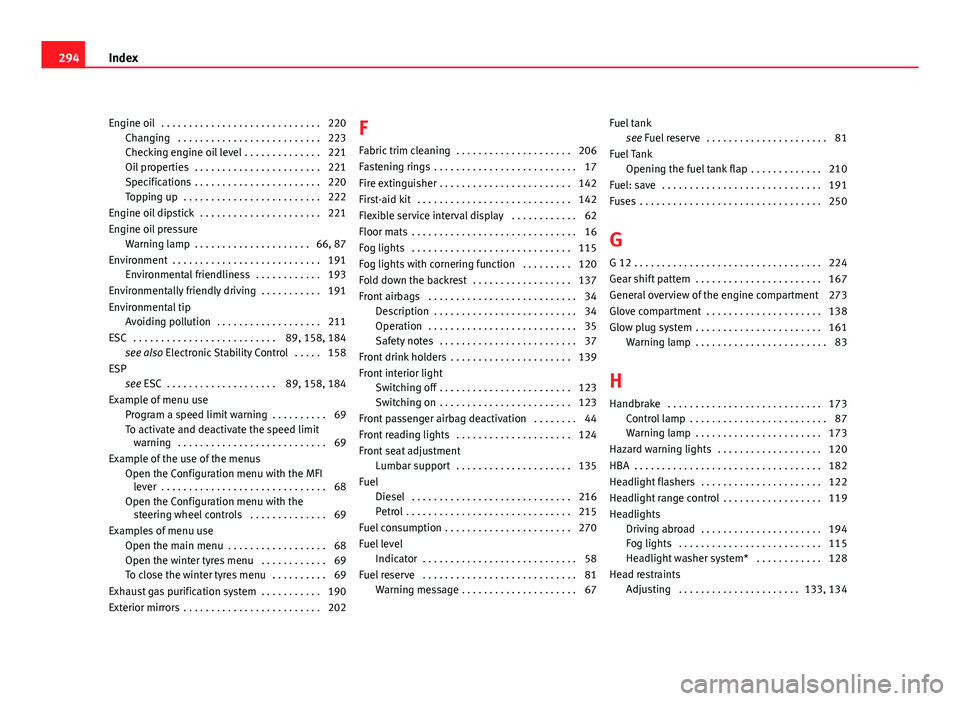
Engine oil . . . . . . . . . . . . . . . . . . . . . . . . . . . . . 220Changing . . . . . . . . . . . . . . . . . . . . . . . . . . 223
Checking engine oil level . . . . . . . . . . . . . . 221
Oil properties . . . . . . . . . . . . . . . . . . . . . . . 221
Specifications . . . . . . . . . . . . . . . . . . . . . . . 220
Topping up . . . . . . . . . . . . . . . . . . . . . . . . . 222
Engine oil dipstick . . . . . . . . . . . . . . . . . . . . . . 221
Engine oil pressure Warning lamp . . . . . . . . . . . . . . . . . . . . . 66, 87
Environment . . . . . . . . . . . . . . . . . . . . . . . . . . . 191 Environmental friendliness . . . . . . . . . . . . 193
Environmentally friendly driving . . . . . . . . . . . 191
Environmental tip Avoiding pollution . . . . . . . . . . . . . . . . . . . 211
ESC . . . . . . . . . . . . . . . . . . . . . . . . . . 89, 158, 184 see also Electronic Stability Control . . . . . 158
ESP see ESC . . . . . . . . . . . . . . . . . . . . 89, 158, 184
Example of menu use Program a speed limit warning . . . . . . . . . . 69
To activate and deactivate the speed limitwarning . . . . . . . . . . . . . . . . . . . . . . . . . . . 69
Example of the use of the menus Open the Configuration menu with the MFIlever . . . . . . . . . . . . . . . . . . . . . . . . . . . . . . 68
Open the Configuration menu with the steering wheel controls . . . . . . . . . . . . . . 69
Examples of menu use Open the main menu . . . . . . . . . . . . . . . . . . 68
Open the winter tyres menu . . . . . . . . . . . . 69
To close the winter tyres menu . . . . . . . . . . 69
Exhaust gas purification system . . . . . . . . . . . 190
Exterior mirrors . . . . . . . . . . . . . . . . . . . . . . . . . 202 F
Fabric trim cleaning . . . . . . . . . . . . . . . . . . . . . 206
Fastening rings . . . . . . . . . . . . . . . . . . . . . . . . . . 17
Fire extinguisher . . . . . . . . . . . . . . . . . . . . . . . . 142
First-aid kit . . . . . . . . . . . . . . . . . . . . . . . . . . . . 142
Flexible service interval display . . . . . . . . . . . . 62
Floor mats . . . . . . . . . . . . . . . . . . . . . . . . . . . . . . 16
Fog lights . . . . . . . . . . . . . . . . . . . . . . . . . . . . . 115
Fog lights with cornering function . . . . . . . . . 120
Fold down the backrest . . . . . . . . . . . . . . . . . . 137
Front airbags . . . . . . . . . . . . . . . . . . . . . . . . . . . 34 Description . . . . . . . . . . . . . . . . . . . . . . . . . . 34
Operation . . . . . . . . . . . . . . . . . . . . . . . . . . . 35
Safety notes . . . . . . . . . . . . . . . . . . . . . . . . . 37
Front drink holders . . . . . . . . . . . . . . . . . . . . . . 139
Front interior light Switching off . . . . . . . . . . . . . . . . . . . . . . . . 123
Switching on . . . . . . . . . . . . . . . . . . . . . . . . 123
Front passenger airbag deactivation . . . . . . . . 44
Front reading lights . . . . . . . . . . . . . . . . . . . . . 124
Front seat adjustment Lumbar support . . . . . . . . . . . . . . . . . . . . . 135
Fuel Diesel . . . . . . . . . . . . . . . . . . . . . . . . . . . . . 216
Petrol . . . . . . . . . . . . . . . . . . . . . . . . . . . . . . 215
Fuel consumption . . . . . . . . . . . . . . . . . . . . . . . 270
Fuel level Indicator . . . . . . . . . . . . . . . . . . . . . . . . . . . . 58
Fuel reserve . . . . . . . . . . . . . . . . . . . . . . . . . . . . 81 Warning message . . . . . . . . . . . . . . . . . . . . . 67 Fuel tank
see Fuel reserve . . . . . . . . . . . . . . . . . . . . . . 81
Fuel Tank Opening the fuel tank flap . . . . . . . . . . . . . 210
Fuel: save . . . . . . . . . . . . . . . . . . . . . . . . . . . . . 191
Fuses . . . . . . . . . . . . . . . . . . . . . . . . . . . . . . . . . 250
G
G 12 . . . . . . . . . . . . . . . . . . . . . . . . . . . . . . . . . . 224
Gear shift pattern . . . . . . . . . . . . . . . . . . . . . . . 167
General overview of the engine compartment 273
Glove compartment . . . . . . . . . . . . . . . . . . . . . 138
Glow plug system . . . . . . . . . . . . . . . . . . . . . . . 161 Warning lamp . . . . . . . . . . . . . . . . . . . . . . . . 83
H Handbrake . . . . . . . . . . . . . . . . . . . . . . . . . . . . 173 Control lamp . . . . . . . . . . . . . . . . . . . . . . . . . 87
Warning lamp . . . . . . . . . . . . . . . . . . . . . . . 173
Hazard warning lights . . . . . . . . . . . . . . . . . . . 120
HBA . . . . . . . . . . . . . . . . . . . . . . . . . . . . . . . . . . 182
Headlight flashers . . . . . . . . . . . . . . . . . . . . . . 122
Headlight range control . . . . . . . . . . . . . . . . . . 119
Headlights Driving abroad . . . . . . . . . . . . . . . . . . . . . . 194
Fog lights . . . . . . . . . . . . . . . . . . . . . . . . . . 115
Headlight washer system* . . . . . . . . . . . . 128
Head restraints Adjusting . . . . . . . . . . . . . . . . . . . . . . 133, 134
294 Index