brakes Seat Leon 5D 2011 Owner's Guide
[x] Cancel search | Manufacturer: SEAT, Model Year: 2011, Model line: Leon 5D, Model: Seat Leon 5D 2011Pages: 302, PDF Size: 4.17 MB
Page 232 of 302
230Checking and refilling levels
WARNING (Continued)
● Brake fluid should be stored in the closed original container in a safe
place out of reach of children. There is a toxic risk.
● Complete the brake fluid change according to the Maintenance Pro-
gramme. Heavy use of the brakes may cause a vapour lock if the brake
fluid is left in the system for too long. This would seriously affect the effi-
ciency of the brakes and the safety of the vehicle. This may cause an ac-
cident.
CAUTION
Brake fluid could damage the paintwork. Wipe off any brake fluid from the
paintwork immediately.
For the sake of the environment
The brake pads and fluid must be collected and disposed of according the
applicable regulations. The SEAT Technical Service network has the neces-
sary equipment and qualified personnel for collecting and disposing of this
waste material.
Vehicle battery Warnings on handling the battery
Wear eye protection
Battery acid is very corrosive and caustic. Wear protective
gloves and eye protection!
Fires, sparks, open flames and smoking are prohibited!
A highly explosive mixture of gases is released when the
battery is under charge.
Keep children away from acid and batteries!
WARNING
Always be aware of the danger of injury and chemical burns as well as
the risk of accident or fire when working on the battery and the electrical
system:
● Wear eye protection. Protect your eyes, skin and clothing from acid
and particles containing lead.
● Battery acid is very corrosive and caustic. Wear protective gloves and
eye protection. Do not tilt the batteries. This could spill acid through the
vents. Rinse battery acid from eyes immediately for several minutes with
clear water. Then seek medical care immediately. Neutralise any acid
splashes on the skin or clothing with a soapy solution, and rinse off with
plenty of water. If acid is swallowed by mistake, consult a doctor immedi-
ately.
● Fires, sparks, open flames and smoking are prohibited. When han-
dling cables and electrical equipment, avoid causing sparks and electro-
static charge. Never short the battery terminals. High-energy sparks can
cause injury.
● A highly explosive mixture of gases is released when the battery is
under charge. The batteries should be charged in a well-ventilated room
only.
● Keep children away from acid and batteries.
● Before working on the electrical system, you must switch off the en-
gine, the ignition and all consumers. The negative cable on the battery
must be disconnected. When a light bulb is changed, you need only
switch off the light.
Page 240 of 302
238Wheels and tyres
WARNING (Continued)
● Avoid driving over obstacles (for example kerbs) or potholes.
● If one or more tyres are being driven in emergency conditions, the
driving quality of the vehicle is impaired and there is a risk of accident.
Note
● The run-flat tyres do not “deflate” on losing pressure because they are
supported on the reinforced sides. Therefore defects in the tyre cannot be
detected with a visual inspection.
● Snow chains must not be used on front tyres used in emergency condi-
tions.
New tyres and wheels
New tyres and wheels have to be run in.
The tyres and wheel rims are an essential part of the vehicle's design. The
tyres and rims approved by SEAT are specially matched to the characteris-
tics of the vehicle and make a major contribution to good road holding and
safe handling ⇒
.
Tyres should be replaced at least in pairs and not individually (i.e. both front
tyres or both rear tyres together). A knowledge of tyre designations makes it
easier to choose the correct tyres. Radial tyres have the tyre designations
marked on the sidewall, for example: 195/65 R15 91T
This contains the following information: Tyre width in mm
Height/width ratio in %
Tyre construction: Radial
195
65
R Rim diameter in inches
Load rating code
Speed rating
The tyres could also have the following information:
● A direction of rotation symbol
● “Reinforced” denotes heavy-duty tyres.
The manufacturing date is also indicated on the tyre sidewall (possibly only
on the inner side of the wheel).
“DOT ... 1103...” means, for example, that the tyre was produced in the 11th
week of 2003.
We recommend that work on tyres and wheels be carried out by an Author-
ised Service Centre. They are familiar with the procedure and have the nec-
essary special tools and spare parts as well as the proper facilities for dis-
posing of the old tyres.
Any Authorised Service Centre has full information on the technical require-
ments when installing or changing tyres, wheels or wheel trims.WARNING
● We recommend that you use only wheels and tyres which have been
approved by SEAT for your model. Failure to do so could impair vehicle
handling. Risk of accident.
● Avoid running the vehicle on tyres that are more than 6 years old. If
you have no alternative, you should drive slowly and with extra care at all
times.
● Never use old tyres or those with an unknown history of use.
● If wheel trims are retrofitted, you must ensure that the flow of air to
the brakes is not restricted. This could cause them to overheat.
● All four wheels must be fitted with radial tyres of the same type, size
(rolling circumference) and the same tread pattern.
15
91
T
Page 244 of 302
242If and when
How to use the temporary spare wheel
Should you ever have a punctured tyre, the temporary spare wheel is only
intended for temporary use until you can reach a workshop. The standard-
size road wheel should be replaced as soon as possible.
Please note the following restrictions when using the temporary spare
wheel. This spare wheel has been specially designed for your vehicle, thus,
it cannot be changed with the spare wheel from another vehicle.
No other type of tyre (normal summer or winter tyre) may be fitted on the
compact temporary spare wheel rim.
Snow chains
For technical reasons, snow chains must not be used on the compact tem-
porary spare wheel.
If you have a puncture on one of the front wheels when using snow chains,
fit the compact temporary spare in place of one of the rear wheels. You can
then attach the snow chains to the wheel taken from the rear and use this
wheel to replace the punctured front wheel.
WARNING
● The tyre pressures must be checked and corrected as soon as possi-
ble. The emergency tyre pressure for dimensions 125/70R16 125/70R18
135/90R16 is 4.2 bar; for all other tyre dimensions please refer to the la-
bel on the fuel cap. Failure to do so could result in an accident.
● Do not drive faster than 80 km/h. Higher speeds can cause an acci-
dent.
● Avoid heavy acceleration, hard braking and fast cornering. Risk of ac-
cident.
● Never use two or more compact spare tyres at the same time, risk of
accident.
● No other type of tyre (normal summer or winter tyre) may be fitted on
the compact temporary spare wheel rim.
Note
● Vehicles with Brembo brakes must never use emergency wheels. These
vehicles are supplied with a tyre repair kit.
Tyre repair kit*
The tyre repair kit (for vehicles not including a spare wheel)
is stored under the floor panel in the luggage compartment. Your vehicle is equipped with the Tyre Mobility System “Tyre repair kit”.
The tyre repair kit consists of a container with sealing compound to repair
the puncture and a compressor to generate the required tyre pressure. The
kit will reliably seal punctures up to a size of about 4 mm caused by the
penetration of a foreign body into the tyre.
Note
● Seek professional assistance if the repair of a tyre puncture is not possi-
ble with the sealing compound.
Wheel change Preparation work
What you must do before changing a wheel.
– If you have a flat tyre or puncture, park the vehicle as far away
from the flow of traffic as possible. Choose a location that is as
level as possible.
Page 276 of 302
274Technical specifications
Petrol engine 1.4 63 kW (85 PS)
Engine specifications
Power output in kW (PS) rpm 63 (85)/ 5000
Maximum torque in Nm at rpm 132/ 3800
No. of cylinders/capacity in cm3
4/ 1390
Fuel Super 95 RON a)
/Normal 91 RON b)
a)
Research Octane Number = Anti-detonation rating of the petrol.
b) Slight power loss.
Performance Maximum speed in km/h 172
Acceleration from 0-80 km/h in sec. 9.2
Acceleration from 0-100 km/h in sec. 14.1
Weights
Gross vehicle weight in kg 1745
Weight in running order (with driver) in kg 1250
Gross front axle weight in kg 900
Gross rear axle weight in kg 895
Permitted roof load in kg 75
Trailer weight
Trailer without brakes in kg 620
Trailer with brakes, gradients up to 8% in kg 1200
Trailer with brakes, gradients up to 12% in kg 800
Engine oil filling capacity
Approximate engine oil capacity with oil filter change 2.8 litres
Page 277 of 302
275
Technical specifications
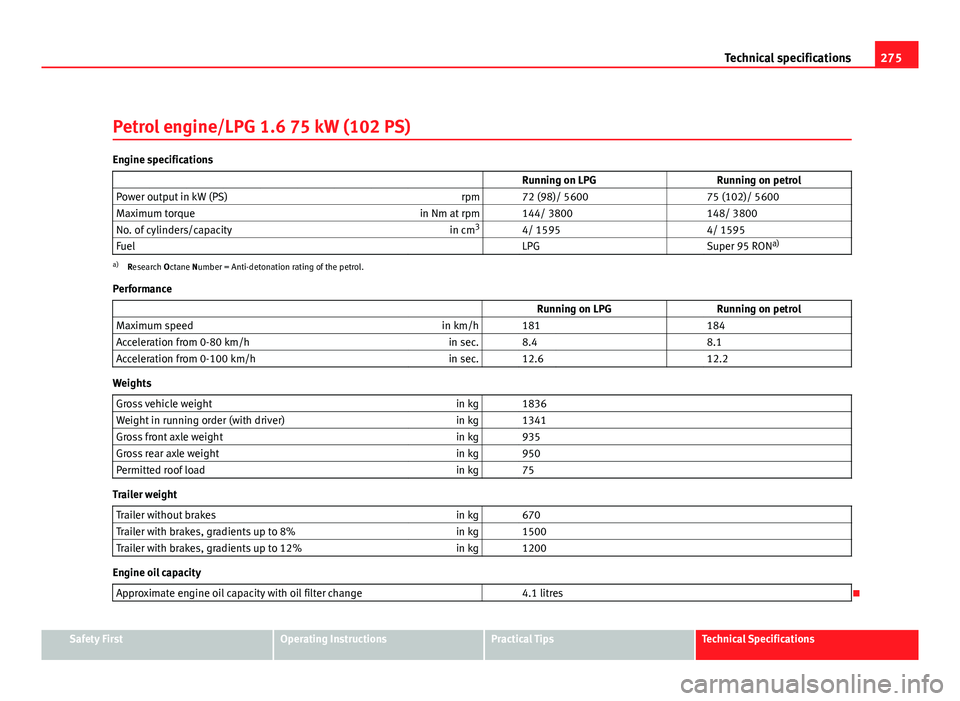
Petrol engine/LPG 1.6 75 kW (102 PS)
Engine specifications Running on LPG Running on petrol
Power output in kW (PS) rpm 72 (98)/ 5600 75 (102)/ 5600
Maximum torque in Nm at rpm 144/ 3800 148/ 3800
No. of cylinders/capacity in cm3
4/ 1595 4/ 1595
Fuel LPG Super 95 RONa)
a)
Research Octane Number = Anti-detonation rating of the petrol.
Performance Running on LPGRunning on petrol
Maximum speed in km/h 181 184
Acceleration from 0-80 km/h in sec. 8.4 8.1
Acceleration from 0-100 km/h in sec. 12.6 12.2
Weights
Gross vehicle weight in kg 1836
Weight in running order (with driver) in kg 1341
Gross front axle weight in kg 935
Gross rear axle weight in kg 950
Permitted roof load in kg 75
Trailer weight
Trailer without brakes in kg 670
Trailer with brakes, gradients up to 8% in kg 1500
Trailer with brakes, gradients up to 12% in kg 1200
Engine oil capacity
Approximate engine oil capacity with oil filter change 4.1 litres
Safety FirstOperating InstructionsPractical TipsTechnical Specifications
Page 278 of 302
276Technical specifications
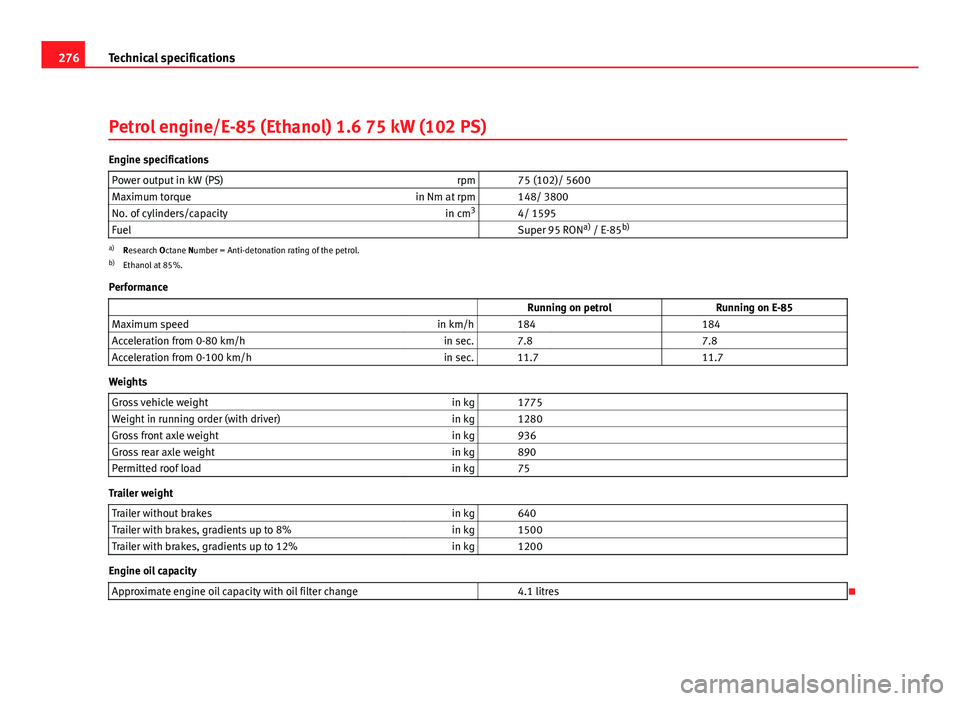
Petrol engine/E-85 (Ethanol) 1.6 75 kW (102 PS)
Engine specifications
Power output in kW (PS) rpm 75 (102)/ 5600
Maximum torque in Nm at rpm 148/ 3800
No. of cylinders/capacity in cm3
4/ 1595
Fuel Super 95 RONa)
/ E-85 b)
a)
Research Octane Number = Anti-detonation rating of the petrol.
b) Ethanol at 85%.
Performance Running on petrolRunning on E-85
Maximum speed in km/h 184 184
Acceleration from 0-80 km/h in sec. 7.8 7.8
Acceleration from 0-100 km/h in sec. 11.7 11.7
Weights
Gross vehicle weight in kg 1775
Weight in running order (with driver) in kg 1280
Gross front axle weight in kg 936
Gross rear axle weight in kg 890
Permitted roof load in kg 75
Trailer weight
Trailer without brakes in kg 640
Trailer with brakes, gradients up to 8% in kg 1500
Trailer with brakes, gradients up to 12% in kg 1200
Engine oil capacity
Approximate engine oil capacity with oil filter change 4.1 litres
Page 279 of 302

277
Technical specifications
Petrol engine 1.2 77 kW (105 PS)
Engine specifications Power output in kW (PS) rpm 77 (105)/5000
Maximum torque in Nm at rpm 175/1550-4100
No. of cylinders/capacity in cm3
4/ 1197
Fuel Super 95 RON a)
/Normal 91 RON b)
a)
Research Octane Number = Anti-detonation rating of the petrol.
b) With a slight power loss
Performance without Start-Stopwith Start-Stop
Maximum speed in km/h 187 187
Acceleration from 0-80 km/h in sec. 7.2 7.2
Acceleration from 0-100 km/h in sec. 10.9 10.9
Weights
without Start-Stop with Start-Stop
Gross vehicle weight in kg 1770 1775
Weight in running order (with driver) in kg 1275 1280
Gross front axle weight in kg 940 940
Gross rear axle weight in kg 890 890
Permitted roof load in kg 75 75
Trailer weight
without Start-Stopwith Start-Stop
Trailer without brakes in kg 630 640
Trailer with brakes, gradients up to 8% in kg 1500 1500
Trailer with brakes, gradients up to 12% in kg 1200 1200
Safety FirstOperating InstructionsPractical TipsTechnical Specifications
Page 280 of 302
278Technical specifications
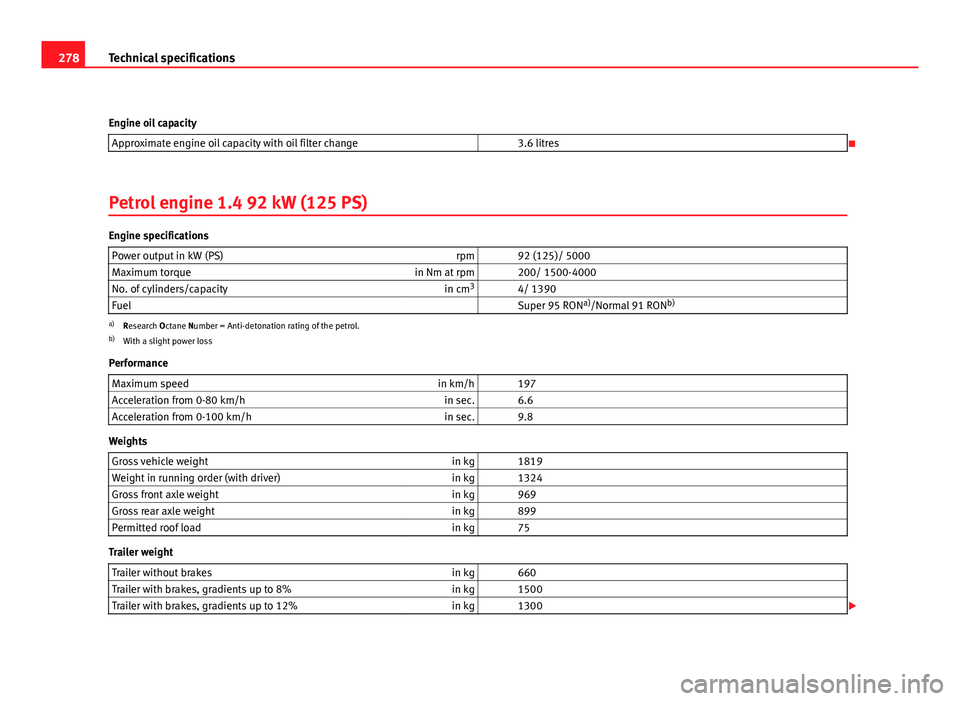
Engine oil capacity Approximate engine oil capacity with oil filter change 3.6 litres
Petrol engine 1.4 92 kW (125 PS)
Engine specifications Power output in kW (PS) rpm 92 (125)/ 5000
Maximum torque in Nm at rpm 200/ 1500-4000
No. of cylinders/capacity in cm3
4/ 1390
Fuel Super 95 RON a)
/Normal 91 RON b)
a)
Research Octane Number = Anti-detonation rating of the petrol.
b) With a slight power loss
Performance Maximum speed in km/h 197
Acceleration from 0-80 km/h in sec. 6.6
Acceleration from 0-100 km/h in sec. 9.8
Weights
Gross vehicle weight in kg 1819
Weight in running order (with driver) in kg 1324
Gross front axle weight in kg 969
Gross rear axle weight in kg 899
Permitted roof load in kg 75
Trailer weight
Trailer without brakes in kg 660
Trailer with brakes, gradients up to 8% in kg 1500
Trailer with brakes, gradients up to 12% in kg 1300
Page 282 of 302
280Technical specifications
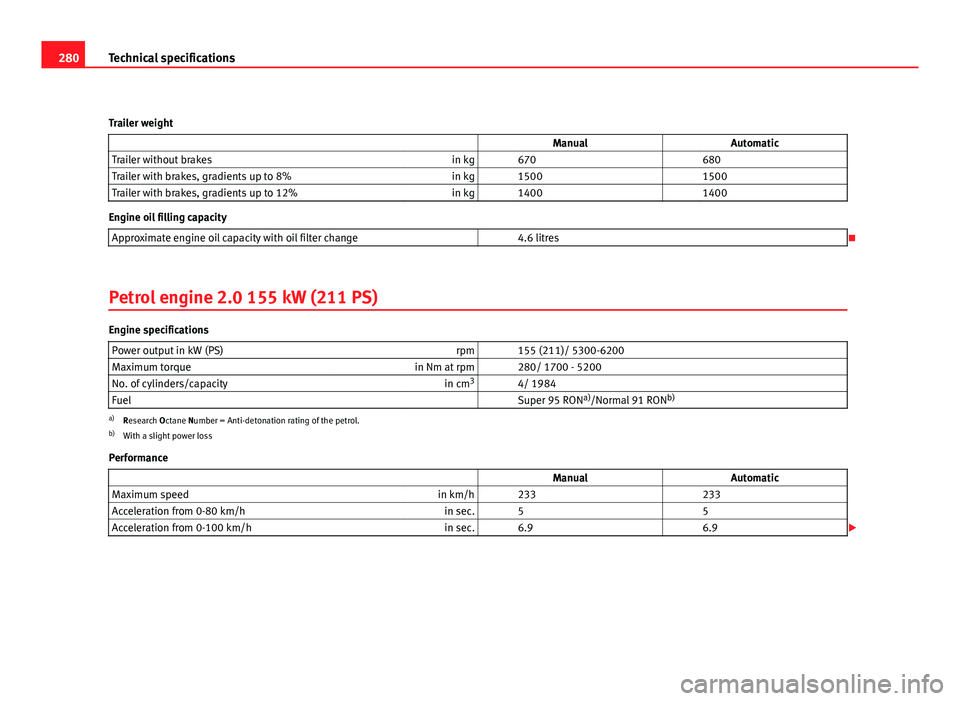
Trailer weight ManualAutomatic
Trailer without brakes in kg 670 680
Trailer with brakes, gradients up to 8% in kg 1500 1500
Trailer with brakes, gradients up to 12% in kg 1400 1400
Engine oil filling capacity
Approximate engine oil capacity with oil filter change 4.6 litres
Petrol engine 2.0 155 kW (211 PS)
Engine specifications Power output in kW (PS) rpm 155 (211)/ 5300-6200
Maximum torque in Nm at rpm 280/ 1700 - 5200
No. of cylinders/capacity in cm3
4/ 1984
Fuel Super 95 RON a)
/Normal 91 RON b)
a)
Research Octane Number = Anti-detonation rating of the petrol.
b) With a slight power loss
Performance ManualAutomatic
Maximum speed in km/h 233 233
Acceleration from 0-80 km/h in sec. 5 5
Acceleration from 0-100 km/h in sec. 6.9 6.9
Page 283 of 302

281
Technical specifications
Weights Manual Automatic
Gross vehicle weight in kg 1890 1920
Weight in running order (with driver) in kg 1395 1425
Gross front axle weight in kg 1045 1075
Gross rear axle weight in kg 900 900
Permitted roof load in kg 75 75
Trailer weight
ManualAutomatic
Trailer without brakes in kg 690 710
Trailer with brakes, gradients up to 8% in kg 1500 1500
Trailer with brakes, gradients up to 12% in kg 1400 1400
Engine oil capacity
Approximate engine oil capacity with oil filter change 4.6 litres
Petrol engine 2.0 195 kW (265 PS) Cupra R
Engine specifications Power output in kW (PS) rpm 195 (265)/ 6000
Maximum torque in Nm at rpm 350/ 2500-5000
No. of cylinders/capacity in cm3
4/ 1984
Fuel Super 98 RON a)
/Super 95 RON b)
a)
Research Octane Number = Anti-detonation rating of the petrol.
b) With a slight power loss
Safety FirstOperating InstructionsPractical TipsTechnical Specifications