door lock Seat Leon 5D 2011 Owner's Guide
[x] Cancel search | Manufacturer: SEAT, Model Year: 2011, Model line: Leon 5D, Model: Seat Leon 5D 2011Pages: 302, PDF Size: 4.17 MB
Page 114 of 302

112Unlocking and locking
WARNING
● Incorrect use of the electric windows can result in injury.
● Always take the key with you when leaving the vehicle, even if you
only intend to be gone for a short time. Please ensure that children are
never left alone inside the vehicle.
● The electric windows will work until the key has been removed from
the ignition and one of the front doors has been opened.
● Never close the tailgate without observing and ensuring it is clear, to
do otherwise could cause serious injury to you and third parties. Make
sure that no one is in the path of a window.
● Never allow people to remain in the vehicle when you close the vehi-
cle from the outside. The windows cannot be opened even in an emergen-
cy.
Note
The roll-back function is deactivated if the windows are closed from the out-
side of the vehicle using the ignition key for convenience closing
⇒ page 112.
Convenience opening and closing*
Using the door lock
– Hold the key in the door lock of the driver door in either the
locking or the unlocking position until all windows are either
opened or closed.
– Release the key to interrupt this function. Using the remote control
–
Push the lock button on the remote control for about 3 seconds.
All windows which function electrically will be either opened or
closed.
– Press the unlock button to interrupt the function.
– Once the windows are completely closed, the turn signals will
flash.
Sliding/tilting sunroof* Opening and closing the sliding/tilting roof
The sliding/tilting sunroof is opened and closed using the
rotary knob when the ignition is switched on.
Fig. 68 Roof lining de-
scription: sliding/tilting
sunroof rotary knob
Page 115 of 302
113
Unlocking and locking
Closing the sliding/tilting sunroof
– Turn the rotary button to position A
⇒ fig. 68 ⇒ .
Opening the sliding/tilting sunroof
– Turn the rotary button to position B
. The sunroof opens to the
convenience position where wind noise is reduced.
– To open the roof further, turn the switch to position C
and hold
the switch in this position until the roof opens to the desired
position.
Tilting the sliding/tilting sunroof
– Turn the rotary button to position D
.
Always close the sliding/tilting sunroof fully if you park the vehicle or leave
it unattended ⇒
.
The sliding/tilting sunroof can be operated for up to about 10 minutes after
the ignition has been switched off, provided the driver door and the front
passenger door are not opened.
Sun visor
The sun visor is opened together with the sliding/tilting sunroof. If required,
it can be closed by hand when the sunroof is closed.
WARNING
● Incorrect use of the sliding/tilting sunroof can result in injury.
● Never close the sliding/tilting sunroof without checking there are no
obstructions, to do otherwise could cause serious injury to you and oth-
ers. Make sure that no one is in the path of the sliding/tilting sunroof.
● Always take the vehicle key with you when you leave the vehicle.
WARNING (Continued)
● Never leave children or disabled persons in the vehicle, particularly if
they have access to the keys. Unsupervised use of a key could mean that
the engine is started or that electrical equipment is used (e.g. electric
sliding/tilting sunroof). Risk of accident! The doors can be locked using
the remote control key. This could make the aid difficult in an emergency
situation.
● The sliding/tilting sunroof continues to function until one of the front
doors is opened and the key removed from the ignition.
Convenience closing*
Using the door lock
– Hold the key in the door lock of the driver door in the locking
position until the sliding/tilting sunroof is closed.
– Release the key to interrupt this function.
Using the remote control
– Push the lock button on the remote control for about 3 seconds.
The sliding/tilting sunroof is closed.
– Release the unlock button to interrupt the function.
– When the sliding/tilting sunroof has closed completely, the turn
signals flash once.
Note
The sliding/tilting sunroof rotary knob remains in the last position selected
if the roof is closed using convenience closing from outside the vehicle and
will have to be re-positioned the next time you drive.
Safety FirstOperating InstructionsPractical TipsTechnical Specifications
Page 117 of 302
115
Lights and visibility
Lights and visibility
Lights Switching lights on and off
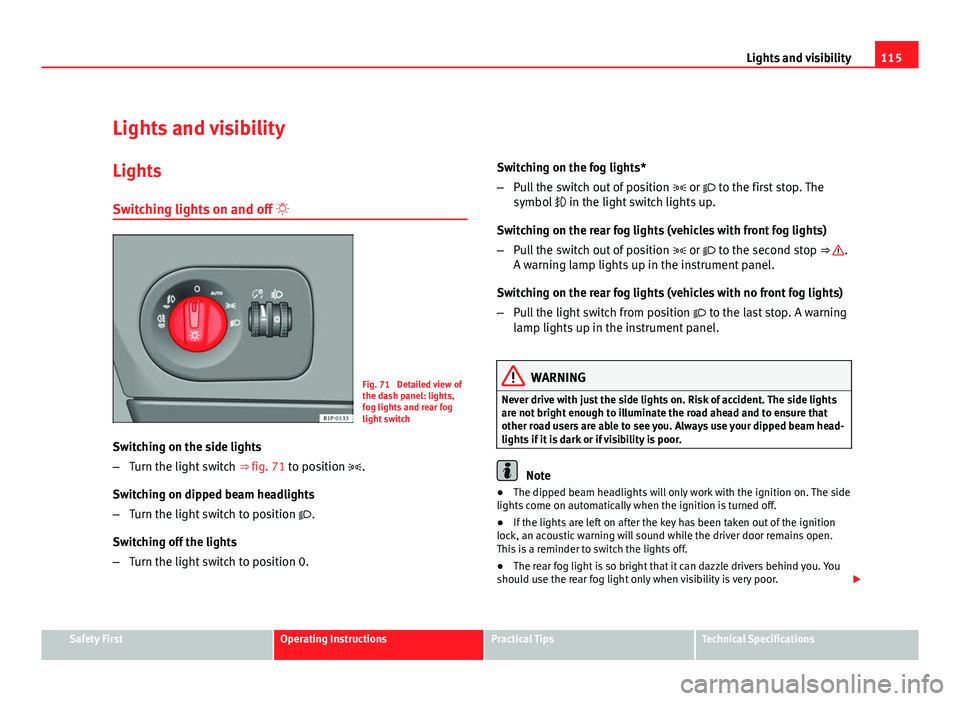
Fig. 71 Detailed view of
the dash panel: lights,
fog lights and rear fog
light switch
Switching on the side lights
– Turn the light switch ⇒ fig. 71 to position .
Switching on dipped beam headlights
– Turn the light switch to position .
Switching off the lights
– Turn the light switch to position 0. Switching on the fog lights*
–
Pull the switch out of position or to the first stop. The
symbol in the light switch lights up.
Switching on the rear fog lights (vehicles with front fog lights)
– Pull the switch out of position or to the second stop ⇒
.
A warning lamp lights up in the instrument panel.
Switching on the rear fog lights (vehicles with no front fog lights)
– Pull the light switch from position to the last stop. A warning
lamp lights up in the instrument panel.
WARNING
Never drive with just the side lights on. Risk of accident. The side lights
are not bright enough to illuminate the road ahead and to ensure that
other road users are able to see you. Always use your dipped beam head-
lights if it is dark or if visibility is poor.
Note
● The dipped beam headlights will only work with the ignition on. The side
lights come on automatically when the ignition is turned off.
● If the lights are left on after the key has been taken out of the ignition
lock, an acoustic warning will sound while the driver door remains open.
This is a reminder to switch the lights off.
● The rear fog light is so bright that it can dazzle drivers behind you. You
should use the rear fog light only when visibility is very poor.
Safety FirstOperating InstructionsPractical TipsTechnical Specifications
Page 120 of 302
118Lights and visibility
Note
Please observe any relevant legal requirements which may apply in your
country.
Coming/leaving home function*
The Coming Home function is controlled manually. The Leav-
ing Home function is controlled with a photosensor.
If the Coming Home or Leaving Home function is connected, the front side
and dipped lights, the tail lights and the number plate light will light up to
provide assistance.
Coming home function
The Coming Home function is activated by switching off the ignition and
briefly flashing the lights. When the driver door is opened, the Coming
Home lighting comes on. If the driver door is already open when the lights
are flashed briefly, the Coming Home lighting comes on immediately.
When the last door of the vehicle or the tailgate is closed, the Coming Home
function starts and the switching off the headlights is delayed.
The Coming Home lighting switches off in the following cases:
● On completion of the time period established for the delay in switching
off the lights after all the vehicle doors and the tailgate have been closed.
● If, 30 seconds after being connected, any doors or the tailgate remain
open.
● If the light switch is turned to position .
● If the ignition is switched on.
Leaving home function
The Leaving Home function is activated when the vehicle is unlocked if: ●
the light control is in position and
● the photosensor detects “darkness”.
The Leaving Home lighting switches off in the following cases:
● If the time period for the delay in switching off the headlights has ended
● If the vehicle is locked again.
● If the light switch is turned to position .
● If the ignition is switched on.
Note
The setting for the delay in switching off the headlights in the Coming Home
and Leaving Home function can be changed or the function can be connec-
ted or disconnected in the menu Lights and visibility ⇒ page 76.
● If the ignition key is removed while the lights are on, and the lights are
flashed briefly and the driver door opened, no acoustic signal is heard, as
when the Coming Home function is on, the lights are automatically switched
off after a period of time (except when the light switch is in position or
.
Page 125 of 302
123
Lights and visibility
● The headlight flasher comes on for as long as you pull the lever – even if
no other lights are switched on. The warning lamp then comes on in the
instrument panel.
● When the parking lights are switched on, the headlight and the tail light
on the corresponding side of the vehicle light up. The parking lights will on-
ly work if the key is removed from the ignition. If the lights are switched on,
an acoustic signal will be emitted while the driver door is open.
● If the turn signal lever is left on after the key has been taken out of the
ignition lock, an acoustic signal sounds when the driver door is opened.
This is a reminder to switch off the turn signal, unless of course you wish to
leave the parking light on.
Interior lights
Front interior light
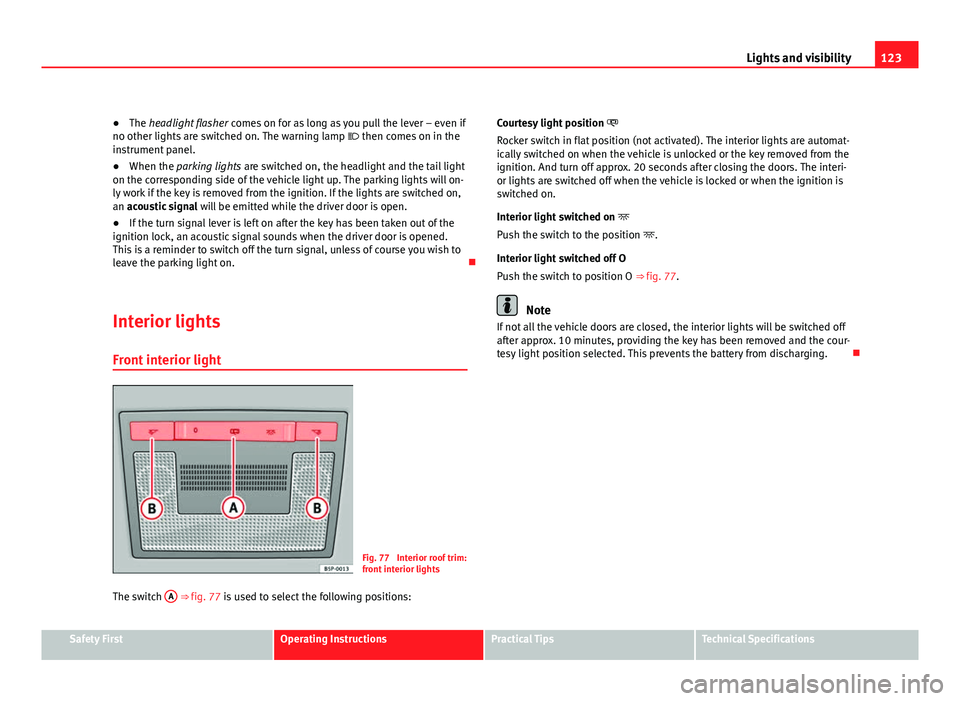
Fig. 77 Interior roof trim:
front interior lights
The switch A
⇒ fig. 77 is used to select the following positions: Courtesy light position
Rocker switch in flat position (not activated). The interior lights are automat-
ically switched on when the vehicle is unlocked or the key removed from the
ignition. And turn off approx. 20 seconds after closing the doors. The interi-
or lights are switched off when the vehicle is locked or when the ignition is
switched on.
Interior light switched on
Push the switch to the position .
Interior light switched off O
Push the switch to position O ⇒ fig. 77.
Note
If not all the vehicle doors are closed, the interior lights will be switched off
after approx. 10 minutes, providing the key has been removed and the cour-
tesy light position selected. This prevents the battery from discharging.
Safety FirstOperating InstructionsPractical TipsTechnical Specifications
Page 126 of 302
124Lights and visibility
Front reading lights
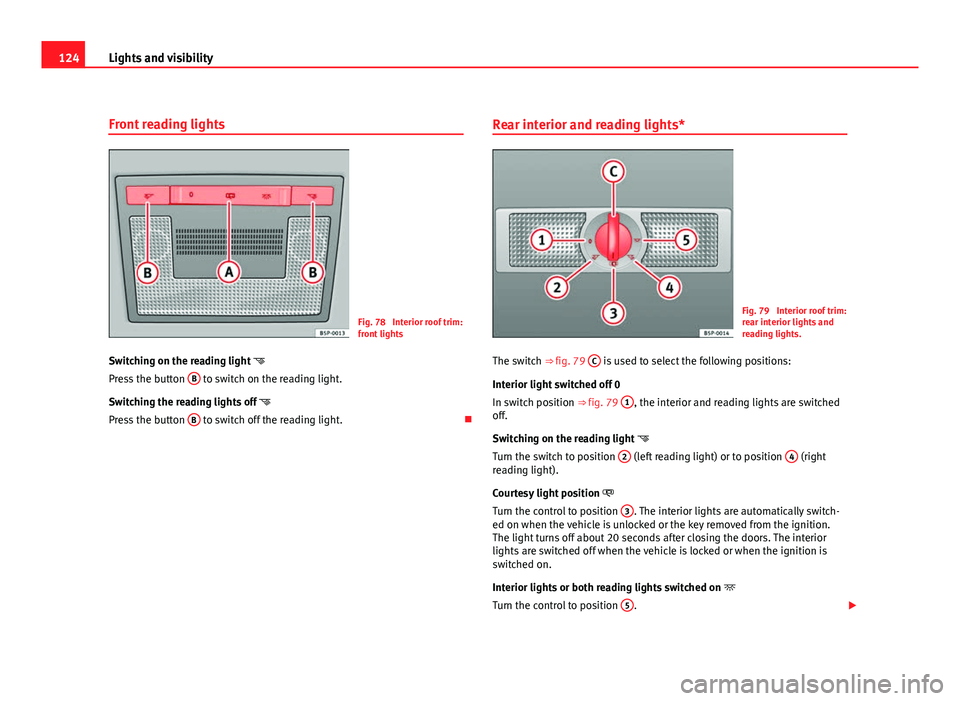
Fig. 78 Interior roof trim:
front lights
Switching on the reading light
Press the button B
to switch on the reading light.
Switching the reading lights off
Press the button B
to switch off the reading light. Rear interior and reading lights*
Fig. 79 Interior roof trim:
rear interior lights and
reading lights.
The switch ⇒ fig. 79 C
is used to select the following positions:
Interior light switched off 0
In switch position ⇒ fig. 79 1
, the interior and reading lights are switched
off.
Switching on the reading light
Turn the switch to position 2
(left reading light) or to position 4 (right
reading light).
Courtesy light position
Turn the control to position 3
. The interior lights are automatically switch-
ed on when the vehicle is unlocked or the key removed from the ignition.
The light turns off about 20 seconds after closing the doors. The interior
lights are switched off when the vehicle is locked or when the ignition is
switched on.
Interior lights or both reading lights switched on
Turn the control to position 5
.
Page 176 of 302
174Driving
–Select first gear.
– Switch the engine off and remove the key from the ignition. Turn
the steering wheel slightly to engage the steering lock.
– Always take you car keys with you when you leave the vehicle
⇒
.
Additional notes on parking the vehicle on gradients:
Turn the steering wheel so that the vehicle rolls against the kerb if it started
to roll.
● If the vehicle is parked facing downhill, turn the front wheels so that
they point towards the kerb .
● If the vehicle is parked facing uphill, turn the front wheels so that they
point away from the kerb .
● Secure the vehicle as normal by applying the handbrake firmly and se-
lecting first gear.
WARNING
● Take measures to reduce the risk of injury when you leave your vehi-
cle unattended.
● Never park where the hot exhaust system could ignite inflammable
materials, such as dry grass, low bushes, spilt fuel etc.
● Never allow vehicle occupants to remain in the vehicle when it is
locked. They would be unable to open the vehicle from the inside, and
could become trapped in the vehicle in an emergency. In the event of an
emergency, locked doors will delay assistance to occupants.
● Never leave children alone in the vehicle. They could set the vehicle
in motion, for example, by releasing the handbrake or the gear lever.
● Depending on weather conditions, it may become extremely hot or
cold inside the vehicle. This can be fatal.
Hill-start aid*
This function is only included in vehicles with ESC (ESP).
This device helps when starting uphill.
These are the basic operation conditions: doors closed, brake pedal press-
ed down and vehicle in neutral. The system gets activated on engaging
gear.
This system also works when reversing uphill.
After removing your foot from the brake pedal, the braking force is main-
tained for a few seconds to prevent the vehicle from moving backward when
putting into gear. This short space of time is enough to start the vehicle
with ease.
This system also works when reversing uphill.
WARNING
● If you do not start the vehicle immediately after taking your foot off
the brake pedal, the vehicle may start to roll back under certain condi-
tions. Depress the brake pedal or use the hand brake immediately.
● If the engine stalls, depress the brake pedal or use the hand brake
immediately.
● When following a line of traffic uphill, if you want to prevent the vehi-
cle from rolling back accidentally when starting off, hold the brake pedal
down for a few seconds before starting off.
Note
The Official Service or a specialist workshop can tell you if your vehicle is
equipped with this system.
Page 203 of 302
201
Vehicle maintenance and cleaning
WARNING
● Wash your vehicle with the ignition switched off.
● Protect your hands and arms from cuts on sharp metal edges when
cleaning the underbody, the inside of the wheel housings etc. Risk of in-
jury.
● Water, ice and salt on the brakes can reduce braking efficiency. Risk
of accident.
CAUTION
● Never remove dirt, mud or dust if the vehicle surface is dry. Never use a
dry cloth or sponge for cleaning purposes. This could scratch the paintwork
or glass on your vehicle.
● Washing the vehicle in low temperatures: when washing the vehicle
with a hose, do not direct water into the lock cylinders or the gaps around
the doors, tailgate, or sunroof. Risk of freezing.
For the sake of the environment
To protect environment, the vehicle should be washed only in specially pro-
vided wash bays. This prevents toxic, oil-laden waste water entering the
sewerage system. In some places, washing vehicles outside wash bays is
prohibited.
Note
Do not wash the vehicle in direct sunlight. Washing the vehicle with a high pressure cleaner
Be particularly careful when using a high pressure cleaner!
– Always observe the instructions for the high-pressure cleaner,
particularly those concerning the pressure and the spraying
distance.
– Increase the spraying distance for soft materials and painted
bumpers.
– Do not use a high pressure cleaner to remove ice or snow from
windows ⇒ page 202.
– Never use concentrated jet nozzles (“rotating jets”) ⇒
.
– After washing, avoid sudden and sharp braking. “Dry” the
brakes by braking several times ⇒ page 189.
WARNING
● Never wash tyres with a concentrated jet (“rotating nozzle”). Even at
large spraying distances and short cleaning times, visible and invisible
damage can occur to the tyres. This may cause an accident.
● Water, ice and salt on the brakes can reduce braking efficiency. Risk
of accident.
CAUTION
● Do not use water hotter than 60°C. This could damage the vehicle.
● To avoid damage to the vehicle, keep a sufficient distance from sensitive
materials such as flexible hoses, plastic, soundproofing material, etc. This
is also important for bumpers painted in the colour of the bodywork. The
closer the nozzle is to the surface, the greater the wear on the material.
Safety FirstOperating InstructionsPractical TipsTechnical Specifications
Page 205 of 302
203
Vehicle maintenance and cleaning
If possible, use a de-icing spray to remove ice. If you use an ice scraper,
push it in one direction only without swinging it.
Use window cleaner or a silicone remover to clean rubber, oil, grease and
silicone deposits off.
Wax deposits can be removed with a special cleaner available in your Au-
thorised Service Centre. Wax deposits on the windscreen could cause the
wiper blades to judder. Adding a window cleaner that dissolves wax to the
windscreen washer fluid prevents wiper blades from juddering, but wax de-
posits are not removed.
CAUTION
● Never use warm or hot water to remove snow and ice from windows and
mirrors. This could cause the glass to crack!
● The heating element for the rear window is located on the inner side of
the window. To prevent damage, do not put stickers on the heating ele-
ments inside the window.
Cleaning windscreen wiper blades
Clean wiper blades improve visibility.
1. Use a soft cloth to remove dust and dirt from the windscreen wiper blades.
2. Use window cleaner to clean the windscreen wiper blades. Use a sponge or a cloth to remove stubborn dirt. Rubber seals maintenance
If rubber seals are well looked after, they will not freeze so
quickly.
1. Use a soft cloth to remove dust and dirt from the rubber seals.
2. Apply a specialist care product to the rubber seals.
The rubber strips on the doors, windows, bonnet and tailgate will remain
pliable and last longer if they are treated with a suitable care product (for
example silicone spray).
Caring for rubber seals will also prevent premature ageing and leaks. The
doors will be easier to open. If rubber seals are well looked after, they will
not freeze so quickly in winter.
Door lock cylinders
The door lock cylinders can freeze up in winter.
To de-ice the lock cylinders you should only use spray with lubricating and
anti-corrosive properties.
Cleaning chrome parts
1. Clean chrome parts with a damp cloth.
2. Polish chrome parts with a soft, dry cloth. If this does not provide satisfying results, use a specialist chrome cleaning
product. Chrome cleaning products will remove stains from the surface.
Safety FirstOperating InstructionsPractical TipsTechnical Specifications
Page 295 of 302
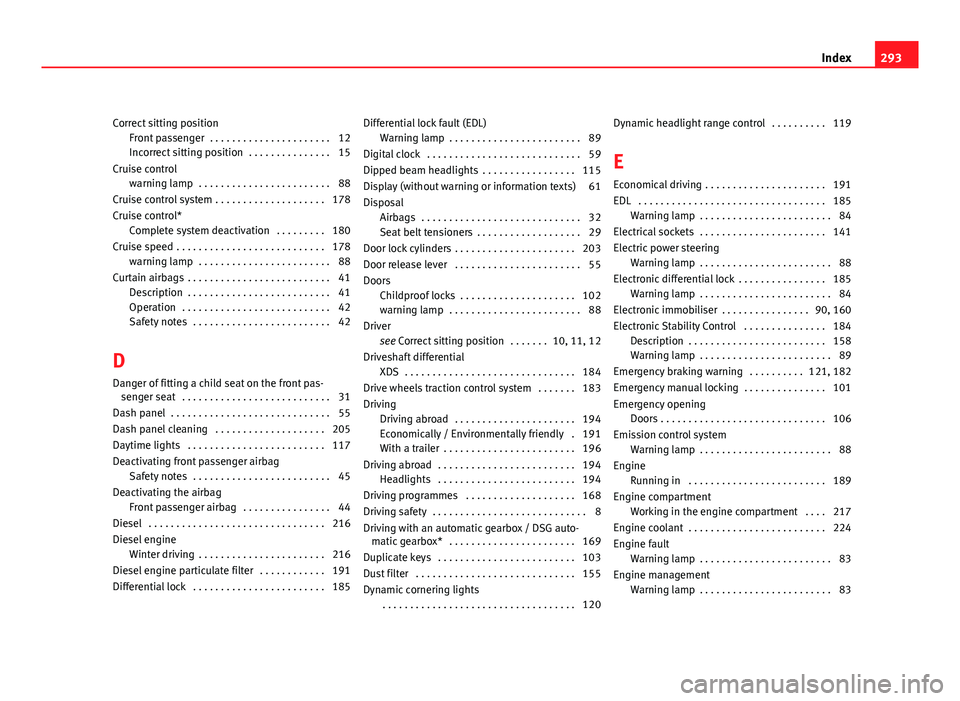
Correct sitting positionFront passenger . . . . . . . . . . . . . . . . . . . . . . 12
Incorrect sitting position . . . . . . . . . . . . . . . 15
Cruise control warning lamp . . . . . . . . . . . . . . . . . . . . . . . . 88
Cruise control system . . . . . . . . . . . . . . . . . . . . 178
Cruise control* Complete system deactivation . . . . . . . . . 180
Cruise speed . . . . . . . . . . . . . . . . . . . . . . . . . . . 178 warning lamp . . . . . . . . . . . . . . . . . . . . . . . . 88
Curtain airbags . . . . . . . . . . . . . . . . . . . . . . . . . . 41 Description . . . . . . . . . . . . . . . . . . . . . . . . . . 41
Operation . . . . . . . . . . . . . . . . . . . . . . . . . . . 42
Safety notes . . . . . . . . . . . . . . . . . . . . . . . . . 42
D Danger of fitting a child seat on the front pas- senger seat . . . . . . . . . . . . . . . . . . . . . . . . . . . 31
Dash panel . . . . . . . . . . . . . . . . . . . . . . . . . . . . . 55
Dash panel cleaning . . . . . . . . . . . . . . . . . . . . 205
Daytime lights . . . . . . . . . . . . . . . . . . . . . . . . . 117
Deactivating front passenger airbag Safety notes . . . . . . . . . . . . . . . . . . . . . . . . . 45
Deactivating the airbag Front passenger airbag . . . . . . . . . . . . . . . . 44
Diesel . . . . . . . . . . . . . . . . . . . . . . . . . . . . . . . . 216
Diesel engine Winter driving . . . . . . . . . . . . . . . . . . . . . . . 216
Diesel engine particulate filter . . . . . . . . . . . . 191
Differential lock . . . . . . . . . . . . . . . . . . . . . . . . 185 Differential lock fault (EDL)
Warning lamp . . . . . . . . . . . . . . . . . . . . . . . . 89
Digital clock . . . . . . . . . . . . . . . . . . . . . . . . . . . . 59
Dipped beam headlights . . . . . . . . . . . . . . . . . 115
Display (without warning or information texts) 61
Disposal Airbags . . . . . . . . . . . . . . . . . . . . . . . . . . . . . 32
Seat belt tensioners . . . . . . . . . . . . . . . . . . . 29
Door lock cylinders . . . . . . . . . . . . . . . . . . . . . . 203
Door release lever . . . . . . . . . . . . . . . . . . . . . . . 55
Doors Childproof locks . . . . . . . . . . . . . . . . . . . . . 102
warning lamp . . . . . . . . . . . . . . . . . . . . . . . . 88
Driver see Correct sitting position . . . . . . . 10, 11, 12
Driveshaft differential XDS . . . . . . . . . . . . . . . . . . . . . . . . . . . . . . . 184
Drive wheels traction control system . . . . . . . 183
Driving Driving abroad . . . . . . . . . . . . . . . . . . . . . . 194
Economically / Environmentally friendly . 191
With a trailer . . . . . . . . . . . . . . . . . . . . . . . . 196
Driving abroad . . . . . . . . . . . . . . . . . . . . . . . . . 194 Headlights . . . . . . . . . . . . . . . . . . . . . . . . . 194
Driving programmes . . . . . . . . . . . . . . . . . . . . 168
Driving safety . . . . . . . . . . . . . . . . . . . . . . . . . . . . 8
Driving with an automatic gearbox / DSG auto- matic gearbox* . . . . . . . . . . . . . . . . . . . . . . . 169
Duplicate keys . . . . . . . . . . . . . . . . . . . . . . . . . 103
Dust filter . . . . . . . . . . . . . . . . . . . . . . . . . . . . . 155
Dynamic cornering lights . . . . . . . . . . . . . . . . . . . . . . . . . . . . . . . . . . . 120Dynamic headlight range control . . . . . . . . . . 119
E
Economical driving . . . . . . . . . . . . . . . . . . . . . . 191
EDL . . . . . . . . . . . . . . . . . . . . . . . . . . . . . . . . . . 185 Warning lamp . . . . . . . . . . . . . . . . . . . . . . . . 84
Electrical sockets . . . . . . . . . . . . . . . . . . . . . . . 141
Electric power steering Warning lamp . . . . . . . . . . . . . . . . . . . . . . . . 88
Electronic differential lock . . . . . . . . . . . . . . . . 185 Warning lamp . . . . . . . . . . . . . . . . . . . . . . . . 84
Electronic immobiliser . . . . . . . . . . . . . . . . 90, 160
Electronic Stability Control . . . . . . . . . . . . . . . 184 Description . . . . . . . . . . . . . . . . . . . . . . . . . 158
Warning lamp . . . . . . . . . . . . . . . . . . . . . . . . 89
Emergency braking warning . . . . . . . . . . 121, 182
Emergency manual locking . . . . . . . . . . . . . . . 101
Emergency opening Doors . . . . . . . . . . . . . . . . . . . . . . . . . . . . . . 106
Emission control system Warning lamp . . . . . . . . . . . . . . . . . . . . . . . . 88
Engine Running in . . . . . . . . . . . . . . . . . . . . . . . . . 189
Engine compartment Working in the engine compartment . . . . 217
Engine coolant . . . . . . . . . . . . . . . . . . . . . . . . . 224
Engine fault Warning lamp . . . . . . . . . . . . . . . . . . . . . . . . 83
Engine management Warning lamp . . . . . . . . . . . . . . . . . . . . . . . . 83
293
Index