ECU Seat Leon 5D 2011 Owner's Guide
[x] Cancel search | Manufacturer: SEAT, Model Year: 2011, Model line: Leon 5D, Model: Seat Leon 5D 2011Pages: 302, PDF Size: 4.17 MB
Page 222 of 302
220Checking and refilling levels
WARNING
If the bonnet is not closed properly, it could open while you are driving
and completely obscure your view of the road. Risk of accident.
● After closing the bonnet, always check that it is properly secured. The
bonnet must be flush with the surrounding body panels.
● If you notice that the bonnet latch is not secured when the vehicle is
moving, stop the vehicle immediately and close the bonnet properly.
Risk of accident.
Engine oil General notes
The engine comes with a special, high quality, multi grade oil that can be
used in all seasons of the year except for those regions affected by extreme
cold.
As the use of good quality oil is necessary for the correct operation and long
service life of the engine, when it becomes necessary to replenish or
change the oil, always use an oil that complies to the VW standards.
The specifications (VW standards) set out in the following page should ap-
pear on the container of the service oil; when the container displays the
specific standards for petrol and diesel engines together, it means that the
oil can be used for both types of engines.
We recommend that the oil change, indicated in the Maintenance Pro-
gramme, be performed by an Authorised Service Centre or a specialised
workshop.
The correct oil specifications for your engine are listed in ⇒ page 221, Oil
properties. Service intervals
Service intervals can be flexible (LongLife service) or fixed (dependent on
time/distance travelled).
If the PR code that appears on the back of the Maintenance Programme
booklet is QG1, this means that your vehicle has the LongLife service pro-
grammed. If it has the codes QG0 or QG2 the interval service is dependent
on time/distance travelled.
Flexible service intervals (LongLife*)
Special oils and processes have been developed which, depending on the
characteristics and individual driving profiles, allow to extend the oil
change service (LongLife service intervals).
Because this oil is essential for extending the service intervals, it
must only
be used observing the following indications:
● Avoid mixing it with oil for fixed service intervals.
● Only in exceptional circumstances, if the engine oil level is too low
⇒ page 221 and LongLife oil is not available, it is permitted to top up
(once) with oil for fixed service intervals ⇒ page 221 (up to a maximum of
0.5 litres).
Fixed service intervals*
If your vehicle does not have the “LongLife service interval” or it has been
disabled (by request), you may use oils for fixed service intervals, which al-
so appear in ⇒ page 221, Oil properties. In this case, your vehicle must be
serviced after a fixed interval of 1 year / 15 000 km (whatever comes first)
⇒ Booklet Maintenance Programme.
● In exceptional circumstances, if the engine oil level is too low
⇒ page 221 and you cannot obtain the oil specified for your vehicle, you
can put in a small quantity of oil conforming to the specification ACEA A2 or
ACEA A3 (petrol engines) or ACEA B3 or ACEA B4 (diesel engines) (up to 0.5
l).
Page 241 of 302
239
Wheels and tyres
For the sake of the environment
Old tyres must be disposed of according to the laws in the country con-
cerned.
Note
● For technical reasons, it is not generally possible to use the wheels from
other vehicles. This can also apply to wheels of the same model. The use of
wheels or tyres which have not been approved by SEAT for use with your
model may invalidate the vehicle's type approval for use on public roads.
● If the spare tyre is not the same as the tyres that are mounted on the
vehicle (e.g. winter tyres) you should only use the spare tyre for a short peri-
od of time and drive with extra care. Refit the normal road wheel as soon as
possible.
Wheel bolts
Wheel bolts must be tightened to the correct torque.
The design of wheel bolts is matched to the rims. If different wheel rims are
fitted, the correct wheel bolts with the right length and correctly shaped
bolt heads must be used. This ensures that wheels are fitted securely and
that the brake system functions correctly.
In certain circumstances, you should not use wheel bolts from a different
vehicle, even if it is the same model ⇒ page 208.
After the wheels have been changed, the tightening torque of the wheel
bolts should be checked as soon as possible with a torque wrench. ⇒
The tightening torque for steel and alloy wheels is 120 Nm.
WARNING
If the wheel bolts are not tightened correctly, the wheel could become
loose while driving. Risk of accident.
● The wheel bolts must be clean and turn easily. Never apply grease or
oil to them.
● Use only wheel bolts which belong to the wheel.
● If the torque of the wheel bolts is too low, they could loosen whilst
the vehicle is in motion. Risk of accident! If the tightening torque is too
high, the wheel bolts and threads can be damaged.
CAUTION
The prescribed torque for wheel bolts for steel and alloy wheels is 120 Nm.
Winter tyres
Winter tyres will improve the vehicles handling on snow and
ice.
In winter conditions winter tyres will considerably improve the vehicle's han-
dling. The design of summer tyres (width, rubber compound, tread pattern)
gives less grip on ice and snow.
Winter tyres must be inflated to a pressure 0.2 bar higher than the pres-
sures specified for summer tyres (see sticker on tank flap).
Winter tyres must be fitted on all four wheels.
Information on permitted winter tyre sizes can be found in the vehicle's reg-
istration documents. Use only radial winter tyres. All tyre sizes listed in the
vehicle documentation also apply to winter tyres.
Winter tyres lose their effectiveness when the tread is worn down to a depth
of 4 mm.
Safety FirstOperating InstructionsPractical TipsTechnical Specifications
Page 245 of 302
243
If and when
– All passengers should leave the vehicle. They should wait in a
safe area (for instance behind the roadside crash barrier).
– Switch off the engine. Switch on the hazard warning lights.
– Apply the handbrake firmly.
– Engage the first gear , or put the selector lever to position P for
those vehicles with an automatic gearbox.
– If you are towing a trailer, unhitch it from your vehicle.
– Take the vehicle tools and the spare wheel out of the luggage
compartment.
WARNING
Put the hazard warning lights on and place the warning triangle in posi-
tion. This is for your own safety and also warns other road users.
CAUTION
If you have to change the wheel on a gradient, block the wheel opposite the
wheel being changed by placing a stone or similar object under it to prevent
the vehicle from rolling away.
Note
Please observe legal requirements when doing so.
Changing a wheel
Change the wheel as described below
– Pull off the hub cap. See ⇒ fig. 155. –
Slacken the wheel bolts.
– Raise the car with the jack at the corresponding point.
– Remove the wheel and then mount the spare wheel
– Lower the vehicle.
– Tighten the wheel bolts firmly with the box spanner.
– Replace the wheel trim.
After changing a wheel
After changing the wheel there are still tasks to complete. – Put the tools and jack back in the luggage compartment.
– Place the wheel with the defective tyre in the luggage compart-
ment and secure it.
– Check the tyre pressure of the newly fitted tyre as soon as pos-
sible.
– Have the tightening torque of the wheel bolts checked as soon
as possible with a torque wrench. The prescribed torque must
be 120 Nm.
Note
● If you notice that the wheel bolts are corroded and difficult to turn when
changing a wheel, they must be replaced before having the wheel bolt tor-
que checked.
● For safety reasons, drive at moderate speeds until the wheel bolt tight-
ening torque has been checked.
Safety FirstOperating InstructionsPractical TipsTechnical Specifications
Page 247 of 302

245
If and when
Loosening the wheel bolts
The wheel bolts must be loosened before raising the vehicle.
Fig. 156 Changing the
wheel: loosen the wheel
bolts
Loosening
– Fit the box spanner as far as it will go over the wheel bolt.
– Grasp the box spanner by the end turn it about one full turn to
the left ⇒ fig. 156.
Tightening
– Fit the box spanner as far as it will go over the wheel bolt.
– Grasp the box spanner close to the end and turn the bolt to the
right until it is secured.
– An adapter is required to unscrew or tighten the anti-theft
wheel bolts.
WARNING
Loosen the wheel bolts only about one turn before raising the vehicle
with the jack, loosening the wheel bolts more than one turn can result in
an accident.
Note
● If the wheel bolt is very tight, you may be able to loosen it by pushing
down the end of the spanner carefully with your foot. Hold on to the vehicle
for support and take care not to slip.
Safety FirstOperating InstructionsPractical TipsTechnical Specifications
Page 262 of 302
260If and when
–Take the bulbholder out pressing on the securing pins and ex-
tract it outwards ⇒ fig. 172.
– Replace the faulty bulb, rotating it to the left and outwards.
– Installation is done in the reverse order.
WARNING
If a bulb is replaced in a tail light assembly with LED, do not pull too hard
on the bulb holder. This may damage the wiring of the LED module.
Side turn signals
Fig. 173 Side turn signal
– Press the turn signal on one of its sides to take it out.
– Remove the bulb holder from the turn signal.
– Remove the failed glass bulb and replace with a new bulb. –
Insert the bulb holder in the turn signal guide until it clicks into
place.
– First place the turn signal in the opening in the bodywork, fixing
the tabs ⇒ fig. 173, arrow 1
.
– Insert the turn signal as shown by the arrow 2
⇒ fig. 173.
Page 294 of 302
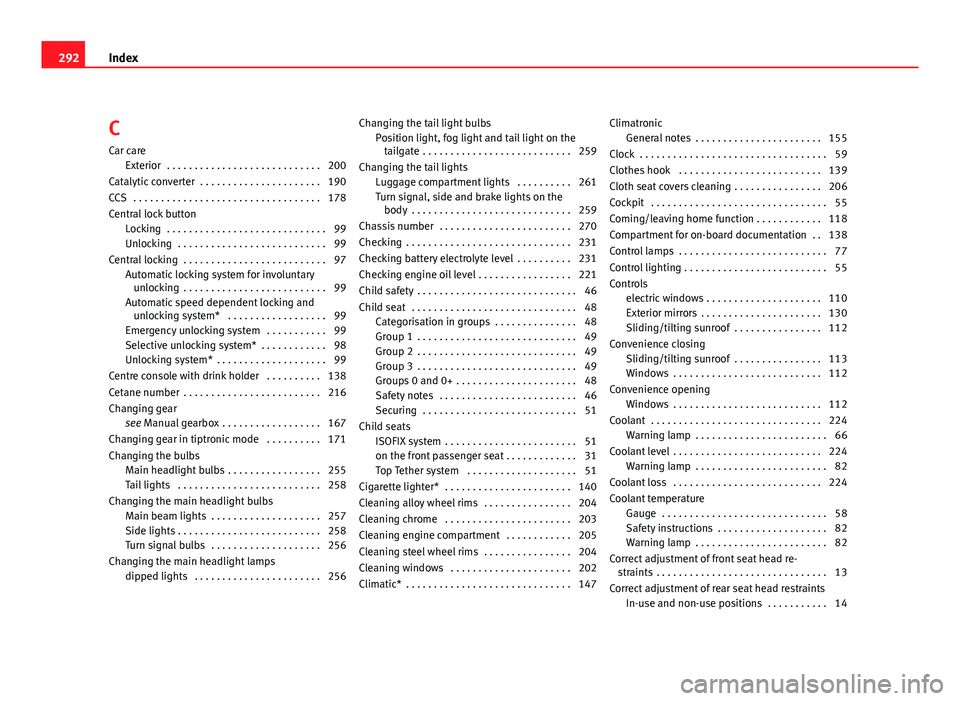
C
Car care Exterior . . . . . . . . . . . . . . . . . . . . . . . . . . . . 200
Catalytic converter . . . . . . . . . . . . . . . . . . . . . . 190
CCS . . . . . . . . . . . . . . . . . . . . . . . . . . . . . . . . . . 178
Central lock button Locking . . . . . . . . . . . . . . . . . . . . . . . . . . . . . 99
Unlocking . . . . . . . . . . . . . . . . . . . . . . . . . . . 99
Central locking . . . . . . . . . . . . . . . . . . . . . . . . . . 97 Automatic locking system for involuntaryunlocking . . . . . . . . . . . . . . . . . . . . . . . . . . 99
Automatic speed dependent locking and unlocking system* . . . . . . . . . . . . . . . . . . 99
Emergency unlocking system . . . . . . . . . . . 99
Selective unlocking system* . . . . . . . . . . . . 98
Unlocking system* . . . . . . . . . . . . . . . . . . . . 99
Centre console with drink holder . . . . . . . . . . 138
Cetane number . . . . . . . . . . . . . . . . . . . . . . . . . 216
Changing gear see Manual gearbox . . . . . . . . . . . . . . . . . . 167
Changing gear in tiptronic mode . . . . . . . . . . 171
Changing the bulbs Main headlight bulbs . . . . . . . . . . . . . . . . . 255
Tail lights . . . . . . . . . . . . . . . . . . . . . . . . . . 258
Changing the main headlight bulbs Main beam lights . . . . . . . . . . . . . . . . . . . . 257
Side lights . . . . . . . . . . . . . . . . . . . . . . . . . . 258
Turn signal bulbs . . . . . . . . . . . . . . . . . . . . 256
Changing the main headlight lamps dipped lights . . . . . . . . . . . . . . . . . . . . . . . 256 Changing the tail light bulbs
Position light, fog light and tail light on thetailgate . . . . . . . . . . . . . . . . . . . . . . . . . . . 259
Changing the tail lights Luggage compartment lights . . . . . . . . . . 261
Turn signal, side and brake lights on thebody . . . . . . . . . . . . . . . . . . . . . . . . . . . . . 259
Chassis number . . . . . . . . . . . . . . . . . . . . . . . . 270
Checking . . . . . . . . . . . . . . . . . . . . . . . . . . . . . . 231
Checking battery electrolyte level . . . . . . . . . . 231
Checking engine oil level . . . . . . . . . . . . . . . . . 221
Child safety . . . . . . . . . . . . . . . . . . . . . . . . . . . . . 46
Child seat . . . . . . . . . . . . . . . . . . . . . . . . . . . . . . 48 Categorisation in groups . . . . . . . . . . . . . . . 48
Group 1 . . . . . . . . . . . . . . . . . . . . . . . . . . . . . 49
Group 2 . . . . . . . . . . . . . . . . . . . . . . . . . . . . . 49
Group 3 . . . . . . . . . . . . . . . . . . . . . . . . . . . . . 49
Groups 0 and 0+ . . . . . . . . . . . . . . . . . . . . . . 48
Safety notes . . . . . . . . . . . . . . . . . . . . . . . . . 46
Securing . . . . . . . . . . . . . . . . . . . . . . . . . . . . 51
Child seats ISOFIX system . . . . . . . . . . . . . . . . . . . . . . . . 51
on the front passenger seat . . . . . . . . . . . . . 31
Top Tether system . . . . . . . . . . . . . . . . . . . . 51
Cigarette lighter* . . . . . . . . . . . . . . . . . . . . . . . 140
Cleaning alloy wheel rims . . . . . . . . . . . . . . . . 204
Cleaning chrome . . . . . . . . . . . . . . . . . . . . . . . 203
Cleaning engine compartment . . . . . . . . . . . . 205
Cleaning steel wheel rims . . . . . . . . . . . . . . . . 204
Cleaning windows . . . . . . . . . . . . . . . . . . . . . . 202
Climatic* . . . . . . . . . . . . . . . . . . . . . . . . . . . . . . 147 Climatronic
General notes . . . . . . . . . . . . . . . . . . . . . . . 155
Clock . . . . . . . . . . . . . . . . . . . . . . . . . . . . . . . . . . 59
Clothes hook . . . . . . . . . . . . . . . . . . . . . . . . . . 139
Cloth seat covers cleaning . . . . . . . . . . . . . . . . 206
Cockpit . . . . . . . . . . . . . . . . . . . . . . . . . . . . . . . . 55
Coming/leaving home function . . . . . . . . . . . . 118
Compartment for on-board documentation . . 138
Control lamps . . . . . . . . . . . . . . . . . . . . . . . . . . . 77
Control lighting . . . . . . . . . . . . . . . . . . . . . . . . . . 55
Controls electric windows . . . . . . . . . . . . . . . . . . . . . 110
Exterior mirrors . . . . . . . . . . . . . . . . . . . . . . 130
Sliding/tilting sunroof . . . . . . . . . . . . . . . . 112
Convenience closing Sliding/tilting sunroof . . . . . . . . . . . . . . . . 113
Windows . . . . . . . . . . . . . . . . . . . . . . . . . . . 112
Convenience opening Windows . . . . . . . . . . . . . . . . . . . . . . . . . . . 112
Coolant . . . . . . . . . . . . . . . . . . . . . . . . . . . . . . . 224 Warning lamp . . . . . . . . . . . . . . . . . . . . . . . . 66
Coolant level . . . . . . . . . . . . . . . . . . . . . . . . . . . 224 Warning lamp . . . . . . . . . . . . . . . . . . . . . . . . 82
Coolant loss . . . . . . . . . . . . . . . . . . . . . . . . . . . 224
Coolant temperature Gauge . . . . . . . . . . . . . . . . . . . . . . . . . . . . . . 58
Safety instructions . . . . . . . . . . . . . . . . . . . . 82
Warning lamp . . . . . . . . . . . . . . . . . . . . . . . . 82
Correct adjustment of front seat head re- straints . . . . . . . . . . . . . . . . . . . . . . . . . . . . . . . 13
Correct adjustment of rear seat head restraints In-use and non-use positions . . . . . . . . . . . 14
292 Index