oil Seat Leon 5D 2011 Owner's Guide
[x] Cancel search | Manufacturer: SEAT, Model Year: 2011, Model line: Leon 5D, Model: Seat Leon 5D 2011Pages: 302, PDF Size: 4.17 MB
Page 238 of 302
236Wheels and tyres
Wear indicators
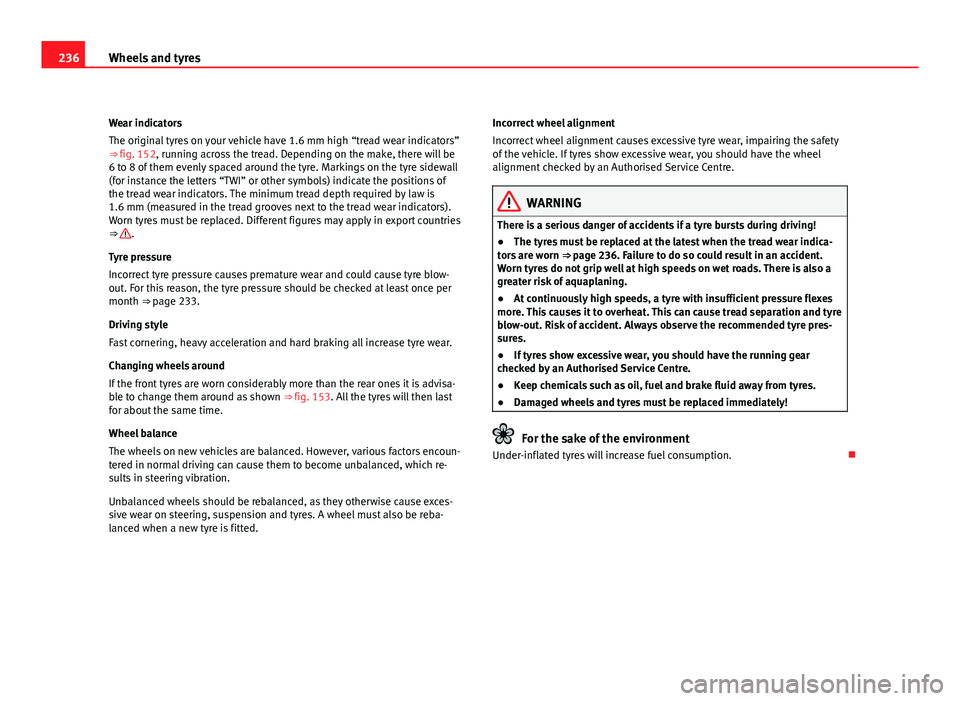
The original tyres on your vehicle have 1.6 mm high “tread wear indicators”
⇒ fig. 152, running across the tread. Depending on the make, there will be
6 to 8 of them evenly spaced around the tyre. Markings on the tyre sidewall
(for instance the letters “TWI” or other symbols) indicate the positions of
the tread wear indicators. The minimum tread depth required by law is
1.6 mm (measured in the tread grooves next to the tread wear indicators).
Worn tyres must be replaced. Different figures may apply in export countries
⇒
.
Tyre pressure
Incorrect tyre pressure causes premature wear and could cause tyre blow-
out. For this reason, the tyre pressure should be checked at least once per
month ⇒ page 233.
Driving style
Fast cornering, heavy acceleration and hard braking all increase tyre wear.
Changing wheels around
If the front tyres are worn considerably more than the rear ones it is advisa-
ble to change them around as shown ⇒ fig. 153. All the tyres will then last
for about the same time.
Wheel balance
The wheels on new vehicles are balanced. However, various factors encoun-
tered in normal driving can cause them to become unbalanced, which re-
sults in steering vibration.
Unbalanced wheels should be rebalanced, as they otherwise cause exces-
sive wear on steering, suspension and tyres. A wheel must also be reba-
lanced when a new tyre is fitted. Incorrect wheel alignment
Incorrect wheel alignment causes excessive tyre wear, impairing the safety
of the vehicle. If tyres show excessive wear, you should have the wheel
alignment checked by an Authorised Service Centre.
WARNING
There is a serious danger of accidents if a tyre bursts during driving!
● The tyres must be replaced at the latest when the tread wear indica-
tors are worn ⇒ page 236. Failure to do so could result in an accident.
Worn tyres do not grip well at high speeds on wet roads. There is also a
greater risk of aquaplaning.
● At continuously high speeds, a tyre with insufficient pressure flexes
more. This causes it to overheat. This can cause tread separation and tyre
blow-out. Risk of accident. Always observe the recommended tyre pres-
sures.
● If tyres show excessive wear, you should have the running gear
checked by an Authorised Service Centre.
● Keep chemicals such as oil, fuel and brake fluid away from tyres.
● Damaged wheels and tyres must be replaced immediately!
For the sake of the environment
Under-inflated tyres will increase fuel consumption.
Page 241 of 302
239
Wheels and tyres
For the sake of the environment
Old tyres must be disposed of according to the laws in the country con-
cerned.
Note
● For technical reasons, it is not generally possible to use the wheels from
other vehicles. This can also apply to wheels of the same model. The use of
wheels or tyres which have not been approved by SEAT for use with your
model may invalidate the vehicle's type approval for use on public roads.
● If the spare tyre is not the same as the tyres that are mounted on the
vehicle (e.g. winter tyres) you should only use the spare tyre for a short peri-
od of time and drive with extra care. Refit the normal road wheel as soon as
possible.
Wheel bolts
Wheel bolts must be tightened to the correct torque.
The design of wheel bolts is matched to the rims. If different wheel rims are
fitted, the correct wheel bolts with the right length and correctly shaped
bolt heads must be used. This ensures that wheels are fitted securely and
that the brake system functions correctly.
In certain circumstances, you should not use wheel bolts from a different
vehicle, even if it is the same model ⇒ page 208.
After the wheels have been changed, the tightening torque of the wheel
bolts should be checked as soon as possible with a torque wrench. ⇒
The tightening torque for steel and alloy wheels is 120 Nm.
WARNING
If the wheel bolts are not tightened correctly, the wheel could become
loose while driving. Risk of accident.
● The wheel bolts must be clean and turn easily. Never apply grease or
oil to them.
● Use only wheel bolts which belong to the wheel.
● If the torque of the wheel bolts is too low, they could loosen whilst
the vehicle is in motion. Risk of accident! If the tightening torque is too
high, the wheel bolts and threads can be damaged.
CAUTION
The prescribed torque for wheel bolts for steel and alloy wheels is 120 Nm.
Winter tyres
Winter tyres will improve the vehicles handling on snow and
ice.
In winter conditions winter tyres will considerably improve the vehicle's han-
dling. The design of summer tyres (width, rubber compound, tread pattern)
gives less grip on ice and snow.
Winter tyres must be inflated to a pressure 0.2 bar higher than the pres-
sures specified for summer tyres (see sticker on tank flap).
Winter tyres must be fitted on all four wheels.
Information on permitted winter tyre sizes can be found in the vehicle's reg-
istration documents. Use only radial winter tyres. All tyre sizes listed in the
vehicle documentation also apply to winter tyres.
Winter tyres lose their effectiveness when the tread is worn down to a depth
of 4 mm.
Safety FirstOperating InstructionsPractical TipsTechnical Specifications
Page 250 of 302

248If and when
Tyres with directional tread pattern
Tyres with directional tread pattern must be fitted so that
they rotate in the correct direction.
A directional tread pattern can be identified by arrows on the sidewall that
point in the direction of rotation. Always note the direction of rotation indi-
cated when fitting the wheel. This is important so that these tyres can give
maximum grip and avoid excessive noise, tread wear and aquaplaning.
If, in an emergency, you have to mount the spare wheel so it rotates in the
wrong direction, you must drive extremely carefully. The tyre will not give
optimum performance. This is particularly important when driving on wet
roads.
To benefit from the advantages of tyres with this type of tread pattern, the
defective tyre should be replaced as soon as possible so that all tyres again
rotate in the correct direction.
Tyre repair kit (Tyre Mobility System)* General information and safety notes
Your vehicle is equipped with a tyre repair kit called Tyre Mobility System.
In the event of a tyre puncture, a sealing compound and an air compressor
are located in the luggage compartment under the floor panel.
The Tyre Mobility System will reliably seal punctures caused by the penetra-
tion of a foreign body of up to about 4 mm in diameter.
It is not necessary to remove the foreign body from the tyre.
Instructions for the sealing compound are located on the sealing compound
container. You will also find instructions for operating the compressor.
WARNING
● Do not attempt to repair a puncture with the sealing compound if the
tyre has been damaged by driving the vehicle after the tyre has lost its
air.
● Always observe warnings and follow instructions concerning com-
pressor and sealing compound carefully.
● Do not drive faster than 80 km/h, avoid heavy acceleration, hard
braking and fast cornering.
● Tyres which have been repaired with sealing compound are only suit-
able for temporary use over a short period. Therefore, please drive care-
fully to the next available specialised workshop.
For the sake of the environment
If you have to dispose of a sealant can, go to a specialised waste service or
to a SEAT Technical Service, where the product can be recycled in an appro-
priate waste container.
Note
● If sealant should leak out, leave it to dry. This way you can pull it off like
a piece of foil.
● Observe the expiry date stated on the sealing compound can. Have the
sealing compound exchanged by a specialised workshop.
● Seek professional assistance if the repair of a tyre puncture is not possi-
ble with the sealing compound.
Page 254 of 302
252If and when
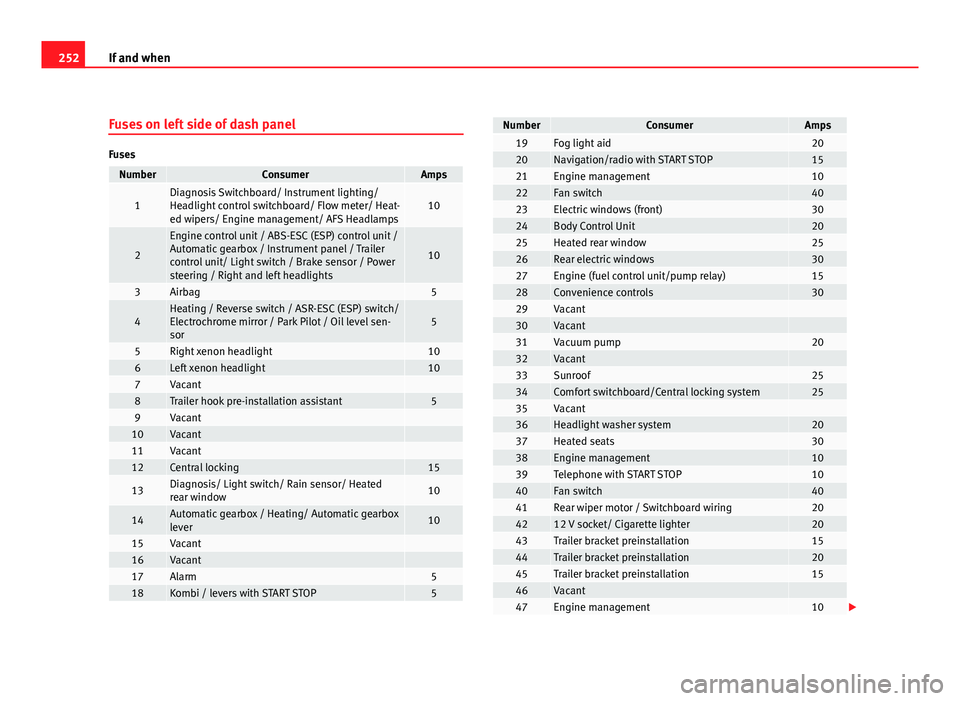
Fuses on left side of dash panel
Fuses
NumberConsumerAmps
1Diagnosis Switchboard/ Instrument lighting/
Headlight control switchboard/ Flow meter/ Heat-
ed wipers/ Engine management/ AFS Headlamps10
2
Engine control unit / ABS-ESC (ESP) control unit /
Automatic gearbox / Instrument panel / Trailer
control unit/ Light switch / Brake sensor / Power
steering / Right and left headlights
10
3Airbag5
4Heating / Reverse switch / ASR-ESC (ESP) switch/
Electrochrome mirror / Park Pilot / Oil level sen-
sor5
5Right xenon headlight106Left xenon headlight107Vacant 8Trailer hook pre-installation assistant59Vacant 10Vacant 11Vacant 12Central locking15
13Diagnosis/ Light switch/ Rain sensor/ Heated
rear window10
14Automatic gearbox / Heating/ Automatic gearbox
lever10
15Vacant 16Vacant 17Alarm518Kombi / levers with START STOP5
NumberConsumerAmps19Fog light aid2020Navigation/radio with START STOP1521Engine management1022Fan switch4023Electric windows (front)3024Body Control Unit2025Heated rear window2526Rear electric windows3027Engine (fuel control unit/pump relay)1528Convenience controls3029Vacant 30Vacant 31Vacuum pump2032Vacant 33Sunroof2534Comfort switchboard/Central locking system2535Vacant 36Headlight washer system2037Heated seats3038Engine management1039Telephone with START STOP1040Fan switch4041Rear wiper motor / Switchboard wiring204212 V socket/ Cigarette lighter2043Trailer bracket preinstallation1544Trailer bracket preinstallation2045Trailer bracket preinstallation1546Vacant 47Engine management10
Page 255 of 302
253
If and when
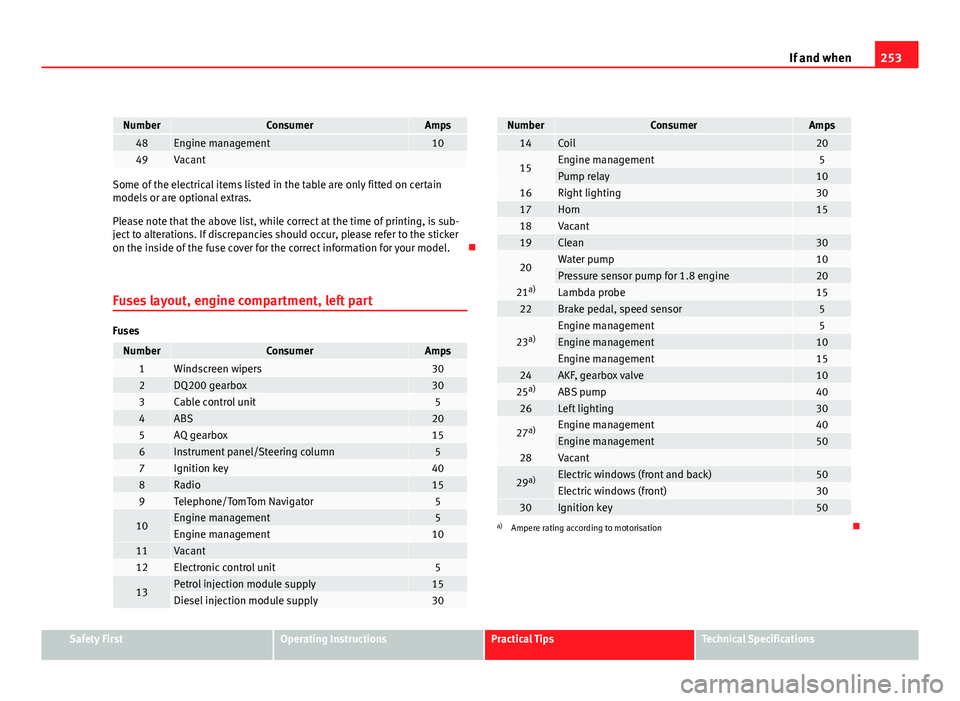
NumberConsumerAmps48Engine management1049Vacant
Some of the electrical items listed in the table are only fitted on certain
models or are optional extras.
Please note that the above list, while correct at the time of printing, is sub-
ject to alterations. If discrepancies should occur, please refer to the sticker
on the inside of the fuse cover for the correct information for your model.
Fuses layout, engine compartment, left part
Fuses
NumberConsumerAmps1Windscreen wipers302DQ200 gearbox303Cable control unit54ABS205AQ gearbox156Instrument panel/Steering column57Ignition key408Radio159Telephone/TomTom Navigator5
10Engine management5Engine management1011Vacant 12Electronic control unit5
13Petrol injection module supply15Diesel injection module supply30
NumberConsumerAmps14Coil20
15Engine management5Pump relay1016Right lighting3017Horn1518Vacant 19Clean30
20Water pump10Pressure sensor pump for 1.8 engine2021 a)Lambda probe1522Brake pedal, speed sensor5
23a)Engine management5Engine management10Engine management1524AKF, gearbox valve1025a)ABS pump4026Left lighting30
27a)Engine management40Engine management5028Vacant
29a)Electric windows (front and back)50Electric windows (front)3030Ignition key50a)
Ampere rating according to motorisation
Safety FirstOperating InstructionsPractical TipsTechnical Specifications
Page 275 of 302
273
Technical specifications
Technical specifications
Checking fluid levels
From time to time, the levels of the different fluids in the ve-
hicle must be checked. Never fill with incorrect fluids, other-
wise serious damage to the engine may be caused.
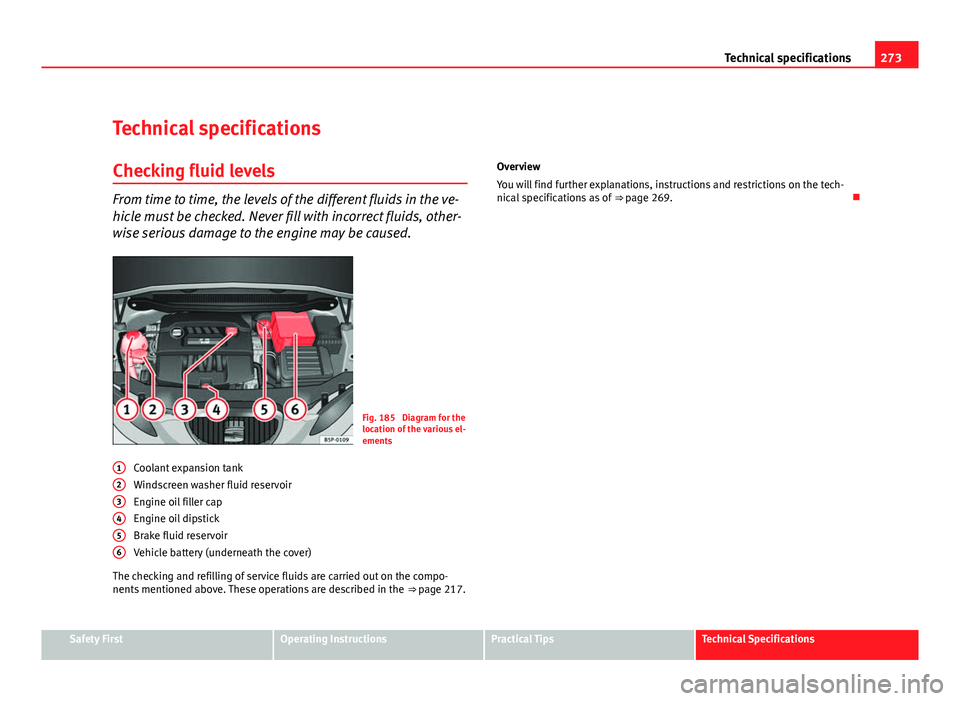
Fig. 185 Diagram for the
location of the various el-
ements
Coolant expansion tank
Windscreen washer fluid reservoir
Engine oil filler cap
Engine oil dipstick
Brake fluid reservoir
Vehicle battery (underneath the cover)
The checking and refilling of service fluids are carried out on the compo-
nents mentioned above. These operations are described in the ⇒ page 217.
1
23456
Overview
You will find further explanations, instructions and restrictions on the tech-
nical specifications as of
⇒ page 269.
Safety FirstOperating InstructionsPractical TipsTechnical Specifications
Page 276 of 302
274Technical specifications
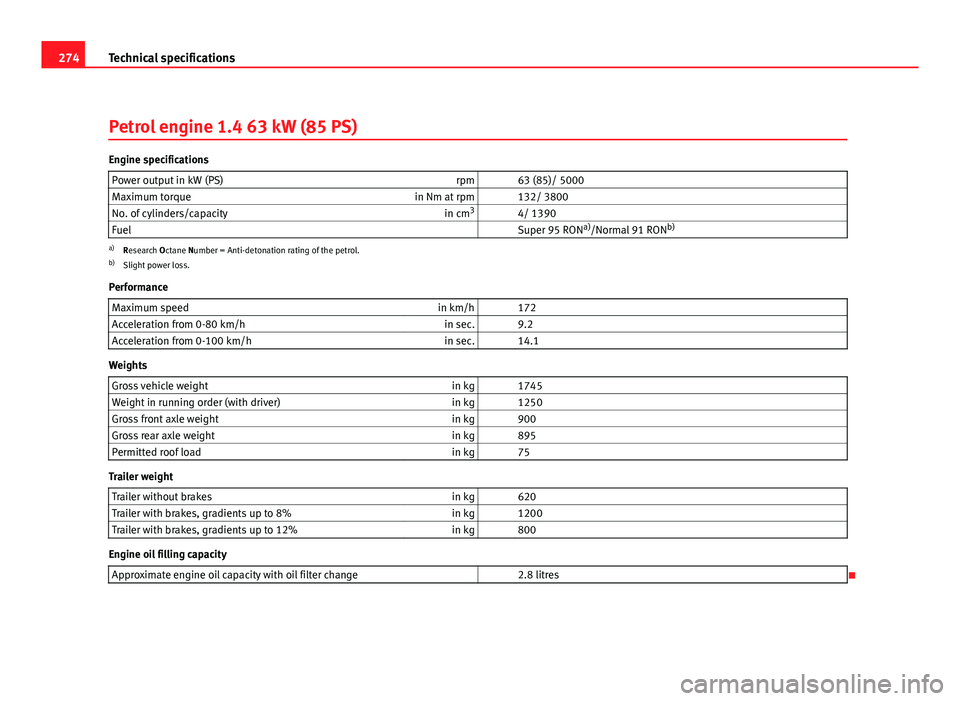
Petrol engine 1.4 63 kW (85 PS)
Engine specifications
Power output in kW (PS) rpm 63 (85)/ 5000
Maximum torque in Nm at rpm 132/ 3800
No. of cylinders/capacity in cm3
4/ 1390
Fuel Super 95 RON a)
/Normal 91 RON b)
a)
Research Octane Number = Anti-detonation rating of the petrol.
b) Slight power loss.
Performance Maximum speed in km/h 172
Acceleration from 0-80 km/h in sec. 9.2
Acceleration from 0-100 km/h in sec. 14.1
Weights
Gross vehicle weight in kg 1745
Weight in running order (with driver) in kg 1250
Gross front axle weight in kg 900
Gross rear axle weight in kg 895
Permitted roof load in kg 75
Trailer weight
Trailer without brakes in kg 620
Trailer with brakes, gradients up to 8% in kg 1200
Trailer with brakes, gradients up to 12% in kg 800
Engine oil filling capacity
Approximate engine oil capacity with oil filter change 2.8 litres
Page 277 of 302
275
Technical specifications
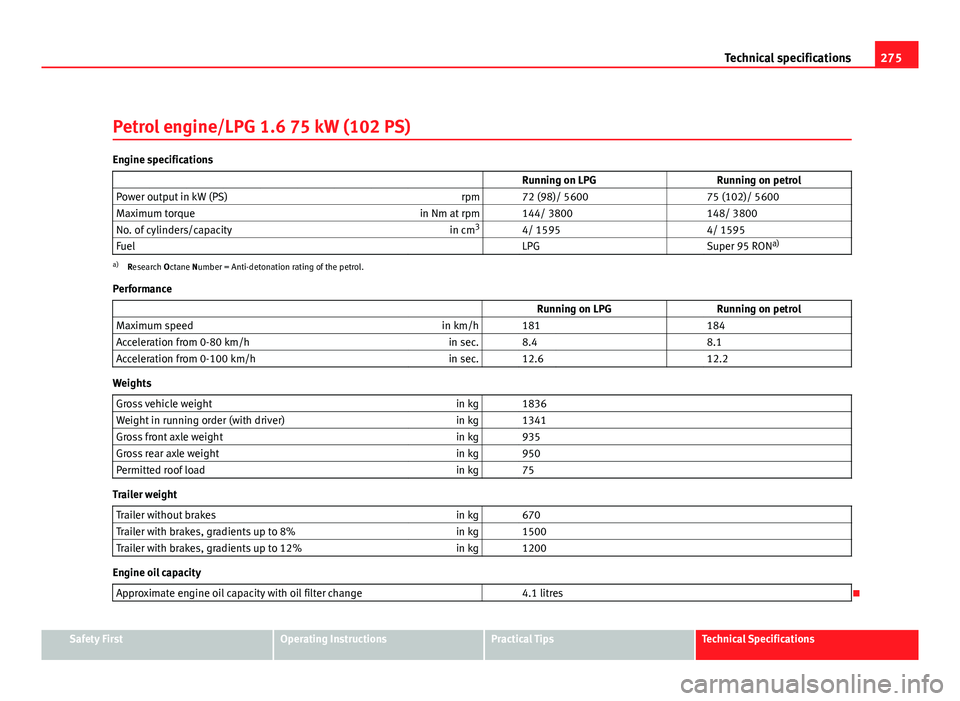
Petrol engine/LPG 1.6 75 kW (102 PS)
Engine specifications Running on LPG Running on petrol
Power output in kW (PS) rpm 72 (98)/ 5600 75 (102)/ 5600
Maximum torque in Nm at rpm 144/ 3800 148/ 3800
No. of cylinders/capacity in cm3
4/ 1595 4/ 1595
Fuel LPG Super 95 RONa)
a)
Research Octane Number = Anti-detonation rating of the petrol.
Performance Running on LPGRunning on petrol
Maximum speed in km/h 181 184
Acceleration from 0-80 km/h in sec. 8.4 8.1
Acceleration from 0-100 km/h in sec. 12.6 12.2
Weights
Gross vehicle weight in kg 1836
Weight in running order (with driver) in kg 1341
Gross front axle weight in kg 935
Gross rear axle weight in kg 950
Permitted roof load in kg 75
Trailer weight
Trailer without brakes in kg 670
Trailer with brakes, gradients up to 8% in kg 1500
Trailer with brakes, gradients up to 12% in kg 1200
Engine oil capacity
Approximate engine oil capacity with oil filter change 4.1 litres
Safety FirstOperating InstructionsPractical TipsTechnical Specifications
Page 278 of 302
276Technical specifications
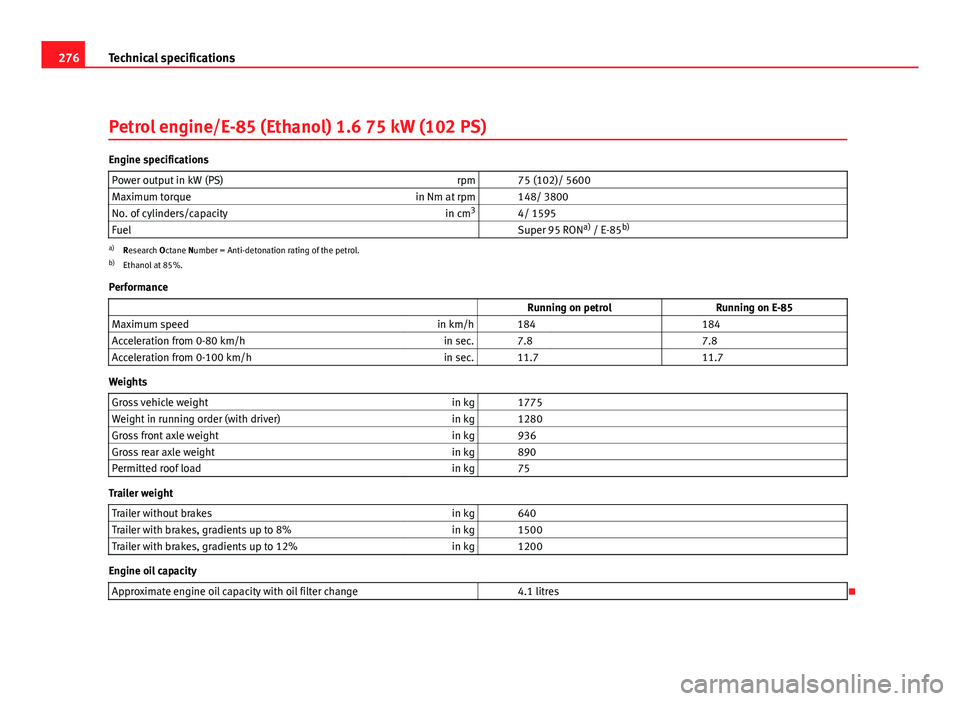
Petrol engine/E-85 (Ethanol) 1.6 75 kW (102 PS)
Engine specifications
Power output in kW (PS) rpm 75 (102)/ 5600
Maximum torque in Nm at rpm 148/ 3800
No. of cylinders/capacity in cm3
4/ 1595
Fuel Super 95 RONa)
/ E-85 b)
a)
Research Octane Number = Anti-detonation rating of the petrol.
b) Ethanol at 85%.
Performance Running on petrolRunning on E-85
Maximum speed in km/h 184 184
Acceleration from 0-80 km/h in sec. 7.8 7.8
Acceleration from 0-100 km/h in sec. 11.7 11.7
Weights
Gross vehicle weight in kg 1775
Weight in running order (with driver) in kg 1280
Gross front axle weight in kg 936
Gross rear axle weight in kg 890
Permitted roof load in kg 75
Trailer weight
Trailer without brakes in kg 640
Trailer with brakes, gradients up to 8% in kg 1500
Trailer with brakes, gradients up to 12% in kg 1200
Engine oil capacity
Approximate engine oil capacity with oil filter change 4.1 litres
Page 280 of 302
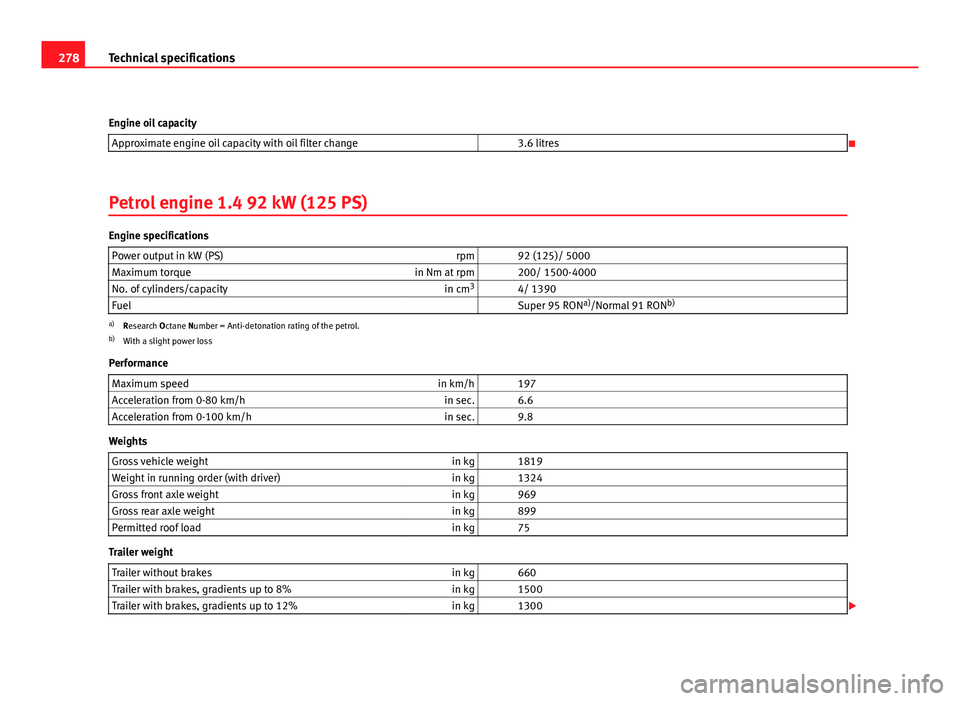
278Technical specifications
Engine oil capacity Approximate engine oil capacity with oil filter change 3.6 litres
Petrol engine 1.4 92 kW (125 PS)
Engine specifications Power output in kW (PS) rpm 92 (125)/ 5000
Maximum torque in Nm at rpm 200/ 1500-4000
No. of cylinders/capacity in cm3
4/ 1390
Fuel Super 95 RON a)
/Normal 91 RON b)
a)
Research Octane Number = Anti-detonation rating of the petrol.
b) With a slight power loss
Performance Maximum speed in km/h 197
Acceleration from 0-80 km/h in sec. 6.6
Acceleration from 0-100 km/h in sec. 9.8
Weights
Gross vehicle weight in kg 1819
Weight in running order (with driver) in kg 1324
Gross front axle weight in kg 969
Gross rear axle weight in kg 899
Permitted roof load in kg 75
Trailer weight
Trailer without brakes in kg 660
Trailer with brakes, gradients up to 8% in kg 1500
Trailer with brakes, gradients up to 12% in kg 1300