lights Seat Leon 5D 2011 Workshop Manual
[x] Cancel search | Manufacturer: SEAT, Model Year: 2011, Model line: Leon 5D, Model: Seat Leon 5D 2011Pages: 302, PDF Size: 4.17 MB
Page 245 of 302
243
If and when
– All passengers should leave the vehicle. They should wait in a
safe area (for instance behind the roadside crash barrier).
– Switch off the engine. Switch on the hazard warning lights.
– Apply the handbrake firmly.
– Engage the first gear , or put the selector lever to position P for
those vehicles with an automatic gearbox.
– If you are towing a trailer, unhitch it from your vehicle.
– Take the vehicle tools and the spare wheel out of the luggage
compartment.
WARNING
Put the hazard warning lights on and place the warning triangle in posi-
tion. This is for your own safety and also warns other road users.
CAUTION
If you have to change the wheel on a gradient, block the wheel opposite the
wheel being changed by placing a stone or similar object under it to prevent
the vehicle from rolling away.
Note
Please observe legal requirements when doing so.
Changing a wheel
Change the wheel as described below
– Pull off the hub cap. See ⇒ fig. 155. –
Slacken the wheel bolts.
– Raise the car with the jack at the corresponding point.
– Remove the wheel and then mount the spare wheel
– Lower the vehicle.
– Tighten the wheel bolts firmly with the box spanner.
– Replace the wheel trim.
After changing a wheel
After changing the wheel there are still tasks to complete. – Put the tools and jack back in the luggage compartment.
– Place the wheel with the defective tyre in the luggage compart-
ment and secure it.
– Check the tyre pressure of the newly fitted tyre as soon as pos-
sible.
– Have the tightening torque of the wheel bolts checked as soon
as possible with a torque wrench. The prescribed torque must
be 120 Nm.
Note
● If you notice that the wheel bolts are corroded and difficult to turn when
changing a wheel, they must be replaced before having the wheel bolt tor-
que checked.
● For safety reasons, drive at moderate speeds until the wheel bolt tight-
ening torque has been checked.
Safety FirstOperating InstructionsPractical TipsTechnical Specifications
Page 251 of 302
249
If and when
Preparation work
Certain steps must be taken before repairing a tyre.
– If you have a flat tyre or puncture, park the vehicle as far away
from the flow of traffic as possible.
– Apply the handbrake firmly.
– Engage first gear , or put the selector lever to position P.
– All passengers should leave the vehicle. They should wait in a
safe area (for instance behind the roadside crash barrier).
– Check whether a repair is possible using the Tyre Mobility Sys-
tem “General information and safety notes.”
– Unscrew inflation cap from the affected wheel.
– Take the tyre repair kit out of the luggage compartment.
WARNING
Put the hazard warning lights on and place the warning triangle in posi-
tion. This is for your own safety and also warns other road users.
CAUTION
Take special care if you have to repair a tyre on a slope.
Note
Please observe legal requirements when doing so. Tyre repair
The following sections describe the procedures for repairing
a tyre.
Using the sealing compound
– The instructions on the container give detailed information on
how to use the sealing compound.
Inflating the tyre.
– Remove the air compressor and hose from the container.
– Screw the retaining nut onto the valve.
– Plug the compressor cable into a 12 volt power point.
– Turn on compressor and monitor the pressure shown on the
pressure gauge.
Completing the repair
– Remove the compressor hose from the valve.
– Fit the valve cap.
– Unplug the compressor from the socket.
– Return all tools to their proper storing location.
Note
● If the vehicle is equipped with tyre pressure control, enter the new tyre
pressures using the SET button on the centre console.
● The compressor should never be allowed to run for longer than 6 mi-
nutes.
Safety FirstOperating InstructionsPractical TipsTechnical Specifications
Page 254 of 302
252If and when
Fuses on left side of dash panel
Fuses
NumberConsumerAmps
1Diagnosis Switchboard/ Instrument lighting/
Headlight control switchboard/ Flow meter/ Heat-
ed wipers/ Engine management/ AFS Headlamps10
2
Engine control unit / ABS-ESC (ESP) control unit /
Automatic gearbox / Instrument panel / Trailer
control unit/ Light switch / Brake sensor / Power
steering / Right and left headlights
10
3Airbag5
4Heating / Reverse switch / ASR-ESC (ESP) switch/
Electrochrome mirror / Park Pilot / Oil level sen-
sor5
5Right xenon headlight106Left xenon headlight107Vacant 8Trailer hook pre-installation assistant59Vacant 10Vacant 11Vacant 12Central locking15
13Diagnosis/ Light switch/ Rain sensor/ Heated
rear window10
14Automatic gearbox / Heating/ Automatic gearbox
lever10
15Vacant 16Vacant 17Alarm518Kombi / levers with START STOP5
NumberConsumerAmps19Fog light aid2020Navigation/radio with START STOP1521Engine management1022Fan switch4023Electric windows (front)3024Body Control Unit2025Heated rear window2526Rear electric windows3027Engine (fuel control unit/pump relay)1528Convenience controls3029Vacant 30Vacant 31Vacuum pump2032Vacant 33Sunroof2534Comfort switchboard/Central locking system2535Vacant 36Headlight washer system2037Heated seats3038Engine management1039Telephone with START STOP1040Fan switch4041Rear wiper motor / Switchboard wiring204212 V socket/ Cigarette lighter2043Trailer bracket preinstallation1544Trailer bracket preinstallation2045Trailer bracket preinstallation1546Vacant 47Engine management10
Page 256 of 302
254If and when
Bulb change
General notes
Before changing any bulb, first turn off the failed component.
Do not touch the bulb glass. Fingerprints vaporise in the heat, causing a re-
duction in the bulb life and condensation on the mirror surface, thus reduc-
ing efficiency.
A bulb should only be replaced by one of the same type. The type is inscri-
bed on the bulb, either on the glass part or on the base.
It is highly recommended to keep a box of spare bulbs in the vehicle. At the
very least, the following spare bulbs, which are essential for road safety,
should be kept in the vehicle.
Main headlights
● Dipped beam – H7
● Main beam – H1
● Side light – W5W
● Turn signal – PY21W Xenon headlights
1)
/adaptive*
● Dipped and main beam – D1S 2)
● DRL – P21W SLL
● Side light – W5W
● Turn signals – PY21W
Fog lights
● Fog light – HB4
Fixed tail light
● Stop/Side light – P21W 3)
or LED module 4)
● Turn signal – P21W
Mobile tailgate light
● Fog light (driver side) – P21W
● Reverse (passenger side) – P21W
● Side light – W5W or LED module 4)
Side turn signal
● Turn signal repeater – W5W
1)
On this type of headlight, the bulb changes must be made by the SEAT dealer, given that
complex elements must be removed from the vehicle and a reset must be made on the
automatic control system incorporated.
2) The Xenon bulbs discharge 2.5 times the light flux and have an average lifespan of 5 times
more than that of halogen bulbs, this means that, except due to unusual circumstances,
there is no need to change the bulbs for the whole life of the vehicle.
3) Electronically controlled single filament bulb for Stop/side bulbs. If the bulb blows it will
not work in either position or Stop.
4) Only in the LED light models. The LED modules cannot be replaced. The other lights, turn
signal light, fog light and reverse light can be replaced. If the warning lamp for the brake
light or side light (LED lights) lights up, the tail light assembly should be replaced. The fail-
ure of the lamp is only shown when the LED function goes out completely. Sometimes, a
LED will stop working, without displaying the warning as the function continues to operate.
Page 257 of 302
255
If and when
Number plate light
● Number plate light – C5W
Glove compartment lamp
● Glove compartment light – W5W
Note
● Depending on weather conditions (cold or wet), the front lights, the fog
lights, the tail lights and the turn signals may be temporarily misted. This
has no influence on the useful life of the lighting system. By switching on
the lights, the area through which the beam of light is projected will quickly
be demisted. However, the edges may continue to be misted.
● Please check at regular intervals that all lighting (especially the exterior
lighting) on your vehicle is functioning properly. This is not only in the inter-
est of your own safety, but also that of all other road users.
● Due to the difficulty in accessing some of the bulbs, any replacement
work should be done by a SEAT dealer. However, the following is a descrip-
tion of how to change the lamps except for the fog lights* and interior
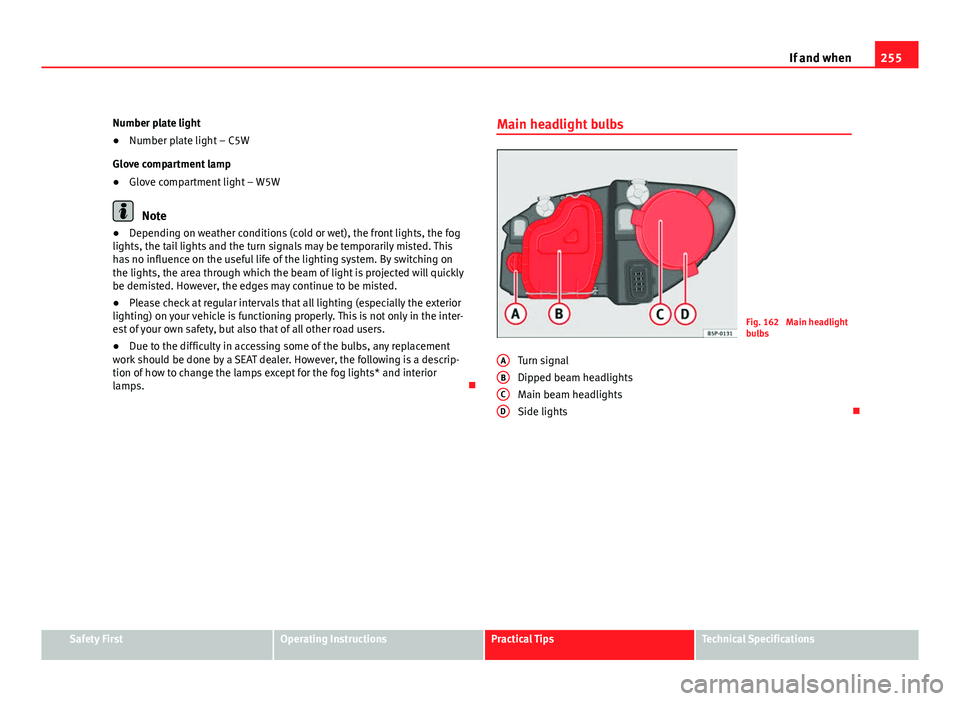
lamps. Main headlight bulbs
Fig. 162 Main headlight
bulbs
Turn signal
Dipped beam headlights
Main beam headlights
Side lights
A
BCD
Safety FirstOperating InstructionsPractical TipsTechnical Specifications
Page 258 of 302
256If and when
Turn signal bulbs
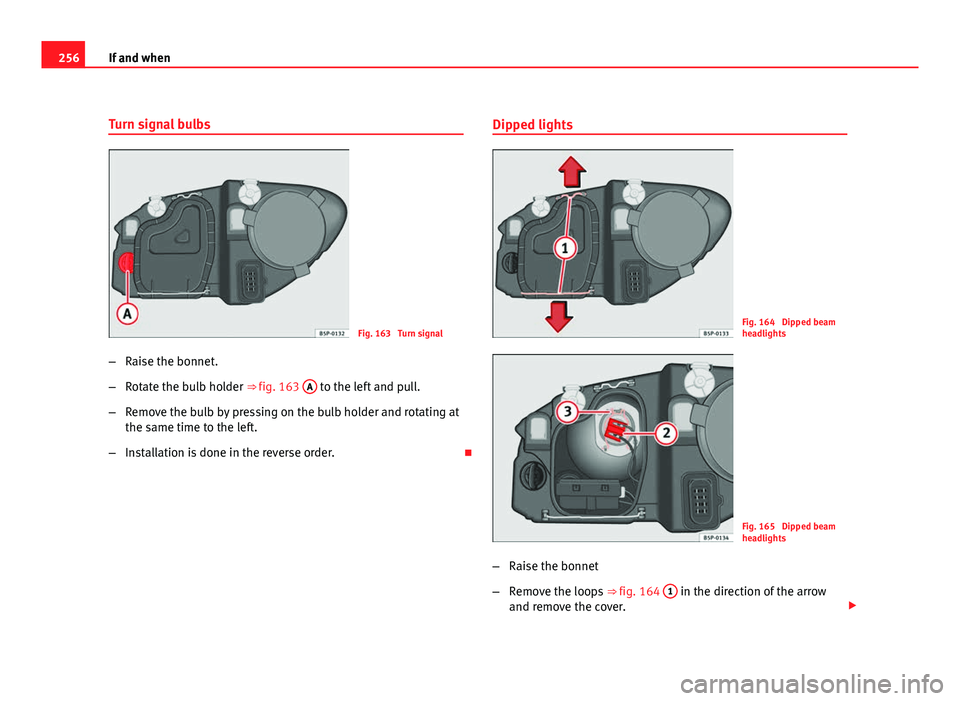
Fig. 163 Turn signal
– Raise the bonnet.
– Rotate the bulb holder ⇒ fig. 163 A
to the left and pull.
– Remove the bulb by pressing on the bulb holder and rotating at
the same time to the left.
– Installation is done in the reverse order. Dipped lights
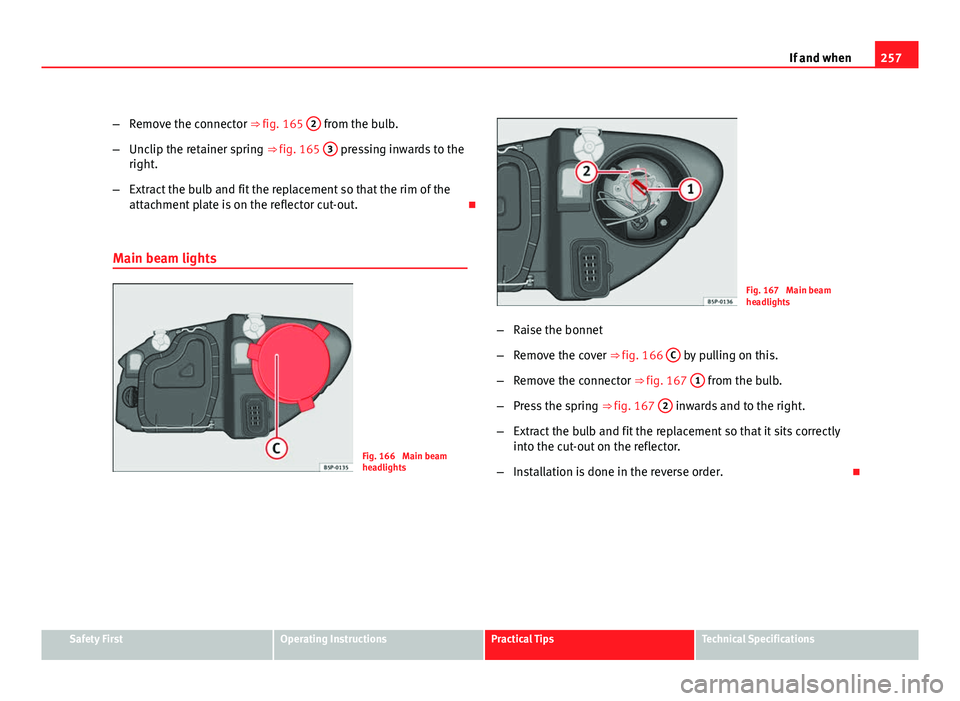
Fig. 164 Dipped beam
headlights
Fig. 165 Dipped beam
headlights
– Raise the bonnet
– Remove the loops ⇒ fig. 164 1
in the direction of the arrow
and remove the cover.
Page 259 of 302
257
If and when
– Remove the connector ⇒ fig. 165 2
from the bulb.
– Unclip the retainer spring ⇒ fig. 165 3
pressing inwards to the
right.
– Extract the bulb and fit the replacement so that the rim of the
attachment plate is on the reflector cut-out.
Main beam lights
Fig. 166 Main beam
headlights
Fig. 167 Main beam
headlights
– Raise the bonnet
– Remove the cover ⇒ fig. 166 C
by pulling on this.
– Remove the connector ⇒ fig. 167 1
from the bulb.
– Press the spring ⇒ fig. 167 2
inwards and to the right.
– Extract the bulb and fit the replacement so that it sits correctly
into the cut-out on the reflector.
– Installation is done in the reverse order.
Safety FirstOperating InstructionsPractical TipsTechnical Specifications
Page 260 of 302
258If and when
Side lights
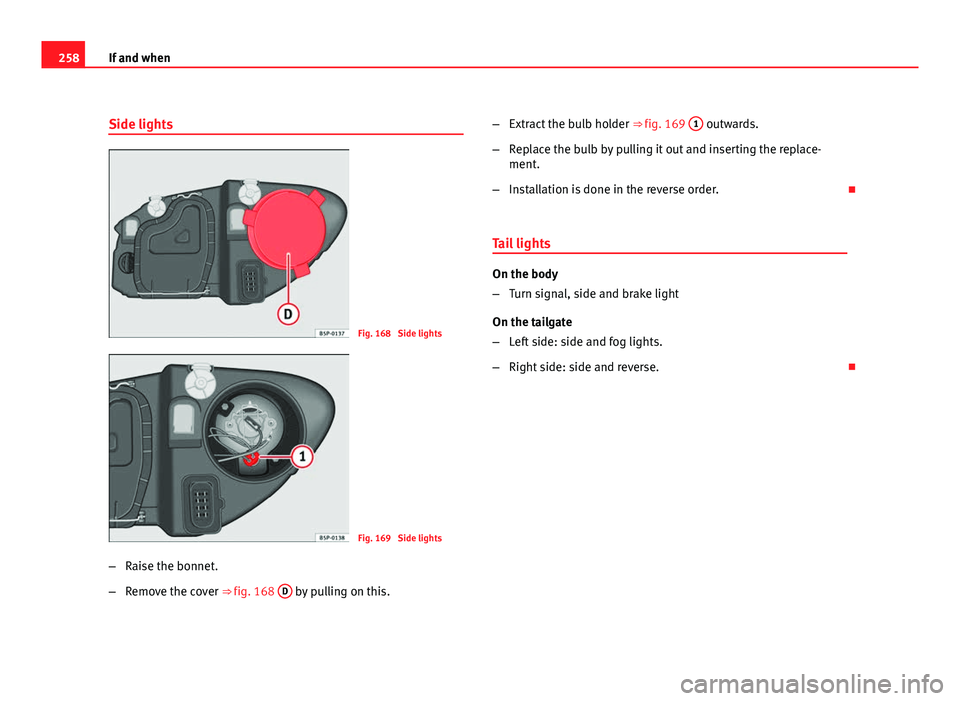
Fig. 168 Side lights
Fig. 169 Side lights
– Raise the bonnet.
– Remove the cover ⇒ fig. 168 D
by pulling on this. –
Extract the bulb holder ⇒ fig. 169 1
outwards.
– Replace the bulb by pulling it out and inserting the replace-
ment.
– Installation is done in the reverse order.
Tail lights
On the body
– Turn signal, side and brake light
On the tailgate
– Left side: side and fog lights.
– Right side: side and reverse.
Page 261 of 302
259
If and when
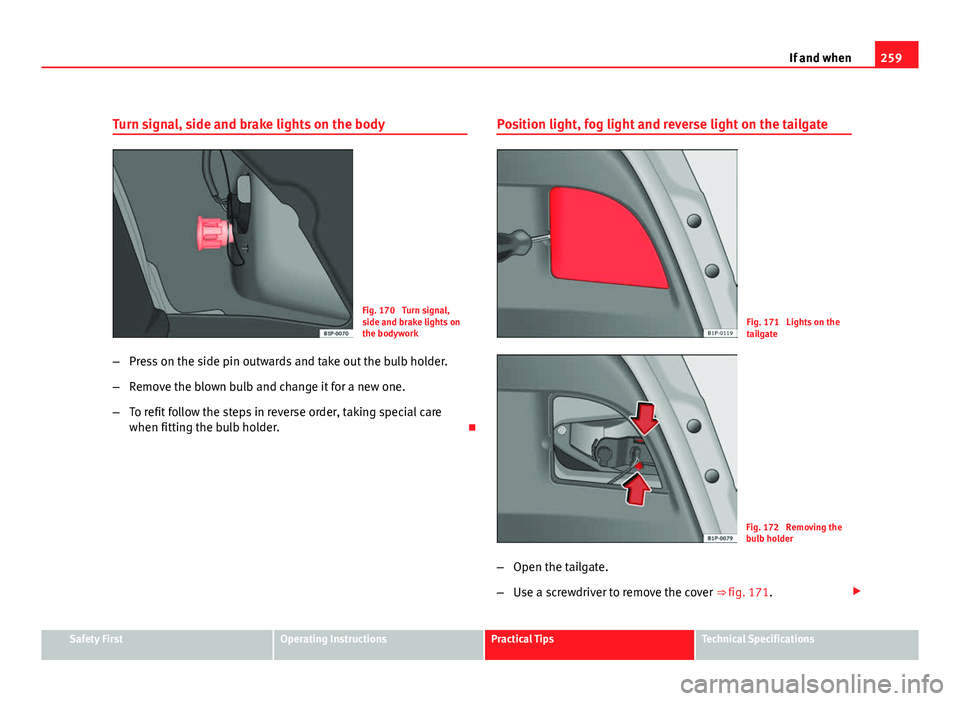
Turn signal, side and brake lights on the body
Fig. 170 Turn signal,
side and brake lights on
the bodywork
– Press on the side pin outwards and take out the bulb holder.
– Remove the blown bulb and change it for a new one.
– To refit follow the steps in reverse order, taking special care
when fitting the bulb holder. Position light, fog light and reverse light on the tailgateFig. 171 Lights on the
tailgate
Fig. 172 Removing the
bulb holder
– Open the tailgate.
– Use a screwdriver to remove the cover ⇒ fig. 171.
Safety FirstOperating InstructionsPractical TipsTechnical Specifications
Page 263 of 302
261
If and when
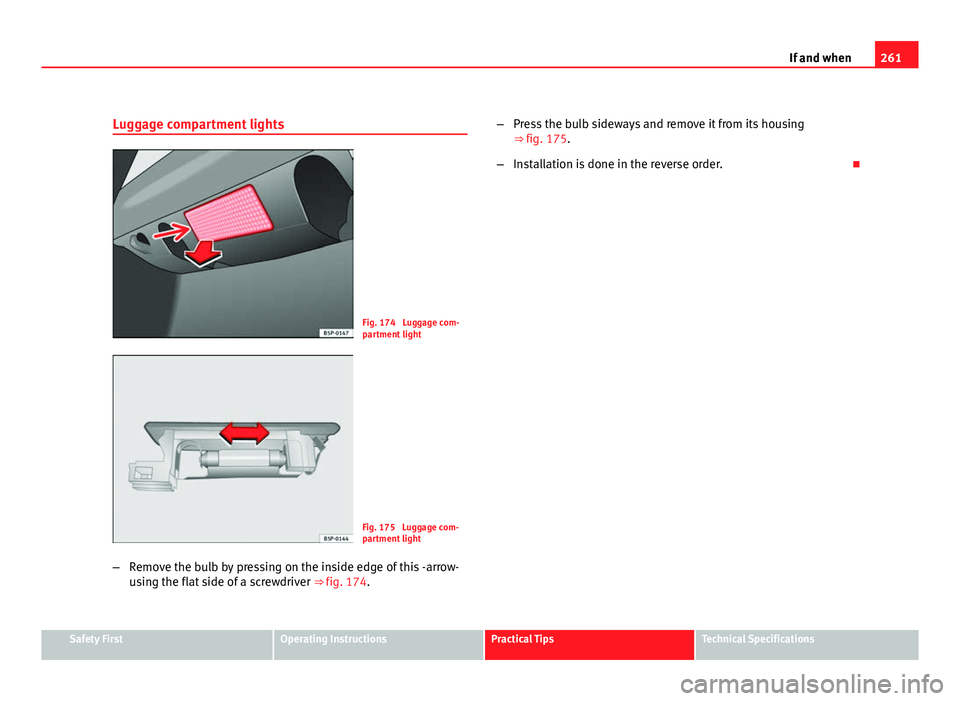
Luggage compartment lights
Fig. 174 Luggage com-
partment light
Fig. 175 Luggage com-
partment light
– Remove the bulb by pressing on the inside edge of this -arrow-
using the flat side of a screwdriver ⇒ fig. 174.–
Press the bulb sideways and remove it from its housing
⇒ fig. 175.
– Installation is done in the reverse order.
Safety FirstOperating InstructionsPractical TipsTechnical Specifications