ECU Seat Leon 5D 2012 User Guide
[x] Cancel search | Manufacturer: SEAT, Model Year: 2012, Model line: Leon 5D, Model: Seat Leon 5D 2012Pages: 289, PDF Size: 3.81 MB
Page 25 of 289
24Seat belts
WARNING
● If the seat belts are worn incorrectly or not at all, the risk of severe
injuries increases. The optimal protection from seat belts can be ach-
ieved only if you use them properly.
● Fasten your seat belt before every trip - even when driving in town.
The other vehicle occupants must also wear the seat belts at all times,
otherwise they run the risk of being injured.
● The seat belt cannot offer its full protection if the seat belt is not
positioned correctly.
● Never allow two passengers (even children) to share the same seat
belt.
● Always keep both feet in the footwell in front of your seat as long as
the vehicle is in motion.
● Never unbuckle a seat belt while the vehicle is in motion. Risk of fatal
injury.
● The seat belt must never be twisted while it is being worn.
● The seat belt should never lie on hard or fragile objects (such as
glasses or pens, etc.) because this can cause injuries.
● Do not allow the seat belt to be damaged or jammed, or to rub on any
sharp edges.
● Never wear the seat belt under the arm or in any other incorrect posi-
tion.
● Loose, bulky clothing (such as an overcoat over a jacket) impairs the
proper fit and function of the seat belts, reducing their capacity to pro-
tect.
● The slot in the seat belt buckle must not be blocked with paper or
other objects, as this can prevent the latch plate from engaging securely.
● Never use seat belt clips, fastening rings or similar instruments to al-
ter the position of the belt webbing.WARNING (Continued)
● Frayed or torn seat belts or damage to the connections, belt retrac-
tors or parts of the buckle could cause severe injuries in the event of an
accident. Therefore, you must check the condition of all seat belts at reg-
ular intervals.
● Seat belts which have been worn in an accident and stretched must
be replaced by a specialised workshop. Renewal may be necessary even
if there is no apparent damage. The belt anchorage should also be
checked.
● Do not attempt to repair a damaged seat belt yourself. The seat belts
must not be removed or modified in any way.
● The belts must be kept clean, otherwise the retractors may not work
properly.
Page 26 of 289
25
Seat belts
Seat belts
Seat belt adjustment
The seat belts for the front and rear occupants are locked in-
to position by a latch.
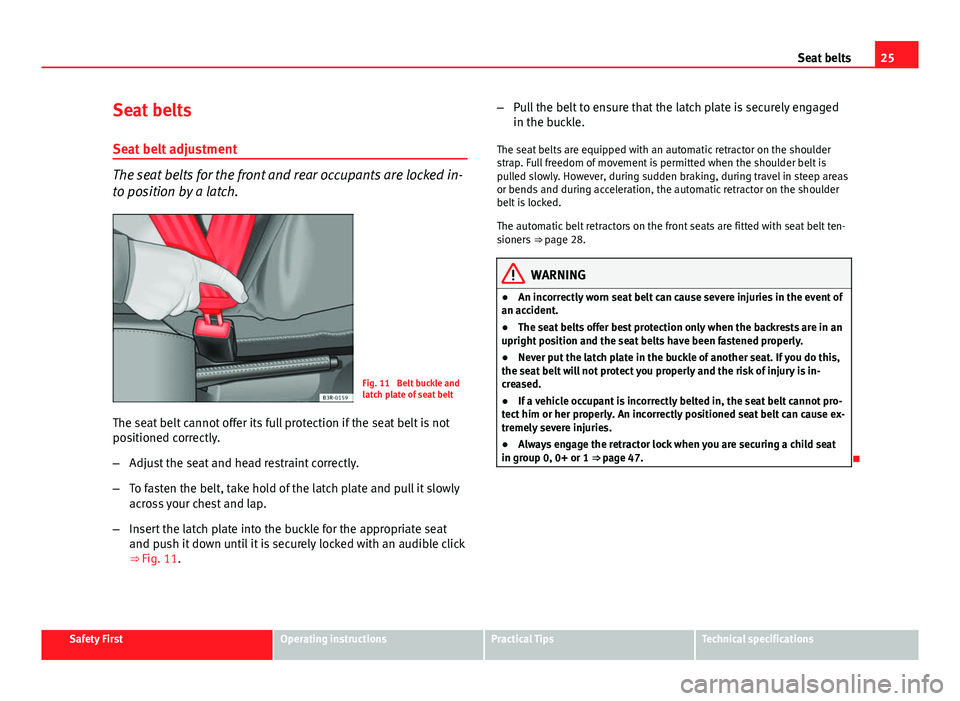
Fig. 11 Belt buckle and
latch plate of seat belt
The seat belt cannot offer its full protection if the seat belt is not
positioned correctly.
– Adjust the seat and head restraint correctly.
– To fasten the belt, take hold of the latch plate and pull it slowly
across your chest and lap.
– Insert the latch plate into the buckle for the appropriate seat
and push it down until it is securely locked with an audible click
⇒ Fig. 11. –
Pull the belt to ensure that the latch plate is securely engaged
in the buckle.
The seat belts are equipped with an automatic retractor on the shoulder
strap. Full freedom of movement is permitted when the shoulder belt is
pulled slowly. However, during sudden braking, during travel in steep areas
or bends and during acceleration, the automatic retractor on the shoulder
belt is locked.
The automatic belt retractors on the front seats are fitted with seat belt ten-
sioners ⇒ page 28.
WARNING
● An incorrectly worn seat belt can cause severe injuries in the event of
an accident.
● The seat belts offer best protection only when the backrests are in an
upright position and the seat belts have been fastened properly.
● Never put the latch plate in the buckle of another seat. If you do this,
the seat belt will not protect you properly and the risk of injury is in-
creased.
● If a vehicle occupant is incorrectly belted in, the seat belt cannot pro-
tect him or her properly. An incorrectly positioned seat belt can cause ex-
tremely severe injuries.
● Always engage the retractor lock when you are securing a child seat
in group 0, 0+ or 1 ⇒ page 47.
Safety FirstOperating instructionsPractical TipsTechnical specifications
Page 28 of 289
27
Seat belts
Pregnant women must also fasten their seat belts properly
The best protection for the unborn child is for the mother to
wear the seat belt properly at all times during the pregnan-
cy.
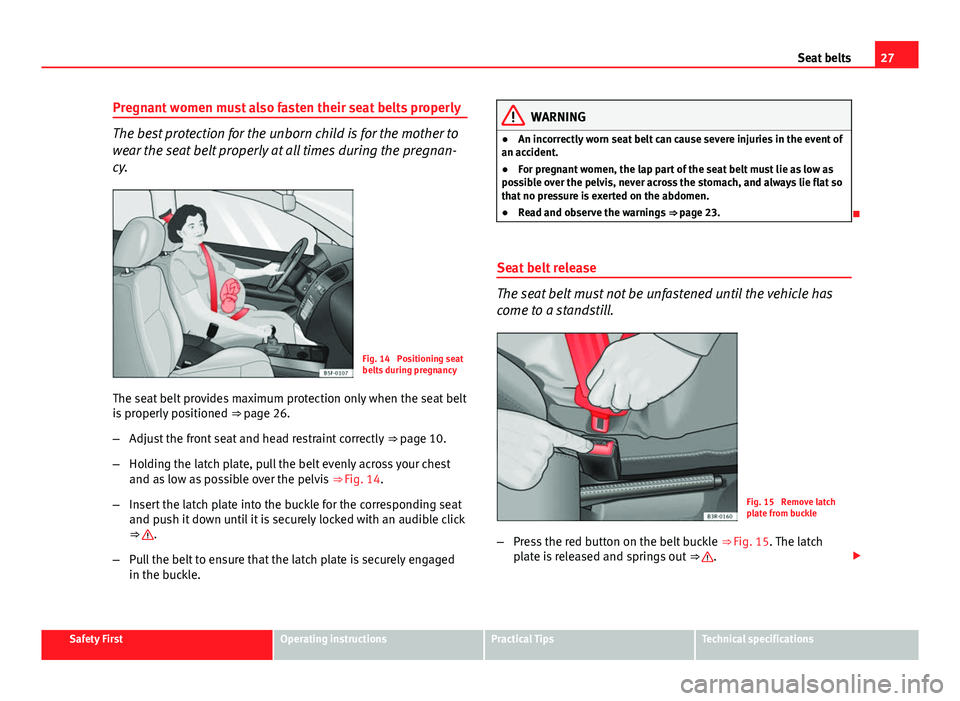
Fig. 14 Positioning seat
belts during pregnancy
The seat belt provides maximum protection only when the seat belt
is properly positioned ⇒ page 26.
– Adjust the front seat and head restraint correctly ⇒ page 10.
– Holding the latch plate, pull the belt evenly across your chest
and as low as possible over the pelvis ⇒ Fig. 14.
– Insert the latch plate into the buckle for the corresponding seat
and push it down until it is securely locked with an audible click
⇒
.
– Pull the belt to ensure that the latch plate is securely engaged
in the buckle.
WARNING
● An incorrectly worn seat belt can cause severe injuries in the event of
an accident.
● For pregnant women, the lap part of the seat belt must lie as low as
possible over the pelvis, never across the stomach, and always lie flat so
that no pressure is exerted on the abdomen.
● Read and observe the warnings ⇒ page 23.
Seat belt release
The seat belt must not be unfastened until the vehicle has
come to a standstill.
Fig. 15 Remove latch
plate from buckle
– Press the red button on the belt buckle ⇒
Fig. 15. The latch
plate is released and springs out ⇒
.
Safety FirstOperating instructionsPractical TipsTechnical specifications
Page 32 of 289

31
Airbag system
WARNING (Continued)
● To reduce the risk of injury from an inflating airbag, always wear the
seat belt properly ⇒ page 19.
● Always adjust the front seats properly.
The danger of fitting a child seat on the front passenger
seat
Rear-facing child seats must never be used on the front pas-
senger seat when the front passenger airbag is enabled. The front passenger front airbag is a serious risk for a child if it is activated.
The front passenger seat is life threatening to a child if he/she is transpor-
ted in a rear-facing child seat. Children up to 12 years old should always
travel on the rear seat.
If a rear-facing child seat is secured to the front passenger seat, an inflating
airbag can strike it with such force that it can cause critical or fatal injuries.
Therefore we strongly recommend you to transport children on the rear
seats. That is the safest place for children in the vehicle. Alternatively, the
front passenger airbag can be disabled with a key-operated switch
⇒ page 44. When transporting children, use a child seat suitable for the
age and size of each child ⇒ page 47.
For those vehicles that do not include a key lock switch to turn the airbag
off, a Technical Service must be consulted.
WARNING
● If a child seat is secured to the front passenger seat, the risk to the
child of sustaining critical or fatal injuries in the event of an accident in-
creases.
● Never secure a rear-facing child seat to the front passenger seat if the
front passenger airbag is enabled. The child can suffer critical or fatal in-
juries if the front passenger airbag is triggered.
● An inflating front passenger airbag can strike the rear-facing child
seat and project it with great force against the door, the roof or the back-
rest.
● For those vehicles that do not include a key lock switch to turn the
airbag off, a Technical Service must be consulted.
● If, under special circumstances, it is necessary to transport a child in
a rear-facing child seat on the front passenger seat, it is absolutely es-
sential that you observe the following safety measures:
–Deactivate the front passenger airbag ⇒ page 44.
– Child seats must be approved by the child seat manufacturer for
use on a front passenger seat with front or side airbag.
– Follow the installation instructions given by the child seat manu-
facturer and observe the safety instructions ⇒ page 47, Child safe-
ty.
– Before properly installing the child seat, push the front passenger
seat completely backwards so that the greatest possible distance to
the front passenger airbag is ensured.
– Ensure that no objects prevent the front passenger seat from being
pushed completely back.
– The backrest of the front passenger seat must be in an upright po-
sition.
Safety FirstOperating instructionsPractical TipsTechnical specifications
Page 49 of 289

48Child safety
WARNING
● Never install a child seat facing backwards on the front passenger
seat unless the front passenger front airbag has been disabled. Risk of
potentially fatal injuries to the child! However, if it is necessary, in excep-
tional cases, to transport a child in the front passenger seat, the front
passenger front airbag must always be disabled ⇒ page 44. If the pas-
senger seat has a height adjustment option, move it to the highest, most
upright position. If you have a fixed seat, do not install any child restraint
system in this location.
● For those vehicles that do not include a key lock switch to deactivate
the airbag, the vehicle must be taken to a Technical Service.
● All vehicle occupants, especially children, must assume the proper
sitting position and be properly belted in while travelling.
● Never hold children or babies on your lap, this can result in potential-
ly fatal injuries to the child!
● Never allow a child to be transported in a vehicle without being prop-
erly secured, or to stand up or kneel on a seat while travelling. In an acci-
dent, the child could be flung through the vehicle, causing possibly fatal
injuries to themselves and to the other vehicle occupants.
● If children assume an improper sitting position when the vehicle is
moving, they expose themselves to greater risk of injury in the event of a
sudden braking manoeuvre or in an accident. This is particularly impor-
tant if the child is travelling on the front passenger seat and the airbag
system is triggered in an accident; as this could cause serious injury or
even death.
● A suitable child seat can protect your child!
● Never leave an unsupervised child alone on a child seat or in the vehi-
cle.
● Depending on weather conditions, it may become extremely hot or
cold inside the vehicle. This can be fatal.WARNING (Continued)
● Children who are less than 1.5 metres tall must not wear a normal
seat belt without a child seat, as this could cause injuries to the abdomi-
nal and neck areas during a sudden braking manoeuvre or in an accident.
● Do not allow the seat belt to become twisted or jammed, or to rub on
any sharp edges.
● Incorrectly worn seat belts can cause injuries even in a minor colli-
sion or in sudden braking manoeuvres.
● The seat belt provides maximum protection only when the seat belt is
properly positioned ⇒ page 25, Seat belts.
● Only one child may occupy a child seat ⇒ page 49, Child seats.
Page 53 of 289

52Child safety
Securing child seats
Ways to secure a child seat
A child seat can be secured differently on the rear seat and
on the front passenger seat.
Fig. 31 On the rear seats: figure A shows the basic child restraint system mounting
using lower retaining rings and the upper retaining strap figure B shows the child re-
straint system mounting using the vehicle seat belt
You can secure a child seat to the rear seat or front passenger seat in the
following ways:
● Child seats in groups 0 to 3 can be secured with a seat belt.
● Child seats in groups 0, 0+ and 1 with the ISOFIX and Top Tether* sys-
tems can be secured without using the seatbelt, thanks to the ISOFIX and
Top Tether* securing rings ⇒ page 54.
● During installation of some models of group I, II and III car seats in the
rear seat, difficulty may arise in mounting the seat given that it comes into
contact with the head restraint. In this case adjust the height of the head restraint or remove it from the seat following the instructions in the corre-
sponding chapter ⇒
page 127. Once you remove the car seat, replace the
head restraint in its original position.
Securing the child seat using the seat belt
The seat belt may be used to secure universal type child seats to the vehicle
seats marked with a U in the table below.
● If the front passenger seat lacks a height adjustment, child seats cannot
be mounted is this location.
Mass groupSeating positionFront passenger seatRear side seatRear centralseat
Group 0
to 10 kgU*UU
Group 0+ to 13 kgU*UU
Group I
9 to 18 kgU*UU
Group II
15 to 25 kgU*UU
Group III
22 to 36 kgU*UU
Suitable for universal restraint systems for use in this mass group.
Only compatible for models with adjustable seat height. Place seat in
the backmost highest position possible.
U:
*:
Page 54 of 289

53
Child safety
WARNING
● When travelling, children must be secured in the vehicle with a re-
straint system suitable for age, weight and size.
● Never install a child seat facing backwards on the front passenger
seat unless the front passenger airbag has been disabled. This could
cause fatal injuries to the child! However, if, in exceptional cases, it is
necessary to transport a child in the front passenger seat, the front pas-
senger airbag ⇒ page 44 must always be disabled and the seat adjusted
to its backmost highest position, where possible.
● Read and always observe information and warnings concerning the
use of child seats ⇒ page 47.
Safety FirstOperating instructionsPractical TipsTechnical specifications
Page 55 of 289
54Child safety
Child seats fastened with the “ISOFIX” and Top Tether* system
Child seats with the “ISOFIX” and Toptether* system can be secured quickly, easily and safely on the rear outer seats.
Two “ISOFIX” retaining rings are fitted on each rear seat. In some vehicles,
the rings are secured to the seat frame and, in others, they are secured to
the rear floor. The access to the ISOFIX rings is between the rear seat back-
rest and the seat cushioning. The Top Tether* anchors are located at the
rear of the backrests of the rear seats (behind the seat backrest or in the
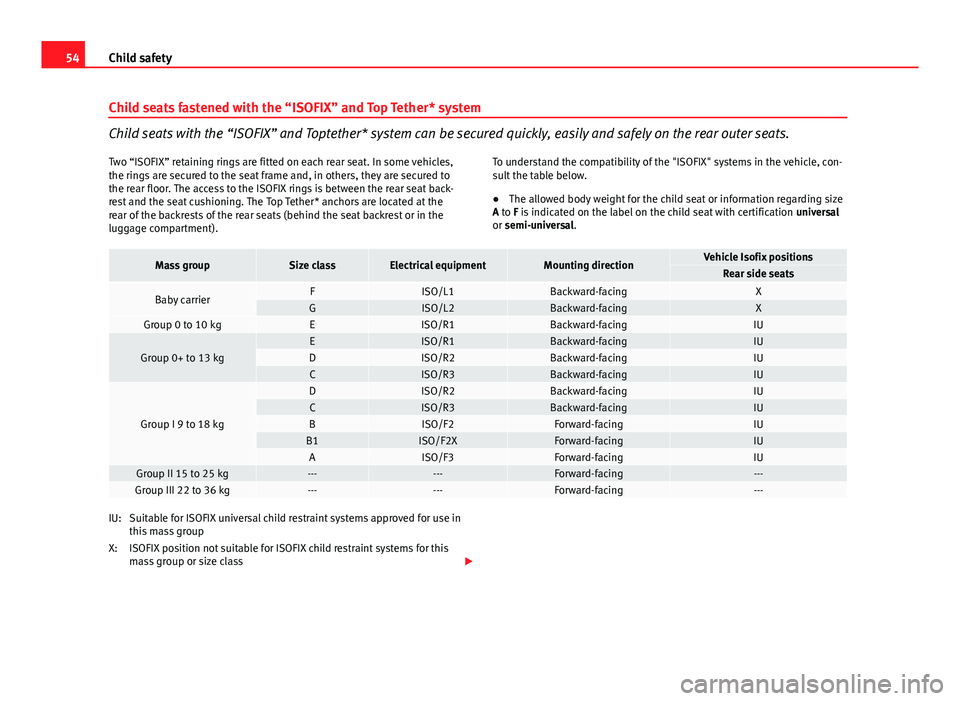
luggage compartment). To understand the compatibility of the "ISOFIX" systems in the vehicle, con-
sult the table below.
●
The allowed body weight for the child seat or information regarding size
A to F is indicated on the label on the child seat with certification universal
or semi-universal.
Mass groupSize classElectrical equipmentMounting directionVehicle Isofix positionsRear side seats
Baby carrierFISO/L1Backward-facingXGISO/L2Backward-facingXGroup 0 to 10 kgEISO/R1Backward-facingIU
Group 0+ to 13 kgEISO/R1Backward-facingIUDISO/R2Backward-facingIUCISO/R3Backward-facingIU
Group I 9 to 18 kg
DISO/R2Backward-facingIUCISO/R3Backward-facingIUBISO/F2Forward-facingIUB1ISO/F2XForward-facingIUAISO/F3Forward-facingIUGroup II 15 to 25 kg------Forward-facing---Group III 22 to 36 kg------Forward-facing---
Suitable for ISOFIX universal child restraint systems approved for use in
this mass group
ISOFIX position not suitable for ISOFIX child restraint systems for this
mass group or size class
IU:
X:
Page 56 of 289

55
Child safety
WARNING
● The securing rings are designed only for use with ISOFIX and Top
Tether* child seats.
● Never secure child seats that do not have the ISOFIX and Top Tether*
system, retaining belts or other objects to the securing rings – this could
result in potentially fatal injuries to the child!
● Ensure that the child seat is secured correctly using the “ISOFIX” and
Top Tether* securing rings.
ISOFIX child seat mounting system
Fig. 32 ISOFIX securing
rings
When removing or fitting the child seat, please be sure to follow
the manufacturer's instructions.
– Remove the protective caps of the “ISOFIX” rings by placing a
finger in the hole and pulling up ⇒
Fig. 32. –
Press the child seat onto the ISOFIX retaining rings until the
child seat can be heard to engage securely. If the child seat is
equipped with Toptether* anchor points, secure it to the corre-
spondent ring. Observe the manufacturer's instructions.
– Do a test by pulling both sides of the car seat to ensure that it is
properly anchored.
Child seats with the ISOFIX and Top Tether* attachment system are available
from Technical Services.
Top Tether retainer straps*
Some child restraint seats have a third Top Tether anchoring
point, apart from both “ISOFIX” anchoring points, which al-
low better child retention.
Fig. 33 Position of the
Top Tether rings on the
back of the rear seat
Safety FirstOperating instructionsPractical TipsTechnical specifications
Page 57 of 289
56Child safety
Child seats with the Top Tether system come with a strap for securing the
seat to the vehicle anchor point, located at the back of the rear seat back-
rest.
The objective of the retainer strap is to reduce forward movements of the
child seat in a crash, helping reduce the risk of injuries to the head from hit-
ting the inside of the vehicle.
Using the Top Tether in rear-facing mounted seats
Currently, there are very few rear-facing child safety seats that have Top
Tether. Please carefully read and follow the seat manufacturer instructions
to learn the proper way to install the Top Tether strap.
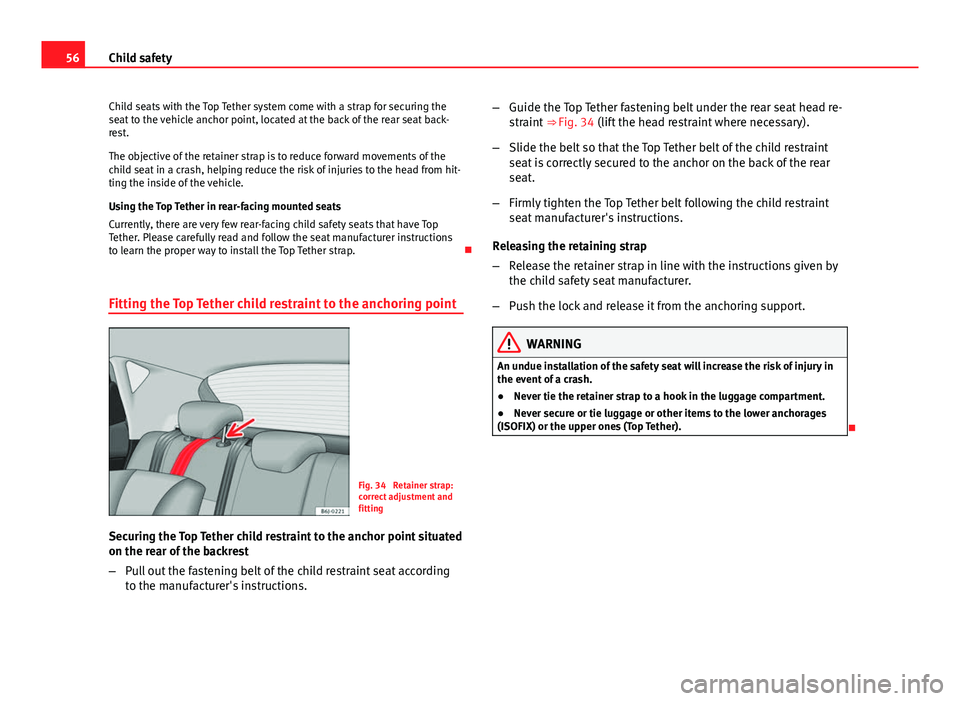
Fitting the Top Tether child restraint to the anchoring point
Fig. 34 Retainer strap:
correct adjustment and
fitting
Securing the Top Tether child restraint to the anchor point situated
on the rear of the backrest
– Pull out the fastening belt of the child restraint seat according
to the manufacturer's instructions. –
Guide the Top Tether fastening belt under the rear seat head re-
straint ⇒ Fig. 34 (lift the head restraint where necessary).
– Slide the belt so that the Top Tether belt of the child restraint
seat is correctly secured to the anchor on the back of the rear
seat.
– Firmly tighten the Top Tether belt following the child restraint
seat manufacturer's instructions.
Releasing the retaining strap
– Release the retainer strap in line with the instructions given by
the child safety seat manufacturer.
– Push the lock and release it from the anchoring support.
WARNING
An undue installation of the safety seat will increase the risk of injury in
the event of a crash.
● Never tie the retainer strap to a hook in the luggage compartment.
● Never secure or tie luggage or other items to the lower anchorages
(ISOFIX) or the upper ones (Top Tether).