brakes Seat Leon 5D 2012 User Guide
[x] Cancel search | Manufacturer: SEAT, Model Year: 2012, Model line: Leon 5D, Model: Seat Leon 5D 2012Pages: 289, PDF Size: 3.81 MB
Page 192 of 289

191
Driving and the environment
Never drive until the tank is empty; an irregular supply of fuel can cause
faulty combustion. In these cases, unburned fuel reaches the exhaust sys-
tem, which can overheat and damage the catalytic converter.
Diesel particulate filter
Applies to vehicles with diesel engine: The diesel particulate filter can filter
out almost all soot particles contained in the exhaust gas. In normal driving
conditions the filter is self-cleaning. The Diesel particulate filter is cleaned
automatically without need for indication by the warning lamp . This may
be noticed because the engine idle speed increases and an odour may be
detected.
If automatic filter purification cannot be carried out (because only short
trips are taken, for example), soot will accumulate on the filter and the Die-
sel particulate filter warning lamp will switch on.
Facilitate the automatic filter cleaning process by driving in the following
manner: Drive for approximately 15 minutes at a minimum speed of 60 km/
h (40 mph) in 4th or 5th gear (automatic gearbox: gear S). Maintain the en-
gine speed at approx. 2000 rpm. The rise in temperature causes the soot on
the filter to burn. On completion of the cleaning the warning lamp will
switch off. If the warning lamp does switch off, go immediately to a special-
ised workshop to rectify the problem.
WARNING
● Because of the high temperatures which can occur in the exhaust gas
control system (catalytic converter or diesel particulate filter), do not
park the vehicle where the exhaust can come into contact with flamma-
ble materials under the car (e.g. on grass or at the forest edge). Fire haz-
ard!
● Do not apply wax underneath the vehicle around the area of the ex-
haust system: Fire hazard!
Economic and ecological driving
Fuel consumption, environmental pollution and wear to the engine, brakes
and tyres depends largely on driving style. Fuel consumption can be re-
duced by 10-15% with an economical driving style and proper anticipation
of traffic conditions. The following section gives you some tips on lessening
the impact on the environment and reducing your operating costs at the
same time.
Foresight when driving
Acceleration causes the vehicle to consume more fuel. If you think ahead
when driving, you will need to brake less and thus accelerate less. Wherever
possible, let the car roll slowly to a stop, with a
gear engaged (for instance
when you can see that the next traffic lights are red). This takes advantage
of the engine braking effect, reducing wear on the brakes and tyres. Emis-
sions and fuel consumption will drop to zero due to the overrun fuel cut-off.
Changing gear to save energy
An effective way of saving is to change in advance to a higher gear. Running
the engine at high rpm in the lower gears uses an unnecessary amount of
fuel.
Manual gearbox : shift up from first to second gear as soon as possible. In
any case, we recommend that you change to a higher gear upon reaching
2000 rpm or so. Choosing the right gear enables fuel savings. Select the
highest possible gear appropriate for the driving situation (the engine
should continue functioning with cyclical regularity).
Automatic gearbox : accelerate gradually and without reaching the “kick-
down” position.
Avoid driving at high speed
Avoid travelling at top speed, whenever possible. Fuel consumption, emis-
sion of harmful gases and noise pollution multiply disproportionately as
speed is increased. Driving at moderate speeds will help to save fuel.
Safety FirstOperating instructionsPractical TipsTechnical specifications
Page 196 of 289

195
Trailer
Note
● Towing a trailer places additional demands on the vehicle. We recom-
mend additional services between the normal inspection intervals if the ve-
hicle is used frequently for towing a trailer.
● Find out whether special regulations apply to towing a trailer in your
country.
Ball coupling of towing bracket*
The ball coupling is provided with instructions on fitting and removing the
ball coupling of the towing bracket.
WARNING
The towing bracket ball coupling must be stored securely in the luggage
compartment to prevent them being flung through the vehicle and caus-
ing injury.
Note
● By law, the ball coupling must be removed if a trailer is not being towed
if it obscures the number plate.
Driving tips
Driving with a trailer always requires extra care. Weight distribution
The weight distribution of a loaded trailer with an unladen vehicle is very
unfavourable. However, if this cannot be avoided, drive extra slowly to allow
for the unbalanced weight distribution. Speed
The stability of the vehicle and trailer is reduced with increasing speed. For
this reason, it is advisable not to drive at the maximum permissible speed
in an unfavourable road, weather or wind conditions. This applies especially
when driving downhill.
You should always reduce speed immediately if the trailer shows the slight-
est sign of
snaking. Never try to stop the “snaking” by increasing speed.
Always brake in due course. If the trailer has an overrun brake, apply the
brakes gently at first and then, firmly. This will prevent the jerking that can
be caused by locking of trailer wheels. Select a low gear in due course be-
fore going down a steep downhill. This enables you to use the engine brak-
ing to slow down the vehicle.
Reheating
At very high temperatures and during prolonged slopes, driving in a low
gear and high engine speed, always monitor the coolant temperature gauge
⇒ page 69.
Electronic Stability Control*
The ESC* system helps to stabilise the trailer in case of skidding or rocking.
Safety FirstOperating instructionsPractical TipsTechnical specifications
Page 202 of 289
201
Care and cleaning
Windows
Clear vision is an essential safety factor.
The windscreen must not be cleaned with insect remover or wax, otherwise
the windscreen wipers will not function properly (juddering).
Traces of rubber, oil, grease or silicone can be removed with a window
cleaning solution or a silicone remover. Wax residue can only be removed
with a special cleaner. Your SEAT Official Service will be able to provide you
with more detailed information.
The windows should also be cleaned on the inside at regular intervals.
Use a separate cloth or chamois to dry the windows. Cloths used for waxing
and polishing contain residues that will cause smears on the glass.
WARNING
Do not use water-repellent coatings on the windscreen. In bad visibility
conditions (e.g. in the rain, dark or with a low sun), these coatings may
cause dazzle: risk of accident! Such coatings can also cause the wind-
screen wiper blades to make noise.
CAUTION
● Remove snow and ice from windows and exterior mirrors with a plastic
scraper only. To avoid scratches caused by dirt on the glass, the scraper
should only be pushed in one direction and not moved to and fro.
● The heating element for the rear window is located on the inner side of
the window. To avoid damaging them, do not apply stickers to the heating
elements.
● Never use warm or hot water to remove snow and ice from windows and
mirrors. This could cause the glass to crack! Rims
The wheels require regular attention to preserve their appearance. It is im-
portant to remove road salt and brake dust by washing the wheels at regu-
lar intervals, otherwise the finish will be impaired.
After washing, the wheels should only be cleaned with an "acid-free" clean-
ing agent for alloy wheels. This is available from SEAT Official Services and
specialist retailers. Never leave the cleaning agent on the rims for any lon-
ger than specified in the instructions before rinsing it off. If the wheel clean-
er fluid contains acid it can attack the surfaces of the wheel bolts.
Car polish or other abrasive agents should not be used for maintaining the
rims. If the protective coating is damaged, e.g. by stone impact, the dam-
aged area should be touched up immediately.
WARNING
Please note when cleaning the wheels that water, ice and road salt can
impair the effectiveness of the brakes; this can cause an accident.
Exhaust tail pipe
It is important to remove road salt and brake dust by washing the wheels at
regular intervals, otherwise the exhaust tail pipe material could be dam-
aged. To remove impurities, do not use rim, paint or chrome cleaners or oth-
er abrasive products. Clean the exhaust tail pipes with cleaning products
that are suitable for stainless steel.
SEAT Official Services carry stocks of cleaning products that have been tes-
ted and approved for use on your vehicle.
Safety FirstOperating instructionsPractical TipsTechnical specifications
Page 218 of 289
217
Checking and refilling levels
Brake fluid
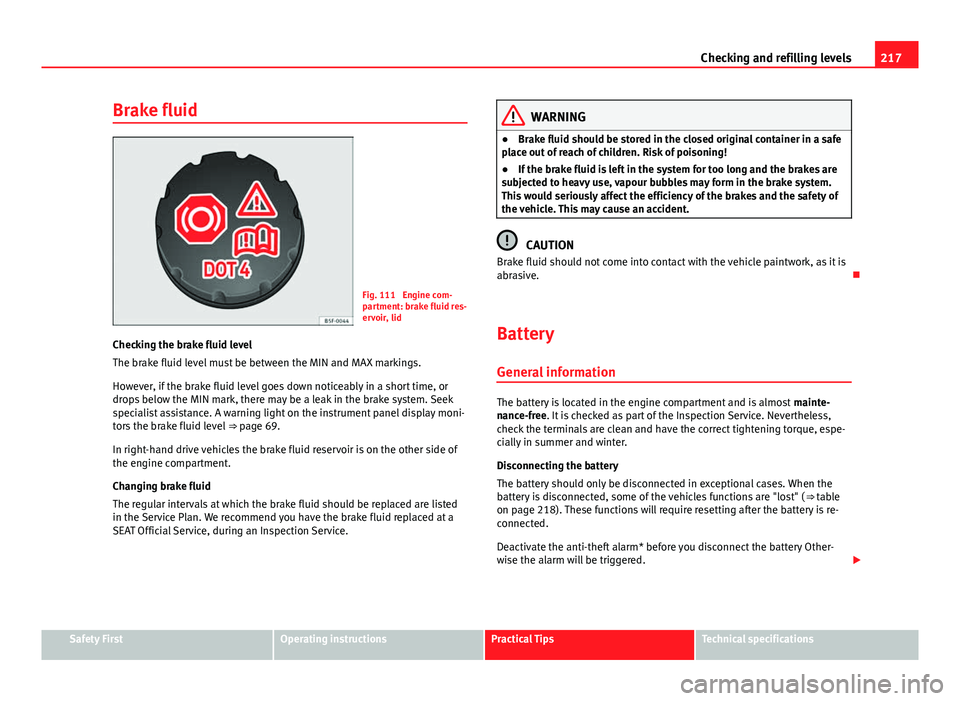
Fig. 111 Engine com-
partment: brake fluid res-
ervoir, lid
Checking the brake fluid level
The brake fluid level must be between the MIN and MAX markings.
However, if the brake fluid level goes down noticeably in a short time, or
drops below the MIN mark, there may be a leak in the brake system. Seek
specialist assistance. A warning light on the instrument panel display moni-
tors the brake fluid level ⇒ page 69.
In right-hand drive vehicles the brake fluid reservoir is on the other side of
the engine compartment.
Changing brake fluid
The regular intervals at which the brake fluid should be replaced are listed
in the Service Plan. We recommend you have the brake fluid replaced at a
SEAT Official Service, during an Inspection Service.
WARNING
● Brake fluid should be stored in the closed original container in a safe
place out of reach of children. Risk of poisoning!
● If the brake fluid is left in the system for too long and the brakes are
subjected to heavy use, vapour bubbles may form in the brake system.
This would seriously affect the efficiency of the brakes and the safety of
the vehicle. This may cause an accident.
CAUTION
Brake fluid should not come into contact with the vehicle paintwork, as it is
abrasive.
Battery General information
The battery is located in the engine compartment and is almost mainte-
nance-free. It is checked as part of the Inspection Service. Nevertheless,
check the terminals are clean and have the correct tightening torque, espe-
cially in summer and winter.
Disconnecting the battery
The battery should only be disconnected in exceptional cases. When the
battery is disconnected, some of the vehicles functions are "lost" ( ⇒ table
on page 218). These functions will require resetting after the battery is re-
connected.
Deactivate the anti-theft alarm* before you disconnect the battery Other-
wise the alarm will be triggered.
Safety FirstOperating instructionsPractical TipsTechnical specifications
Page 269 of 289

268Technical specifications
Petrol engine 1.2 63 kW (85 PS)
Engine specifications
Power output in kW (PS) rpm 63 (85)/ 4300-5300
Maximum torque in Nm at rpm 160/ 1400-3500
No. of cylinders/capacity in cm3
4/ 1197
Fuel Super 95 RON a)
a)
Research Octane Number = Anti-detonation rating of the petrol.
Performance Maximum speed in km/h (mph) 179 (V)
Acceleration from 0-80 km/h (0-60 mph) in sec. 7,7
Acceleration from 0-100 km/h (0-60 mph) in sec. 11,7
Weights
Gross vehicle weight in kg 1720
Weight in running order (with driver) in kg 1192
Gross front axle weight in kg 910
Gross rear axle weight in kg 860
Permitted roof load in kg 75
Trailer weight
Trailer without brakes in kg 590
Trailer with brakes, gradients up to 8% in kg 1300
Trailer with brakes, gradients up to 12% in kg 1100
Page 270 of 289

269
Technical specifications
Petrol engine 1.2 77 kW (105 PS)
Engine specifications Power output in kW (PS) rpm 77 (105)/ 4500-5500
Maximum torque in Nm at rpm 175/ 1400-4000
No. of cylinders/capacity in cm3
4/ 1197
Fuel Super 95 RON a)
a)
Research Octane Number = Anti-detonation rating of the petrol.
Performance ManualStart-Stop Automatic
Maximum speed in km/h (mph) 192 (V) 193 (V) 191 (VI)
Acceleration from 0-80 km/h (0-60
mph) in sec. 6,7
6,6 6,8
Acceleration from 0-100 km/h (0-60
mph) in sec. 10,1
10 10
Weights
ManualStart-Stop Automatic
Gross vehicle weight in kg 1720 1740 1760
Weight in running order (with driver) in kg 1194 1205 1229
Gross front axle weight in kg 910 920 950
Gross rear axle weight in kg 860 870 860
Permitted roof load in kg 75 75 75
Trailer weight
ManualStart-Stop Automatic
Trailer without brakes in kg 590 600 610
Trailer with brakes, gradients up to 8% in kg 1500 1500 1500
Trailer with brakes, gradients up to 12% in kg 1300 1300 1300
Safety FirstOperating instructionsPractical TipsTechnical specifications
Page 271 of 289
270Technical specifications
Petrol engine 1.4 90 kW (122 PS) Start-Stop
Engine specifications
Power output in kW (PS) rpm 90 (122)/ 5000-6000
Maximum torque in Nm at rpm 200/ 1400-4000
No. of cylinders/capacity in cm3
4/ 1395
Fuel Super 95 RON a)
a)
Research Octane Number = Anti-detonation rating of the petrol.
Performance Maximum speed in km/h (mph) 202 (V)
Acceleration from 0-80 km/h (0-60 mph) in sec. 6,2
Acceleration from 0-100 km/h (0-60 mph) in sec. 9,3
Weights
Gross vehicle weight in kg 1760
Weight in running order (with driver) in kg 1224
Gross front axle weight in kg 930
Gross rear axle weight in kg 880
Permitted roof load in kg 75
Trailer weight
Trailer without brakes in kg 610
Trailer with brakes, gradients up to 8% in kg 1700
Trailer with brakes, gradients up to 12% in kg 1400
Page 272 of 289

271
Technical specifications
Petrol engine 1.4 103 kW (140 PS) Start-Stop
Engine specifications Power output in kW (PS) rpm 103 (140)/ 5000
Maximum torque in Nm at rpm 250/ 1500-3500
No. of cylinders/capacity in cm3
4/ 1395
Fuel Super 95 RON a)
/Normal 91 RON b)
a)
Research Octane Number = Anti-detonation rating of the petrol.
b) With a slight power loss
Performance Maximum speed in km/h (mph) 212 (V&VI)
Acceleration from 0-80 km/h (0-60 mph) in sec. 5,8
Acceleration from 0-100 km/h (0-60 mph) in sec. 8,2
Weights
Gross vehicle weight in kg 1740
Weight in running order (with driver) in kg 1228
Gross front axle weight in kg 910
Gross rear axle weight in kg 880
Permitted roof load in kg 75
Trailer weight
Trailer without brakes in kg 610
Trailer with brakes, gradients up to 8% in kg 1800
Trailer with brakes, gradients up to 12% in kg 1500
Engine oil filling capacity
Approximate engine oil capacity with oil filter change 4.0 litres
Safety FirstOperating instructionsPractical TipsTechnical specifications
Page 273 of 289

272Technical specifications
Petrol engine 1.8 132 kW (180 PS) Start-Stop
Engine specifications
Power output in kW (PS) rpm 132 / 5100-6200
Maximum torque in Nm at rpm 250/ 1250-3900
No. of cylinders/capacity in cm3
4/ 1798
Fuel Super 95 RON a)
a)
Research Octane Number = Anti-detonation rating of the petrol.
Performance ManualAutomatic
Maximum speed in km/h (mph) 225 (V&VI) 225 (VI)
Acceleration from 0-80 km/h (0-60 mph) in sec. 5,5 5,5
Acceleration from 0-100 km/h (0-60 mph) in sec. 7,5 7,5
Weights
Manual Automatic
Gross vehicle weight in kg 1810 1820
Weight in running order (with driver) in kg 1300 1315
Gross front axle weight in kg 980 1000
Gross rear axle weight in kg 880 870
Permitted roof load in kg 75 75
Trailer weight
ManualAutomatic
Trailer without brakes in kg 650 650
Trailer with brakes, gradients up to 8% in kg 1800 1800
Trailer with brakes, gradients up to 12% in kg 1500 1500
Page 274 of 289

273
Technical specifications
Diesel engine 1.6 66 kW (90 PS)
Engine specifications Power output in kW (PS) rpm 66 (90) /2750-4800
Maximum torque in Nm at rpm 230/1400-2750
No. of cylinders/capacity in cm3
4/1598
Fuel Diesel according to standard EN 590, Min. 51 CN
Performance
Maximum speed in km/h (mph) 179 (IV)
Acceleration from 0-80 km/h (0-60 mph) in sec. 8,2
Acceleration from 0-100 km/h (0-60 mph) in sec. 12,6
Weights
Gross vehicle weight in kg 1820
Weight in running order (with driver) in kg 1281
Gross front axle weight in kg 990
Gross rear axle weight in kg 850
Permitted roof load in kg 75
Trailer weight
Trailer without brakes in kg 640
Trailer with brakes, gradients up to 8% in kg 1700
Trailer with brakes, gradients up to 12% in kg 1400
Safety FirstOperating instructionsPractical TipsTechnical specifications