oil Seat Leon 5D 2013 User Guide
[x] Cancel search | Manufacturer: SEAT, Model Year: 2013, Model line: Leon 5D, Model: Seat Leon 5D 2013Pages: 339, PDF Size: 4.8 MB
Page 167 of 339
165
Driving
WARNING
● Never run the engine in confined spaces, as the exhaust gases are
poisonous.
● Never remove the key from the ignition if the vehicle is in motion.
Otherwise, the steering could suddenly lock, making it impossible to
steer the vehicle: risk of accident!
● Always take the key with you when you leave the vehicle. This is par-
ticularly important if there are children in the vehicle, as they might oth-
erwise be able to start the engine or use power-operated equipment (e.g.
the electric windows), which could cause injuries.
CAUTION
Avoid high engine speeds, full throttle and extreme load conditions until
the engine has reached its normal operating temperature, otherwise this
can damage the engine.
For the sake of the environment
Do not warm up the engine by running it with the car stationary. You should
drive off as soon as you start the engine. This will help avoid unnecessary
exhaust emissions.
Note
● If it is difficult to turn the ignition key to the position 1, turn the steer-
ing wheel to both sides to release the steering lock.
● When starting from cold, the engine may be a little noisy for the first few
seconds until oil pressure has built up in the hydraulic valve lifters. This is
quite normal, and no cause for concern.
● If the vehicle battery is disconnected and reconnected, the key must re-
main in the position 1
for around 5 seconds before starting up.
● Vehicles with automatic gearbox: After switching off the ignition, you
can only remove the ignition key if the selector lever is in position “P” (park-
ing lock). Next, the selector lever is locked. Switching off the engine with the key
Switching off the engine
–
Stop the vehicle.
– Turn the ignition key to position 1
⇒ Fig. 118.
Engaging the steering wheel lock
Important: selector lever (automatic gearbox*) must be in position
P.
– Remove the key from the ignition in position 1
⇒ Fig. 118
⇒ .
– Turn the steering wheel until you hear it engage.
Possible vehicle theft is prevented with the steering lock engaged.
WARNING
● Never switch the engine off until the vehicle is stationary. The brake
servo and power steering functions will not be completely covered under
warranty. More force may also be needed to turn the steering wheel or to
brake. As you cannot steer and brake in the normal manner, there is a
greater risk of accidents and serious injury.
● Never remove the key from the ignition if the vehicle is in motion.
Otherwise, the steering could lock making it impossible to steer the vehi-
cle.
● Always take the ignition key with you whenever you leave the vehicle,
even temporarily. This is particularly important if there are children in
the vehicle, as they might otherwise be able to start the engine or use
power-operated equipment (e.g. the electric windows), which could
cause injuries.
Safety FirstOperating instructionsPractical TipsTechnical specifications
Page 194 of 339
192Driver assistance systems
On the front bumper there is a radar sensor to detect traffic conditions
⇒ Fig. 131 1
. This sensor can detect vehicles driving ahead at a distance
of up to approx. 120 m.
The radar sensor's visibility may be impaired by dirt, such as mud or snow,
or by environmental influences, such as rain or water mist. In this case the
adaptive cruise control (ACC) does not work. The following message is
shown in the instrument panel display: ACC: Sensor without visibility!. If nec-
essary, clean the radar sensor ⇒
.
When the radar sensor works properly again, the ACC will be automatically
available again. The message on the instrument panel display will go off
and the ACC can be switched on again.
ACC operation may be affected by a heavy reverse reflection of the radar sig-
nal. This may occur, for example, in a closed car park or due to the presence
of metal objects (e.g. rails on the road or the panels used on work sites).
The area ahead of and behind the radar sensor should not be covered with
adhesives, additional headlights or the likes, as this may have a negative
effect on ACC operation.
If structural modifications are made to the vehicle, e.g., if the suspension is
lowered or the front spoiler is modified, ACC operation may be affected. This
is why structural modifications should only be assigned to specialised work-
shops. SEAT recommends visiting a SEAT dealership for this.
If the front part of the vehicle is repaired incorrectly, the radar sensor might
lose its setting and ACC operation would be affected. This is why repair jobs
should only be assigned to specialised workshops. SEAT recommends visit-
ing a SEAT dealership for this.
CAUTION
If you have the impression that the radar sensor is damaged or has lost its
setting, disconnect the ACC. This will prevent possible damage. In this case
have it adjusted.
● The sensor may lose its settings if it is knocked, for example, during a
parking manoeuvre. This may compromise the system's efficacy or lead it to
switch off.
● A radar sensor repair requires specialist knowledge and special tools.
SEAT recommends visiting a SEAT dealership for this.
● Snow should be removed with a brush, while ice should be removed
with a solvent-free anti-ice aerosol.
Page 206 of 339
204Driver assistance systems
WARNING
Failure to heed the warning lamps when they light up and the corre-
sponding messages may result in an accident and injury.
● Never ignore the warning lamps or on-screen messages.
Note
When the Front Assist is connected, the instrument panel display messages
pertaining to other functions may be hidden, such as an incoming call.
Radar sensor
Fig. 139 On the front
bumper: radar sensor.
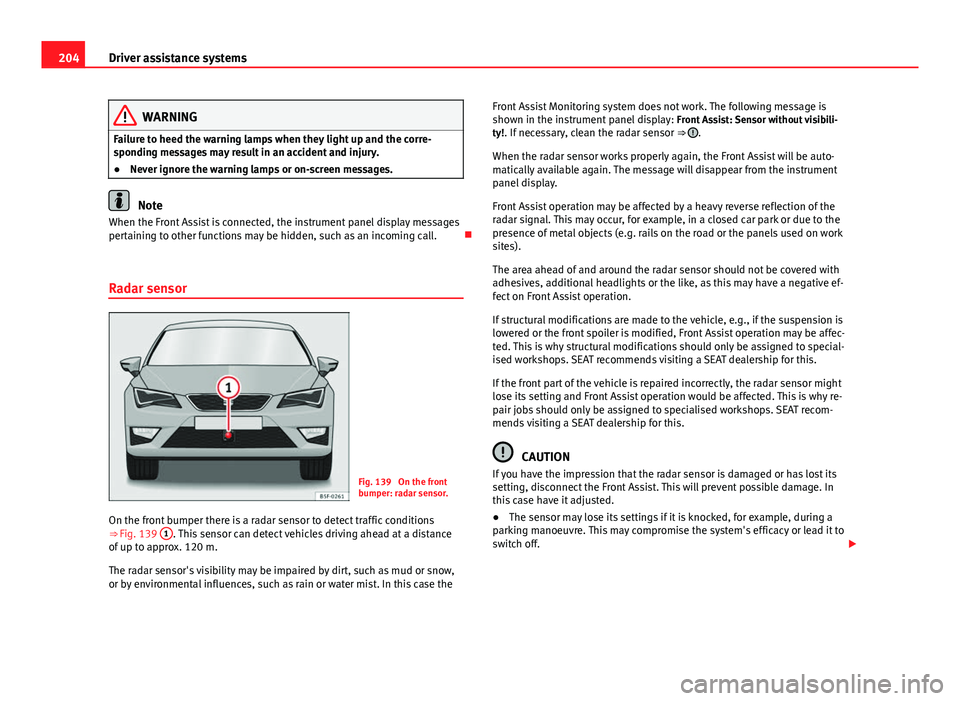
On the front bumper there is a radar sensor to detect traffic conditions
⇒ Fig. 139 1
. This sensor can detect vehicles driving ahead at a distance
of up to approx. 120 m.
The radar sensor's visibility may be impaired by dirt, such as mud or snow,
or by environmental influences, such as rain or water mist. In this case the Front Assist Monitoring system does not work. The following message is
shown in the instrument panel display:
Front Assist: Sensor without visibili-
ty!. If necessary, clean the radar sensor ⇒
.
When the radar sensor works properly again, the Front Assist will be auto-
matically available again. The message will disappear from the instrument
panel display.
Front Assist operation may be affected by a heavy reverse reflection of the
radar signal. This may occur, for example, in a closed car park or due to the
presence of metal objects (e.g. rails on the road or the panels used on work
sites).
The area ahead of and around the radar sensor should not be covered with
adhesives, additional headlights or the like, as this may have a negative ef-
fect on Front Assist operation.
If structural modifications are made to the vehicle, e.g., if the suspension is
lowered or the front spoiler is modified, Front Assist operation may be affec-
ted. This is why structural modifications should only be assigned to special-
ised workshops. SEAT recommends visiting a SEAT dealership for this.
If the front part of the vehicle is repaired incorrectly, the radar sensor might
lose its setting and Front Assist operation would be affected. This is why re-
pair jobs should only be assigned to specialised workshops. SEAT recom-
mends visiting a SEAT dealership for this.
CAUTION
If you have the impression that the radar sensor is damaged or has lost its
setting, disconnect the Front Assist. This will prevent possible damage. In
this case have it adjusted.
● The sensor may lose its settings if it is knocked, for example, during a
parking manoeuvre. This may compromise the system's efficacy or lead it to
switch off.
Page 227 of 339
225
Intelligent technology
Corrosion
There may be a tendency for corrosion to form on the discs and dirt to build
up on the brake pads if the vehicle is used infrequently or the brakes are
not used very often.
If the brakes are not used frequently, or if rust has formed on the disks, it is
advisable to clean off the pads and disks by braking firmly a few times at a
moderately high speed ⇒
.
Fault in the brake system
If the brake pedal travel should ever increase suddenly, this may mean that
one of the two brake circuits has failed. Drive immediately to the nearest
specialised workshop and have the fault repaired. Drive there slowly and re-
member that you will have to apply more pressure on the brake pedal and
allow for longer stopping distances.
Low brake fluid level
Malfunctions can occur in the brake system if the brake fluid level is too
low. The brake fluid level is monitored electronically.
Brake servo
The brake servo increases the pressure you apply to the brake pedal. It
works only when the engine is running.
WARNING
● Apply the brakes heavily to clean the brake system only in a suitable
traffic situation. Do not put other road users in danger: risk of causing an
accident.
● Ensure the vehicle does not move while in neutral, when the engine is
stopped. Failure to do so could result in an accident.
CAUTION
● Never let the brakes “drag” by leaving your foot on the pedal when it is
not necessary to brake. This overheats the brakes, resulting in longer stop-
ping distances and greater wear.
● Before driving down a long, steep gradient, it is advisable to reduce
speed and select a lower gear. This makes use of engine braking and re-
lieves the brakes. If you still have to use the brakes, it is better to brake
firmly at intervals than to apply the brakes continuously.
Note
● If the brake servo is out of action due to a malfunction, or if the car has
to be towed, you will have to press the brake pedal considerably harder to
make up for the lack of servo assistance.
● If you wish to equip the vehicle with accessories such as a front spoiler
or wheel covers, it is important that the flow of air to the front wheels is not
obstructed, otherwise the brakes can overheat.
Electro-mechanical steering
Electro-mechanical power steering assists the driver when
steering.
Electro-mechanical power steering adapts electronically to the speed of the
car, torque and turning angle.
If the power steering should fail at any time or the engine is switched off (for
instance when being towed), the car can still be steered. However, more ef-
fort than normal will be required to turn the steering wheel.
Driver warning lamps and messages
(in red) Faulty steering! To park the vehicle
Safety FirstOperating instructionsPractical TipsTechnical specifications
Page 240 of 339
238Care and cleaning
Care and cleaning
General information
Regular care helps to maintain the value of the vehicle.
Regular and careful care helps to maintain the value of the vehicle. This may
also be one of the requirements for upholding any warranty claims in the
event of corrosion or paint defects.
SEAT Official Services and specialist retailers carry stocks of suitable car
care materials. Please follow the instructions for use on the packaging.
WARNING
● Cleaning products and other materials used for car care can be dam-
aging to your health if misused.
● Always keep care products in a safe place, out of the reach of chil-
dren. Failure to comply could result in poisoning.
For the sake of the environment
● If possible, use environmentally friendly products.
● The remains of car care products should not be disposed of with ordina-
ry household waste. Care of vehicle exterior
Washing the vehicle
The longer substances such as insects, bird droppings, resinous tree sap,
road dirt, industrial deposits, tar, soot or road salt and other aggressive ma-
terials remain on the vehicle, the more damage they do to the paintwork.
High temperatures (for instance due to strong sunlight) further intensify the
corrosive effect.
After the period when salt is put on the roads it is important to have the un-
derside of the vehicle washed thoroughly.
Automatic car washes
Before going through a car wash, be sure to take the usual precautions such
as closing the windows and roof. If the vehicle has special accessories such
as spoilers or a roof carrier or two-way radio aerial, etc., it is advisable to
consult the car wash operator.
It is best to use a car wash without revolving bristles if possible.
Washing the vehicle with a high pressure cleaner
When washing the vehicle with a high-pressure cleaner, always follow the
operating instructions for the equipment. This applies particularly to the op-
erating pressure and the spraying distance. Do not hold the nozzle too
close to soft materials such as rubber hoses or seals. The same applies to
the parking aid sensors*, which are located in the rear bumper.
Do not use a nozzle that sprays the water out in a direct stream or one that
has a rotating jet for forcing off dirt.
Page 241 of 339
239
Care and cleaning
Washing the car by hand
When washing the car by hand, use plenty of water to soften the dirt first,
and rinse off as well as possible.
Then clean the vehicle with a soft sponge, glove or brush using only slight
pressure. You should start on the roof and work down. Special car shampoo
should only be used for very persistent dirt.
Rinse the sponge or glove thoroughly and often.
Wheels, sills and similar should be cleaned last. Use a second sponge for
this.
WARNING
● The vehicle should only be washed with the ignition switched off.
Failure to do so could result in an accident.
● Do not clean the underside of chassis, the inside of wheel arches or
wheel trims without protecting your hands and arms. You may cut your-
self on sharp-edged metal parts. Otherwise, there is a risk of sustaining
cuts.
● When washing the car during the winter season: water and ice in the
brake system can reduce braking effectiveness: risk of accident!
CAUTION
● Do not wash the vehicle in direct sunlight – otherwise the paint can be
damaged.
● Do not use sponges, abrasive household sponges or similar to clean in-
sect remains. This could damage the surface.
● Clean off stubborn dirt (insects, etc.) from the headlights at regular in-
tervals, for instance when filling the fuel tank. The headlights should only
be washed with water, do not wipe them with a dry cloth or sponge. It is
best to use soapy water. ●
Never wash tyres with a jet that sprays the water out in a direct stream.
This could damage the tyres even if the spray is kept at a distance and only
used for a very short time.
● Before washing the vehicle in an automatic car wash, please make sure
to retract the exterior mirrors to prevent them from being damaged. Electri-
cally retractable exterior mirrors must not be folded in or out by hand. Al-
ways use the electrical power control.
CAUTION
● If you wash the vehicle in an automatic car wash, proceed as follows to
lock and prevent the windscreen wiper blades from being pushed up to-
wards the top of the windscreen:
–the bonnet must be closed
– switch the ignition on and off
– press the windscreen wiper lever downwards briefly towards the front
(windscreen wiper function). The windscreen wiper blades will be
locked.
For the sake of the environment
The car should only be washed in special wash bays. This prevents oily wa-
ter from getting into the public drains. In some places, washing vehicles
anywhere else may be prohibited.
Sensors and camera lenses
● Use a small brush to remove snow and a de-icer spray to remove ice.
● Clean the sensors with a solvent-free product and a soft, dry cloth.
● Moisten the camera lens using a standard alcohol-based glass cleaning
agent and clean the lens with a dry cloth. The area in front of the active
Lane Assist* lens area is normally cleaned with the windscreen washer.
Safety FirstOperating instructionsPractical TipsTechnical specifications
Page 243 of 339
241
Care and cleaning
Carbon components
The carbon parts on your vehicle have a painted surface. They do not need
any special care and are cleaned just like any other painted part
⇒ page 238.
Paint damage
Minor damage to the paint, such as scratches or stone chips, should be
touched up without delay before the metal starts to corrode. Suitable touch-
up brushes or sprays for your car can be obtained from a SEAT Official Serv-
ice.
The number of the original paint finish on the vehicle is given on the data
sticker ⇒ page 305.
If corrosion is already visible it must be thoroughly removed by a special-
ised workshop.
Windows
Clear vision is an essential safety factor.
The windscreen must not be cleaned with insect remover or wax, otherwise
the windscreen wipers will not function properly (juddering).
Traces of rubber, oil, grease or silicone can be removed with a window
cleaning solution or a silicone remover. Wax residue can only be removed
with a special cleaner. Your SEAT Official Service will be able to provide you
with more detailed information.
The windows should also be cleaned on the inside at regular intervals. Use a separate cloth or chamois to dry the windows. Cloths used for waxing
and polishing contain residues that will cause smears on the glass.
WARNING
Do not use water-repellent coatings on the windscreen. In bad visibility
conditions (e.g. in the rain, dark or with a low sun), these coatings may
cause dazzle: risk of accident! Such coatings can also cause the wind-
screen wiper blades to make noise.
CAUTION
● Remove snow and ice from windows and exterior mirrors with a plastic
scraper only. To avoid scratches caused by dirt on the glass, the scraper
should only be pushed in one direction and not moved to and fro.
● The heating element for the rear window is located on the inner side of
the window. To avoid damaging them, do not apply stickers to the heating
elements.
● Never use warm or hot water to remove snow and ice from windows and
mirrors. This could cause the glass to crack!
Rims
The wheels require regular attention to preserve their appearance. It is im-
portant to remove road salt and brake dust by washing the wheels at regu-
lar intervals, otherwise the finish will be impaired.
After washing, the wheels should only be cleaned with an "acid-free" clean-
ing agent for alloy wheels. This is available from SEAT Official Services and
specialist retailers. Never leave the cleaning agent on the rims for any lon-
ger than specified in the instructions before rinsing it off. If the wheel clean-
er fluid contains acid it can attack the surfaces of the wheel bolts.
Safety FirstOperating instructionsPractical TipsTechnical specifications
Page 245 of 339
243
Care and cleaning
sponge. If the stains are difficult to remove, a washing paste can be applied
directly onto the stain and worked into the fabric. The surface will then have
to be wiped with clear water to remove any residue left by the paste. To do
so, use a damp cloth or sponge and then dab the stain with an absorbent
cloth.
Remove chocolate or make-up stains with a cleaning paste (for e.g., soft
soap). Then remove the soap with water (wet sponge).
A spirit-based cleaner can be used to remove grease, oil, lipstick or ball
point pen. Then dab the dissolved grease or colour particles off with an ab-
sorbent cloth or similar. You may also have to treat the stain once more us-
ing washing paste and water.
If the covers or textile trim panels are badly soiled we recommend that you
have them cleaned by a professional cleaning company with a shampoo
and spray.
Note
Open Velcro fasteners on clothes can damage the seat upholstery. Make
sure that Velcro fasteners are closed.
Natural leather
SEAT does everything possible to preserve the genuine qual-
ities of this natural product. General information
Our range of leathers is large. The main type used is nappa in various forms,
that is, leather with a smooth surface in various different colours.
The amount of dye used determines the appearance and properties of leath-
er. If the leather is left in a more natural state, it retains its typical natural
napped appearance and confers excellent all-weather properties to the
seats. Fine veins, healed scars, insect bites, wrinkles and a subtle variation in shading remain visible; these are the characteristic features of genuine
natural leather.
Natural napped leather does not have a protective surface coating of dye. It
is therefore somewhat more prone to damage. This should be borne in mind
if children or pets often travel in the car, or if there are other factors that
could lead to damage.
Types of leather with a coloured surface coating are likely to be more resist-
ant to damage. This has a great advantage for day-to-day use. However, this
means that the typical natural characteristics of the surface are less appa-
rent, though this does not affect quality.
Cleaning and care
Due to the natural properties of the specially selected hides employed, the
finished leather has a certain sensitivity to grease and dirt, etc. so a degree
of care is required in everyday use and when looking after the leather. Dark
clothing (especially if damp or incorrectly dyed) may stain leather uphols-
tery. Dust and grit in the pores and seams can scratch and damage the sur-
face. Therefore leather should be cleaned at regular intervals, depending on
the actual amount of use. When they have been in use for a certain time,
your car seats will acquire a typical and unmistakable patina. This is charac-
teristic for leather as a natural product and is a sign of genuine quality.
To maintain the value of natural leather you should note the following
points:CAUTION
● Avoid exposing leather to direct sunlight for long periods, otherwise it
may tend to lose some of its colour. If the car is left for a prolonged period
in the bright sun, it is best to cover the leather.
● Sharp-edged objects on clothing, such as belts, zip fasteners, rivets or
similar, can also leave permanent scratches and rough marks on the surface
of the leather.
Safety FirstOperating instructionsPractical TipsTechnical specifications
Page 254 of 339

252Checking and refilling levels
WARNING (Continued)
● Protect face, hands and arms by covering the cap with a large, thick
rag to protect against escaping coolant and steam.
● If it is necessary to work in the engine compartment while the engine
is running, the rotating components (for example, poly-V belt, alternator,
radiator fan) and the high voltage ignition system are an additional haz-
ard.
● Observe the following additional warnings if work on the fuel system
or the electrical system is necessary:
–Always disconnect the battery from the on-board network.
– Do not smoke.
– Never work near naked flames.
– Always keep an approved fire extinguisher immediately available.
CAUTION
When changing or topping up service fluids, make absolutely certain that
you fill the fluids into the correct reservoirs. Using the wrong fluids could
cause serious malfunctions and engine damage!
For the sake of the environment
Inspect the ground underneath your vehicle regularly so that any leaks are
detected at an early stage. If you find spots of oil or other fluids, have your
vehicle inspected at the workshop.
Note
On right-hand drive vehicles* some of the containers/reservoirs mentioned
below are located on the other side of the engine compartment. Opening the bonnet
The bonnet is released from inside the vehicle.
Fig. 153 Release lever in driver footwell and cam below the bonnet
Check that the windscreen wiper arms are not unfolded. Otherwise
the paint may be damaged.
The bonnet can only be unlocked when the driver door is open.
– Pull the lever under the dash panel in the direction of the arrow
1
⇒ Fig. 153.
– Lift the bonnet slightly ⇒
.
– Press the release catch under the bonnet upwards ⇒ Fig. 153
2
. This will release the arrester hook under the bonnet.
– Open the bonnet. Release the bonnet stay and secure it in fix-
ture designed for this in the bonnet.
Page 255 of 339

253
Checking and refilling levels
WARNING
Never open the bonnet if you see steam or drips of coolant being re-
leased from the engine compartment. Failure to comply could result in
burns. Wait until no steam or coolant can be seen before opening the
bonnet.
Closing the bonnet
– Slightly raise the bonnet.
– Release the bonnet stay before pressing it back into its support.
– Carefully close the bonnet.
– Press the bonnet down until it locks into place.
– Make sure that the bonnet catches onto its clasp. Do not press
down too hard ⇒
.
WARNING
● For safety reasons the bonnet must always be completely closed
when the vehicle is moving. Therefore, after closing the bonnet, always
check that the locking element is properly engaged. This is the case if
the bonnet is flush with the adjacent body panels.
● Should you notice that the bonnet is not safely secured when the ve-
hicle is moving, stop the vehicle immediately and close the bonnet. Fail-
ure to do so could result in an accident.
Engine oil
General notes
The engine comes with a special, multi-grade oil that can be used all year
round.
Because the use of high-quality oil is essential for the correct operation of
the engine and its long useful life, when topping up or changing oil, use on-
ly those oils that comply with VW standards.
The specifications (VW standards) set out in the following page should ap-
pear on the container of the service oil; when the container displays the
specific standards for petrol and diesel engines together, it means that the
oil can be used for both types of engines.
We recommend that the oil change, indicated in the Maintenance Pro-
gramme, be performed by a Technical Service or a specialised workshop.
The correct oil specifications for your engine are listed in the ⇒ page 254,
Oil properties.
Service intervals
Service intervals can be flexible (LongLife service) or fixed (dependent on
time/distance travelled).
If the PR code that appears on the back of the “Maintenance Programme”
booklet is PR QI6, this means that your vehicle has the LongLife service pro-
grammed. If it lists the codes QI1, QI2, QI3, QI4 or QI7, the interval service
is dependent on time/distance travelled.
Flexible service intervals (LongLife service intervals*)
Special oils and processes have been developed which, depending on the
characteristics and individual driving profiles, enable the extension of the
oil change service (LongLife service intervals).
Safety FirstOperating instructionsPractical TipsTechnical specifications