oil Seat Leon 5D 2013 Owner's Guide
[x] Cancel search | Manufacturer: SEAT, Model Year: 2013, Model line: Leon 5D, Model: Seat Leon 5D 2013Pages: 339, PDF Size: 4.8 MB
Page 256 of 339
254Checking and refilling levels
Because this oil is essential for extending the service intervals, it must only
be used observing the following indications:
● Avoid mixing it with oil for fixed service intervals.
● Only in exceptional circumstances, if the engine oil level is too low
⇒ page 255 and LongLife oil is not available, it is permitted to top up
(once) with oil for fixed service intervals ⇒ page 254 (up to a maximum of
0.5 litres).
Fixed service intervals*
If your vehicle does not have the “LongLife service interval” or it has been
disabled (by request), you may use oils for fixed service intervals, which al-
so appear in ⇒ page 254, Oil properties. In this case, your vehicle must be
serviced after a fixed interval of 1 year/15 000 km (10 000 miles)(whatever
comes first) ⇒ Booklet Maintenance Programme.
● In exceptional circumstances, if the engine oil level is too low
⇒ page 255 and you cannot obtain the oil specified for your vehicle, you
can put in a small quantity of oil conforming to the specification ACEA A2 or
ACEA A3 (petrol engines) or ACEA B3 or ACEA B4 (diesel engines) (up to 0.5
l).
Vehicles with diesel particulate filter*
The “Maintenance Programme” states whether your vehicle is fitted with a
diesel particulate filter.
Only VW 507 00 engine oil, with reduced ash formation, may be used in die-
sel engines equipped with particulate filter. Using other types of oil will
cause a higher soot concentration and reduce the life of the DPF. Therefore:
● Avoid mixing this oil with other engine oils.
● Only in exceptional circumstances, if the engine oil level is too low
⇒ page 255 and you cannot obtain the oil specified for your vehicle, you
can use a small quantity of oil (once) conforming to the VW 506 00,
VW 506 01, VW 505 00, VW 505 01 or ACEA B3/ACEA B4 specification. (up
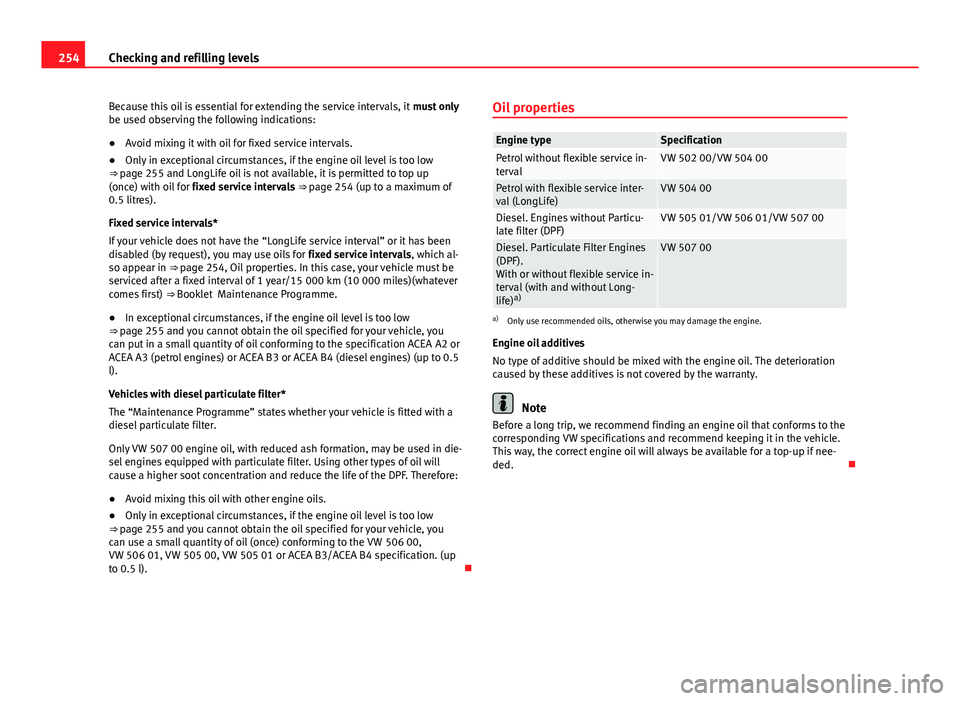
to 0.5 l). Oil properties
Engine typeSpecificationPetrol without flexible service in-
tervalVW 502 00/VW 504 00
Petrol with flexible service inter-
val (LongLife)VW 504 00
Diesel. Engines without Particu-
late filter (DPF)VW 505 01/VW 506 01/VW 507 00
Diesel. Particulate Filter Engines
(DPF).
With or without flexible service in-
terval (with and without Long-
life)
a)VW 507 00
a)
Only use recommended oils, otherwise you may damage the engine.
Engine oil additives
No type of additive should be mixed with the engine oil. The deterioration
caused by these additives is not covered by the warranty.
Note
Before a long trip, we recommend finding an engine oil that conforms to the
corresponding VW specifications and recommend keeping it in the vehicle.
This way, the correct engine oil will always be available for a top-up if nee-
ded.
Page 257 of 339
255
Checking and refilling levels
Checking engine oil level
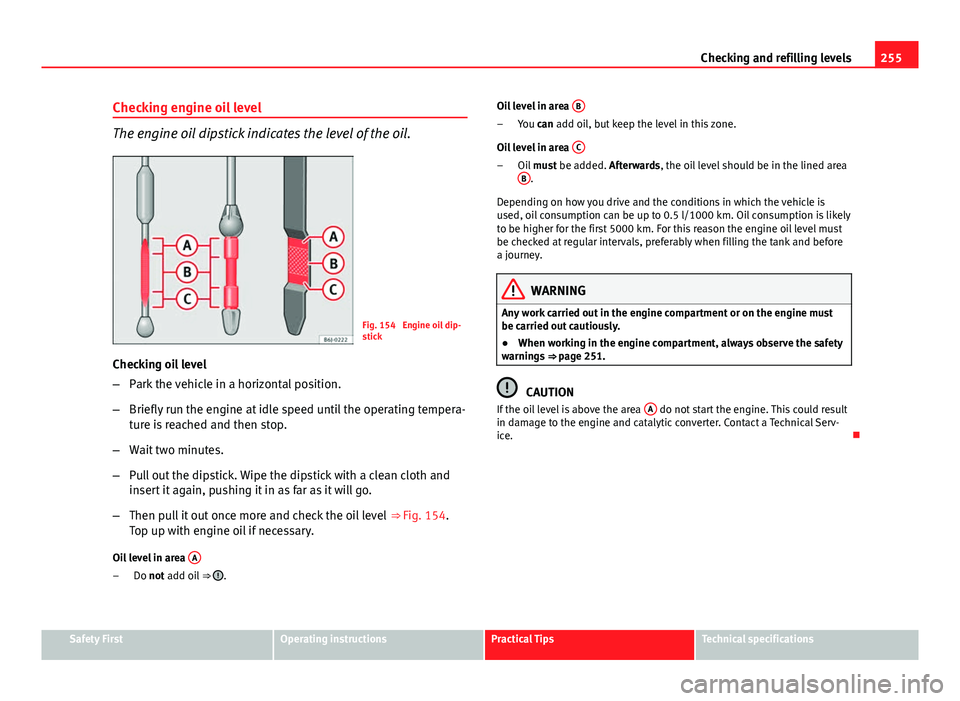
The engine oil dipstick indicates the level of the oil.
Fig. 154 Engine oil dip-
stick
Checking oil level
– Park the vehicle in a horizontal position.
– Briefly run the engine at idle speed until the operating tempera-
ture is reached and then stop.
– Wait two minutes.
– Pull out the dipstick. Wipe the dipstick with a clean cloth and
insert it again, pushing it in as far as it will go.
– Then pull it out once more and check the oil level ⇒ Fig. 154.
Top up with engine oil if necessary.
Oil level in area A
Do not add oil
⇒ .
– Oil level in area
B
You can add oil, but keep the level in this zone.
Oil level in area C
Oil
must be added. Afterwards, the oil level should be in the lined area
B.
Depending on how you drive and the conditions in which the vehicle is
used, oil consumption can be up to 0.5 l/1000 km. Oil consumption is likely
to be higher for the first 5000 km. For this reason the engine oil level must
be checked at regular intervals, preferably when filling the tank and before
a journey.
WARNING
Any work carried out in the engine compartment or on the engine must
be carried out cautiously.
● When working in the engine compartment, always observe the safety
warnings ⇒ page 251.
CAUTION
If the oil level is above the area A do not start the engine. This could result
in damage to the engine and catalytic converter. Contact a Technical Serv-
ice.
–
–
Safety FirstOperating instructionsPractical TipsTechnical specifications
Page 258 of 339
256Checking and refilling levels
Topping up engine oil
Top up gradually with small quantities of engine oil.
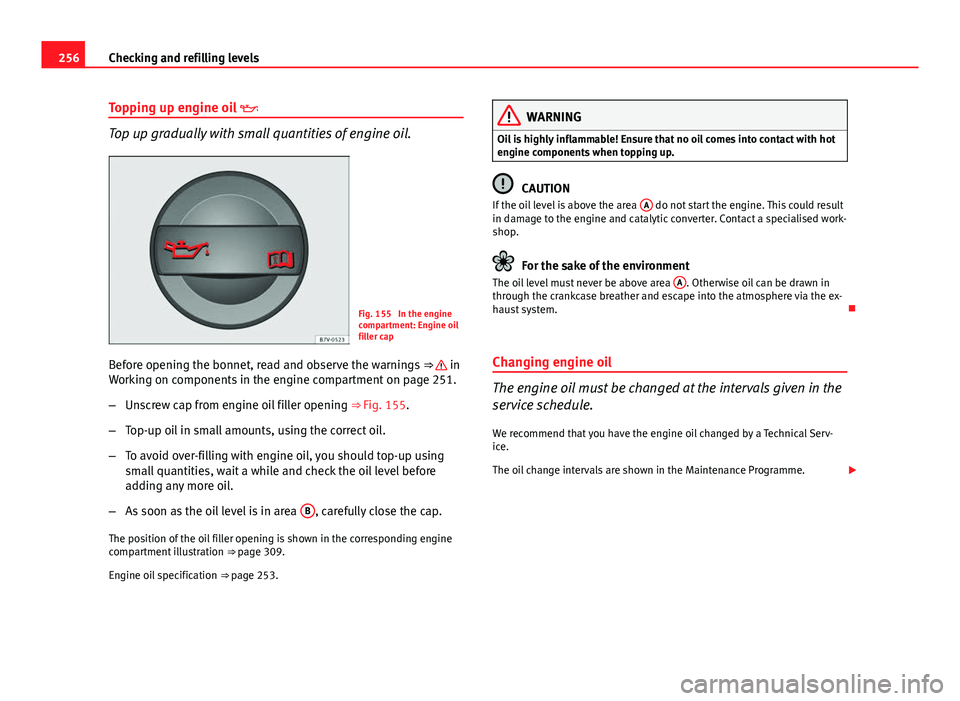
Fig. 155 In the engine
compartment: Engine oil
filler cap
Before opening the bonnet, read and observe the warnings ⇒
in
Working on components in the engine compartment on page 251.
– Unscrew cap from engine oil filler opening ⇒ Fig. 155.
– Top-up oil in small amounts, using the correct oil.
– To avoid over-filling with engine oil, you should top-up using
small quantities, wait a while and check the oil level before
adding any more oil.
– As soon as the oil level is in area B
, carefully close the cap.
The position of the oil filler opening is shown in the corresponding engine
compartment illustration ⇒ page 309.
Engine oil specification ⇒ page 253.
WARNING
Oil is highly inflammable! Ensure that no oil comes into contact with hot
engine components when topping up.
CAUTION
If the oil level is above the area A do not start the engine. This could result
in damage to the engine and catalytic converter. Contact a specialised work-
shop.
For the sake of the environment
The oil level must never be above area A. Otherwise oil can be drawn in
through the crankcase breather and escape into the atmosphere via the ex-
haust system.
Changing engine oil
The engine oil must be changed at the intervals given in the
service schedule. We recommend that you have the engine oil changed by a Technical Serv-
ice.
The oil change intervals are shown in the Maintenance Programme.
Page 259 of 339

257
Checking and refilling levels
WARNING
Only change the engine oil yourself if you have the specialist knowledge
required!
● Before opening the bonnet, read and observe the warnings
⇒ page 251.
● Wait for the engine to cool down. Hot oil may cause burn injuries.
● Wear eye protection to avoid injuries, such as acid burns, caused by
splashes of oil.
● When removing the oil drain plug with your fingers, keep your arm
horizontal to help prevent oil from running down your arm.
● Wash your skin thoroughly if it comes into contact with engine oil.
● Engine oil is poisonous! Used oil must be stored in a safe place out of
the reach of children.
CAUTION
No additives should be used with engine oil. This could result in engine
damage. Any damage caused by the use of such additives would not be
covered by the factory warranty.
For the sake of the environment
● Because of the disposal problems, the necessary special tools and spe-
cialist knowledge required, we recommend that you have the engine oil and
filter changed by a Technical Service.
● Never pour oil down drains or into the ground.
● Use a suitable container when draining the used oil. It must be large
enough to hold all the engine oil. Cooling system
Engine coolant specifications
The engine cooling system is supplied from the factory with a specially trea-
ted mixture of water and, at least, 40 % of the additive G 13 (TLVW 774 J).
The engine coolant additive is recognisable by its purple colour. This mix-
ture of water and additive gives the necessary frost protection down to
-25°C (-13 °F) and protects the light alloy parts of the cooling system
against corrosion. It also prevents scaling and considerably raises the boil-
ing point of the coolant.
To protect the engine cooling system, the percentage of additive must al-
ways be at least 40 %, even in warm climates where anti-freeze protection is
not required.
If greater frost protection is required in very cold climates, the proportion of
additive can be increased. However, the percentage of additive should not
exceed 60 %, as this would reduce the frost protection and, in turn, de-
crease the cooling capacity.
When the coolant is topped up, use a mixture of distilled water and, at
least, 40 % of the G 13 or G 12 plus-plus (TL-VW 774 G) additive (both are
purple) to obtain an optimum anticorrosion protection ⇒
. The mixture of
G 13 with G 12 plus (TL-VW 774 F), G 12 (red) or G 11 (green-blue) engine
coolants will significantly reduce the anticorrosion protection and should,
therefore be avoided ⇒
.
Safety FirstOperating instructionsPractical TipsTechnical specifications
Page 261 of 339

259
Checking and refilling levels
– Top up the coolant only if there is still coolant in the expansion
tank, otherwise you could damage the engine. If there is no
coolant in the expansion tank, do not continue driving. You
should obtain professional assistance ⇒
.
– If there is still some coolant in the expansion tank, top up to the
upper mark.
– Top up with coolant to the upper mark until the level becomes
stable.
– Screw the cap back on correctly.
Any loss of coolant fluid normally indicates a leak in the cooling system.
Take the vehicle straight to a specialised workshop to have the cooling sys-
tem examined. If there are no leaks in the engine cooling system, a loss of
coolant can only occur if the coolant boils and is forced out of the system as
a result of overheating.
WARNING
● The cooling system is under pressure. Do not unscrew the cap on the
coolant expansion tank when the engine is hot: risk of burns!
● The antifreeze and coolant fluid can be a health hazard. Therefore,
the antifreeze should be stored in the original container in a safe place
out of reach of children. Failure to comply could result in poisoning.
● If working inside the engine compartment, remember that, even when
the ignition is switched off, the radiator fan may start up automatically,
and therefore there is a risk of injury.
CAUTION
Do not top up the expansion tank with coolant fluid if it is empty! Air could
enter the cooling system. In this case, stop driving. Seek specialist assis-
tance. Otherwise, there is a risk of engine damage. Brake fluid
Fig. 157 Engine com-
partment: brake fluid res-
ervoir, lid
Checking the brake fluid level
The brake fluid level must be between the MIN and MAX markings.
However, if the brake fluid level goes down noticeably in a short time, or
drops below the MIN mark, there may be a leak in the brake system. Seek
specialist assistance. A warning light on the instrument panel display moni-
tors the brake fluid level ⇒ page 69.
In right-hand drive vehicles the brake fluid reservoir is on the other side of
the engine compartment.
Changing brake fluid
The regular intervals at which the brake fluid should be replaced are listed
in the Service Plan. We recommend you have the brake fluid replaced at a
SEAT Official Service, during an Inspection Service.
Safety FirstOperating instructionsPractical TipsTechnical specifications
Page 267 of 339
265
Wheels and tyres
Wheels and tyres
Wheels
General notes
– When driving with new tyres, be especially careful during the
first 500 km (300 miles).
– If you have to drive over a kerb or similar obstacle, drive very
slowly and as near as possible at a right angle to the obstacle.
– Check from time to time if the tyres are damaged (punctures,
cuts, cracks or dents). Remove any foreign objects embedded in
the treads.
– Damaged wheels and tyres must be replaced immediately.
– Keep grease, oil and fuel off the tyres.
– Replace any missing valve caps as soon as possible.
– Mark the wheels before taking them off so that they rotate in
the same direction when put back.
– When removed, the wheels or tyres should be stored in a cool,
dry and preferably dark place.
New tyres
New tyres do not give maximum grip straight away and should therefore be
“run in” by driving carefully and at moderate speeds for about the first 500
km (300 miles). This will also increase the useful life of the tyres. The tread depth of new tyres may
vary, according to the type and make of
tyre and the tread pattern.
Concealed damage
Damage to tyres and rims is often not readily visible. If you notice unusual
vibration or the car pulling to one side, this may indicate that one of the
tyres is damaged. Reduce speed immediately if there is any reason to sus-
pect that damage may have occurred. Inspect the tyres for damage. If no ex-
ternal damage is visible, drive slowly and carefully to the nearest special-
ised workshop and have the car inspected.
Tyres with directional tread pattern
An arrow on the tyre sidewall indicates the direction of rotation on single
drive tyres. Always note the direction of rotation indicated when mounting
the wheel. This guarantees optimum grip and helps to avoid aquaplaning,
excessive noise and wear.
Retrofitting Accessories
If you wish to change or fit wheels, rims or wheel trims, we recommend that
you consult with a SEAT Official Service centre for advice regarding current
techniques.
Useful life of tyres
Correct inflation pressures and sensible driving habits will
increase the useful life of your tyres.
– Check tyre pressure at least once a month, and also prior to any
long trip.
Safety FirstOperating instructionsPractical TipsTechnical specifications
Page 277 of 339
275
Emergencies
Tyre repair kit
What to do first
– Please observe the important safety notes ⇒ page 274.
– Apply the handbrake.
– Manual gearbox: Select first gear.
– Automatic gearbox: Move the selector lever to P.
– Check whether a repair is possible using the tyre repair kit
⇒ page 275.
Using the tyre repair kit
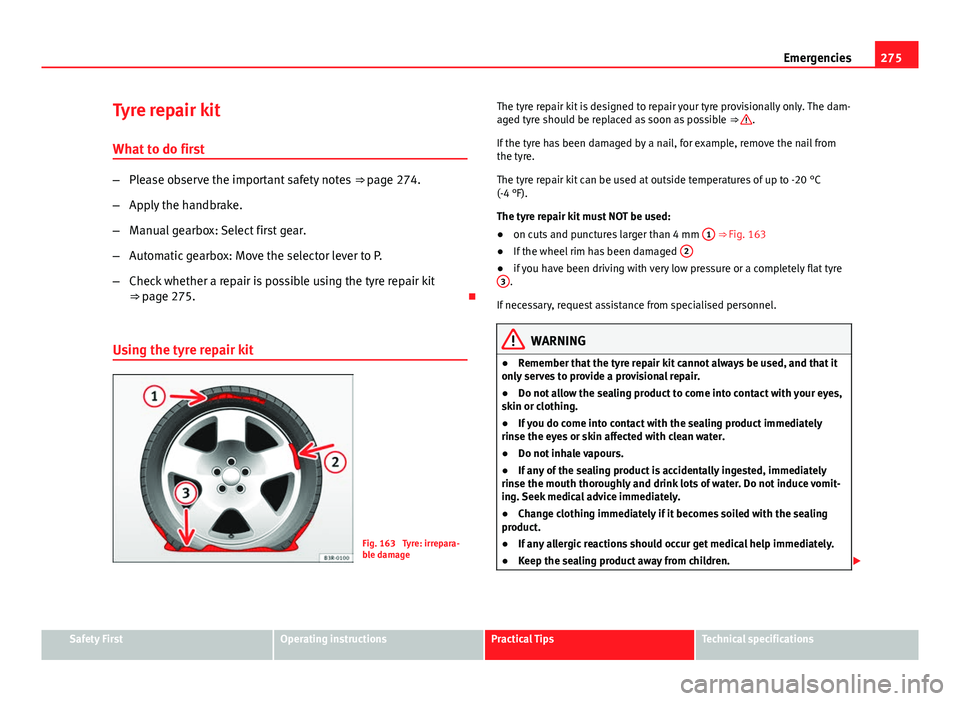
Fig. 163 Tyre: irrepara-
ble damage The tyre repair kit is designed to repair your tyre provisionally only. The dam-
aged tyre should be replaced as soon as possible
⇒
.
If the tyre has been damaged by a nail, for example, remove the nail from
the tyre.
The tyre repair kit can be used at outside temperatures of up to -20 °C
(-4 °F).
The tyre repair kit must NOT be used:
● on cuts and punctures larger than 4 mm 1
⇒ Fig. 163
● If the wheel rim has been damaged 2
●
if you have been driving with very low pressure or a completely flat tyre
3.
If necessary, request assistance from specialised personnel.
WARNING
● Remember that the tyre repair kit cannot always be used, and that it
only serves to provide a provisional repair.
● Do not allow the sealing product to come into contact with your eyes,
skin or clothing.
● If you do come into contact with the sealing product immediately
rinse the eyes or skin affected with clean water.
● Do not inhale vapours.
● If any of the sealing product is accidentally ingested, immediately
rinse the mouth thoroughly and drink lots of water. Do not induce vomit-
ing. Seek medical advice immediately.
● Change clothing immediately if it becomes soiled with the sealing
product.
● If any allergic reactions should occur get medical help immediately.
● Keep the sealing product away from children.
Safety FirstOperating instructionsPractical TipsTechnical specifications
Page 278 of 339
276Emergencies
Note
● If sealing product should leak out, leave it to dry. This way you can pull it
off like a piece of foil.
● Observe the expiry date stated on the sealing compound can. Have the
sealing compound changed by a specialised workshop or SEAT Service.
● Please observe legal requirements when doing so.
Repairing tyres
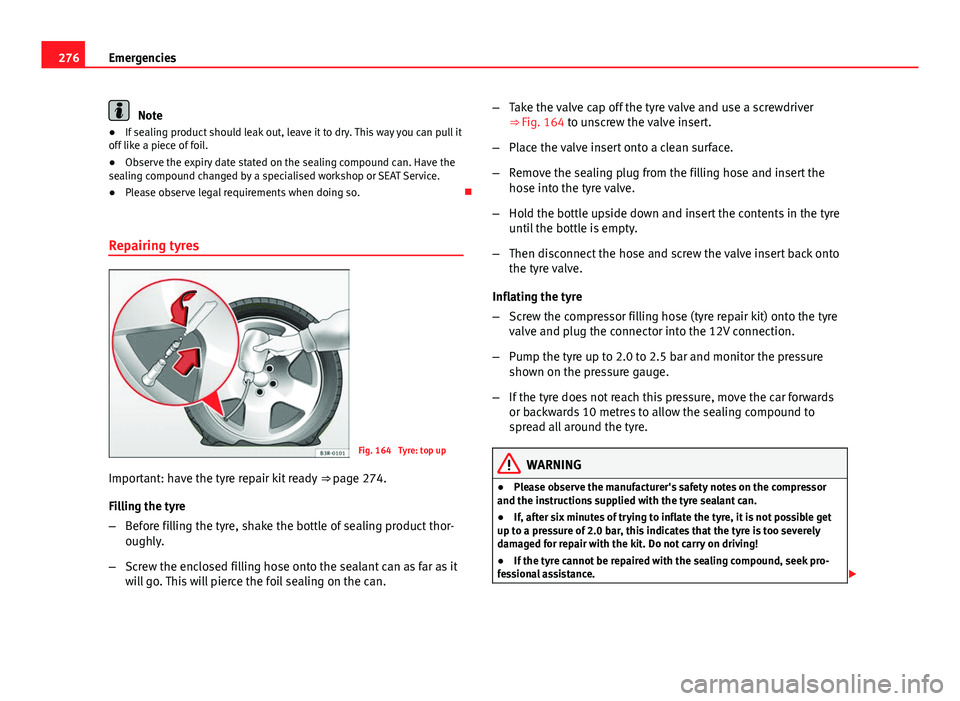
Fig. 164 Tyre: top up
Important: have the tyre repair kit ready ⇒
page 274.
Filling the tyre
– Before filling the tyre, shake the bottle of sealing product thor-
oughly.
– Screw the enclosed filling hose onto the sealant can as far as it
will go. This will pierce the foil sealing on the can. –
Take the valve cap off the tyre valve and use a screwdriver
⇒ Fig. 164 to unscrew the valve insert.
– Place the valve insert onto a clean surface.
– Remove the sealing plug from the filling hose and insert the
hose into the tyre valve.
– Hold the bottle upside down and insert the contents in the tyre
until the bottle is empty.
– Then disconnect the hose and screw the valve insert back onto
the tyre valve.
Inflating the tyre
– Screw the compressor filling hose (tyre repair kit) onto the tyre
valve and plug the connector into the 12V connection.
– Pump the tyre up to 2.0 to 2.5 bar and monitor the pressure
shown on the pressure gauge.
– If the tyre does not reach this pressure, move the car forwards
or backwards 10 metres to allow the sealing compound to
spread all around the tyre.WARNING
● Please observe the manufacturer's safety notes on the compressor
and the instructions supplied with the tyre sealant can.
● If, after six minutes of trying to inflate the tyre, it is not possible get
up to a pressure of 2.0 bar, this indicates that the tyre is too severely
damaged for repair with the kit. Do not carry on driving!
● If the tyre cannot be repaired with the sealing compound, seek pro-
fessional assistance.
Page 288 of 339
286Emergencies
Towing and tow-starting the vehicle
General information
Points to observe when tow-starting or towing away If you use a tow rope:
Notes for the driver of the towing vehicle
– The tow rope must be taut before you drive off.
– Release the clutch very carefully when starting the vehicle
(manual gearbox), or accelerate gently (automatic gearbox).
Notes for the driver of the towed vehicle
– The ignition should be switched on so that the turn signals,
windscreen wipers and washers can be used. Please ensure
that the steering wheel is unlocked when you switch on the ig-
nition, and that it moves freely.
– Put the gearbox lever in neutral (manual gearbox) or move the
selector lever to position N (automatic gearbox).
– The brake servo only works when the engine is running. Consid-
erably more effort is required on the brake pedal when the en-
gine is switched off.
– Remember that the power steering only works when the ignition
is switched on and the vehicle is moving 1)
. Otherwise, consider-
ably more strength than usual will be required when steering. –
Ensure that the tow rope remains taut at all times.
Tow rope or tow bar
It is easier and safer to tow a vehicle with a tow bar. You should only use a
tow rope if you do not have a tow bar.
A tow rope should be slightly elastic to avoid damage to both vehicles. It is
advisable to use a tow rope made of synthetic fibre or similarly elastic mate-
rial.
Only attach the tow rope or the tow bar to the towing rings ⇒ page 287.
Driving style
Towing requires some experience, especially when using a tow rope. Both
drivers should be familiar with the technique required for towing. Inexper-
ienced drivers should not attempt to tow.
Do not pull too hard with the towing vehicle and take care to avoid jerking
the tow rope. When towing on an unpaved road, there is always a risk of
overloading and damaging the anchorage points.
WARNING
If the vehicle has no electrical power, the brake lights, turn signals and
all other lights will no longer function. Do not have the vehicle towed
away. Failure to do so could result in an accident.
CAUTION
If there is no oil in the gearbox or no lubricant in the automatic transmission
the car may only be towed with the driven wheels lifted clear of the road, or
transported on a special car transporter or trailer.
1)
Important: the battery must be correctly charged.
Page 291 of 339
289
Emergencies
Tow-starting
As a general rule, tow-starting is not recommended.
– Engage 2nd or 3rd gear before moving off.
– Press the clutch and hold the pedal down.
– Switch the ignition on.
– Once both vehicles are moving, release the clutch.
– As soon as the engine starts: press the clutch and put the gear
lever in neutral.
If the engine will not start, it is best to try starting it using the battery of an-
other vehicle ⇒ page 283 before attempting to tow start. You should only try
to tow-start the engine if jump starting is not successful. Tow-starting is an
attempt to start the engine via the movement of the wheels.
When tow-starting a vehicle with a petrol engine, do not tow it more than a
short distance, otherwise unburned fuel can enter the catalytic converter
and cause damage.
WARNING
The risk of accidents is high when tow-starting, as the towed vehicle can
easily be driven into the towing vehicle.
CAUTION
Do not tow vehicles for more than 50 m. Risk of damage to the catalytic con-
verter. Towing vehicles with a manual gearbox
Towing is relatively straightforward.
Please observe the relevant instructions ⇒ page 286.
The vehicle can be towed using a tow bar or tow rope in the normal way,
with all four wheels on the road; it can also be towed with either the front or
rear wheels lifted off the road. The maximum towing speed is 50 km/h (30
mph).
Towing a vehicle equipped with automatic gearbox
Certain restrictions must be observed when towing your ve-
hicle. Please observe the relevant instructions ⇒ page 286.
The vehicle can be towed with a tow bar or tow rope in the normal way, with
all four wheels on the ground. When doing so, please note the following
points:
● Make sure the selector lever is in the N position.
● The vehicle must not be towed faster than 50 km/h (30 mph).
● The vehicle must not be towed further than 50 km (30 miles). Reason:
when the engine is not running, the gearbox oil pump does not work and
the gearbox is not adequately lubricated for higher speeds or longer distan-
ces.
If the vehicle has to be towed with a breakdown truck, it must only be sus-
pended at the front wheels. Reason: the drive shafts are located on the front
wheels. If the car is towed with the rear wheels lifted off the road (I.e. travel-
ling backwards), the drive shafts also turn backwards. The planetary gears
in the automatic gearbox then turn at such high speeds that the gearbox
will be severely damaged in a short time.
Safety FirstOperating instructionsPractical TipsTechnical specifications