sport mode Seat Leon 5D 2013 User Guide
[x] Cancel search | Manufacturer: SEAT, Model Year: 2013, Model line: Leon 5D, Model: Seat Leon 5D 2013Pages: 339, PDF Size: 4.8 MB
Page 218 of 339
216Driver assistance systems
WARNING (Continued)
● Driving with tyres at the wrong pressure can cause them damage and
result in an accident. Ensure that the tyre pressures of all the tyres corre-
spond to the vehicle load.
● Before starting a journey, always inflate tyres to the correct pressure.
● Tyres with insufficient pressure are subjected to more flexing. Due to
this, the tyre could become excessively hot, causing tread separation
and also tyre blow-out.
● With an overloaded vehicle at high speed, the tyres can overheat and
burst resulting in a loss of vehicle control.
● Tyre pressures which are too high or too low reduce the useful life of
the tyre, affecting vehicle performance.
● If a tyre has not been punctured then it does not have to be changed
immediately; drive to the nearest specialised workshop at a moderate
speed and have the tyre checked and inflated to the correct pressure.
WARNING
If the warning lamps and messages are ignored, the vehicle may stall in
traffic, or may cause accidents and severe injuries.
● Never ignore the warning lamps or text messages.
● Stop the vehicle safely as soon as possible.
CAUTION
Failure to heed the control lamps and text messages when they appear may
result in faults in the vehicle.
Note
● If excessively low tyre pressure is detected with the ignition on, an audi-
ble warning will sound. In the event that there is a fault in the system, an
audible warning will sound.
● Driving on dirt tracks for a long period of time or driving in a sporty style
can temporarily deactivate the TPMS. The control lamp shows a fault, but
disappears when road conditions or the driving style change.
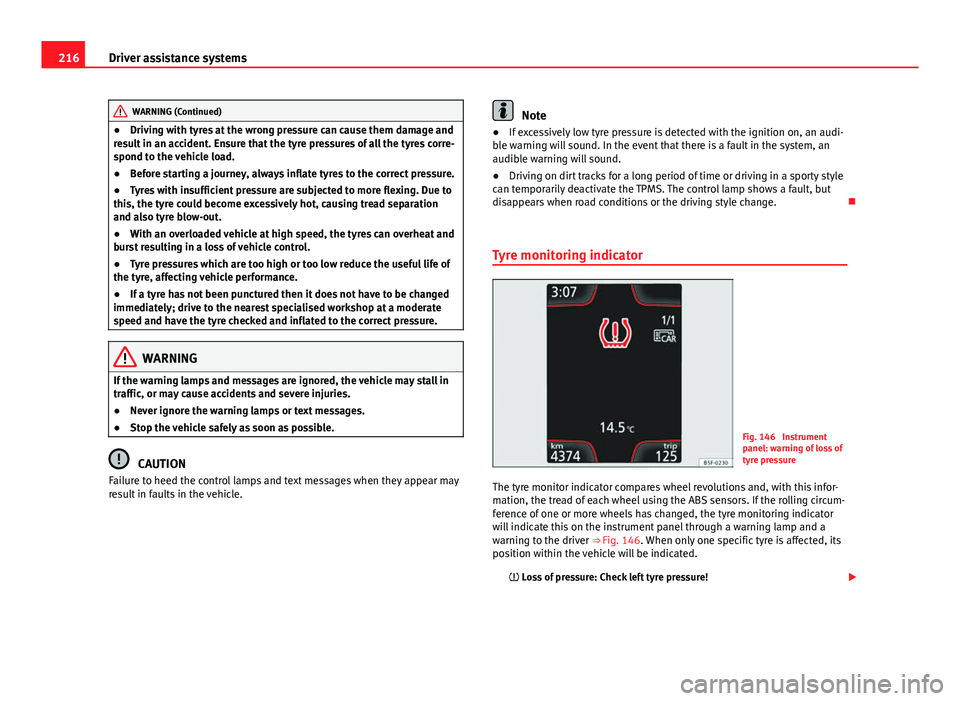
Tyre monitoring indicator
Fig. 146 Instrument
panel: warning of loss of
tyre pressure
The tyre monitor indicator compares wheel revolutions and, with this infor-
mation, the tread of each wheel using the ABS sensors. If the rolling circum-
ference of one or more wheels has changed, the tyre monitoring indicator
will indicate this on the instrument panel through a warning lamp and a
warning to the driver ⇒ Fig. 146. When only one specific tyre is affected, its
position within the vehicle will be indicated. Loss of pressure: Check left tyre pressure!
Page 225 of 339
223
Intelligent technology
Multi-collision brake
In an accident, the multi-collision brake can help the driver by braking to
avoid the risk of skidding during the accident, which could lead to further
collisions.
The multi-collision brake works for front, side or rear accidents, when the
airbag control unit records its activation level and the accident takes place
at a speed of over 10 km/h (6 mph). The ESC automatically brakes the vehi-
cle, as long as the accident has not damaged the ESC, the brake hydraulics
or the on-board network.
The following actions control automatic braking during the accident:
● When the driver presses the accelerator. The automatic braking does not
take place.
● When the braking pressure through pressing the brake pedal is greater
than the system’s braking pressure. The vehicle will brake manually.
● Multi-collision braking will not be available if ESC is malfunctioning.
WARNING
● The ESC, ABS, ASR, EDL, electronic self-locking differential or selec-
tive torque control systems cannot exceed the limits imposed by the laws
of physics. Always bear this in mind, especially on wet or slippery roads.
If you notice the systems cutting in, you should reduce your speed imme-
diately to suit the road and traffic conditions. Do not be encouraged to
take risks by the presence of more safety systems. If you do, an accident
may occur.
● Please remember that the accident risk always increases if you drive
fast, especially in corners or on a slippery road, or if you follow too close
behind the vehicle in front of you. The ESC, ABS, brake assist, EDL, elec-
tronic self-locking and selective torque control systems cannot prevent
accidents: risk of accidents!
● Accelerate with caution on slippery surfaces (for example, icy or
snow-covered). Despite the control systems, the driven wheels could
spin, affecting the stability of the vehicle: risk of accident!
Note
● The ABS and ASR will only operate correctly if the four wheels have iden-
tical tyres. Any differences in the rolling radius of the tyres can cause the
system to reduce engine power when this is not desired.
● The regulating processes of the systems can make noises when they in-
tervene.
● If the warning lamp lights up, or alternatively, there could be a
fault ⇒ page 69.
Switching on/off the ESC and ASR
The ESC is switched on automatically when the engine is
started. The ESC cannot be deactivated. ESC in “Sport Mode”
Sport mode is activated through the Easy Connect system menu ⇒ page 79.
The ability of the ESC to stabilise the vehicle is limited; the traction control
system (ASR) becomes disabled ⇒
.
The control lamp will light up. For vehicles with a driver information sys-
tem*, the driver will be shown the electronic stability control (ESC) option:
sport. Warning! Limited stability .
In the following exceptional circumstances enabling the ESC Sport mode to
improve the traction of the wheels is tenable:
● “Swing” the vehicle to unblock it.
● Driving in deep snow or on loose surfaces.
Disable ESC Sport mode
Through the Easy Connect system ⇒ page 79. The warning lamp will
switch off. For vehicles with a driver information system*, the driver will be
shown the electronic stability control (ESC) option: on .
Safety FirstOperating instructionsPractical TipsTechnical specifications
Page 226 of 339
224Intelligent technology
Disable ASR
ASR mode is deactivated ⇒ page 79 through the Easy Connect system
menu. The traction control system will be disabled.
The control lamp will light up. For vehicles with a driver information sys-
tem* the driver will be informed that ASR is disabled.
In the following exceptional circumstances enabling the ESC Sport mode to
improve the traction of the wheels is tenable:
● “Swing” the vehicle to unblock it.
● Driving in deep snow or on loose surfaces.
Activate ASR
ASR mode is activated ⇒ page 79 through the Easy Connect system menu.
The traction control system will be enabled.
The control lamp switches off. For vehicles with a driver information sys-
tem* the driver will be informed that ASR is enabled.
WARNING
You should switch on the ESC Sport mode only if the traffic conditions
and your driving ability allow you to do so safely: risk of skidding!
● With ESC in Sport mode, the stabilising function will be limited to al-
low for a sportier drive. The driving wheels could spin and the vehicle
could skid.
Note
If the ASR is disconnected or the ESC’s Sport mode is selected, cruise con-
trol* will be switched off. Brakes
New brake pads
For the first 400 km (250 miles), new brake pads have not yet reached their
maximum braking capacity, and need to be “run in” first. However, you can
compensate for the slightly reduced braking effect by applying more pres-
sure on the brake pedal. Avoid overloading the brakes while running them
in.
Wear
The rate of wear on the
brake pads depends a great deal on how you drive
and the conditions in which the vehicle is operated. This is a particular
problem in urban traffic and short stretches, or with very sporty driving.
Depending on the speed, the braking force, and the environmental condi-
tions (for example, the temperature, air humidity, etc.) noises may be pro-
duced on braking.
Wet roads or road salt
In certain situations (for example, on driving through flooded areas, in se-
vere downpours or after washing the vehicle) the braking action could be
delayed if the discs and pads are damp, or frozen in winter. In this case the
brakes should be dried by pressing the brake pedal several times.
At high speed and with the windscreen wipers activated, the brake pads will
briefly touch the brake discs. This takes place, although unnoticeable to the
driver, at regular intervals to improve the response time of the brakes when
they are wet.
The effectiveness of the brakes can also be temporarily reduced if the vehi-
cle is driven for some distance without using the brakes when there is a lot
of salt on the road in winter. The layer of salt that accumulates on the discs
and pads can be removed by gently applying the brakes a few times.
Page 236 of 339
234Trailer
Trailer
Trailer towing What do you need to bear in mind when towing a trailer?
Your vehicle may be used to tow a trailer when fitted with the correct equip-
ment.
If you wish to retrofit a towing bracket, consult ⇒ page 236.
Connectors
Your vehicle is fitted with a 12-pin connector for the electrical connection
between the trailer and the vehicle.
If the trailer has a 7-pin plug you will need to use an adapter cable. This is
available in any Technical Service.
Trailer weight/drawbar load
Never exceed the authorised trailer weight. If you do not load the trailer up
to the maximum permitted trailer weight, you can then climb correspond-
ingly steeper slopes.
The maximum trailer weights listed are only applicable for altitudes up to
1000 m above sea level. With increasing altitude the engine power and
therefore the vehicle climbing ability are impaired because of the reduced
air density. The maximum trailer weight has to be reduced accordingly. The
weight of the vehicle and trailer combination must be reduced by 10% for
every further 1000 m (or part thereof). The gross combination weight is the
actual weight of the laden vehicle plus the actual weight of the laden trailer.
When possible, operate the trailer with the maximum permitted drawbar
load on the ball joint of the towing bracket, but do not exceed the specified
limit. The figures for
trailer weights and drawbar loads that are given on the data
plate of the towing bracket are for certification purposes only. The correct
figures for your specific model, which may be lower than these figures for
the towing bracket, are given in the vehicle documentation or in ⇒ chap-
ter Technical Data.
Distributing the load
Distribute loads in the trailer so that heavy objects are as near to the axle as
possible. Loads carried in the trailer must be secured to prevent them mov-
ing.
Tyre pressure
Set tyre pressure to the maximum permissible pressure shown on the stick-
er on the inside of the fuel tank flap. Set the tyre pressure of the trailer tyres
in accordance with the trailer manufacturer's recommendations.
Exterior mirrors
Check whether you can see enough of the road behind the trailer with the
standard rear vision mirrors. If this is not the case, you should have addi-
tional exterior mirrors fitted. Both exterior mirrors should be mounted on
hinged extension brackets. Adjust the mirrors to give sufficient vision to the
rear.
WARNING
Never transport people in a trailer. This could result in fatal accidents.
Page 308 of 339
306Technical specifications
Identifying letters
The identifying letters of the engine can be viewed on the instrument panel.
Important: The engine must be off and the ignition on.
● Hold down the 0.0/SET
4 ⇒ Fig. 38 button for more than 15 seconds.
Information on fuel consumption
Fuel consumption
The consumption and emission details shown on the vehicle
data sticker differ from one vehicle to another. The vehicle fuel consumption and CO 2 emissions can be consulted on the
vehicle data sticker in the spare wheel well, inside the luggage compart-
ment and on the rear cover of the Maintenance Programme.
The fuel consumption and CO 2 emission values refer to the weight category
assigned to your vehicle according to the engine and gearbox combination,
as well as the specific equipment fitted, and is only used to compare be-
tween the different models.
The fuel consumption and CO 2 emissions do not depend only on the per-
formance of the vehicle, they can also differ from the established values de-
pending on other factors such as driving style, road conditions, traffic con-
ditions, environmental conditions, load and number of passengers.
Calculation of fuel consumption
The consumption values have been calculated based on measurements per-
formed or supervised by certified CE laboratories according to the latest ver-
sion of directives 715/2007/EC and 80/1268/CEE (for more information
consult the European Union Publications Office at EUR-Lex: © European Un- ion, http://eur-lex.europa.eu/en/index.htm) and are valid for the kerb
weight indicated for the vehicle.
Note
In practice, and considering all the factors mentioned here, consumption
values can differ from those calculated in the current European regulations.
Weights
Kerb weight refers to the basic model with a fuel tank filled to 90% capacity
and without optional extras. The figure quoted includes 75 kg to allow for
the weight of the driver.
For special versions and optional equipment fittings or for the addition of
accessories, the weight of the vehicle will increase ⇒
.
WARNING
● Please note that the centre of gravity may shift when transporting
heavy objects; this may affect vehicle handling and lead to an accident.
Always adjust your speed and driving style to suit road conditions and re-
quirements.
● Never exceed the gross axle weight rating or the gross vehicle weight
rating. If the allowed axle load or the allowed total weight is exceeded,
the driving characteristics of the vehicle may change, leading to acci-
dents, injuries and damage to the vehicle.
Page 330 of 339

E
E10see Ethanol (fuel) . . . . . . . . . . . . . . . . . . . . 246
Easy Connect . . . . . . . . . . . . . . . . . . . . . . . . . . . 79
Economic driving . . . . . . . . . . . . . . . . . . . . . . . 231
EDL see Electronic differential lock . . . . . . . . . 222
Efficiency programme Additional electrical appliances . . . . . . . . . 77
Saving tips . . . . . . . . . . . . . . . . . . . . . . . . . . 78
Electrical accessories see Power socket . . . . . . . . . . . . . . . . . . . . 135
Electric windows . . . . . . . . . . . . . . . . . . . . . . . . 102 Convenience opening/closing . . . . . . . . . 103
Electro-mechanical steering . . . . . . . . . . . . . . 225 Warning lamp . . . . . . . . . . . . . . . . . . . . . . . 225
Electronic differential lock . . . . . . . . . . . . . . . . 222
Electronic Self-locking . . . . . . . . . . . . . . . . . . . 222
Electronic Stability Control (ESC) . . . . . . . . . . 222
Emergencies . . . . . . . . . . . . . . . . . . . . . . . . . . . 274 Automatic gearbox Backup programme . . 181
Replacing the battery . . . . . . . . . . . . . . . . . 262
Emergency braking warning . . . . . . . . . . . . . . 114
Emergency locking and unlocking . . . . . . . . . . 98
Engine Assisted starting . . . . . . . . . . . . . . . . . . . . 283
Preheating . . . . . . . . . . . . . . . . . . . . . . . . . 163
Start-Stop system . . . . . . . . . . . . . . . . . . . . 169
Starting up . . . . . . . . . . . . . . . . . . . . . . . . . 163 Starting up (driver messages with the me-
chanical contact) . . . . . . . . . . . . . . . . . . . 164
Switching off (engine) . . . . . . . . . . . . . . . . 165
Engine compartment Closing the bonnet . . . . . . . . . . . . . . . . . . . 253
Opening the bonnet . . . . . . . . . . . . . . . . . . 252
Safety notes . . . . . . . . . . . . . . . . . . . . . . . . 251
Engine coolant G 12 plus-plus . . . . . . . . . . . . . . . . . . . . . . 257
G 13 . . . . . . . . . . . . . . . . . . . . . . . . . . . . . . . 257
Specifications . . . . . . . . . . . . . . . . . . . . . . . 257
Engine oil . . . . . . . . . . . . . . . . . . . . . . . . . . . . . 253 Changing . . . . . . . . . . . . . . . . . . . . . . . . . . 256
Checking oil level . . . . . . . . . . . . . . . . . . . . 255
Consumption . . . . . . . . . . . . . . . . . . . . . . . 255
Engine oil dipstick . . . . . . . . . . . . . . . . . . . 255
Inspection service . . . . . . . . . . . . . . . . . . . 253
Longlife inspection service . . . . . . . . . . . . 253
Oil properties . . . . . . . . . . . . . . . . . . . . . . . 254
Replace . . . . . . . . . . . . . . . . . . . . . . . . . . . . 253
Service intervals . . . . . . . . . . . . . . . . . . . . . 253
Specifications . . . . . . . . . . . . . . . . . . . . . . . 253
Temperature display . . . . . . . . . . . . . . . . . . . 77
Topping up . . . . . . . . . . . . . . . . . . . . . . . . . 256
Environment Ecological driving . . . . . . . . . . . . . . . . . . . . 231
Environmental friendliness . . . . . . . . . . . . 232
Environmental tip Leaks . . . . . . . . . . . . . . . . . . . . . . . . . . . . . . 252
Environmental tips Filling the tank . . . . . . . . . . . . . . . . . . 248, 250
Environment warning . . . . . . . . . . . . . . . . . . . . 219 ESC
Electronic stability control . . . . . . . . . . . . . 222
Multi-collision brake . . . . . . . . . . . . . . . . . 223
Sport Mode . . . . . . . . . . . . . . . . . . . . . . . . . 223
Ethanol (fuel) . . . . . . . . . . . . . . . . . . . . . . . . . . 246
Exhaust tail pipe: Cleaning . . . . . . . . . . . . . . . 242
extending the rear lid locking time see rear lid . . . . . . . . . . . . . . . . . . . . . . . . . 100
Exterior lighting Changing a bulb . . . . . . . . . . . . . . . . . . . . . 293
Exterior mirrors Adjust . . . . . . . . . . . . . . . . . . . . . . . . . . . . . 125
heated . . . . . . . . . . . . . . . . . . . . . . . . . . . . . 125
Heating . . . . . . . . . . . . . . . . . . . . . . . . . . . . 125
F
Fastening rings . . . . . . . . . . . . . . . . . . . . . . 18, 145
Fault in the gearbox (warning lamp) . . . . . . . . 181
Fault memory . . . . . . . . . . . . . . . . . . . . . . . . . . 228
Faults Panoramic sliding sunroof . . . . . . . . . . . . . 106
Faults in the gearbox (warning lamps) . . . . . . 182
Faulty bulbs Changing a bulb . . . . . . . . . . . . . . . . . . . . . 293
Filling the tank . . . . . . . . . . . . . . . . . . . . . . . . . 248 Fuel gauge . . . . . . . . . . . . . . . . . . . . . . . . . . 67
Opening the fuel tank cap . . . . . . . . . . . . . 248
Floor mats . . . . . . . . . . . . . . . . . . . . . . . . . . . . . . 17
Fog light . . . . . . . . . . . . . . . . . . . . . . . . . . . . . . 111
Fold the seats . . . . . . . . . . . . . . . . . . . . . . . . . . . 137
328 Index
Page 335 of 339
Safety interlock for ignition key . . . . . . . . . . . . 163
Safety notesAirbags . . . . . . . . . . . . . . . . . . . . . . . . . . . . . 34
Curtain airbags . . . . . . . . . . . . . . . . . . . . . . . 44
Front airbags . . . . . . . . . . . . . . . . . . . . . . . . 38
Seat belt tensioners . . . . . . . . . . . . . . . . . . . 30
Side airbags . . . . . . . . . . . . . . . . . . . . . . . . . 42
Using child seats . . . . . . . . . . . . . . . . . . . . . 48
Using seat belts . . . . . . . . . . . . . . . . . . . . . . 24
Saving fuel Conscientious driving . . . . . . . . . . . . . . . . 231
Inertia mode . . . . . . . . . . . . . . . . . . . . . . . . 180
Saving tips (efficiency programme) . . . . . . . . . 78
Seat adjuster . . . . . . . . . . . . . . . . . . . . . . . . . . . 10
Seat belt control lamp . . . . . . . . . . . . . . . . . . . . 20
Seat belt position Pregnant women . . . . . . . . . . . . . . . . . . . . . 28
Seat belts . . . . . . . . . . . . . . . . . . . . . . . . . . . 27
Seat belt protection . . . . . . . . . . . . . . . . . . . . . . 24
Seat belt release . . . . . . . . . . . . . . . . . . . . . . . . 28
Seat belts . . . . . . . . . . . . . . . . . . . . . . . . . . . . . . 20 Adjustment . . . . . . . . . . . . . . . . . . . . . . . . . . 26
Cleaning . . . . . . . . . . . . . . . . . . . . . . . . . . . 245
control lamp . . . . . . . . . . . . . . . . . . . . . . . . . 20
Incorrectly fastened . . . . . . . . . . . . . . . . . . . 29
Not worn . . . . . . . . . . . . . . . . . . . . . . . . . . . . 23
Safety notes . . . . . . . . . . . . . . . . . . . . . . . . . 24
Seat belt tensioners . . . . . . . . . . . . . . . . . . . . . . 29
SEAT Drive Mode . . . . . . . . . . . . . . . . . . . . . . . 211 Seats
adjustment . . . . . . . . . . . . . . . . . . . . . . . . . 129
heating . . . . . . . . . . . . . . . . . . . . . . . . . . . . 130
rear seat backrest . . . . . . . . . . . . . . . . . . . . 138
Selective unlocking system . . . . . . . . . . . . . . . . 92
Selector lever Automatic gearbox . . . . . . . . . . . . . . . . . . . 173
Function fault . . . . . . . . . . . . . . . . . . . . . . . 175
Selector lever (automatic gearbox) Manual release . . . . . . . . . . . . . . . . . . . . . . 182
Service interval display . . . . . . . . . . . . . . . . . . . 65
Service intervals . . . . . . . . . . . . . . . . . . . . . . . . 253
Service notification: read . . . . . . . . . . . . . . . . . . 65
Setting Headlight range . . . . . . . . . . . . . . . . . . . . . 117
Side airbags . . . . . . . . . . . . . . . . . . . . . . . . . . . . 40 Description . . . . . . . . . . . . . . . . . . . . . . . . . . 40
Operation . . . . . . . . . . . . . . . . . . . . . . . . . . . 41
Safety notes . . . . . . . . . . . . . . . . . . . . . . . . . 42
Side light . . . . . . . . . . . . . . . . . . . . . . . . . . . . . 111
Sitting position driver . . . . . . . . . . . . . . . . . . . . . . . . . . . . . . . 11
Sitting position for vehicle occupants . . . . . . . 10
Sliding/tilting sunroof Convenience opening/closing . . . . . . . . . 103
Smell of gas . . . . . . . . . . . . . . . . . . . . . . . . . . . 248
Snow chains . . . . . . . . . . . . . . . . . . . . . . . 271, 307
Spanner symbol . . . . . . . . . . . . . . . . . . . . . . . . . 65
Special features Windscreen wipers . . . . . . . . . . . . . . . . . . . 121
Speedometer . . . . . . . . . . . . . . . . . . . . . . . . . . . 73
Speed warning function . . . . . . . . . . . . . . . . . . 168 Sport Mode . . . . . . . . . . . . . . . . . . . . . . . . . . . . 223
Start-Stop system . . . . . . . . . . . . . . . . . . . . . . . 169
Driver messages . . . . . . . . . . . . . . . . . . . . . 172
Stop/Start the engine . . . . . . . . . . . . . . . . 170
Switching on/off . . . . . . . . . . . . . . . . . . . . . 171
The engine does not switch off . . . . . . . . . 170
The engine starts by itself . . . . . . . . . . . . . 170
Warning lamps . . . . . . . . . . . . . . . . . . . . . . 170
Starting up (engine) . . . . . . . . . . . . . . . . . . . . . 163
Steering Electro-mechanical steering . . . . . . . . . . . 225
Engage the steering lock (ignitionkey) . . . . . . . . . . . . . . . . . . . . . . . . . . 163, 165
Steering wheel Gearshift paddles (automatic gearbox) . . 178
Setting . . . . . . . . . . . . . . . . . . . . . . . . . . . . 162
Storage area front seat . . . . . . . . . . . . . . . . . . . . . . . . . . . 133
Storage compartment . . . . . . . . . . . . . . . . . . . 135
Storage compartments . . . . . . . . . . . . . . . . . . 133 Glove compartment lighting . . . . . . . . . . . 118
Storing the rear shelf . . . . . . . . . . . . . . . . . . . . 141
Sun blind . . . . . . . . . . . . . . . . . . . . . . . . . . . . . 119
Sun protection . . . . . . . . . . . . . . . . . . . . . . . . . 118
Sun visor . . . . . . . . . . . . . . . . . . . . . . . . . . . . . . 119
Switch Hazard warning lights . . . . . . . . . . . . . . . . 113
Switching ignition on/off . . . . . . . . . . . . . . . . . 163
Switching off using inertia . . . . . . . . . . . . . . . . 231
Switching off (engine) With the key . . . . . . . . . . . . . . . . . . . . . . . . 165
333
Index