engine oil Seat Leon 5D 2014 User Guide
[x] Cancel search | Manufacturer: SEAT, Model Year: 2014, Model line: Leon 5D, Model: Seat Leon 5D 2014Pages: 284, PDF Size: 5.85 MB
Page 201 of 284

Checking and refilling levels
●
Take care not to cause short circuits in the
electrical system, especially when working
on the battery.
● If working inside the engine compartment,
remember that, even when the ignition is
switched off, the radiator fan may start up au-
tomatically, and therefore there is a risk of in-
jury.
● Never cover the engine with additional in-
sulating materials such as a blanket. Risk of
fire!
● Do not unscrew the cap on the coolant ex-
pansion tank when the engine is hot. The
cooling system is under pressure.
● Protect face, hands and arms by covering
the cap with a large, thick rag to protect
against escaping coolant and steam.
● If it is necessary to work in the engine com-
partment while the engine is running, the ro-
tating components (for example, poly-V belt,
alternator, radiator fan) and the high voltage
ignition system are an additional hazard.
● Observe the following additional warnings
if work on the fuel system or the electrical
system is necessary:
– Always disconnect the battery from the
on-board network.
– Do not smoke.
– Never work near naked flames.
– Always keep an approved fire extinguish-
er immediately available. CAUTION
When topping up fluids make sure the correct
fluid is put into the correct filler opening, oth-
erwise this can cause serious malfunctions or
engine damage. For the sake of the environment
Inspect the ground underneath your vehicle
regularly so that any leaks are detected at an
early stage. If you find spots of oil or other
fluids in the area where it was parked, have
your vehicle inspected at the workshop. Note
On right-hand drive vehicles* some of the
containers/reservoirs mentioned below are
located on the other side of the engine com-
partment. Opening the bonnet
Read the additional information carefully
››› page 10
The bonnet is released from inside the vehi-
cle.
Check that the windscreen wiper arms are
not unfolded. Otherwise the paint may be
damaged.
The bonnet can only be unlocked when the
driver door is open. WARNING
Never open the bonnet if you see steam or
drips of coolant being released from the en-
gine compartment. Failure to comply could
result in burns. Wait until no steam or coolant
can be seen before opening the bonnet. Closing the bonnet
–
Slightly lift the bonnet.
– Release the bonnet stay before pressing it
back into its support.
– Carefully close the bonnet.
– Press the bonnet down until it locks into
place.
– Make sure that the bonnet catches onto its
clasp. Do not press down too hard › › › .
WARNING
● For safety reasons the bonnet must always
be completely closed when the vehicle is
moving. Therefore, after closing the bonnet,
always check that the locking element is
properly engaged. This is the case if the bon-
net is flush with the adjacent body panels.
● Should you notice that the bonnet is not
safely secured when the vehicle is moving,
stop the vehicle immediately and close the
bonnet. Failure to follow this instruction
could result in an accident. 199
Technical specifications
Advice
Operation
Safety
The essentials
Page 202 of 284
Advice
Engine oil General notes The engine comes with a special, multi-grade
oil that can be used all year round.
Because the use of high-quality oil is essen-
tial for the correct operation of the engine
and its long useful life, when topping up or
changing oil, use only those oils that comply
with VW standards.
The specifications (VW standards) set out in
the following page should appear on the con-
tainer of the service oil; when the container
displays the specific standards for petrol and
diesel engines together, it means that the oil
can be used for both types of engines.
We recommend that the oil change indicated
in the Maintenance Programme, be per-
formed by a technical service or specialised
workshop.
The correct oil specifications for your engine
are listed in the
›››
page 201, Oil properties .
Service intervals
Service intervals can be flexible (LongLife
service) or fixed (dependent on time/dis-
tance travelled).
If the PR code that appears on the back of the
Maintenance Programme booklet is PR QI6,
this means that your vehicle has the LongLife service programmed. If it lists the codes QI1,
QI2, QI3, QI4 or QI7, the interval service is
dependent on time/distance travelled.
Flexible service intervals (LongLife service
intervals*)
Special oils and processes have been devel-
oped which, depending on the characteris-
tics and individual driving profiles, enable
the extension of the oil change service (Long-
Life service intervals).
Because this oil is essential for extending the
service intervals, it
must only be used ob-
serving the following indications:
● Avoid mixing it with oil for fixed service in-
tervals.
● Only in exceptional circumstances, if the
engine oil level is too low ››› page 201 and
LongLife oil is not available, it is permitted to
top up (once) with oil for fixed service inter-
vals › ››
page 201 (up to a maximum of 0.5 li-
tres).
Fixed service intervals*
If your vehicle does not have the “LongLife
service interval” or it has been disabled (by
request), you may use oils for fixed service
intervals
, which also appear in ››› page 201,
Oil properties . In this case, your vehicle must
be serviced after a fixed interval of 1
year/15,000 km (10,000 miles)(whatever comes first)
››› Booklet Maintenance Pro-
gramme.
● In ex
ceptional circumstances, if the engine
oil level is too low ››› page 201 and you can-
not o
btain the oil specified for your vehicle,
you can add a small quantity of oil conform-
ing to the specification ACEA A2 or ACEA A3
(petrol engines) or ACEA B3 or ACEA B4 (die-
sel engines) (up to 0.5 l).
Vehicles with diesel particulate filter*
The Maintenance Programme states whether
your vehicle is fitted with a diesel particulate
filter.
Only VW 507 00 engine oil, with reduced ash
formation, may be used in diesel engines
equipped with particulate filter. Using other
types of oil will cause a higher soot concen-
tration and reduce the life of the DPF. There-
fore:
● Avoid mixing this oil with other engine oils.
● Only in exceptional circumstances, if the
engine oil level is too low ››› page 201 and
you cannot obtain the oil specified for your
vehicle, you can use a small quantity of oil
(once) conforming to the VW 506 00,
VW 506 01, VW 505 00, VW 505 01 or
ACEA B3/ACEA B4 specification. (up to 0.5 l).
200
Page 203 of 284
Checking and refilling levels
Oil propertiesEngine typeSpecification
Petrol without flexible
service intervalVW 502 00/VW 504 00
Petrol with flexible serv-
ice interval (LongLife)VW 504 00
Diesel. Engines without
Particulate filter (DPF)VW 505 01/VW 506 01/VW
507 00
Diesel. Particulate Filter
Engines (DPF).
With or without flexible
service interval (with
and without LongLife) a)VW 507 00
Natural gas enginesVW 502 00
a)
Only use recommended oils, otherwise you may damage the
engine.
Engine oil additives
No type of additive should be mixed with the
engine oil. The deterioration caused by these
additives is not covered by the warranty. Note
Before a long trip, we recommend finding an
engine oil that conforms to the correspond-
ing VW specifications and recommend keep-
ing it in the vehicle. This way, the correct en-
gine oil will always be available for a top-up if
needed. Checking engine oil level
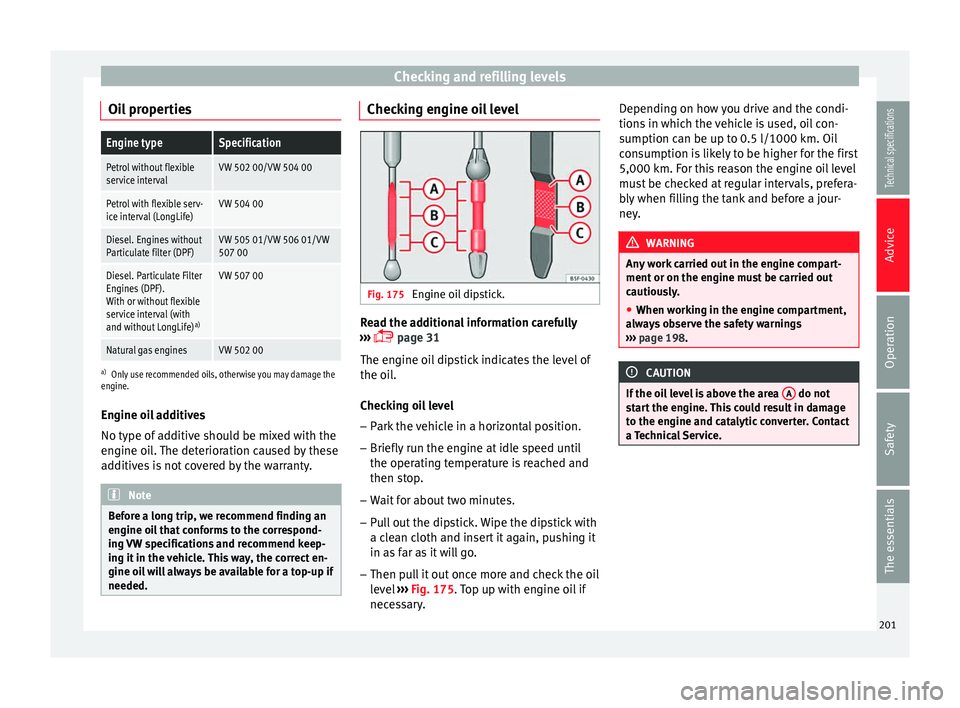
Fig. 175
Engine oil dipstick. Read the additional information carefully
››› page 31
The engine oil dipstick indicates the level of
the oil.
Checking oil level
– Park the vehicle in a horizontal position.
– Briefly run the engine at idle speed until
the operating temperature is reached and
then stop.
– Wait for about two minutes.
– Pull out the dipstick. Wipe the dipstick with
a clean cloth and insert it again, pushing it
in as far as it will go.
– Then pull it out once more and check the oil
level ››› Fig. 175 . Top up with engine oil if
nec e
ssary. Depending on how you drive and the condi-
tions in which the vehicle is used, oil con-
sumption can be up to 0.5 l/1000 km. Oil
consumption is likely to be higher for the first
5,000 km. For this reason the engine oil level
must be checked at regular intervals, prefera-
bly when filling the tank and before a jour-
ney.
WARNING
Any work carried out in the engine compart-
ment or on the engine must be carried out
cautiously.
● When working in the engine compartment,
always observe the safety warnings
››› page 198. CAUTION
If the oil level is above the area A do not
start the engine. This could result in damage
to the engine and catalytic converter. Contact
a Technical Service. 201
Technical specifications
Advice
Operation
Safety
The essentials
Page 204 of 284

Advice
Topping up engine oil Fig. 176
In the engine compartment: Engine
oil filler cap Read the additional information carefully
››› page 31
Before opening the bonnet, read and observe
the warnings ››› in Work in the engine
compartment on page 198 .
The po s
ition of the oil filler opening is shown
in the corresponding engine compartment il-
lustration ››› page 198
.
Engine oil specification ››› page 200. WARNING
Oil is highly inflammable! Ensure that no oil
comes into contact with hot engine compo-
nents when topping up. CAUTION
If the oil level is above the area A do not
start the engine. This could result in damage
to the engine and catalytic converter. Contact
a specialised workshop. For the sake of the environment
The oil level must never be above area A .
Otherwise oil can be drawn in through the
crankcase breather and escape into the at-
mosphere via the exhaust system. Changing engine oil
The engine oil must be changed at the inter-
vals given in the service schedule.
We recommend that you have the engine oil
changed by a Technical Service.
The oil change intervals are shown in the
Maintenance Programme.
WARNING
Only change the engine oil yourself if you
have the specialist knowledge required!
● Before opening the bonnet, read and ob-
serve the warnings ››› page 198.
● Wait
for the engine to cool down. Hot oil
may cause burn injuries.
● Wear eye protection to avoid injuries, such
as acid burns, caused by splashes of oil. ●
When removing the oil drain plug with your
fingers, keep your arm horizontal to help pre-
vent oil from running down your arm.
● Wash your skin thoroughly if it comes into
contact with engine oil.
● Engine oil is poisonous! Used oil must be
stored in a safe place out of the reach of chil-
dren. CAUTION
No additives should be used with engine oil.
This could result in engine damage. Any dam-
age caused by the use of such additives
would not be covered by the factory warranty. For the sake of the environment
● Because of disposal problems and the spe-
cial tools and specialist knowledge required,
we recommend that you have the engine oil
and filter changed by a Technical Service.
● Never pour oil down drains or into the
ground.
● Use a suitable container when draining the
used oil. It must be large enough to hold all
the engine oil. 202
Page 205 of 284

Checking and refilling levels
Cooling system Engine coolant specifications The engine cooling system is supplied from
the factory with a specially treated mixture of
water and, at least, 40 % of the additive
G 13
(TLVW 774 J). The engine coolant additive is
recognisable by its purple colour. This mix-
ture of water and additive gives the necessa-
ry frost protection down to -25°C (-13°F) and
protects the light alloy parts of the cooling
system against corrosion. It also prevents
scaling and considerably raises the boiling
point of the coolant.
To protect the engine cooling system, the
percentage of additive must always
be at
l e
ast 40 %, even in warm climates where an-
ti-freeze protection is not required.
If greater frost protection is required in very
cold climates, the proportion of additive can
be increased. However, the percentage of ad-
ditive should not exceed 60%, as this would
reduce the frost protection and, in turn, de-
crease the cooling capacity.
When the coolant is topped up, use a mixture
of distilled water and, at least, 40 % of the G
13 or G 12 plu
s-plus (TL-VW 774 G) additive
(both are purple) to obtain an optimum anti-
corrosion protection ››› . The mixture of G
13 with G 12 plus (TL-VW 774 F), G 12 (red) or
G 11 (green-blue) engine coolants will signifi- cantly reduce the anticorrosion protection
and should, therefore be avoided
››› .
WARNING
If there is not enough anti-freeze in the cool-
ant system, the engine may fail leading to se-
rious damage.
● Please make sure that the percentage of
additive is correct with respect to the lowest
expected ambient temperature in the zone in
which the vehicle is to be used.
● When the outside temperature is very low,
the coolant could freeze and the vehicle
would be immobilised. In this case, the heat-
ing would not work either and inadequately
dressed passengers could die of cold. CAUTION
The original additives should never be mixed
with coolants which are not approved by
SEAT. Otherwise, you run the risk of causing
severe damage to the engine and the engine
cooling system. ● If the fluid in the expansion tank is not pur-
ple but is, for example, brown, this indicates
that the G 13 additive has been mixed with
an inadequate coolant. The coolant must be
changed as soon as possible if this is the
case! This could result in serious faults and
engine damage. For the sake of the environment
Coolants and additives can contaminate the
environment. If any fluids are spilled, they
should be collected and correctly disposed
of, with respect to the environment. Topping up coolant
Read the additional information carefully
››› page 32
Top up coolant when the level is below the
MIN (minimum) mark.
Checking coolant level – Park the vehicle in a horizontal position.
– Switch the ignition off.
– Read off the coolant level on coolant ex-
pansion tank. When the engine is cold, the
coolant level should be between the marks.
When the engine is hot, it may be slightly
above the upper mark.
Topping up coolant – Wait for the engine to cool down.
– Cover the coolant expansion tank cap with
a cloth and carefully unscrew it to the left
››› .
– Top up the coolant only if there is still cool-
ant in the expansion tank, otherwise you »
203
Technical specifications
Advice
Operation
Safety
The essentials
Page 206 of 284

Advice
could damage the engine
. If there is no
c
oolant in the expansion tank, do not con-
tinue driving. You should obtain professio-
nal assistance ››› .
– If there is still some coolant in the expan-
sion tank, top up to the upper mark.
– Top up with coolant until the level becomes
stable.
– Screw the cap back on correctly.
Any loss of coolant fluid normally indicates a
leak in the cooling system. Take the vehicle
straight to a specialised workshop to have
the cooling system examined. If there are no
leaks in the engine cooling system, a loss of
coolant can only occur if the coolant boils
and is forced out of the system as a result of
overheating. WARNING
● The cooling system is under pressure. Do
not unscrew the cap on the coolant expan-
sion tank when the engine is hot: risk of
burns!
● The antifreeze and coolant fluid can be a
health hazard. Therefore, the antifreeze
should be stored in the original container in a
safe place out of reach of children. Failure to
comply could result in poisoning.
● If working inside the engine compartment,
remember that, even when the ignition is
switched off, the radiator fan may start up au- tomatically, and therefore there is a risk of in-
jury.
CAUTION
Do not top up the expansion tank with cool-
ant fluid if it is empty! Air could enter the
cooling system. In this case, stop driving.
Seek specialist assistance. Otherwise, there
is a risk of engine damage. Brake fluid
Topping up the brake fluid Read the additional information carefully
››› page 32
Checking the brake fluid level
The brake fluid level must be between the
MIN and MAX markings.
However, if the brake fluid level goes down
noticeably in a short time, or drops below the
MIN mark, there may be a leak in the brake
system. Seek specialist assistance. A warn-
ing light on the instrument panel display
monitors the brake fluid level ››› page 71.
In right-hand drive vehicles the brake fluid
reservoir is on the other side of the engine
compartment. Changing brake fluid
The regular intervals at which the brake fluid
should be replaced are listed in the Mainte-
nance Programme. We recommend you have
it replaced at a SEAT Official Service, during
an Inspection Service.
WARNING
● Brake fluid should be stored in the closed
original container in a safe place out of reach
of children. Risk of poisoning!
● If the brake fluid is left in the system for
too long and the brakes are subjected to
heavy use, vapour bubbles may form in the
brake system. This would seriously affect the
efficiency of the brakes and the safety of the
vehicle. This may cause an accident. CAUTION
Brake fluid should not come into contact with
the vehicle paintwork, as it is abrasive. Windscreen washer reservoir
Checking and topping up the
windscreen washer reservoir with
water Read the additional information carefully
››› page 32
204
Page 229 of 284

Emergencies
● Make sure the selector lever is in the N
po-
s ition.
● The
vehicle must not be towed faster than
50 km/h (30 mph).
● The v
ehicle must not be towed further than
50 km (30 miles)
. Reason: when the engine
is not running, the gearbox oil pump does
not work and the gearbox is not adequately
lubricated for higher speeds or longer distan-
ces.
If the vehicle has to be towed with a break-
down truck
, it must only be suspended at the
front wheels. Reason: the drive shafts are lo-
cated on the front wheels. If the car is towed
with the rear wheels lifted off the road (I.e.
travelling backwards), the drive shafts also
turn backwards. The planetary gears in the
aut
omatic gearbox then turn at such high
speeds that the gearbox will be severely
damaged in a short time. Note
● If it is not possible to tow the vehicle in the
normal way, or if it has to be towed further
than 50 km (30 miles), it must be transported
on a special car transporter or trailer.
● Should the power supply to the selector
lever be interrupted in position P, the selector
lever will be locked. Before the vehicle can be
recovered/manoeuvred you must manually
release the selector lever ››› page 229. Emergency locking and
unlocking
Introduction The doors, rear lid and panoramic tilting sun-
roof can be locked manually and partially
opened, for example if the key or the central
locking is damaged.
WARNING
Opening and closing doors carelessly can
cause serious injury.
● If the vehicle is locked from outside, the
doors and windows cannot be opened from
the inside.
● Never leave children or disabled people
alone in the car. They could be trapped in the
car in an emergency and will not be able to
get themselves to safety.
● Depending on the time of the year, temper-
atures inside a locked and closed vehicle can
be extremely high or extremely low resulting
in serious injuries and illness or even death,
particularly for young children. WARNING
Getting in the way of the doors and the rear
lid is dangerous and can lead to serious in-
jury.
● Open and close the doors and the rear lid
only when there is nobody in the way. CAUTION
When opening and closing in an emergency,
carefully disassemble components and then
reassemble them carefully to avoid damage
to the vehicle. Locking or unlocking the driver door
Fig. 194
Driver door lever: hidden lock cylin-
der. If the central locking system should fail to op-
erate, the driver door can still be locked and
unlocked by turning the key in the lock.
As a general rule, when the driver door is
locked all other doors are locked. When the
vehicle is unlocked manually, only the driver
door opens. Please observe the instructions
relating to the anti-theft alarm system
››› page 82 .
● Unf o
ld the vehicle key shaft ››› page 83.
»
227
Technical specifications
Advice
Operation
Safety
The essentials
Page 273 of 284

Index
Cooling system Checking the coolant . . . . . . . . . . . . . . . . . . . . 203
Coolant temperature gauge . . . . . . . . . . . . . . . . 69
Topping up coolant . . . . . . . . . . . . . . . . . . . . . . 203
Cornering lights . . . . . . . . . . . . . . . . . . . . . . . . . . . 97
Correct adjustment of front head restraints . . . . . 41
Correct adjustment of rear head restraints In-use and non-use positions of rear head re-straints . . . . . . . . . . . . . . . . . . . . . . . . . . . . . . 41
Correct sitting position front passenger . . . . . . . . . . . . . . . . . . . . . . . . . 39
Incorrect sitting position . . . . . . . . . . . . . . . . . . 40
passenger . . . . . . . . . . . . . . . . . . . . . . . . . . . . . . 40
Cruise control . . . . . . . . . . . . . . . . . . . . . . . . 21, 150 Control lamp . . . . . . . . . . . . . . . . . . . . . . . . . . . 150
Operation . . . . . . . . . . . . . . . . . . . . . . . . . . . . . 151
Warning lamp . . . . . . . . . . . . . . . . . . . . . . . . . . 150
Cruise control system . . . . . . . . . . . . . . . . . . . . . . 150
D Dangers in not using the seat belt . . . . . . . . . . . . 45
Daytime driving light . . . . . . . . . . . . . . . . . . . . . . . 95
Deactivating the front passenger front airbag . . . 11
DEF (instrument panel) . . . . . . . . . . . . . . . . . . . . . 69
Diesel Diesel particulate filter . . . . . . . . . . . . . . . . . . . 141
Engine oil . . . . . . . . . . . . . . . . . . . . . . . . . . . . . 200
Pre-heating . . . . . . . . . . . . . . . . . . . . . . . . . . . . 129
Digital clock . . . . . . . . . . . . . . . . . . . . . . . . . . . . . . 66
Dimensions . . . . . . . . . . . . . . . . . . . . . . . . . . . . . . 267
Dipped beam headlight . . . . . . . . . . . . . . . . . . . . . 94
Direction of rotation (tyres) . . . . . . . . . . . . . . . . . 220
Disabling the front airbag . . . . . . . . . . . . . . . . . . . 54
Display . . . . . . . . . . . . . . . . . . . . . . . . . . . . . . . 66, 67
Display/Easy Connect control panel: cleaning . . 187
Disposal Seat belt tensioners . . . . . . . . . . . . . . . . . . . . . . 47 Distance control
see Adaptive cruise control . . . . . . . . . . . . . . . 151
Door/r e
ar lid warning . . . . . . . . . . . . . . . . . . . . . . . 72
Door cylinder . . . . . . . . . . . . . . . . . . . . . . . . . . . . 227
Door handle . . . . . . . . . . . . . . . . . . . . . . . . . . . . . 227
Door lock . . . . . . . . . . . . . . . . . . . . . . . . . . . . . . . . 227
Doors Childproof locks . . . . . . . . . . . . . . . . . . . . . . . . . 87
Opening and closing . . . . . . . . . . . . . . . . . . . . . . 9
Downhill speed control . . . . . . . . . . . . . . . . . . . . 138
Drawer . . . . . . . . . . . . . . . . . . . . . . . . . . . . . . . . . . 111
Drink holders . . . . . . . . . . . . . . . . . . . . . . . . . . . . 112
Driver see
Correct sitting position . . . . . . . . . 38, 39, 40
Driver information system . . . . . . . . . . . . . . . . . . . 19 CD/radio display . . . . . . . . . . . . . . . . . . . . . . . . . 72
Control . . . . . . . . . . . . . . . . . . . . . . . . . . . . . . . . . 19
Door/rear lid warning . . . . . . . . . . . . . . . . . . . . . 72
Engine oil temperature display . . . . . . . . . . . . . 77
Menu . . . . . . . . . . . . . . . . . . . . . . . . . . . . . . . . . . 20
Operation via the windscreen wiper lever . . . . . 72
Outside temperature display . . . . . . . . . . . . . . . 72
Driving With a trailer . . . . . . . . . . . . . . . . . . . . . . 177, 179
Driving abroad Headlights . . . . . . . . . . . . . . . . . . . . . . . . . . . . 100
Driving mode . . . . . . . . . . . . . . . . . . . . . . . 170, 171
Driving profile . . . . . . . . . . . . . . . . . . . . . . . 170, 171
Driving safety . . . . . . . . . . . . . . . . . . . . . . . . . . . . . 37
Driving through water . . . . . . . . . . . . . . . . . . . . . 141
Dynamic headlight range control . . . . . . . . . . . . 100
E
E10 see Ethanol (fuel) . . . . . . . . . . . . . . . . . . . . . . . 195
E a
sy Connect . . . . . . . . . . . . . . . . . . . . . . . . . . 17, 81
Economic driving . . . . . . . . . . . . . . . . . . . . . . . . . 142 EDL
see Electronic differential lock . . . . . . . . . . . . . 143
Effic iency
programme
Additional electrical appliances . . . . . . . . . . . . 77
Saving tips . . . . . . . . . . . . . . . . . . . . . . . . . . . . . 78
Electric Windows . . . . . . . . . . . . . . . . . . . . . . . . . . . . . . . 90
Electrical accessories see
Power socket . . . . . . . . . . . . . . . . . . . . . . . 113
Electrical sockets trailer . . . . . . . . . . . . . . . . . . . . . . . . . . . . . . . . . 179
Electric seat Adjustment . . . . . . . . . . . . . . . . . . . . . . . . . . . . . 12
Electric windows . . . . . . . . . . . . . . . . . . . . . . . . 10, 90 Convenience opening/closing . . . . . . . . . . . . . . 91
Electro-mechanical steering . . . . . . . . . . . . . . . . 190 Warning lamp . . . . . . . . . . . . . . . . . . . . . . . . . . 190
Electronic differential lock . . . . . . . . . . . . . . . . . . 143
Electronic self-locking . . . . . . . . . . . . . . . . . . . . . 143
Electronic Stability Control (ESC) . . . . . . . . . . . . 143
Emergencies . . . . . . . . . . . . . . . . . . . . . . . . . . . . . 217 Automatic gearbox Backup programme . . . . . 139
Replacing the battery . . . . . . . . . . . . . . . . . . . . 207
Emergency braking warning . . . . . . . . . . . . . . . . . 99
Emergency locking and unlocking . . . . . . . . . . . 227
Emergency towing . . . . . . . . . . . . . . . . . . . . . . . . . 35
Engine Assisted starting . . . . . . . . . . . . . . . . . . . . . . . . 223
Pre-heating . . . . . . . . . . . . . . . . . . . . . . . . . . . . 129
Start-Stop system . . . . . . . . . . . . . . . . . . . . . . . 148
Starting . . . . . . . . . . . . . . . . . . . . . . . . . . . . . . . 129
Starting up (driver messages with the me-chanical contact) . . . . . . . . . . . . . . . . . . . . . 129
Switching off (engine) . . . . . . . . . . . . . . . . . . . 130
Engine compartment . . . . . . . . . . . . . . . . . . 10, 198 Closing the bonnet . . . . . . . . . . . . . . . . . . . . . . 199
Opening the bonnet . . . . . . . . . . . . . . . . . . . . . 199
Safety notes . . . . . . . . . . . . . . . . . . . . . . . . . . . 198 271
Page 274 of 284

Index
Engine coolant . . . . . . . . . . . . . . . . . . . . . . . . . . . 203 G 12 plus-plus . . . . . . . . . . . . . . . . . . . . . . . . . 203
G 13 . . . . . . . . . . . . . . . . . . . . . . . . . . . . . . . . . . 203
Specifications . . . . . . . . . . . . . . . . . . . . . . . . . . 203
Engine fault control lamp . . . . . . . . . . . . . . . . . . . . . . . . . . . . 71
Engine management control lamp . . . . . . . . . . . . . . . . . . . . . . . . . . . . 71
Engine oil . . . . . . . . . . . . . . . . . . . . . . . . . . . . . . . 200 Changing . . . . . . . . . . . . . . . . . . . . . . . . . . . . . . 202
Checking oil level . . . . . . . . . . . . . . . . . . . . . . . 201
Consumption . . . . . . . . . . . . . . . . . . . . . . . . . . 201
Engine oil dipstick . . . . . . . . . . . . . . . . . . . . . . 201
Inspection service . . . . . . . . . . . . . . . . . . . . . . 200
Longlife inspection service . . . . . . . . . . . . . . . 200
Oil properties . . . . . . . . . . . . . . . . . . . . . . . . . . 201
Replace . . . . . . . . . . . . . . . . . . . . . . . . . . . . . . . 200
Service intervals . . . . . . . . . . . . . . . . . . . . . . . . 200
Specifications . . . . . . . . . . . . . . . . . . . . . . . . . . 200
Temperature display . . . . . . . . . . . . . . . . . . . . . . 77
Topping up . . . . . . . . . . . . . . . . . . . . . . . . . . . . 202
Environment Ecological driving . . . . . . . . . . . . . . . . . . . . . . . 142
Environmental friendliness . . . . . . . . . . . . . . . 140
Environmental tip Leaks . . . . . . . . . . . . . . . . . . . . . . . . . . . . . . . . . 199
Environmental tips Filling the tank . . . . . . . . . . . . . . . . . . . . . . . . . 194
Refuelling . . . . . . . . . . . . . . . . . . . . . . . . . . . . . 193
Environment warning . . . . . . . . . . . . . . . . . . . . . . 174
Equipment . . . . . . . . . . . . . . . . . . . . . . . . . . . . . . 113
ESC Electronic stability control . . . . . . . . . . . . . . . . 143
Multi-collision brake . . . . . . . . . . . . . . . . . . . . . 144
Sport Mode . . . . . . . . . . . . . . . . . . . . . . . . . . . . 145
Ethanol (fuel) . . . . . . . . . . . . . . . . . . . . . . . . . . . . 195 Exhaust gas filtration system
Catalytic converter . . . . . . . . . . . . . . . . . . . . . . 141
Exhaust tail pipe: Cleaning . . . . . . . . . . . . . . . . . 186
Extending the luggage compartment . . . . . . . . . . . . . . . . 109
Exterior lighting Changing a bulb . . . . . . . . . . . . . . . . . . . . . . . . 233
Exterior mirrors adjusting . . . . . . . . . . . . . . . . . . . . . . . . . . . . . . 104
Adjusting . . . . . . . . . . . . . . . . . . . . . . . . . . . . . . . 13
Exterior view . . . . . . . . . . . . . . . . . . . . . . . . . . . . . . . 5
F Fastening rings . . . . . . . . . . . . . . . . . . . . . . . . . . . 119
Fault in the gearbox (warning lamp) . . . . . . . . . . 139
Faults Panoramic sliding sunroof . . . . . . . . . . . . . . . . . 93
Faults in the gearbox (warning lamps) . . . . . . . . 139
Faulty bulbs Changing a bulb . . . . . . . . . . . . . . . . . . . . . . . . 233
Filling the fuel tank . . . . . . . . . . . . . . . . . . . . . . . 193
Floor mats . . . . . . . . . . . . . . . . . . . . . . . . . . . . . . . . 42
Fog light . . . . . . . . . . . . . . . . . . . . . . . . . . . . . . . . . 97
Folding down the back seats . . . . . . . . . . . . . . . . 109
Folding table . . . . . . . . . . . . . . . . . . . . . . . . . . . . . 111
Four wheel drive . . . . . . . . . . . . . . . . . . . . . . . . . . 191
Front airbags . . . . . . . . . . . . . . . . . . . . . . . . . . . . . 50
Front armrest . . . . . . . . . . . . . . . . . . . . . . . . . . . . 108
Front Assist City Emergency braking function . . . . . . . . . . . 165
malfunction . . . . . . . . . . . . . . . . . . . . . . . . . . . . 162
on-screen messages . . . . . . . . . . . . . . . . . . . . 162
operating . . . . . . . . . . . . . . . . . . . . . . . . . . . . . . 163
radar sensor . . . . . . . . . . . . . . . . . . . . . . . . . . . 163
switching off temporarily . . . . . . . . . . . . . . . . . 164
system limitations . . . . . . . . . . . . . . . . . . . . . . 164
see also Front Assist Monitoring system . . . . . 161 Fr
ont Assist monitoring system
malfunction . . . . . . . . . . . . . . . . . . . . . . . . . . . . 162
on-screen messages . . . . . . . . . . . . . . . . . . . . 162
operating . . . . . . . . . . . . . . . . . . . . . . . . . . . . . . 163
Front Assist Monitoring system . . . . . . . . . . . . . . 161 City Emergency braking function . . . . . . . . . . . 165
radar sensor . . . . . . . . . . . . . . . . . . . . . . . . . . . 163
Front Assist Monitoring System switching off temporarily . . . . . . . . . . . . . . . . . 164
system limitations . . . . . . . . . . . . . . . . . . . . . . 164
Front head restraints . . . . . . . . . . . . . . . . . . . . . . . 41
Front headrests . . . . . . . . . . . . . . . . . . . . . . . . . . . 41
Front passenger front airbag Deactivating . . . . . . . . . . . . . . . . . . . . . . . . . . . . 11
Front seats Manually adjusting . . . . . . . . . . . . . . . . . . . . . . . 12
Fuel . . . . . . . . . . . . . . . . . . . . . . . . . . . . . . . . 31, 195 Consumption . . . . . . . . . . . . . . . . . . . . . . . . . . 241
diesel . . . . . . . . . . . . . . . . . . . . . . . . . . . . . . . . . 196
Ethanol . . . . . . . . . . . . . . . . . . . . . . . . . . . . . . . 195
Fuel gauge . . . . . . . . . . . . . . . . . . . . . . . . . . . . . 70
natural gas . . . . . . . . . . . . . . . . . . . . . . . . . . . . 196
Fuel consumption . . . . . . . . . . . . . . . . . . . . . . . . . 242
Fuel tank cap Opening and closing . . . . . . . . . . . . . . . . . . . . . 31
Fuel tank flap Opening and closing . . . . . . . . . . . . . . . . . . . . . 31
Full-LED headlights . . . . . . . . . . . . . . . . . . . . . . . 233
Fuses . . . . . . . . . . . . . . . . . . . . . . . . . . . . . . . 33, 231 Fuse box . . . . . . . . . . . . . . . . . . . . . . . . . . . . . . 232
Identifying blown fuses . . . . . . . . . . . . . . . . . . 233
Identifying by colours . . . . . . . . . . . . . . . . . . . . 232
Preparation before replacing . . . . . . . . . . . . . . 233
Replacement . . . . . . . . . . . . . . . . . . . . . . . . . . . 233
272
Page 279 of 284

Index
Sun protection . . . . . . . . . . . . . . . . . . . . . . . . . . . 101
Sunroof . . . . . . . . . . . . . . . . . . . . . . . . . . . . . . . . . . 11
Sun visor . . . . . . . . . . . . . . . . . . . . . . . . . . . . . . . . 101
Switch Hazard warning lights . . . . . . . . . . . . . . . . . . . . 99
Switching off using inertia . . . . . . . . . . . . . . . . . . 142
Switching off (engine) With the key . . . . . . . . . . . . . . . . . . . . . . . . . . . 130
Switching the ignition on/off . . . . . . . . . . . . . . . 129
Switching the lights off . . . . . . . . . . . . . . . . . . . . . 94
Switching the lights on . . . . . . . . . . . . . . . . . . . . . 94
Symbols See "Lamps" . . . . . . . . . . . . . . . . . . . . . . . . . . . . 71
System Automatic dipped beam control . . . . . . . . . . . . 96
System Easy Connect . . . . . . . . . . . . . . . . . . . . . . . 81
Systems ACC . . . . . . . . . . . . . . . . . . . . . . . . . . . . . . . . . . 151
Adaptive Cruise Control . . . . . . . . . . . . . . . . . . 151
Cruise control . . . . . . . . . . . . . . . . . . . . . . . . . . 150
Front Assist monitoring system . . . . . . . . . . . . 161
Tiredness detection . . . . . . . . . . . . . . . . . . . . . 172
Tyre monitoring indicator . . . . . . . . . . . . . . . . . 213
Tyre monitoring systems . . . . . . . . . . . . . . . . . 212
T Tailboard for transporting long items . . . . . . . . . 118
Tailgate locking time extension see Luggage compartment . . . . . . . . . . . . . 89, 90
T ec
hnical data
roof load . . . . . . . . . . . . . . . . . . . . . . . . . . . . . . 124
Top-up quantities . . . . . . . . . . . . . . . . . . . . . . . 205
Technical modifications . . . . . . . . . . . . . . . . . . . . 182
Technical specifications . . . . . . . . . . . . . . . . . . . . 241
Temperature display Engine oil . . . . . . . . . . . . . . . . . . . . . . . . . . . . . . 77
Outside temperature . . . . . . . . . . . . . . . . . . 72, 74 Things to note
natural gas . . . . . . . . . . . . . . . . . . . . . . . . . . . . 194
Tightening torque of wheel bolts . . . . . . . . . . . . 244
Timer . . . . . . . . . . . . . . . . . . . . . . . . . . . . . . . . . . . . 78 lap times . . . . . . . . . . . . . . . . . . . . . . . . . . . . . . . 78
menu . . . . . . . . . . . . . . . . . . . . . . . . . . . . . . . . . . 78
statistics . . . . . . . . . . . . . . . . . . . . . . . . . . . . . . . 78
Tiptronic (automatic gearbox) . . . . . . . . . . 132, 135
Tiredness detection . . . . . . . . . . . . . . . . . . . . . . . 172
Tire Mobility Set Check after 10 minutes . . . . . . . . . . . . . . . . . . 222
Do not use . . . . . . . . . . . . . . . . . . . . . . . . . . . . . 221
Inflating a tyre . . . . . . . . . . . . . . . . . . . . . . . . . . 222
Tools . . . . . . . . . . . . . . . . . . . . . . . . . . . . . . . . . . . 220
Top-up quantities Windscreen washer reservoir . . . . . . . . . . . . . . 205
Top Tether . . . . . . . . . . . . . . . . . . . . . . . . . . . . . 59, 61
Top Tether system . . . . . . . . . . . . . . . . . . . . . . . . . 59
Top Tether System . . . . . . . . . . . . . . . . . . . . . . . . . 61
Tow-away protection . . . . . . . . . . . . . . . . . . . . . . . 89
Tow-starting the engine . . . . . . . . . . . . . . . . . . . . 224
Towing Retrofitting a towing bracket . . . . . . . . . . . . . . 180
Towing a trailer . . . . . . . . . . . . . . . . . . . . . . 177, 243
Towing bracket . . . . . . . . . . . . . . . . . . . . . . . . . . . 179
Towing the vehicle . . . . . . . . . . . . . . . . . . . . 35, 224
Towline anchorage . . . . . . . . . . . . . . . . . . . . . . . . 220
Tow rope . . . . . . . . . . . . . . . . . . . . . . . . . . . . . . . . 178
Traction control system . . . . . . . . . . . . . . . . . . . . 143
Trailer connecting . . . . . . . . . . . . . . . . . . . . . . . . . . . . 178
electrical socket . . . . . . . . . . . . . . . . . . . . . . . . 179
hitching . . . . . . . . . . . . . . . . . . . . . . . . . . . . . . . 178
Parking aid . . . . . . . . . . . . . . . . . . . . . . . . . . . . 177
rear lights . . . . . . . . . . . . . . . . . . . . . . . . . . . . . 178
tow rope . . . . . . . . . . . . . . . . . . . . . . . . . . . . . . 178
Trailer weights . . . . . . . . . . . . . . . . . . . . . . . . . . . 243 Transporting children . . . . . . . . . . . . . . . . . . . . . . . 56
Transporting items
fastening rings . . . . . . . . . . . . . . . . . . . . . . . . . 119
Roof carrier . . . . . . . . . . . . . . . . . . . . . . . . . . . . 122
roof carrier system . . . . . . . . . . . . . . . . . . . . . . 122
Transporting objects net bag . . . . . . . . . . . . . . . . . . . . . . . . . . . . . . . 120
retaining hooks . . . . . . . . . . . . . . . . . . . . . . . . 120
roof carrier system . . . . . . . . . . . . . . . . . . . . . . 124
tailboard for transporting long items . . . . . . . 118
Trim parts: cleaning . . . . . . . . . . . . . . . . . . . . . . . 187
Trims: Cleaning . . . . . . . . . . . . . . . . . . . . . . . . . . . 185
Trip recorder . . . . . . . . . . . . . . . . . . . . . . . . . . . 66, 69
Turn signal convenience function . . . . . . . . . . . . . 95
Turn signal lever . . . . . . . . . . . . . . . . . . . . . . . . 15, 95
Two-way radios . . . . . . . . . . . . . . . . . . . . . . . . . . . 182
Tyre Tyre pressure . . . . . . . . . . . . . . . . . . . . . . . . . . . 208
Useful life . . . . . . . . . . . . . . . . . . . . . . . . . . . . . 208
Tyre mobility set . . . . . . . . . . . . . . . . . . . . . . . . . . . 33 Components . . . . . . . . . . . . . . . . . . . . . . . . . . . 222
Sealing a tyre . . . . . . . . . . . . . . . . . . . . . . . . . . 222
Tyre mobility system . . . . . . . . . . . . . . . . . . . . . . . 220
Tyre Mobility System See tyre mobility system . . . . . . . . . . . . . . . . . 220
Tyre monitoring indicator . . . . . . . . . . . . . . . . . . . 213
Tyre monitoring system . . . . . . . . . . . . . . . . . . . . 212
Tyre monitoring systems Control lamp . . . . . . . . . . . . . . . . . . . . . . . . . . . 212
Tyre monitoring indicator . . . . . . . . . . . . . . . . . 213
Tyre pressure . . . . . . . . . . . . . . . . . . . . . . . . . . . . 208
Tyre pressures . . . . . . . . . . . . . . . . . . . . . . . . . . . . 243
Tyre profile . . . . . . . . . . . . . . . . . . . . . . . . . . . . . . 209
Tyre repair kit . . . . . . . . . . . . . . . . . . . . . . . . . . . . 220
Tyre repair set See tyre mobility system . . . . . . . . . . . . . . . . . 220
277