trailer Seat Leon 5D 2014 Owner's Guide
[x] Cancel search | Manufacturer: SEAT, Model Year: 2014, Model line: Leon 5D, Model: Seat Leon 5D 2014Pages: 284, PDF Size: 5.85 MB
Page 182 of 284

Operation
You should always reduce speed immediately
if the trailer shows the slightest sign of snak-
ing . Never try to stop the “snaking” by in-
c r
easing speed.
Always brake in due course. If the trailer has
an overrun brake, apply the brakes gen
tly at
first and then, firmly. This will prevent the
jerking that can be caused by locking of trail-
er wheels. Select a low gear in due course
before going down a steep downhill. This en-
ables you to use the engine braking to slow
down the vehicle.
Reheating
At very high temperatures and during pro-
longed slopes, driving in a low gear and high
engine speed, always monitor the coolant
temperature gauge ››› page 71.
Electronic stability control*
The ESC* system helps to stabilise the trailer
in case of skidding or rocking. Retrofitting a towing bracket*
Fig. 172
Attachment points for towing brack-
et. If a towing bracket is to be fitted after the ve-
hicle is purchased, this must be completed
according to the instructions of the towing
bracket manufacturer.The attachment points for the towing bracket
A are on the lower part of the vehicle.
The distance between the centre of the ball
coupling and the ground should never be
lower than the indicated value, even with a
fully loaded vehicle and including the maxi-
mum drawbar load.
Elevation values for securing the towing
bracket:
B65 mm (minimum)
C350 mm to 420 mm (fully laden vehicle)
D1040 mm
E317 mm
FLEON/LEON SCLEON ST
319 mm596 mm Fitting a towing bracket
●
Driving with a trailer involves an extra effort
for the vehicle. Therefore, before fitting a
towing bracket, please contact a Technical
Service to check whether your cooling system
needs modification.
● The legal requirements in your country
must be observed (e.g. the fitting of a sepa-
rate control lamp).
● Certain vehicle components, e.g. the rear
bumper, must be removed and reinstalled.
The towing bracket securing bolts must be
180
Page 219 of 284
Emergencies
Snow chains will improve braking ability as
well as traction in winter conditions.
F or t
echnical reasons snow chains may only
be used with the following wheel rim/tyre
combination.
195/65 R15Chains with links of maximum 15 mm
205/55 R16Chains with links of maximum 15 mm
225/45 R17Chains with links of maximum 9 mm
225/40 R18Chains with links of maximum 9 mm Remove wheel covers and any
integral trim
ring before fitting snow chains.
R emo
ve the chains when roads are free of
snow
. Otherwise they will impair handling,
damage the tyres and wear out very quickly. Emergencies
Changing a wheel What to do first Read the additional information carefully
››› page 34
– If you have a flat tyre or puncture, park the
car as far away from the flow of traffic as
possible in a safe place. If you have a punc-
ture, stop the vehicle on a horizontal sur-
face. If you are on a slope, take extra care.
– Apply the handbrake.
– Switch on the hazard warning lights.
– Manual gearbox: select the 1st gear.
– Automatic gearbox: move the selector lever
to P.
– When towing a trailer: unhitch the trailer
from your vehicle.
– Have the vehicle tool kit ›››
page 220 and
the spare wheel ready ›››
page 214.
– Observe the applicable legislation for each
country (reflective vest, warning triangles,
etc.).
– All vehicle occupants should leave the car.
They should wait in a safe area (for in-
stance behind the roadside crash barrier). WARNING
● Always observe the above steps and pro-
tect yourself and other road users.
● If you change the wheel on a slope, block
the wheel on the opposite side of the car with
a stone or similar to prevent the vehicle from
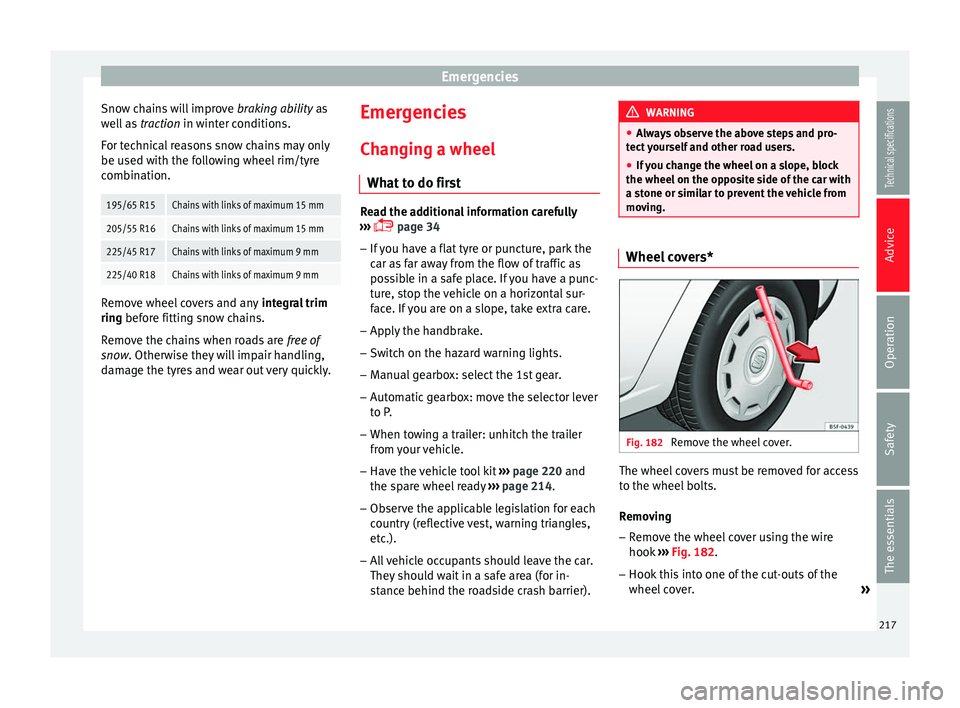
moving. Wheel covers*
Fig. 182
Remove the wheel cover. The wheel covers must be removed for access
to the wheel bolts.
Removing
– Remove the wheel cover using the wire
hook ›››
Fig. 182 .
– Hook thi
s into one of the cut-outs of the
wheel cover. »
217
Technical specifications
Advice
Operation
Safety
The essentials
Page 227 of 284

Emergencies
Do not pull too hard with the towing vehicle
and take care to avoid jerking the tow rope.
When towing on an unpaved road, there is al-
ways a risk of overloading and damaging the
anchorage points. WARNING
If the vehicle has no electrical power, the
brake lights, turn signals and all other lights
will no longer function. Do not have the vehi-
cle towed away. Failure to follow this instruc-
tion could result in an accident. CAUTION
If there is no oil in the gearbox or no lubricant
in the automatic transmission the car may
only be towed with the driven wheels lifted
clear of the road, or transported on a special
car transporter or trailer. Note
● Please observe related legal requirements.
● Switch on the hazard warning lights of both
vehicles. However, observe any regulations
to the contrary.
● The tow rope must not be twisted. Other-
wise the front towline anchorage could be
pulled off the vehicle. Towline anchorage at the front of the
vehicle
Fig. 191
Right side of the front bumper: tow-
line anchorage screwed in. The front towline anchorage is only mounted
if the vehicle has to be towed.
There is a cover with an opening into which
the towline anchorage is screwed on the right
part of the front bumper.
– To remove the bumper cover, just press the
upper left side inwards.
– Take the towline anchorage out of the vehi-
cle tool kit ››› page 220 .
– Sc r
ew the towline anchorage into the screw
connection as far as it will go ››› Fig. 191
and tighten with the wheel brace.
After use, unscrew the towline anchorage
and fit the cover back on the bumper. Put the
towline anchorage back in the vehicle tool kit. The towline anchorage should always be
kept in the vehicle.
Rear towline anchorage Fig. 192
Right side of the rear bumper: cover-
cap. Fig. 193
Right side of the rear bumper: tow-
line anchorage screwed in. The rear towline anchorage should only be
mounted if you wish to tow another vehicle.
»
225
Technical specifications
Advice
Operation
Safety
The essentials
Page 229 of 284

Emergencies
● Make sure the selector lever is in the N
po-
s ition.
● The
vehicle must not be towed faster than
50 km/h (30 mph).
● The v
ehicle must not be towed further than
50 km (30 miles)
. Reason: when the engine
is not running, the gearbox oil pump does
not work and the gearbox is not adequately
lubricated for higher speeds or longer distan-
ces.
If the vehicle has to be towed with a break-
down truck
, it must only be suspended at the
front wheels. Reason: the drive shafts are lo-
cated on the front wheels. If the car is towed
with the rear wheels lifted off the road (I.e.
travelling backwards), the drive shafts also
turn backwards. The planetary gears in the
aut
omatic gearbox then turn at such high
speeds that the gearbox will be severely
damaged in a short time. Note
● If it is not possible to tow the vehicle in the
normal way, or if it has to be towed further
than 50 km (30 miles), it must be transported
on a special car transporter or trailer.
● Should the power supply to the selector
lever be interrupted in position P, the selector
lever will be locked. Before the vehicle can be
recovered/manoeuvred you must manually
release the selector lever ››› page 229. Emergency locking and
unlocking
Introduction The doors, rear lid and panoramic tilting sun-
roof can be locked manually and partially
opened, for example if the key or the central
locking is damaged.
WARNING
Opening and closing doors carelessly can
cause serious injury.
● If the vehicle is locked from outside, the
doors and windows cannot be opened from
the inside.
● Never leave children or disabled people
alone in the car. They could be trapped in the
car in an emergency and will not be able to
get themselves to safety.
● Depending on the time of the year, temper-
atures inside a locked and closed vehicle can
be extremely high or extremely low resulting
in serious injuries and illness or even death,
particularly for young children. WARNING
Getting in the way of the doors and the rear
lid is dangerous and can lead to serious in-
jury.
● Open and close the doors and the rear lid
only when there is nobody in the way. CAUTION
When opening and closing in an emergency,
carefully disassemble components and then
reassemble them carefully to avoid damage
to the vehicle. Locking or unlocking the driver door
Fig. 194
Driver door lever: hidden lock cylin-
der. If the central locking system should fail to op-
erate, the driver door can still be locked and
unlocked by turning the key in the lock.
As a general rule, when the driver door is
locked all other doors are locked. When the
vehicle is unlocked manually, only the driver
door opens. Please observe the instructions
relating to the anti-theft alarm system
››› page 82 .
● Unf o
ld the vehicle key shaft ››› page 83.
»
227
Technical specifications
Advice
Operation
Safety
The essentials
Page 245 of 284

Technical specifications
Note
In practice, and considering all the factors
mentioned here, consumption values can dif-
fer from those calculated in the current Euro-
pean regulations. Weights
Kerb weight refers to the basic model with a
fuel tank filled to 90% capacity and without
optional extras. The figure quoted includes
75 kg to allow for the weight of the driver.
Special versions, optional equipment fittings
or retro-fitting accessories will increase the
weight of the vehicle
››› .
WARNING
● Please note that the centre of gravity may
shift when transporting heavy objects; this
may affect vehicle handling and lead to an ac-
cident. Always adjust your speed and driving
style to suit road conditions and require-
ments.
● Never exceed the gross axle weight rating
or the gross vehicle weight rating. If the per-
missible axle load or the permissible total
weight is exceeded, the driving characteris-
tics of the vehicle may change, which could
lead to accidents, injuries and damage to the
vehicle. Towing a trailer
Trailer weights Trailer weight
The trailer weights and drawbar loads ap-
proved are selected in intensive trials accord-
ing to precisely defined criteria. The ap-
proved trailer weights apply to vehicles in the
EU and generally for maximum speeds of 80
km/h (100 km/h in c
er
tain circumstances).
The figures may be different in other coun-
tries. All data in the official vehicle documen-
tation takes precedence over these data at all
times ››› .
Drawbar loads
The maximum
permitted drawbar load on the
b
all joint of the towing bracket must not ex-
ceed
80 kg.
In the interest of road safety, we recommend
that you always tow approaching the maxi-
mum drawbar load. The response of the trail-
er on the road will be poor, if the drawbar
load is too small.
If the maximum permissible drawbar load
cannot be met (e.g. with small, empty and
light-weight single axle trailers or tandem
axle trailers with a wheelbase of less than 1
metre), a minimum of 4% of the actual trailer
weight is legally required for the drawbar
load. WARNING
● For safety reasons, do not exceed the 80
km/h (50 mph) limit. This is also valid in
countries where higher speeds are permitted.
● Never exceed the maximum trailer weights
or the drawbar load. If the permissible axle
load or the permissible total weight is excee-
ded, the driving characteristics of the vehicle
may change, leading to accidents, injuries
and damage to the vehicle. Wheels
Tyre pressure, snow chains, wheel
bolts Tyre pressures
The sticker with the tyre pressure values can
be found on the inside of the fuel tank flap.
The tyre pressure values given there are for
cold
tyres. The slightly raised pressures of
w arm ty
res must not be reduced. ››› Snow chains
Snow chains may be fitted only to the front
wheels, and only for the following tyres:
»
243
Technical specifications
Advice
Operation
Safety
The essentials
Page 247 of 284

Technical specifications
Engine specifications Petrol engine 1.2 63 kW (85 PS)Power output in kW (PS) at rpmMaximum torque (Nm at rpm)No. of cylinders/displacement (cm 3
)Fuel
63 (86)/4,300-5,300160/1,400-3,5004/1,197Super 95 RON/Normal 91 RON a)
a)
Slight power loss.
PerformanceLEONLEON SCLEON ST
Top speed (km/h)178 (V)178 (V)178 (V)
Acceleration from 0-80 km/h (seconds)7.67.57.8
Acceleration from 0-100 km/h (seconds)11.911.812.1
Weights (in kg)
Gross vehicle weight1,6901,7001,800
Weight in running order (with driver)1,1881,1681,233
Gross front axle weight880880890
Gross rear axle weight860870960
Permitted roof load757575
Maximum trailer weights (in kg)
Trailer without brakes590580610
Trailer with brakes, gradients up to 8%1,3001,3001,300
Trailer with brakes, gradients up to 12%1,1001,1001,100 245
Technical specifications
Advice
Operation
Safety
The essentials
Page 248 of 284

Technical specifications
Petrol engine 1.2 77 kW (105 PS)Power output in kW (PS) at rpmMaximum torque (Nm at rpm)No. of cylinders/displacement (cm 3
)Fuel
77 (105)/4,500-5,500175/1,400-4,0004/1,197Super 95 RON/Normal 91 RON a)
a)
Slight power loss.
PerformanceLEON
ManualLEON
Start-StopLEON
AutomaticLEON SC ManualLEON SC
Start-StopLEON SC
AutomaticLEON ST ManualLEON ST
Start-StopLEON ST
Automatic
Top speed (km/h)191 (V)191 (V)191 (VI)191 (V)191 (V)191 (V)191 (V)191 (V)191 (VI)
Acceleration from 0-80 km/h (sec-
onds)6.86.86.86.76.76.76.96.87.0
Acceleration from 0-100 km/h (sec-
onds)10.210.210.210101010.410.310.3
Weights (in kg)
Gross vehicle weight1,7201,7201,7501,7101,7101,7301,8101,8201,850
Weight in running order (with driv-
er)1,1991,2091,2351,1791,1891,2151,2441,2541,280
Gross front axle weight890890920880890920880890920
Gross rear axle weight880880880880870860980980980
Permitted roof load757575757575757575
Maximum trailer weights (in kg)
Trailer without brakes590600610580590600620620640
Trailer with brakes, gradients up to
8%1,5001,5001,5001,5001,5001,5001,5001,5001,500
Trailer with brakes, gradients up to
12%1,3001,3001,3001,3001,3001,3001,3001,3001,300 246
Page 249 of 284

Technical specifications
Petrol engine 1.2 TSI 81 kW (110 PS)Power output in kW (PS) at rpmMaximum torque (Nm at rpm)No. of cylinders/displacement (cm 3
)Fuel
81 (110)/4,600-5,600175/1,400-4,0004/1,197Super 95 RON/Normal 91 RON a)
a)
Slight power loss.
PerformanceLEONLEON SCLEON ST
ManualStart-StopAutomaticManualStart-StopAutomaticManualStart-StopAutomatic
Top speed (km/h)194 (V)194 (V)194 (V)194 (V)194 (V)194 (VI)194 (V)194 (V)194 (VI)
Acceleration from 0-80 km/h (seconds)6.66.66.66.56.56.56.76.76.7
Acceleration from 0-100 km/h (seconds)9.99.99.99.79.79.710.110.110.1
Weights (in kg)
Gross vehicle weight1,7401,7401,7601,7101,7201,7501,7901,8001,820
Weight in running order (with driver)1,2061,2131,2411,1861,1931,2211,2401,2471,275
Gross front axle weight900900930890890920890890920
Gross rear axle weight890890880870880880950960950
Permitted roof load757575757575757575
Maximum trailer weights (in kg)
Trailer without brakes600600620590590610620620630
Trailer with brakes, gradients up to 8%1,5001,5001,5001,5001,5001,5001,5001,5001,500
Trailer with brakes, gradients up to 12%1,3001,3001,3001,3001,3001,3001,3001,3001,300 247
Technical specifications
Advice
Operation
Safety
The essentials
Page 250 of 284

Technical specifications
Petrol engine 1.4 90 kW (122 PS) Start-StopPower output in kW (PS) at rpmMaximum torque (Nm at rpm)No. of cylinders/displacement (cm 3
)Fuel
90 (122)/5,000-6,000200/1,400-4,0004/1,395Super 95 RON/Normal 91 RON a)
a)
Slight power loss.
PerformanceLEON
Start-StopLEON SC
Start-StopLEON ST
Start-Stop
Top speed (km/h)202 (V&VI)202 (V&VI)202 (V&VI)
Acceleration from 0-80 km/h (seconds)6.36.26.5
Acceleration from 0-100 km/h (seconds)9.39.19.6
Weights (in kg)
Gross vehicle weight1,7401,7101,840
Weight in running order (with driver)1,2241,2041,269
Gross front axle weight910910910
Gross rear axle weight880850980
Permitted roof load757575
Maximum trailer weights (in kg)
Trailer without brakes610600630
Trailer with brakes, gradients up to 8%1,7001,7001,700
Trailer with brakes, gradients up to 12%1,4001,4001,400 248
Page 251 of 284

Technical specifications
Petrol engine 1.4 92 kW (125 PS) Start-StopPower output in kW (PS) at rpmMaximum torque (Nm at rpm)No. of cylinders/displacement (cm 3
)Fuel
92 (125)/5,000-6,000200/1,400-4,0004/1,395Super 95 RON/Normal 91 RON a)
a)
Slight power loss.
PerformanceLEONLEON SCLEON ST
Top speed (km/h)203 (V&VI)203 (V&VI)203 (V&VI)
Acceleration from 0-80 km/h (seconds)6.26.16.4
Acceleration from 0-100 km/h (seconds)9.18.99.4
Weights (in kg)
Gross vehicle weight1,7701,7501,840
Weight in running order (with driver)1,2331,2131,267
Gross front axle weight920910910
Gross rear axle weight900890970
Permitted roof load757575
Maximum trailer weights (in kg)
Trailer without brakes610600630
Trailer with brakes, gradients up to 8%1,7001,7001,700
Trailer with brakes, gradients up to 12%1,4001,4001,400 249
Technical specifications
Advice
Operation
Safety
The essentials