ECU Seat Leon 5D 2017 Service Manual
[x] Cancel search | Manufacturer: SEAT, Model Year: 2017, Model line: Leon 5D, Model: Seat Leon 5D 2017Pages: 332, PDF Size: 7.25 MB
Page 250 of 332

Operation
Thus adjusted, the detachable ball is ready
f or in
s
tallation. CAUTION
The key cannot be removed or turned in the
st andb
y position. Assembling the detachable ball - Step
1
Fig. 236
Fitting the detachable ball / Release
bo lt
in the dep
loyed position. Fitting the detachable ball
● Remove the hook housing cap 4›››
Fig. 232 down w
ards.
● Set the detachable ball to its standby posi-
tion ›››
page 247.
● Grip the detachable ball from below
›
›› Fig. 236 and insert it into the hook hous- ing following the direction of arrow
1 until it
en g
ag
es audibly ››› .
L ev
er A turns
automatically in the direction
of arr
ow 2 upwards, and the release bolt
B moves outwards (the red and green part will
be
v
i
sible) ››› .
If l
ev
er A does not turn automatically or the
r el
e
ase bolt B does not come out, the de-
t ac
h
able ball should be removed by turning
the lever as far as possible downwards from
the housing cavity, and the detachable ball's
support surfaces and the cavity should then
be cleaned. WARNING
● When attac hin
g the detachable ball, keep
your hands well away from the reach of the
lever's rotation. There is a risk of injuring
your fingers!
● Never try to pull the lever upwards by force
to turn the k
ey. The detachable ball would not
be secured properly! Assembling the detachable ball - Step
2
Fig. 237
Locking the lock. Fig. 238
Placing the cover over the lock. Do not omit this first step
››
›
page 248, As-
sembling the detachable ball - Step 1 !
● Turn key A in the direction of arrow
1 un-
ti l the p
art of the key with the holes reaches
the bottom position ››› Fig. 237.
248
Page 251 of 332

Towing bracket device
● Remo
v
e the key in the direction of arrow
2 .
● Place cover B in the lock in the direction
of arr
o
w 3
› ››
Fig. 238
››› .
● Check that the detachable ball is securely
att ac
hed ›
›› page 249, Checking proper at-
tachment. CAUTION
● Aft er r
emoving the key, always place the
cover over the lever's lock. If the lock be-
comes soiled it will be impossible to insert
the key.
● Keep the towing bracket device's housing
cavity
clean at all times. Dirtiness can pre-
vent the detachable ball from being properly
secured!
● If the detachable ball is removed, always
plac
e the cap on the hook's housing. Checking proper attachment
Fig. 239
Detachable ball properly attached. Whenever you go to use the detachable ball,
m
ak
e s
ure that it is properly attached first.
Detachable ball properly attached. ● The detachable ball will not fall out of the
housin
g cavity after a major “knock or jerk”.
● Lever A
› ›
› Fig. 239
is fully raised.
● The release bolt B
› ›
› Fig. 239
is sticking
fully out (the red and green part is visible).
● The key has been removed.
● Cover C
› ›
› Fig. 239
is placed over the lock. WARNING
The towing bracket device should only be
used if the det
achable ball has been properly
locked! Removing the detachable ball - Step 1
Fig. 240
Removing the lock cover. Fig. 241
Releasing the lock. ●
Remove cover A from the lock in the direc-
tion of arr
o
w 1
› ›
› Fig. 240 .
● Insert key B into the lock in the direction
of arr
o
w 2
› ›
› Fig. 241 .
● Turn the key in the direction of arrow 3 un-
ti l
the p
art of the key with the holes is facing
upwards. »
249
Technical data
Advice
Operation
Emergencies
Safety
Page 253 of 332

Towing bracket device
Trailer towing Wh at
do
you need to bear in mind
when towing a trailer? Your vehicle may be used to tow a trailer
when fitted w
ith the c
orrect equipment.
If you wish to retrofit a towing bracket, con-
sult ››› page 254.
Connectors
Your vehicle is fitted with a 13-pin connector
for the electrical connection between the
trailer and the vehicle.
If the trailer has a 7-pin plug you will need to
use an adapter cable. It is available at any
Technical Service.
Trailer weight/drawbar load
Never exceed the authorised trailer weight. If
you do not load the trailer up to the maxi-
mum permitted trailer weight, you can then
climb correspondingly steeper slopes.
The maximum trailer weights listed are only
applicable for altitudes up to 1000 m above
sea level. With increasing altitude the engine
power and therefore the vehicle climbing
ability are impaired because of the reduced
air density. The maximum trailer weight has
to be reduced accordingly. The weight of the
vehicle and trailer combination must be re- duced by 10% for every further 1000 m (or
par
t
thereof). The gross combination weight
is the actual weight of the laden vehicle plus
the actual weight of the laden trailer. When
possible, operate the trailer with the maxi-
mum permitted drawbar load on the ball joint
of the towing bracket, but do not exceed the
specified limit.
The figures for trailer weights and drawbar
loads that are given on the data plate of the
towing bracket are for certification purposes
only. The correct towing bracket figures for
your specific model, which may be lower than
these figures, are given in the vehicle docu-
mentation or on ››› page 289, Technical
specifications.
Distributing the load
Distribute loads in the trailer so that heavy
objects are as near to the axle as possible.
Loads carried in the trailer must be secured
to prevent them moving.
Tyre pressure
The maximum permissible tyre pressure val-
ues are shown on the sticker on the back of
the left front door frame. Set the tyre pres-
sure of the trailer tyres in accordance with the
trailer manufacturer's recommendations. Exterior mirrors
Check whether
you can see enough of the
road behind the trailer with the standard rear
vision mirrors. If this is not the case, you
should have additional exterior mirrors fitted.
Both exterior mirrors should be mounted on
hinged extension brackets. Adjust the mirrors
to give sufficient vision to the rear.
Tow rope
Always use a cable between the vehicle and
the trailer ››› page 252.
Trailer rear lights
The trailer's rear lights should comply with
the statutory safety regulations ››› page 252. WARNING
Never transport people in a trailer. This could
re s
ult in fatal accidents. Note
● To w
ing a trailer places additional demands
on the vehicle. We recommend additional
services between the normal inspection inter-
vals if the vehicle is used frequently for tow-
ing a trailer.
● Find out whether special regulations apply
to to
wing a trailer in your country. 251
Technical data
Advice
Operation
Emergencies
Safety
Page 255 of 332

Towing bracket device
WARNING
The towing bracket ball coupling must be
st or
ed securely in the luggage compartment
to prevent them being flung through the vehi-
cle and causing injury. Note
● By l
aw, the ball coupling must be removed
if a trailer is not being towed if it obscures
the number plate. Driving with a trailer
Fig. 244
Turn the 13-pin connector. Before driving
●
Grip the 13-pin connector at area A and
r emo
v
e it in the direction of the arrow
››› Fig. 244.
● Remove the protective cover 5
› ››
Fig. 232
up w
ards.
After driving
● Grip the 13-pin connector at area A and
in ser
t
it in the opposite direction to the arrow
››› Fig. 244.
● Fit the protective cover 5
› ›
› Fig. 232
on
the ball coupling.
Safety lug
The safety lug B
› ›
› Fig. 244
is used to hook
up the trailer's retainer cable.
On hooking it up to the safety lug, the retain-
er cable should have slack in all the trailer
positions with respect to the vehicle (sharp
bends, reverse gear, etc.).
Headlights
The front part of the vehicle may be raised
when the trailer is connected and the light
may dazzle the rest of the traffic.
Adapt the height of the headlights using the
headlight range rotary adjuster 1)
. WARNING
● Never u se the s
afety lug to tow!
● Adjust your speed to suit the road and traf-
fic condition
s.
● All work on the electrical system must be
carried out on
ly by specialised workshops.
● Never connect the trailer's electric system
to the electric
al connections of the rear lights
or any other power sources.
● After hooking up the trailer and connecting
the socket, c
heck that all the trailer's rear
lights are working properly. Note
● If ther e i
s any fault in the trailer's lighting,
check the fuses in the instrument panel fuse
box ›››
page 63.
● The contact between the retainer cable and
the safety
lug may give rise to mechanical
wear in the lug's surface protection. This
wear will not prevent the safety lug from op-
erating properly or cause any fault and is ex-
cluded from the warranty.
● When connecting and disconnecting the
trail
er, the towing vehicle's handbrake
should be applied.
● When the tow hitch ball has not been fitted,
the socket
should remain concealed in its
housing on the bumper. 1)
This does not apply for vehicles with bi-xenon
hea dlights.
253
Technical data
Advice
Operation
Emergencies
Safety
Page 257 of 332
Towing bracket device
If a towing bracket is to be fitted after the ve-
hic l
e i
s purchased, this must be completed
according to the instructions of the towing
bracket manufacturer.
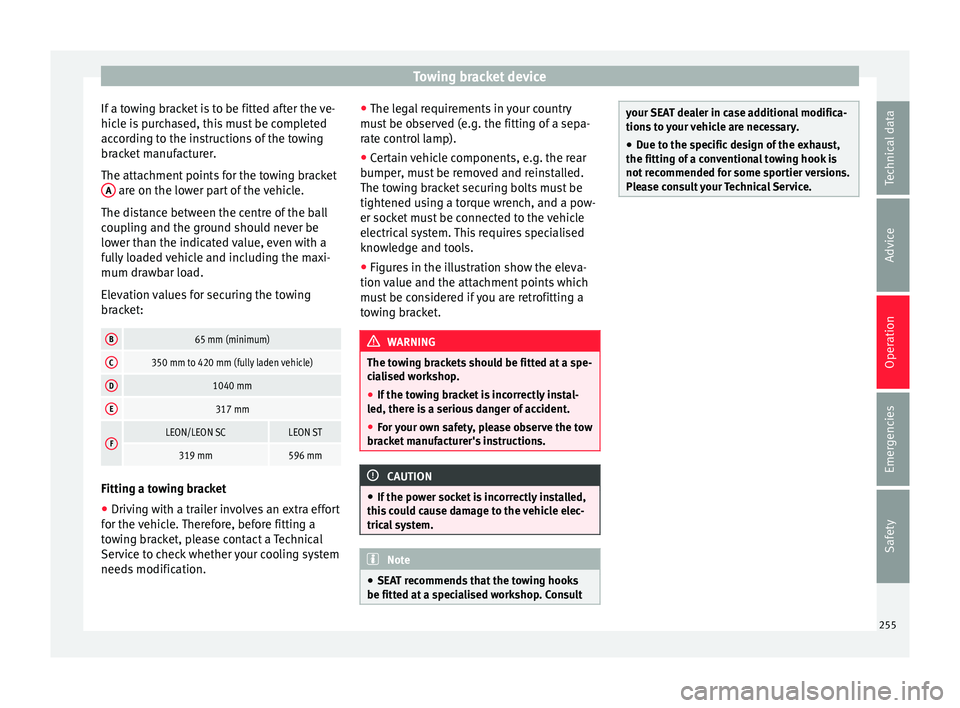
The attachment points for the towing bracket A are on the lower part of the vehicle.
The di s
t
ance between the centre of the ball
coupling and the ground should never be
lower than the indicated value, even with a
fully loaded vehicle and including the maxi-
mum drawbar load.
Elevation values for securing the towing
bracket:
B65 mm (minimum)
C350 mm to 420 mm (fully laden vehicle)
D1040 mm
E317 mm
FLEON/LEON SCLEON ST
319 mm596 mm Fitting a towing bracket
●
Driving with a trailer involves an extra effort
f or the
v
ehicle. Therefore, before fitting a
towing bracket, please contact a Technical
Service to check whether your cooling system
needs modification. ●
The leg
al requirements in your country
must be observed (e.g. the fitting of a sepa-
rate control lamp).
● Certain vehicle components, e.g. the rear
bumper, mu
st be removed and reinstalled.
The towing bracket securing bolts must be
tightened using a torque wrench, and a pow-
er socket must be connected to the vehicle
electrical system. This requires specialised
knowledge and tools.
● Figures in the illustration show the eleva-
tion value and the att
achment points which
must be considered if you are retrofitting a
towing bracket. WARNING
The towing brackets should be fitted at a spe-
ci a
lised workshop.
● If the towing bracket is incorrectly instal-
led, there i
s a serious danger of accident.
● For your own safety, please observe the tow
brack
et manufacturer's instructions. CAUTION
● If the po w
er socket is incorrectly installed,
this could cause damage to the vehicle elec-
trical system. Note
● SEA T r
ecommends that the towing hooks
be fitted at a specialised workshop. Consult your SEAT dealer in case additional modifica-
tions
t
o your vehicle are necessary.
● Due to the specific design of the exhaust,
the fitting of a c
onventional towing hook is
not recommended for some sportier versions.
Please consult your Technical Service. 255
Technical data
Advice
Operation
Emergencies
Safety
Page 273 of 332
Checking and refilling levels
●
Tak e c
are not to cause short circuits in the
electrical system, especially when working
on the battery.
● If working inside the engine compartment,
remember that, ev
en when the ignition is
switched off, the radiator fan may start up au-
tomatically, and therefore there is a risk of in-
jury.
● Never cover the engine with additional in-
sul
ating materials such as a blanket. Risk of
fire!
● Do not unscrew the cap on the coolant ex-
pans
ion tank when the engine is hot. The
cooling system is under pressure.
● Protect face, hands and arms by covering
the cap with a l
arge, thick rag to protect
against escaping coolant and steam.
● If it is necessary to work in the engine com-
partment
while the engine is running, the ro-
tating components (for example, poly-V belt,
alternator, radiator fan) and the high voltage
ignition system are an additional hazard.
● Observe the following additional warnings
if work
on the fuel system or the electrical
system is necessary:
– Always disconnect the battery from the
on-board network.
– Do not smoke.
– Never work near naked flames.
– Always keep an approved fire extinguish-
er immediately available. CAUTION
When topping up fluids make sure the correct
fluid is p
ut into the correct filler opening, oth-
erwise this can cause serious malfunctions or
engine damage. For the sake of the environment
Inspect the ground underneath your vehicle
re gu
larly so that any leaks are detected at an
early stage. If you find spots of oil or other
fluids in the area where it was parked, have
your vehicle inspected at the workshop. Note
In right-hand drive vehicles* some brake flu-
id re ser
voirs are on the other side of the en-
gine compartment ››› Fig. 247. Opening the bonnet
Read the additional information carefully
› ›
›
page 17
The bonnet is released from inside the vehi-
cle.
Check that the windscreen wiper arms are
not unfolded. Otherwise the paint may be
damaged.
The bonnet can only be unlocked when the
driver door is open. WARNING
Never open the bonnet if you see steam or
drips of
coolant being released from the en-
gine compartment. Failure to comply could
result in burns. Wait until no steam or coolant
can be seen before opening the bonnet. Closing the bonnet
–
Slightly lift the bonnet.
– Release the bonnet stay before pressing it
bac k
into its support.
– Carefully close the bonnet.
– Press the bonnet down until it locks into
plac
e.
– Make sure that the bonnet catches onto its
cla
sp. Do not press down too hard ››› .
WARNING
● For s af
ety reasons the bonnet must always
be completely closed when the vehicle is
moving. Therefore, after closing the bonnet,
always check that the locking element is
properly engaged. This is the case if the bon-
net is flush with the adjacent body panels.
● Should you notice that the bonnet is not
safely
secured when the vehicle is moving,
stop the vehicle immediately and close the
bonnet. Failure to follow this instruction
could result in an accident. 271
Technical data
Advice
Operation
Emergencies
Safety
Page 281 of 332

Wheels
CAUTION
● Some v ehic
les, for example those with the
Start-Stop system* are fitted with a special
battery (AGM-type or EFB-type battery). If any
other type of battery is fitted, the Start-Stop
function may be considerably reduced and
the vehicle may not stop on repeated occa-
sions.
● Make sure that the vent hose is always at-
tached t
o the original opening on the side of
the battery. Gases or battery acid can other-
wise escape and possibly cause damage.
● The battery holder and clamps must always
be correctly
secured.
● Before starting any work on the battery, al-
way
s observe the warnings listed under
››› page 277, Important safety warnings for
handling a vehicle battery .
● Do not forget to replace the battery cover-
ings, wher
e applicable. It is a protection for
high temperatures. This in turn extends the
vehicle service life. For the sake of the environment
Batteries contain toxic substances includ-
in g s
ulphuric acid and lead. They must be
disposed of appropriately and must not be
disposed of with ordinary household waste.
Make sure disconnected batteries cannot tip
over. Sulphuric acid could be spilt! Wheels
Wheel s
and ty
res
General notes –
When driving with new tyr e
s, be especially
careful during the first 500 km (300 miles).
– If you have to drive over a kerb or similar
obs
tacle, drive very slowly and as near as
possible at a right angle to the obstacle.
– Check from time to time if the tyres are
dam ag
ed (punctures, cuts, cracks or
dents). Remove any foreign objects embed-
ded in the treads.
– Damaged wheels and tyres must be re-
plac
ed immediately.
– Keep grease, oil and fuel off the tyres.
– Replace any missing valve caps as soon as
poss
ible.
– Mark the wheels before taking them off so
that they
rotate in the same direction when
put back.
– When removed, the wheels or tyres should
be stor
ed in a cool, dry and preferably dark
place.
New tyres
New tyres do not give maximum grip straight
away and should therefore be “run in” by driving carefully and at moderate speeds for
about the firs
t 500 km (300 miles). This will
also increase the useful life of the tyres.
The tread depth of new tyres may vary, ac-
cording to the type and make of tyre and the
tread pattern.
Concealed damage
Damage to tyres and rims is often not readily
visible. If you notice unusual vibration or the
car pulling to one side, this may indicate that
one of the tyres is damaged. Reduce speed
immediately if there is any reason to suspect
that damage may have occurred. Inspect the
tyres for damage. If no external damage is
visible, drive slowly and carefully to the near-
est specialised workshop and have the car
inspected.
Tyres with directional tread pattern
An arrow on the tyre sidewall indicates the di-
rection of rotation on single drive tyres. Al-
ways note the direction of rotation indicated
when mounting the wheel. This guarantees
optimum grip and helps to avoid aquaplan-
ing, excessive noise and wear.
Retrofitting accessories
If you wish to change or fit wheels, rims or
wheel trims, we recommend that you consult
with a SEAT Official Service centre for advice
regarding current techniques.
279
Technical data
Advice
Operation
Emergencies
Safety
Page 289 of 332

Wheels
Extraction of the spare wheel in vehi-
c l
e
s with SEAT SOUND 10 speakers
(with subwoofer)* Fig. 256
In the luggage compartment: re-
mo v
e the s
ubwoofer. To remove the spare wheel, you must first re-
mo
v
e the
subwoofer.
– Disassemble the subwoofer's
floor panel
(carpet) as follows:
– LEON/LEON SC model: first, p
ull the carpet
in the direction of the backrest and then
pull it upwards to remove it. LEON ST mod-
el: lift and secure the floor storage com-
partment as explained in ››› page 170.
– Disconnect the subwoofer’s
speaker cable
››› Fig. 256 1 . –
Turn the sec urin
g wheel anti-clockwise 2 .
– Remove the s ub
woofer
speaker and the
spare wheel.
– When re-mounting the spare tyre, place the
subwoofer
on the base of the wheel rim
with care. When doing so, the tip of the
“FRONT” arrow on the subwoofer should
point forward.
– Reconnect the speaker cable and firmly ro-
tate the sec
uring wheel clockwise so that
the subwoofer system and wheel are firmly
in place.
Winter service Winter ty
res –
Winter tyres must be fitted on al
l
four
wheels.
– Only use winter tyres that are approved for
your v
ehicle.
– Please note that the maximum permissible
speed for w
inter tyres may be lower than
for summer tyres.
– Also note that winter tyres are no longer ef-
fective when the
tread is worn down. –
After fittin
g the wheels you must always
check the tyre pressures. When doing so,
take into account the correct tyre pressures
listed on the rear of the front left door
frame ››› page 280.
In winter road conditions winter tyres will
considerably improve vehicle handling. The
design of summer tyres (width, rubber com-
pound, tread pattern) gives less grip on ice
and snow. This applies particularly to vehi-
cles equipped with wide section tyres or with
high speed tyres (code letters H, V or Y on
the sidewall).
Only use winter tyres of the correct type ap-
proved for your vehicle. The sizes of these
tyres are specified in the vehicle's docu-
ments (e.g. EC Certificate of Conformity or
COC 1)
). The vehicle documentation varies de-
pending on the country of residence. See al-
so ››› page 281.
Winter tyres lose a great deal of their proper-
ties when the tread is worn down to a depth
of 4 mm.
The performance of winter tyres is also se-
verely impaired by ageing, even if the tread is
still much deeper than 4 mm.
Winter tyres are subject to the following max-
imum speed limits according to speed rating
code letter: ››› »
1)
COC = certificate of conformity.
287
Technical data
Advice
Operation
Emergencies
Safety
Page 317 of 332

Index
Index
A
A C
C
. . . . . . . . . . . . . . . . . . . . . . . . . . . . . . . . . . . . 214
radar sensor . . . . . . . . . . . . . . . . . . . . . . . . . . . 217
Accessories . . . . . . . . . . . . . . . . . . . . . . . . . 159, 256
Adaptive cruise control . . . . . . . . . . . . . . . . . . . . 214 function for preventing overtaking in an insidelane . . . . . . . . . . . . . . . . . . . . . . . . . . . . . . . . 221
indications on the display . . . . . . . . . . . . . . . . 216
malfunction . . . . . . . . . . . . . . . . . . . . . . . . . . . . 215
radar sensor . . . . . . . . . . . . . . . . . . . . . . . . . . . 217
special driving situations . . . . . . . . . . . . . . . . . 222
warning and control lamp . . . . . . . . . . . . . . . . 216
Adaptive Cruise Control deactivating temporarily . . . . . . . . . . . . . . . . . 221
operating . . . . . . . . . . . . . . . . . . . . . . . . . . . . . . 218
Additional consumers (efficiency program) . . . . . 43
Adjusting front head restraints . . . . . . . . . . . . . . . . . . . . . . 78
front seats . . . . . . . . . . . . . . . . . . . . . . . . . . . . . 152
lights . . . . . . . . . . . . . . . . . . . . . . . . . . . . . . . . . 146
rear head restraints . . . . . . . . . . . . . . . . . . . . . 153
seats . . . . . . . . . . . . . . . . . . . . . . . . . . . . . . . . . . 75
Adjusting the head restraints front head restraints . . . . . . . . . . . . . . . . . . . . . 153
Adjustment CAR menu . . . . . . . . . . . . . . . . . . . . . . . . . . . . . 120
front head restraints . . . . . . . . . . . . . . . . . . . . . 153
rear head restraints . . . . . . . . . . . . . . . . . . . . . . 78
Airbag covers . . . . . . . . . . . . . . . . . . . . . . . . . . . . . 22
Airbags . . . . . . . . . . . . . . . . . . . . . . . . . . . . . . . . . . 85 description . . . . . . . . . . . . . . . . . . . . . . . . . . . . . 86
Airbag system . . . . . . . . . . . . . . . . . . . . . . . . . . 22, 85 activation . . . . . . . . . . . . . . . . . . . . . . . . . . . . . . 86
control lamp . . . . . . . . . . . . . . . . . . . . . . . . . . . . 90 deactivation of front airbag . . . . . . . . . . . . . . . . 89
desc
ription . . . . . . . . . . . . . . . . . . . . . . . . . . . . . 86
front airbags . . . . . . . . . . . . . . . . . . . . . . . . . 22, 87
functioning . . . . . . . . . . . . . . . . . . . . . . . . . . . . . 86
head-protection airbags . . . . . . . . . . . . . . . 24, 88
knee airbags . . . . . . . . . . . . . . . . . . . . . . . . . 23, 87
side airbags . . . . . . . . . . . . . . . . . . . . . . . . . 24, 87
Air conditioning Climatronic . . . . . . . . . . . . . . . . . . . . . . . . 52, 173
heating and fresh air . . . . . . . . . . . . . . . . . . . . . 56
manual air conditioning . . . . . . . . . . . . . . . . . . . 54
user instructions . . . . . . . . . . . . . . . . . . . . . . . . 175
Air outlets . . . . . . . . . . . . . . . . . . . . . . . . . . . . . . . 176
Air recirculation . . . . . . . . . . . . . . . . . . . . . . . . . . 176
Alcantara: cleaning . . . . . . . . . . . . . . . . . . . . . . . 263
Anchoring the front tow line. . . . . . . . . . . . . . . . . . . . . . . . . 99
Anti-freeze . . . . . . . . . . . . . . . . . . . . . . . . . . . . . . . 60
Anti-locking system . . . . . . . . . . . . . . . . . . . . . . . 187
Anti-puncture . . . . . . . . . . . . . . . . . . . . . . . . . . 65, 95
Anti-puncture kit . . . . . . . . . . . . . . . . . . . . . . . . 65, 95 check after 10 minutes . . . . . . . . . . . . . . . . . . . . 97
Anti-puncture set . . . . . . . . . . . . . . . . . . . . . . . . . . 95
Anti-theft alarm . . . . . . . . . . . . . . . . . . . . . 125, 133 trailer . . . . . . . . . . . . . . . . . . . . . . . . . . . . . . . . . 254
vehicle interior monitoring and anti-tow pro-tection . . . . . . . . . . . . . . . . . . . . . . . . . . . . . . 135
Anti-theft security system . . . . . . . . . . 15, 125, 131
Anti-tow protection . . . . . . . . . . . . . . . . . . . . . . . 135
Aspects to note before setting off . . . . . . . . . . . . . 74
ASR see Traction control system . . . . . . . . . . . . . . . 187
Assistance systems ACC . . . . . . . . . . . . . . . . . . . . . . . . . . . . . . . . . . 214
adaptive cruise control . . . . . . . . . . . . . . . . . . . 214
Auto Hold function . . . . . . . . . . . . . . . . . . . . . . 208
cruise control system . . . . . . . . . . . . . . . . . . . . 209
Emergency Assist . . . . . . . . . . . . . . . . . . . . . . . 228 emergency brake assist (Front Assist) . . . . . . . 210
fatigue detection
. . . . . . . . . . . . . . . . . . . . . . . 236
parking aid . . . . . . . . . . . . . . . . . . . . . . . 237, 238
traffic jam assist . . . . . . . . . . . . . . . . . . . . . . . . 227
traffic sign detection system . . . . . . . . . . . . . . 233
tyre monitoring . . . . . . . . . . . . . . . . . . . . . . . . . 284
tyre monitoring indicator . . . . . . . . . . . . . . . . . 285
tyre monitoring systems . . . . . . . . . . . . . . . . . 283
Assisted starting . . . . . . . . . . . . . . . . . . . . . . . . . . 70
Audible warning signal control and warning lamps . . . . . . . . . . . . . . . 119
lights . . . . . . . . . . . . . . . . . . . . . . . . . . . . . . . . . 140
unfastened safety belt . . . . . . . . . . . . . . . . . . . . 80
Auto Hold . . . . . . . . . . . . . . . . . . . . . . . . . . . . . . . 208
Auto Hold function . . . . . . . . . . . . . . . . . . . . . . . . 208
Auto Lock (central locking) . . . . . . . . . . . . . . . . . 125
Automatic car washes switching the Auto Hold function off . . . . . . . . 209
Automatic dipped beam control . . . . . . . . . . . . . 141
Automatic gearbox . . . . . . . . . . . . . . . . . . . . . . . . 191 downhill speed control . . . . . . . . . . . . . . . . . . 196
driving tips . . . . . . . . . . . . . . . . . . . . . . . . . . . . 194
emergency program . . . . . . . . . . . . . . . . . . . . . 197
kick-down feature . . . . . . . . . . . . . . . . . . . . . . . 195
launch control program . . . . . . . . . . . . . . . . . . 195
manual release of the selector lever . . . . . . . . . 50
safety interlock for ignition key . . . . . . . . . . . . 178
selector lever lock . . . . . . . . . . . . . . . . . . . . . . . 192
selector lever positions . . . . . . . . . . . . . . . . . . 191
steering wheel with gear shift paddles . . . . . . 193
tiptronic . . . . . . . . . . . . . . . . . . . . . . . . . . 191, 193
AUX-IN . . . . . . . . . . . . . . . . . . . . . . . . . . . . . . . . . . 123
B Battery . . . . . . . . . . . . . . . . . . . . . . . . . . . . . . . . . . 132
Before setting off . . . . . . . . . . . . . . . . . . . . . . . . . . 74
315
Page 318 of 332

Index
Belt tensioners contr
o
l lamp . . . . . . . . . . . . . . . . . . . . . . . . . . . . 90
Belt tightening . . . . . . . . . . . . . . . . . . . . . . . . . . . . 84
Bench seat . . . . . . . . . . . . . . . . . . . . . . . . . . . . . . 156
Biodiesel . . . . . . . . . . . . . . . . . . . . . . . . . . . . . . . . 267
Bonnet . . . . . . . . . . . . . . . . . . . . . . . . . . . . . 17, 270 opening the bonnet . . . . . . . . . . . . . . . . . . . . . 271
Brake emergency braking function . . . . . . . . . . . . . . 184
Brake assist . . . . . . . . . . . . . . . . . . . . . . . . . . . . . 187
Brake fluid . . . . . . . . . . . . . . . . . . . . . . . . . . . . . . . 61
Brakes . . . . . . . . . . . . . . . . . . . . . . . . . . . . . . . . . . 186 brake assist . . . . . . . . . . . . . . . . . . . . . . . . . . . . 187
brake fluid . . . . . . . . . . . . . . . . . . . . . . . . . . . . . 275
brake servo . . . . . . . . . . . . . . . . . . . . . . . . . . . . 186
electronic parking brake . . . . . . . . . . . . . . . . . 183
moving off . . . . . . . . . . . . . . . . . . . . . . . . . . . . . 190
new brake pads . . . . . . . . . . . . . . . . . . . . . . . . 186
C Camera cleaning . . . . . . . . . . . . . . . . . . . . . . . . . . . . . . 259
cleanliness . . . . . . . . . . . . . . . . . . . . . . . . . . . . 233
Lane Assist . . . . . . . . . . . . . . . . . . . . . . . . . . . . 224
Capacities . . . . . . . . . . . . . . . . . . . . . . . . . . . . . . . . 58 fuel tank . . . . . . . . . . . . . . . . . . . . . . . . . . . . . . 118
natural gas tank . . . . . . . . . . . . . . . . . . . . . . . . 265
windscreen washer water . . . . . . . . . . . . . . . . 276
Car-care products . . . . . . . . . . . . . . . . . . . . . . . . . 257
Catalytic converter . . . . . . . . . . . . . . . . . . . . . . . . 203 malfunction . . . . . . . . . . . . . . . . . . . . . . . . . . . . 203
CCS . . . . . . . . . . . . . . . . . . . . . . . . . . . . . . . . . . . . . 45
CD-ROM player (navigation) . . . . . . . . . . . . . . . . 158
Central locking adjusting . . . . . . . . . . . . . . . . . . . . . . . . . . . . . . 128
anti-theft alarm . . . . . . . . . . . . . . . . . . . . . . . . . 133
central locking switch . . . . . . . . . . . . . . . . . . . . 128 electric windows . . . . . . . . . . . . . . . . . . . . . . . . 137
emergency
locking . . . . . . . . . . . . . . . . . . . . . . . 16
Keyless Access . . . . . . . . . . . . . . . . . . . . . . . . . 129
Panoramic sliding/tilting sunroof . . . . . . . . . . 137
remote control key . . . . . . . . . . . . . . . . . . . . . . 127
selective unlocking system . . . . . . . . . . . . . . . 127
Central locking system . . . . . . . . . . . . . . . . . . . . . 125
Centre console . . . . . . . . . . . . . . . . . . . . . . . . . . . . 11
Cetane number (diesel fuel) . . . . . . . . . . . . . . . . 267
Changing a bulb . . . . . . . . . . . . . . . . . . . . . . . . . . 103 fog light . . . . . . . . . . . . . . . . . . . . . . . . . . . . . . . 106
number plate light . . . . . . . . . . . . . . . . . . . . . . 110
rear bulb in the side panel . . . . . . . . . . . . . . . . 108
rear bulbs . . . . . . . . . . . . . . . . . . . . . . . . . . . . . 107
Changing a wheel . . . . . . . . . . . . . . . . . . . . . . . . . 66 subsequent work . . . . . . . . . . . . . . . . . . . . . . . . 68
Changing gear engaging gears (manual gearbox) . . . . . . . . . 190
Changing main headlight turn signal . . . . . . . . . . . . . . . . . . . . . . . . . . . . . 105
Changing settings CAR menu . . . . . . . . . . . . . . . . . . . . . . . . . . . . . . 33
Changing the blades . . . . . . . . . . . . . . . . . . . . . . . 97
Changing the main beam headlight bulb main beam headlight . . . . . . . . . . . . . . . . . . . . 106
Changing the main headlight bulb day light . . . . . . . . . . . . . . . . . . . . . . . . . . . . . . 105
dipped headlight . . . . . . . . . . . . . . . . . . . . . . . 105
Changing the wiper blades . . . . . . . . . . . . . . . . . . 72
Charging the battery . . . . . . . . . . . . . . . . . . . . . . 278
Checking levels engine compartment . . . . . . . . . . . . . . . . . . . . 270
Childproof locks electric windows . . . . . . . . . . . . . . . . . . . . . . . . 136 Child seats . . . . . . . . . . . . . . . . . . . . . . . . . . . . 25, 92
cate gorisation into groups . . . . . . . . . . . . . . . . . 92
ISOFIX system . . . . . . . . . . . . . . . . . . . . . . . . . . . 27
safety instructions . . . . . . . . . . . . . . . . . . . . 25, 91
securing with seat belt . . . . . . . . . . . . . . . . . . . . 26
Top Tether system . . . . . . . . . . . . . . . . . . . . . 27, 29
Top Tether System . . . . . . . . . . . . . . . . . . . . . . . 29
Cleaning . . . . . . . . . . . . . . . . . . . . . . . . . . . . . . . . 257 alcantara . . . . . . . . . . . . . . . . . . . . . . . . . . . . . . 263
carbon parts . . . . . . . . . . . . . . . . . . . . . . . . . . . 260
Easy Connect control panel . . . . . . . . . . . . . . . 261
exhaust pipe . . . . . . . . . . . . . . . . . . . . . . . . . . . 261
fabrics . . . . . . . . . . . . . . . . . . . . . . . . . . . . . . . . 261
leather . . . . . . . . . . . . . . . . . . . . . . . . . . . . . . . . 262
natural leather . . . . . . . . . . . . . . . . . . . . . . . . . 263
plastic parts . . . . . . . . . . . . . . . . . . . . . . 260, 261
radio screen . . . . . . . . . . . . . . . . . . . . . . . . . . . 261
rims . . . . . . . . . . . . . . . . . . . . . . . . . . . . . . . . . . 260
seat belts . . . . . . . . . . . . . . . . . . . . . . . . . . . . . 264
trims . . . . . . . . . . . . . . . . . . . . . . . . . . . . . . . . . 259
washing the vehicle . . . . . . . . . . . . . . . . . . . . . 257
windows . . . . . . . . . . . . . . . . . . . . . . . . . . . . . . 260
Climatronic . . . . . . . . . . . . . . . . . . . . . . . . . . . . . . . 52
Close . . . . . . . . . . . . . . . . . . . . . . . . . . . . . . . . . . . 125
Closing . . . . . . . . . . . . . . . . . . . . . . . . . . . . . . . . . 125 bonnet . . . . . . . . . . . . . . . . . . . . . . . . . . . . . . . . 271
panoramic sliding sunroof . . . . . . . . . . . . . . . . 138windows . . . . . . . . . . . . . . . . . . . . . . . . . . . . . . 136
Clutch (warning lamp) . . . . . . . . . . . . . . . . . . . . . 197
Coming Home . . . . . . . . . . . . . . . . . . . . . . . . . . . . 143
Connectivity Box . . . . . . . . . . . . . . . . . . . . . . . . . . 123
Control and warning lamps . . . . . . . . . . . . . 47, 119 adaptive cruise control . . . . . . . . . . . . . . . . . . . 216
airbags . . . . . . . . . . . . . . . . . . . . . . . . . . . . . . . . 89airbag system . . . . . . . . . . . . . . . . . . . . . . . . . . . 90
applying the brake . . . . . . . . . . . . . . . . . . . . . . 216
ASR . . . . . . . . . . . . . . . . . . . . . . . . . . . . . . . . . . 188
316