warning Seat Leon SC 2013 Owner's manual
[x] Cancel search | Manufacturer: SEAT, Model Year: 2013, Model line: Leon SC, Model: Seat Leon SC 2013Pages: 339, PDF Size: 4.8 MB
Page 283 of 339
281
Emergencies
WARNING
● Make sure that the jack* remains stable. If the surface is slippery or
soft, the jack* could slip or sink, respectively, with the resultant risk of
injury.
● Only raise the vehicle with the jack* supplied by the manufacturer.
Other vehicles could slip, with the consequent risk of injury.
● Only mount the jack* on the support points designed for this purpose
on the strut, and always align the jack correctly. If you do not, the jack*
could slip as it does not have an adequate grip on the vehicle: risk of in-
jury!
● The height of the parked vehicle can change as a result of variations
in temperature and loading.
CAUTION
The vehicle must not be raised on the crossbar. Only place the jack* on the
points designed for this purpose on the strut. Otherwise, the vehicle may be
damaged.
Removing and fitting a wheel
After loosening the wheel bolts and raising the vehicle with the
jack, change the wheel as described below:
Taking off the wheel
– Unscrew the wheel bolts using the box spanner and place them
on a clean surface.
– Take off the wheel ⇒
. Putting on the spare wheel
When fitting tyres with a compulsory rotation direction, observe
the instructions in
⇒ page 281.
– Mount the wheel.
– Screw on the wheel bolts in position and tighten them loosely
with a box spanner.
– Carefully lower the vehicle using the jack*.
– Tighten the wheel bolts in diagonal pairs using the wheel
brace.
The wheel bolts should be clean and turn easily. Before fitting the spare
wheel, inspect the wheel condition and hub mounting surfaces. These sur-
faces must be clean before fitting the wheel.
CAUTION
When removing/fitting the wheel, the rim may hit and damage the brake
disc. For this reason, please take care and get a second person to assist
you.
Tyres with compulsory direction of rotation
A directional tread pattern can be identified by arrows on the sidewall that
point in the direction of rotation. Always observe the direction of rotation in-
dicated when mounting the wheel. This is important so that these tyres can
give maximum grip and avoid excessive noise, tread wear and aquaplaning.
If, exceptionally, it is necessary to mount the spare wheel* in the opposite
direction of rotation, please drive carefully, as in this case the tyre does not
have optimum conditions of use. This is particularly important when driving
on wet roads.
Safety FirstOperating instructionsPractical TipsTechnical specifications
Page 285 of 339
283
Emergencies
– Take out the temporary spare wheel.
Chains
For technical reasons, snow chains must not be used on the temporary
spare wheel.
If you have a puncture on one of the front wheels when using snow chains,
fit the temporary spare wheel in place of one of the rear wheels. Fit the snow
chains on the rear wheel that you have removed and replace the punctured
front wheel with this wheel.
WARNING
● After fitting the temporary spare wheel, check the tyre pressures as
soon as possible. Failure to do so may cause an accident. The tyre pres-
sures are listed on the inside of the fuel tank flap.
● Do not drive at over 80 km/h (50 mph) when the temporary spare
wheel is fitted on the vehicle: risk of accident!
● Avoid heavy acceleration, hard braking and fast cornering: risk of ac-
cident!
● Never use more than one temporary spare wheel at the same time,
risk of accident.
● No other type of tyre (normal summer or winter tyre) may be fitted on
the compact temporary spare wheel rim.
Extraction of the spare wheel in vehicles with SEAT SOUND
10 speakers (with subwoofer)*
– Disassemble the subwoofer’s floor panel (carpet) as follows:
– LEON / LEON SC model: first, pull the carpet in the direction of
the backrest and then pull the carpet upwards to remove it. LEON ST Model: lift and secure the luggage compartment floor
as explained in
⇒ page 148.
– Disconnect the subwoofer’s speaker cable.
– Turn the securing wheel anti-clockwise.
– Remove the subwoofer speaker and the spare wheel.
– When replacing the spare wheel, place the subwoofer speaker
in the direction indicated by the arrow and with the word
“FRONT” facing forward.
– Reconnect the speaker cable and firmly rotate the securing
wheel clockwise so that the subwoofer system and wheel are
firmly in place.
Jump starting Jump leads
The jump lead must have a sufficient wire cross section.
If the engine fails to start because of a discharged battery, the battery can
be connected to the battery of another vehicle to start the engine.
Jump leads
Jump leads must comply with standard DIN 72553 (see cable manufactur-
er's instructions). The wire cross section must be at least 25 mm 2
for petrol
engines and at least 35 mm 2
for diesel engines.
Safety FirstOperating instructionsPractical TipsTechnical specifications
Page 287 of 339
285
Emergencies
6. Position the leads in such a way that they cannot come into contact with any moving parts in the engine compartment.
Starting
7. Start the engine of the vehicle with the boosting battery and let it run at idling speed.
8. Start the engine of the vehicle with the flat battery and wait two or three minutes until the engine is “running”.
Removing the jump leads
9. Before you remove the jump leads, switch off the dipped beam headlights (if they are switched on).
10.Turn on the heater blower and heated rear window in the vehi- cle with the flat battery. This helps minimise voltage peaks
which are generated when the leads are disconnected.
11.When the engine is running, disconnect the leads in reverse or- der to the details given above.
Connect the battery clamps so they have good metal-to-metal contact with
the battery terminals.
If the engine fails to start, switch off the starter after about 10 seconds and
try again after about half a minute.
WARNING
● Please note the safety warnings referring to working in the engine
compartment ⇒ page 251.
● The battery providing assistance must have the same voltage as the
flat battery (12V) and approximately the same capacity (see imprint on
battery). Failure to comply could result in an explosion.
● Never use jump leads when one of the batteries is frozen. Danger of
explosion! Even after the battery has thawed, battery acid could leak and
cause chemical burns. If a battery freezes, it should be replaced.
● Keep sparks, flames and lighted cigarettes away from batteries, dan-
ger of explosion. Failure to comply could result in an explosion.
● Observe the instructions provided by the manufacturer of the jump
leads.
● Do not connect the negative cable from the other vehicle directly to
the negative terminal of the flat battery. The gas emitted from the battery
could be ignited by sparks. Danger of explosion.
● Do not attach the negative cable from the other vehicle to parts of the
fuel system or to the brake line.
● The non-insulated parts of the battery clamps must not be allowed to
touch. The jump lead attached to the positive battery terminal must not
touch metal parts of the vehicle, this can cause a short circuit.
● Position the leads in such a way that they cannot come into contact
with any moving parts in the engine compartment.
● Do not lean on the batteries. This could result in chemical burns.
Note
The vehicles must not touch each other, otherwise electricity could flow as
soon as the positive terminals are connected.
Safety FirstOperating instructionsPractical TipsTechnical specifications
Page 288 of 339
286Emergencies
Towing and tow-starting the vehicle
General information
Points to observe when tow-starting or towing away If you use a tow rope:
Notes for the driver of the towing vehicle
– The tow rope must be taut before you drive off.
– Release the clutch very carefully when starting the vehicle
(manual gearbox), or accelerate gently (automatic gearbox).
Notes for the driver of the towed vehicle
– The ignition should be switched on so that the turn signals,
windscreen wipers and washers can be used. Please ensure
that the steering wheel is unlocked when you switch on the ig-
nition, and that it moves freely.
– Put the gearbox lever in neutral (manual gearbox) or move the
selector lever to position N (automatic gearbox).
– The brake servo only works when the engine is running. Consid-
erably more effort is required on the brake pedal when the en-
gine is switched off.
– Remember that the power steering only works when the ignition
is switched on and the vehicle is moving 1)
. Otherwise, consider-
ably more strength than usual will be required when steering. –
Ensure that the tow rope remains taut at all times.
Tow rope or tow bar
It is easier and safer to tow a vehicle with a tow bar. You should only use a
tow rope if you do not have a tow bar.
A tow rope should be slightly elastic to avoid damage to both vehicles. It is
advisable to use a tow rope made of synthetic fibre or similarly elastic mate-
rial.
Only attach the tow rope or the tow bar to the towing rings ⇒ page 287.
Driving style
Towing requires some experience, especially when using a tow rope. Both
drivers should be familiar with the technique required for towing. Inexper-
ienced drivers should not attempt to tow.
Do not pull too hard with the towing vehicle and take care to avoid jerking
the tow rope. When towing on an unpaved road, there is always a risk of
overloading and damaging the anchorage points.
WARNING
If the vehicle has no electrical power, the brake lights, turn signals and
all other lights will no longer function. Do not have the vehicle towed
away. Failure to do so could result in an accident.
CAUTION
If there is no oil in the gearbox or no lubricant in the automatic transmission
the car may only be towed with the driven wheels lifted clear of the road, or
transported on a special car transporter or trailer.
1)
Important: the battery must be correctly charged.
Page 289 of 339
287
Emergencies
Note
● Please observe legal requirements when doing so.
● Switch on the hazard warning lights of both vehicles. However, observe
any regulations to the contrary.
● The tow rope must not be twisted. Otherwise the front towline anchor-
age could be pulled off the vehicle.
Towline anchorage at the front of the vehicle
The front towline anchorage is only mounted if the vehicle
has to be towed.
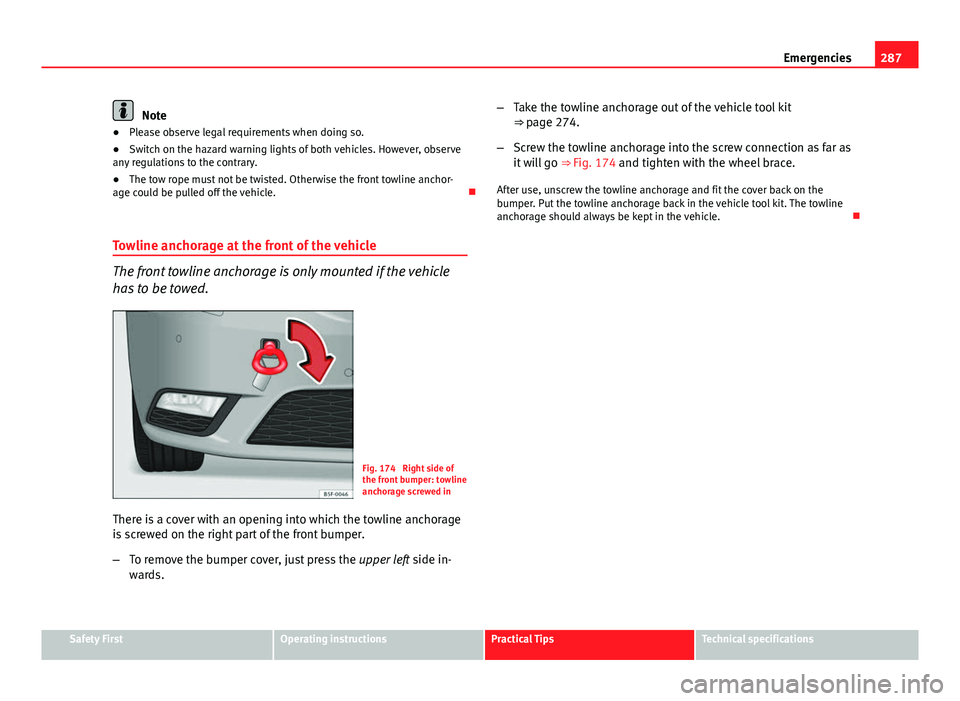
Fig. 174 Right side of
the front bumper: towline
anchorage screwed in
There is a cover with an opening into which the towline anchorage
is screwed on the right part of the front bumper.
– To remove the bumper cover, just press the upper left side in-
wards. –
Take the towline anchorage out of the vehicle tool kit
⇒ page 274.
– Screw the towline anchorage into the screw connection as far as
it will go ⇒ Fig. 174 and tighten with the wheel brace.
After use, unscrew the towline anchorage and fit the cover back on the
bumper. Put the towline anchorage back in the vehicle tool kit. The towline
anchorage should always be kept in the vehicle.
Safety FirstOperating instructionsPractical TipsTechnical specifications
Page 290 of 339
288Emergencies
Rear towline anchorage
The rear towline anchorage should only be mounted if you
wish to tow another vehicle.
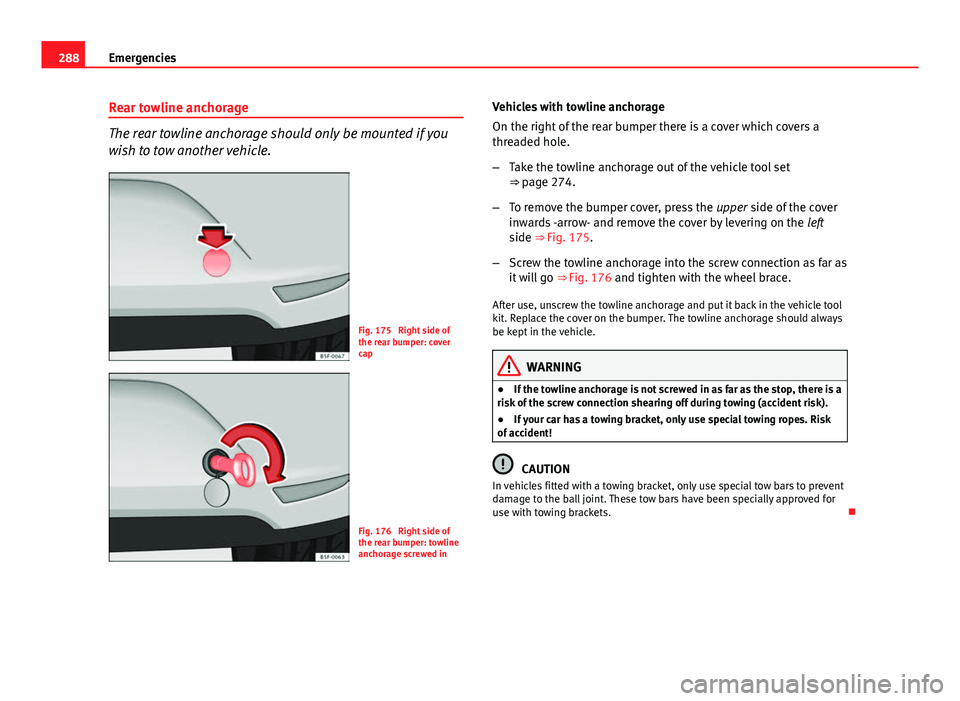
Fig. 175 Right side of
the rear bumper: cover
cap
Fig. 176 Right side of
the rear bumper: towline
anchorage screwed in Vehicles with towline anchorage
On the right of the rear bumper there is a cover which covers a
threaded hole.
–
Take the towline anchorage out of the vehicle tool set
⇒ page 274.
– To remove the bumper cover, press the upper side of the cover
inwards -arrow- and remove the cover by levering on the left
side ⇒ Fig. 175.
– Screw the towline anchorage into the screw connection as far as
it will go ⇒ Fig. 176 and tighten with the wheel brace.
After use, unscrew the towline anchorage and put it back in the vehicle tool
kit. Replace the cover on the bumper. The towline anchorage should always
be kept in the vehicle.
WARNING
● If the towline anchorage is not screwed in as far as the stop, there is a
risk of the screw connection shearing off during towing (accident risk).
● If your car has a towing bracket, only use special towing ropes. Risk
of accident!
CAUTION
In vehicles fitted with a towing bracket, only use special tow bars to prevent
damage to the ball joint. These tow bars have been specially approved for
use with towing brackets.
Page 291 of 339
289
Emergencies
Tow-starting
As a general rule, tow-starting is not recommended.
– Engage 2nd or 3rd gear before moving off.
– Press the clutch and hold the pedal down.
– Switch the ignition on.
– Once both vehicles are moving, release the clutch.
– As soon as the engine starts: press the clutch and put the gear
lever in neutral.
If the engine will not start, it is best to try starting it using the battery of an-
other vehicle ⇒ page 283 before attempting to tow start. You should only try
to tow-start the engine if jump starting is not successful. Tow-starting is an
attempt to start the engine via the movement of the wheels.
When tow-starting a vehicle with a petrol engine, do not tow it more than a
short distance, otherwise unburned fuel can enter the catalytic converter
and cause damage.
WARNING
The risk of accidents is high when tow-starting, as the towed vehicle can
easily be driven into the towing vehicle.
CAUTION
Do not tow vehicles for more than 50 m. Risk of damage to the catalytic con-
verter. Towing vehicles with a manual gearbox
Towing is relatively straightforward.
Please observe the relevant instructions ⇒ page 286.
The vehicle can be towed using a tow bar or tow rope in the normal way,
with all four wheels on the road; it can also be towed with either the front or
rear wheels lifted off the road. The maximum towing speed is 50 km/h (30
mph).
Towing a vehicle equipped with automatic gearbox
Certain restrictions must be observed when towing your ve-
hicle. Please observe the relevant instructions ⇒ page 286.
The vehicle can be towed with a tow bar or tow rope in the normal way, with
all four wheels on the ground. When doing so, please note the following
points:
● Make sure the selector lever is in the N position.
● The vehicle must not be towed faster than 50 km/h (30 mph).
● The vehicle must not be towed further than 50 km (30 miles). Reason:
when the engine is not running, the gearbox oil pump does not work and
the gearbox is not adequately lubricated for higher speeds or longer distan-
ces.
If the vehicle has to be towed with a breakdown truck, it must only be sus-
pended at the front wheels. Reason: the drive shafts are located on the front
wheels. If the car is towed with the rear wheels lifted off the road (I.e. travel-
ling backwards), the drive shafts also turn backwards. The planetary gears
in the automatic gearbox then turn at such high speeds that the gearbox
will be severely damaged in a short time.
Safety FirstOperating instructionsPractical TipsTechnical specifications
Page 293 of 339
291
Fuses and bulbs
Fuses and bulbs Fuses
Introduction
Due to the constant update of vehicles, fuse assignments depending on
equipment and the use of the same fuse for various electrical components,
at the time of printing this manual it is not possible to provide an up-to-date
summary of the electrical components fuse positions. For detailed informa-
tion about the fuse positions, please consult a Technical Service.
In general, a fuse can be assigned to various electrical components. Like-
wise, an electrical component can be protected by several fuses.
Only replace fuses when the cause of the problem has been solved. If a
newly inserted fuse blows after a short time, you must have the electrical
system checked by a specialised workshop as soon as possible.
Additional information and warnings:
● Working in the engine compartment ⇒ page 251
WARNING
The high voltages in the electrical system can give serious electrical
shocks, causing burns and even death!
● Never touch the electrical wiring of the ignition system.
● Take care not to cause short circuits in the electrical system.
WARNING
Using unsuitable fuses, repairing fuses or bridging a current circuit with-
out fuses can cause a fire and serious injury.
● Never use a fuse with a higher value. Only replace fuses with a fuse of
the same amperage (same colour and markings) and size.
● Never repair a fuse.
● Never replace a fuse by a metal strip, staple or similar.
CAUTION
● To avoid damage to the vehicles electric system, before replacing a fuse
turn off the ignition, the lights and all electrical elements and remove the
keys from the ignition.
● If you replace a fuse with higher-rating fuse, you could cause damage to
another part of the electrical system.
● Protect the fuse boxes when open to avoid the entry of dust or humidity.
Dirt and humidity inside fuse boxes can cause damage to the electrical sys-
tem.
Note
● One single consumer could have more than one fuse.
● Several consumers could run over one single fuse.
Safety FirstOperating instructionsPractical TipsTechnical specifications
Page 296 of 339
294Fuses and bulbs
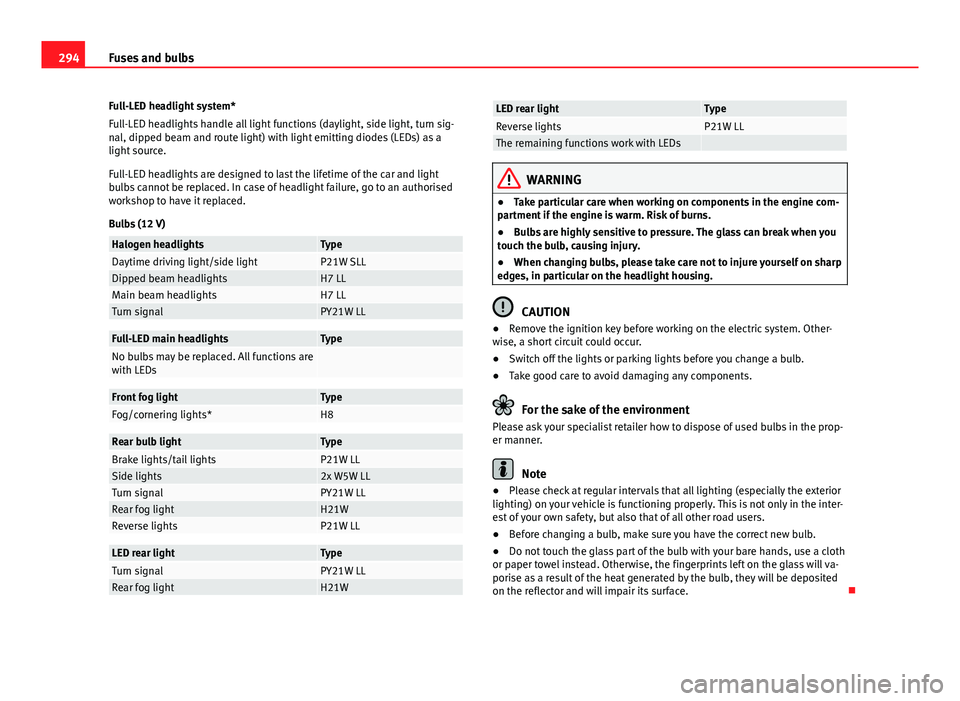
Full-LED headlight system*
Full-LED headlights handle all light functions (daylight, side light, turn sig-
nal, dipped beam and route light) with light emitting diodes (LEDs) as a
light source.
Full-LED headlights are designed to last the lifetime of the car and light
bulbs cannot be replaced. In case of headlight failure, go to an authorised
workshop to have it replaced.
Bulbs (12 V)
Halogen headlightsTypeDaytime driving light/side lightP21W SLLDipped beam headlightsH7 LLMain beam headlightsH7 LLTurn signalPY21W LL
Full-LED main headlightsTypeNo bulbs may be replaced. All functions are
with LEDs
Front fog lightTypeFog/cornering lights*H8
Rear bulb lightTypeBrake lights/tail lightsP21W LLSide lights2x W5W LLTurn signalPY21W LLRear fog lightH21WReverse lightsP21W LL
LED rear lightTypeTurn signalPY21W LLRear fog lightH21W
LED rear lightTypeReverse lightsP21W LLThe remaining functions work with LEDs
WARNING
● Take particular care when working on components in the engine com-
partment if the engine is warm. Risk of burns.
● Bulbs are highly sensitive to pressure. The glass can break when you
touch the bulb, causing injury.
● When changing bulbs, please take care not to injure yourself on sharp
edges, in particular on the headlight housing.
CAUTION
● Remove the ignition key before working on the electric system. Other-
wise, a short circuit could occur.
● Switch off the lights or parking lights before you change a bulb.
● Take good care to avoid damaging any components.
For the sake of the environment
Please ask your specialist retailer how to dispose of used bulbs in the prop-
er manner.
Note
● Please check at regular intervals that all lighting (especially the exterior
lighting) on your vehicle is functioning properly. This is not only in the inter-
est of your own safety, but also that of all other road users.
● Before changing a bulb, make sure you have the correct new bulb.
● Do not touch the glass part of the bulb with your bare hands, use a cloth
or paper towel instead. Otherwise, the fingerprints left on the glass will va-
porise as a result of the heat generated by the bulb, they will be deposited
on the reflector and will impair its surface.
Page 308 of 339
306Technical specifications
Identifying letters
The identifying letters of the engine can be viewed on the instrument panel.
Important: The engine must be off and the ignition on.
● Hold down the 0.0/SET
4 ⇒ Fig. 38 button for more than 15 seconds.
Information on fuel consumption
Fuel consumption
The consumption and emission details shown on the vehicle
data sticker differ from one vehicle to another. The vehicle fuel consumption and CO 2 emissions can be consulted on the
vehicle data sticker in the spare wheel well, inside the luggage compart-
ment and on the rear cover of the Maintenance Programme.
The fuel consumption and CO 2 emission values refer to the weight category
assigned to your vehicle according to the engine and gearbox combination,
as well as the specific equipment fitted, and is only used to compare be-
tween the different models.
The fuel consumption and CO 2 emissions do not depend only on the per-
formance of the vehicle, they can also differ from the established values de-
pending on other factors such as driving style, road conditions, traffic con-
ditions, environmental conditions, load and number of passengers.
Calculation of fuel consumption
The consumption values have been calculated based on measurements per-
formed or supervised by certified CE laboratories according to the latest ver-
sion of directives 715/2007/EC and 80/1268/CEE (for more information
consult the European Union Publications Office at EUR-Lex: © European Un- ion, http://eur-lex.europa.eu/en/index.htm) and are valid for the kerb
weight indicated for the vehicle.
Note
In practice, and considering all the factors mentioned here, consumption
values can differ from those calculated in the current European regulations.
Weights
Kerb weight refers to the basic model with a fuel tank filled to 90% capacity
and without optional extras. The figure quoted includes 75 kg to allow for
the weight of the driver.
For special versions and optional equipment fittings or for the addition of
accessories, the weight of the vehicle will increase ⇒
.
WARNING
● Please note that the centre of gravity may shift when transporting
heavy objects; this may affect vehicle handling and lead to an accident.
Always adjust your speed and driving style to suit road conditions and re-
quirements.
● Never exceed the gross axle weight rating or the gross vehicle weight
rating. If the allowed axle load or the allowed total weight is exceeded,
the driving characteristics of the vehicle may change, leading to acci-
dents, injuries and damage to the vehicle.