heating Seat Leon SC 2013 Owner's Guide
[x] Cancel search | Manufacturer: SEAT, Model Year: 2013, Model line: Leon SC, Model: Seat Leon SC 2013Pages: 339, PDF Size: 4.8 MB
Page 234 of 339
232Driving and the environment
Reduce idling time
In vehicles with the Start-Stop system idling is automatically reduced. In ve-
hicles without the Start-Stop system it is worth switching off the engine, for
example, at level crossings and at traffic lights that remain red for long peri-
ods of time. When an engine has reached operating temperature, and de-
pending on the cylinder capacity, keeping it switched off for a minimum of
about 5 seconds already saves more than the amount of fuel necessary for
restarting.
The engine takes a long time to warm up when it is idling. Mechanical wear
and pollutant emissions are also especially high during this initial warm-up
phase. It is therefore best to drive off immediately after starting the engine.
Avoid running the engine at high speed.
Regular maintenance
Regular servicing helps in saving fuel even before the engine is started. A
well-serviced engine gives you the benefit of improved fuel efficiency as
well as maximum reliability and an enhanced resale value. A badly serviced
engine can consume up to 10% more fuel than necessary.
Avoid short journeys
The engine and catalytic converter need to reach their optimal operating
temperature in order to minimise fuel consumption and emissions.
A cold engine consumes a disproportionate amount of fuel. The engine only
reaches its working temperature after about four kilometres (2.5 miles),
when fuel consumption will return to a normal level.
Check tyre pressure
Always make sure the tyres are inflated to the correct pressures
⇒ page 265 to save fuel. If the pressure is below half bar, fuel consumption
may increase by 5%. Due to the greater rolling resistance, under-inflation
also increases tyre wear and impairs handling.
Do not use winter tyres all year round as they increase fuel consumption by
up to 10%. Avoid carrying unnecessary loads
Given that every kilo of
extra weight will increase the fuel consumption, it is
advisable to always check the luggage compartment to make sure that no
unnecessary loads are being transported.
Since the luggage rack increases the aerodynamic drag of the vehicle, you
should remove it when not needed. This will save, at a speed of 100-120
km/h (60-75 mph), approximately 12% of fuel.
Save electrical energy
The engine drives the alternator, thereby generating electricity. This implies
that any increase in power consumption also increases fuel consumption!
For this reason, switch off any unneeded consumption of electricity. Electri-
cal equipment which uses a lot of electricity includes the blower (at a high
setting), the rear window heating and the seat heating*.
Environmental friendliness
Environmental protection is a top priority in the design, choice of materials
and manufacture of your new SEAT.
Constructive measures to encourage recycling
● Joints and connections designed for easy dismantling
● Modular construction to facilitate dismantling
● Increased use of single-grade materials.
● Plastic parts and elastomers are marked in accordance with ISO 1043,
ISO 11469 and ISO 1629.
Choice of materials
● Use of recycled materials.
● Use of compatible plastics in the same part if its components are not
easily separated.
Page 237 of 339
235
Trailer
Note
● Towing a trailer places additional demands on the vehicle. We recom-
mend additional services between the normal inspection intervals if the ve-
hicle is used frequently for towing a trailer.
● Find out whether special regulations apply to towing a trailer in your
country.
Ball coupling of towing bracket*
The ball coupling is provided with instructions on fitting and removing the
ball coupling of the towing bracket.
WARNING
The towing bracket ball coupling must be stored securely in the luggage
compartment to prevent them being flung through the vehicle and caus-
ing injury.
Note
● By law, the ball coupling must be removed if a trailer is not being towed
if it obscures the number plate.
Driving tips
Driving with a trailer always requires extra care. Weight distribution
The weight distribution of a loaded trailer with an unladen vehicle is very
unfavourable. However, if this cannot be avoided, drive extra slowly to allow
for the unbalanced weight distribution. Speed
The stability of the vehicle and trailer is reduced with increasing speed. For
this reason, it is advisable not to drive at the maximum permissible speed
in an unfavourable road, weather or wind conditions. This applies especially
when driving downhill.
You should always reduce speed immediately if the trailer shows the slight-
est sign of
snaking. Never try to stop the “snaking” by increasing speed.
Always brake in due course. If the trailer has an overrun brake, apply the
brakes gently at first and then, firmly. This will prevent the jerking that can
be caused by locking of trailer wheels. Select a low gear in due course be-
fore going down a steep downhill. This enables you to use the engine brak-
ing to slow down the vehicle.
Reheating
At very high temperatures and during prolonged slopes, driving in a low
gear and high engine speed, always monitor the coolant temperature gauge
⇒ page 69.
Electronic Stability Control*
The ESC* system helps to stabilise the trailer in case of skidding or rocking.
Safety FirstOperating instructionsPractical TipsTechnical specifications
Page 243 of 339
241
Care and cleaning
Carbon components
The carbon parts on your vehicle have a painted surface. They do not need
any special care and are cleaned just like any other painted part
⇒ page 238.
Paint damage
Minor damage to the paint, such as scratches or stone chips, should be
touched up without delay before the metal starts to corrode. Suitable touch-
up brushes or sprays for your car can be obtained from a SEAT Official Serv-
ice.
The number of the original paint finish on the vehicle is given on the data
sticker ⇒ page 305.
If corrosion is already visible it must be thoroughly removed by a special-
ised workshop.
Windows
Clear vision is an essential safety factor.
The windscreen must not be cleaned with insect remover or wax, otherwise
the windscreen wipers will not function properly (juddering).
Traces of rubber, oil, grease or silicone can be removed with a window
cleaning solution or a silicone remover. Wax residue can only be removed
with a special cleaner. Your SEAT Official Service will be able to provide you
with more detailed information.
The windows should also be cleaned on the inside at regular intervals. Use a separate cloth or chamois to dry the windows. Cloths used for waxing
and polishing contain residues that will cause smears on the glass.
WARNING
Do not use water-repellent coatings on the windscreen. In bad visibility
conditions (e.g. in the rain, dark or with a low sun), these coatings may
cause dazzle: risk of accident! Such coatings can also cause the wind-
screen wiper blades to make noise.
CAUTION
● Remove snow and ice from windows and exterior mirrors with a plastic
scraper only. To avoid scratches caused by dirt on the glass, the scraper
should only be pushed in one direction and not moved to and fro.
● The heating element for the rear window is located on the inner side of
the window. To avoid damaging them, do not apply stickers to the heating
elements.
● Never use warm or hot water to remove snow and ice from windows and
mirrors. This could cause the glass to crack!
Rims
The wheels require regular attention to preserve their appearance. It is im-
portant to remove road salt and brake dust by washing the wheels at regu-
lar intervals, otherwise the finish will be impaired.
After washing, the wheels should only be cleaned with an "acid-free" clean-
ing agent for alloy wheels. This is available from SEAT Official Services and
specialist retailers. Never leave the cleaning agent on the rims for any lon-
ger than specified in the instructions before rinsing it off. If the wheel clean-
er fluid contains acid it can attack the surfaces of the wheel bolts.
Safety FirstOperating instructionsPractical TipsTechnical specifications
Page 249 of 339
247
Checking and refilling levels
● Only use fuel additives that have been approved by SEAT. Octane boost-
ing or anti-knock additives may contain metal additives that could seriously
damage the engine or the catalytic converter. These additives must not be
used.
● High engine speed and full throttle can damage the engine when using
petrol with an octane rating lower than the correct grade for the engine.
Note
● You may use petrol with a high octane number than the one recommen-
ded for your engine.
● In those countries where unleaded petrol is not available, you may refuel
with a fuel with a low lead content.
Diesel Fuel
Please note the information on the inside of the fuel tank
flap.
We recommend the use of Diesel fuel which complies to European standard
EN 590. If diesel fuel which meets European standard EN 590 is not availa-
ble, the Cetane number (CZ) must, at minimum, be 51. If the engine is
equipped with a particulate filter, the sulphur content of the fuel must be
below 50 parts per million.
Winter-grade diesel
Summer fuel becomes thicker in winter and it is more difficult to start the
engine. For this reason petrol stations in some countries also offer winter
diesel with improved fluidity when cold.
CAUTION
● The vehicle is not designed for the use of biodiesel (FAME fuel). The fuel
system would be damaged if you used biodiesel.
● Do not mix fuel additives, the so-called “thinners”, petrol or similar ad-
ditives with diesel fuel.
● If poor-quality diesel fuel is used, it may be necessary to drain the fuel
filter more frequently than is specified in the Service Plan. We recommend
having this done by a specialised workshop. If water is allowed to collect in
the filter, this can cause engine performance problems.
Natural gas
Natural gas
Natural gas, in addition to others, can be in compressed or liquid form.
Liquefied natural gas (LNG) is the result of heavy cooling of natural gas.
Therefore its volume is considerably reduced compared with compressed
natural gas (CNG). In vehicles with a natural gas engine, liquefied natural
gas cannot be directly refilled, given that the gas would expand excessively
in the vehicle gas tank.
Therefore, vehicles with a natural gas engine must only be refuelled using
compressed natural gas ⇒
.
Natural gas quality and consumption
Natural gas is divided into the groups H and L depending on its quality.
Gas type H has a superior heating power and inferior nitrogen and carbon
dioxide content than type L. The higher the heating power of the natural
gas, the lower the consumption will be.
However, the heating power and the proportion of nitrogen and carbon di-
oxide can fluctuate within the quality groups. Therefore, vehicle consump-
tion can also vary, even when using one type of gas only.
Safety FirstOperating instructionsPractical TipsTechnical specifications
Page 252 of 339
250Checking and refilling levels
For the sake of the environment
Do not overfill the fuel tank – it may cause the fuel to overflow if it becomes
warm.
Note
Diesel vehicles are fitted with a protective device that prevents the insertion
of the wrong fuel hose 1)
. It is only possible to refuel with Diesel nozzles.
● If the pump nozzle is worn, damaged, or if it is very small, it is possible
that it will not be able to open the protective device. Before trying to insert
the pump nozzle by turning it, try a different pump or request specialist
help.
● If you fill the tank from a reserve fuel canister, the protective device will
not open. One way to resolve this is to pour the fuel in very slowly.
Refuelling natural gas
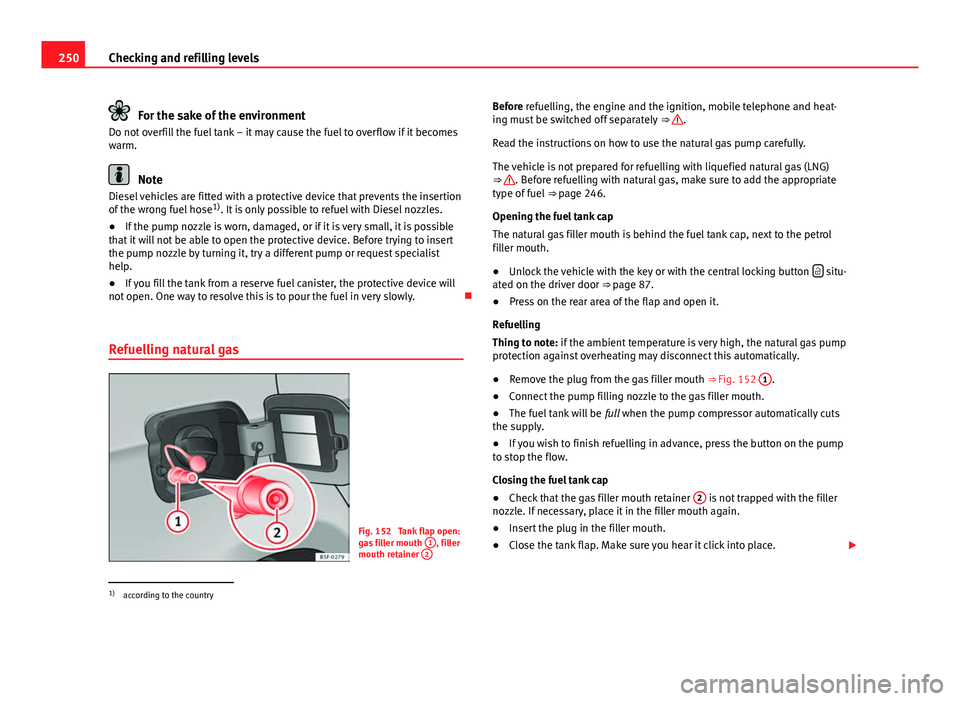
Fig. 152 Tank flap open:
gas filler mouth 1, filler
mouth retainer 2
Before refuelling, the engine and the ignition, mobile telephone and heat-
ing must be switched off separately
⇒ .
Read the instructions on how to use the natural gas pump carefully.
The vehicle is not prepared for refuelling with liquefied natural gas (LNG)
⇒
. Before refuelling with natural gas, make sure to add the appropriate
type of fuel ⇒ page 246.
Opening the fuel tank cap
The natural gas filler mouth is behind the fuel tank cap, next to the petrol
filler mouth.
● Unlock the vehicle with the key or with the central locking button
situ-
ated on the driver door ⇒ page 87.
● Press on the rear area of the flap and open it.
Refuelling
Thing to note: if the ambient temperature is very high, the natural gas pump
protection against overheating may disconnect this automatically.
● Remove the plug from the gas filler mouth ⇒ Fig. 152 1
.
● Connect the pump filling nozzle to the gas filler mouth.
● The fuel tank will be full when the pump compressor automatically cuts
the supply.
● If you wish to finish refuelling in advance, press the button on the pump
to stop the flow.
Closing the fuel tank cap
● Check that the gas filler mouth retainer 2
is not trapped with the filler
nozzle. If necessary, place it in the filler mouth again.
● Insert the plug in the filler mouth.
● Close the tank flap. Make sure you hear it click into place.
1)
according to the country
Page 260 of 339
258Checking and refilling levels
WARNING
If there is not enough anti-freeze in the coolant system, the engine may
fail leading to serious damage.
● Please make sure that the percentage of additive is correct with re-
spect to the lowest expected ambient temperature in the zone in which
the vehicle is to be used.
● When the outside temperature is very low, the coolant could freeze
and the vehicle would be immobilised. In this case, the heating would
not work either and inadequately dressed passengers could die of cold.
CAUTION
The original additives should never be mixed with coolants which are not
approved by SEAT. Otherwise, you run the risk of causing severe damage to
the engine and the engine cooling system.
● If the fluid in the expansion tank is not purple but is, for example,
brown, this indicates that the G 13 additive has been mixed with an inade-
quate coolant. The coolant must be changed as soon as possible if this is
the case! This could result in serious faults and engine damage.
For the sake of the environment
Coolants and additives can contaminate the environment. If any fluids are
spilled, they should be collected and correctly disposed of, with respect to
the environment. Topping up coolant
Top up coolant when the level is below the MIN (minimum)
mark.
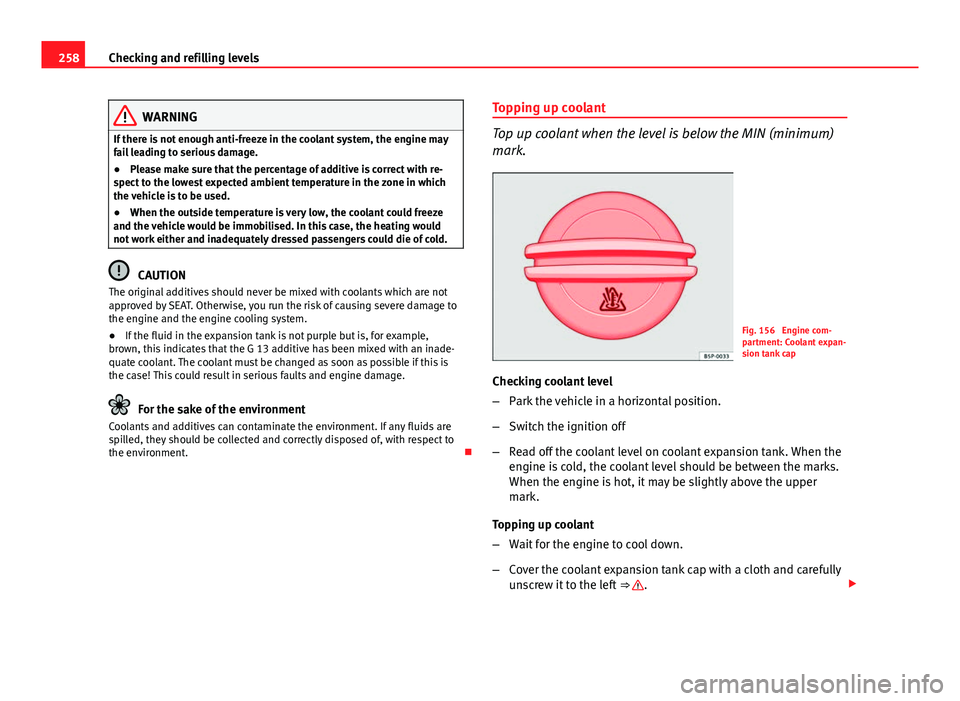
Fig. 156 Engine com-
partment: Coolant expan-
sion tank cap
Checking coolant level
– Park the vehicle in a horizontal position.
– Switch the ignition off
– Read off the coolant level on coolant expansion tank. When the
engine is cold, the coolant level should be between the marks.
When the engine is hot, it may be slightly above the upper
mark.
Topping up coolant
– Wait for the engine to cool down.
– Cover the coolant expansion tank cap with a cloth and carefully
unscrew it to the left ⇒
.
Page 261 of 339
259
Checking and refilling levels
– Top up the coolant only if there is still coolant in the expansion
tank, otherwise you could damage the engine. If there is no
coolant in the expansion tank, do not continue driving. You
should obtain professional assistance ⇒
.
– If there is still some coolant in the expansion tank, top up to the
upper mark.
– Top up with coolant to the upper mark until the level becomes
stable.
– Screw the cap back on correctly.
Any loss of coolant fluid normally indicates a leak in the cooling system.
Take the vehicle straight to a specialised workshop to have the cooling sys-
tem examined. If there are no leaks in the engine cooling system, a loss of
coolant can only occur if the coolant boils and is forced out of the system as
a result of overheating.
WARNING
● The cooling system is under pressure. Do not unscrew the cap on the
coolant expansion tank when the engine is hot: risk of burns!
● The antifreeze and coolant fluid can be a health hazard. Therefore,
the antifreeze should be stored in the original container in a safe place
out of reach of children. Failure to comply could result in poisoning.
● If working inside the engine compartment, remember that, even when
the ignition is switched off, the radiator fan may start up automatically,
and therefore there is a risk of injury.
CAUTION
Do not top up the expansion tank with coolant fluid if it is empty! Air could
enter the cooling system. In this case, stop driving. Seek specialist assis-
tance. Otherwise, there is a risk of engine damage. Brake fluid
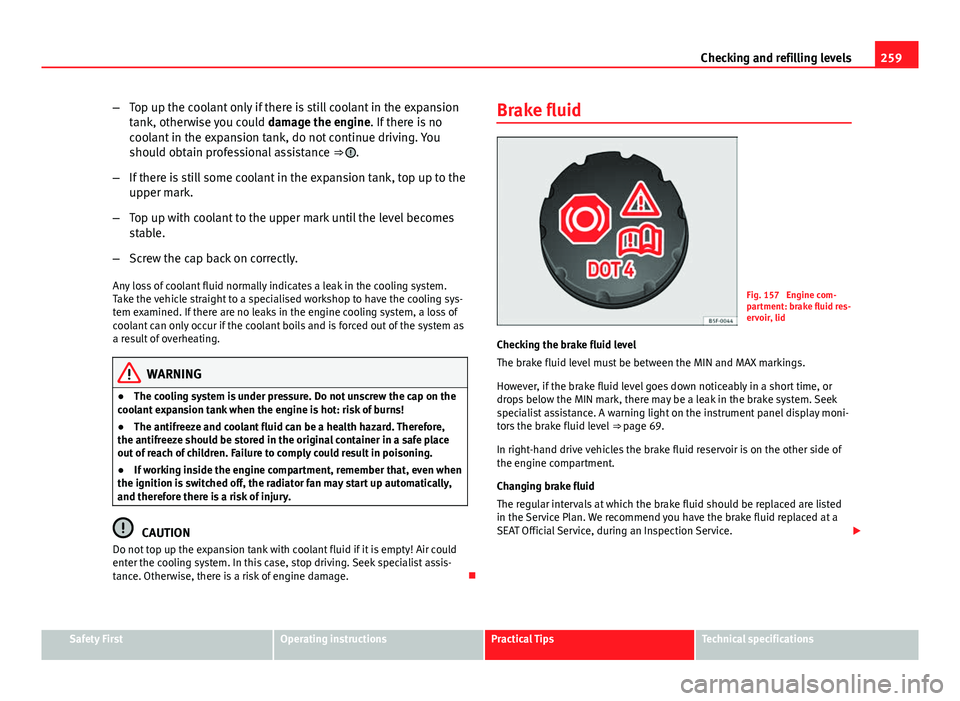
Fig. 157 Engine com-
partment: brake fluid res-
ervoir, lid
Checking the brake fluid level
The brake fluid level must be between the MIN and MAX markings.
However, if the brake fluid level goes down noticeably in a short time, or
drops below the MIN mark, there may be a leak in the brake system. Seek
specialist assistance. A warning light on the instrument panel display moni-
tors the brake fluid level ⇒ page 69.
In right-hand drive vehicles the brake fluid reservoir is on the other side of
the engine compartment.
Changing brake fluid
The regular intervals at which the brake fluid should be replaced are listed
in the Service Plan. We recommend you have the brake fluid replaced at a
SEAT Official Service, during an Inspection Service.
Safety FirstOperating instructionsPractical TipsTechnical specifications
Page 268 of 339
266Wheels and tyres
–The tyre pressure should only be checked when the tyres are
cold. The slightly raised pressures of warm tyres must not be re-
duced.
– Adjust tyre pressure to the load being carried by the vehicle.
– In vehicles with a tyre pressure indicator, save the pressure of
modified tyres ⇒ page 214, ⇒ page 265.
– Avoid fast cornering and hard acceleration.
– Inspect the tyres for irregular wear from time to time.
The useful life of your tyres depends on the following factors:
Tyre pressure
Tyre pressure values are indicated on the inside of the fuel tank flap.
Insufficient or excessive pressure greatly reduces the useful life of the tyres
and adversely affects vehicle performance and ride. Correct inflation pres-
sures are very important, especially at high speeds.
If you want a more comfortable ride, you can inflate tyres to the pressure
corresponding to the normal vehicle load (up to 3 people) if the vehicle is
carrying a normal load. If the vehicle is going to carry the maximum load,
the tyre pressure should be increased to maximum value indicated.
The tyre pressure must be adjusted according to the load the vehicle is car-
rying. We recommend adhering to the tyre pressure specifications for a max-
imum load.
Do not forget the spare wheel when checking the tyre pressures: Keep the
spare wheel inflated to the highest pressure required for the road wheels.
In the case of a minimised temporary spare wheel (125/70 R16 or 125/70
R18) inflate to a pressure of 4.2 bar as indicated on the tyre pressure label
on the fuel tank flap. Driving style
Fast cornering, heavy acceleration and hard braking (squealing tyres) all in-
crease tyre wear.
Wheel balance
The wheels on new vehicles are balanced. However, certain circumstances
may lead to imbalance (run-out), which is detected as vibrations in the
steering wheel.
Unbalanced wheels should be rebalanced, as they otherwise cause exces-
sive wear on steering, suspension and tyres. A wheel must also be reba-
lanced when a new tyre is fitted or if a tyre is repaired.
Incorrect wheel alignment
Incorrect wheel alignment causes excessive tyre wear, impairing the safety
of the vehicle. If you notice excessive tyre wear, you should check wheel
alignment at a SEAT Official Service.
WARNING
● Always adapt the tyre pressure accordingly when the vehicle load
changes.
● A tyre with low air pressure has to flex a lot more when the vehicle is
heavily loaded or at high speeds, therefore causing overheating to occur.
Under these conditions, the tyre bead may be released or the tyre may
burst. Risk of accident!
For the sake of the environment
Under-inflated tyres will increase fuel consumption.
Page 329 of 339
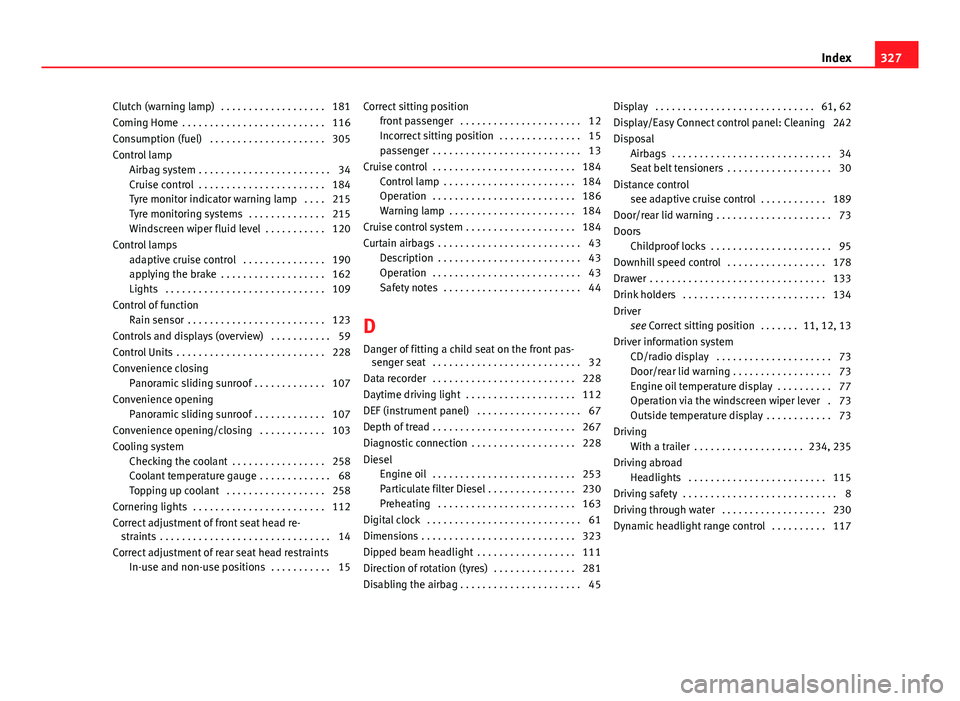
Clutch (warning lamp) . . . . . . . . . . . . . . . . . . . 181
Coming Home . . . . . . . . . . . . . . . . . . . . . . . . . . 116
Consumption (fuel) . . . . . . . . . . . . . . . . . . . . . 305
Control lampAirbag system . . . . . . . . . . . . . . . . . . . . . . . . 34
Cruise control . . . . . . . . . . . . . . . . . . . . . . . 184
Tyre monitor indicator warning lamp . . . . 215
Tyre monitoring systems . . . . . . . . . . . . . . 215
Windscreen wiper fluid level . . . . . . . . . . . 120
Control lamps adaptive cruise control . . . . . . . . . . . . . . . 190
applying the brake . . . . . . . . . . . . . . . . . . . 162
Lights . . . . . . . . . . . . . . . . . . . . . . . . . . . . . 109
Control of function Rain sensor . . . . . . . . . . . . . . . . . . . . . . . . . 123
Controls and displays (overview) . . . . . . . . . . . 59
Control Units . . . . . . . . . . . . . . . . . . . . . . . . . . . 228
Convenience closing Panoramic sliding sunroof . . . . . . . . . . . . . 107
Convenience opening Panoramic sliding sunroof . . . . . . . . . . . . . 107
Convenience opening/closing . . . . . . . . . . . . 103
Cooling system Checking the coolant . . . . . . . . . . . . . . . . . 258
Coolant temperature gauge . . . . . . . . . . . . . 68
Topping up coolant . . . . . . . . . . . . . . . . . . 258
Cornering lights . . . . . . . . . . . . . . . . . . . . . . . . 112
Correct adjustment of front seat head re- straints . . . . . . . . . . . . . . . . . . . . . . . . . . . . . . . 14
Correct adjustment of rear seat head restraints In-use and non-use positions . . . . . . . . . . . 15 Correct sitting position
front passenger . . . . . . . . . . . . . . . . . . . . . . 12
Incorrect sitting position . . . . . . . . . . . . . . . 15
passenger . . . . . . . . . . . . . . . . . . . . . . . . . . . 13
Cruise control . . . . . . . . . . . . . . . . . . . . . . . . . . 184 Control lamp . . . . . . . . . . . . . . . . . . . . . . . . 184
Operation . . . . . . . . . . . . . . . . . . . . . . . . . . 186
Warning lamp . . . . . . . . . . . . . . . . . . . . . . . 184
Cruise control system . . . . . . . . . . . . . . . . . . . . 184
Curtain airbags . . . . . . . . . . . . . . . . . . . . . . . . . . 43 Description . . . . . . . . . . . . . . . . . . . . . . . . . . 43
Operation . . . . . . . . . . . . . . . . . . . . . . . . . . . 43
Safety notes . . . . . . . . . . . . . . . . . . . . . . . . . 44
D Danger of fitting a child seat on the front pas- senger seat . . . . . . . . . . . . . . . . . . . . . . . . . . . 32
Data recorder . . . . . . . . . . . . . . . . . . . . . . . . . . 228
Daytime driving light . . . . . . . . . . . . . . . . . . . . 112
DEF (instrument panel) . . . . . . . . . . . . . . . . . . . 67
Depth of tread . . . . . . . . . . . . . . . . . . . . . . . . . . 267
Diagnostic connection . . . . . . . . . . . . . . . . . . . 228
Diesel Engine oil . . . . . . . . . . . . . . . . . . . . . . . . . . 253
Particulate filter Diesel . . . . . . . . . . . . . . . . 230
Preheating . . . . . . . . . . . . . . . . . . . . . . . . . 163
Digital clock . . . . . . . . . . . . . . . . . . . . . . . . . . . . 61
Dimensions . . . . . . . . . . . . . . . . . . . . . . . . . . . . 323
Dipped beam headlight . . . . . . . . . . . . . . . . . . 111
Direction of rotation (tyres) . . . . . . . . . . . . . . . 281
Disabling the airbag . . . . . . . . . . . . . . . . . . . . . . 45 Display . . . . . . . . . . . . . . . . . . . . . . . . . . . . . 61, 62
Display/Easy Connect control panel: Cleaning . .242
Disposal
Airbags . . . . . . . . . . . . . . . . . . . . . . . . . . . . . 34
Seat belt tensioners . . . . . . . . . . . . . . . . . . . 30
Distance control see adaptive cruise control . . . . . . . . . . . . 189
Door/rear lid warning . . . . . . . . . . . . . . . . . . . . . 73
Doors Childproof locks . . . . . . . . . . . . . . . . . . . . . . 95
Downhill speed control . . . . . . . . . . . . . . . . . . 178
Drawer . . . . . . . . . . . . . . . . . . . . . . . . . . . . . . . . 133
Drink holders . . . . . . . . . . . . . . . . . . . . . . . . . . 134
Driver see Correct sitting position . . . . . . . 11, 12, 13
Driver information system CD/radio display . . . . . . . . . . . . . . . . . . . . . 73
Door/rear lid warning . . . . . . . . . . . . . . . . . . 73
Engine oil temperature display . . . . . . . . . . 77
Operation via the windscreen wiper lever . 73
Outside temperature display . . . . . . . . . . . . 73
Driving With a trailer . . . . . . . . . . . . . . . . . . . . 234, 235
Driving abroad Headlights . . . . . . . . . . . . . . . . . . . . . . . . . 115
Driving safety . . . . . . . . . . . . . . . . . . . . . . . . . . . . 8
Driving through water . . . . . . . . . . . . . . . . . . . 230
Dynamic headlight range control . . . . . . . . . . 117
327
Index
Page 330 of 339
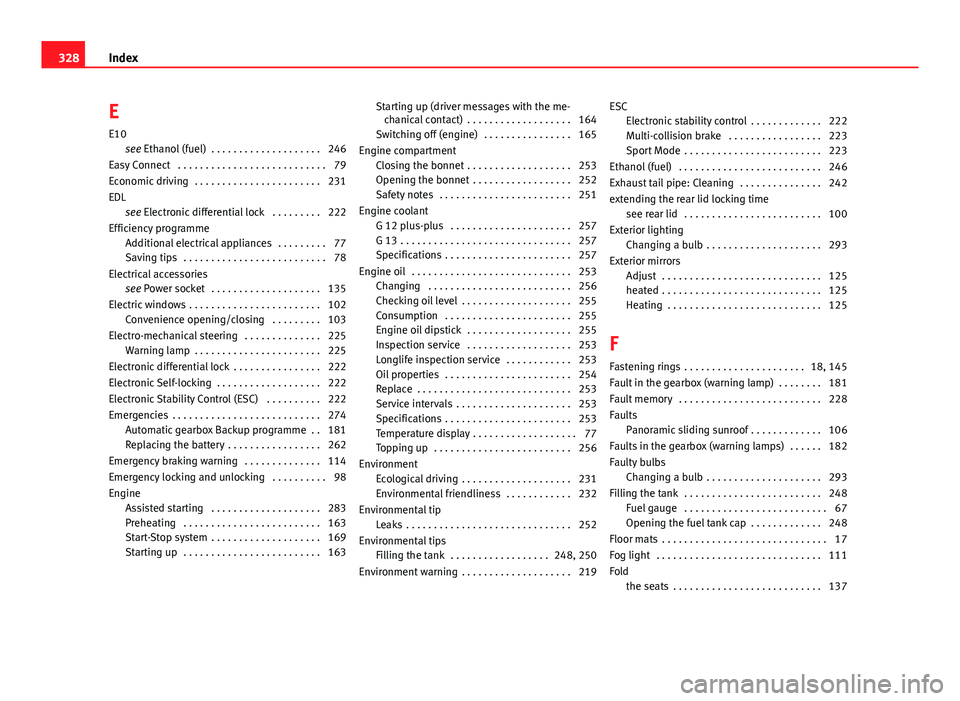
E
E10see Ethanol (fuel) . . . . . . . . . . . . . . . . . . . . 246
Easy Connect . . . . . . . . . . . . . . . . . . . . . . . . . . . 79
Economic driving . . . . . . . . . . . . . . . . . . . . . . . 231
EDL see Electronic differential lock . . . . . . . . . 222
Efficiency programme Additional electrical appliances . . . . . . . . . 77
Saving tips . . . . . . . . . . . . . . . . . . . . . . . . . . 78
Electrical accessories see Power socket . . . . . . . . . . . . . . . . . . . . 135
Electric windows . . . . . . . . . . . . . . . . . . . . . . . . 102 Convenience opening/closing . . . . . . . . . 103
Electro-mechanical steering . . . . . . . . . . . . . . 225 Warning lamp . . . . . . . . . . . . . . . . . . . . . . . 225
Electronic differential lock . . . . . . . . . . . . . . . . 222
Electronic Self-locking . . . . . . . . . . . . . . . . . . . 222
Electronic Stability Control (ESC) . . . . . . . . . . 222
Emergencies . . . . . . . . . . . . . . . . . . . . . . . . . . . 274 Automatic gearbox Backup programme . . 181
Replacing the battery . . . . . . . . . . . . . . . . . 262
Emergency braking warning . . . . . . . . . . . . . . 114
Emergency locking and unlocking . . . . . . . . . . 98
Engine Assisted starting . . . . . . . . . . . . . . . . . . . . 283
Preheating . . . . . . . . . . . . . . . . . . . . . . . . . 163
Start-Stop system . . . . . . . . . . . . . . . . . . . . 169
Starting up . . . . . . . . . . . . . . . . . . . . . . . . . 163 Starting up (driver messages with the me-
chanical contact) . . . . . . . . . . . . . . . . . . . 164
Switching off (engine) . . . . . . . . . . . . . . . . 165
Engine compartment Closing the bonnet . . . . . . . . . . . . . . . . . . . 253
Opening the bonnet . . . . . . . . . . . . . . . . . . 252
Safety notes . . . . . . . . . . . . . . . . . . . . . . . . 251
Engine coolant G 12 plus-plus . . . . . . . . . . . . . . . . . . . . . . 257
G 13 . . . . . . . . . . . . . . . . . . . . . . . . . . . . . . . 257
Specifications . . . . . . . . . . . . . . . . . . . . . . . 257
Engine oil . . . . . . . . . . . . . . . . . . . . . . . . . . . . . 253 Changing . . . . . . . . . . . . . . . . . . . . . . . . . . 256
Checking oil level . . . . . . . . . . . . . . . . . . . . 255
Consumption . . . . . . . . . . . . . . . . . . . . . . . 255
Engine oil dipstick . . . . . . . . . . . . . . . . . . . 255
Inspection service . . . . . . . . . . . . . . . . . . . 253
Longlife inspection service . . . . . . . . . . . . 253
Oil properties . . . . . . . . . . . . . . . . . . . . . . . 254
Replace . . . . . . . . . . . . . . . . . . . . . . . . . . . . 253
Service intervals . . . . . . . . . . . . . . . . . . . . . 253
Specifications . . . . . . . . . . . . . . . . . . . . . . . 253
Temperature display . . . . . . . . . . . . . . . . . . . 77
Topping up . . . . . . . . . . . . . . . . . . . . . . . . . 256
Environment Ecological driving . . . . . . . . . . . . . . . . . . . . 231
Environmental friendliness . . . . . . . . . . . . 232
Environmental tip Leaks . . . . . . . . . . . . . . . . . . . . . . . . . . . . . . 252
Environmental tips Filling the tank . . . . . . . . . . . . . . . . . . 248, 250
Environment warning . . . . . . . . . . . . . . . . . . . . 219 ESC
Electronic stability control . . . . . . . . . . . . . 222
Multi-collision brake . . . . . . . . . . . . . . . . . 223
Sport Mode . . . . . . . . . . . . . . . . . . . . . . . . . 223
Ethanol (fuel) . . . . . . . . . . . . . . . . . . . . . . . . . . 246
Exhaust tail pipe: Cleaning . . . . . . . . . . . . . . . 242
extending the rear lid locking time see rear lid . . . . . . . . . . . . . . . . . . . . . . . . . 100
Exterior lighting Changing a bulb . . . . . . . . . . . . . . . . . . . . . 293
Exterior mirrors Adjust . . . . . . . . . . . . . . . . . . . . . . . . . . . . . 125
heated . . . . . . . . . . . . . . . . . . . . . . . . . . . . . 125
Heating . . . . . . . . . . . . . . . . . . . . . . . . . . . . 125
F
Fastening rings . . . . . . . . . . . . . . . . . . . . . . 18, 145
Fault in the gearbox (warning lamp) . . . . . . . . 181
Fault memory . . . . . . . . . . . . . . . . . . . . . . . . . . 228
Faults Panoramic sliding sunroof . . . . . . . . . . . . . 106
Faults in the gearbox (warning lamps) . . . . . . 182
Faulty bulbs Changing a bulb . . . . . . . . . . . . . . . . . . . . . 293
Filling the tank . . . . . . . . . . . . . . . . . . . . . . . . . 248 Fuel gauge . . . . . . . . . . . . . . . . . . . . . . . . . . 67
Opening the fuel tank cap . . . . . . . . . . . . . 248
Floor mats . . . . . . . . . . . . . . . . . . . . . . . . . . . . . . 17
Fog light . . . . . . . . . . . . . . . . . . . . . . . . . . . . . . 111
Fold the seats . . . . . . . . . . . . . . . . . . . . . . . . . . . 137
328 Index