battery Seat Leon SC 2015 Owner's Guide
[x] Cancel search | Manufacturer: SEAT, Model Year: 2015, Model line: Leon SC, Model: Seat Leon SC 2015Pages: 308, PDF Size: 5.93 MB
Page 241 of 308
Intelligent technology
sportier, more direct and noticeably more dy-
n amic
driv
ing sensation.
Four-wheel drive 3
Valid for vehicles: with four-wheel drive
› ›
› table on page 2
On all-wheel drive models, the engine power
is distributed to all four wheels
General notes
On four-wheel drive vehicles, the engine
power is distributed to all four wheels. The
distribution of power is controlled automati-
cally according to your driving style and the
road conditions. Also see ›››
page 178, Brak-
ing and stability systems .
The all-wheel drive is specially designed to
complement the superior engine power. This
combination gives the vehicle exceptional
handling and performance capabilities, both
on normal roads and in more difficult condi-
tions, such as snow and ice. Even so (or per-
haps especially for this reason), it is impor-
tant to observe certain safety points ››› .
W int
er ty
res
Thanks to all-wheel drive, your vehicle will
have plenty of traction in winter conditions,
even with the standard tyres. Nevertheless,
we still recommend that winter tyres or all- season tyres be fitted on all
four wheels t
o
give even better braking response.
Snow chains
On roads where snow chains are mandatory,
this also applies to cars with four-wheel drive
››› page 61.
Changing tyres
On vehicles with four-wheel drive, all four
tyres must have the same rolling circumfer-
ence. Also avoid using tyres with varying
tread depths ››› page 257.
Off-roader?
Your SEAT is not an off-road vehicle: it does
not have enough ground clearance to be
used as such. It is therefore best to avoid
rough tracks and uneven terrain as much as
possible. WARNING
● Ev en w
ith all-wheel drive, you should al-
ways adjust your speed to suit the condi-
tions. Do not let the extra safety features
tempt you into taking any risks when driving.
Risk of accident!
● The braking capability of your vehicle is
limited by
the tyres' grip. It is therefore no
different from a car without four-wheel drive.
So do not be tempted to drive too fast on firm
or slippery roads just because the vehicle still has good acceleration in these condi-
tions. Ri
sk
of accident!
● On wet roads bear in mind that the front
wheels m
ay start to “aquaplane” and lose
contact with the road if the car is driven too
fast. If this should happen, there will be no
sudden increase in engine speed to warn the
driver, as occurs with a front-wheel drive car.
For this reason you should always choose a
driving speed suitable for the road condi-
tions. Risk of accident! Power Management
Thi s
sy
stem helps to ensure reliable
starting The power management controls the distribu-
tion of
el
ectric
al energy and thus helps to en-
sure that there is always enough power avail-
able to start the engine.
If a vehicle with a conventional electrical sys-
tem is left parked for a long time, the battery
will gradually lose its charge because certain
electrical devices, such as the electronic
gearbox lock continues to draw current even
when the ignition is off. In some cases there
may not be enough power available to start
the engine.
Your vehicle is equipped with an intelligent
power management system to control the »
239
Technical data
Advice
Operation
Emergencies
Safety
Page 242 of 308
Advice
distribution of electrical energy. This signifi-
c antly
impr
oves reliability when starting the
engine, and also prolongs the useful life of
the battery.
The main functions incorporated in the power
management system are battery diagnosis,
residual current management and dynamic
power management.
Battery diagnosis
The battery diagnosis function constantly
registers the condition of the battery. Sen-
sors detect the battery voltage, battery cur-
rent and battery temperature. This enables
the system to calculate the current power lev-
el and charge condition of the battery.
Residual current management
The residual current management reduces
power consumption while the vehicle is
parked. It controls the supply of power to the
various electrical devices while the ignition is
switched off. The system takes the battery di-
agnosis data into consideration.
Depending on the power level of the battery,
switch off the individual electrical devices
one after the other to prevent the battery
from losing too much charge and to ensure
that the engine can be started reliably. Dynamic power management
While the
vehicle is moving, this function dis-
tributes the available power to the various
electrical devices and systems according to
their requirements. The power management
ensures that on-board systems do not con-
sume more electrical power than the alterna-
tor can supply, and thus maintains the maxi-
mum possible battery power level. Note
● Neither is the po
wer management system
able to overcome the given physical limits.
Please remember that the power and useful
life of the battery are limited.
● When there is a risk that the vehicle will
not st
art, the alternator power failure or low
battery charge level warning lamp will be
shown ››› page 108. Flat battery
Starting ability has first priority.
Shor
t
trip
s, city traffic and low temperatures
all place a heavy load on the battery. In these
conditions a large amount of power is con-
sumed, but only a small amount is supplied.
The situation is also critical if electrical devi-
ces are in use when the engine is not run-
ning. In this case power is consumed when
none is being generated. In these situations you will be aware that the
power m
anagement system is intervening to
control the distribution of electrical power.
When the vehicle is parked for long periods
If you do not drive your vehicle for a period of
several days or weeks, the power manage-
ment will gradually shut off the electrical de-
vices one by one or reduce the amount of cur-
rent they are using. This limits the amount of
power consumed and helps to ensure relia-
ble starting even after a long period. Some
convenience functions, such as remote vehi-
cle opening, may not be available under cer-
tain circumstances. These functions will be
restored when you switch on the ignition and
start the engine.
With the engine switched off
For example, if you listen to the sound sys-
tem with the engine switched off the battery
will run down.
If the energy consumption means there is a
risk that the engine will not start, a text will
appear in vehicles with a driver information
system*.
This driver indicator tells you that you must
start the engine so that the battery can re-
charge.
240
Page 243 of 308
Checking and refilling levels
When the engine is running
A lthough the alt
ern
ator generates electrical
power, the battery can still become dis-
charged while the vehicle is being driven.
This can occur when a lot of power is being
consumed but only a small amount supplied,
especially if the battery is not fully charged
initially.
To restore the necessary energy balance, the
system will then temporarily shut off the elec-
trical devices that are using a lot of power, or
reduce the current they are consuming. Heat-
ing systems in particular use a large amount
of electrical power. If you notice, for instance,
that the seat heating* or the rear window
heater is not working, they may have been
temporarily switched off or regulated to a
lower heat output. These systems will be
available again as soon as sufficient electri-
cal power is available.
You may also notice that the engine runs at a
slightly faster idling speed when necessary.
This is quite normal, and no cause for con-
cern. The increased idling speed allows the
alternator to meet the greater power require-
ment and charge the battery at the same
time. Checking and refilling levels
Fi l
lin
g the tank
Filling up Read the additional information carefully
›› ›
page 51
If the automatic filler nozzle is operated cor-
rectly, it will switch itself off as soon as the
fuel tank is “full”. Do not try to put in more
fuel after the nozzle cuts out, as this will fill
the expansion chamber in the fuel tank.
The correct fuel grade for your vehicle is giv-
en on a sticker on the inside of the fuel tank
flap. Further notes on fuel can be found at
››› page 243.
The capacity of your vehicle's fuel tank is giv-
en in ›››
page 51.
Vehicles with natural gas engines and hy-
brids
Every 6 months it is necessary to run on pet-
rol until the control lamp switches off and
then the tank must be refilled. This is neces-
sary to ensure that the system works proper-
ly, as well as the fuel quality required for driv-
ing with petrol. WARNING
Fuel is highly flammable and can cause seri-
ous b
urns and other injuries.
● Do not smoke when filling the fuel tank or a
canis
ter. Naked flames are forbidden in the
vicinity due to the risk of explosion.
● Observe legislation governing the use,
stor
age and carrying of a spare fuel canister
in the vehicle.
● For safety reasons we do not recommend
carry
ing a spare fuel canister in the vehicle.
In an accident the canister could be damaged
and could leak.
● If, in exceptional circumstances, you have
to carr
y a spare fuel canister, please observe
the following points:
– Never fill fuel into the spare fuel canister
if it is inside or on top of the vehicle. An
electrostatic charge could build up during
filling, causing the fuel vapour to ignite.
Danger of explosion. Always place the
canister on the ground to fill it.
– Insert the filling nozzle as far as possible
into the spare fuel canister.
– If the spare fuel canister is made of met-
al, the filling nozzle must be in contact
with the canister during filling. This
helps prevent an electrostatic charge
building up.
– Never spill fuel in the vehicle or in the
luggage compartment. Fuel vapour is ex-
plosive. Risk of fatal accident! » 241
Technical data
Advice
Operation
Emergencies
Safety
Page 248 of 308
Advice
Engine compartment Chec k
in
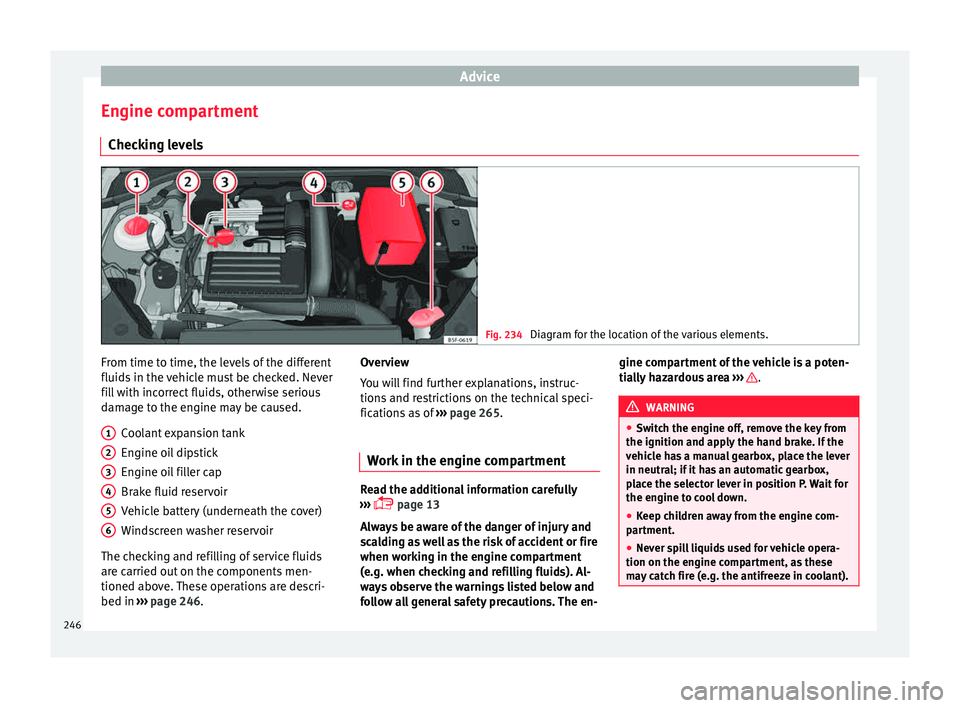
g levels Fig. 234
Diagram for the location of the various elements. From time to time, the levels of the different
fluid
s
in the
vehicle must be checked. Never
fill with incorrect fluids, otherwise serious
damage to the engine may be caused.
Coolant expansion tank
Engine oil dipstick
Engine oil filler cap
Brake fluid reservoir
Vehicle battery (underneath the cover)
Windscreen washer reservoir
The checking and refilling of service fluids
are carried out on the components men-
tioned above. These operations are descri-
bed in ››› page 246.
1 2
3
4
5
6 Overview
Y
ou w
i
ll find further explanations, instruc-
tions and restrictions on the technical speci-
fications as of ››› page 265.
Work in the engine compartment Read the additional information carefully
›› ›
page 13
Always be aware of the danger of injury and
scalding as well as the risk of accident or fire
when working in the engine compartment
(e.g. when checking and refilling fluids). Al-
ways observe the warnings listed below and
follow all general safety precautions. The en- gine compartment of the vehicle is a poten-
tia
l
ly hazardous area ››› .
WARNING
● Swit c
h the engine off, remove the key from
the ignition and apply the hand brake. If the
vehicle has a manual gearbox, place the lever
in neutral; if it has an automatic gearbox,
place the selector lever in position P. Wait for
the engine to cool down.
● Keep children away from the engine com-
partment
.
● Never spill liquids used for vehicle opera-
tion on the engine comp
artment, as these
may catch fire (e.g. the antifreeze in coolant). 246
Page 249 of 308
Checking and refilling levels
●
Tak e c
are not to cause short circuits in the
electrical system, especially when working
on the battery.
● If working inside the engine compartment,
remember that, ev
en when the ignition is
switched off, the radiator fan may start up au-
tomatically, and therefore there is a risk of in-
jury.
● Never cover the engine with additional in-
sul
ating materials such as a blanket. Risk of
fire!
● Do not unscrew the cap on the coolant ex-
pans
ion tank when the engine is hot. The
cooling system is under pressure.
● Protect face, hands and arms by covering
the cap with a l
arge, thick rag to protect
against escaping coolant and steam.
● If it is necessary to work in the engine com-
partment
while the engine is running, the ro-
tating components (for example, poly-V belt,
alternator, radiator fan) and the high voltage
ignition system are an additional hazard.
● Observe the following additional warnings
if work
on the fuel system or the electrical
system is necessary:
– Always disconnect the battery from the
on-board network.
– Do not smoke.
– Never work near naked flames.
– Always keep an approved fire extinguish-
er immediately available. CAUTION
When topping up fluids make sure the correct
fluid is p
ut into the correct filler opening, oth-
erwise this can cause serious malfunctions or
engine damage. For the sake of the environment
Inspect the ground underneath your vehicle
re gu
larly so that any leaks are detected at an
early stage. If you find spots of oil or other
fluids in the area where it was parked, have
your vehicle inspected at the workshop. Note
In right-hand drive vehicles* some brake flu-
id re ser
voirs are on the other side of the en-
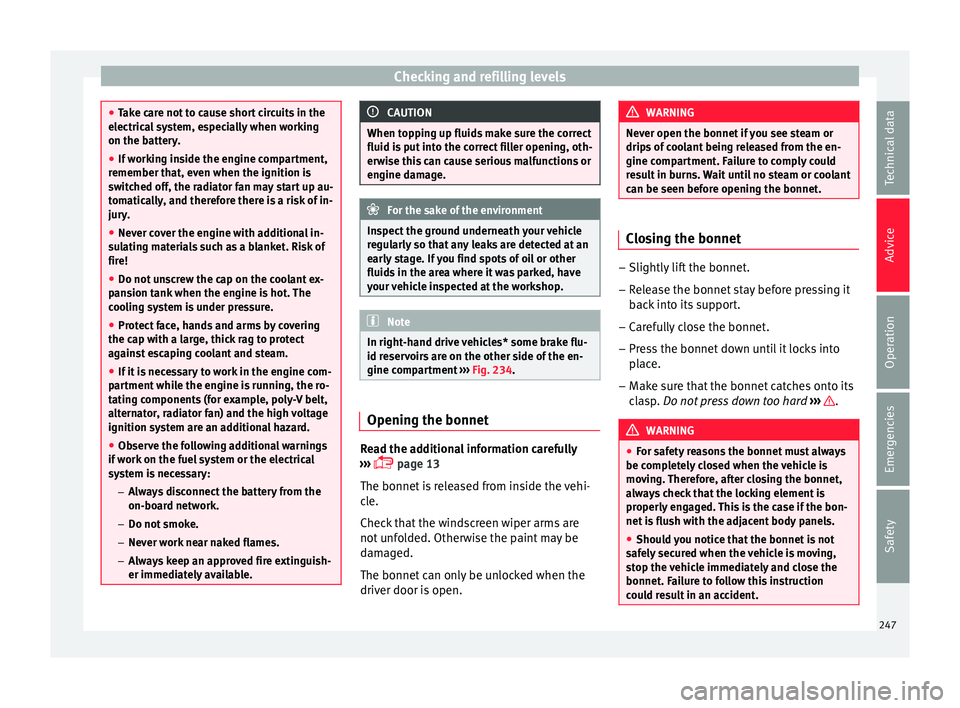
gine compartment ››› Fig. 234. Opening the bonnet
Read the additional information carefully
› ›
›
page 13
The bonnet is released from inside the vehi-
cle.
Check that the windscreen wiper arms are
not unfolded. Otherwise the paint may be
damaged.
The bonnet can only be unlocked when the
driver door is open. WARNING
Never open the bonnet if you see steam or
drips of
coolant being released from the en-
gine compartment. Failure to comply could
result in burns. Wait until no steam or coolant
can be seen before opening the bonnet. Closing the bonnet
–
Slightly lift the bonnet.
– Release the bonnet stay before pressing it
bac k
into its support.
– Carefully close the bonnet.
– Press the bonnet down until it locks into
plac
e.
– Make sure that the bonnet catches onto its
cla
sp. Do not press down too hard ››› .
WARNING
● For s af
ety reasons the bonnet must always
be completely closed when the vehicle is
moving. Therefore, after closing the bonnet,
always check that the locking element is
properly engaged. This is the case if the bon-
net is flush with the adjacent body panels.
● Should you notice that the bonnet is not
safely
secured when the vehicle is moving,
stop the vehicle immediately and close the
bonnet. Failure to follow this instruction
could result in an accident. 247
Technical data
Advice
Operation
Emergencies
Safety
Page 255 of 308

Checking and refilling levels
CAUTION
● Do not mi x
cleaning products recommen-
ded by SEAT with other products. This could
lead to flocculation and may block the wind-
screen washer jets.
● When topping up service fluids, make abso-
lutely c
ertain that you fill the fluids into the
correct reservoirs. Using the wrong fluids
could cause serious malfunctions and engine
damage!
● Not having windscreen wiper fluid reduces
vis
ibility through the windscreen, and leads
to loss of visibility in headlights in models
with headlight washer. Battery
Gener a
l
informationRead the additional information carefully
› ›
›
page 53.
The battery is located in the engine compart-
ment and is almost maintenance-free. It is
checked as part of the Inspection Service.
Nevertheless, check the terminals are clean
and have the correct tightening torque, espe-
cially in summer and winter.
Disconnecting the battery
The battery should only be disconnected in
exceptional cases. When the battery is dis- connected, some of the vehicle's functions
are “los
t” (››› table on page 253). These
functions will require resetting after the bat-
tery is reconnected.
Deactivate the anti-theft alarm* before you
disconnect the battery Otherwise the alarm
will be triggered.
FunctionReprogramming
One-touch function of
the electric windows››› page 126, One-touch
opening and closing*.
Remote control key
If the vehicle does not re-
spond to the key, they
should be synchronised
››› page 121.
Digital clock››› page 106.
ESC warning lampAfter driving for a few me-
tres, the warning lamp goes
out again. If the vehicle is not used for long periods
The
v
ehic
le has a system for monitoring the
current consumption when the engine is left
unused for long periods of time ››› page 239.
Some functions, such as the interior lights, or
the remote door opening, may be temporarily
disabled to prevent the battery from running
flat. These functions will come back on as
soon as the ignition is switched on and the
engine started. Winter conditions
During the w
inter, the starting power may be
reduced, and if necessary, the battery should
be charged ››› in Important safety warn-
in g
s
for handling a vehicle battery on
page 254
Important safety warnings for han-
dling a v
ehicle battery All work on batteries requires specialist
kno
wl
edg
e. Please refer to a SEAT Official
Service or a workshop specialising in batter-
ies: risk of burns or exploding battery!
The battery must not be opened. Never try to
change the fluid level of the battery. Other-
wise explosive gas is released from the bat-
tery that could cause an explosion.
Wear eye protection.
Battery acid is very corrosive and caustic. Wear
protective gloves and eye protection. In the event
of electrolyte splashes, rinse off with plenty of
water.
Fires, sparks, open flames and smoking are pro-
hibited.
The battery should only be charged in a well-ven-
tilated zone. Risk of explosion!
Keep children away from acid and batteries!»
253
Technical data
Advice
Operation
Emergencies
Safety
Page 256 of 308
Advice
WARNING
● When rep airin
g or working on the electrical
system, proceed as follows:
–1. Remove the key from the ignition. The
negative cable on the battery must be
disconnected.
– 2. When the repair is finished, reconnect
the negative pole of the battery.
● Switch off all electrical devices before re-
connecting the b
attery. Reconnect first the
positive cable and then the negative cable.
Never reverse the polarity of the connections.
This could cause an electrical fire.
● Ensure that the vent hose is always connec-
ted to the b
attery.
● Never use damaged batteries. This could
cause an e
xplosion! Replace a damaged bat-
tery immediately. CAUTION
● Never di s
connect the battery if the ignition
is switched on or if the engine is running.
This could damage the electrical system or
electronic components. Charging the battery
Terminals for charging the battery are fitted
in the en
gine comp
artment. –
Note the warnin
gs ››› in Important safety
w arnin
g
s for handling a vehicle battery on
page 254 and ››› .
– Switch off all electrical devices. Remove the
ignition k ey
.
– R
aise the bonnet ›››
page 247.
– Open the battery cover.
– Connect the charger clamps as described
to the po
sitive pole of the battery (+) and
exclusively to an earth on the bodywork
(–).
– Only use a charger which is compatible for
use with 12
V nominal voltage batteries.
The charge must not exceed a voltage of 15
V.
– Now connect the battery charger to the
power soc
ket and switch on.
– After charging the battery: switch off the
batter
y charger and disconnect the power
socket cable.
– Finally disconnect the charger cables from
the batter
y.
– Replace the battery cover correctly.
– Close the bonnet ›››
page 247.
Important: Before you charge the battery
make sure you read the manufacturer's in-
structions for using the battery charger. WARNING
Never charge a battery that has frozen: re-
pl ac
e battery! Failure to do so may lead to an
explosion. Note
Use only the terminals in the engine compart-
ment t o c
harge the battery. Replacing the battery
The new battery should have the same speci-
fic
ation
s
(amperage, load and voltage) as the
used battery.
Your vehicle is equipped with an intelligent
power management system to control the
distribution of electrical energy ›››
page 239.
The power management function ensures
that the battery is charged much more effi-
ciently than on vehicles without a power
management system. To maintain this func-
tion after replacing the battery, we recom-
mend that the replacement battery used is of
the same make and type as the original fitted
battery. To make proper use of the power
management function after the battery has
been changed, have the battery coded to the
power management mode at a specialised
workshop.
254
Page 257 of 308
Wheels
CAUTION
● Some v ehic
les, for example those with the
Start-Stop system* are fitted with a special
battery (AGM-type or EFB-type battery). If any
other type of battery is fitted, the Start-Stop
function may be considerably reduced and
the vehicle may not stop on repeated occa-
sions.
● Make sure that the vent hose is always at-
tached t
o the original opening on the side of
the battery. Gases or battery acid can other-
wise escape and possibly cause damage.
● The battery holder and clamps must always
be correctly
secured.
● Before starting any work on the battery, al-
way
s observe the warnings listed under
››› page 253, Important safety warnings for
handling a vehicle battery .
● Do not forget to replace the battery cover-
ings, wher
e applicable. It is a protection for
high temperatures. This in turn extends the
vehicle service life. For the sake of the environment
Batteries contain toxic substances includ-
in g s
ulphuric acid and lead. They must be
disposed of appropriately and must not be
disposed of with ordinary household waste.
Make sure disconnected batteries cannot tip
over. Sulphuric acid could be spilt! Wheels
Wheel s
and ty
res
General notes –
When driving with new tyr e
s, be especially
careful during the first 500 km (300 miles).
– If you have to drive over a kerb or similar
obs
tacle, drive very slowly and as near as
possible at a right angle to the obstacle.
– Check from time to time if the tyres are
dam ag
ed (punctures, cuts, cracks or
dents). Remove any foreign objects embed-
ded in the treads.
– Damaged wheels and tyres must be re-
plac
ed immediately.
– Keep grease, oil and fuel off the tyres.
– Replace any missing valve caps as soon as
poss
ible.
– Mark the wheels before taking them off so
that they
rotate in the same direction when
put back.
– When removed, the wheels or tyres should
be stor
ed in a cool, dry and preferably dark
place.
New tyres
New tyres do not give maximum grip straight
away and should therefore be “run in” by driving carefully and at moderate speeds for
about the firs
t 500 km (300 miles). This will
also increase the useful life of the tyres.
The tread depth of new tyres may vary, ac-
cording to the type and make of tyre and the
tread pattern.
Concealed damage
Damage to tyres and rims is often not readily
visible. If you notice unusual vibration or the
car pulling to one side, this may indicate that
one of the tyres is damaged. Reduce speed
immediately if there is any reason to suspect
that damage may have occurred. Inspect the
tyres for damage. If no external damage is
visible, drive slowly and carefully to the near-
est specialised workshop and have the car
inspected.
Tyres with directional tread pattern
An arrow on the tyre sidewall indicates the di-
rection of rotation on single drive tyres. Al-
ways note the direction of rotation indicated
when mounting the wheel. This guarantees
optimum grip and helps to avoid aquaplan-
ing, excessive noise and wear.
Retrofitting accessories
If you wish to change or fit wheels, rims or
wheel trims, we recommend that you consult
with a SEAT Official Service centre for advice
regarding current techniques.
255
Technical data
Advice
Operation
Emergencies
Safety
Page 295 of 308
Index
Index
A
ABS se
e
Anti-lock brake system . . . . . . . . . . . . . . . 178
ACC . . . . . . . . . . . . . . . . . . . . . . . . . . . . . . . . . . . . 187 radar sensor . . . . . . . . . . . . . . . . . . . . . . . . . . . 189
Accessories . . . . . . . . . . . . . . . . . . . . . . . . . 147, 230
Adaptive cruise control . . . . . . . . . . . . . . . . . . . . 187 indications on the display . . . . . . . . . . . . . . . . 188
malfunction . . . . . . . . . . . . . . . . . . . . . . . . . . . . 188
radar sensor . . . . . . . . . . . . . . . . . . . . . . . . . . . 189
special driving situations . . . . . . . . . . . . . . . . . 195
warning and indication lamp . . . . . . . . . . . . . . 188
Adaptive Cruise Control deactivating temporarily . . . . . . . . . . . . . . . . . 194
operating . . . . . . . . . . . . . . . . . . . . . . . . . . . . . . 190
Additional electrical appliances (efficiency pro- gramme) . . . . . . . . . . . . . . . . . . . . . . . . . . . . . . . 36
Adjusting front seats . . . . . . . . . . . . . . . . . . . . . . . . . . . . . 140
Adjusting the head restraints front head restraints . . . . . . . . . . . . . . . . . . . . . 141
Adjustment CAR menu . . . . . . . . . . . . . . . . . . . . . . . . . . . . . 110
front head restraints . . . . . . . . . . . . . . . . . 70, 141
lights . . . . . . . . . . . . . . . . . . . . . . . . . . . . . . . . . 134
rear head restraints . . . . . . . . . . . . . . . . . 70, 141
seats . . . . . . . . . . . . . . . . . . . . . . . . . . . . . . . . . . 67
Airbag system . . . . . . . . . . . . . . . . . . . . . . . . . . 17, 77 activation . . . . . . . . . . . . . . . . . . . . . . . . . . . . . . 78
covers . . . . . . . . . . . . . . . . . . . . . . . . . . . . . . . . . 17
deactivation of front airbag . . . . . . . . . . . . . . . . 81
description . . . . . . . . . . . . . . . . . . . . . . . . . . . . . 78
front airbags . . . . . . . . . . . . . . . . . . . . . . . . . 17, 79
functioning . . . . . . . . . . . . . . . . . . . . . . . . . . . . . 78 head-protection airbags . . . . . . . . . . . . . . . . . . 20
Knee airbag . . . . . . . . . . . . . . . . . . . . . . . . . . . . .
19
side airbags . . . . . . . . . . . . . . . . . . . . . . . . . . . . 19
Air conditioning Climatronic . . . . . . . . . . . . . . . . . . . . . . . . 45, 159
heating and fresh air . . . . . . . . . . . . . . . . . . . . . 49
manual air conditioning . . . . . . . . . . . . . . . . . . . 47
User instructions . . . . . . . . . . . . . . . . . . . . . . . 161
Air outlets . . . . . . . . . . . . . . . . . . . . . . . . . . . . . . . 162
Air recirculation . . . . . . . . . . . . . . . . . . . . . . . . . . 163
Alcantara: cleaning . . . . . . . . . . . . . . . . . . . . . . . 237
All-wheel drive snow chains . . . . . . . . . . . . . . . . . . . . . . . . . . . 239
winter tyres . . . . . . . . . . . . . . . . . . . . . . . . . . . . 239
Ambient lighting . . . . . . . . . . . . . . . . . . . . . . . . . 135
Anti-freeze . . . . . . . . . . . . . . . . . . . . . . . . . . . . . . . 52
Anti-lock brake system . . . . . . . . . . . . . . . . . . . . . 178
Anti-puncture kit . . . . . . . . . . . . . . . . . . . . . . . . 57, 86 check after 10 minutes . . . . . . . . . . . . . . . . . . . . 88
components . . . . . . . . . . . . . . . . . . . . . . . . . . . . 87
inflating a tyre . . . . . . . . . . . . . . . . . . . . . . . . . . . 87
sealing a tyre . . . . . . . . . . . . . . . . . . . . . . . . . . . 87
Anti-theft alarm . . . . . . . . . . . . . . . . . . . . . . . . . . 121 vehicle interior monitoring and anti-tow sys-tem . . . . . . . . . . . . . . . . . . . . . . . . . . . . . . . . . 123
Anti-theft alarm system . . . . . . . . . . . . . . . . . . . . 116 trailer . . . . . . . . . . . . . . . . . . . . . . . . . . . . . . . . . 228
Anti-theft security system . . . . . . . . . . . . . . 11, 119
Anti-tow protection . . . . . . . . . . . . . . . . . . . . . . . 123
Aspects to take into account before starting the vehicle . . . . . . . . . . . . . . . . . . . . . . . . . . . . . . . . . 66
ASR see Traction control system . . . . . . . . . . . . . . . 178
Assistance systems cruise control system . . . . . . . . . . . . . . . . . . . . 185
front assist monitoring system . . . . . . . . . . . . 197
parking aid . . . . . . . . . . . . . . . . . . . . . . . . . . . . 211
Parking aid . . . . . . . . . . . . . . . . . . . . . . . . . . . . 213 tiredness detection . . . . . . . . . . . . . . . . . . . . . 210
traffic s
ign detection system . . . . . . . . . . . . . . 208
tyre monitoring . . . . . . . . . . . . . . . . . . . . . . . . . 260
tyre monitoring indicator . . . . . . . . . . . . . . . . . 261
tyre monitoring system . . . . . . . . . . . . . . . . . . 259
Assisted starting . . . . . . . . . . . . . . . . . . . . . . . . . . 62
Assist systems ACC . . . . . . . . . . . . . . . . . . . . . . . . . . . . . . . . . . 187
adaptive cruise control . . . . . . . . . . . . . . . . . . . 187
Audible signal lights . . . . . . . . . . . . . . . . . . . . . . . . . . . . . . . . . 128
Audible warning signal seat belt not fastened . . . . . . . . . . . . . . . . . . . . 72
warning and indication lamps . . . . . . . . . . . . . 108
Auto Lock (central locking) . . . . . . . . . . . . . . . . . 116
Automatic dipped beam control . . . . . . . . . . . . . 130
Automatic gear Safety interlock for ignition key . . . . . . . . . . . . 164
Automatic gearbox . . . . . . . . . . . . . . . . . . . . . . . . 167 backup programme . . . . . . . . . . . . . . . . . . . . . 174
downhill speed control . . . . . . . . . . . . . . . . . . 173
driving tips . . . . . . . . . . . . . . . . . . . . . . . . . . . . 171
kick-down feature . . . . . . . . . . . . . . . . . . . . . . . 172
launch control programme . . . . . . . . . . . . . . . . 172
manual release of selector lever . . . . . . . . . . . . 44
selector lever lock . . . . . . . . . . . . . . . . . . . . . . . 169
selector lever positions . . . . . . . . . . . . . . . . . . 168
Steering wheel with gearshift paddles . . . . . . 170
tiptronic . . . . . . . . . . . . . . . . . . . . . . . . . . 167, 170
AUX-IN . . . . . . . . . . . . . . . . . . . . . . . . . . . . . . . . . . 115
B Battery . . . . . . . . . . . . . . . . . . . . . . . . . . . . . . . . . . 120
Before starting the vehicle . . . . . . . . . . . . . . . . . . 66
Belt tightening . . . . . . . . . . . . . . . . . . . . . . . . . . . . 76
Bench seat . . . . . . . . . . . . . . . . . . . . . . . . . . . . . . 144
Biodiesel . . . . . . . . . . . . . . . . . . . . . . . . . . . . . . . . 244
293
Page 296 of 308
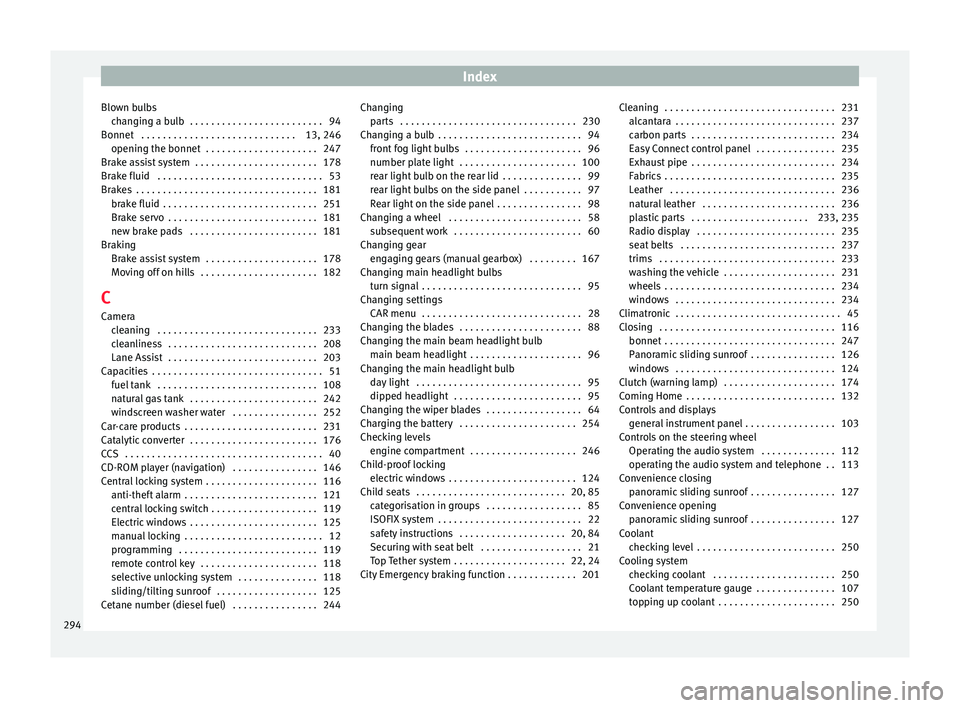
Index
Blown bulbs ch
an
ging a bulb . . . . . . . . . . . . . . . . . . . . . . . . . 94
Bonnet . . . . . . . . . . . . . . . . . . . . . . . . . . . . . 13, 246 opening the bonnet . . . . . . . . . . . . . . . . . . . . . 247
Brake assist system . . . . . . . . . . . . . . . . . . . . . . . 178
Brake fluid . . . . . . . . . . . . . . . . . . . . . . . . . . . . . . . 53
Brakes . . . . . . . . . . . . . . . . . . . . . . . . . . . . . . . . . . 181 brake fluid . . . . . . . . . . . . . . . . . . . . . . . . . . . . . 251
Brake servo . . . . . . . . . . . . . . . . . . . . . . . . . . . . 181
new brake pads . . . . . . . . . . . . . . . . . . . . . . . . 181
Braking Brake assist system . . . . . . . . . . . . . . . . . . . . . 178
Moving off on hills . . . . . . . . . . . . . . . . . . . . . . 182
C Camera cleaning . . . . . . . . . . . . . . . . . . . . . . . . . . . . . . 233
cleanliness . . . . . . . . . . . . . . . . . . . . . . . . . . . . 208
Lane Assist . . . . . . . . . . . . . . . . . . . . . . . . . . . . 203
Capacities . . . . . . . . . . . . . . . . . . . . . . . . . . . . . . . . 51 fuel tank . . . . . . . . . . . . . . . . . . . . . . . . . . . . . . 108
natural gas tank . . . . . . . . . . . . . . . . . . . . . . . . 242
windscreen washer water . . . . . . . . . . . . . . . . 252
Car-care products . . . . . . . . . . . . . . . . . . . . . . . . . 231
Catalytic converter . . . . . . . . . . . . . . . . . . . . . . . . 176
CCS . . . . . . . . . . . . . . . . . . . . . . . . . . . . . . . . . . . . . 40
CD-ROM player (navigation) . . . . . . . . . . . . . . . . 146
Central locking system . . . . . . . . . . . . . . . . . . . . . 116 anti-theft alarm . . . . . . . . . . . . . . . . . . . . . . . . . 121
central locking switch . . . . . . . . . . . . . . . . . . . . 119
Electric windows . . . . . . . . . . . . . . . . . . . . . . . . 125
manual locking . . . . . . . . . . . . . . . . . . . . . . . . . . 12
programming . . . . . . . . . . . . . . . . . . . . . . . . . . 119
remote control key . . . . . . . . . . . . . . . . . . . . . . 118
selective unlocking system . . . . . . . . . . . . . . . 118
sliding/tilting sunroof . . . . . . . . . . . . . . . . . . . 125
Cetane number (diesel fuel) . . . . . . . . . . . . . . . . 244 Changing
parts . . . . . . . . . . . . . . . . . . . . . . . . . . . . . . . . . 230
Changing a bulb . . . . . . . . . . . . . . . . . . . . . . . . . . . 94 front fog light bulbs . . . . . . . . . . . . . . . . . . . . . . 96
number plate light . . . . . . . . . . . . . . . . . . . . . . 100
rear light bulb on the rear lid . . . . . . . . . . . . . . . 99
rear light bulbs on the side panel . . . . . . . . . . . 97
Rear light on the side panel . . . . . . . . . . . . . . . . 98
Changing a wheel . . . . . . . . . . . . . . . . . . . . . . . . . 58 subsequent work . . . . . . . . . . . . . . . . . . . . . . . . 60
Changing gear engaging gears (manual gearbox) . . . . . . . . . 167
Changing main headlight bulbs turn signal . . . . . . . . . . . . . . . . . . . . . . . . . . . . . . 95
Changing settings CAR menu . . . . . . . . . . . . . . . . . . . . . . . . . . . . . . 28
Changing the blades . . . . . . . . . . . . . . . . . . . . . . . 88
Changing the main beam headlight bulb main beam headlight . . . . . . . . . . . . . . . . . . . . . 96
Changing the main headlight bulb day light . . . . . . . . . . . . . . . . . . . . . . . . . . . . . . . 95
dipped headlight . . . . . . . . . . . . . . . . . . . . . . . . 95
Changing the wiper blades . . . . . . . . . . . . . . . . . . 64
Charging the battery . . . . . . . . . . . . . . . . . . . . . . 254
Checking levels engine compartment . . . . . . . . . . . . . . . . . . . . 246
Child-proof locking electric windows . . . . . . . . . . . . . . . . . . . . . . . . 124
Child seats . . . . . . . . . . . . . . . . . . . . . . . . . . . . 20, 85 categorisation in groups . . . . . . . . . . . . . . . . . . 85
ISOFIX system . . . . . . . . . . . . . . . . . . . . . . . . . . . 22
safety instructions . . . . . . . . . . . . . . . . . . . . 20, 84
Securing with seat belt . . . . . . . . . . . . . . . . . . . 21Top Tether system . . . . . . . . . . . . . . . . . . . . . 22, 24
City Emergency braking function . . . . . . . . . . . . . 201 Cleaning . . . . . . . . . . . . . . . . . . . . . . . . . . . . . . . . 231
alcantar a . . . . . . . . . . . . . . . . . . . . . . . . . . . . . . 237
carbon parts . . . . . . . . . . . . . . . . . . . . . . . . . . . 234
Easy Connect control panel . . . . . . . . . . . . . . . 235
Exhaust pipe . . . . . . . . . . . . . . . . . . . . . . . . . . . 234
Fabrics . . . . . . . . . . . . . . . . . . . . . . . . . . . . . . . . 235
Leather . . . . . . . . . . . . . . . . . . . . . . . . . . . . . . . 236
natural leather . . . . . . . . . . . . . . . . . . . . . . . . . 236
plastic parts . . . . . . . . . . . . . . . . . . . . . . 233, 235
Radio display . . . . . . . . . . . . . . . . . . . . . . . . . . 235
seat belts . . . . . . . . . . . . . . . . . . . . . . . . . . . . . 237
trims . . . . . . . . . . . . . . . . . . . . . . . . . . . . . . . . . 233
washing the vehicle . . . . . . . . . . . . . . . . . . . . . 231
wheels . . . . . . . . . . . . . . . . . . . . . . . . . . . . . . . . 234
windows . . . . . . . . . . . . . . . . . . . . . . . . . . . . . . 234
Climatronic . . . . . . . . . . . . . . . . . . . . . . . . . . . . . . . 45
Closing . . . . . . . . . . . . . . . . . . . . . . . . . . . . . . . . . 116 bonnet . . . . . . . . . . . . . . . . . . . . . . . . . . . . . . . . 247
Panoramic sliding sunroof . . . . . . . . . . . . . . . . 126
windows . . . . . . . . . . . . . . . . . . . . . . . . . . . . . . 124
Clutch (warning lamp) . . . . . . . . . . . . . . . . . . . . . 174
Coming Home . . . . . . . . . . . . . . . . . . . . . . . . . . . . 132
Controls and displays general instrument panel . . . . . . . . . . . . . . . . . 103
Controls on the steering wheel Operating the audio system . . . . . . . . . . . . . . 112
operating the audio system and telephone . . 113
Convenience closing panoramic sliding sunroof . . . . . . . . . . . . . . . . 127
Convenience opening panoramic sliding sunroof . . . . . . . . . . . . . . . . 127
Coolant checking level . . . . . . . . . . . . . . . . . . . . . . . . . . 250
Cooling system checking coolant . . . . . . . . . . . . . . . . . . . . . . . 250
Coolant temperature gauge . . . . . . . . . . . . . . . 107
topping up coolant . . . . . . . . . . . . . . . . . . . . . . 250
294