heating Seat Leon SC 2015 Owner's Guide
[x] Cancel search | Manufacturer: SEAT, Model Year: 2015, Model line: Leon SC, Model: Seat Leon SC 2015Pages: 308, PDF Size: 5.93 MB
Page 181 of 308
Driver assistance systems
Brake assist system
The br ak
e a
ssist system can reduce the re-
quired braking distance. The braking force is
automatically boosted if you press the brake
pedal quickly in an emergency. You must
keep pressing the brake pedal until the dan-
ger has passed.
Traction control system (ASR)
In the event of wheelspin, the traction control
system reduces the engine torque to match
the amount of grip available. This helps the
car to start moving, accelerate or climb a gra-
dient.
Electronic differential lock (EDL)
When the EDL detects wheelspin, it brakes
the spinning wheel and directs the power to
the other driven wheel. This function is active
up to approximately 100 km/h.
To prevent the disc brake of the braked wheel
from overheating, the EDL cuts out automati-
cally if subjected to excessive loads. The ve-
hicle can still be driven. The EDL will switch
on again automatically when the brake has
cooled down.
Tractor-trailer sway mitigation*
If the vehicle is pulling a trailer, it will control
the following: Tractor-trailers tend to sway.
When the swaying of the trailer is felt by the
vehicle and detected by the ESC, it will auto- matically brake the towing vehicle within the
limits of the sy
stem and mitigate the sway.
Tractor-trailer sway mitigation is not available
in all countries.
Electronic torque management (XDS)
When taking a curve, the driveshaft differen-
tial mechanism allows the outer wheel to turn
at a higher speed than the inner wheel. In
this way, the wheel that is turning faster (out-
er wheel) receives less drive torque than the
inner wheel. This may mean that in certain
situations the torque delivered to the inner
wheel is too high, causing the wheels to
spin. On the other hand, the outer wheel is
receiving a lower drive torque than it could
transmit. This causes an overall loss of lateral
grip on the front axle, resulting in understeer
or “lengthening” of the trajectory.
The XDS system can detect and correct this
effect via the sensors and signals of the ESC.
Via the ESC, the XDS will brake the inside
wheel and counter the excess driving torque
of that wheel. This means that the driver's
desired trajectory is much more precise.
The XDS system works in combination with
the ESC and is always active, even when ASR
traction control is disconnected, or the ESC in
Sport mode or disconnected. Multi-collision brake
In an accident, the mu
lti-collision brake can
help the driver by braking to avoid the risk of
skidding during the accident, which could
lead to further collisions.
The multi-collision brake works for front, side
or rear accidents, when the airbag control
unit records its activation level and the acci-
dent takes place at a speed of over 10 km/h
(6 mph). The ESC automatically brakes the
vehicle, as long as the accident has not dam-
aged the ESC, the brake hydraulics or the on-
board network.
The following actions control automatic brak-
ing during the accident:
● When the driver presses the accelerator,
the automatic
braking does not take place.
● When the braking pressure through press-
ing the brak
e pedal is greater than the sys-
tem’s braking pressure the vehicle will brake
automatically.
● Multi-collision braking will not be available
if ESC
is malfunctioning. WARNING
● The ESC, ABS, ASR, EDL, el ectr
onic self-
locking differential or selective torque control
systems cannot exceed the limits imposed by
the laws of physics. Always bear this in mind, » 179
Technical data
Advice
Operation
Emergencies
Safety
Page 230 of 308
Operation
Anti-theft alarm system When the vehicle is locked, the alarm is trig-
ger
ed when the el
ectrical connection be-
tween vehicle and trailer is interrupted.
Always turn off the anti-theft alarm system
before connecting or disconnecting a trailer
››› page 121.
Conditions for the integration of a trailer in
the anti-theft alarm system.
● The vehicle is factory-equipped with an an-
ti-theft al
arm system and a towing bracket
device.
● The trailer is connected electrically to the
tow
ing vehicle by the trailer connector.
● The electrical system of the vehicle and the
trail
er are prepared for operation.
● The vehicle is locked with the ignition key
and the anti-theft al
arm system is activated.CAUTION
For technical reasons, trailers fitted with rear
LED lights ar
e not integrated in the anti-theft
alarm system. Driving tips
Driving with a trailer always requires extra
c
ar e. W
eight distribution
The weight di
stribution of a loaded trailer
with an unladen vehicle is very unfavourable.
However, if this cannot be avoided, drive ex-
tra slowly to allow for the unbalanced weight
distribution.
Speed
The stability of the vehicle and trailer is re-
duced with increasing speed. For this reason,
it is advisable not to drive at the maximum
permissible speed in an unfavourable road,
weather or wind conditions. This applies es-
pecially when driving downhill.
You should always reduce speed immediately
if the trailer shows the slightest sign of snak-
ing. Never try to stop the “snaking” by in-
creasing speed.
Always brake in due course. If the trailer has
an overrun brake, apply the brakes gently at
first and then, firmly. This will prevent the
jerking that can be caused by locking of trail-
er wheels. Select a low gear in due course
before going down a steep downhill. This en-
ables you to use the engine braking to slow
down the vehicle.
Reheating
At very high temperatures and during pro-
longed slopes, driving in a low gear and high
engine speed, always monitor the coolant
temperature gauge ››› page 108. Electronic stability control*
The ESC* sys
tem helps to stabilise the trailer
in case of skidding or rocking.
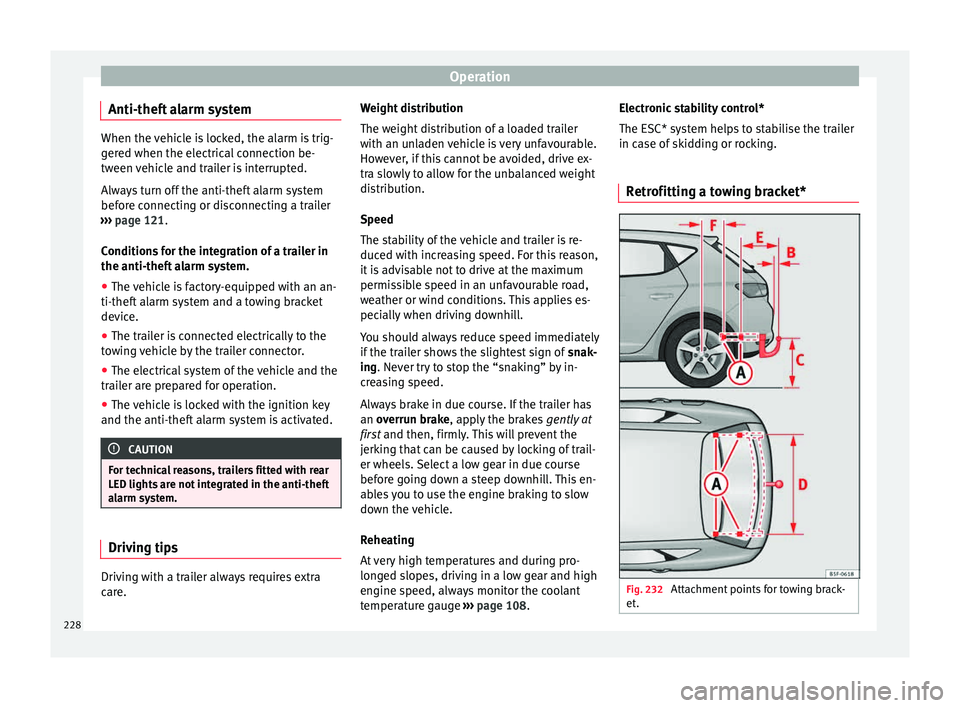
Retrofitting a towing bracket* Fig. 232
Attachment points for towing brack-
et . 228
Page 236 of 308
Advice
Carbon parts The carbon parts on your vehicle have a pain-
ted s
ur
face. They do not need any special
care and are cleaned just like any other pain-
ted part ››› page 231.
Paint damage Minor damage to the paint, such as scratches
or st
one c
hips, should be touched up without
delay before the metal starts to corrode. Suit-
able touch-up brushes or sprays for your car
can be obtained from a SEAT Official Service.
The number of the original paint finish on the
vehicle is given on the data sticker
››› page 265.
If corrosion is already visible it must be thor-
oughly removed by a specialised workshop.
Windows Clear vision is an essential safety factor.
The w
ind
s
creen must not be cleaned with in-
sect remover or wax, otherwise the wind-
screen wipers will not function properly (jud-
dering).
Traces of rubber, oil, grease or silicone can
be removed with a window cleaning solution
or a silicone remover. Wax residue can only be removed with a special cleaner. Your SEAT
Offici
al Service will be able to provide you
with more detailed information.
The windows should also be cleaned on the
inside at regular intervals.
Use a separate cloth or chamois to dry the
windows. Cloths used for waxing and polish-
ing contain residues that will cause smears
on the glass. WARNING
Do not use water-repellent coatings on the
wind s
creen. In bad visibility conditions (e.g.
in the rain, dark or with a low sun), these
coatings may cause dazzle: risk of accident!
Such coatings can also cause the windscreen
wiper blades to make noise. CAUTION
● Remo v
e snow and ice from windows and ex-
terior mirrors with a plastic scraper only. To
avoid scratches caused by dirt on the glass,
the scraper should only be pushed in one di-
rection and not moved to and fro.
● The heating element for the rear window is
located on the inner s
ide of the window. To
avoid damaging them, do not apply stickers
to these heating elements.
● Never use warm or hot water to remove
snow and ic
e from windows and mirrors. This
could cause the glass to crack! Wheels
The wheels require regular attention to pre-
serv
e their ap
pearance. It is important to re-
move road salt and brake dust by washing
the wheels at regular intervals, otherwise the
finish will be impaired.
After washing, the wheels should only be
cleaned with an "acid-free" cleaning agent
for alloy wheels. This is available from SEAT
Official Services and specialist retailers. Nev-
er leave the cleaning agent on the rims for
any longer than specified in the instructions
before rinsing it off. If the wheel cleaner fluid
contains acid it can attack the surfaces of the
wheel bolts.
Car polish or other abrasive agents should
not be used for maintaining the rims. If the
protective coating is damaged, e.g. by flying
stones, the damaged area should be re-
paired immediately. WARNING
Please note when cleaning the wheels that
wat er
, ice and road salt can impair the effec-
tiveness of the brakes; this can cause an acci-
dent. Exhaust tail pipe
It is important to remove road salt and brake
du
s
t
by washing the wheels at regular
234
Page 243 of 308
Checking and refilling levels
When the engine is running
A lthough the alt
ern
ator generates electrical
power, the battery can still become dis-
charged while the vehicle is being driven.
This can occur when a lot of power is being
consumed but only a small amount supplied,
especially if the battery is not fully charged
initially.
To restore the necessary energy balance, the
system will then temporarily shut off the elec-
trical devices that are using a lot of power, or
reduce the current they are consuming. Heat-
ing systems in particular use a large amount
of electrical power. If you notice, for instance,
that the seat heating* or the rear window
heater is not working, they may have been
temporarily switched off or regulated to a
lower heat output. These systems will be
available again as soon as sufficient electri-
cal power is available.
You may also notice that the engine runs at a
slightly faster idling speed when necessary.
This is quite normal, and no cause for con-
cern. The increased idling speed allows the
alternator to meet the greater power require-
ment and charge the battery at the same
time. Checking and refilling levels
Fi l
lin
g the tank
Filling up Read the additional information carefully
›› ›
page 51
If the automatic filler nozzle is operated cor-
rectly, it will switch itself off as soon as the
fuel tank is “full”. Do not try to put in more
fuel after the nozzle cuts out, as this will fill
the expansion chamber in the fuel tank.
The correct fuel grade for your vehicle is giv-
en on a sticker on the inside of the fuel tank
flap. Further notes on fuel can be found at
››› page 243.
The capacity of your vehicle's fuel tank is giv-
en in ›››
page 51.
Vehicles with natural gas engines and hy-
brids
Every 6 months it is necessary to run on pet-
rol until the control lamp switches off and
then the tank must be refilled. This is neces-
sary to ensure that the system works proper-
ly, as well as the fuel quality required for driv-
ing with petrol. WARNING
Fuel is highly flammable and can cause seri-
ous b
urns and other injuries.
● Do not smoke when filling the fuel tank or a
canis
ter. Naked flames are forbidden in the
vicinity due to the risk of explosion.
● Observe legislation governing the use,
stor
age and carrying of a spare fuel canister
in the vehicle.
● For safety reasons we do not recommend
carry
ing a spare fuel canister in the vehicle.
In an accident the canister could be damaged
and could leak.
● If, in exceptional circumstances, you have
to carr
y a spare fuel canister, please observe
the following points:
– Never fill fuel into the spare fuel canister
if it is inside or on top of the vehicle. An
electrostatic charge could build up during
filling, causing the fuel vapour to ignite.
Danger of explosion. Always place the
canister on the ground to fill it.
– Insert the filling nozzle as far as possible
into the spare fuel canister.
– If the spare fuel canister is made of met-
al, the filling nozzle must be in contact
with the canister during filling. This
helps prevent an electrostatic charge
building up.
– Never spill fuel in the vehicle or in the
luggage compartment. Fuel vapour is ex-
plosive. Risk of fatal accident! » 241
Technical data
Advice
Operation
Emergencies
Safety
Page 244 of 308
Advice
CAUTION
● If an y
fuel is spilt onto the vehicle, it
should be removed immediately. It could oth-
erwise damage the paintwork.
● Never run the tank completely dry. An irreg-
ular f
uel supply could cause misfiring. As a
result, unburnt fuel could enter the exhaust
system and damage the catalytic converter.
● When filling the fuel tank after having run it
compl
etely dry on a vehicle with a diesel en-
gine, the ignition must be switched on for at
least 30 seconds before starting the engine.
When you then start the engine it may take
longer than normal (up to one minute) to
start firing. This is because air needs to be
bled from the fuel system while starting. For the sake of the environment
Do not overfill the fuel tank, it may cause the
fuel t
o overflow if it becomes warm. Note
Diesel vehicles are fitted with a protective de-
vic e th
at prevents the insertion of the wrong
fuel hose 1)
. It is only possible to refuel with
Diesel nozzles.
● If the pump nozzle is worn, damaged, or if
it is
very small, it is possible that it will not
be able to open the protective device. Before
trying to insert the pump nozzle by turning it, try a different pump or request specialist
help.
●
If
you fill the tank from a reserve fuel canis-
ter, the pr
otective device will not open. One
way to resolve this is to pour the fuel in very
slowly. Refuelling with natural gas
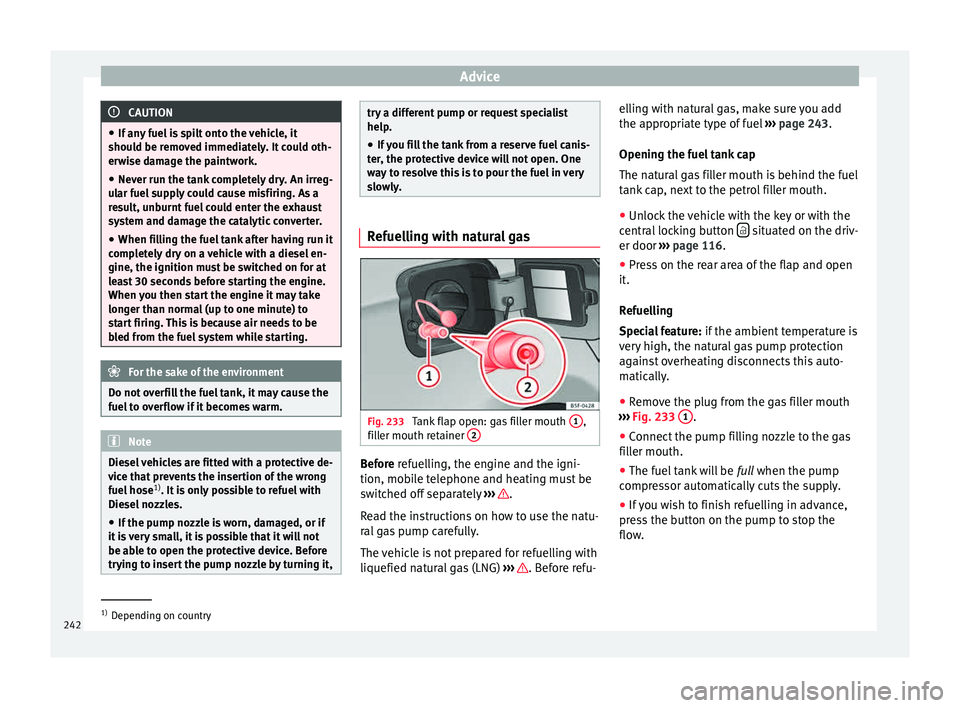
Fig. 233
Tank flap open: gas filler mouth 1 ,
fi ll
er mouth retainer 2 Before r
efuelling, the engine and the igni-
tion, mo b
ile telephone and heating must be
switched off separately ››› .
R e
a
d the instructions on how to use the natu-
ral gas pump carefully.
The vehicle is not prepared for refuelling with
liquefied natural gas (LNG) ››› . Before refu-elling with natural gas, make sure you add
the ap
pr
opri
ate type of fuel ››› page 243.
Opening the fuel tank cap
The natural gas filler mouth is behind the fuel
tank cap, next to the petrol filler mouth.
● Unlock the vehicle with the key or with the
central
locking button situated on the driv-
er door ››
›
page 116.
● Press on the rear area of the flap and open
it.
Ref
uelling
Special feature: if the ambient temperature is
very high, the natural gas pump protection
against overheating disconnects this auto-
matically.
● Remove the plug from the gas filler mouth
›››
Fig. 233 1 .
● Connect the pump filling nozzle to the gas
fi l
l
er mouth.
● The fuel tank will be full when the p
ump
compressor automatically cuts the supply.
● If you wish to finish refuelling in advance,
pres
s the button on the pump to stop the
flow. 1)
Depending on country
242
Page 247 of 308
Checking and refilling levels
by a specialised workshop. If water is allowed
to c
o
llect in the filter, this can cause engine
performance problems. Natural gas
›› ›
table on page 2
Natural gas
Natural gas can be compressed or in liquid
form, addition to others.
Liquefied natural gas (LNG) is the result of
heavy cooling of natural gas. Therefore its
volume is considerably reduced compared
with compressed natural gas (CNG). In vehi-
cles with a natural gas engine, liquefied nat-
ural gas cannot be directly refilled, as the gas
would expand excessively in the vehicle gas
tank.
Therefore, vehicles with a natural gas engine
must only be refuelled using compressed
natural gas ››› .
Nat ur
a
l gas quality and consumption
Natural gas is divided into the groups H and
L depending on its quality.
Gas type H has a superior heating power and
inferior nitrogen and carbon dioxide content
than type L. The higher the heating power of the natural gas, the lower the consumption
wil
l be.
However, the heating power and the propor-
tion of nitrogen and carbon dioxide can fluc-
tuate within the quality groups. Therefore, ve-
hicle consumption can also vary when using
a single type of gas only.
The engine management automatically
adapts to the natural gas used according to
its quality. Therefore, different quality gases
can be mixed in the tank, without the need
for comprehensive draining before applying a
different quality gas.
Updated information relating to natural gas
quality is displayed on the instrument panel
››› page 31.
Natural gas and safety
If you can smell gas or suspect that there is a
leak ››› :
● Stop the vehicle immediately.
● Switch the ignition off.
● Open the doors to appropriately ventilate
the v
ehic
le.
● Extinguish cigarettes immediately.
● Move away from the vehicle or switch off
obj
ects that may cause sparks or a fire.
● If you continue to smell gas, do not contin-
ue drivin g! ●
Seek s pec
ialist assistance. Have the fault
repaired. WARNING
Failure to act when you can smell gas in the
vehic l
e or when refuelling can cause serious
injuries.
● Carry out the necessary operations.
● Leave the danger zone.
● If necessary, warn the emergency services. WARNING
The vehicle is not prepared to use liquefied
nat ur
al gas (LNG) and this fuel must not be
added under any circumstances. Liquefied
natural gas can cause the natural gas tank to
explode, resulting in serious injury. Note
Have the natural gas system checked regular-
ly b y
a specialised workshop, according to
the Maintenance Programme. 245
Technical data
Advice
Operation
Emergencies
Safety
Page 253 of 308
Checking and refilling levels
could d amage the engine. If there is no
c oo
lant in the expansion tank, do not con-
tinue driving. You should obtain professio-
nal assistance ››› .
– If there is still some coolant in the expan-
sion t
ank, t
op up to the upper mark.
– Top up with coolant until the level becomes
stab
le.
– Screw the cap back on correctly.
Any lo
ss of coolant fluid normally indicates a
leak in the cooling system. Take the vehicle
straight to a specialised workshop to have
the cooling system examined. If there are no
leaks in the engine cooling system, a loss of
coolant can only occur if the coolant boils
and is forced out of the system as a result of
overheating. WARNING
● The coo lin
g system is under pressure. Do
not unscrew the cap on the coolant expan-
sion tank when the engine is hot: risk of
burns!
● The antifreeze and coolant fluid can be a
health h
azard. Therefore, the antifreeze
should be stored in the original container in a
safe place out of reach of children. Failure to
comply could result in poisoning.
● If working inside the engine compartment,
remember that, ev
en when the ignition is
switched off, the radiator fan may start up au- tomatically, and therefore there is a risk of in-
jury
. WARNING
If there is not enough anti-freeze in the cool-
ant sys
tem, the engine may fail leading to se-
rious damage.
● Please make sure that the percentage of
additiv
e is correct with respect to the lowest
expected ambient temperature in the zone in
which the vehicle is to be used.
● When the outside temperature is very low,
the cool
ant could freeze and the vehicle
would be immobilised. In this case, the heat-
ing would not work either and inadequately
dressed passengers could die of cold. CAUTION
Do not top up the expansion tank with cool-
ant fluid if it
is empty! Air could enter the
cooling system. In this case, stop driving.
Seek specialist assistance. Otherwise, there
is a risk of engine damage. CAUTION
The original additives should never be mixed
with c oo
lants which are not approved by
SEAT. Otherwise, you run the risk of causing
severe damage to the engine and the engine
cooling system.
● If the fluid in the expansion tank is not pur-
ple b
ut is, for example, brown, this indicates that the G13 additive has been mixed with an
ina
dequat
e coolant. The coolant must be
changed as soon as possible if this is the
case! This could result in serious faults and
engine damage. For the sake of the environment
Coolants and additives can contaminate the
en vir
onment. If any fluids are spilled, they
should be collected and correctly disposed
of, with respect to the environment. Brake fluid
Top
pin
g up brake fluid Read the additional information carefully
› ›
›
page 53
Checking the brake fluid level
The brake fluid level must be between the
MIN and MAX markings.
However, if the brake fluid level goes down
noticeably in a short time, or drops below the
MIN mark, there may be a leak in the brake
system. Seek specialist assistance. A warn-
ing light on the instrument panel display
monitors the brake fluid level ››› page 108. »
251
Technical data
Advice
Operation
Emergencies
Safety
Page 259 of 308
Wheels
WARNING
● Alw a
ys adapt the tyre pressure accordingly
when the vehicle load changes.
● A tyre with low air pressure has to flex a lot
more when the v
ehicle is heavily loaded or at
high speeds, therefore causing overheating
to occur. Under these conditions, the tyre
bead may be released or the tyre may burst.
Risk of accident! For the sake of the environment
Under-inflated tyres will increase fuel con-
sumption. Wear indicators
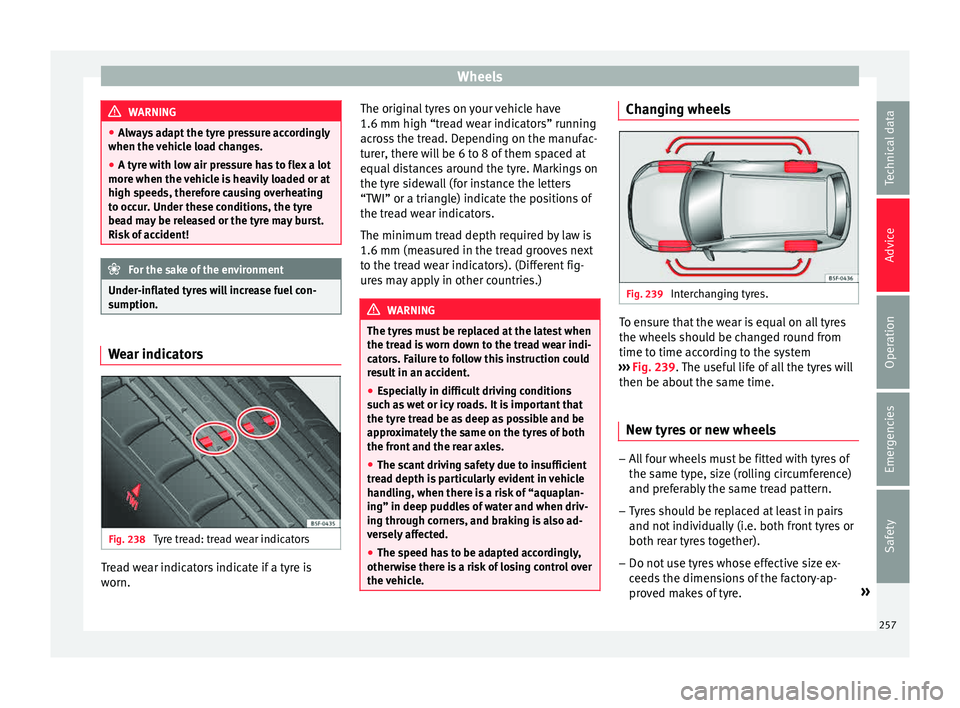
Fig. 238
Tyre tread: tread wear indicators Tread wear indicators indicate if a tyre is
w
orn. The origin
al
tyres on your vehicle have
1.6 mm high “trea
d wear indicators” running
across the tread. Depending on the manufac-
turer, there will be 6 to 8 of them spaced at
equal distances around the tyre. Markings on
the tyre sidewall (for instance the letters
“TWI” or a triangle) indicate the positions of
the tread wear indicators.
The minimum tread depth required by law is
1.6 mm (measured in the tread grooves next
to the tread wear indicators). (Different fig-
ures may apply in other countries.) WARNING
The tyres must be replaced at the latest when
the tre a
d is worn down to the tread wear indi-
cators. Failure to follow this instruction could
result in an accident.
● Especially in difficult driving conditions
such a
s wet or icy roads. It is important that
the tyre tread be as deep as possible and be
approximately the same on the tyres of both
the front and the rear axles.
● The scant driving safety due to insufficient
trea
d depth is particularly evident in vehicle
handling, when there is a risk of “aquaplan-
ing” in deep puddles of water and when driv-
ing through corners, and braking is also ad-
versely affected.
● The speed has to be adapted accordingly,
otherwi
se there is a risk of losing control over
the vehicle. Changing wheels
Fig. 239
Interchanging tyres. To ensure that the wear is equal on all tyres
the wheel
s
shou
ld be changed round from
time to time according to the system
››› Fig. 239. The useful life of all the tyres will
then be about the same time.
New tyres or new wheels –
All four wheels must be fitted with tyres of
the s ame type, s
iz
e (rolling circumference)
and preferably the same tread pattern.
– Tyres should be replaced at least in pairs
and not individual
ly (i.e. both front tyres or
both rear tyres together).
– Do not use tyres whose effective size ex-
ceeds
the dimensions of the factory-ap-
proved makes of tyre. »
257
Technical data
Advice
Operation
Emergencies
Safety
Page 261 of 308
Wheels
manufacturer. Inadequate tyre clearance can
re
s
ult in damage to the tyres or the vehicle,
causing a serious safety risk. Risk of acci-
dent! It may also invalidate the vehicle's reg-
istration for use on public roads.
● Avoid running the vehicle on tyres that are
more than 6
years old. If you have no alterna-
tive, you should drive slowly and with extra
care at all times.
● If wheel trims are fitted after the car is pur-
cha
sed, ensure that there is an adequate flow
of air for cooling the brake system. For the sake of the environment
Old tyres must be disposed of according to
the la w
s in the country concerned. Note
● Never mou nt
used tyres if you are not sure
of their “previous history”.
● For technical reasons, it is not generally
poss
ible to use the wheels from other vehi-
cles. In some cases, this may also be true for
the same model of wheel. Wheel bolts
The wheel
bolts
ar
e m
atched to the rims.
When installing different wheels (for instance
alloy wheels or wheels with winter tyres) it is
important to use the correct wheel bolts with
the right length and correctly shaped bolt heads. This ensures that wheels are fitted se-
curely
and that the brake system functions
correctly.
The wheel bolts must be clean and turn easi-
ly.
A special adapter is required to turn the anti-
theft wheel bolts* ›››
page 59.
Tyre monitoring systems Introduction WARNING
Unsuitable handling of the wheels and tyres
ma y
lead to sudden tyre pressure losses, to
tread separation or even to a blow-out.
● Check tyre pressures regularly and ensure
they are m
aintained at the pressures indica-
ted. Tyre pressure that is too low could cause
overheating, resulting in tread detachment or
even burst tyres.
● Tyre pressure should be that indicated on
the label when the ty
res are cold at all times
››› page 267.
● Regularly check the cold inflation pressure
of the tyr
es. If necessary, change the tyre
pressure of the vehicle tyres while they are
cold.
● Regularly check your tyres for damage and
wear
. ●
Never e x
ceed the maximum permitted
speed or loads specified for the type of tyre
fitted on your vehicle. For the sake of the environment
Under-inflated tyres lead to increased fuel
c on s
umption and tyre wear. Note
● Drivin g f
or the first time with new tyres at a
high speed can cause them to slightly ex-
pand, which could then produce an air pres-
sure warning.
● Only replace used tyres with those author-
ised by
SEAT for the corresponding type vehi-
cle.
● Do not only rely on the tyre monitoring sys-
tem. Re
gularly check your tyres to ensure
that the tyre pressure is correct and that the
tyres are not damaged due to puncture, cuts,
tears and impacts/dents. Remove objects
from the tyres only when they have not
pierced the tyres. 259
Technical data
Advice
Operation
Emergencies
Safety
Page 295 of 308
Index
Index
A
ABS se
e
Anti-lock brake system . . . . . . . . . . . . . . . 178
ACC . . . . . . . . . . . . . . . . . . . . . . . . . . . . . . . . . . . . 187 radar sensor . . . . . . . . . . . . . . . . . . . . . . . . . . . 189
Accessories . . . . . . . . . . . . . . . . . . . . . . . . . 147, 230
Adaptive cruise control . . . . . . . . . . . . . . . . . . . . 187 indications on the display . . . . . . . . . . . . . . . . 188
malfunction . . . . . . . . . . . . . . . . . . . . . . . . . . . . 188
radar sensor . . . . . . . . . . . . . . . . . . . . . . . . . . . 189
special driving situations . . . . . . . . . . . . . . . . . 195
warning and indication lamp . . . . . . . . . . . . . . 188
Adaptive Cruise Control deactivating temporarily . . . . . . . . . . . . . . . . . 194
operating . . . . . . . . . . . . . . . . . . . . . . . . . . . . . . 190
Additional electrical appliances (efficiency pro- gramme) . . . . . . . . . . . . . . . . . . . . . . . . . . . . . . . 36
Adjusting front seats . . . . . . . . . . . . . . . . . . . . . . . . . . . . . 140
Adjusting the head restraints front head restraints . . . . . . . . . . . . . . . . . . . . . 141
Adjustment CAR menu . . . . . . . . . . . . . . . . . . . . . . . . . . . . . 110
front head restraints . . . . . . . . . . . . . . . . . 70, 141
lights . . . . . . . . . . . . . . . . . . . . . . . . . . . . . . . . . 134
rear head restraints . . . . . . . . . . . . . . . . . 70, 141
seats . . . . . . . . . . . . . . . . . . . . . . . . . . . . . . . . . . 67
Airbag system . . . . . . . . . . . . . . . . . . . . . . . . . . 17, 77 activation . . . . . . . . . . . . . . . . . . . . . . . . . . . . . . 78
covers . . . . . . . . . . . . . . . . . . . . . . . . . . . . . . . . . 17
deactivation of front airbag . . . . . . . . . . . . . . . . 81
description . . . . . . . . . . . . . . . . . . . . . . . . . . . . . 78
front airbags . . . . . . . . . . . . . . . . . . . . . . . . . 17, 79
functioning . . . . . . . . . . . . . . . . . . . . . . . . . . . . . 78 head-protection airbags . . . . . . . . . . . . . . . . . . 20
Knee airbag . . . . . . . . . . . . . . . . . . . . . . . . . . . . .
19
side airbags . . . . . . . . . . . . . . . . . . . . . . . . . . . . 19
Air conditioning Climatronic . . . . . . . . . . . . . . . . . . . . . . . . 45, 159
heating and fresh air . . . . . . . . . . . . . . . . . . . . . 49
manual air conditioning . . . . . . . . . . . . . . . . . . . 47
User instructions . . . . . . . . . . . . . . . . . . . . . . . 161
Air outlets . . . . . . . . . . . . . . . . . . . . . . . . . . . . . . . 162
Air recirculation . . . . . . . . . . . . . . . . . . . . . . . . . . 163
Alcantara: cleaning . . . . . . . . . . . . . . . . . . . . . . . 237
All-wheel drive snow chains . . . . . . . . . . . . . . . . . . . . . . . . . . . 239
winter tyres . . . . . . . . . . . . . . . . . . . . . . . . . . . . 239
Ambient lighting . . . . . . . . . . . . . . . . . . . . . . . . . 135
Anti-freeze . . . . . . . . . . . . . . . . . . . . . . . . . . . . . . . 52
Anti-lock brake system . . . . . . . . . . . . . . . . . . . . . 178
Anti-puncture kit . . . . . . . . . . . . . . . . . . . . . . . . 57, 86 check after 10 minutes . . . . . . . . . . . . . . . . . . . . 88
components . . . . . . . . . . . . . . . . . . . . . . . . . . . . 87
inflating a tyre . . . . . . . . . . . . . . . . . . . . . . . . . . . 87
sealing a tyre . . . . . . . . . . . . . . . . . . . . . . . . . . . 87
Anti-theft alarm . . . . . . . . . . . . . . . . . . . . . . . . . . 121 vehicle interior monitoring and anti-tow sys-tem . . . . . . . . . . . . . . . . . . . . . . . . . . . . . . . . . 123
Anti-theft alarm system . . . . . . . . . . . . . . . . . . . . 116 trailer . . . . . . . . . . . . . . . . . . . . . . . . . . . . . . . . . 228
Anti-theft security system . . . . . . . . . . . . . . 11, 119
Anti-tow protection . . . . . . . . . . . . . . . . . . . . . . . 123
Aspects to take into account before starting the vehicle . . . . . . . . . . . . . . . . . . . . . . . . . . . . . . . . . 66
ASR see Traction control system . . . . . . . . . . . . . . . 178
Assistance systems cruise control system . . . . . . . . . . . . . . . . . . . . 185
front assist monitoring system . . . . . . . . . . . . 197
parking aid . . . . . . . . . . . . . . . . . . . . . . . . . . . . 211
Parking aid . . . . . . . . . . . . . . . . . . . . . . . . . . . . 213 tiredness detection . . . . . . . . . . . . . . . . . . . . . 210
traffic s
ign detection system . . . . . . . . . . . . . . 208
tyre monitoring . . . . . . . . . . . . . . . . . . . . . . . . . 260
tyre monitoring indicator . . . . . . . . . . . . . . . . . 261
tyre monitoring system . . . . . . . . . . . . . . . . . . 259
Assisted starting . . . . . . . . . . . . . . . . . . . . . . . . . . 62
Assist systems ACC . . . . . . . . . . . . . . . . . . . . . . . . . . . . . . . . . . 187
adaptive cruise control . . . . . . . . . . . . . . . . . . . 187
Audible signal lights . . . . . . . . . . . . . . . . . . . . . . . . . . . . . . . . . 128
Audible warning signal seat belt not fastened . . . . . . . . . . . . . . . . . . . . 72
warning and indication lamps . . . . . . . . . . . . . 108
Auto Lock (central locking) . . . . . . . . . . . . . . . . . 116
Automatic dipped beam control . . . . . . . . . . . . . 130
Automatic gear Safety interlock for ignition key . . . . . . . . . . . . 164
Automatic gearbox . . . . . . . . . . . . . . . . . . . . . . . . 167 backup programme . . . . . . . . . . . . . . . . . . . . . 174
downhill speed control . . . . . . . . . . . . . . . . . . 173
driving tips . . . . . . . . . . . . . . . . . . . . . . . . . . . . 171
kick-down feature . . . . . . . . . . . . . . . . . . . . . . . 172
launch control programme . . . . . . . . . . . . . . . . 172
manual release of selector lever . . . . . . . . . . . . 44
selector lever lock . . . . . . . . . . . . . . . . . . . . . . . 169
selector lever positions . . . . . . . . . . . . . . . . . . 168
Steering wheel with gearshift paddles . . . . . . 170
tiptronic . . . . . . . . . . . . . . . . . . . . . . . . . . 167, 170
AUX-IN . . . . . . . . . . . . . . . . . . . . . . . . . . . . . . . . . . 115
B Battery . . . . . . . . . . . . . . . . . . . . . . . . . . . . . . . . . . 120
Before starting the vehicle . . . . . . . . . . . . . . . . . . 66
Belt tightening . . . . . . . . . . . . . . . . . . . . . . . . . . . . 76
Bench seat . . . . . . . . . . . . . . . . . . . . . . . . . . . . . . 144
Biodiesel . . . . . . . . . . . . . . . . . . . . . . . . . . . . . . . . 244
293