light Seat Leon SC 2017 Owner's manual
[x] Cancel search | Manufacturer: SEAT, Model Year: 2017, Model line: Leon SC, Model: Seat Leon SC 2017Pages: 332, PDF Size: 7.25 MB
Page 282 of 332
Advice
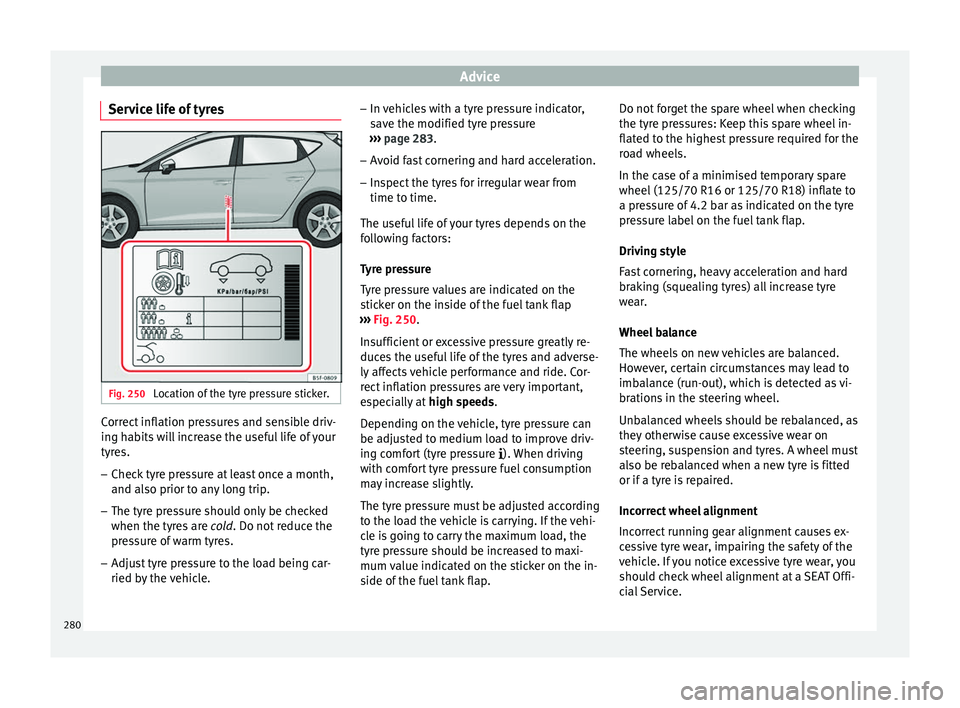
Service life of tyres Fig. 250
Location of the tyre pressure sticker. Correct inflation pressures and sensible driv-
in
g h
ab
its will increase the useful life of your
tyres.
– Check tyre pressure at least once a month,
and also prior to an
y long trip.
– The tyre pressure should only be checked
when the tyre
s are cold. Do not reduce the
pressure of warm tyres.
– Adjust tyre pressure to the load being car-
ried by the
vehicle. –
In vehic
les with a tyre pressure indicator,
save the modified tyre pressure
››› page 283.
– Avoid fast cornering and hard acceleration.
– Inspect the tyres for irregular wear from
time to time.
The usef
ul life of your tyres depends on the
following factors:
Tyre pressure
Tyre pressure values are indicated on the
sticker on the inside of the fuel tank flap
››› Fig. 250.
Insufficient or excessive pressure greatly re-
duces the useful life of the tyres and adverse-
ly affects vehicle performance and ride. Cor-
rect inflation pressures are very important,
especially at high speeds.
Depending on the vehicle, tyre pressure can
be adjusted to medium load to improve driv-
ing comfort (tyre pressure ). When driving
with comfort tyre pressure fuel consumption
may increase slightly.
The tyre pressure must be adjusted according
to the load the vehicle is carrying. If the vehi-
cle is going to carry the maximum load, the
tyre pressure should be increased to maxi-
mum value indicated on the sticker on the in-
side of the fuel tank flap. Do not forget the spare wheel when checking
the tyre pr
essures: Keep this spare wheel in-
flated to the highest pressure required for the
road wheels.
In the case of a minimised temporary spare
wheel (125/70 R16 or 125/70 R18) inflate to
a pressure of 4.2 bar as indicated on the tyre
pressure label on the fuel tank flap.
Driving style
Fast cornering, heavy acceleration and hard
braking (squealing tyres) all increase tyre
wear.
Wheel balance
The wheels on new vehicles are balanced.
However, certain circumstances may lead to
imbalance (run-out), which is detected as vi-
brations in the steering wheel.
Unbalanced wheels should be rebalanced, as
they otherwise cause excessive wear on
steering, suspension and tyres. A wheel must
also be rebalanced when a new tyre is fitted
or if a tyre is repaired.
Incorrect wheel alignment
Incorrect running gear alignment causes ex-
cessive tyre wear, impairing the safety of the
vehicle. If you notice excessive tyre wear, you
should check wheel alignment at a SEAT Offi-
cial Service.
280
Page 285 of 332

Wheels
●
Av oid ru
nning the vehicle on tyres that are
more than 6 years old. If you have no
alternative, you should drive slowly and with
extra care at all times.
● If wheel trims are fitted after the car is pur-
cha
sed, ensure that there is an adequate flow
of air for cooling the brake system. For the sake of the environment
Old tyres must be disposed of according to
the l aw
s in the country concerned. Note
● A S EA
T Service Centre should be consulted
to find out whether wheels or tyres of differ-
ent sizes to those originally fitted by SEAT
can be fitted, and to find out about the com-
binations allowed between the front axle
(axle 1) and the rear axle (axle 2).
● Never mount used tyres if you are not sure
of their “pr
evious history”.
● For technical reasons, it is not generally
poss
ible to use the wheels from other vehi-
cles. In some cases, this may also be true for
the same model of wheel. Wheel bolts
The wheel
bolts
ar
e m
atched to the rims.
When installing different wheels (for instance
alloy wheels or wheels with winter tyres) it is
important to use the correct wheel bolts with the right length and correctly shaped bolt
head
s. This ensures that wheels are fitted se-
curely and that the brake system functions
correctly.
The wheel bolts must be clean and turn easi-
ly.
A special adapter is required to turn the anti-
theft wheel bolts* ›››
page 67.
Tyre monitoring systems Introduction WARNING
Unsuitable handling of the wheels and tyres
ma y
lead to sudden tyre pressure losses, to
tread separation or even to a blow-out.
● Check tyre pressures regularly and ensure
they are m
aintained at the pressures indica-
ted. Tyre pressure that is too low could cause
overheating, resulting in tread detachment or
even burst tyres.
● Tyre pressure should be that indicated on
the label when the ty
res are cold at all times
››› page 291.
● Regularly check the cold inflation pressure
of the tyr
es. If necessary, change the tyre
pressure of the vehicle tyres while they are
cold. ●
Re gu
larly check your tyres for damage and
wear.
● Never exceed the maximum permitted
speed or loa
ds specified for the type of tyre
fitted on your vehicle. For the sake of the environment
Under-inflated tyres lead to increased fuel
c on s
umption and tyre wear. Note
● Driv ing f
or the first time with new tyres at a
high speed can cause them to slightly ex-
pand, which could then produce an air pres-
sure warning.
● Only replace used tyres with those author-
ised by
SEAT for the corresponding type vehi-
cle.
● Do not only rely on the tyre monitoring sys-
tem. Re
gularly check your tyres to ensure
that the tyre pressure is correct and that the
tyres are not damaged due to puncture, cuts,
tears and impacts/dents. Remove objects
from the tyres only when they have not
pierced the tyres. 283
Technical data
Advice
Operation
Emergencies
Safety
Page 286 of 332

Advice
Tyre monitoring control lamp If a light appears
The pressure in one or more tyres has
clearly reduced in comparison to the
tyre pressure set by the driver or the
tyre has structural damage.
Additionally, an audible warning can be heard and a text
message can be seen on the instrument panel display.
Stop! Reduce speed immediately! Stop the vehicle
safely as soon as possible. Avoid sudden manoeuvres
and braking! Check all tyres and pressures. Replace any
damaged tyres. If flashing
System malfunction
The control lamp flashes for approximately one minute
and then lights up permanently.
If tyre pressure is correct, switch the ignition off and on
again. If the control lamp remains lit up, the tyre moni-
toring indicator can be calibrated. Have the system
checked by a specialised workshop.
Several warning and control lamps light up
f
or a f
ew sec
onds when the ignition is switch-
ed on while the function is verified. They will
switch off after a few seconds. WARNING
When the tyres are inflated at different pres-
sur e
s or at a pressure that is too low then a
tyre may be damaged resulting in a loss of control of the vehicle and a serious or fatal
acc
ident
.
● If the warning lamp lights up
, stop im-
mediately and check the tyres.
● If the tyres are inflated at different pres-
sure
s or if a tyre pressure is too low, this will
increase tyre wear, negatively affecting vehi-
cle stability and increasing braking distan-
ces.
● If tyres are inflated at different pressures or
a tyre pr
essure is too low, a tyre may be dam-
aged and burst resulting in a loss of control
of the vehicle.
● The driver is responsible for ensuring that
all
of the vehicle tyres are correctly inflated
to the right pressure. The recommended tyre
pressure is indicated on the label
››› page 291.
● The tyre monitoring system can only oper-
ate corr
ectly if all of the tyres are inflated to
the correct pressure when cold.
● Driving with tyres at the wrong pressure
can dam
age them and result in an accident.
Ensure that the tyre pressures of all the tyres
correspond to the vehicle load.
● Before starting a journey, always inflate
tyre
s to the correct pressure.
● Tyres with insufficient pressure are subjec-
ted to mor
e flexing. Due to this, the tyre
could become excessively hot, causing tread
separation and also tyre blow-out.
● With an overloaded vehicle at high speed,
the tyre
s can overheat and burst resulting in
a loss of vehicle control. ●
Ty r
e pressures which are too high or too
low reduce the useful life of the tyre, affect-
ing vehicle performance.
● If a tyre has not been punctured and it does
not hav
e to be changed immediately, drive to
the nearest specialised workshop at a moder-
ate speed and have the tyre checked and in-
flated to the correct pressure. WARNING
Observe the safety warnings ›
››
in Warning
and contr o
l lamps on page 119. Note
● If e x
cessively low tyre pressure is detected
with the ignition on, an audible warning will
sound. In the event that there is a fault in the
system, an audible warning will sound.
● Driving on dirt tracks for a long period of
time or driving in a s
porty style can tempora-
rily deactivate the TPMS. The control lamp
shows a fault, but disappears when road con-
ditions or the driving style change. 284
Page 293 of 332

Technical specifications
km/h (62 mph)). The figures may be different
in other c ou
ntrie
s. All data in the official vehi-
cle documentation takes precedence over
these data at all times ››› .
Dr a
wb
ar loads
The maximum permitted drawbar load on the
ball joint of the towing bracket must not ex-
ceed 80 kg.
In the interest of road safety, we recommend
that you always tow approaching the maxi-
mum drawbar load. The response of the trail-
er on the road will be poor, if the drawbar
load is too small.
If the maximum permissible drawbar load
cannot be met (e.g. with small, empty and
light-weight single axle trailers or tandem
axle trailers with a wheelbase of less than 1
metre), a minimum of 4% of the actual trailer
weight is legally required for the drawbar
load. WARNING
● For s af
ety reasons, you should not drive at
speeds above 80 km/h (50 mph) when towing
a trailer. This also applies in countries where
higher speeds are permitted.
● Never exceed the maximum trailer weights
or the drawb
ar load. If the permissible axle
load or the permissible total weight is excee-
ded, the driving characteristics of the vehicle
may change, leading to accidents, injuries
and damage to the vehicle. Wheels
Ty
r
e pressure, snow chains and wheel
bolts Tyre pressure
The stic
k
er with the tyre pressure values can
be found on the back of the left front door
frame. The tyre pressure values given there
are for cold tyres. The slightly raised pres-
sures of warm tyres must not be reduced.
››› The pressure for win
t
er
tyres is 0.2 bar
(2.9 psi / 20 kPa) higher than that of summer
tyres.
Snow chains
Snow chains may be fitted only to the front
wheels, and only for the following tyres:
195/65 R15Chains with links of maximum 15 mm
205/55 R16Chains with links of maximum 15 mm
205/50 R17Chains with links of maximum 15 mm
225/45 R17Chains with links of maximum 9 mm
225/40 R18Chains with links of maximum 9 mm
225/35 R19Chains with links of maximum 7 mm
205/55 R17Snow chains are not permitted
225/45 R18Snow chains are not permitted Wheel bolts
Af
t
er the wheel
s have been changed, the
tightening torque of the wheel bolts should
be checked as soon as possible with a torque
wrench ››› . The tightening torque for steel
and al lo
y
wheels is 120 Nm. WARNING
● Check the ty
re pressure at least once per
month. Checking the tyre pressure is very im-
portant. If the tyre pressure is too high or too
low, there is an increased danger of accidents
- particularly at high speeds.
● If the tightening torque of the wheel bolts
is t
oo low, they could loosen while the vehi-
cle is in motion. Risk of accident! If the tight-
ening torque is too high, the wheel bolts and
threads can be damaged. Note
We recommend that you ask your Technical
Serv ic
e for information about appropriate
wheel, tyre and snow chain size. 291
Technical data
Advice
Operation
Emergencies
Safety
Page 294 of 332
Technical data
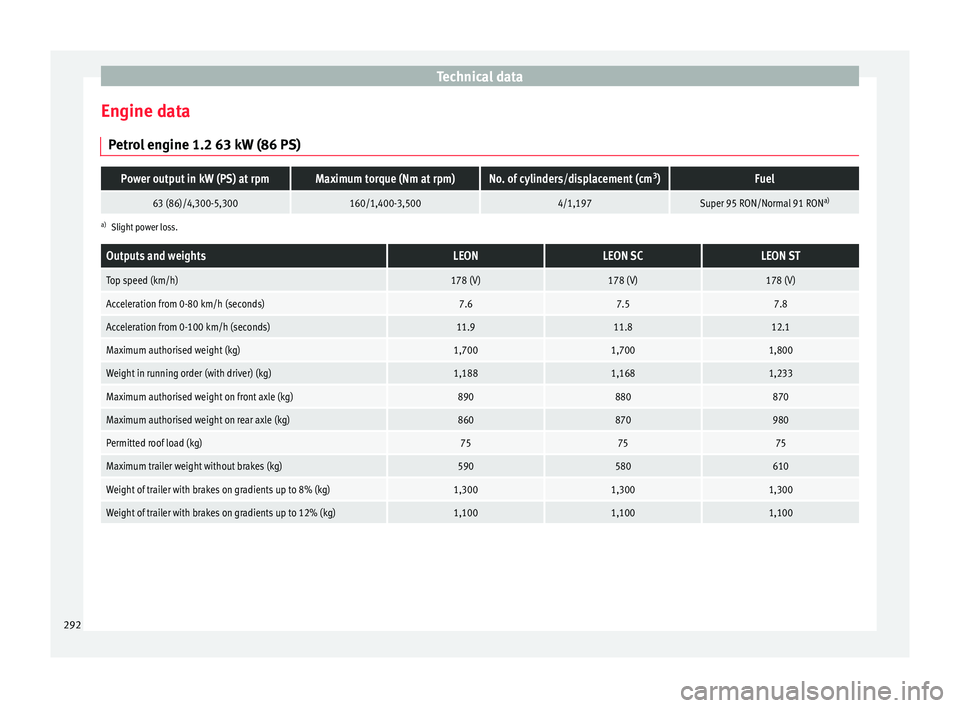
Engine data P etr
o
l engine 1.2 63 kW (86 PS)
Power output in kW (PS) at rpmMaximum torque (Nm at rpm)No. of cylinders/displacement (cm 3
)Fuel
63 (86)/4,300-5,300160/1,400-3,5004/1,197Super 95 RON/Normal 91 RON a)
a)
Slight power loss.
Outputs and weightsLEONLEON SCLEON ST
Top speed (km/h)178 (V)178 (V)178 (V)
Acceleration from 0-80 km/h (seconds)7.67.57.8
Acceleration from 0-100 km/h (seconds)11.911.812.1
Maximum authorised weight (kg)1,7001,7001,800
Weight in running order (with driver) (kg)1,1881,1681,233
Maximum authorised weight on front axle (kg)890880870
Maximum authorised weight on rear axle (kg)860870980
Permitted roof load (kg)757575
Maximum trailer weight without brakes (kg)590580610
Weight of trailer with brakes on gradients up to 8% (kg)1,3001,3001,300
Weight of trailer with brakes on gradients up to 12% (kg)1,1001,1001,100 292
Page 295 of 332

Technical specifications
Petrol engine 1.2 TSI 81 kW (110 PS)Power output in kW (PS) at rpmMaximum torque (Nm at rpm)No. of cylinders/displacement (cm 3
)Fuel
81 (110)/4,600-5,600175/1,400-4,0004/1,197Super 95 RON/Normal 91 RON a)
a)
Slight power loss.
Outputs and weightsLEON
ManualLEON
Start-StopLEON
AutomaticLEON SC ManualLEON SC
Start-StopLEON ST ManualLEON ST
Start-StopLEON ST
Automatic
Top speed (km/h)194 (V)194 (V)194 (V)194 (V)194 (V)194 (V)194 (V)194 (V)
Acceleration from 0-80 km/h (seconds)6.66.66.66.76.56.76.76.7
Acceleration from 0-100 km/h (seconds)9.99.99.910.19.810.110.110.1
Maximum authorised weight (kg)1,7401,7401,7601,7201,7301,7901,8001,820
Weight in running order (with driver) (kg)1,2131,2131,2411,1861,1931,2401,2471,275
Maximum authorised weight on front axle
(kg)900900930890890880890910
Maximum authorised weight on rear axle (kg)890890880880890960960960
Permitted roof load (kg)7575757575757575
Maximum trailer weight without brakes (kg)600600620590590620620630
Weight of trailer with brakes on gradients up
to 8% (kg)1,5001,5001,5001,5001,5001,5001,5001,500
Weight of trailer with brakes on gradients up
to 12% (kg)1,3001,3001,3001,3001,3001,3001,3001,300 293
Technical data
Advice
Operation
Emergencies
Safety
Page 296 of 332
Technical data
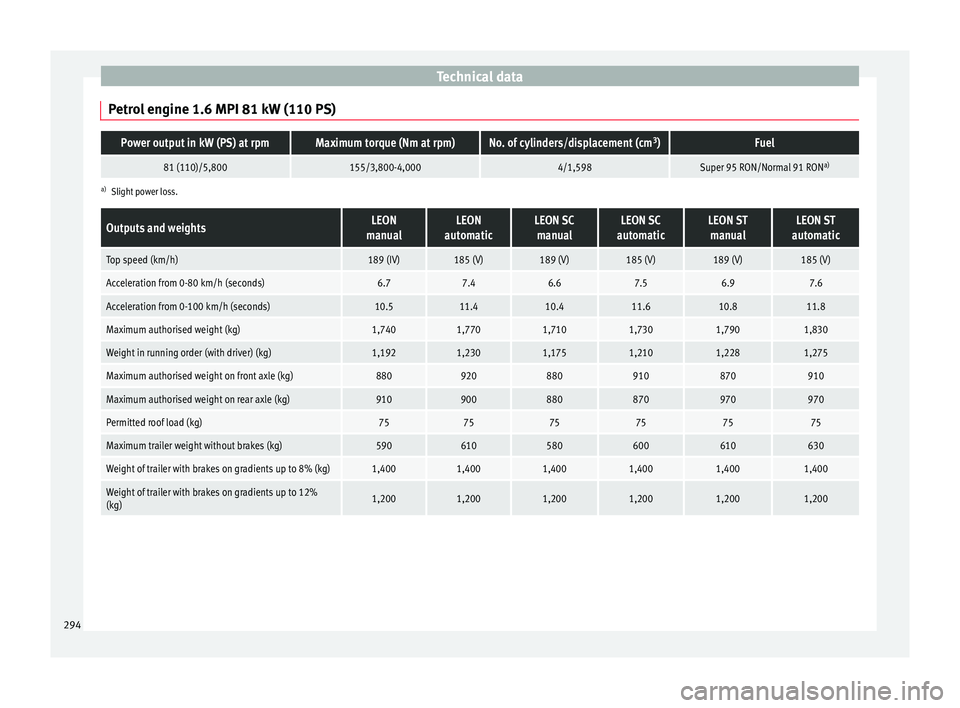
Petrol engine 1.6 MPI 81 kW (110 PS)Power output in kW (PS) at rpmMaximum torque (Nm at rpm)No. of cylinders/displacement (cm 3
)Fuel
81 (110)/5,800155/3,800-4,0004/1,598Super 95 RON/Normal 91 RON a)
a)
Slight power loss.
Outputs and weightsLEON
manualLEON
automaticLEON SC manualLEON SC
automaticLEON ST manualLEON ST
automatic
Top speed (km/h)189 (IV)185 (V)189 (V)185 (V)189 (V)185 (V)
Acceleration from 0-80 km/h (seconds)6.77.46.67.56.97.6
Acceleration from 0-100 km/h (seconds)10.511.410.411.610.811.8
Maximum authorised weight (kg)1,7401,7701,7101,7301,7901,830
Weight in running order (with driver) (kg)1,1921,2301,1751,2101,2281,275
Maximum authorised weight on front axle (kg)880920880910870910
Maximum authorised weight on rear axle (kg)910900880870970970
Permitted roof load (kg)757575757575
Maximum trailer weight without brakes (kg)590610580600610630
Weight of trailer with brakes on gradients up to 8% (kg)1,4001,4001,4001,4001,4001,400
Weight of trailer with brakes on gradients up to 12%
(kg)1,2001,2001,2001,2001,2001,200 294
Page 297 of 332
Technical specifications
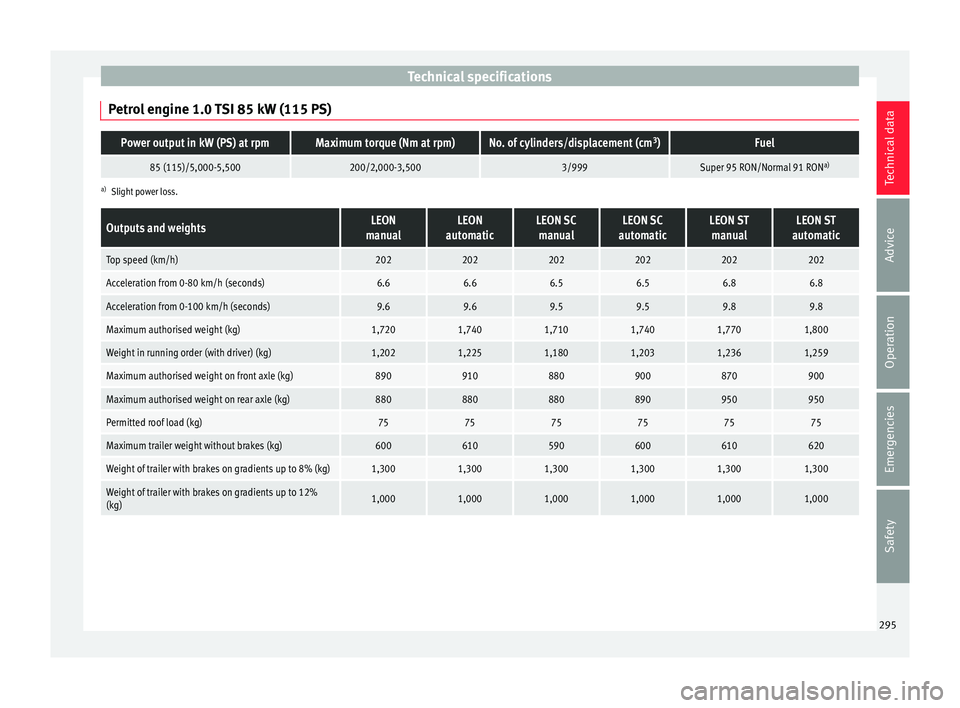
Petrol engine 1.0 TSI 85 kW (115 PS)Power output in kW (PS) at rpmMaximum torque (Nm at rpm)No. of cylinders/displacement (cm 3
)Fuel
85 (115)/5,000-5,500200/2,000-3,5003/999Super 95 RON/Normal 91 RON a)
a)
Slight power loss.
Outputs and weightsLEON
manualLEON
automaticLEON SC manualLEON SC
automaticLEON ST manualLEON ST
automatic
Top speed (km/h)202202202202202202
Acceleration from 0-80 km/h (seconds)6.66.66.56.56.86.8
Acceleration from 0-100 km/h (seconds)9.69.69.59.59.89.8
Maximum authorised weight (kg)1,7201,7401,7101,7401,7701,800
Weight in running order (with driver) (kg)1,2021,2251,1801,2031,2361,259
Maximum authorised weight on front axle (kg)890910880900870900
Maximum authorised weight on rear axle (kg)880880880890950950
Permitted roof load (kg)757575757575
Maximum trailer weight without brakes (kg)600610590600610620
Weight of trailer with brakes on gradients up to 8% (kg)1,3001,3001,3001,3001,3001,300
Weight of trailer with brakes on gradients up to 12%
(kg)1,0001,0001,0001,0001,0001,000 295
Technical data
Advice
Operation
Emergencies
Safety
Page 298 of 332

Technical data
Petrol engine 1.4 92 kW (125 PS) Start-StopPower output in kW (PS) at rpmMaximum torque (Nm at rpm)No. of cylinders/displacement (cm 3
)Fuel
92 (125)/5,000-6,000200/1,400-4,0004/1,395Super 95 RON/Normal 91 RON a)
a)
Slight power loss.
Outputs and weightsLEONLEON SCLEON STLEON ST
X-PERIENCE
Top speed (km/h)203 (V&VI)203 (V&VI)203 (V&VI)200 (V&VI)
Acceleration from 0-80 km/h (seconds)6.26.16.46.6
Acceleration from 0-100 km/h (seconds)9.18.99.49.7
Maximum authorised weight (kg)1,7701,7501,8301,820
Weight in running order (with driver) (kg)1,2331,2131,2571,263
Maximum authorised weight on front axle (kg)920910900890
Maximum authorised weight on rear axle (kg)900890980980
Permitted roof load (kg)75757575
Maximum trailer weight without brakes (kg)610600620630
Weight of trailer with brakes on gradients up to 8% (kg)1,7001,7001,7001,700
Weight of trailer with brakes on gradients up to 12%
(kg)1,4001,4001,4001,400 296
Page 299 of 332
Technical specifications
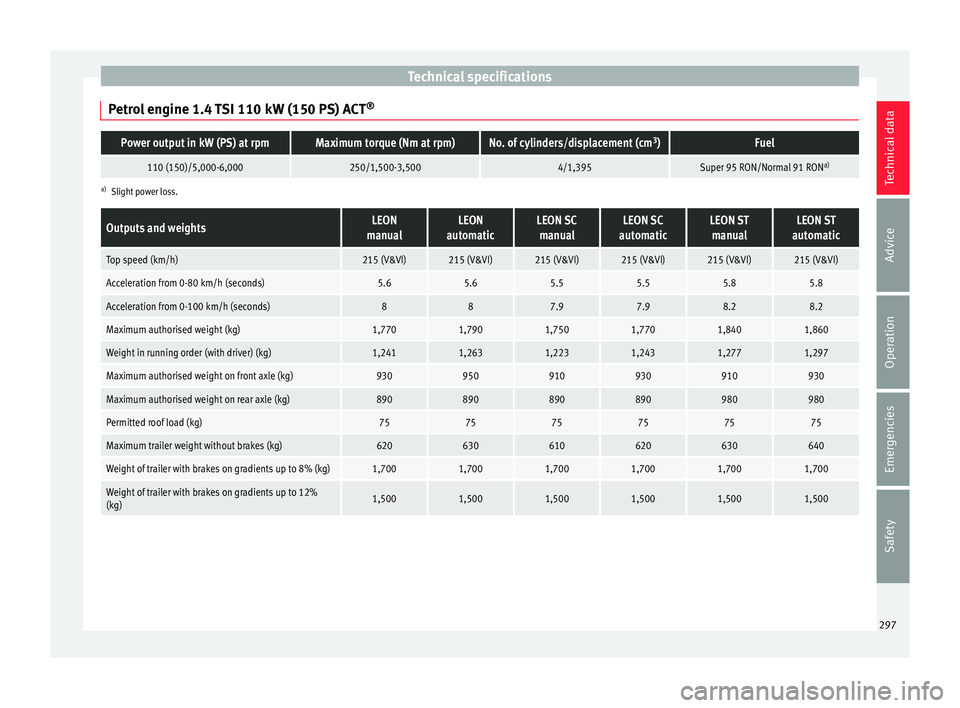
Petrol engine 1.4 TSI 110 kW (150 PS) ACT ®Power output in kW (PS) at rpmMaximum torque (Nm at rpm)No. of cylinders/displacement (cm
3
)Fuel
110 (150)/5,000-6,000250/1,500-3,5004/1,395Super 95 RON/Normal 91 RON a)
a)
Slight power loss.
Outputs and weightsLEON
manualLEON
automaticLEON SC manualLEON SC
automaticLEON ST manualLEON ST
automatic
Top speed (km/h)215 (V&VI)215 (V&VI)215 (V&VI)215 (V&VI)215 (V&VI)215 (V&VI)
Acceleration from 0-80 km/h (seconds)5.65.65.55.55.85.8
Acceleration from 0-100 km/h (seconds)887.97.98.28.2
Maximum authorised weight (kg)1,7701,7901,7501,7701,8401,860
Weight in running order (with driver) (kg)1,2411,2631,2231,2431,2771,297
Maximum authorised weight on front axle (kg)930950910930910930
Maximum authorised weight on rear axle (kg)890890890890980980
Permitted roof load (kg)757575757575
Maximum trailer weight without brakes (kg)620630610620630640
Weight of trailer with brakes on gradients up to 8% (kg)1,7001,7001,7001,7001,7001,700
Weight of trailer with brakes on gradients up to 12%
(kg)1,5001,5001,5001,5001,5001,500 297
Technical data
Advice
Operation
Emergencies
Safety