warning Seat Mii 2012 Owner's manual
[x] Cancel search | Manufacturer: SEAT, Model Year: 2012, Model line: Mii, Model: Seat Mii 2012Pages: 308, PDF Size: 4.13 MB
Page 232 of 308

230Vehicle care and maintenance
Removing and fitting the navigator holder
● Press the holder release button ⇒ Fig. 126 (arrow).
● Remove the holder from the dash panel in an upwards direction.
● If necessary, close the opening with the corresponding cover.
In order to fit the holder, place it on the opening from above and press in a
downwards direction until it engages with a click. ⇒
.
WARNING
Any distraction may lead to an accident, with the risk of injury. Operating
the navigator could distract you from the traffic.
● Always stay alert and drive responsibly.
● Select volume settings that allow you to easily hear signals from out-
side the vehicle at all times (e.g. emergency service sirens).
● Setting the volume too high may cause damage to your hearing. This
also applies if the device is set to high volumes for a short period.
WARNING
Journey instructions and traffic signals shown on the navigation system
may differ to the current traffic situation.
● Traffic signals and driving regulations take precedence over journey
instructions and indications from the navigation system.
● Adjust your speed and driving style to visibility, road, traffic and
weather conditions.
WARNING
If the navigator is not securely fastened in position, it could be sent fly-
ing around the vehicle in the event of sharp braking, sudden manoeuvres
or accident, causing injury.
● Fit the navigator housing safely on the corresponding opening on the
dash panel.
● Always place the navigator securely in its holder or store it safely in
the vehicle.
CAUTION
An unsuitable gradient and angle of vision setting can damage the naviga-
tor.
● When adjusting the navigation device, move it with care and not beyond
its limits.
CAUTION
Excessively high or low outside temperatures can affect the Portable Navi-
gation System operation or damage the device.
● Always take the Portable Navigation System with you when you leave the
vehicle to protect it from excessively high or low temperatures and intense
sunlight.
CAUTION
Humidity can damage the Portable Navigation System connections on the
dash panel.
● Do not clean the holder for the navigation device with moist products.
Use a dry cloth.
Note
SEAT recommends taking the Portable Navigation System with you when
you leave the vehicle to prevent it from being stolen.
Page 233 of 308
231
Vehicle care and maintenance
Jacking points for raising vehicle
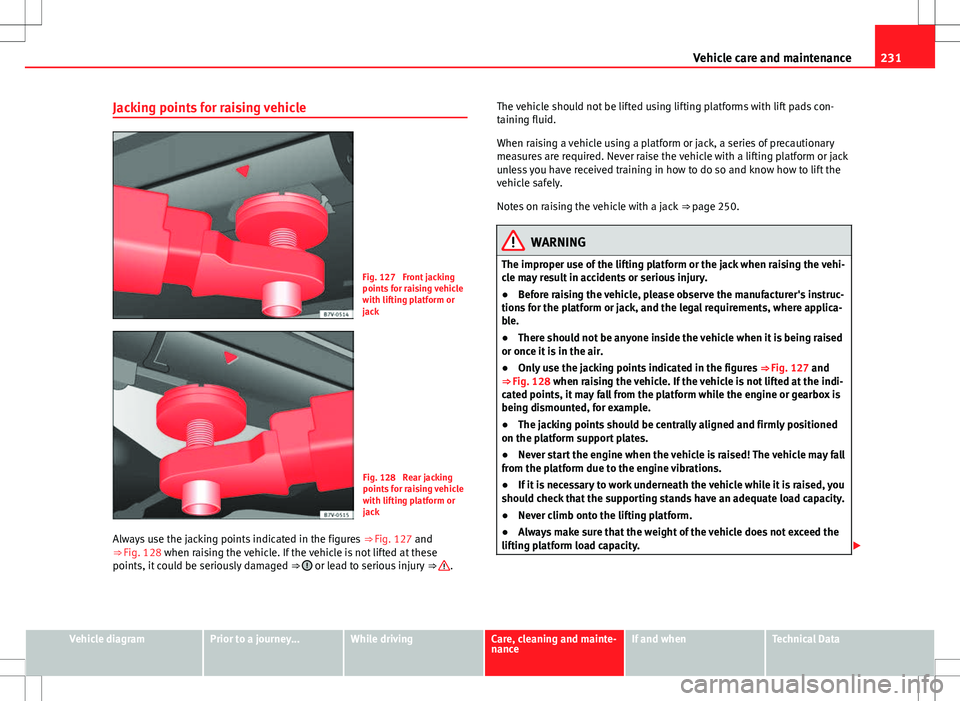
Fig. 127 Front jacking
points for raising vehicle
with lifting platform or
jack
Fig. 128 Rear jacking
points for raising vehicle
with lifting platform or
jack
Always use the jacking points indicated in the figures ⇒ Fig. 127 and
⇒ Fig. 128 when raising the vehicle. If the vehicle is not lifted at these
points, it could be seriously damaged ⇒
or lead to serious injury ⇒ .The vehicle should not be lifted using lifting platforms with lift pads con-
taining fluid.
When raising a vehicle using a platform or jack, a series of precautionary
measures are required. Never raise the vehicle with a lifting platform or jack
unless you have received training in how to do so and know how to lift the
vehicle safely.
Notes on raising the vehicle with a jack
⇒ page 250.
WARNING
The improper use of the lifting platform or the jack when raising the vehi-
cle may result in accidents or serious injury.
● Before raising the vehicle, please observe the manufacturer's instruc-
tions for the platform or jack, and the legal requirements, where applica-
ble.
● There should not be anyone inside the vehicle when it is being raised
or once it is in the air.
● Only use the jacking points indicated in the figures ⇒ Fig. 127 and
⇒ Fig. 128 when raising the vehicle. If the vehicle is not lifted at the indi-
cated points, it may fall from the platform while the engine or gearbox is
being dismounted, for example.
● The jacking points should be centrally aligned and firmly positioned
on the platform support plates.
● Never start the engine when the vehicle is raised! The vehicle may fall
from the platform due to the engine vibrations.
● If it is necessary to work underneath the vehicle while it is raised, you
should check that the supporting stands have an adequate load capacity.
● Never climb onto the lifting platform.
● Always make sure that the weight of the vehicle does not exceed the
lifting platform load capacity.
Vehicle diagramPrior to a journey...While drivingCare, cleaning and mainte-
nanceIf and whenTechnical Data
Page 235 of 308

233
Vehicle care and maintenance
Notes for the user Introduction
Additional information and warnings:
● Exterior detail ⇒ page 6
● Accessories, parts replacement, repairs and modifications ⇒ page 222
● ⇒ Booklet Maintenance Programme
WARNING
Failure to treat the vehicle with the correct care increases the risk of acci-
dent and injury.
● Observe legal requirements.
● Observe the Instruction Manual.
CAUTION
If you do not treat the vehicle suitably, you may cause it to be damaged.
● Observe legal requirements.
● Carry out regular maintenance of the vehicle, according to specifications
in the Maintenance Programme.
● Observe the Instruction Manual. Labels and plates
Fig. 129 Warnings relat-
ing to handling of the
City Safety Assist system
laser sensor function
Some parts in the engine compartment come from the factory with certifi-
cates of safety, labels or plates containing important information regarding
the operation of the vehicle, for example, on the petrol cap, on the passeng-
er's sun visor, on the driver door strut, or on the floor of the luggage com-
partment.
● Never remove these certificates of safety, labels or plates, and ensure
they are kept in good condition and are legible.
● If a vehicle part, bearing a certificate of safety, label or plate, is re-
placed, the Specialised workshop should attach the information back in the
same place.
Certificate of safety
A certificate of safety on the door strut states that all the safety standards
and regulations established by the national traffic authorities responsible
for road safety were met at the time of manufacture. It may also give the
month and year of manufacture, together with the chassis number.
Vehicle diagramPrior to a journey...While drivingCare, cleaning and mainte-
nanceIf and whenTechnical Data
Page 236 of 308

234Vehicle care and maintenance
Warning of high voltage label
There is a label close to the bonnet lock which warns of high voltage in the
vehicle electrical installation.
Warning relating to the City Safety Assist system laser sensor
There are some warning and information signs on the City Safety Assist sys-
tem laser sensor ⇒ Fig. 129.
Using your vehicle in other countries and continents
The vehicle is manufactured at the factory for use in a particular country in
accordance with the national legislation in force at the time of manufacture.
If the vehicle is sold in another country or used in another country for an ex-
tended period of time, the applicable legislation of that country should be
observed.
It may be necessary to fit or remove certain pieces of equipment or to deac-
tivate certain functions. Service work may also be affected. This is particu-
larly true if the vehicle is used in a different climate for an extended period
of time.
As there are different types of frequency bands around the world, you may
find that the radio system or the Portable Navigation System (supplied by
SEAT) supplied at the factory does not work in another country.
CAUTION
● SEAT does not accept liability for any damage to the vehicle due to the
use of a lower quality fuel, an inadequate service or the non-availability of
genuine spare parts.
● SEAT does not accept liability if the vehicle does not comply in part or in
full with the legal requirements of other countries or continents. Radio reception and the aerial
For factory-fitted radio equipment, the aerial for radio reception is fitted to
the roof of the vehicle.
Note
If electrical equipment such as mobile telephones, is used near a roof aer-
ial, you may observe interference in the reception of AM stations.
Notes on SEAT repairs
Information about authorised SEAT services and authorised SEAT repairs
can be requested by payment at the following addresses:
Clients in Europe, Asia, Australia, Africa, Central America and South
America
Contact a Technical Service or specialised workshop, or request the corre-
sponding documentation at www.erwin.volkswagen.de.
WARNING
Repairs or modifications which are not performed correctly may result in
damage or errors in the vehicle operation, affecting the efficiency of the
driver assist and airbag systems. This could result in serious accident.
● Have any repairs or modifications carried out at a Specialised work-
shop.
Conformity certification
The respective manufacturer hereby declares that the products indicated as
follows fulfil the basic requirements and the following dispositions and
Page 238 of 308

236Vehicle care and maintenance
Engine management and exhaust gas
purification system
Introduction
Additional information and warnings:
● Changing gear ⇒ page 124
● Refuelling ⇒ page 171
● Fuel ⇒ page 177
● Engine oil ⇒ page 185
● Vehicle battery ⇒ page 193
● Information stored in the control units ⇒ page 222
● Tow-starting and towing away ⇒ page 276
WARNING
The components of the exhaust system reach very high temperatures.
This could cause a fire.
● Always park your vehicle so that no part of the exhaust system can
come in contact with flammable materials (such as dried grass).
● Never apply additional underseal or anti-corrosion coatings to the ex-
haust pipes, catalytic converter or the heat shields on the exhaust sys-
tem.
Control lamps
lights
upPossible causeSolution
Fault in engine management
(Electronic Power Control).Take the vehicle to a Specialised
workshop as soon as possible
and have the engine checked.
Fault in catalytic converter.
You should reduce speed accord-
ingly. Drive carefully until you
reach the next Specialised work-
shop. Have the engine checked
there.
flashesPossible causeSolution
Combustion fault which could
damage the catalytic convert-
er.You should reduce speed accord-
ingly. Drive carefully until you
reach the next Specialised work-
shop. Have the engine checked
there.
Several warning and control lamps light up for a few seconds when the igni-
tion is switched on while a test of the function is being carried out. They will
switch off after a few seconds.
CAUTION
Always pay attention to any lit lamps and to the corresponding descriptions
and instructions to avoid damage to the vehicle.
Note
While the control lamps or maintain lit up, the engine will present
faults, a higher consumption of fuel and a loss of engine power.
Page 242 of 308

240Practical information
In case of emergency
Introduction
Additional information and warnings:
● Braking, stopping and parking ⇒ page 134
● Emergency locking and unlocking ⇒ page 243
● Vehicle tools ⇒ page 246
● Change wheel ⇒ page 250
WARNING
A faulty vehicle in traffic represents a risk of accident for the driver and
for other road users.
● Stop the vehicle safely as soon as possible. Park the vehicle a safe
distance from surrounding traffic to lock all the doors in case of an emer-
gency. Turn on the hazard warning lights to warn other road users.
● Never leave children or disabled people alone in the vehicle if the
doors are to be locked. In case of an emergency, passengers will be trap-
ped inside the vehicle. Individuals locked in the vehicle can be exposed
to very high or very low temperatures.
Protecting yourself and securing the vehicle
Fig. 130 Dash panel:
Button to switch on and
off the hazard warning
lights system
Always fulfil legal requirements for securing a broken down vehicle. In a
number of countries it is now obligatory, for example, to turn on the hazard
warning lights and use a reflective safety vest ⇒ page 242.
Checklist
For your own safety and that of other passengers, the following points
should be observed in the order given ⇒
:
1. Park the vehicle a safe distance from traffic and on suitable ground ⇒
.
2. Turn on the hazard warning lights system with the button
⇒ Fig. 130.
3. Apply the handbrake firmly ⇒ page 134.
4. Put the gearbox lever in neutral or the selector lever in position P ⇒ page 124.
5. Switch off the engine and remove the key from the ignition.
6. Have all occupants leave the vehicle and move to safety, for example behind a guard rail.
Page 243 of 308

241
Practical information
Checklist (Continued) 7. When leaving the vehicle, take all keys with you.
8. Place an emergency warning triangle to indicate the position of your vehicle to other road users.
9. Allow the engine to cool and check if a specialist is required.
When being towed with the hazard warning lights system on, a change in
direction or traffic lane can be indicated as usual using the turn signals lev-
er. The hazard lights will be interrupted temporarily.
Examples of when to use the hazard warning lights system:
● If the vehicles ahead suddenly slow down or reach the end of a traffic
jam, to warn the vehicles behind.
● In case of an emergency.
● If the vehicle breaks down.
● When tow-starting or towing.
Always comply with the applicable laws regarding the use of hazard warn-
ing lights.
If the hazard warning lights system is not working, you must use an alterna-
tive method of drawing attention to your vehicle. This method must comply
with traffic legislation.
WARNING
Failure to follow the checklist prepared for your own safety could lead to
accidents and severe injuries.
● Always complete the operations given in the checklist and observe
the general rules of safety.
WARNING
The components of the exhaust system reach very high temperatures.
This could cause a fire and considerable damage.
● Always park your vehicle so that no part of the exhaust system can
come in contact with flammable materials (such as dried grass or fuel).
Note
The vehicle battery will discharge and run down if the hazard warning lights
remain on for too much time (even with the ignition turned off).
Note
For some vehicles, the brake lights will blink when braking suddenly at
speeds of approximately 80 km/h (50 mph) to warn vehicles behind. If brak-
ing continues, then the hazard warning lights system will automatically be
turned on at the speed of less than approximately 10 km/h (6 mph). The
brake lights remain lit. Upon accelerating, the hazard warning lights system
will be automatically turned off.
Vehicle diagramPrior to a journey...While drivingCare, cleaning and mainte-
nanceIf and whenTechnical Data
Page 244 of 308
242Practical information
First aid kit, warning triangle and fire extinguishers*
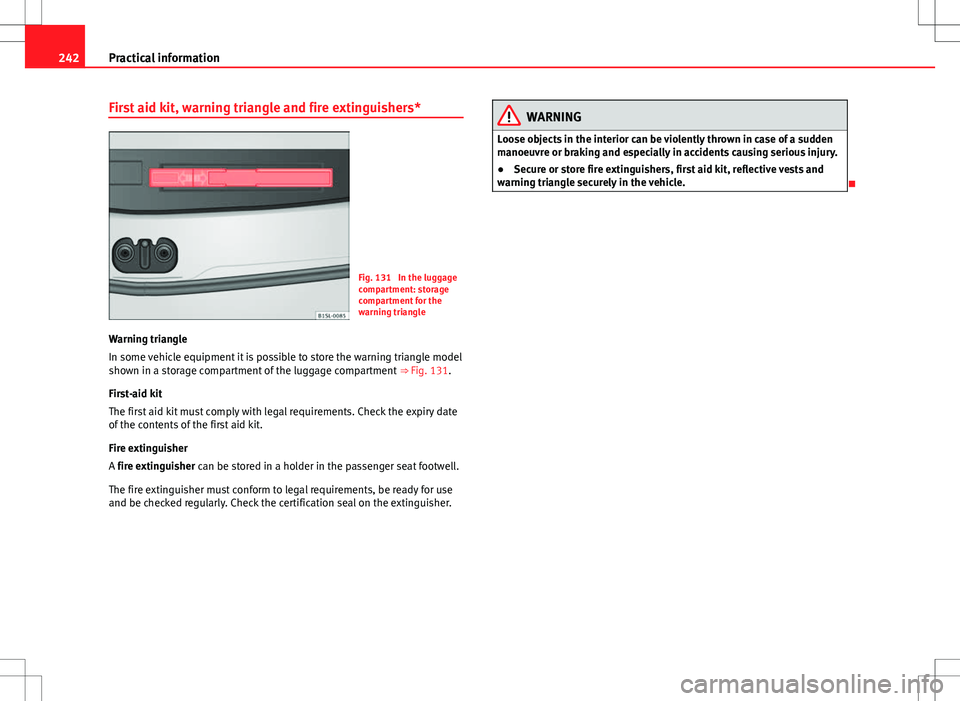
Fig. 131 In the luggage
compartment: storage
compartment for the
warning triangle
Warning triangle
In some vehicle equipment it is possible to store the warning triangle model
shown in a storage compartment of the luggage compartment ⇒ Fig. 131.
First-aid kit
The first aid kit must comply with legal requirements. Check the expiry date
of the contents of the first aid kit.
Fire extinguisher
A fire extinguisher can be stored in a holder in the passenger seat footwell.
The fire extinguisher must conform to legal requirements, be ready for use
and be checked regularly. Check the certification seal on the extinguisher.
WARNING
Loose objects in the interior can be violently thrown in case of a sudden
manoeuvre or braking and especially in accidents causing serious injury.
● Secure or store fire extinguishers, first aid kit, reflective vests and
warning triangle securely in the vehicle.
Page 245 of 308
243
Practical information
Emergency locking and unlocking Introduction
The doors and rear lid can be locked manually and partially opened, for ex-
ample if the key or the central locking is damaged.
Additional information and warnings:
● Vehicle key set ⇒ page 28
● Central locking and locking system ⇒ page 33
● Doors ⇒ page 38
● Rear lid ⇒ page 40
● In case of emergency ⇒ page 240
WARNING
Opening and closing doors carelessly can cause serious injury.
● If the vehicle is locked from outside, the doors and windows cannot
be opened from the inside.
● Never leave children or disabled people alone in the vehicle. They
could be trapped in the vehicle in an emergency and will not be able to
get themselves to safety.
● Depending on the time of the year, temperatures inside a locked and
closed vehicle can be extremely high or extremely low resulting in seri-
ous injuries and illness or even death, particularly for young children.
WARNING
Getting in the way of the doors and the rear lid is dangerous and can lead
to serious injury.
● Open and close the doors and the rear lid only when there is nobody
in the way.
CAUTION
When opening and closing in an emergency, carefully disassemble compo-
nents and then reassemble them carefully to avoid damage to the vehicle.
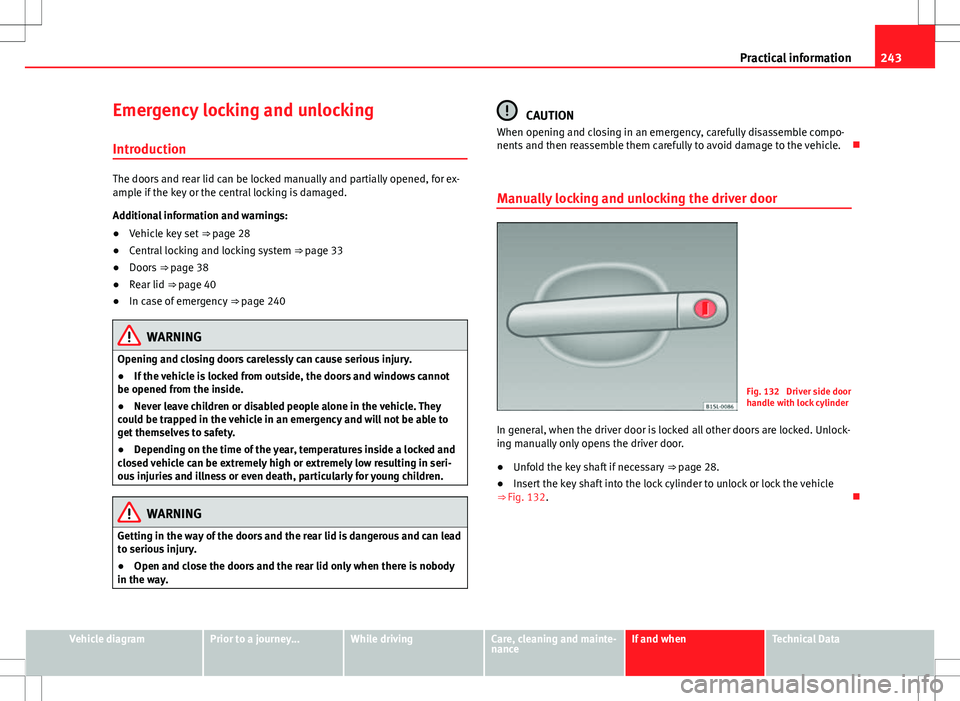
Manually locking and unlocking the driver door
Fig. 132 Driver side door
handle with lock cylinder
In general, when the driver door is locked all other doors are locked. Unlock-
ing manually only opens the driver door.
● Unfold the key shaft if necessary
⇒ page 28.
● Insert the key shaft into the lock cylinder to unlock or lock the vehicle
⇒ Fig. 132.
Vehicle diagramPrior to a journey...While drivingCare, cleaning and mainte-
nanceIf and whenTechnical Data
Page 248 of 308
246Practical information
Vehicle tool kit*
Introduction
When securing the vehicle in case of a breakdown, please note the legal re-
quirements for each country.
Vehicle tool kit
For vehicles with a factory-fitted spare wheel or temporary spare wheel, in
addition to winter wheels, the luggage compartment may contain additional
vehicle tools ⇒ page 246.
Additional information and warnings:
● Working in the engine compartment ⇒ page 180
● In case of emergency ⇒ page 240
● Change wheel ⇒ page 250
● Tire Mobility Set ⇒ page 256
WARNING
When the vehicle tool kit, tire mobility set and spare wheel are loose in
the interior they can be violently thrown in case of a sudden manoeuvre
or braking and especially in accidents causing serious injury.
● Ensure that the vehicle tool kit, the tire mobility set and the spare
wheel or temporary spare wheel are safely secured in the luggage com-
partment.
WARNING
Unsuitable or damaged vehicle tool kit can cause injury or accidents.
● Never work with inappropriate or damaged tools.
Location
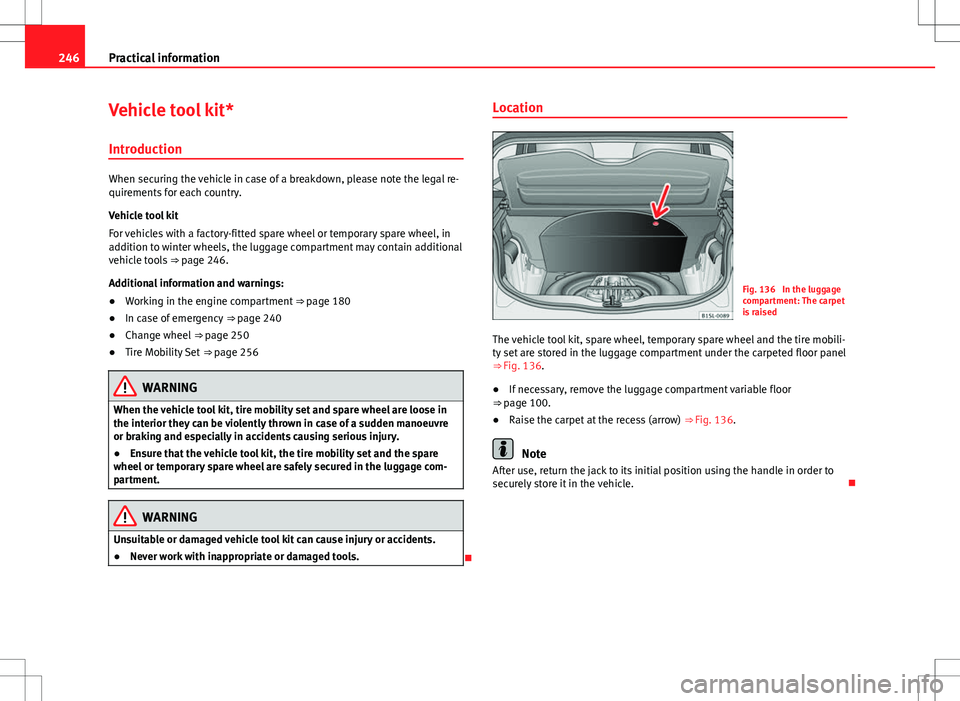
Fig. 136 In the luggage
compartment: The carpet
is raised
The vehicle tool kit, spare wheel, temporary spare wheel and the tire mobili-
ty set are stored in the luggage compartment under the carpeted floor panel
⇒ Fig. 136.
● If necessary, remove the luggage compartment variable floor
⇒ page 100.
● Raise the carpet at the recess (arrow) ⇒ Fig. 136.
Note
After use, return the jack to its initial position using the handle in order to
securely store it in the vehicle.