heating Seat Mii 2012 User Guide
[x] Cancel search | Manufacturer: SEAT, Model Year: 2012, Model line: Mii, Model: Seat Mii 2012Pages: 308, PDF Size: 4.13 MB
Page 142 of 308

140Starting, changing gears, parking
The ABS, BAS, ASR and EDL systems are incorporated into the ESC*. The
ESC* is always on 1)
.
Anti-lock brake system (ABS)
ABS can prevent the wheels from locking during braking until just before
the vehicle stops thus helping the driver to steer the vehicle and maintain
control. This means that, even during full braking, the risk of skidding is re-
duced:
● Press and hold the brake pedal fully. Do not remove your foot from the
brake pedal or reduce braking force!
● Do not “pump” the brake pedal, or reduce braking force!
● Maintain vehicle direction when braking fully with the brake pedal.
● When the brake pedal is released or when the brake force is reduced,
ABS is turned off.
ABS control can be observed by vibration of the brake pedal and noise. You
should never expect the ABS to reduce the braking distance under any cir-
cumstances. Braking distances will increase when driving on gravel, recent
snow or on icy and slippery ground.
Brake assist system (BAS)
The brake assist system may reduce the required braking distance. The
brake assist system boosts the braking force if you press the brake pedal
quickly in an emergency. As a result, the braking pressure increases rapidly,
the braking force is multiplied and the braking distance is reduced. This en-
ables the ABS to be activated more quickly and efficiently.
¡Do not lift your foot off the brake pedal! When the brake pedal is released
or when the brake force is reduced, braking assist automatically turns off
the brake servo. Traction control system (ASR) or Traction Control (TC)
In the event of wheelspin, the traction control system ASR or TC reduces the
engine torque to match the amount of grip available. The ASR or TC makes
some situations easier, for example, when starting, accelerating or going
uphill, even in unfavourable road conditions.
Electronic differential lock system (EDL)
EDL is available when driving in straight lines under normal conditions.
When the EDL detects wheelspin, it brakes the spinning wheel and directs
the power to the other driven wheel. To prevent the disc brake of the braked
wheel from overheating, the EDL cuts out automatically if subjected to ex-
cessive loads. The EDL will switch on again automatically when the brake
has cooled down.
WARNING
Driving at high speed on icy, slippery wet ground can result in loss of ve-
hicle control and serious injury to the driver and passengers.
● Adjust your speed and driving style to visibility, road, traffic and
weather conditions. Even though the braking assist systems, ABS, BAS,
EDL, ASR, TC and ESC*, provide more security, do not take unnecessary
risks while driving.
● Braking assist systems can not overcome the laws of physics. Even
with ESC* and other systems, slippery and wet roads will always be dan-
gerous.
● Driving to quickly on wet ground can result in the wheels losing con-
tact with the ground in an effect known as “aquaplaning”. Without ad-
herence, it is impossible to brake, steer or control the vehicle.
● Braking assist systems cannot avoid accidents if, for example, the
driver does not respect safety distances or drives to quickly in difficult
conditions.
1)
According to version
Page 147 of 308

145
Starting, changing gears, parking
Moderate use of additional electrical appliances
It is important to travel in comfort, but convenience systems should be used
in an ecological manner.
Some equipment, when connected, increase fuel consumption considera-
bly, for example:
● Air conditioning cooling system: If the air conditioning system is re-
quired to cool to significantly lower temperatures than the true outside tem-
perature, it will require a large quantity of energy from the engine. There-
fore, we recommend that the selected temperature for the vehicle is not too
different to the outside temperature. It is a good idea to open all the win-
dows of the vehicle before starting your journey, and to drive a short dis-
tance with all the windows open to allow the vehicle to cool down slightly.
Only then should you close all the windows and switch on the air condition-
ing system. Keep windows closed when travelling at high speeds. Driving
with the windows open increases fuel consumption.
● Switch off the seat heating when the seats have warmed up.
● Switch off the heated rear window when it is not moist or covered in ice.
Other factors which increase fuel consumption (examples):
● Fault in engine management.
● Driving on hills. Saving fuel while driving
Fig. 92 Fuel consump-
tion in litres per 100 km
at 2 different outside
temperatures
By adopting an economical driving style and anticipating the traffic situa-
tion ahead, you can easily reduce fuel consumption by 10-15%.
A vehicle uses most fuel when accelerating. By anticipating the traffic situa-
tion ahead, you will brake and therefore accelerate less. Wherever possible,
let the vehicle roll slowly to a stop, for instance when you can see that the
next traffic lights are red.
Avoid short journeys
Fuel consumption is much higher when the engine is cold, immediately af-
ter it has been started. It takes a few kilometres of driving for the engine to
warm up and to normalise consumption.
The engine and catalytic converter need to reach their proper working tem-
perature in order to minimise fuel consumption and emissions. The ambient
temperature has a decisive influence.
Fig. 92 shows the difference in consumption for the same journey at +20 °C
(+68 °F) and at -10 °C (+14 °F).
Vehicle diagramPrior to a journey...While drivingCare, cleaning and mainte-
nanceIf and whenTechnical Data
Page 166 of 308

164Air control
Air control
Heating, Ventilation and Air conditioning
system Introduction
Dust and pollen filter
The dust and pollen filter with its activated charcoal cartridge serves as a
barrier against impurities in the interior ambient air.
For the air conditioner to work with maximum efficiency, the dust and pollen
filter must be replaced at the intervals specified in the Maintenance Pro-
gramme.
If the filter loses efficiency prematurely due to use in areas with very high
levels of air pollution, the filter must be changed more frequently than sta-
ted in the Service Schedule.
Additional information and warnings:
● SEAT information system ⇒ page 22
● Windscreen wash system ⇒ page 91
● Caring for and cleaning the vehicle exterior ⇒ page 197
WARNING
Reduced visibility through the windows increases the risk of serious acci-
dents.
● Ensure that all windows are free of ice and snow and that they are not
fogged up preventing a clear view of everything outside.
WARNING (Continued)
● The maximum heat output required to defrost windows as quickly as
possible is only available when the engine has reached its normal run-
ning temperature. Only drive when you have good visibility.
● Always ensure that you use the heating system, ventilation, air condi-
tioner and the heated rear window to maintain good visibility.
● Never leave the air recirculation on for a long period of time. If the
cooling system mode is switched off and air recirculation mode switched
on, the windows can mist over very quickly, considerably limiting visibili-
ty.
● Switch air recirculation mode off when it is not required.
WARNING
Stuffy or used air will increase fatigue and reduce driver concentration
possibly resulting in a serious accident.
● Never leave the air fan turned off or use the air recirculation for long
periods of time; the air inside the interior will not be refreshed.
CAUTION
● Switch the air conditioner off if you think it may be broken. This will
avoid additional damage. Have the air conditioner checked by a Specialised
workshop.
● Repairs to the climate air conditioner specialist knowledge and special
tools. SEAT recommends visiting a Technical Service.
Page 167 of 308

165
Air control
Note
When the cooling system is turned off, air coming from the outside will not
be dehumidified. To avoid fogging up the windows, SEAT recommends leav-
ing the cooler (compressor) on. To do this, press the AC
button. The button
indicator should light up.
Note
The maximum heat output required to defrost windows as quickly as possi-
ble is only available when the engine has reached its normal running tem-
perature.
Note
Keep the air vents in front of the windscreen free of snow, ice and leaves to
ensure heating and cooling are not impaired and to prevent the windows
from misting over.
Vehicle diagramPrior to a journey...While drivingCare, cleaning and mainte-
nanceIf and whenTechnical Data
Page 168 of 308

166Air control
Controls
Fig. 102 In the centre console: Heating and ventilation
system rotary control
Fig. 103 In the centre console: Air conditioning system
controls
Page 169 of 308
167
Air control
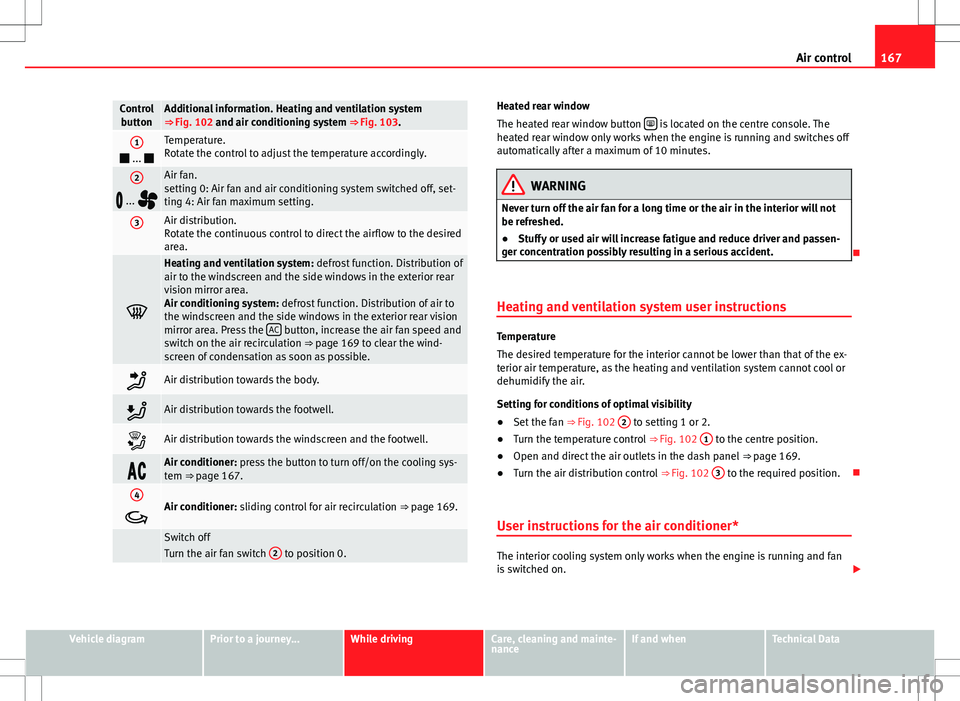
Control
buttonAdditional information. Heating and ventilation system
⇒ Fig. 102 and air conditioning system ⇒ Fig. 103.
1 ...
Temperature.
Rotate the control to adjust the temperature accordingly.
2
...
Air fan.
setting 0: Air fan and air conditioning system switched off, set-
ting 4: Air fan maximum setting.
3Air distribution.
Rotate the continuous control to direct the airflow to the desired
area.
Heating and ventilation system: defrost function. Distribution of
air to the windscreen and the side windows in the exterior rear
vision mirror area.
Air conditioning system: defrost function. Distribution of air to
the windscreen and the side windows in the exterior rear vision
mirror area. Press the AC
button, increase the air fan speed and
switch on the air recirculation ⇒ page 169 to clear the wind-
screen of condensation as soon as possible.
Air distribution towards the body.
Air distribution towards the footwell.
Air distribution towards the windscreen and the footwell.
Air conditioner: press the button to turn off/on the cooling sys-
tem ⇒ page 167.
4
Air conditioner: sliding control for air recirculation ⇒ page 169.
Switch off
Turn the air fan switch 2 to position 0.
Heated rear window
The heated rear window button is located on the centre console. The
heated rear window only works when the engine is running and switches off
automatically after a maximum of 10 minutes.
WARNING
Never turn off the air fan for a long time or the air in the interior will not
be refreshed.
● Stuffy or used air will increase fatigue and reduce driver and passen-
ger concentration possibly resulting in a serious accident.
Heating and ventilation system user instructions
Temperature
The desired temperature for the interior cannot be lower than that of the ex-
terior air temperature, as the heating and ventilation system cannot cool or
dehumidify the air.
Setting for conditions of optimal visibility
● Set the fan ⇒ Fig. 102 2
to setting 1 or 2.
● Turn the temperature control ⇒ Fig. 102 1 to the centre position.
● Open and direct the air outlets in the dash panel ⇒ page 169.
● Turn the air distribution control ⇒ Fig. 102 3
to the required position.
User instructions for the air conditioner*
The interior cooling system only works when the engine is running and fan
is switched on.
Vehicle diagramPrior to a journey...While drivingCare, cleaning and mainte-
nanceIf and whenTechnical Data
Page 171 of 308

169
Air control
Air vents
Fig. 104 Dash panel: Air vents
Air vents
Never close the air vents ⇒ Fig. 104 A
completely to ensure heating, cool-
ing and ventilation inside the vehicle.
● To open the air vents press the recess with one slat.
● Change the air direction by turning the slats.
● To close the air vents, fold the slats.
There are additional air vents in the centre of the dash panel and in the foot-
well area.
CAUTION
Never place food, medicines or other heat-sensitive objects close to the air
vents. Food, medicines and other heat-sensitive objects may be damaged
or made unsuitable for use by the air coming from the air vents. Air recirculation
Important
Air recirculation mode prevents the ambient air from entering the interior.
When the outside temperature is very high or very low, selecting manual air
recirculation mode for a short period refreshes or heats the interior more
quickly.
●
Switch off air recirculation mode by turning the air distribution control to
the ⇒
position.
Switching the air recirculation mode on and off
Switching on: Move the sliding control ⇒ Fig. 103 4
to the right to maxi-
mum.
Switching off: Move the sliding control ⇒ Fig. 103 4
as far left as possible.
Vehicle diagramPrior to a journey...While drivingCare, cleaning and mainte-
nanceIf and whenTechnical Data
Page 176 of 308

174At the filling station
Refuelling with petrol
Fig. 107 Open fuel tank
flap with tank plug at-
tached to the holder
Before refuelling, always turn off the engine, the ignition, mobile tele-
phones, auxiliary heating and keep them off during refuelling.
Opening the fuel tank flap
● The fuel tank plug is at the rear of the vehicle on the right.
● Pull the rear zone of the fuel tank flap to open.
● Unfold the key shaft if necessary
⇒ page 28.
● Insert the vehicle key into the lock cylinder of the fuel tank plug and turn
the key in an anticlockwise direction.
● Take out the fuel tank plug by turning it in an anticlockwise direction
and rest it on the upper part of the fuel tank flap ⇒ Fig. 107.
Refuelling
The correct petrol type for the vehicle is located on a sticker inside the fuel
tank flap ⇒ page 177. ●
If the automatic filler nozzle is operated correctly, it will switch itself off
as soon as the fuel tank is full ⇒
.
● Do not continue to refuel if it is turned off! Otherwise, this will fill the ex-
pansion chamber and fuel may leak out if the ambient conditions are warm.
Closing the fuel tank flap
● Screw on the fuel tank filler plug in a clockwise direction until it is fully
inserted with a click.
● Insert the vehicle key into the lock cylinder of the fuel tank plug, turn the
key in a clockwise direction and remove the key.
● Press the tank flap until it clicks into place. The fuel tank flap must be
flush with the body contour.
WARNING
Do not continue refuelling once the fuel nozzle has switched itself off.
The fuel tank may be filled too much. As a result, fuel may spurt out and
spill. This could lead to a fire, explosion and severe injuries.
CAUTION
● Always remove any fuel spilled anywhere on the vehicle to avoid dam-
age to the wheel housing, the tyre and vehicle paintwork.
For the sake of the environment
Fuels can contaminate the environment. Collect any spilt service fluids and
allow a professional to dispose of them.
Page 177 of 308

175
At the filling station
Refuelling with natural gas
Fig. 108 Tank flap open:
gas filler mouth 1, filler
mouth retainer 2
Before refuelling, the engine and the ignition, mobile telephone and heat-
ing must be switched off separately
⇒ .
It is also essential to carefully read the instructions for the natural gas
pump.
The vehicle is not prepared for refuelling with liquefied natural gas (LNG)
⇒
. Before refuelling with natural gas, make sure to add the appropriate
type of fuel.
Opening the fuel tank cap
The natural gas filler mouth is behind the fuel tank cap, next to the petrol
filler mouth.
● Unlock the vehicle with the key or with the central locking button situ-
ated on the driver door ⇒ page 36.
● Press on the rear area of the flap and open it. Refuelling
Problem: If the ambient temperature is very high, the natural gas pump pro-
tection against overheating disconnects this automatically.
●
Remove the plug from the gas filler mouth ⇒ Fig. 108 1
.
● Connect the pump filling nozzle to the gas filler mouth.
● The fuel tank will be full when the pump compressor automatically cuts
the supply.
● If you wish to finish refuelling in advance, press the button on the pump
to stop the flow.
Closing the fuel tank flap
● Check that the gas filler mouth retainer 2
is not trapped with the filler
nozzle. If necessary, place it in the filler mouth again.
● Insert the plug in the filler mouth.
● Close the tank flap. Make sure you hear it click into place.
WARNING
Natural gas is a highly explosive, easily flammable substance. Incorrect
handling of the natural gas can cause accidents serious burns and other
injuries.
● Before refuelling with natural gas, the filling mouth must be correctly
engaged. If you can smell gas, stop refuelling immediately.
WARNING
The vehicle is not prepared to use liquefied natural gas (LNG) and this
fuel must not be added under any circumstances. Liquefied natural gas
can cause the natural gas tank to explode resulting in serious injury.
Vehicle diagramPrior to a journey...While drivingCare, cleaning and mainte-
nanceIf and whenTechnical Data
Page 180 of 308

178At the filling station
Not all petrol additives have been shown to be effective. The use of unsuita-
ble petrol additives could seriously damage the engine and the catalytic
converter. Petrol additives with metal additives must never be used.
Available petrol additives for improvements in Anti-detonation ratings or oc-
tane ratings may contain metal additives ⇒
.
SEAT recommends “Genuine SEAT Additives for petrol engines”. These addi-
tives are available from Specialised workshops, who will inform you of their
application.
CAUTION
● Only use fuel with an octane rating that is in line with the norm EN 228,
otherwise significant damage could be caused to the engine and fuel sys-
tem. Furthermore, it could lead to a loss of performance with the conse-
quent engine fault.
● The use of unsuitable petrol additives could seriously damage the en-
gine and the catalytic converter.
● If, in exceptional circumstances, petrol with a lower octane rating to that
recommended is used, only use moderate engine speeds and a light throt-
tle. Avoid using full throttle and overloading the engine. Otherwise engine
damage may occur. Fill up with fuel of a suitable octane rating as soon as
possible.
● Do not refuel if the filler indicates that the fuel contains metal. LRP (lead
replacement petrol) fuels also contain high concentrations of metal addi-
tives. This could damage the engine!
● Just filling one full tank of leaded fuel or with other metal additives
would seriously impair the efficiency of the catalytic converter and could
damage it.
Natural gas
Natural gas, in addition to others, can be in liquid form. Liquefied natural gas (LNG) is the result of heavy cooling of natural gas.
Therefore its volume is considerably reduced compared with compressed
natural gas (CNG). In vehicles with a natural gas engine, liquefied natural
gas cannot be directly refilled, given that the gas would expand excessively
in the vehicle gas tank.
Therefore, vehicles with a natural gas engine must only be refuelled using
compressed natural gas
⇒
.
Natural gas quality and consumption
Natural gas is divided into the groups H and L depending on its quality.
Gas type H has a superior heating power and inferior nitrogen and carbon
dioxide content than type L. The higher the heating power of the natural
gas, the lower the consumption will be.
However, the heating power and the proportion of nitrogen and carbon di-
oxide can fluctuate within the quality groups. Therefore, vehicle consump-
tion can also vary when using one type of gas only.
The engine management automatically adapts to the natural gas used ac-
cording to its quality. Therefore, different quality gases can be mixed in the
tank, without the need for comprehensive draining before applying a differ-
ent quality gas.
Natural gas and safety
If you can smell gas or suspect that there is a leak ⇒
:
● Stop the vehicle immediately.
● Switch the ignition off.
● Open the doors to appropriately ventilate the vehicle.
● Immediately extinguish cigarettes.
● Move away from the vehicle or switch off objects that may cause sparks
or a fire.
● If you continue to smell gas, do not continue driving!
● You should obtain professional assistance. Have the fault repaired.