heating Seat Mii 2012 Owner's manual
[x] Cancel search | Manufacturer: SEAT, Model Year: 2012, Model line: Mii, Model: Seat Mii 2012Pages: 308, PDF Size: 4.13 MB
Page 5 of 308
Table of Contents
Manual structure . . . . . . . . . . . . . . . . . . . . 5
Vehicle diagram . . . . . . . . . . . . . . . . . . . . . . 6
Exterior views . . . . . . . . . . . . . . . . . . . . . . . . . . . . . 6
Side view . . . . . . . . . . . . . . . . . . . . . . . . . . . . . . . . 6
Front view . . . . . . . . . . . . . . . . . . . . . . . . . . . . . . . 7
Rear view . . . . . . . . . . . . . . . . . . . . . . . . . . . . . . . . 8
Vehicle interior . . . . . . . . . . . . . . . . . . . . . . . . . . . . 9
Driver door overview . . . . . . . . . . . . . . . . . . . . . . . 9
Overview of the driver side . . . . . . . . . . . . . . . . . . 10
Overview of centre console . . . . . . . . . . . . . . . . . 12
Detail of the passenger seat . . . . . . . . . . . . . . . . 14
Symbols on the roof . . . . . . . . . . . . . . . . . . . . . . . 14
Instrument panel . . . . . . . . . . . . . . . . . . . . . . . . . . 15
Control and warning lamps . . . . . . . . . . . . . . . . . 15
Instruments . . . . . . . . . . . . . . . . . . . . . . . . . . . . . . 17
SEAT information system . . . . . . . . . . . . . . . . . . . 22
Prior to a journey... . . . . . . . . . . . . . . . . . . 25
Before starting the engine . . . . . . . . . . . . . . . . . 25
Tips for driving . . . . . . . . . . . . . . . . . . . . . . . . . . . 25
Unlocking and locking . . . . . . . . . . . . . . . . . . . . . 28
Vehicle key set . . . . . . . . . . . . . . . . . . . . . . . . . . . 28
Central locking* and locking system . . . . . . . . . . 33
Doors . . . . . . . . . . . . . . . . . . . . . . . . . . . . . . . . . . . 38
Rear lid . . . . . . . . . . . . . . . . . . . . . . . . . . . . . . . . . . 40
Windows . . . . . . . . . . . . . . . . . . . . . . . . . . . . . . . . 43
Opening and closing the sliding/tilting electric
panoramic sunroof . . . . . . . . . . . . . . . . . . . . . . . . 44 Ensuring you are correctly and safely seated
48
Adjusting the seat position . . . . . . . . . . . . . . . . . 48
Seat functions . . . . . . . . . . . . . . . . . . . . . . . . . . . . 55
Seat belts . . . . . . . . . . . . . . . . . . . . . . . . . . . . . . . 57
Airbag system . . . . . . . . . . . . . . . . . . . . . . . . . . . . 67
Child seats (accessories) . . . . . . . . . . . . . . . . . . . 76
Lights and visibility . . . . . . . . . . . . . . . . . . . . . . . . 84
Lights . . . . . . . . . . . . . . . . . . . . . . . . . . . . . . . . . . . 84
Sun blind . . . . . . . . . . . . . . . . . . . . . . . . . . . . . . . . 89
Window wash/wipe system . . . . . . . . . . . . . . . . . 91
Rear vision mirror . . . . . . . . . . . . . . . . . . . . . . . . . 95
Transporting . . . . . . . . . . . . . . . . . . . . . . . . . . . . . . 97
Driving tips . . . . . . . . . . . . . . . . . . . . . . . . . . . . . . 97
Loading luggage compartment . . . . . . . . . . . . . . 100
Roof carrier system . . . . . . . . . . . . . . . . . . . . . . . . 104
Trailer coupling . . . . . . . . . . . . . . . . . . . . . . . . . . . 107
Practical equipment . . . . . . . . . . . . . . . . . . . . . . . 108
Storage compartments . . . . . . . . . . . . . . . . . . . . . 108
Drink holders . . . . . . . . . . . . . . . . . . . . . . . . . . . . . 113
Ashtray and Lighter . . . . . . . . . . . . . . . . . . . . . . . . 115
Electrical power socket* . . . . . . . . . . . . . . . . . . . . 117
While driving . . . . . . . . . . . . . . . . . . . . . . . . . 119
Starting, changing gears, parking . . . . . . . . . . 119
Stopping and starting the engine . . . . . . . . . . . . 119
Changing gear . . . . . . . . . . . . . . . . . . . . . . . . . . . . 124
Braking, stopping and parking . . . . . . . . . . . . . . 134
Ecological driving . . . . . . . . . . . . . . . . . . . . . . . . . 144
Steering . . . . . . . . . . . . . . . . . . . . . . . . . . . . . . . . . 147
Driver assistance systems . . . . . . . . . . . . . . . . . . 149
Parking distance warning system* . . . . . . . . . . . 149
Cruise control* (Cruise control system - CCS) . . . 152 Safety Assist* (City Safety Assist function) . . . . . 155
Hill hold . . . . . . . . . . . . . . . . . . . . . . . . . . . . . . . . . 160
Hill-start aid* . . . . . . . . . . . . . . . . . . . . . . . . . . . . . 162
Air control . . . . . . . . . . . . . . . . . . . . . . . . . . . . . . . . . 164
Heating, Ventilation and Air conditioning system . .164
At the filling station . . . . . . . . . . . . . . . . . . . . . . . . 171
Refuelling . . . . . . . . . . . . . . . . . . . . . . . . . . . . . . . 171
Fuel . . . . . . . . . . . . . . . . . . . . . . . . . . . . . . . . . . . . 177
Care, cleaning and maintenance . 180
In the engine compartment . . . . . . . . . . . . . . . . 180
Working in the engine compartment . . . . . . . . . . 180
Engine oil . . . . . . . . . . . . . . . . . . . . . . . . . . . . . . . . 185
Engine coolant . . . . . . . . . . . . . . . . . . . . . . . . . . . 189
Vehicle battery . . . . . . . . . . . . . . . . . . . . . . . . . . . 193
Vehicle care and maintenance . . . . . . . . . . . . . . 197
Care and cleaning the vehicle exterior . . . . . . . . 197
Caring for and cleaning the vehicle interior . . . . 205
Wheels and tyres . . . . . . . . . . . . . . . . . . . . . . . . . . 210
Accessories, replacements, repairs and
modifications . . . . . . . . . . . . . . . . . . . . . . . . . . . . 222
Notes for the user . . . . . . . . . . . . . . . . . . . . . . . . . 233
Engine management and exhaust gas
purification system . . . . . . . . . . . . . . . . . . . . . . . . 236
If and when . . . . . . . . . . . . . . . . . . . . . . . . . . . 238
Practical information . . . . . . . . . . . . . . . . . . . . . . 238
Frequently asked questions . . . . . . . . . . . . . . . . . 238
In case of emergency . . . . . . . . . . . . . . . . . . . . . . 240
Emergency locking and unlocking . . . . . . . . . . . . 243
Vehicle tool kit* . . . . . . . . . . . . . . . . . . . . . . . . . . . 246
3
Table of Contents
Page 14 of 308

12Vehicle interior
Overview of centre console
Top part of the centre console
Fig. 6 Detail of the top part of the centre console
Legend for the Fig. 6:
SEAT Portable System (supplied by SEAT) . . . . . . . . . . . . . . . . . . .222
Hazard warning lights switch . . . . . . . . . . . . . . . . . . . . . . . . . . . . 240
Passenger front airbag off warning lamp PASSENGER AIR-
BAG . . . . . . . . . . . . . . . . . . . . . . . . . . . . . . . . . . . . . . . . . . . . . . . . 67
Right seat heating controls or rear window heating but-
ton (alternative position) . . . . . . . . . . . . . . . . . . . . . . . . . . . . . . . 55, 164
1
23
4
Radio (factory-fitted) ⇒ Booklet Radio system, cover or stor-
age compartment
. . . . . . . . . . . . . . . . . . . . . . . . . . . . . . . . . . . . . . . . . 108
Left seat heating controls . . . . . . . . . . . . . . . . . . . . . . . . . . . . . . . . 55
Rear window heating button . . . . . . . . . . . . . . . . . . . . . . . . . . . . 164
Start-Stop system button . . . . . . . . . . . . . . . . . . . . . . . . . . . . . . 160
Switches for:
– Heating and ventilation system . . . . . . . . . . . . . . . . . . . . . . . . . . 164
– Air conditioner . . . . . . . . . . . . . . . . . . . . . . . . . . . . . . . . . . . . . . . . . 1645
6789
Page 46 of 308
44Unlocking and locking
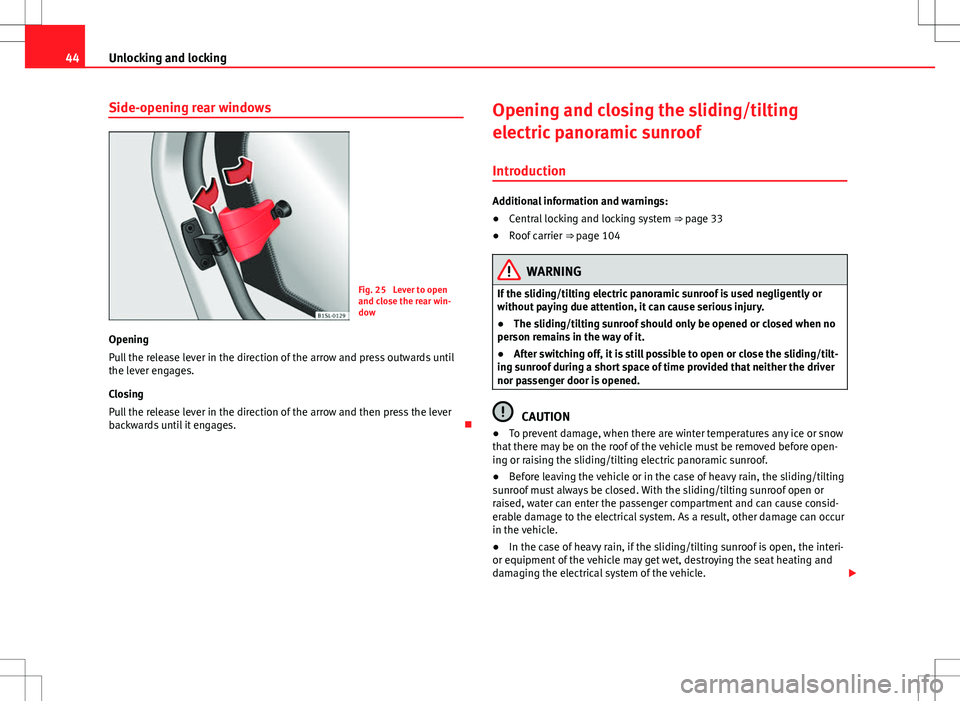
Side-opening rear windows
Fig. 25 Lever to open
and close the rear win-
dow
Opening
Pull the release lever in the direction of the arrow and press outwards until
the lever engages.
Closing
Pull the release lever in the direction of the arrow and then press the lever
backwards until it engages. Opening and closing the sliding/tilting
electric panoramic sunroof
Introduction
Additional information and warnings:
● Central locking and locking system ⇒ page 33
● Roof carrier ⇒ page 104
WARNING
If the sliding/tilting electric panoramic sunroof is used negligently or
without paying due attention, it can cause serious injury.
● The sliding/tilting sunroof should only be opened or closed when no
person remains in the way of it.
● After switching off, it is still possible to open or close the sliding/tilt-
ing sunroof during a short space of time provided that neither the driver
nor passenger door is opened.
CAUTION
● To prevent damage, when there are winter temperatures any ice or snow
that there may be on the roof of the vehicle must be removed before open-
ing or raising the sliding/tilting electric panoramic sunroof.
● Before leaving the vehicle or in the case of heavy rain, the sliding/tilting
sunroof must always be closed. With the sliding/tilting sunroof open or
raised, water can enter the passenger compartment and can cause consid-
erable damage to the electrical system. As a result, other damage can occur
in the vehicle.
● In the case of heavy rain, if the sliding/tilting sunroof is open, the interi-
or equipment of the vehicle may get wet, destroying the seat heating and
damaging the electrical system of the vehicle.
Page 57 of 308
55
Ensuring you are correctly and safely seated
Seat functions Introduction
Additional information and warnings:
● Adjust the seat position ⇒ page 48
● Seat belts ⇒ page 57
● Airbag system ⇒ page 67
● Child seats (accessories) ⇒ page 76
● Exterior mirrors ⇒ page 95
WARNING
Inappropriate use of the seat functions can cause severe injuries.
● Assume the proper sitting position before your trip and remain in it
throughout. This also applies to the other occupants.
● Keep hands, fingers, feet and other limbs away from the seat operat-
ing and adjustment radius.
Seat heating*
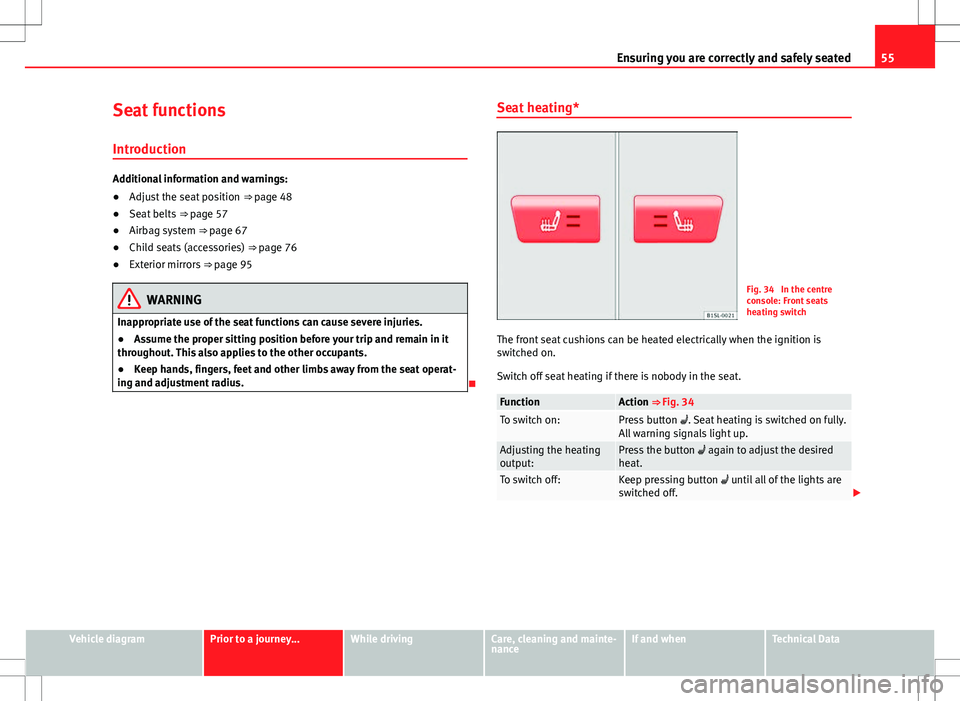
Fig. 34 In the centre
console: Front seats
heating switch
The front seat cushions can be heated electrically when the ignition is
switched on.
Switch off seat heating if there is nobody in the seat.
FunctionAction ⇒ Fig. 34To switch on:Press button . Seat heating is switched on fully.
All warning signals light up.
Adjusting the heating
output:Press the button again to adjust the desired
heat.
To switch off:Keep pressing button until all of the lights are
switched off.
Vehicle diagramPrior to a journey...While drivingCare, cleaning and mainte-
nanceIf and whenTechnical Data
Page 58 of 308

56Ensuring you are correctly and safely seated
WARNING
People whose pain and temperature threshold has been affected by some
kind of medicine, paraplegia or chronic illness (e.g. diabetes) may sus-
tain burns to the back, buttocks and legs from use of the seat heating
that may lead to a long healing process or that may never completely
heal. Seek medical advice if you have doubts regarding your health.
● People with a limit pain and temperature threshold must never use
seat heating.
CAUTION
● To avoid damaging the heating elements of the seat heating, please do
not kneel on the seat or apply sharp pressure at a single point to the seat
cushion and backrest.
● Liquids, sharp objects and insulating materials on the seat could dam-
age the seat heating.
● In the event of smells, switch off the seat heating immediately and have
the unit inspected by a Specialised workshop.
For the sake of the environment
The seat heating should remain on only when needed. Otherwise, it is an
unnecessary fuel consumption.
Page 98 of 308

96Lights and visibility
Turn the rotary control ⇒ Fig. 66 to the required position:
Switch on the exterior mirror heating.
Adjust the left-hand exterior rear vision mirror by turning the
knob forwards, backwards, to the left or to the right.
Zero position. Exterior mirror heating switched off, it is not
possible to adjust the exterior mirrors.
Adjust the right-hand exterior rear vision mirror by turning the
knob forwards, backwards, to the left or to the right.
Folding in the exterior mirrors and returning them to their original position
is possible through a mechanical system. Carefully fold the exterior rear vi-
sion mirror casing towards the side window or pull it away from the window
until it clicks into place.
WARNING
Fold and unfold the exterior rear vision mirror, taking care to avoid inju-
ries.
● Only fold or unfold the exterior rear vision mirror when there is no-
one in the way of the mirror.
● When moving the rear vision mirror, take care not to trap fingers be-
tween the mirror and the mirror bracket.
WARNING
Failure to correctly estimate the distance of the vehicle behind could lead
to serious accident.
● Rear-view convex or aspheric mirrors increase the field of vision, how-
ever objects appear smaller and further away in the mirrors.
● The use of these mirrors to estimate the distance to the next vehicle
when changing lane is imprecise and could result in serious accident.
WARNING (Continued)
● If possible, use the rear vision mirror to estimate distances to vehi-
cles behind you or in other circumstances.
● Make sure that the rear visibility is adequate.
For the sake of the environment
The exterior mirror heating should be switched off when it is no longer nee-
ded. Otherwise, it is an unnecessary fuel consumption.
Note
In the event of faults, the electric exterior mirrors can be adjusted manually
by pressing the edge of the mirror surface.
Page 100 of 308

98Transporting
Transporting a load
Secure all objects in the vehicle
●Distribute the load throughout the vehicle and on the roof as uniformly
as possible.
● Transport heavy objects as far forward as possible in the luggage com-
partment and lock the seat backs in the vertical position.
● Check the headlight adjustment ⇒ page 84.
● Use the suitable tyre pressure according to the load being transported.
Read the tire pressure information label ⇒ page 210.
CAUTION
Objects on the shelf could chafe against the wires of the heating element in
the heated rear window and cause damage.
Note
Please refer to the notes on loading the roof carrier ⇒ page 104.
Driving with the rear lid open
Driving with the rear lid open creates an additional risk. Secure all objects
and secure the rear lid correctly and take all measures possible to reduce
toxic gases from entering the vehicle.
WARNING
Driving with the rear lid unlocked or open could cause serious injuries.
● Always drive with the rear lid closed.
WARNING (Continued)
● Secure all objects in the vehicle. Loose items could fall out of the ve-
hicle and injure other road users or damage other vehicles.
● Drive particularly carefully and think ahead.
● Avoid sudden manoeuvres and braking given that this could cause an
uncontrolled movement of the open rear lid.
● When transporting objects that protrude out of the luggage compart-
ment, indicate them suitably. Observe legal requirements.
● If objects must project out of the luggage compartment, the rear lid
must never be used to “secure” or “attach” objects.
● If a baggage rack is fitted on the rear lid, it should be removed before
travelling with the rear lid open.
WARNING
Toxic gases may enter the vehicle interior when the rear lid is open. This
could cause loss of consciousness, carbon monoxide poisoning, serious
injury and accidents.
● To avoid toxic gases entering the vehicle always drive with the rear lid
closed.
● In exceptional circumstances, if you must drive with the rear lid open,
observe the following to reduce the entry of toxic gases inside the vehi-
cle:
–Close all windows.
– Disable air recirculation mode.
– Open all of the air outlets on the instrument panel.
– Switch on the blower to maximum.
CAUTION
An open rear lid changes the length and height of the vehicle.
Page 102 of 308

100Transporting
Loading luggage compartment
Introduction
Always transport heavy loads in the luggage compartment and place the
seat backs in a vertical position. Never overload the vehicle. Both the carry-
ing capacity as well as the distribution of the load in the vehicle have ef-
fects on the driving behaviour and braking ability ⇒
.
Additional information and warnings:
● Airbag system ⇒ page 67
● Light ⇒ page 84
● Transporting ⇒ page 97
● Wheels and tyres ⇒ page 210
WARNING
When the vehicle is not in use or being watched, always lock the doors
and the rear lid to reduce the risk of serious injury or death.
● Do not leave children unwatched, especially when the rear lid is open.
Children could climb into the luggage compartment, close the rear lid
from inside and be unable to escape themselves. This could lead to seri-
ous injury or death.
● Never allow children to play in or around the vehicle.
● Never transport people in the luggage compartment.
WARNING
Unsecured or incorrectly secured objects can cause serious injury in case
of a sudden manoeuvring or breaking or in case of an accident. This is es-
pecially true when objects are struck by a detonating airbag and fired
through the vehicle interior. To reduce the risks, please note the follow-
ing:
● Secure all objects in the vehicle. Always keep equipment and heavy
objects in the luggage compartment.
● Always secure objects with suitable rope or straps so that they can-
not enter the deployment areas around the frontal or side airbags in case
of sudden braking or an accident.
● While driving, always keep object compartments closed.
● Do not place hard, heavy or sharp objects inside the interior, in open
storage compartments, the rear shelf or on the dash panel.
● Remove hard, heavy and sharp objects from clothes and pockets in-
side the vehicle and store securely.
WARNING
The transport of heavy object changes vehicle handling and increases
braking distance. Heavy loads that have not been stored or secured cor-
rectly could cause loss of control and result in serious injury.
● The vehicle handling changes when transporting heavy objects due
to a change in the centre of gravity.
● Distribute the load as uniformly and as low down on the vehicle as
possible.
● Store heavy objects in the luggage compartment as far from the rear
axle as possible.
CAUTION
Hard objects on the rear shelf could chafe against the wires of the heating
element in the heated rear window and cause damage.
Page 110 of 308

108Practical equipment
Practical equipment
Storage compartments
Introduction
Storage compartments must only be used to store light or small objects.
Additional information and warnings:
● Care and cleaning of the vehicle interior ⇒ page 205
● ⇒ Booklet Radio system
WARNING
In the event of sudden braking movements or turns, loose objects may be
thrown around the vehicle interior. This could cause serious injuries to
passengers and cause the driver to lose control of the vehicle.
● Do not transport animals or place hard, heavy or sharp objects in the
interior of the vehicle in: open storage compartments, dash panel, stor-
age tray, items of clothing or bags.
● While driving, always keep object compartments closed.
WARNING
Objects falling into the driver's footwell could prevent use of the pedals.
This could lead the driver to lose control of the vehicle, increasing the
risk of a serious accident.
● Make sure the pedals can be used at all times, with no objects rolling
underneath them.
● The floor mat should always be secured to the floor.
WARNING (Continued)
● Never place other mats or rugs on top of the original mat supplied by
the factory.
● Make sure that no objects can fall into the driver's footwell while the
vehicle is in motion.
CAUTION
● Objects on the shelf could chafe against the wires of the heating ele-
ment in the heated rear window and cause damage.
● Do not keep temperature-sensitive objects, food or medicines inside the
vehicle. Heat and cold could damage them or render them useless.
● Light-transparent objects placed inside the vehicle, such as lenses,
magnifying glasses or transparent suction caps on the windows, could con-
centrate the sun's rays and cause damage to the vehicle.
Note
The ventilating slits between the heated rear window and the rear shelf
must not be covered so that used air can escape from the vehicle.
Page 134 of 308

132Starting, changing gears, parking
Automatic gearbox malfunction
Back-up programme
When automatic gearbox warning and control lamps light up on the instru-
ment panel, there may be a system malfunction ⇒ page 124. In the event of
some faults the automatic gearbox functions using a backup programme.
When the backup programme is activated, it is possible to drive the vehicle,
however, at low speeds and within a selected range of gears.
With the manual gearbox, in some cases it is not possible to drive with all
the gears.
In all cases the automatic gearbox must be checked at a specialised work-
shop.
Automatic gearbox overheating
The automatic gearbox can overheat with a prolonged start up, or when
stopping and starting continuously. This overheating is displayed with a
warning lamp in the instrument panel. Additionally, an audible warning
can be heard. Stop and let the gearbox cool ⇒
.
The vehicle moves forward or back despite having selected a gear range
When the vehicle does not move in the required direction, the system may
not have the gear range correctly engaged. Press the brake pedal and en-
gage the gear range again. If the vehicle still does not move in the required
direction, there is a system malfunction. Seek specialist assistance and
have the system checked.
CAUTION
● When the gearbox is displayed as overheating for the first time, the vehi-
cle must be parked safely or must be driven at a speed of more than 20 km/
h (12 mph).
● When the warning lamp lights up and the audible warning is sounded,
the vehicle must be parked safely and the engine switched off. Let the gear-
box cool down.
● To prevent damage to the gearbox, driving must only be continued when
the warning lamps are no longer lit up. While the gearbox is overheated,
starting up and driving at walking speed should be avoided.
Recommended gear display
In some vehicles, the recommended gear for reducing fuel consumption is
displayed on the instrument panel display:
DisplayMeaning
Optimum gear.
Recommendation to change up a gear.
Recommendation to change down a gear.
WARNING
The recommended gear display is intended as a guideline only; it should
never replace the driver's attention to driving carefully.
● Responsibility for selecting the correct gear for each situation contin-
ues to lie with the driver, for example when overtaking or climbing a hill.