battery Seat Mii 2012 Owner's Guide
[x] Cancel search | Manufacturer: SEAT, Model Year: 2012, Model line: Mii, Model: Seat Mii 2012Pages: 308, PDF Size: 4.13 MB
Page 197 of 308
195
In the engine compartment
Colour indicatorNecessary operations
light yellow or col-
ourlessThe electrolyte level of the vehicle's battery is too low.
Have the battery checked and, where applicable, re-
placed by a Specialised workshop.
blackThe electrolyte level of the vehicle's battery is correct.
WARNING
Working with the vehicle battery involves a risk of corrosion, explosions
and electric shock.
● Always wear protective gloves and eye protection.
● Battery acid is very corrosive and caustic. It can burn skin and cause
blindness. When handling the battery, protect yourself from splashes of
acids, above all your hands, arms and face.
● Never tilt the vehicle battery. Battery acid could spill out of the open-
ings to release gases and cause corrosion damage.
● Never open the vehicle battery.
● If battery acid splashes on you, immediately rinse your eyes and skin
abundantly with water for several minutes. Then seek medical care imme-
diately.
● If acid is swallowed by mistake, consult a doctor immediately.
Charging, replacing and connecting or disconnecting the
battery
Charging the battery
The vehicle battery should be charged by a specialised workshop only, as
batteries using special technology have been installed and they must be
charged in a controlled environment ⇒
. SEAT recommends visiting a
Technical Service. Replacing a vehicle battery
The battery has been developed to suit the conditions of its location and
has special safety features. If the battery must be replaced, consult a Tech-
nical Service for information on electromagnetic compatibility, the size and
maintenance, performance and safety requirements of the new battery in
your vehicle before you purchase one. SEAT recommends you have the bat-
tery replaced by a Technical Service.
Use only maintenance-free genuine batteries conforming to TL 825 06 and
VW 7 50 73 Standards. These standards must be dated April 2008 or later.
Vehicles fitted with the Start-Stop system are equipped with a special bat-
tery. Therefore, this battery must only be replaced by another of the same
specifications.
Disconnecting the vehicle's battery
If you must disconnect the battery from the electrical system, please note
the following:
●
Switch off the ignition and all electrical equipment.
● The vehicle must be unlocked before disconnecting the battery, other-
wise the alarm will be triggered.
● First disconnect the negative cable and then the positive ⇒
.
Connecting the vehicle's battery
● Before reconnecting the battery, switch off the engine, the ignition and
electric devices.
● First reconnect the positive cable and then the negative ⇒
.
Different control lamps may light up after connecting the battery and switch-
ing the ignition on. They will be turned off after a short trip at a speed of
between 15 - 20 km/h (10 - 12 mph). If the warning indicators remain lit,
please visit a specialised workshop to have the vehicle checked.
If the battery has been disconnected for a long time, it is possible that the
next service date is not displayed or calculated correctly ⇒ page 17. Respect
Vehicle diagramPrior to a journey...While drivingCare, cleaning and mainte-
nanceIf and whenTechnical Data
Page 198 of 308

196In the engine compartment
the maximum service intervals permitted ⇒ Booklet Maintenance
Programme.
Automatic consumer disconnection
The intelligent vehicle electrical system automatically implements a range
of measures to prevent the battery from discharging when high demands
are made on it:
● the idling speed is increased so that the alternator provides more elec-
tricity.
● where necessary, the power of the most powerful consumers is reduced
or even completely disconnected.
● On starting the engine, the power supply from the 12-volt socket and
the cigarette lighter may be interrupted for a short time.
The on-board management program cannot always prevent the battery from
running flat. For example, if the ignition is left on for a long period with the
engine off or if the side lights or parking lights are left on while the vehicle
is stationary.
Why the battery runs flat:
● When stationary for a long time without starting the engine, particularly
if the ignition is switched on.
● Use of electrical consumers with the engine switched off.
WARNING
Incorrectly securing the battery or using the wrong battery can cause
short-circuits, fire and serious injuries.
● Always use only maintenance free batteries, protected to prevent a
leak, and whose properties, specifications and size correspond to the
standard battery.
WARNING
A highly explosive mixture of gases is released when the battery is under
charge.
● The batteries should be charged in a well-ventilated room only.
● Never charge a frozen or recently thawed battery. A flat battery can al-
so freeze at temperatures close to 0 °C (+32 °F).
● Always replace a battery which has frozen.
● Battery cables not correctly connected may cause a short circuit. Re-
connect first the positive cable and then the negative cable.
CAUTION
● Never disconnect the battery if the ignition is switched on or if the en-
gine is running. This could damage the electrical system or electronic com-
ponents.
● Never plug accessories supply current, such as solar panels or a battery
charger, to the 12-volt socket or the cigarette lighter. This could damage the
vehicle's electrical system.
For the sake of the environment
Dispose of the battery in an environment-friendly manner. Batteries contain
toxic substances such as sulphuric acid and lead.
For the sake of the environment
Battery acid can contaminate the environment. Collect any spilt service flu-
ids and allow a dispose of them correctly.
Page 224 of 308

222Vehicle care and maintenance
Accessories, replacements, repairs and
modifications
Introduction
Additional information and warnings:
● Seat belts ⇒ page 57
● Airbag system ⇒ page 67
● Roof carrier ⇒ page 104
● Ashtray and cigarette lighter ⇒ page 115
● Power socket ⇒ page 117
● Braking, stopping and parking ⇒ page 134
● Parking distance warning system ⇒ page 149
● Cruise control system (CCS) ⇒ page 152
● Working in the engine compartment ⇒ page 180
● Engine oil ⇒ page 185
● Engine coolant ⇒ page 189
● Vehicle battery ⇒ page 193
● Caring for and cleaning the vehicle exterior ⇒ page 197
● Care and cleaning of the vehicle interior ⇒ page 205
● Notes for the user ⇒ page 233
● ⇒ Booklet Radio system
● Instruction Manual for the Portable Navigation System (supplied by
SEAT) in the equipment.
WARNING
The use of unsuitable spare parts and accessories, or incorrectly per-
formed modifications or repairs may result in damage to the vehicle, acci-
dents and serious injury.
● SEAT strongly recommends you to only use SEAT approved accesso-
ries and SEAT ®
original spare parts. These parts and accessories have
been specially tested by SEAT for suitability, reliability and safety.
● Have any repairs or modifications carried out at a Specialised work-
shop. Specialised workshops have the necessary tools, diagnostics
equipment, repair information and qualified personnel.
● Only mount parts with the same specifications as the parts fitted at
factory.
● Never mount, fasten or fit objects such as drink holders or telephone
cradles over the covers of the airbag modules or within their deployment
zones.
● Only use wheels and tyre combinations which have been approved by
SEAT for your vehicle type.
Page 238 of 308

236Vehicle care and maintenance
Engine management and exhaust gas
purification system
Introduction
Additional information and warnings:
● Changing gear ⇒ page 124
● Refuelling ⇒ page 171
● Fuel ⇒ page 177
● Engine oil ⇒ page 185
● Vehicle battery ⇒ page 193
● Information stored in the control units ⇒ page 222
● Tow-starting and towing away ⇒ page 276
WARNING
The components of the exhaust system reach very high temperatures.
This could cause a fire.
● Always park your vehicle so that no part of the exhaust system can
come in contact with flammable materials (such as dried grass).
● Never apply additional underseal or anti-corrosion coatings to the ex-
haust pipes, catalytic converter or the heat shields on the exhaust sys-
tem.
Control lamps
lights
upPossible causeSolution
Fault in engine management
(Electronic Power Control).Take the vehicle to a Specialised
workshop as soon as possible
and have the engine checked.
Fault in catalytic converter.
You should reduce speed accord-
ingly. Drive carefully until you
reach the next Specialised work-
shop. Have the engine checked
there.
flashesPossible causeSolution
Combustion fault which could
damage the catalytic convert-
er.You should reduce speed accord-
ingly. Drive carefully until you
reach the next Specialised work-
shop. Have the engine checked
there.
Several warning and control lamps light up for a few seconds when the igni-
tion is switched on while a test of the function is being carried out. They will
switch off after a few seconds.
CAUTION
Always pay attention to any lit lamps and to the corresponding descriptions
and instructions to avoid damage to the vehicle.
Note
While the control lamps or maintain lit up, the engine will present
faults, a higher consumption of fuel and a loss of engine power.
Page 240 of 308

238Practical information
If and when
Practical information
Frequently asked questions
If you suspect that the vehicle has a fault or is damaged when using it, be-
fore consulting a SEAT dealership or a specialised workshop, carefully read
the following instructions. Similarly, the terms in the alphabetical index
“Things to note” or “Checklist” may be of help.
ProblemPossible causes,
among othersPossible solution
The engine does
not start.
The vehicle battery is
flat.– Carry out the jump start
⇒ page 273.
– Charge the battery
⇒ page 193.
You are using an incor-
rect vehicle key.Use the correct key
⇒ page 28.
The fuel tank level is
insufficient.Refuel ⇒ page 171.
The vehicle cannot
be locked or un-
locked with the
key.
– Vehicle key battery is
flat.
– Too far away from
the vehicle.
– Buttons pressed out-
side the radius of
reach.– Change the battery
⇒ page 28.
– Move closer to the vehicle.
– Synchronize the vehicle
key ⇒ page 28.
– Manually lock or unlock
the vehicle ⇒ page 243.
Unusual noises.
Engine cold, City Safe-
ty Assist system, steer-
ing column electronic
lock.See entry “Noises” in the de-
tailed alphabetical index.
ProblemPossible causes,
among othersPossible solution
Handling is
strange.
Assistance systems ac-
tive.See entry “Assistance sys-
tems” in the detailed alpha-
betical index.
You are using an incor-
rect tyre pressure.Check the tyre pressure
⇒ page 210.
Damage to the wheel
trims or tyres.
Inspect wheel trims and
tyres regularly for damage
⇒ page 210 and replace
them if necessary
⇒ page 250.
Vehicle has no
jack, spare wheel
or tire mobility set
present.Equipment subject to
the vehicle.
No direct solution, depends
on the equipment. In this
case, you should contact a
SEAT Dealership
⇒ page 246.
Surface not correct-
ly illuminated.
– Headlights covered
for driving on the left-
hand side or right-
hand side.
– Headlight adjust-
ment too high.
– Faulty bulbs.
– Dipped headlights
switched off.– Cover the headlights for
driving on the left-hand side
or right-hand side
⇒ page 84.
– Adjust the headlight range
⇒ page 84.
– Change the bulbs
⇒ page 264.
– Switch on the dipped
headlights ⇒ page 84.
Page 241 of 308

239
Practical information
ProblemPossible causes,
among othersPossible solution
The electrical
equipment is not
working.Vehicle battery flat.Charge the battery
⇒ page 193.
Fuel tank level insuffi-
cient.Refuel ⇒ page 171.
A fuse is blown.Check fuse and change if
necessary ⇒ page 261.
Fuel consumption
higher than nor-
mal.
– Short trips.
– “Irregularities in the
accelerator pedal”.– Avoid short trips.
– Foresight when driving.
– Press the accelerator even-
ly.
Electrical equipment
connected.Switch off any unnecessary
electrical equipment.
Fault in engine man-
agement.Have the fault rectified
⇒ page 236.
Tyre pressure too low.Adjust tyre pressure
⇒ page 210.
Driving on hills.No direct solution.Driving with a heavy
load.No direct solution.
Driving at an excessive
engine speed.Shift up a gear.
Vehicle diagramPrior to a journey...While drivingCare, cleaning and mainte-
nanceIf and whenTechnical Data
Page 243 of 308

241
Practical information
Checklist (Continued) 7. When leaving the vehicle, take all keys with you.
8. Place an emergency warning triangle to indicate the position of your vehicle to other road users.
9. Allow the engine to cool and check if a specialist is required.
When being towed with the hazard warning lights system on, a change in
direction or traffic lane can be indicated as usual using the turn signals lev-
er. The hazard lights will be interrupted temporarily.
Examples of when to use the hazard warning lights system:
● If the vehicles ahead suddenly slow down or reach the end of a traffic
jam, to warn the vehicles behind.
● In case of an emergency.
● If the vehicle breaks down.
● When tow-starting or towing.
Always comply with the applicable laws regarding the use of hazard warn-
ing lights.
If the hazard warning lights system is not working, you must use an alterna-
tive method of drawing attention to your vehicle. This method must comply
with traffic legislation.
WARNING
Failure to follow the checklist prepared for your own safety could lead to
accidents and severe injuries.
● Always complete the operations given in the checklist and observe
the general rules of safety.
WARNING
The components of the exhaust system reach very high temperatures.
This could cause a fire and considerable damage.
● Always park your vehicle so that no part of the exhaust system can
come in contact with flammable materials (such as dried grass or fuel).
Note
The vehicle battery will discharge and run down if the hazard warning lights
remain on for too much time (even with the ignition turned off).
Note
For some vehicles, the brake lights will blink when braking suddenly at
speeds of approximately 80 km/h (50 mph) to warn vehicles behind. If brak-
ing continues, then the hazard warning lights system will automatically be
turned on at the speed of less than approximately 10 km/h (6 mph). The
brake lights remain lit. Upon accelerating, the hazard warning lights system
will be automatically turned off.
Vehicle diagramPrior to a journey...While drivingCare, cleaning and mainte-
nanceIf and whenTechnical Data
Page 275 of 308
273
Practical information
Starting assistance
Introduction
If the engine fails to start because of a discharged battery, the battery of an-
other vehicle can be used to start the engine. Before starting, check the
magic eye on the battery ⇒ page 193.
For starting assistance, jump lead cables conforming to the standard
DIN 72553 are required (see the cable manufacturer instructions). The cable
section in vehicles with petrol engine must be at least 25 mm 2
.
Additional information and warnings:
● Working in the engine compartment ⇒ page 180
● Vehicle battery ⇒ page 193
WARNING
Incorrect use of jump leads and incorrectly jump starting could cause the
battery to explode resulting in serious injury. Please observe the follow-
ing rules to minimise the risk of a battery explosion:
● All work involving the vehicle battery and electrical system can cause
corrosion, fire and serious electric shocks. Always read and take into ac-
count the safety warnings and standards before beginning work on the
battery ⇒ page 193, Vehicle battery.
● The battery providing current must have the same voltage (12V) and
approximately the same capacity (see markings on battery) as the flat
battery.
● Never charge a frozen or recently thawed battery. A flat battery can al-
so freeze at temperatures close to 0 °C (+32 °F).
● If a battery is frozen and/or has been frozen then it must be replaced.
WARNING (Continued)
● A highly explosive mixture of gases is released when the battery is
being charged. Always keep lit cigarettes, open flames, sparks and fire
far from the battery. Never use a mobile telephone when connecting and
removing the jump leads.
● Charge the battery only in well ventilated areas given that when the
battery is charged by outside assistance, it creates a mix of highly explo-
sive gases.
● Jump leads should never enter into contact with moving parts in the
engine compartment.
● Never switch the positive and negative poles or connect the jump
leads incorrectly.
● Note the Instruction Manual provided by the manufacturer of the
jump leads.
CAUTION
To avoid considerable damage to the vehicle electrical system, note the fol-
lowing carefully:
● If the jump leads are incorrectly connected, this could result in a short
circuit.
● The vehicles must not touch each other, otherwise electricity could flow
as soon as the positive terminals are connected.
Vehicle diagramPrior to a journey...While drivingCare, cleaning and mainte-
nanceIf and whenTechnical Data
Page 276 of 308
274Practical information
How to jump start: description
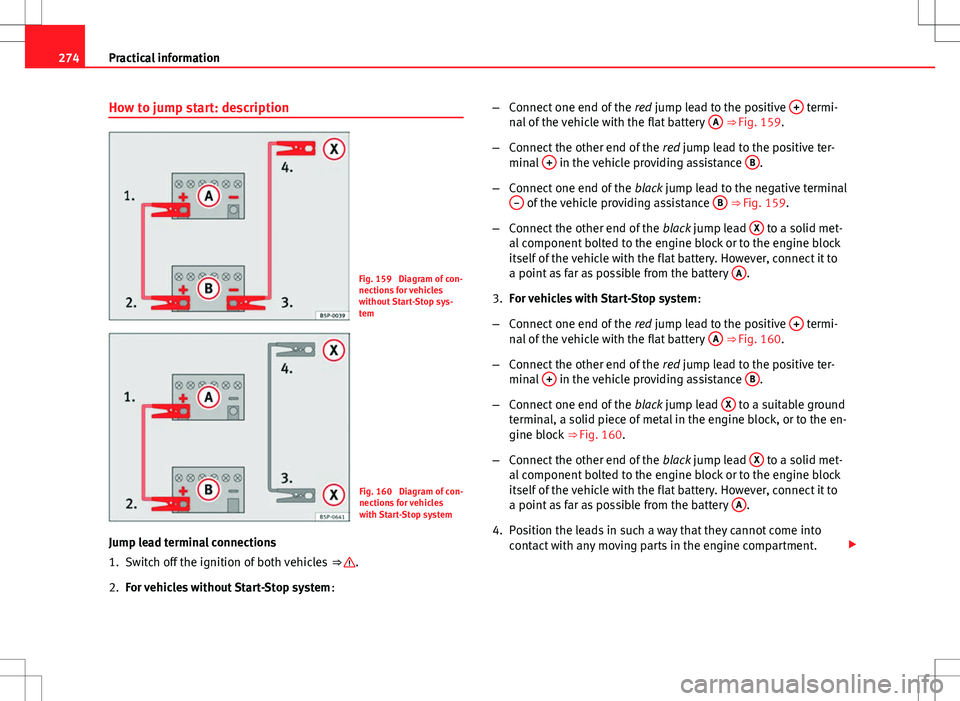
Fig. 159 Diagram of con-
nections for vehicles
without Start-Stop sys-
tem
Fig. 160 Diagram of con-
nections for vehicles
with Start-Stop system
Jump lead terminal connections
1. Switch off the ignition of both vehicles ⇒
.
2. For vehicles without Start-Stop system :–
Connect one end of the red jump lead to the positive +
termi-
nal of the vehicle with the flat battery A ⇒ Fig. 159.
– Connect the other end of the red jump lead to the positive ter-
minal +
in the vehicle providing assistance B.
– Connect one end of the black jump lead to the negative terminal
–
of the vehicle providing assistance B ⇒ Fig. 159.
– Connect the other end of the black jump lead X
to a solid met-
al component bolted to the engine block or to the engine block
itself of the vehicle with the flat battery. However, connect it to
a point as far as possible from the battery A
.
3. For vehicles with Start-Stop system :
– Connect one end of the red jump lead to the positive +
termi-
nal of the vehicle with the flat battery A ⇒ Fig. 160.
– Connect the other end of the red jump lead to the positive ter-
minal +
in the vehicle providing assistance B.
– Connect one end of the black jump lead X
to a suitable ground
terminal, a solid piece of metal in the engine block, or to the en-
gine block ⇒ Fig. 160.
– Connect the other end of the black jump lead X
to a solid met-
al component bolted to the engine block or to the engine block
itself of the vehicle with the flat battery. However, connect it to
a point as far as possible from the battery A
.
4. Position the leads in such a way that they cannot come into contact with any moving parts in the engine compartment.
Page 277 of 308
275
Practical information
Starting
5. Start the engine of the vehicle with the boosting battery and let it run at idling speed.
6. Start the engine of the vehicle with the flat battery and wait one or two minutes until the engine is “running”.
Removing the jump leads
7. Before you remove the jump leads, switch off the headlights (if they are switched on).
8. When the engine is running, disconnect the leads in reverse or- der to the details given above.
Connect the battery clamps so they have good metal-to-metal contact with
the battery terminals.
If the engine fails to start, switch off the starter after about 10 seconds and
try again after about half a minute.
WARNING
● Please note the safety warnings referring to working in the engine
compartment ⇒ page 182.
● The battery providing assistance must have the same voltage as the
flat battery (12V) and approximately the same capacity (see imprint on
battery). Failure to comply could result in an explosion.
● Never use jump leads when one of the batteries is frozen. Danger of
explosion! Even after the battery has thawed, battery acid could leak and
cause chemical burns. If a battery freezes, it should be replaced.
● Keep sparks, flames and lighted cigarettes away from batteries, dan-
ger of explosion. Failure to comply could result in an explosion.
WARNING (Continued)
● Observe the instructions provided by the manufacturer of the jump
leads.
● Do not connect the negative cable from the other vehicle directly to
the negative terminal of the flat battery. The gas emitted from the battery
could be ignited by sparks. Danger of explosion.
● Do not attach the negative cable from the other vehicle to parts of the
fuel system or to the brake line.
● The non-insulated parts of the battery clamps must not be allowed to
touch. The jump lead attached to the positive battery terminal must not
touch metal parts of the vehicle, this can cause a short circuit.
● Position the leads in such a way that they cannot come into contact
with any moving parts in the engine compartment.
● Do not bend over the batteries. This could result in chemical burns.
Note
The vehicles must not touch each other, otherwise electricity could flow as
soon as the positive terminals are connected.
Vehicle diagramPrior to a journey...While drivingCare, cleaning and mainte-
nanceIf and whenTechnical Data