maintenance Seat Mii 2012 Owner's Guide
[x] Cancel search | Manufacturer: SEAT, Model Year: 2012, Model line: Mii, Model: Seat Mii 2012Pages: 308, PDF Size: 4.13 MB
Page 203 of 308

201
Vehicle care and maintenance
Cleaning and changing windscreen wiper blades
Fig. 116 Changing the
front windscreen wiper
blades
Fig. 117 Changing the
rear wiper blade
The windscreen wiper blades are supplied as standard with a layer of graph-
ite. This layer is responsible for ensuring that the wipe is silent. If the graph-
ite layer is damaged, the noise of the water as it is wiped across the wind-
screen will be louder. Check the condition of the wiper blades regularly.
If the wipers scrape
across the glass they should be changed if they are damaged, or cleaned if
they are dirty ⇒
.
Damaged wiper blades should be replaced immediately. Blades are availa-
ble from Specialised workshops.
Lifting and unfolding the wiper arms
The wiper arm may only be lifted at the point where it is fastened to the
blade.
For windscreen wipers, please note: the windscreen wiper should be in
service position before unfolding it ⇒ page 91.
Cleaning windscreen wiper blades
● Lifting and unfolding the wiper arms.
● Use a soft cloth to remove dust and dirt from the windscreen wiper
blades.
● If the blades are very dirty, a sponge or damp cloth may be used ⇒
.
Changing the front windscreen wiper blades
● Lifting and unfolding the wiper arms.
● Hold down the release button ⇒ Fig. 116 1
while gently pulling the
wiper blade in the direction of the arrow.
● Fit a new wiper blade of the same length and design on to the wiper arm
and hook it into place.
● Rest the wiper arms back onto the windscreen.
Changing the rear wiper blade
● Lift the windscreen wiper arm and fold it at an angle of approximately
60° ⇒ Fig. 117.
● Press and hold the release button 1
.
● Fold the wiper blade towards the windscreen wiper arm ⇒ Fig. 117 (ar-
row A
) while simultaneously pulling in the direction of arrow B. This may
require some strength.
Vehicle diagramPrior to a journey...While drivingCare, cleaning and mainte-
nanceIf and whenTechnical Data
Page 204 of 308

202Vehicle care and maintenance
● Insert a new blade of the same length and type in the windscreen wiper
arm in the opposite direction to the arrow B
and hook into place. This fea-
ture is operational when the blade is in position (arrow A).
● Return the windscreen wiper arm to the windscreen. Do not let it simply
drop down!
WARNING
Worn or dirty wiper blades reduce visibility and increase the risk of acci-
dent and serious injury.
● Always replace damaged or worn blades or blades which do not clean
the windscreen correctly.
CAUTION
● Damaged or dirty windscreen wipers could scratch the glass.
● If products containing solvents, rough sponges or sharp objects are
used to clean the blades, the graphite layer will be damaged.
● Never use fuel, nail varnish remover, paint thinner or similar products to
clean the windows.
Note
If wax deposits, other cleaning products from the automatic car wash, or
other care products, are left on the windscreen and the rear window, the
blades can scratch the glass. Remove wax deposits with a special product
or cleaning cloths.
Caring for and polishing the vehicle paintwork
Waxing
Regular waxing protects the paintwork. It is time to apply a good coat of wax
when water no longer forms droplets and rolls off the clean paintwork. Even if a
wax solution is used regularly in the automatic car wash, SEAT rec-
ommends protecting the paint with a hard wax coating at least twice a year.
Polishing
Polishing is only necessary if the paint has lost its shine, and the gloss can-
not be brought back by applying wax.
If the polish does not contain wax, a wax product should be applied after
polishing.
CAUTION
● To prevent damage, vehicle polish or hard wax should not be used on
components painted in matt paint, plastic components and the glass head-
lamp and tail light covers.
● Do not polish your vehicle in a sandy or dusty environment.
Care and cleaning of chrome and aluminium wheel rims
● Use a clean, damp, lint-free, smooth cloth to clean anodized surfaces.
● If there is a lot of dirt, use a special cleaning product which does not
contain solvents.
● Then, polish the chrome and aluminium wheel trims with a smooth dry
cloth.
CAUTION
In order to prevent damage to the aluminium and chrome wheel trims:
● Do not clean or polish them in direct sunlight.
● Do not clean or polish them in sandy or dusty environments.
● Do not use abrasive cleaning agents such as home cream cleaners.
● Do not use insect sponges, scouring pads, or similar products to clean
insect deposits.
Page 205 of 308

203
Vehicle care and maintenance
● Do not polish dirty surfaces.
● Do not use products containing solvents.
● Do not use hard wax.
CAUTION
Chrome hub caps or wheel covers may have been painted additionally. Do
not treat them with aluminium or chrome wax products, nor chrome or alu-
minium polish. Instead, use commercial paint wax or polish.
Cleaning wheels
Cleaning steel wheels
Use an industrial cleaner to remove brake dust. Therefore, clean wheel rims
regularly with a separate sponge.
Any damage to the paint on steel wheel rims should be touched up before
the metal starts to rust.
Caring for and cleaning alloy wheels
Remove road salt and brake dust by washing the wheels approximately
once a fortnight. Use an acid free detergent to clean the wheel rims. SEAT
recommends treating the wheel rims thoroughly with a hard wax about
once every three months.
It is important to remove road salt and brake dust by washing the wheels at
regular intervals, otherwise the finish will be impaired.
Always use an acid-free detergent for alloy wheel rims. Vehicle polish or oth-
er abrasive agents should not be used.
If the protective coating on the paint has been damaged (for example, hit by
a stone), it should be repaired immediately. Caring for rubber seals
The rubber seals on doors, windows, etc., remain flexible, provide a better
seal and last longer if they are regularly treated with a product specifically
designed for use on rubber.
Before applying the product, use a soft cloth to remove dust and dirt from
the rubber seals.
De-icing the door lock cylinder
To de-ice the lock cylinders, SEAT recommend the use of genuine SEAT spray
with lubricating and anti-corrosive properties.
CAUTION
The use of products containing degreasing agents to de-ice the locks may
rust the lock cylinder.
Protection of vehicle undercarriage
The vehicle underbody is coated to protect it from chemical and mechanical
damage. The protective coat on the undercarriage may wear through use
while driving. Therefore, SEAT recommends that the protective coating on
the undercarriage and on the running gear should be regularly checked, and
repaired if necessary.
Vehicle diagramPrior to a journey...While drivingCare, cleaning and mainte-
nanceIf and whenTechnical Data
Page 206 of 308

204Vehicle care and maintenance
WARNING
Additional underseal or anti-corrosion products could catch fire due to
the high temperatures reached by the exhaust gas system and other en-
gine components.
● Do not apply additional underseal or anti-corrosion products to the
exhaust pipes, catalytic converters, heat shields or other parts of the ve-
hicle which reach high temperatures.
Cleaning the engine compartment
The engine compartment of any motor vehicle is a potentially hazardous
area ⇒ page 180. The engine compartment should only be cleaned by qualified personnel. If
it is not correctly cleaned, the anti-corrosion coating and consequently elec-
trical components may be damaged. Moreover, water may filter directly into
the vehicle interior through the water chamber ⇒
.
If the engine compartment is very dirty, always take the vehicle to a Special-
ised workshop for professional cleaning. SEAT recommends visiting a Tech-
nical Service.
Water box
The water box is in the engine compartment, between the windscreen and
the engine, and beneath a perforated cover. Air is taken in through the wa-
ter box from outside to the vehicle interior via the heating and air condition-
ing system.
Leaves and other loose objects should be regularly cleaned away from the
water box either by hand or with a vacuum.
WARNING
When working on the engine or in the engine compartment, there is a
risk of injury, burns, accident or fire.
● Before starting work, please ensure you are familiar with the required
procedure and the safety precautions ⇒ page 180.
● SEAT recommends you have this work performed by a specialised
workshop.
CAUTION
If water is manually poured into the water box (for example, using a high
pressure cleaning appliance), this could cause significant damage to the ve-
hicle.
For the sake of the environment
Only wash the engine compartment in areas allocated for this purpose, to
prevent dirty water which may be contaminated by oil, grease or fuel, from
entering the drains. In some districts, the engine compartment may not be
washed outside the wash bays provided for this purpose.
Page 207 of 308

205
Vehicle care and maintenance
Caring for and cleaning the vehicle interior
Introduction
The dye from many items of modern clothing (e.g. dark jeans) is not always
solid enough. Seat upholstery (material and leather), especially when light-
coloured, may visibly discolour if the dye comes out of clothing (even when
used correctly). This is not an upholstery defect but indicates that the dye in
the item of clothing is not solid enough.
Additional information and warnings:
● Caring for and cleaning the vehicle exterior ⇒ page 197
● Accessories, parts replacement, repairs and modifications ⇒ page 222
WARNING
Vehicle care products may be toxic and hazardous. If vehicle care prod-
ucts are not suitable or are used inappropriately, this could result in acci-
dent, serious injury, burns or intoxication.
● Vehicle care products must always be stored in the original container
which should be kept closed.
● Observe information provided by the manufacturer.
● To prevent confusion, never store vehicle care products in empty food
cans, bottles or other containers.
● Keep all care products out of reach of children.
● Harmful vapours may be produced when using vehicle care products.
Therefore, care products should only be used in well-ventilated spaces or
in the open air.
● Never use fuel, turpentine, engine oil, acetone or any other volatile
liquid to wash, clean or care for the vehicle. These are toxic and highly
flammable.
WARNING
Inappropriate care and cleaning of vehicle components may effect the ve-
hicle safety equipment, increasing the risk of severe injury.
● Vehicle components should only be cleaned and maintained in ac-
cordance with the manufacturer's instructions.
● Only use approved or recommended care products.
CAUTION
● Cleaning products which contain solvents will damage the material.
● To avoid damage, stubborn stains should be removed by a specialised
workshop.
Note
Suitable vehicle care products are available from your Technical Service.
Vehicle diagramPrior to a journey...While drivingCare, cleaning and mainte-
nanceIf and whenTechnical Data
Page 208 of 308

206Vehicle care and maintenance
Treating your upholstery
Check list
For information on how to treat and care for the vehicle upholstery, please
bear the following in mind ⇒
:
¥ Before entering the vehicle, fasten all Velcro fastenings which could
come into contact with upholstery and coverings. If the Velcro fasten-
ings on upholstery and material covers are not securely fastened,
this could damage them.
¥ To prevent damage, do not allow the upholstery or covers to come
into contact with sharp or decorative objects. Decorative objects
such as zips, rivets and rhinestones on clothing and belts.
¥ Dust and grit in the pores and seams should be removed regularly to
prevent them scratching and damaging the surface.
¥ Always check that the dyes used in clothing are fast to prevent them
from staining the upholstery. This is particularly true for clear-col-
oured upholstery.
CAUTION
Failure to observe the instructions in the check list for caring for your up-
holstery could result in damage or discolouration of the upholstery and cov-
ers.
● Always follow the check list and perform the necessary operations.
Note
SEAT recommends you take the vehicle to a Specialised workshop to treat
any stains on the upholstery caused by the discolouration of clothing. Padding and fabric trim cleaning
Normal cleaning
●
Before applying cleaning products, please read the instructions for han-
dling and the warnings shown on the container.
● The upholstery, textile covers, and carpet should be regularly vacuumed
(with vacuum brush).
● We recommend that you use a soft sponge or lint-free, micro-fibre cloth
for normal cleaning ⇒
.
General superficial dirt on upholstery and textile covers can be cleaned with
a normal foam cleaning product.
If the upholstery and the material trims are very dirty, we recommend you
have them cleaned by a specialist cleaning form.
Cleaning stains
It may be necessary to clean the whole surface and not only the stain itself.
Especially if the surface has been dirtied through normal use. Otherwise,
the stained area may become lighter than the rest of the surface after treat-
ment.
Page 209 of 308
207
Vehicle care and maintenance
Type of stainCleaning the vehicleWater-based stains ,
e.g. coffee or fruit
juice.– Use a sponge and wipe with a solution of water
and wool wash.
– Dry with a dry, absorbent cloth.
Persistent stains ,
e.g. chocolate or
make-up.– Apply a washing paste a)
directly to the stain and
allow it to work.
– Apply clean water using a sponge or damp cloth to
remove the cleaning product deposits.
– Dry with a dry absorbent cloth.
Grease-based
stains, e.g. oil or lip-
stick.– Apply neutral soap or cleaning paste a)
and allow it
to work.
– Remove dissolved grease or colour particles with
an absorbent cloth.
– Then apply clean water. Take care not to soak the
upholstery.
a) Bile soap can be used as a cleaning paste.
CAUTION
Brushes should only be used to clean the mats and floor mat! Other surfa-
ces may be damaged if a brush is used.
CAUTION
Do not use steam cleaning equipment, as the dirt becomes more encrusted
in the material when steam is applied.
CAUTION
Never use brushes for cleaning damp material as they could damage the
surface. Cleaning storage compartments, drinks holders and
ashtray
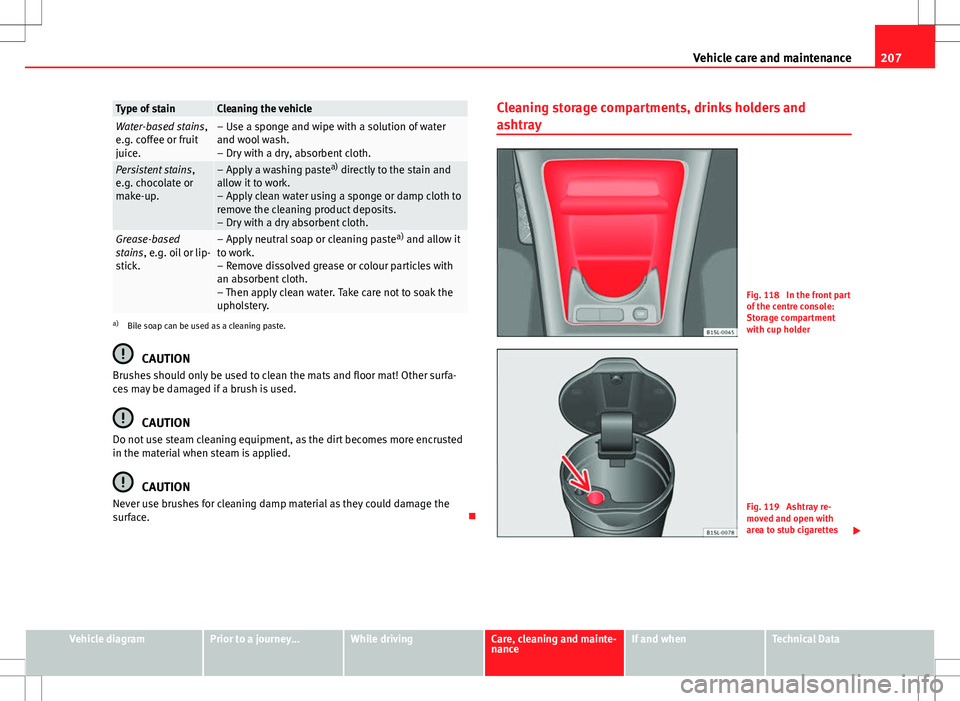
Fig. 118 In the front part
of the centre console:
Storage compartment
with cup holder
Fig. 119 Ashtray re-
moved and open with
area to stub cigarettes
Vehicle diagramPrior to a journey...While drivingCare, cleaning and mainte-
nanceIf and whenTechnical Data
Page 210 of 308

208Vehicle care and maintenance
Cleaning storage compartments and drinks holders
● Use a clean, damp, lint-free cloth to clean parts.
● If this does not provide satisfactory results, we recommend using a spe-
cial solvent-free plastic cleaning product.
Cleaning the ashtray
● Extract the ashtray and empty it.
● Clean the ashtray with a dishcloth.
Use a toothpick or similar to remove ash from the area where cigarettes are
stubbed out ⇒ Fig. 119.
Care and cleaning of plastic parts, wooden trim and the
dash panel
● Use a clean, damp, lint-free cloth to clean parts.
● Clean plastic parts (inside and outside the vehicle) and the dash panel
with a special solvent-free product for the care and cleaning of plastic, ap-
proved by SEAT ⇒
.
● Wash wooden trims with a mild soap and water solution.
● Clean the Portable Navigation System housing (Supplied by SEAT) with a
dry cloth only.
WARNING
Solvents cause the surfaces of the airbag modules to become porous. If
an airbag is accidentally triggered, the detachment of plastic parts could
cause serious injury.
● Never clean the dash panel and the surfaces of the airbag modules
with cleaners containing solvents.
CAUTION
When cleaning the instrument panel, be careful not to dampen the Portable
Navigation System connections as this can damage the electrical installa-
tion.
Cleaning seat belts
If the seat belt is very dirty, the belt retractor may not work correctly thus
preventing the seat belt from operating correctly.
The seat belts should never be removed from the vehicle for cleaning.
● Use a soft brush to remove the worst dirt ⇒
.
● Pull the seat belt right out and leave it out.
● Clean dirty seat belts with a gentle soap and water solution.
● Wait until they are completely dry.
● Only allow the seat belt to retract when it is completely dry.
WARNING
Check the condition of all the seat belts at regular intervals. If the web-
bing or other parts of the seat belt are damaged, the vehicle should be
taken to a Specialised workshop immediately and the belts should be re-
placed. It is extremely dangerous to drive using damaged seat belts and
could result in serious injury or loss of life.
● Seat belts and their components must never be cleaned with chemi-
cal products, nor should they be allowed to come into contact with corro-
sive liquids, solvents or sharp objects. This could affect the strength of
the seat belt webbing.
Page 211 of 308

209
Vehicle care and maintenance
WARNING (Continued)
● Seat belts should be completely dry before retracting. Damp could
damage the belt retractor so that it is does not operate correctly.
● Do not allow liquids or foreign bodies to enter the buckle fastenings.
This could damage the buckles and seat belts.
● Never attempt to repair, modify or remove a seat belt yourself.
● Always have damaged seatbelts replaced immediately by seat belts
approved for the vehicle in question by SEAT. Seat belts which have been
worn in an accident and stretched must be replaced by a Specialised
workshop. Renewal may be necessary even if there is no apparent dam-
age. The belt anchor points should also be checked.
Vehicle diagramPrior to a journey...While drivingCare, cleaning and mainte-
nanceIf and whenTechnical Data
Page 212 of 308

210Vehicle care and maintenance
Wheels and tyres
Introduction
SEAT recommend that all work on tyres and wheels is carried out by a Speci-
alised workshop. They have the necessary special tools and replacement
parts, trained personnel and facilities for disposing of the old tyres. SEAT
recommends visiting a Technical Service.
Additional information and warnings:
● Transporting ⇒ page 97
● Braking, stopping and parking ⇒ page 134
● Caring for and cleaning the vehicle exterior ⇒ page 197
● Notes for the user ⇒ page 233
● Vehicle tool kit ⇒ page 246
● Wheel trims ⇒ page 248
● Change wheel ⇒ page 250
● Tire Mobility Set ⇒ page 256
WARNING
The vehicle cannot be totally controlled or braked if the tyres (new or
used) are worn or damaged.
● Incorrect use of wheels and tyres could make driving more dangerous
and result in serious accidents and damage.
● All four wheels must be fitted with radial tyres of the same type, size
(rolling circumference) and the same tread pattern.
● New tyres do not give maximum grip and will not have reached their
maximum braking capacity to start with, and therefore need running in.
To prevent accidents and major damage, extreme caution should be tak-
en for the first 600 km (400 miles).
WARNING (Continued)
● Check tyre pressures regularly and ensure they are maintained at the
pressures indicated. If the tyre pressure is too low, the tyres could over-
heat, resulting in tread detachment or even burst tyres.
● Never drive on damaged (punctured, cut, cracked or dented) or worn
tyres. Driving on damaged or worn tyres could result in burst tyres, seri-
ous accidents or damage. Worn or damaged tyres must be replaced im-
mediately.
● Never exceed the maximum permitted speed or loads specified for the
type of tyre fitted on your vehicle.
● The efficiency of driver and brake assist systems also depends on the
grip of the tyres.
● If you notice unusual vibration or if the vehicle pulls to one side when
driving, stop the vehicle immediately and check the tyres and wheels for
damage.
● To minimise the risk of losing control of the vehicle or causing a seri-
ous accident, never undo the bolted joints of beadlock wheels.
● Never mount used tyres or wheels if you are not sure of their previous
history. They may be damaged, although the damage is not immediately
visible.
● Old tyres, even if they have never been used, may lose air or burst un-
expectedly while driving, especially at high speeds, resulting in serious
accident and injury. If tyres are over six years old, they should only be
used in an emergency and with extreme caution.
Note
For technical reasons, it is not generally possible to use the wheels from
other vehicles. In some cases, this may also be true for the same model of
wheel. Please refer to the vehicle documents or ask at a Technical Service.