maintenance Seat Mii 2012 Workshop Manual
[x] Cancel search | Manufacturer: SEAT, Model Year: 2012, Model line: Mii, Model: Seat Mii 2012Pages: 308, PDF Size: 4.13 MB
Page 233 of 308
231
Vehicle care and maintenance
Jacking points for raising vehicle
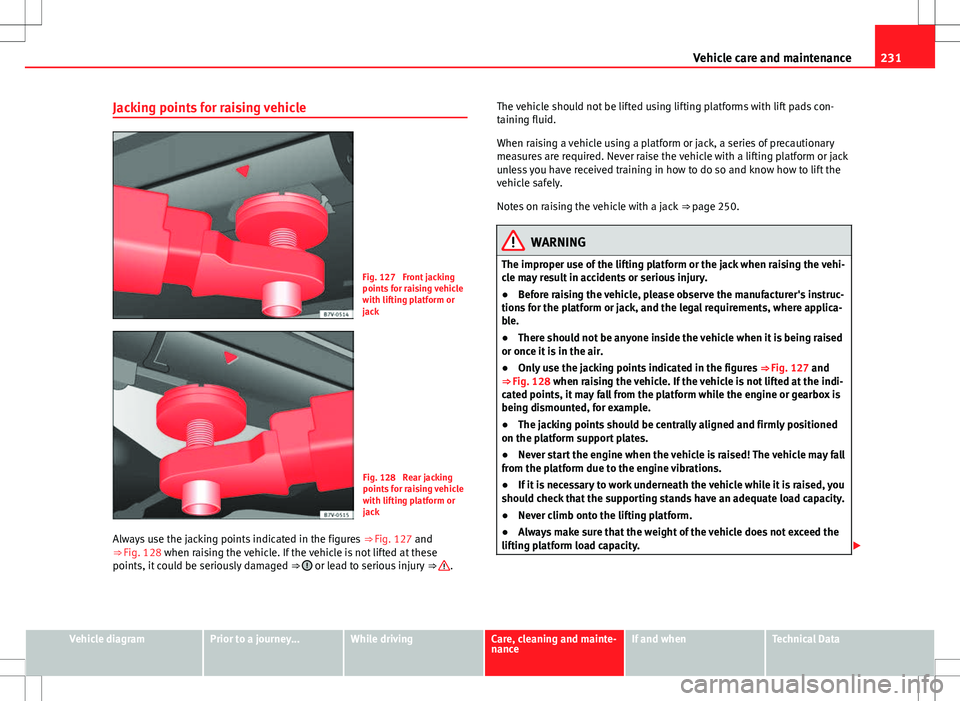
Fig. 127 Front jacking
points for raising vehicle
with lifting platform or
jack
Fig. 128 Rear jacking
points for raising vehicle
with lifting platform or
jack
Always use the jacking points indicated in the figures ⇒ Fig. 127 and
⇒ Fig. 128 when raising the vehicle. If the vehicle is not lifted at these
points, it could be seriously damaged ⇒
or lead to serious injury ⇒ .The vehicle should not be lifted using lifting platforms with lift pads con-
taining fluid.
When raising a vehicle using a platform or jack, a series of precautionary
measures are required. Never raise the vehicle with a lifting platform or jack
unless you have received training in how to do so and know how to lift the
vehicle safely.
Notes on raising the vehicle with a jack
⇒ page 250.
WARNING
The improper use of the lifting platform or the jack when raising the vehi-
cle may result in accidents or serious injury.
● Before raising the vehicle, please observe the manufacturer's instruc-
tions for the platform or jack, and the legal requirements, where applica-
ble.
● There should not be anyone inside the vehicle when it is being raised
or once it is in the air.
● Only use the jacking points indicated in the figures ⇒ Fig. 127 and
⇒ Fig. 128 when raising the vehicle. If the vehicle is not lifted at the indi-
cated points, it may fall from the platform while the engine or gearbox is
being dismounted, for example.
● The jacking points should be centrally aligned and firmly positioned
on the platform support plates.
● Never start the engine when the vehicle is raised! The vehicle may fall
from the platform due to the engine vibrations.
● If it is necessary to work underneath the vehicle while it is raised, you
should check that the supporting stands have an adequate load capacity.
● Never climb onto the lifting platform.
● Always make sure that the weight of the vehicle does not exceed the
lifting platform load capacity.
Vehicle diagramPrior to a journey...While drivingCare, cleaning and mainte-
nanceIf and whenTechnical Data
Page 234 of 308

232Vehicle care and maintenance
CAUTION
● Never raise the vehicle at the engine oil sump, the gearbox or the rear or
front axles.
● Always use an intermediate rubber support to prevent damage to the
vehicle underbody. Check that the arms of the lifting platform are able to
move with obstruction.
● The arms should not come into contact with the side running boards or
other parts of the vehicle.
Page 235 of 308

233
Vehicle care and maintenance
Notes for the user Introduction
Additional information and warnings:
● Exterior detail ⇒ page 6
● Accessories, parts replacement, repairs and modifications ⇒ page 222
● ⇒ Booklet Maintenance Programme
WARNING
Failure to treat the vehicle with the correct care increases the risk of acci-
dent and injury.
● Observe legal requirements.
● Observe the Instruction Manual.
CAUTION
If you do not treat the vehicle suitably, you may cause it to be damaged.
● Observe legal requirements.
● Carry out regular maintenance of the vehicle, according to specifications
in the Maintenance Programme.
● Observe the Instruction Manual. Labels and plates
Fig. 129 Warnings relat-
ing to handling of the
City Safety Assist system
laser sensor function
Some parts in the engine compartment come from the factory with certifi-
cates of safety, labels or plates containing important information regarding
the operation of the vehicle, for example, on the petrol cap, on the passeng-
er's sun visor, on the driver door strut, or on the floor of the luggage com-
partment.
● Never remove these certificates of safety, labels or plates, and ensure
they are kept in good condition and are legible.
● If a vehicle part, bearing a certificate of safety, label or plate, is re-
placed, the Specialised workshop should attach the information back in the
same place.
Certificate of safety
A certificate of safety on the door strut states that all the safety standards
and regulations established by the national traffic authorities responsible
for road safety were met at the time of manufacture. It may also give the
month and year of manufacture, together with the chassis number.
Vehicle diagramPrior to a journey...While drivingCare, cleaning and mainte-
nanceIf and whenTechnical Data
Page 236 of 308

234Vehicle care and maintenance
Warning of high voltage label
There is a label close to the bonnet lock which warns of high voltage in the
vehicle electrical installation.
Warning relating to the City Safety Assist system laser sensor
There are some warning and information signs on the City Safety Assist sys-
tem laser sensor ⇒ Fig. 129.
Using your vehicle in other countries and continents
The vehicle is manufactured at the factory for use in a particular country in
accordance with the national legislation in force at the time of manufacture.
If the vehicle is sold in another country or used in another country for an ex-
tended period of time, the applicable legislation of that country should be
observed.
It may be necessary to fit or remove certain pieces of equipment or to deac-
tivate certain functions. Service work may also be affected. This is particu-
larly true if the vehicle is used in a different climate for an extended period
of time.
As there are different types of frequency bands around the world, you may
find that the radio system or the Portable Navigation System (supplied by
SEAT) supplied at the factory does not work in another country.
CAUTION
● SEAT does not accept liability for any damage to the vehicle due to the
use of a lower quality fuel, an inadequate service or the non-availability of
genuine spare parts.
● SEAT does not accept liability if the vehicle does not comply in part or in
full with the legal requirements of other countries or continents. Radio reception and the aerial
For factory-fitted radio equipment, the aerial for radio reception is fitted to
the roof of the vehicle.
Note
If electrical equipment such as mobile telephones, is used near a roof aer-
ial, you may observe interference in the reception of AM stations.
Notes on SEAT repairs
Information about authorised SEAT services and authorised SEAT repairs
can be requested by payment at the following addresses:
Clients in Europe, Asia, Australia, Africa, Central America and South
America
Contact a Technical Service or specialised workshop, or request the corre-
sponding documentation at www.erwin.volkswagen.de.
WARNING
Repairs or modifications which are not performed correctly may result in
damage or errors in the vehicle operation, affecting the efficiency of the
driver assist and airbag systems. This could result in serious accident.
● Have any repairs or modifications carried out at a Specialised work-
shop.
Conformity certification
The respective manufacturer hereby declares that the products indicated as
follows fulfil the basic requirements and the following dispositions and
Page 237 of 308

235
Vehicle care and maintenance
important legislations on the date of manufacture of the vehicle, among
others FCC Part 15.19, FCC Part 15.21 and RSS-Gen Issue 1:
Radio frequency equipment
● Electronic gearbox lock.
● Vehicle key.
Electrical equipment
● 12 volt socket.
Collection and scrapping of end-of-life vehicles
Collection of end-of-life vehicles
SEAT is already prepared for the moment when you wish to scrap your vehi-
cle and offers you an environmentally-friendly solution. An extensive net-
work of used vehicle reception centres already exists in much of Europe. Af-
ter the vehicle has been delivered, you will receive a certificate of destruc-
tion describing the environmentally friendly scrapping of the vehicle in ac-
cordance with applicable legislation.
We will collect the used vehicle free of charge, provided it complies with all
national legislation.
Please see your Technical Service for further information about the collec-
tion and scrapping of end-of-life vehicles.
Scrapping
The relevant safety requirements must be observed when the vehicle or
components of the airbag or belt tensioner systems are scrapped. These re-
quirements are known to qualified dealerships.
Vehicle diagramPrior to a journey...While drivingCare, cleaning and mainte-
nanceIf and whenTechnical Data
Page 238 of 308

236Vehicle care and maintenance
Engine management and exhaust gas
purification system
Introduction
Additional information and warnings:
● Changing gear ⇒ page 124
● Refuelling ⇒ page 171
● Fuel ⇒ page 177
● Engine oil ⇒ page 185
● Vehicle battery ⇒ page 193
● Information stored in the control units ⇒ page 222
● Tow-starting and towing away ⇒ page 276
WARNING
The components of the exhaust system reach very high temperatures.
This could cause a fire.
● Always park your vehicle so that no part of the exhaust system can
come in contact with flammable materials (such as dried grass).
● Never apply additional underseal or anti-corrosion coatings to the ex-
haust pipes, catalytic converter or the heat shields on the exhaust sys-
tem.
Control lamps
lights
upPossible causeSolution
Fault in engine management
(Electronic Power Control).Take the vehicle to a Specialised
workshop as soon as possible
and have the engine checked.
Fault in catalytic converter.
You should reduce speed accord-
ingly. Drive carefully until you
reach the next Specialised work-
shop. Have the engine checked
there.
flashesPossible causeSolution
Combustion fault which could
damage the catalytic convert-
er.You should reduce speed accord-
ingly. Drive carefully until you
reach the next Specialised work-
shop. Have the engine checked
there.
Several warning and control lamps light up for a few seconds when the igni-
tion is switched on while a test of the function is being carried out. They will
switch off after a few seconds.
CAUTION
Always pay attention to any lit lamps and to the corresponding descriptions
and instructions to avoid damage to the vehicle.
Note
While the control lamps or maintain lit up, the engine will present
faults, a higher consumption of fuel and a loss of engine power.
Page 239 of 308
237
Vehicle care and maintenance
Catalytic converter
The catalytic converter permits the subsequent treatment of the exhaust
gases thus reducing contaminating gas emissions. To ensure a longer work-
ing life for the exhaust system and catalytic converter in a petrol engine:
● Always use unleaded petrol.
● Never run the fuel tank completely dry.
● Do not top up with too much engine oil ⇒ page 185.
● Do not tow-start the vehicle; use the starter cables ⇒ page 273.
If you should notice misfiring, uneven running or loss of power when the ve-
hicle is moving, reduce speed immediately. Have the vehicle inspected by a
Specialised workshop. If this happens, unburnt fuel can enter the exhaust
gas system and escape into the atmosphere. The catalytic converter can al-
so be damaged by overheating.
For the sake of the environment
Even when the emission control system is working perfectly, there may be a
smell of sulphur from the exhaust gas under some conditions. This depends
on the sulphur content of the fuel used.
Vehicle diagramPrior to a journey...While drivingCare, cleaning and mainte-
nanceIf and whenTechnical Data
Page 282 of 308

280Description of specifications
Technical Data
Description of specifications
Technical specifications
Introduction
The information in your vehicle's official documentation al-
ways take precedence over the information in the current in-
struction manual. The Maintenance Programme vehicle data or the official vehicle documents
show which engine is installed in the vehicle.
All the technical data provided in this documentation is applicable to the
basic model. The figures indicated here may be different depending on the
additional equipment added to the vehicle or the vehicle version, in addi-
tion to special vehicles for other markets.
Additional information and warnings:
● Transporting ⇒ page 97
● Ecological driving ⇒ page 144
● Fuel ⇒ page 177
● Engine oil ⇒ page 185
● Engine coolant ⇒ page 189
● Wheels and tyres ⇒ page 210
● Notes for the user ⇒ page 233
WARNING
Failure to observe requirements for weight, loads, dimensions and maxi-
mum speed may lead to severe accident.
Page 283 of 308

281
Description of specifications
Vehicle identification data
Fig. 163 TO: Vehicle da-
ta label: in the example,
engine with code CBFA 3
. B: Identification plate
Fig. 164 Vehicle identifi-
cation number
Vehicle identification number
The vehicle identification number (chassis number) can be read from out-
side the vehicle through a viewer in the windscreen ⇒ Fig. 164. This viewer
is located in the lower part of the windscreen. The vehicle identification number (chassis number) is also stamped on the right water drain channel.
The water drain channel is located between the suspension tower and the
wing. Open the bonnet to read the vehicle identification number
.
Vehicle data plate
The vehicle data label ⇒ Fig. 163 is at the front of the spare wheel well. It
contains the following data:
Vehicle identification number (chassis number)
Vehicle type, engine power, gearbox type
Engine and gearbox code, paint number, interior equipment. In the ex-
ample, the engine has the code “CBFA” ⇒ Fig. 163.
Optional extras, PR numbers
These data are also provided in the Maintenance Programme.
Specific vehicle weight information
The instructions in the official vehicle documents take precedence. All the
technical data provided in this documentation is applicable to the basic
model. The vehicle data label in the Maintenance Programme or the vehicle
documents show which engine is installed in your vehicle.
The figures may be different depending whether additional equipment is fit-
ted, for different models and for special vehicles.
Kerb weight values shown in the following table apple for a vehicle with
driver (75 kg), liquids including a fuel tank 90% full, in addition to tools and
a spare wheel ⇒
. The kerb weight indicated increases with optional
equipment and retrofitting of accessories, while proportionally reducing car-
rying capacity.
The load is equivalent to the following weights:
1
23
4
Vehicle diagramPrior to a journey...While drivingCare, cleaning and mainte-
nanceIf and whenTechnical Data