wheel Seat Mii 2012 Repair Manual
[x] Cancel search | Manufacturer: SEAT, Model Year: 2012, Model line: Mii, Model: Seat Mii 2012Pages: 308, PDF Size: 4.13 MB
Page 254 of 308

252Practical information
If the wheel bolt is very tight, you may be able to loosen it by pushing down
on the end of the wheel brace carefully with your foot. Hold on to the vehicle
for support and take care not to slip.
Loosening wheel bolts
● Fit the wheel brace as far as it will go over the wheel bolt ⇒ Fig. 141.
● Hold the wheel brace at the end and rotate the bolt approximately one
turn anticlockwise ⇒
.
Loosening anti-theft wheel bolts
For wheels with full hubcap, the anti-theft wheel lock must be threaded into
position ⇒ Fig. 142 2
before mounting the hubcap. Otherwise it will not be
possible to mount the full hubcap.
● Take the adapter for anti-theft wheel bolts out of the vehicle tool kit.
● Insert the adapter onto the wheel bolt ⇒ Fig. 142. Push it on as far as it
will go.
● Fit the wheel brace onto the adapter as far as possible.
● Hold the wheel brace at the end and rotate the bolt approximately one
turn anticlockwise ⇒
.
Important information about wheel bolts
The wheel rims and bolts have been designed to be fitted to factory op-
tions. If different rims are fitted, the correct wheel bolts with the right length
and correctly shaped bolt heads must be used. This ensures that wheels are
fitted securely and that the brake system functions correctly.
In some circumstances, wheel bolts from the same model vehicle should
not be used.
Wheel bolt tightening torque
The prescribed tightening torque for wheel bolts for steel and alloy wheels
is 110 Nm. Have the tightening torque of the wheel bolts checked as soon
as possible with a reliable torque wrench. If wheel bolts are rusty and it is difficult to tighten them, the threads should
be replaced and cleaned before checking the tightening torque.
Never grease or lubricate wheel bolts or the wheel hub threads. Although
they have been tightened to the prescribed torque, they could come loose
while driving.
WARNING
If the wheel bolts are not fitted correctly they could be released while
driving leading to loss of vehicle control and serious damage.
● Only use wheel bolts which correspond to the wheel rims in question.
● Never use different wheel bolts.
● The bolts and threads should be clean, free of oil and grease and easy
to thread.
● To loosen and tighten the wheel bolts, always use the wheel brace
supplied with the vehicle.
● Loosen the wheel bolts only about one turn before raising the vehicle
with the jack.
● Never grease or lubricate wheel bolts or the wheel hub threads. Al-
though they have been tightened to the prescribed torque, they could
come loose while driving.
● Never loosen the bolted joints of wheel trims with bolted ring trims.
● If the wheel bolts are not tightened to the correct torque, they may
come loose while driving, and the bolts and rims may come out. If the
tightening torque is too high, the wheel bolts and threads can be dam-
aged.
Page 255 of 308
253
Practical information
Raising the vehicle with the jack
Fig. 143 Jack position
points
Fig. 144 jack mounted on the left rear part of the vehi-
cle
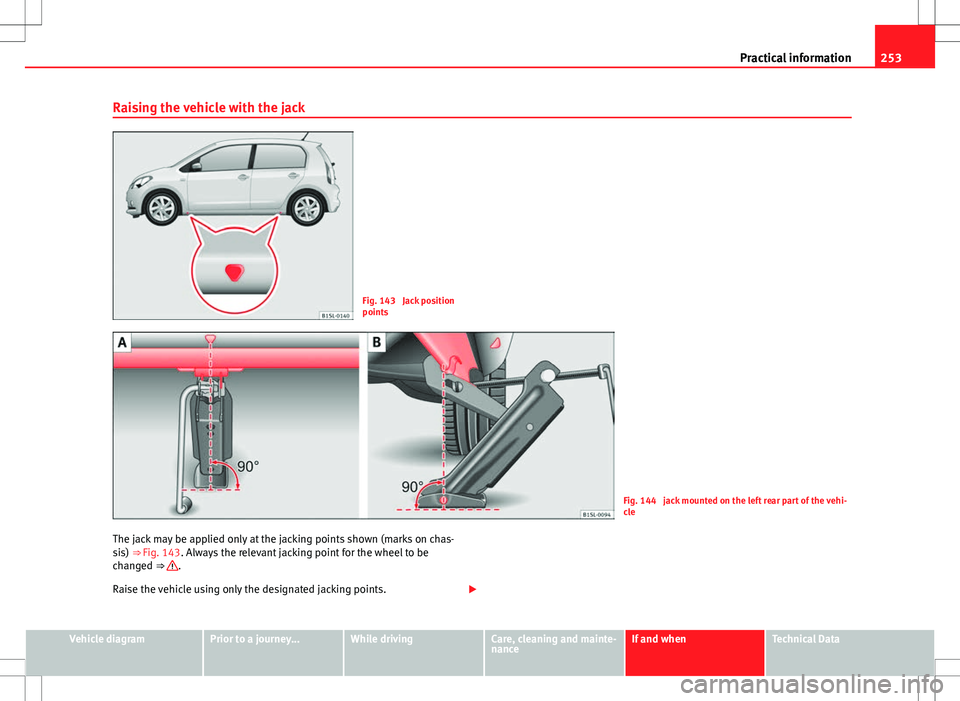
The jack may be applied only at the jacking points shown (marks on chas-
sis) ⇒ Fig. 143. Always the relevant jacking point for the wheel to be
changed ⇒
.
Raise the vehicle using only the designated jacking points.
Vehicle diagramPrior to a journey...While drivingCare, cleaning and mainte-
nanceIf and whenTechnical Data
Page 256 of 308
254Practical information
Check list
For your own safety and that of other passengers, the following points
should be observed in the order given ⇒
:
1. Select a suitable flat and firm surface for raising the vehicle.
2. Switch off the engine, engage a gear (manual gearbox) or place the selector lever in position P ⇒ page 124 and engage the handbrake
⇒ page 134.
3. Block the wheel diagonally opposite the wheel being changed with collapsible wheel chocks or other suitable objects.
4. Loosen the wheel bolts on the wheel to be changed ⇒ page 251.
5. Look below the vehicle for the jacking point ⇒ Fig. 143 closest to the
tyre which has to be changed.
6. Raise the jack with the handle until it can be inserted below the jack- ing point.
7. Ensure that the foot of the jack is firmly on the ground and that it is placed, at a vertical angle, immediately below the lifting point on the
vehicle ⇒ Fig. 144.
8. Straighten the jack and continue raising it using the handle until the claw holds the vertical reinforcement beneath the vehicle ⇒ Fig. 144.
9. Raise the vehicle until the wheel is clear of the ground.
WARNING
If the vehicle is not correctly raised, it could fall off the jack causing seri-
ous injury. Please observe the following rules to minimise the risk of in-
jury:
● You should only use a jack approved by SEAT for your vehicle. Other
jacks, even those approved for other SEAT models, might slip out of
place.
WARNING (Continued)
● The ground should be firm and flat. If the ground is sloped or soft
then the vehicle could slip and fall off the jack. If necessary, support the
jack on a wide solid base.
● If the ground is slippery (for example, on tiles), place a non-slip sur-
face (for example a floor mat) beneath the jack to avoid slipping.
● Only fit the jack at the prescribed jacking points. The claw of the jack
should grip the reinforcement nerve on the underbody ⇒ Fig. 144.
● You should never have any limbs beneath a raised vehicle which is
only supported by a jack.
● If you have to work underneath the vehicle, you must use suitable
stands additionally to support the vehicle, there is a risk of accident!.
● Never raise the vehicle if it is tilting to one side or the engine is run-
ning.
● Never start the engine when the vehicle is raised. The vehicle may
come loose from the jack due to the engine vibrations.
WARNING
Failure to follow the checklist prepared for your own safety could lead to
accidents and severe injuries.
● Always complete the operations given in the checklist and observe
the general rules of safety.
Page 257 of 308

255
Practical information
Changing a wheel
Fig. 145 Changing the
wheel: loosen wheel
bolts with the socket at
the end of the wheel
brace
Removing the wheel
● Please observe the check list ⇒ page 251.
● Loosen the wheel bolts ⇒ page 251.
● Jacking up the vehicle ⇒ page 253.
● Using the hexagonal socket in the wheel brace ⇒ Fig. 145, unscrew the
slackened wheel bolts and place them on a clean surface.
● Take off the wheel.
How to use the spare wheel or temporary spare wheel
Check the direction of rotation of the tyre ⇒ page 218, Tyre code.
● Place the spare wheel or temporary spare wheel into position.
● Replace the wheel bolts and tighten slightly using the hexagonal socket
on the end of the wheel brace.
● To tighten the anti-theft locking wheel bolts use the corresponding
adaptor.
● Lower the vehicle with the jack. ●
Tighten all of the wheel bolts clockwise ⇒
. Tighten the bolts in diago-
nal pairs (not in a circle).
● Put the caps, trim or full hubcap back on ⇒ page 248.
WARNING
If the wheel bolts are not treated suitably or not tightened to the correct
torque then this could lead to loss of vehicle control and to a serious ac-
cident.
● All the wheel bolts and hub threads should be clean and free of oil
and grease. The wheel bolts should be easily tightened to the correct tor-
que.
● The hexagonal socket in the wheel brace should be used for turning
wheel bolts only. Do not use it to loosen or tighten the wheel bolts.
After changing the wheel
● Clean the vehicle tools, if necessary and put them away in the luggage
compartment foam holder ⇒ page 246.
● Store the spare wheel, the temporary spare wheel or the changed wheel
securely in the luggage compartment.
● Have the tightening torque of the wheel bolts checked as soon as possi-
ble with a torque wrench ⇒ page 252.
● Have the flat tyre replaced as quickly as possible.
Vehicle diagramPrior to a journey...While drivingCare, cleaning and mainte-
nanceIf and whenTechnical Data
Page 258 of 308

256Practical information
Anti-puncture kit*
Introduction
The Tyre Mobility Set* will reliably seal punctures caused by the penetration
of a foreign body of up to about 4 mm in diameter. Do not remove foreign
objects, e.g. screws or nails, from the tyre.
After inserting the sealant residue in the tyre, you must again check the tyre
pressure about 10 minutes after starting the engine.
You should only use the tire mobility set if the vehicle is parked in a safe
place, you are familiar with the procedure and you have the necessary tire
mobility set! Otherwise, you should seek professional assistance.
The tyre sealant must not be used in the following cases:
● If the wheel rim has been damaged.
● In outside temperatures below -20 °C (-4 °F).
● In the event of cuts or perforations in the tyre greater than 4 mm.
● If you have been driving with very low pressure or a completely flat tyre.
● If the sealant bottle has passes its use by date.
Additional information and warnings:
● Vehicle key set ⇒ page 28
● Braking, stopping and parking ⇒ page 134
● Wheels and tyres ⇒ page 210
● In case of emergency ⇒ page 240
● Wheel trims ⇒ page 248
WARNING
Using the tire mobility set can be dangerous, especially when filling the
tyre at the roadside. Please observe the following rules to minimise the
risk of injury:
● Stop the vehicle safely as soon as possible. Park your vehicle as safe
distance from surrounding traffic to fill the tyre.
● Ensure the ground on which you park is flat and solid.
● All passengers and particularly children must keep a safe distance
from the work area.
● Turn on the hazard warning lights to warn other road users.
● Use the tire mobility set only if you are familiar with the necessary
procedure. Otherwise, you should seek professional assistance.
● The tire mobility set is intended for temporary, emergency use only.
Use only until you can reach the nearest specialised workshop.
● Replace the repaired tyre with the tire mobility set as soon as possi-
ble.
● The sealant is a health hazard and must be cleaned immediately if it
comes into contact with the skin.
● Always keep the tire mobility set out of the reach of small children.
● Never use the approved jack, even if it has been approved for your ve-
hicle.
● Always stop the engine, apply the handbrake lever firmly and engage
gear if using a manual gearbox, in order to reduce the risk of vehicle in-
voluntary movement.
WARNING
A tyre filled with sealant does not have the same performance properties
as a conventional tyre.
● Never drive faster than 80 km/h (50 mph).
Page 261 of 308

259
Practical information
● Start the vehicle engine and leave it running.
● Attach the connector ⇒ Fig. 146 9
to a 12 volt socket of the vehicle
⇒ page 117.
● Connect the air compressor with the ON/OFF switch ⇒ Fig. 146 8
.
● Keep the air compressor running until it reaches 2.0 to 2.5 bar
(29-36 psi / 200-250 kPa) ⇒
. Maximum operation time 8 minutes ⇒ .
● Disconnect the air compressor.
● If it is not possible to achieve an air pressure of 2.0 to 2.5 bar
(29-36 psi / 200-250 kPa), unscrew the tyre inflator tube from the tyre valve.
● Move the vehicle some 10 metres forwards or backwards so that the
sealant is evenly distributed in the tyre interior.
● Securely screw the compressor tyre inflator tube into the tyre valve and
repeat the inflation process.
● If the indicated pressure can still not be reached, the tyre is too badly
damaged. The tyre cannot be sealed with the anti-puncture kit. Do not con-
tinue driving. You should obtain professional assistance ⇒
.
● Disconnect the air compressor and unscrew the flexible inflator tube
from the tyre valve.
● When the tyre pressure is between 2.5 and 2.0 bars, immediately con-
tinue driving without exceeding 80 km/h (50 mph).
● After 10 minutes, Check the pressure again ⇒ page 259.
WARNING
When inflating the wheel, the air compressor and the inflator tube may
become hot.
● Protect hands and skin from hot parts.
● Do not place the hot flexible inflator tube or hot air compressor on
flammable material.
WARNING (Continued)
● Allow them to cool before storing the device.
● If it is not possible to inflate the tyre to at least 2.0 bars (29 psi /
200 kPa), the tyre is too badly damaged. The sealant is not in a good con-
dition to seal the tyre. Do not continue driving. You should obtain profes-
sional assistance.
CAUTION
Switch off the air compressor after a maximum of 8 operational minutes to
avoid overheating! Before switching on the air compressor again, let it cool
for several minutes.
Check after 10 minutes of driving
Screw the inflator tube ⇒ Fig. 146 5 again and check the pressure on the
gauge 6.
1.3 bar (19 psi / 130 kPa) and lower:
● Stop the vehicle! The tyre cannot be sealed sufficiently with the tyre mo-
bility set.
● You should obtain professional assistance ⇒
.
1.4 bar (20 psi / 140 kPa) and higher:
● Set the tyre pressure to the correct value again ⇒ page 210.
● Carefully resume your journey until you reach the nearest specialised
workshop without exceeding 80 km/h (50 mph).
● Have the damaged tyre replaced.
Vehicle diagramPrior to a journey...While drivingCare, cleaning and mainte-
nanceIf and whenTechnical Data
Page 269 of 308

267
Practical information
Complete operations only in the sequence given:
⇒ Fig. 150ABCDipped beam and main beam headlightsSide light and daytime driving lightTurn signals (front)
6.Insert the bulb, return it to its position and
insert the retaining clip D.Insert the bulb holder in the headlight and
turn it clockwise as far as the stop.Insert the bulb holder in the headlight and
turn it clockwise as far as the stop.
7.Place the rubber cover and check that is
correctly in position. Insert the connector to the bulb H4.
Note
The images show the left hand headlight from behind. The structure of the
right hand side headlight is symmetric.
Replacing the front bumper bulbs
Fig. 151 In the front
right wheel arch: Remove
the retaining screws (ar-
rows) and take out the
expansive rivet A
.
Fig. 152 Changing the
bulbs in the headlights
Complete operations only in the sequence given:
1.Always take the checklist into account and take the necessary ac-
tions
⇒ page 265.
2.Unscrew the 2 retaining screws of the wheel arch trim ⇒ Fig. 151
(arrows) with the screwdriver from the vehicle took kit ⇒ page 246.
3.Unscrew the expansive rivet in the lower front part of the wheel arch
trim A with the screwdriver from the vehicle tool kit and complete-
ly remove it ⇒ page 246.
4.Carefully fold the wheel arch trim to the side.5.Release the connector ⇒ Fig. 152 1 and remove it.
Vehicle diagramPrior to a journey...While drivingCare, cleaning and mainte-
nanceIf and whenTechnical Data
Page 270 of 308

268Practical information
Complete operations only in the sequence given:
6.Turn the bulb holder ⇒ Fig. 152 in the direction of the arrow, in an
anticlockwise direction as far as it will go and remove it, along with
the bulb, pulling backwards.
7.Replace the faulty bulb by a new identical bulb.
8.Insert the bulb holder in the headlight and turn it clockwise as far
as the stop.
9.Plug the connector 1 into the bulb holder. The connector must au-
dibly click into place.
Complete operations only in the sequence given:10.Replace the wheel arch trim into its position.
11.Place the expansive rivet in the wheel arch trim and bumper and
press it completely inwards ⇒ Fig. 151 A.
12.Securely screw the 2 retaining screws
⇒ Fig. 151 (arrows) with a
screwdriver.
Page 278 of 308
276Practical information
Towing and tow starting
Introduction
When towing or tow starting, respect the legal requirements.
For technical reasons, it is not possible to tow a vehicle if the battery is flat.
Additional information and warnings:
● Exterior detail ⇒ page 6
● Electronic power control and exhaust gases purification system
⇒ page 236
WARNING
A vehicle with a flat battery should never be towed.
● Never remove the key from the ignition lock. Otherwise, the steering
wheel lock could suddenly lock. Then the vehicle will be uncontrollable.
You may lose control of the vehicle and there is a risk of serious accident.
WARNING
When towing the vehicle, the handling and braking efficiency change
considerably. Please observe the following instructions to minimise the
risk of serious accidents and injury:
● As the driver of the vehicle being towed:
– The brake must be depressed must harder as the brake servo does
not operate. Always remain aware to avoid collision with the towing
vehicle.
– More strength is required at the steering wheel as the power steer-
ing does not operate when the engine is switched off.
● As the driver of the towing vehicle:
– Accelerate gently and carefully.
– Avoid sudden braking and manoeuvres.
– Brake well in advance than usual and brake gently.
CAUTION
● Carefully fit and remove the towing ring and its cover to avoid damage to
the vehicle (for example, paintwork).
● When towing, fuel could enter the catalytic converter and cause dam-
age!
Note
Fitting a towline anchorage to the rear bumper is not possible. The vehicle is
not suitable for towing other vehicles.
Page 279 of 308
277
Practical information
Instructions for tow starting
In general, the vehicle should not be started by towing. Jump-starting is
much more preferable ⇒ page 273.
For technical reasons, the following vehicles can not be tow started:
● Vehicles with an automatic gearbox.
● If the vehicle battery is flat, it is possible that the engine control unit
does not operate correctly.
However, if your vehicle must absolutely be tow-started (manual gearbox):
● Engage the 2nd or 3rd gear.
● Keep the clutch pressed down.
● Switch on the ignition and the hazard warning lights.
● Release the clutch when both vehicles are moving.
● As soon as the engine starts, press the clutch and move the gear lever
into neutral. This helps to prevent a collision with the towing vehicle.
CAUTION
When tow-starting, fuel could enter the catalytic converter and damage it.
Notes on towing
Tow rope or tow bar
When towing, the tow bar is the safest and vehicle friendly way. You should
only use a tow rope if you do not have a tow bar.
A tow rope should be slightly elastic to avoid damage to both vehicles. It is
advisable to use a tow rope made of synthetic fibre or similarly elastic mate-
rial. Only secure the tow rope or tow bar to the tow ring or specially designed
fitting.
Towing vehicles with an automatic gearbox
Note the following for a towed vehicle:
●
Make sure the gear selector lever is in the N position.
● Do not drive faster than 50 km/h (30 mph) when towing a vehicle.
● Do not tow further than 50 km (30 miles).
● If a breakdown truck is used, the vehicle must be towed with the front
wheels raised.
Situations in which the vehicle should not be towed
In the following cases, the vehicle should not be towed but transported on a
trailer or special vehicle:
● If the vehicle gearbox does not contain lubricant due to a fault.
● If the battery is flat as the steering cannot be unlocked, as a result, the
electronic steering lock and electronic parking brake cannot be disengaged.
● If the vehicle to be towed has an automatic gearbox and the distance to
be covered is greater than 50 km (30 miles).
Note
The vehicle can only be towed if the steering lock electronic gearbox lock is
deactivated. If the vehicle has no power supply or there is an electric system
fault, the engine must be started using jump leads to deactivate the steer-
ing column electronic gearbox lock.
Vehicle diagramPrior to a journey...While drivingCare, cleaning and mainte-
nanceIf and whenTechnical Data