wheel Seat Mii 2012 Workshop Manual
[x] Cancel search | Manufacturer: SEAT, Model Year: 2012, Model line: Mii, Model: Seat Mii 2012Pages: 308, PDF Size: 4.13 MB
Page 225 of 308

223
Vehicle care and maintenance
Running-in
Please observe the instructions for running-in new components.
Running-in the engine
The engine needs to be run in over the first 1500 km (1000 miles). During
its first few hours of running, the internal friction in the engine is greater
than later on when all the moving parts have bedded down.
How the vehicle is driven for the first 1500 km (1000 miles) influences the
future engine performance. Throughout the life of the vehicle, it should be
driven at a moderate speed, especially when the engine is cold, as this will
reduce engine wear and increase its useful life. Never drive at extremely low
engine speeds. Change down to a lower gear when the engine no longer
runs “smoothly”. Up to 1000 kilometres the following instructions apply:
● Do not use full throttle.
● Do not force the engine above two thirds of its maximum speed.
Between 1000 and 1500 kilometres (600 to 1000 miles), gradually in-
crease power until reaching the maximum speed and high engine speeds.
Running in new tyres and brake pads
● Replacement of new tyres and wheel trims ⇒ page 210
● Notes on the brakes ⇒ page 134
For the sake of the environment
If the engine is run in gently, the life of the engine will be increased and the
engine oil consumption reduced.
Accessories and spare parts
SEAT recommends you consult an Official Service before purchasing acces-
sories and spare parts or consumables. For example, when fitting accesso- ries at a later date, or when replacing a component. A SEAT Official Service
will advise you as to the legal requirements and manufacturer's recommen-
dations regarding accessories, spare parts and other components.
SEAT recommend you use only approved
SEAT accessories and genuine
SEAT spare parts ®
. These parts and accessories have been specially tested
by SEAT for suitability, reliability and safety. In addition the SEAT Technical
Service will guarantee that the assembly is carried out professionally.
Although we continually monitor the market, SEAT cannot guarantee that
products not approved by SEAT are reliable, safe and suitable for the vehi-
cle. Therefore, SEAT cannot accept liability, even in those cases authorised
by an officially recognised technical inspection office or other official body.
Any retro-fitted equipment which has a direct effect on vehicle control must
be approved by SEAT for use in your vehicle and bear the e mark (the Euro-
pean Union's authorisation symbol). This includes cruise control systems or
electronically controlled suspension.
If any additional electrical components are fitted which do not serve to con-
trol the vehicle itself, these must bear the mark (European Union manu-
facturer conformity declaration). This includes refrigerator boxes, laptops or
ventilator fans.
WARNING
Unprofessional repairs or modifications to the vehicle may affect the per-
formance of the airbags, resulting in operating faults or fatal accident.
● Never mount, fasten or fit objects such as drink holders or telephone
cradles over or next to the covers of the airbag modules or within their
deployment zones.
● Objects placed over the airbag covers, or within their deployment
zones, could lead to serious injury or loss of life if the airbags are trig-
gered.
Vehicle diagramPrior to a journey...While drivingCare, cleaning and mainte-
nanceIf and whenTechnical Data
Page 227 of 308

225
Vehicle care and maintenance
The vehicle owner should keep the documentation for the additional equip-
ment safely and hand it over to the scrap yard at the end of the vehicle's
service life. This ensures that any additional equipment mounted in end-of-
life vehicles is correctly disposed of with respect for the environment.
WARNING
Repairs or modifications which are not performed correctly may result in
damage or errors in the vehicle operation, affecting the efficiency of the
driver assist systems. This could result in serious accident.
● All repairs and modifications to the vehicle should only be performed
by a Specialised workshop.
Repair and faults in the airbag system
When performing repairs and technical modifications, SEAT's directives
must be observed! ⇒
Modifications and repairs to the front bumper, doors, front seats, and re-
pairs to the roof or chassis should only be carried out in a Specialised work-
shop. These components may contain parts or sensors belonging to the air-
bag system.
If work is carried out on the airbag system or parts have to be removed and
fitted on the system when performing other repair work, parts of the airbag
system may be damaged. The consequence may be that, in the event of an
accident, the airbag inflates incorrectly or does not inflate at all.
So that the effectiveness of the airbag is not reduced and that removed
parts do not cause any injuries or environmental pollution, regulations must
be observed. These requirements are known to qualified dealerships.
Modifications to the vehicle suspension may affect the operation of the air-
bag system in the event of collision. For example, if wheel and tyre combi-
nations not approved by SEAT are used, or if the vehicle height is lowered, the suspension is stiffened or the suspension springs, telescopic arms,
dampers, etc., are modified, the results received by the airbag sensors and
sent to the control unit may not be accurate. For example, some modifica-
tions to the suspension could increase the force measured by the sensors
and result in the triggering of the airbag systems in collisions. Under normal
conditions, the measured values would be lower and the airbag would not
have been triggered. Other modifications may reduce the forces measured
by the sensors and therefore the airbags are not triggered in situations
when they should have triggered.
WARNING
Repairs or modifications which are not performed correctly may result in
damage or errors in the vehicle operation, affecting the efficiency of the
airbag systems. This could result in serious or fatal accident.
● All repairs and modifications to the vehicle should only be performed
by a Specialised workshop.
● Airbag modules must never be repaired: if damaged, they must be re-
placed.
● Never fit recycled or reused airbag components in your vehicle.
WARNING
Modifications to the vehicle suspension, including the use of unauthor-
ised wheel and tyre combinations, may affect the performance of the air-
bags and increase the risk of serious or fatal injury in the event of acci-
dent.
● Never fit suspension components which are not identical to the origi-
nal parts mounted in the vehicle.
● Never use wheel and tyre combinations not approved by SEAT.
Vehicle diagramPrior to a journey...While drivingCare, cleaning and mainte-
nanceIf and whenTechnical Data
Page 240 of 308

238Practical information
If and when
Practical information
Frequently asked questions
If you suspect that the vehicle has a fault or is damaged when using it, be-
fore consulting a SEAT dealership or a specialised workshop, carefully read
the following instructions. Similarly, the terms in the alphabetical index
“Things to note” or “Checklist” may be of help.
ProblemPossible causes,
among othersPossible solution
The engine does
not start.
The vehicle battery is
flat.– Carry out the jump start
⇒ page 273.
– Charge the battery
⇒ page 193.
You are using an incor-
rect vehicle key.Use the correct key
⇒ page 28.
The fuel tank level is
insufficient.Refuel ⇒ page 171.
The vehicle cannot
be locked or un-
locked with the
key.
– Vehicle key battery is
flat.
– Too far away from
the vehicle.
– Buttons pressed out-
side the radius of
reach.– Change the battery
⇒ page 28.
– Move closer to the vehicle.
– Synchronize the vehicle
key ⇒ page 28.
– Manually lock or unlock
the vehicle ⇒ page 243.
Unusual noises.
Engine cold, City Safe-
ty Assist system, steer-
ing column electronic
lock.See entry “Noises” in the de-
tailed alphabetical index.
ProblemPossible causes,
among othersPossible solution
Handling is
strange.
Assistance systems ac-
tive.See entry “Assistance sys-
tems” in the detailed alpha-
betical index.
You are using an incor-
rect tyre pressure.Check the tyre pressure
⇒ page 210.
Damage to the wheel
trims or tyres.
Inspect wheel trims and
tyres regularly for damage
⇒ page 210 and replace
them if necessary
⇒ page 250.
Vehicle has no
jack, spare wheel
or tire mobility set
present.Equipment subject to
the vehicle.
No direct solution, depends
on the equipment. In this
case, you should contact a
SEAT Dealership
⇒ page 246.
Surface not correct-
ly illuminated.
– Headlights covered
for driving on the left-
hand side or right-
hand side.
– Headlight adjust-
ment too high.
– Faulty bulbs.
– Dipped headlights
switched off.– Cover the headlights for
driving on the left-hand side
or right-hand side
⇒ page 84.
– Adjust the headlight range
⇒ page 84.
– Change the bulbs
⇒ page 264.
– Switch on the dipped
headlights ⇒ page 84.
Page 242 of 308

240Practical information
In case of emergency
Introduction
Additional information and warnings:
● Braking, stopping and parking ⇒ page 134
● Emergency locking and unlocking ⇒ page 243
● Vehicle tools ⇒ page 246
● Change wheel ⇒ page 250
WARNING
A faulty vehicle in traffic represents a risk of accident for the driver and
for other road users.
● Stop the vehicle safely as soon as possible. Park the vehicle a safe
distance from surrounding traffic to lock all the doors in case of an emer-
gency. Turn on the hazard warning lights to warn other road users.
● Never leave children or disabled people alone in the vehicle if the
doors are to be locked. In case of an emergency, passengers will be trap-
ped inside the vehicle. Individuals locked in the vehicle can be exposed
to very high or very low temperatures.
Protecting yourself and securing the vehicle
Fig. 130 Dash panel:
Button to switch on and
off the hazard warning
lights system
Always fulfil legal requirements for securing a broken down vehicle. In a
number of countries it is now obligatory, for example, to turn on the hazard
warning lights and use a reflective safety vest ⇒ page 242.
Checklist
For your own safety and that of other passengers, the following points
should be observed in the order given ⇒
:
1. Park the vehicle a safe distance from traffic and on suitable ground ⇒
.
2. Turn on the hazard warning lights system with the button
⇒ Fig. 130.
3. Apply the handbrake firmly ⇒ page 134.
4. Put the gearbox lever in neutral or the selector lever in position P ⇒ page 124.
5. Switch off the engine and remove the key from the ignition.
6. Have all occupants leave the vehicle and move to safety, for example behind a guard rail.
Page 248 of 308
246Practical information
Vehicle tool kit*
Introduction
When securing the vehicle in case of a breakdown, please note the legal re-
quirements for each country.
Vehicle tool kit
For vehicles with a factory-fitted spare wheel or temporary spare wheel, in
addition to winter wheels, the luggage compartment may contain additional
vehicle tools ⇒ page 246.
Additional information and warnings:
● Working in the engine compartment ⇒ page 180
● In case of emergency ⇒ page 240
● Change wheel ⇒ page 250
● Tire Mobility Set ⇒ page 256
WARNING
When the vehicle tool kit, tire mobility set and spare wheel are loose in
the interior they can be violently thrown in case of a sudden manoeuvre
or braking and especially in accidents causing serious injury.
● Ensure that the vehicle tool kit, the tire mobility set and the spare
wheel or temporary spare wheel are safely secured in the luggage com-
partment.
WARNING
Unsuitable or damaged vehicle tool kit can cause injury or accidents.
● Never work with inappropriate or damaged tools.
Location
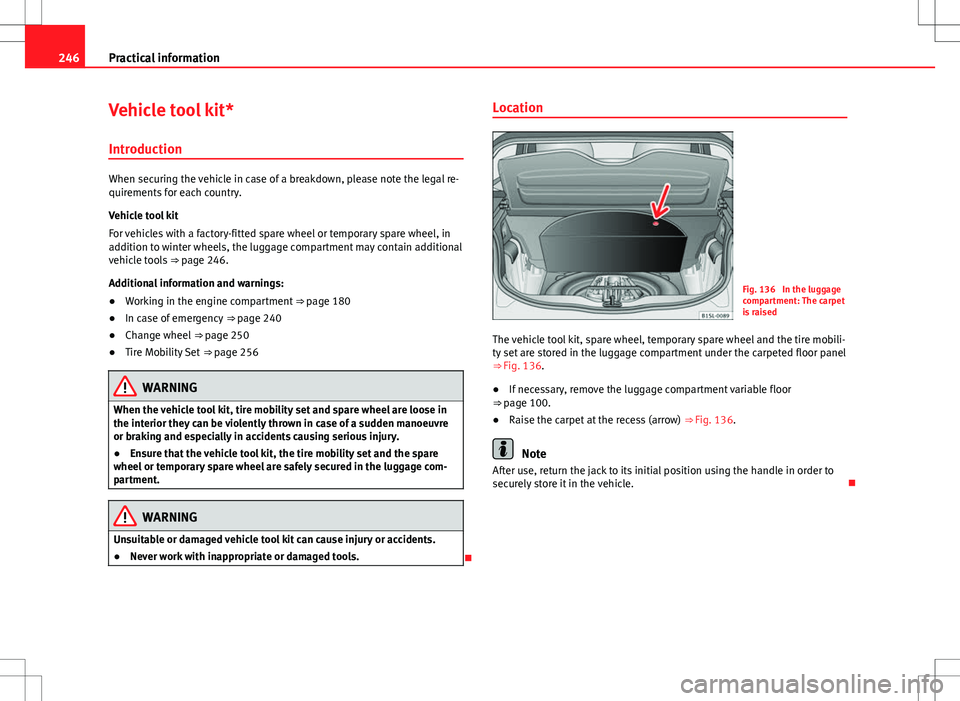
Fig. 136 In the luggage
compartment: The carpet
is raised
The vehicle tool kit, spare wheel, temporary spare wheel and the tire mobili-
ty set are stored in the luggage compartment under the carpeted floor panel
⇒ Fig. 136.
● If necessary, remove the luggage compartment variable floor
⇒ page 100.
● Raise the carpet at the recess (arrow) ⇒ Fig. 136.
Note
After use, return the jack to its initial position using the handle in order to
securely store it in the vehicle.
Page 249 of 308
247
Practical information
Components
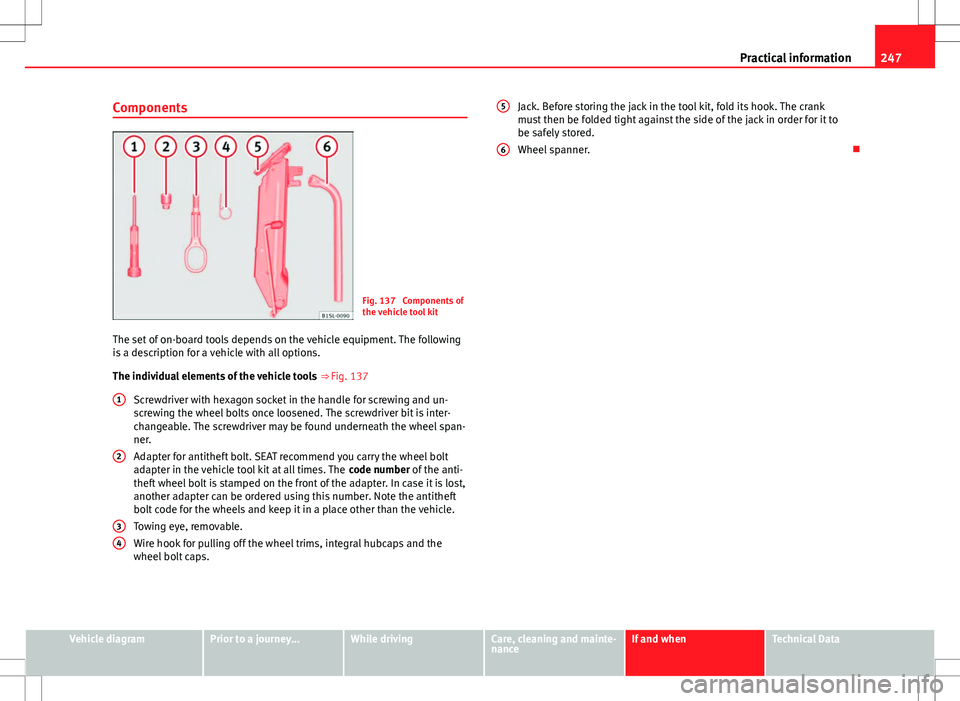
Fig. 137 Components of
the vehicle tool kit
The set of on-board tools depends on the vehicle equipment. The following
is a description for a vehicle with all options.
The individual elements of the vehicle tools ⇒ Fig. 137
Screwdriver with hexagon socket in the handle for screwing and un-
screwing the wheel bolts once loosened. The screwdriver bit is inter-
changeable. The screwdriver may be found underneath the wheel span-
ner.
Adapter for antitheft bolt. SEAT recommend you carry the wheel bolt
adapter in the vehicle tool kit at all times. The code number of the anti-
theft wheel bolt is stamped on the front of the adapter. In case it is lost,
another adapter can be ordered using this number. Note the antitheft
bolt code for the wheels and keep it in a place other than the vehicle.
Towing eye, removable.
Wire hook for pulling off the wheel trims, integral hubcaps and the
wheel bolt caps.
1
2
34
Jack. Before storing the jack in the tool kit, fold its hook. The crank
must then be folded tight against the side of the jack in order for it to
be safely stored.
Wheel spanner.
5
6
Vehicle diagramPrior to a journey...While drivingCare, cleaning and mainte-
nanceIf and whenTechnical Data
Page 250 of 308
248Practical information
Wheel trims
Introduction
Additional information and warnings:
● Caring for and cleaning the vehicle exterior ⇒ page 197
● Vehicle tools ⇒ page 246
● Change wheel ⇒ page 250
● Tire Mobility Set ⇒ page 256
WARNING
If the wheel trims are not appropriate or not fitted correctly, they could
cause major accidents or damage.
● Incorrectly mounted wheel trims may come off while driving and en-
danger other road users.
● Damaged trims must never be mounted on the wheels.
● Always ensure that the brake ventilation and cooling is not cut off or
blocked. This is also valid if hubcaps are fitted later. If there is not
enough air, you may require significantly longer braking distances.
CAUTION
Remove and remount wheel trims taking care to avoid damage to the vehi-
cle. Hubcaps
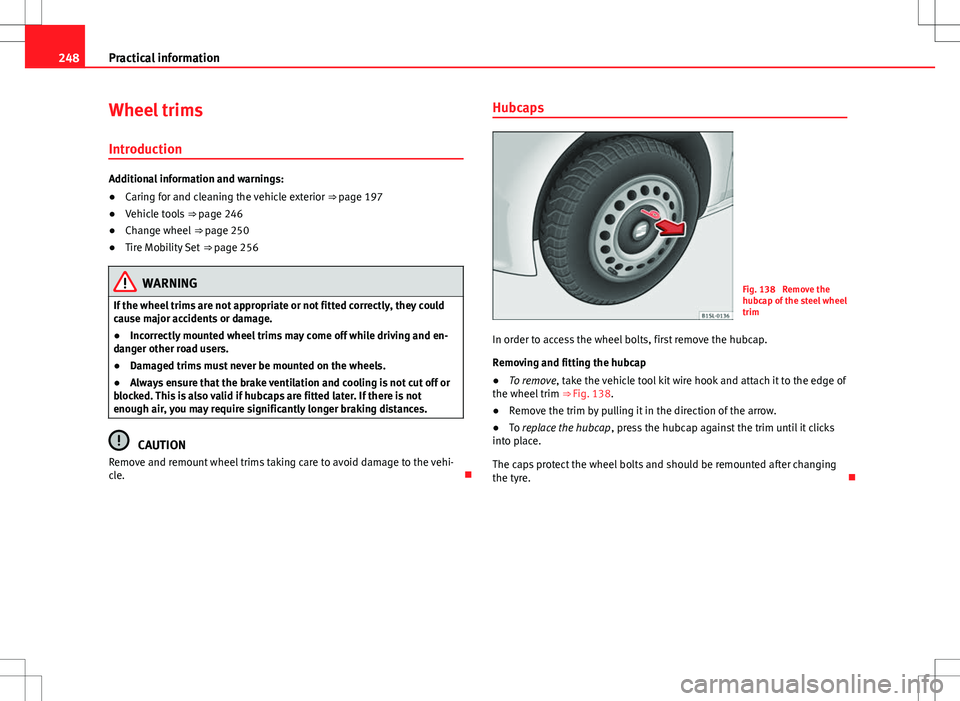
Fig. 138 Remove the
hubcap of the steel wheel
trim
In order to access the wheel bolts, first remove the hubcap.
Removing and fitting the hubcap
● To remove, take the vehicle tool kit wire hook and attach it to the edge of
the wheel trim ⇒ Fig. 138.
● Remove the trim by pulling it in the direction of the arrow.
● To replace the hubcap , press the hubcap against the trim until it clicks
into place.
The caps protect the wheel bolts and should be remounted after changing
the tyre.
Page 251 of 308

249
Practical information
Full hubcaps
Fig. 139 Removing the
full hubcap
Removing the full hubcap
● Take the wheel brace and the wire hook from the vehicle tool kit
⇒ page 246.
● Hook the wire through one of the grooves on the hubcap.
● Insert the wheel brace onto the wire hook
⇒ Fig. 139 and pull the hub
cap in the direction shown by the arrow.
Fitting hubcaps
Press the hubcap against the wheel so that the space for the valve fits over
the tyre valve. Make sure that the hubcap is correctly fitted all the way
around the wheel. If you are using an anti-theft wheel lock, screw it in the
opposite position to the valve. Wheel bolt capsFig. 140 Removing the
wheel bolt caps
● Take the wire hook from the vehicle tool kit ⇒ page 246.
● Insert the wire hook in the cap through the opening ⇒ Fig. 140 and pull
outwards in the direction of the arrow.
The caps protect the wheel bolts and should be remounted after changing
the tyre.
The anti-theft wheel locking bolt has a special cap. This cap only fits on an-
ti-theft locking bolts and is not for use with standard wheel bolts.
Vehicle diagramPrior to a journey...While drivingCare, cleaning and mainte-
nanceIf and whenTechnical Data
Page 252 of 308

250Practical information
Changing a wheel
Introduction
Some vehicle versions and models do not have a factory-fitted jack or box
spanner. In this case, we recommend consulting a Specialised workshop to
change the wheel.
You should only change the wheels yourself if the vehicle is parked in a safe
place, you are familiar with the procedure and you have all the necessary
tools! Otherwise, you should seek professional assistance.
Additional information and warnings:
● Exterior detail ⇒ page 6
● Vehicle key set ⇒ page 28
● Wheels and tyres ⇒ page 210
● In case of emergency ⇒ page 240
● Vehicle tools ⇒ page 246
● Wheel trims ⇒ page 248
WARNING
Changing a wheel can be dangerous, especially on the hard shoulder.
Please observe the following rules to minimise the risk of injury:
● Stop the vehicle safely as soon as possible. Park your vehicle as safe
distance from surrounding traffic to change a wheel.
● When changing a wheel, keep all passengers and particularly chil-
dren a safe distance away from the work area.
● Turn on the hazard warning lights to warn other road users.
● Ensure the ground on which you park is flat and solid. If necessary,
support the jack on a wide solid base.
WARNING (Continued)
● If you are changing a wheel yourself, you should be familiar with the
required procedure. Otherwise, you should seek professional assistance.
● Only use suitable tools that are not damaged when changing a wheel.
● Always stop the engine, apply the handbrake lever firmly and place
the selector lever in position P, or engage a gear for a manual gearbox to
reduce the risk of the vehicle moving accidentally.
● Have the tightening torque of the wheel bolts checked as soon as
possible with a reliable torque wrench.
Page 253 of 308

251
Practical information
Preparations for changing a wheel
Check list
Before changing a wheel, complete the following operations in the order
given ⇒
:
1. In the event of a flat tyre, park the vehicle a safe distance from traffic and on suitable ground.
2. Apply the handbrake firmly ⇒ page 134.
3. Automatic gearbox: move the selector lever to position P
⇒ page 124.
4. Stop the engine and remove the key from the ignition ⇒ page 119.
5. Manual gearbox: Select a gear ⇒ page 124.
6. Have all vehicle occupants get out of the vehicle and wait in a safe place (for example, behind the safety barrier).
7. Chock the wheel opposite the wheel being changed with a stone or similar object.
8. If the luggage compartment is full: take the baggage out of the vehi- cle.
9. Remove the spare wheel or the temporary spare wheel and the vehi- cle tool kit from the luggage compartment.
10. Remove the wheel trims ⇒ page 248.
WARNING
Failure to follow the checklist prepared for your own safety could lead to
accidents and severe injuries.
● Always complete the operations given in the checklist and observe
the general rules of safety.
Wheel bolts
Fig. 141 Changing the
wheel: Slacken the wheel
bolts
Fig. 142 Changing the
wheel: Tyre valve
1 and
position of anti-theft
wheel locking bolt 2
Only use the tool supplied with the vehicle to loosen the wheel bolts.
Loosen the wheel bolts only about one turn before raising the vehicle with
the jack.
Vehicle diagramPrior to a journey...While drivingCare, cleaning and mainte-
nanceIf and whenTechnical Data