warning Seat Mii 2013 Owner's manual
[x] Cancel search | Manufacturer: SEAT, Model Year: 2013, Model line: Mii, Model: Seat Mii 2013Pages: 306, PDF Size: 4.3 MB
Page 227 of 306
225
Vehicle care and maintenance
The vehicle owner should keep the documentation for the additional equip-
ment safely and hand it over to the scrap yard at the end of the vehicle's
service life. This ensures that any additional equipment mounted in end-of-
life vehicles is correctly disposed of with respect for the environment.
WARNING
Repairs or modifications which are not performed correctly may result in
damage or errors in the vehicle operation, affecting the effectiveness of
the driver assist systems. This could result in serious accident.
● All repairs and modifications to the vehicle should only be performed
by a specialised workshop.
Repair and faults in the airbag system
When performing repairs and technical modifications, SEAT's directives
must be observed! ⇒
Modifications and repairs to the front bumper, doors, front seats, and re-
pairs to the roof or chassis should only be carried out in a specialised work-
shop. These components may contain parts or sensors belonging to the air-
bag system.
If work is carried out on the airbag system or parts have to be removed and
fitted on the system when performing other repair work, parts of the airbag
system may be damaged. The consequence may be that, in the event of an
accident, the airbag inflates incorrectly or does not inflate at all.
So that the effectiveness of the airbag is not reduced and that removed
parts do not cause any injuries or environmental pollution, regulations must
be observed. These requirements are known to specialised workshops.
Modifications to the vehicle suspension may affect the operation of the air-
bag system in the event of collision. For example, if wheel and tyre combi-
nations not approved by SEAT are used, or if the vehicle height is lowered, the suspension is stiffened or the suspension springs, telescopic arms,
dampers, etc., are modified, the results received by the airbag sensors and
sent to the control unit may not be accurate. For example, some modifica-
tions to the suspension could increase the force measured by the sensors
and result in the triggering of the airbag systems in collisions. Under normal
conditions, the measured values would be lower and the airbag would not
have been triggered. Other modifications may reduce the forces measured
by the sensors and therefore the airbags are not triggered in situations
when they should have triggered.
WARNING
Repairs or modifications which are not performed correctly may result in
damage or errors in the vehicle operation, affecting the effectiveness of
the airbag systems. This could result in serious or fatal accident.
● All repairs and modifications to the vehicle should only be performed
by a specialised workshop.
● Airbag modules must never be repaired: if damaged, they must be re-
placed.
● Never fit recycled or reused airbag components in your vehicle.
WARNING
Modifications to the vehicle suspension, including the use of unauthor-
ised wheel and tyre combinations, may affect the performance of the air-
bags and increase the risk of serious or fatal injury in the event of acci-
dent.
● Never fit suspension components which are not identical to the origi-
nal parts mounted in the vehicle.
● Never use wheel and tyre combinations not approved by SEAT.
Vehicle diagramPrior to a journey...While drivingCare, cleaning and mainte-
nanceIf and whenTechnical specifications
Page 228 of 306
226Vehicle care and maintenance
Retro-fitting of two-way radios
An exterior aerial is required for the use of two-way radios in the vehicle.
The retro-fitting of electrical or electronic appliances in the vehicle is sub-
ject to their approval for use in your vehicle. Under certain circumstances,
this could mean that your vehicle registration documents are no longer val-
id.
SEAT has approved your vehicle for use with two-way radios providing the
following conditions are observed:
●The exterior aerial must be mounted professionally.
● The maximum transmitting power is 10 watts.
The optimal reach of the equipment is only achieved with an external aerial.
Check first with a specialised workshop if you wish to use a two-way radio
with a transmitting power of over 10 watts. The specialised workshops are
familiar with the technical options for installation. SEAT recommends visit-
ing a Technical Service.
All legal requirements, together with the instructions for the use of two-way
radios must be observed.
WARNING
If the two-way radio is not securely fastened in position, it could be sent
flying around the vehicle in the event of sharp braking, sudden manoeu-
vres or accident, causing injury.
● While driving, two-way radios must be securely fastened in position,
outside the airbags deployment zones, or safely stowed away.
WARNING
When using a two-way radio without a connection to an exterior aerial,
the maximum permitted levels of electromagnetic radiation may be ex-
ceeded. This is also the case if the aerial has not been correctly installed.
● You should only use a two-way radio inside the vehicle if it has first
been correctly connected to an exterior aerial.
Information stored by the control units
Your vehicle is fitted at the factory with a series of electronic control units
responsible for the engine and gearbox management. In addition, the con-
trol units supervise the performance of the exhaust gas system and the air-
bag systems.
Therefore, while the vehicle is being driven, these electronic control units
are continuously analysing the vehicle data. In the event of faults or devia-
tions from the theoretical values, only this data is stored. Normally, the
warning lamps on the instrument panel light up in the event of faults.
This data can only be read and analysed using special equipment.
The storing of the data allows specialised workshops to detect and repair
faults. Stored data may include:
● Data relating to the engine or the gearbox
● Speed
● Direction of travel
● Braking force
● Detection of seat belt
The vehicle control units never record conversations held by passengers in
the vehicle.
Page 230 of 306
228Vehicle care and maintenance
plate. The mobile will be secure on the instrument panel and always within
reach of the driver only by following these procedures. Mobile telephone
connection with an external aerial is carried out subject to the hands-free
device, via the telephone support or by the Bluetooth ®
connections present
in the mobile telephone and the vehicle.
If the mobile phone is connected to an aerial incorporated into the vehicle
or an exterior aerial connected to the vehicle, this will help to reduce the
electromagnetic radiation transmitted and the risk to human health. It will
also improve the quality of the connection.
If the phone is used inside the vehicle without the hands-free system, it will
not be securely fastened and will not be connected to the exterior aerial of
the vehicle telephone. Nor will the telephone charge if it is not on the sup-
port. In addition, some calls may break off and the quality of the connection
will be affected.
Mobile telephones should only be used inside the vehicle if they are con-
nected to a hands-free system. SEAT recommends using an external aerial
should you wish to use a mobile telephone inside the vehicle.
Bluetooth ®
is a registered trademark of Bluetooth ®
SIG, Inc.
WARNING
If the mobile phone is not securely fastened in position, it could be sent
flying around the vehicle in the event of sharp braking, sudden manoeu-
vres or accident, causing injury.
● While driving, the mobile telephone, other equipment including tele-
phone accessories such as telephone supports, notepads and navigators
must be correctly secured, away from the airbags deployment zones, or
stored in a safe place.
WARNING
When using a mobile telephone or two-way radio without connecting an
external aerial, the maximum permitted levels of electromagnetic radia-
tion in the vehicle may be exceeded, thus putting the driver and the rest
of the vehicle occupants in danger. This is also the case if the aerial has
not been correctly installed.
● A minimum of 20 centimetres should be kept between mobile phone
aerials and artificial pacemakers, as mobile telephones may affect the
working of pacemakers.
● Do not keep mobile phones in breast pockets directly above pacemak-
ers.
● Immediately switch off the mobile telephone if you suspect any inter-
ference with pacemakers or other types of medical equipment.
Page 232 of 306
230Vehicle care and maintenance
Removing and fitting the navigator holder
● Press the holder release button ⇒ Fig. 129 (arrow).
● Remove the holder from the dash panel in an upwards direction.
● If necessary, close the opening with the corresponding cover.
In order to fit the holder, place it on the opening from above and press in a
downwards direction until it engages with a click. ⇒
.
WARNING
Any distraction may lead to an accident, with the risk of injury. Operating
the navigator could distract you from the traffic.
● Always stay alert and drive responsibly.
● Select volume settings that allow you to easily hear signals from out-
side the vehicle at all times (e.g. emergency service sirens).
● Setting the volume too high may cause damage to your hearing. This
also applies if the device is set to high volumes for a short period.
WARNING
Journey instructions and traffic signals shown on the navigation system
may differ to the current traffic situation.
● Traffic signals and driving regulations take precedence over journey
instructions and indications from the navigation system.
● Adjust your speed and driving style to visibility, road, traffic and
weather conditions.
WARNING
If the navigator is not securely fastened in position, it could be sent fly-
ing around the vehicle in the event of sharp braking, sudden manoeuvres
or accident, causing injury.
● Fit the navigator housing safely on the corresponding opening on the
dash panel.
● Always place the navigator securely in its holder or store it safely in
the vehicle.
CAUTION
An unsuitable gradient and angle of vision setting can damage the naviga-
tor.
● When adjusting the navigation device, move it with care and not beyond
its limits.
CAUTION
Excessively high or low outside temperatures can affect the Portable Navi-
gation System operation or damage the device.
● Always take the Portable Navigation System with you when you leave the
vehicle to protect it from excessively high or low temperatures and intense
sunlight.
CAUTION
Humidity can damage the Portable Navigation System connections on the
dash panel.
● Do not clean the holder for the navigation device with moist products.
Use a dry cloth.
Note
SEAT recommends taking the Portable Navigation System with you when
you leave the vehicle to prevent it from being stolen.
Page 233 of 306
231
Vehicle care and maintenance
Jacking points for raising vehicle
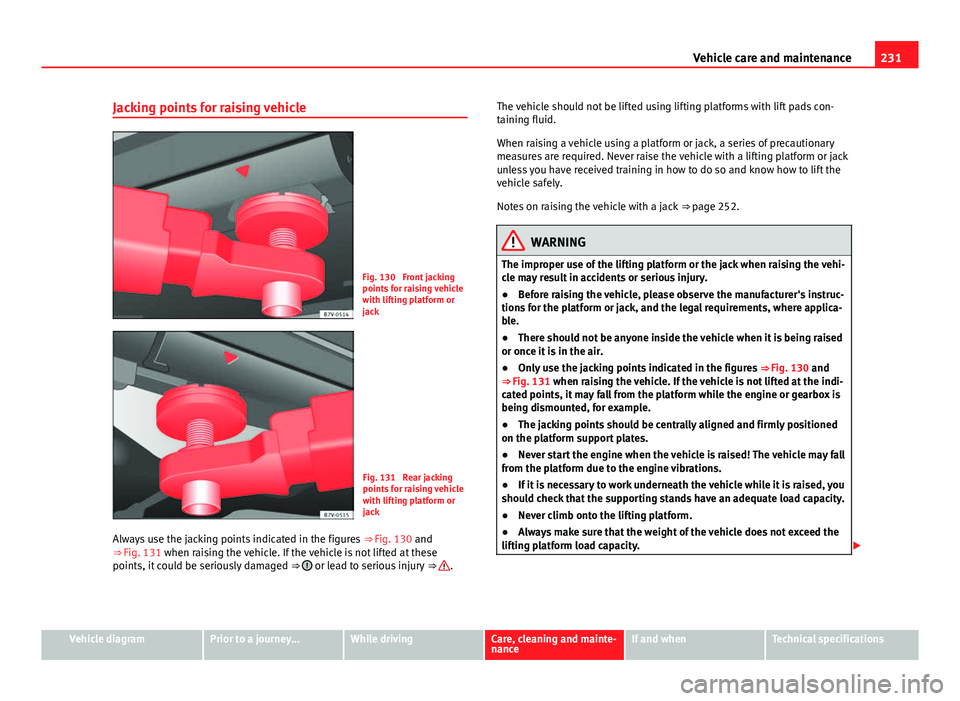
Fig. 130 Front jacking
points for raising vehicle
with lifting platform or
jack
Fig. 131 Rear jacking
points for raising vehicle
with lifting platform or
jack
Always use the jacking points indicated in the figures ⇒ Fig. 130 and
⇒ Fig. 131 when raising the vehicle. If the vehicle is not lifted at these
points, it could be seriously damaged ⇒
or lead to serious injury ⇒ .The vehicle should not be lifted using lifting platforms with lift pads con-
taining fluid.
When raising a vehicle using a platform or jack, a series of precautionary
measures are required. Never raise the vehicle with a lifting platform or jack
unless you have received training in how to do so and know how to lift the
vehicle safely.
Notes on raising the vehicle with a jack
⇒ page 252.
WARNING
The improper use of the lifting platform or the jack when raising the vehi-
cle may result in accidents or serious injury.
● Before raising the vehicle, please observe the manufacturer's instruc-
tions for the platform or jack, and the legal requirements, where applica-
ble.
● There should not be anyone inside the vehicle when it is being raised
or once it is in the air.
● Only use the jacking points indicated in the figures ⇒ Fig. 130 and
⇒ Fig. 131 when raising the vehicle. If the vehicle is not lifted at the indi-
cated points, it may fall from the platform while the engine or gearbox is
being dismounted, for example.
● The jacking points should be centrally aligned and firmly positioned
on the platform support plates.
● Never start the engine when the vehicle is raised! The vehicle may fall
from the platform due to the engine vibrations.
● If it is necessary to work underneath the vehicle while it is raised, you
should check that the supporting stands have an adequate load capacity.
● Never climb onto the lifting platform.
● Always make sure that the weight of the vehicle does not exceed the
lifting platform load capacity.
Vehicle diagramPrior to a journey...While drivingCare, cleaning and mainte-
nanceIf and whenTechnical specifications
Page 235 of 306
233
Vehicle care and maintenance
Notes for the user Introduction
Additional information and warnings:
● Exterior detail ⇒ page 6
● Accessories, parts replacement, repairs and modifications ⇒ page 222
● ⇒ Booklet Maintenance Programme
WARNING
Failure to treat the vehicle with the correct care increases the risk of acci-
dent and injury.
● Observe legal requirements.
● Observe the Instruction Manual.
CAUTION
If you do not treat the vehicle suitably, you may cause it to be damaged.
● Observe legal requirements.
● Carry out regular maintenance of the vehicle, according to specifications
in the Maintenance Programme.
● Observe the Instruction Manual. Labels and plates
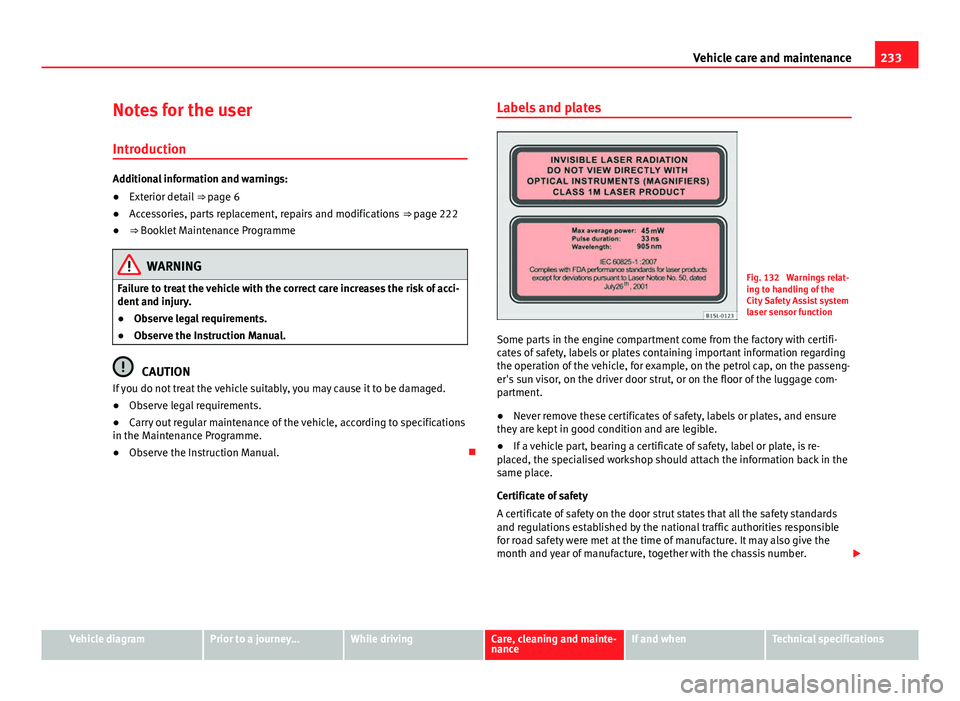
Fig. 132 Warnings relat-
ing to handling of the
City Safety Assist system
laser sensor function
Some parts in the engine compartment come from the factory with certifi-
cates of safety, labels or plates containing important information regarding
the operation of the vehicle, for example, on the petrol cap, on the passeng-
er's sun visor, on the driver door strut, or on the floor of the luggage com-
partment.
● Never remove these certificates of safety, labels or plates, and ensure
they are kept in good condition and are legible.
● If a vehicle part, bearing a certificate of safety, label or plate, is re-
placed, the specialised workshop should attach the information back in the
same place.
Certificate of safety
A certificate of safety on the door strut states that all the safety standards
and regulations established by the national traffic authorities responsible
for road safety were met at the time of manufacture. It may also give the
month and year of manufacture, together with the chassis number.
Vehicle diagramPrior to a journey...While drivingCare, cleaning and mainte-
nanceIf and whenTechnical specifications
Page 236 of 306
234Vehicle care and maintenance
Warning of high voltage label
There is a label close to the bonnet lock which warns of high voltage in the
vehicle electrical installation.
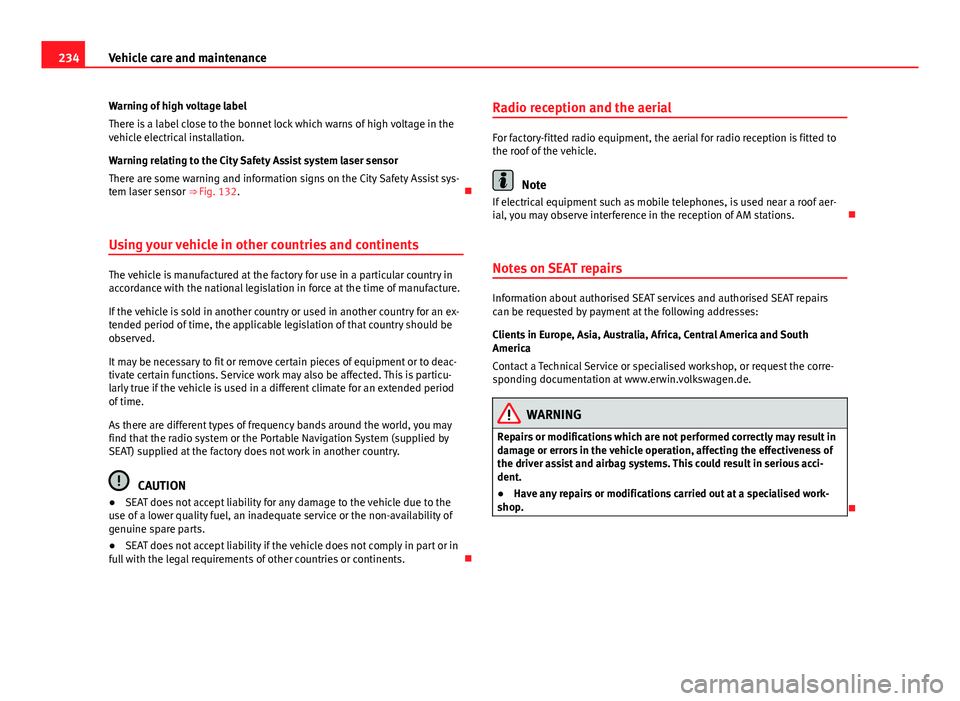
Warning relating to the City Safety Assist system laser sensor
There are some warning and information signs on the City Safety Assist sys-
tem laser sensor ⇒ Fig. 132.
Using your vehicle in other countries and continents
The vehicle is manufactured at the factory for use in a particular country in
accordance with the national legislation in force at the time of manufacture.
If the vehicle is sold in another country or used in another country for an ex-
tended period of time, the applicable legislation of that country should be
observed.
It may be necessary to fit or remove certain pieces of equipment or to deac-
tivate certain functions. Service work may also be affected. This is particu-
larly true if the vehicle is used in a different climate for an extended period
of time.
As there are different types of frequency bands around the world, you may
find that the radio system or the Portable Navigation System (supplied by
SEAT) supplied at the factory does not work in another country.
CAUTION
● SEAT does not accept liability for any damage to the vehicle due to the
use of a lower quality fuel, an inadequate service or the non-availability of
genuine spare parts.
● SEAT does not accept liability if the vehicle does not comply in part or in
full with the legal requirements of other countries or continents. Radio reception and the aerial
For factory-fitted radio equipment, the aerial for radio reception is fitted to
the roof of the vehicle.
Note
If electrical equipment such as mobile telephones, is used near a roof aer-
ial, you may observe interference in the reception of AM stations.
Notes on SEAT repairs
Information about authorised SEAT services and authorised SEAT repairs
can be requested by payment at the following addresses:
Clients in Europe, Asia, Australia, Africa, Central America and South
America
Contact a Technical Service or specialised workshop, or request the corre-
sponding documentation at www.erwin.volkswagen.de.
WARNING
Repairs or modifications which are not performed correctly may result in
damage or errors in the vehicle operation, affecting the effectiveness of
the driver assist and airbag systems. This could result in serious acci-
dent.
● Have any repairs or modifications carried out at a specialised work-
shop.
Page 239 of 306
237
Vehicle care and maintenance
Engine management and exhaust gas
purification system Introduction
Additional information and warnings:
● Changing gear ⇒ page 124
● Refuelling ⇒ page 171
● Fuel ⇒ page 177
● Engine oil ⇒ page 185
● Vehicle battery ⇒ page 193
● Information stored in the control units ⇒ page 222
● Tow starting and towing away ⇒ page 278
WARNING
The components of the exhaust system reach very high temperatures.
This could cause a fire.
● Always park your vehicle so that no part of the exhaust system can
come in contact with flammable materials (such as dried grass).
● Never apply additional underseal or anti-corrosion coatings to the ex-
haust pipes, catalytic converter or the heat shields on the exhaust sys-
tem.
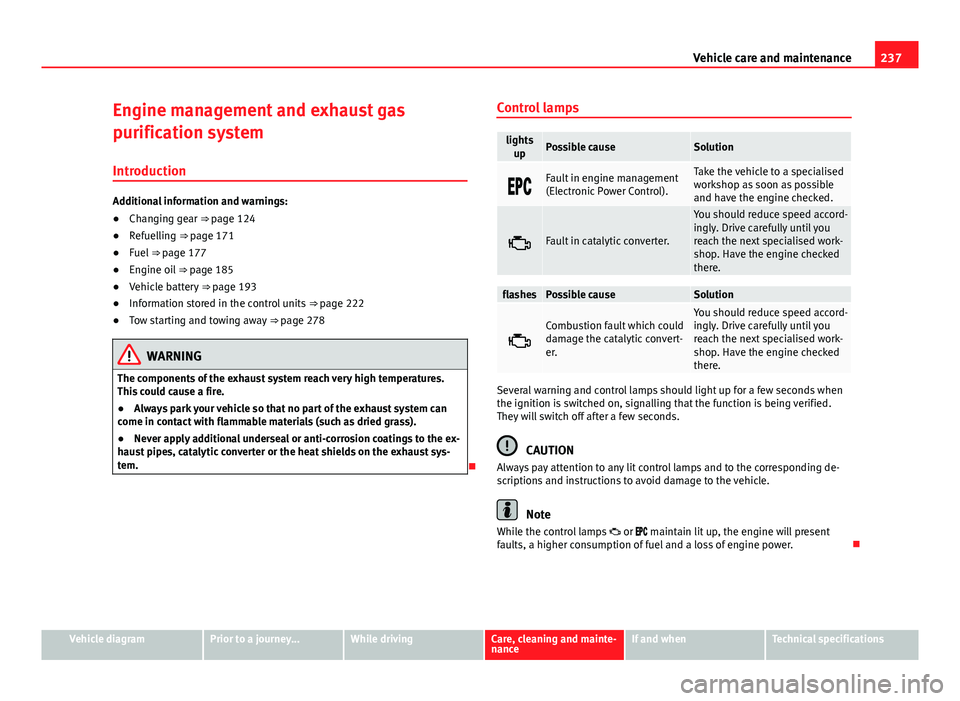
Control lamps
lights
upPossible causeSolution
Fault in engine management
(Electronic Power Control).Take the vehicle to a specialised
workshop as soon as possible
and have the engine checked.
Fault in catalytic converter.
You should reduce speed accord-
ingly. Drive carefully until you
reach the next specialised work-
shop. Have the engine checked
there.
flashesPossible causeSolution
Combustion fault which could
damage the catalytic convert-
er.You should reduce speed accord-
ingly. Drive carefully until you
reach the next specialised work-
shop. Have the engine checked
there.
Several warning and control lamps should light up for a few seconds when
the ignition is switched on, signalling that the function is being verified.
They will switch off after a few seconds.
CAUTION
Always pay attention to any lit control lamps and to the corresponding de-
scriptions and instructions to avoid damage to the vehicle.
Note
While the control lamps or maintain lit up, the engine will present
faults, a higher consumption of fuel and a loss of engine power.
Vehicle diagramPrior to a journey...While drivingCare, cleaning and mainte-
nanceIf and whenTechnical specifications
Page 243 of 306
241
Practical information
In case of emergency
Introduction
Additional information and warnings:
● Braking, stopping and parking ⇒ page 134
● Emergency locking and unlocking ⇒ page 244
● Vehicle tools ⇒ page 247
● Change wheel ⇒ page 252
WARNING
A faulty vehicle in traffic represents a risk of accident for the driver and
for other road users.
● Stop the vehicle safely as soon as possible. Park the vehicle a safe
distance from surrounding traffic to lock all the doors in case of an emer-
gency. Turn on the hazard warning lights to warn other road users.
● Never leave children or disabled people alone in the vehicle if the
doors are to be locked. In case of an emergency, passengers will be trap-
ped inside the vehicle. Individuals locked in the vehicle can be exposed
to very high or very low temperatures.
Protecting yourself and securing the vehicle
Fig. 133 Dash panel:
Button to switch on and
off the hazard warning
lights system
Always fulfil legal requirements for securing a broken down vehicle. In a
number of countries it is now obligatory, for example, to turn on the hazard
warning lights and use a reflective safety vest ⇒ page 243.
Checklist
For your own safety and that of other passengers, the following points
should be observed in the order given ⇒
:
1. Park the vehicle a safe distance from traffic and on suitable ground ⇒
.
2. Turn on the hazard warning lights with the button ⇒
Fig. 133.
3. Apply the handbrake firmly ⇒ page 134.
4. Put the gearbox lever in neutral or the selector lever in position P ⇒ page 124.
5. Switch off the engine and remove the key from the ignition.
6. Have all occupants leave the vehicle and move to safety, for example behind a guard rail.
7. When leaving the vehicle, take all keys with you.
Vehicle diagramPrior to a journey...While drivingCare, cleaning and mainte-
nanceIf and whenTechnical specifications
Page 244 of 306

242Practical information
Checklist (Continued) 8. Place an emergency warning triangle to indicate the position of your vehicle to other road users.
9. Allow the engine to cool and check if a specialist is required.
When being towed with the hazard warning lights on, a change in direction
or traffic lane can be indicated as usual using the turn signal lever. The haz-
ard lights will be interrupted temporarily.
Examples of when to use the hazard warning lights:
● If the vehicles ahead suddenly slow down or reach the end of a traffic
jam, to warn the vehicles behind.
● In case of an emergency.
● If the vehicle breaks down.
● When tow-starting or towing.
Always comply with the applicable laws regarding the use of hazard warn-
ing lights.
If the hazard warning lights are not working, you must use an alternative
method of drawing attention to your vehicle. This method must comply with
traffic legislation.
WARNING
Failure to follow the checklist prepared for your own safety could lead to
accidents and severe injuries.
● Always complete the operations given in the checklist and observe
the general rules of safety.
WARNING
The components of the exhaust system reach very high temperatures.
This could cause a fire and considerable damage.
● Always park your vehicle so that no part of the exhaust system can
come in contact with flammable materials (such as dried grass or fuel).
Note
The vehicle battery will discharge and run down if the hazard warning lights
remain on for too much time (even with the ignition turned off).
Note
For some vehicles, the brake lights will blink when braking suddenly at
speeds of approximately 80 km/h (50 mph) to warn vehicles behind. If brak-
ing continues, then the hazard warning lights system will automatically be
turned on at the speed of less than approximately 10 km/h (6 mph). The
brake lights remain lit. Upon accelerating, the hazard warning lights will be
automatically turned off.