warning Seat Mii 2013 Owner's manual
[x] Cancel search | Manufacturer: SEAT, Model Year: 2013, Model line: Mii, Model: Seat Mii 2013Pages: 306, PDF Size: 4.3 MB
Page 176 of 306
174At the filling station
Refuelling with petrol
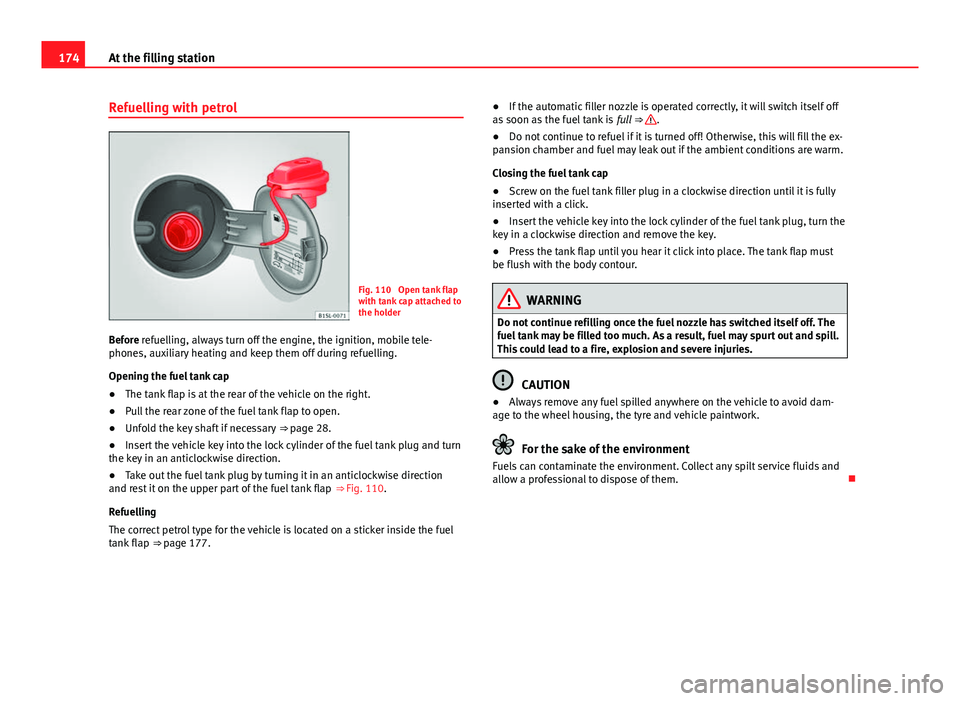
Fig. 110 Open tank flap
with tank cap attached to
the holder
Before refuelling, always turn off the engine, the ignition, mobile tele-
phones, auxiliary heating and keep them off during refuelling.
Opening the fuel tank cap
● The tank flap is at the rear of the vehicle on the right.
● Pull the rear zone of the fuel tank flap to open.
● Unfold the key shaft if necessary
⇒ page 28.
● Insert the vehicle key into the lock cylinder of the fuel tank plug and turn
the key in an anticlockwise direction.
● Take out the fuel tank plug by turning it in an anticlockwise direction
and rest it on the upper part of the fuel tank flap ⇒ Fig. 110.
Refuelling
The correct petrol type for the vehicle is located on a sticker inside the fuel
tank flap ⇒ page 177. ●
If the automatic filler nozzle is operated correctly, it will switch itself off
as soon as the fuel tank is full ⇒
.
● Do not continue to refuel if it is turned off! Otherwise, this will fill the ex-
pansion chamber and fuel may leak out if the ambient conditions are warm.
Closing the fuel tank cap
● Screw on the fuel tank filler plug in a clockwise direction until it is fully
inserted with a click.
● Insert the vehicle key into the lock cylinder of the fuel tank plug, turn the
key in a clockwise direction and remove the key.
● Press the tank flap until you hear it click into place. The tank flap must
be flush with the body contour.
WARNING
Do not continue refilling once the fuel nozzle has switched itself off. The
fuel tank may be filled too much. As a result, fuel may spurt out and spill.
This could lead to a fire, explosion and severe injuries.
CAUTION
● Always remove any fuel spilled anywhere on the vehicle to avoid dam-
age to the wheel housing, the tyre and vehicle paintwork.
For the sake of the environment
Fuels can contaminate the environment. Collect any spilt service fluids and
allow a professional to dispose of them.
Page 177 of 306
175
At the filling station
Refuelling with natural gas
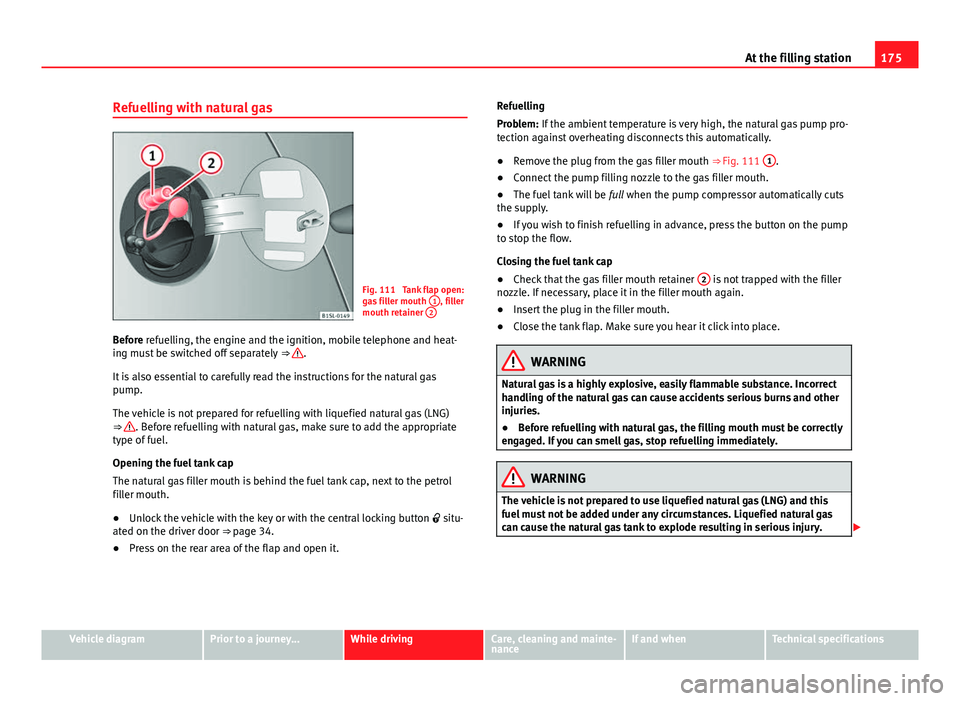
Fig. 111 Tank flap open:
gas filler mouth 1, filler
mouth retainer 2
Before refuelling, the engine and the ignition, mobile telephone and heat-
ing must be switched off separately
⇒ .
It is also essential to carefully read the instructions for the natural gas
pump.
The vehicle is not prepared for refuelling with liquefied natural gas (LNG)
⇒
. Before refuelling with natural gas, make sure to add the appropriate
type of fuel.
Opening the fuel tank cap
The natural gas filler mouth is behind the fuel tank cap, next to the petrol
filler mouth.
● Unlock the vehicle with the key or with the central locking button situ-
ated on the driver door ⇒ page 34.
● Press on the rear area of the flap and open it. Refuelling
Problem: If the ambient temperature is very high, the natural gas pump pro-
tection against overheating disconnects this automatically.
●
Remove the plug from the gas filler mouth ⇒ Fig. 111 1
.
● Connect the pump filling nozzle to the gas filler mouth.
● The fuel tank will be full when the pump compressor automatically cuts
the supply.
● If you wish to finish refuelling in advance, press the button on the pump
to stop the flow.
Closing the fuel tank cap
● Check that the gas filler mouth retainer 2
is not trapped with the filler
nozzle. If necessary, place it in the filler mouth again.
● Insert the plug in the filler mouth.
● Close the tank flap. Make sure you hear it click into place.
WARNING
Natural gas is a highly explosive, easily flammable substance. Incorrect
handling of the natural gas can cause accidents serious burns and other
injuries.
● Before refuelling with natural gas, the filling mouth must be correctly
engaged. If you can smell gas, stop refuelling immediately.
WARNING
The vehicle is not prepared to use liquefied natural gas (LNG) and this
fuel must not be added under any circumstances. Liquefied natural gas
can cause the natural gas tank to explode resulting in serious injury.
Vehicle diagramPrior to a journey...While drivingCare, cleaning and mainte-
nanceIf and whenTechnical specifications
Page 179 of 306
177
At the filling station
Fuel
Introduction
You will find a factory-fitted sticker containing information on the type of
fuel for your vehicle on the inside of the fuel tank flap.
Additional information and warnings:
● ⇒ Booklet Maintenance Programme
● Refuelling ⇒ page 171
● Electronic power control and exhaust gases purification system
⇒ page 237
WARNING
Refuelling or handling fuel carelessly can cause an explosion or fire re-
sulting in serious burns and injuries.
● Fuel is a highly explosive, easily flammable substance.
● Observe current safety instructions and local regulations concerning
the handling of fuel.
Types of fuel
The type of fuel to use when refilling will depend on the vehicle's engine.
You will find a factory-fitted sticker containing information on the type of
fuel for your vehicle on the inside of the fuel tank flap.
SEAT recommends the use of sulphur-free or low sulphur fuel to reduce con-
sumption and prevent engine damage.
Possible types of fuelAlternative namesFurther information
91a)
RONNormal petrol, normal unlea-
ded petrol
⇒ page 17795 a)
RONPremium unleaded petrol (95
RON)
98 a)
RONPremium unleaded petrol (98
RON)
a) RON = Regulation Octane Number
Petrol
Petrol types
Vehicles with petrol engines must refuel using unleaded petrol according to
European norm EN 228 ⇒
.
Petrol types are categorised according to their octane number (e.g. 91, 95,
98 or 99 RON (RON = “Research Octane Number”). You may use petrol with
a high octane number than the one recommended for your engine. Howev-
er, this has no advantage in terms of fuel consumption and engine power.
SEAT recommends refuelling with a low sulphur content or sulphur-free pet-
rol to reduce fuel consumption for petrol engines.
Petrol additives
The quality of the fuel influences the behaviour, performance and service
life of the engine. This is why the petrol you use should carry suitable addi-
tives already included by the petrol industry, free of metals. These additives
will help to prevent corrosion, keep the fuel system clean and prevent de-
posits from building up in the engine.
If good quality petrol with metal-free additives is not available or engine
problems arise, the necessary additives must be added when refuelling
⇒
.
Vehicle diagramPrior to a journey...While drivingCare, cleaning and mainte-
nanceIf and whenTechnical specifications
Page 181 of 306
179
At the filling station
WARNING
Failure to act when you can smell gas in the vehicle or when refuelling
can cause serious injuries.
● Carry out the necessary operations.
● Leave the danger zone.
● If necessary, warn the emergency services.
WARNING
The vehicle is not prepared to use liquefied natural gas (LNG) and this
fuel must not be added under any circumstances. Liquefied natural gas
can cause the natural gas tank to explode resulting in serious injury.
Note
The natural gas system must be subject to regular inspections at a special-
ised workshop in accordance with the Service Plan.
Vehicle diagramPrior to a journey...While drivingCare, cleaning and mainte-
nanceIf and whenTechnical specifications
Page 182 of 306

180In the engine compartment
Care, cleaning and maintenance
In the engine compartment
Working in the engine compartmentIntroduction
Before working in the engine compartment, make sure that the vehicle is
parked on horizontal and firm ground.
The engine compartment of the vehicle is a hazardous area. Never work on
the engine or in the engine compartment if you are not familiar with the op-
erations to be carried out, the applicable safety standards and especially if
you do not have the instruments, liquids and tools necessary ⇒
! In such
a case, have any work carried out by a Specialised workshop. Negligent
work can cause serious injury.
Additional information and warnings:
● Exterior detail ⇒ page 6
● Windscreen wash system ⇒ page 89
● Start and stop the engine ⇒ page 119
● Brake fluid ⇒ page 134
● Checks when filling up ⇒ page 171
● Engine oil ⇒ page 185
● Engine coolant ⇒ page 189
● Vehicle battery ⇒ page 193
● Accessories, parts replacement, repairs and modifications ⇒ page 222
WARNING
If the vehicle moves unexpectedly, this could cause serious injury.
● Never work underneath the vehicle if it is not secured against moving.
If you must work underneath the vehicle with the wheels in contact with
the ground then it should be parked on flat ground, the wheels should be
prevented from moving and the key must be removed from the ignition.
● If you have to work underneath the vehicle, you must use suitable
stands additionally to support the vehicle, there is a risk of accident!.
The jack is not intended for this kind of work and its failure could lead to
severe injuries.
● Disconnect the Start-Stop system.
WARNING
The engine compartment is a dangerous area capable of causing serious
injury.
● For all type of work, always take the utmost precautions, work care-
fully and note the general safety standards in force. Never take personal
risks.
● Never work on the engine or in the engine compartment if you are not
familiar with the necessary operations. If you are not sure about proce-
dures then visit a specialised workshop to carry out the necessary work.
Incorrect work can cause serious injuries.
Page 183 of 306
181
In the engine compartment
WARNING (Continued)
● Never open the bonnet if you see steam or coolant escaping from the
engine compartment. Hot vapours and coolant can cause serious burns.
Always wait until you cannot see or hear the sound of steam or coolant
coming from the engine compartment.
● Always allow the engine to cool down before opening the bonnet.
● Contact with hot elements of the engine and the exhaust system can
cause burns.
● Once the engine has cooled, follow the instructions below before
opening the bonnet:
–Engage the handbrake and place the gear selector lever in P or the
gear stick in neutral.
– Remove the key from the ignition.
– Keep children away from the engine compartment and never leave
them unsupervised.
● When the engine is warm or hot, the cooling system is pressurised.
Do not unscrew the cap on the expansion tank when the engine is hot.
Otherwise, coolant may spray out under pressure causing burns and seri-
ous injury.
–After cooling, carefully and slowly unscrew the cap anticlockwise,
gently pressing down on it.
– Always protect your face, hands and arms from hot coolant and
steam using a large, thick cloth.
● When refilling liquids, avoid spilling them on parts of the engine and
the exhaust system. Spilled liquids could cause a fire.WARNING
The high voltages of the electrical system can give electric shocks as well
as causing burns and serious injury and possibly even death!
● Never cause short circuits in the electrical system. The battery could
explode.
● To minimise the risk of electric shock and serious consequences
while the engine is running or starting the engine, note the following:
–Never touch the electrical wiring of the ignition system.
WARNING
In the engine compartment, there are rotating parts that could cause se-
rious injury.
● Never place your hands directly on or near the radiator fan. Touching
the rotor blades could seriously harm you. The ventilator works accord-
ing to the engine temperature and could start suddenly even when the ig-
nition is turned off and the key is removed.
● If any work has to be performed when the engine is started or with
the engine running, there is an additional, potentially fatal, safety risk
from the rotating parts, such as the drive belts, alternator, radiator fan
etc as well as from the high-voltage ignition system. Always work with
the utmost caution.
–Always make sure that no parts of your body, jewellery, ties, loose
clothing and long hair can be trapped by the rotating parts of the en-
gine. Before any work, remove ties and jewellery ( necklaces, etc), tie
longhair back and tie all items of loose clothing to your body to make
sure that they cannot be trapped by engine components.
– Take extreme caution when operating the accelerator and remain
attentive. The vehicle could move, even if the handbrake is applied.
● Always make sure you have not left any objects, such as cloths or
tools, in the engine compartment. If any object is left in the engine com-
partment, this could cause malfunctions, engine faults and even a fire.
Vehicle diagramPrior to a journey...While drivingCare, cleaning and mainte-
nanceIf and whenTechnical specifications
Page 184 of 306

182In the engine compartment
WARNING
Refill liquids and certain materials can catch fire easily in the engine
compartment, causing a fire and serious injury!
● Never smoke.
● Never work close to places exposed to flames or sparks.
● Never pour service fluids over the engine. These fluid may ignite hot
engine parts and cause injuries.
● If it is necessary to work on the fuel system or the electrical system,
please follow the instructions below:
–Always disconnect the vehicle battery.
– Never work close to heaters, heat sources or places exposed to
flames or sparks.
● Always keep a recently serviced and perfectly working fire extin-
guisher close by.
CAUTION
When refilling or changing service liquids, ensure that you put the liquids
into the right tank. Making a mistake when refilling could cause serious
malfunctions and damage the engine!
For the sake of the environment
Service fluids leaks are harmful to the environment. For this reason you
should make regular checks on the ground underneath your vehicle. Take
the vehicle to a specialised workshop to be checked if you see stains, oil or
other fluids on the ground. Collect any spilt service fluids and allow a pro-
fessional to dispose of them. Preparing the vehicle for work in the engine compartment
Checklist
Carry out the operations below in the order indicated before starting work in
the engine compartment
⇒
:
Park the vehicle on an even and solid surface.
Press and hold the brake pedal until the vehicle comes to a stand-
still.
Apply the handbrake firmly
⇒ page 134.
Move the gear lever into the neutral position
⇒ page 124.
Stop the engine and remove the key from the ignition
⇒ page 119.
Wait for the engine to cool down.
Always keep children and other people far from the engine compart-
ment.
Ensure that the vehicle can not move off unexpectedly.
WARNING
Always complete the operations given in the checklist and observe the
general rules of safety.
● Ignoring this checklist, drawn up for your own safety, could result in
serious injury.
Page 186 of 306
184In the engine compartment
Opening the bonnet
● Before opening the bonnet, make sure that the windscreen wiper arms
are in place against the windscreen ⇒
.
● Pull the release lever 1 in the direction of the arrow
⇒ Fig. 112 A. The
bonnet is released from the lock carrier by a spring mechanism ⇒ .
● Lift the bonnet up slightly while pressing the release lever 2 B in the
direction of the arrow to completely open the bonnet.
● Take out the bonnet support rod from its clip in the direction of the ar-
row 3
C and place it in the corresponding open position 4 D (arrow).
Closing the bonnet
● Slightly lift the bonnet ⇒
.
● Take out the bonnet support rod from the opening catch 4 D and insert
it into its clip 3 C in the opening catch.
● Let the bonnet fall from a height of 30 cm into its clip; Do not apply pres-
sure!
If the bonnet is not correctly closed, open it once again and close it correct-
ly.
The bonnet is correctly closed when it is flush with the corresponding parts
on the bodywork.
WARNING
If the bonnet is not correctly closed, it could suddenly open while driving
leaving the driver without visibility. This could result in a serious acci-
dent.
● After closing the bonnet, always check that it is properly secured by
the locking mechanism in the lock carrier piece. The bonnet must be
flush with the surrounding body panels.
● While driving, if you notice that the bonnet is not correctly closed
then stop immediately and close it correctly.
● Only open and close the bonnet when there is nobody within its
range.
CAUTION
● To avoid damage to the bonnet and to the windscreen wiper arms, only
open the bonnet when the windscreen wipers are in place against the wind-
screen.
● Before driving, always lower the wiper arms.
Page 187 of 306
185
In the engine compartment
Engine oil Introduction
Additional information and warnings:
● ⇒ Booklet Maintenance Programme
● Working in the engine compartment ⇒ page 180
● Accessories, parts replacement, repairs and modifications ⇒ page 222
WARNING
Incorrectly handling engine oil can cause injury and serious burns.
● Always protect your eyes when handling engine oil.
● Oil is toxic and must be kept out of the reach of children.
● Engine oil must only be kept closed in its original container. The same
applies to use oil until it has been disposed of.
● Never store engine oil in empty food containers or bottles as other
people may accidentally drink it.
● Regular contact with engine oil can be bad for the skin. If you come
into contact with engine oil, wash your skin with soap and water.
● With the engine running, the engine oil gets extremely hot and can
cause severe skin burns. Always wait until the engine has fully cooled.
For the sake of the environment
Similar to the other service liquids, spilled engine oil can be bad for the en-
vironment. Collect any spilt fluids in suitable containers and dispose of in
accordance with legislation and with the utmost respect for the environ-
ment. Warning and control lamps
flashesPossible causeSolution
Engine oil pressure too low.
Stop the vehicle!
Switch off the engine. Check the
engine oil level, and if necessa-
ry, refill with ⇒ page 186.
engine oil - If the warning indica-
tor flashes although the oil level
is correct, do not continue driv-
ing or leave the engine running.
Otherwise, the engine could be
damaged. Seek specialist assis-
tance.
WARNING
If the warning lamps are ignored, the vehicle may stall in traffic, or may
cause accidents and severe injuries.
● Never ignore the warning lamps.
● Stop the vehicle safely as soon as possible.
CAUTION
Failure to heed the warning lamps when they appear may result in faults in
the vehicle.
Engine oil specifications
Replacement engine oil must strictly comply with the specifications.
Vehicle diagramPrior to a journey...While drivingCare, cleaning and mainte-
nanceIf and whenTechnical specifications
Page 189 of 306
187
In the engine compartment
● Open the bonnet ⇒ page 180.
● The engine oil filler neck can be recognised by the symbol on the
cap ⇒ Fig. 115 and the dipstick by its coloured handle.
Check the engine oil level
● Pull out the dipstick and wipe it on a clean cloth.
● Replace the dipstick, pushing it in as far as it will go. If the dipstick to
measure engine oil has a mark, when you reintroduce it this mark should
slot into the corresponding groove located on the upper end of the tube.
● Remove the dipstick again and check the engine oil level ⇒ table on
page 187.
● After reading the oil level, replace the dipstick in the tube completely.
Engine oil topping up ranges
Fig. 114Operations required depending on the engine oil topping
up level:
Area ADo not top up oil
⇒ .Area BYou can add oil, but keep the level in this zone.
Area COil
must be added. After topping up the oil level should be
in area B.
Adding oil after checking the level
Only add engine oil in small quantities and in steps.
●
Unscrew the cap from engine oil filler neck on the cylinder head
⇒ Fig. 115. If you are not sure where the cap is, request help from a special-
ist.
● Only refill using approved SEAT engine oil in small quantities (no more
than 0.5 ltr) ⇒ page 185.
● To avoid adding too much oil, each time you add a quantity, wait until
the oil has flowed into the crankcase so that it can be measured with the
dipstick.
● Check the oil level before adding any more oil. Do not top up with too
much engine oil ⇒
. ●
When the oil level is in at least the ⇒ Fig. 114 B
zone, insert the dip-
stick into the tube fully to avoid engine oil escaping when the engine is run-
ning.
● After topping up the oil, ensure that the cap is screwed on to the filler
neck correctly.
WARNING
Oil could catch fire if it comes into contact with hot engine components.
This could lead to a fire, explosion and severe injuries.
● Always ensure that after topping of oil, the engine oil filler cap is cor-
rectly tightened. This will avoid engine oil spilling onto hot engine parts
when the engine is running.
CAUTION
● If the engine oil level is above the area A do not start the engine. Seek
specialist assistance. Otherwise catalytic converter and engine damage may
occur.
● When refilling or changing service liquids, ensure that you put the liq-
uids into the right tank. Making a mistake when refilling could cause seri-
ous malfunctions and damage the engine!
For the sake of the environment
The oil level must never be above area A. Otherwise oil can be drawn in
through the crankcase breather and escape into the atmosphere via the ex-
haust system.
Engine oil consumption
The consumption of engine oil can be different from one engine to another
and can vary during the useful life of the engine.
Vehicle diagramPrior to a journey...While drivingCare, cleaning and mainte-
nanceIf and whenTechnical specifications