child lock Seat Mii 2013 User Guide
[x] Cancel search | Manufacturer: SEAT, Model Year: 2013, Model line: Mii, Model: Seat Mii 2013Pages: 306, PDF Size: 4.3 MB
Page 81 of 306
79
Ensuring you are correctly and safely seated
● Insert the latch plate into the buckle for the appropriate seat and push it
down until it is securely locked with an audible click.
● Ensure that the upper belt web lies tightly on the child seat.
● Pull the belt (it must be no longer possible to pull the lower belt web-
bing out).
Removing the child seat
The seat belt must not be unfastened until the vehicle has come to a stand-
still ⇒
.
● Press the red button on the buckle. The latch plate is released from the
buckle.
● Guide the belt back by hand so that it rolls up easily and the trim will not
be damaged.
● Remove the child seat from the vehicle.
WARNING
Unbuckling the seat belt while the vehicle is in motion can cause severe
or fatal injuries in the event of an accident or sudden braking.
● The seat belt must not be unfastened until the vehicle has come to a
standstill.
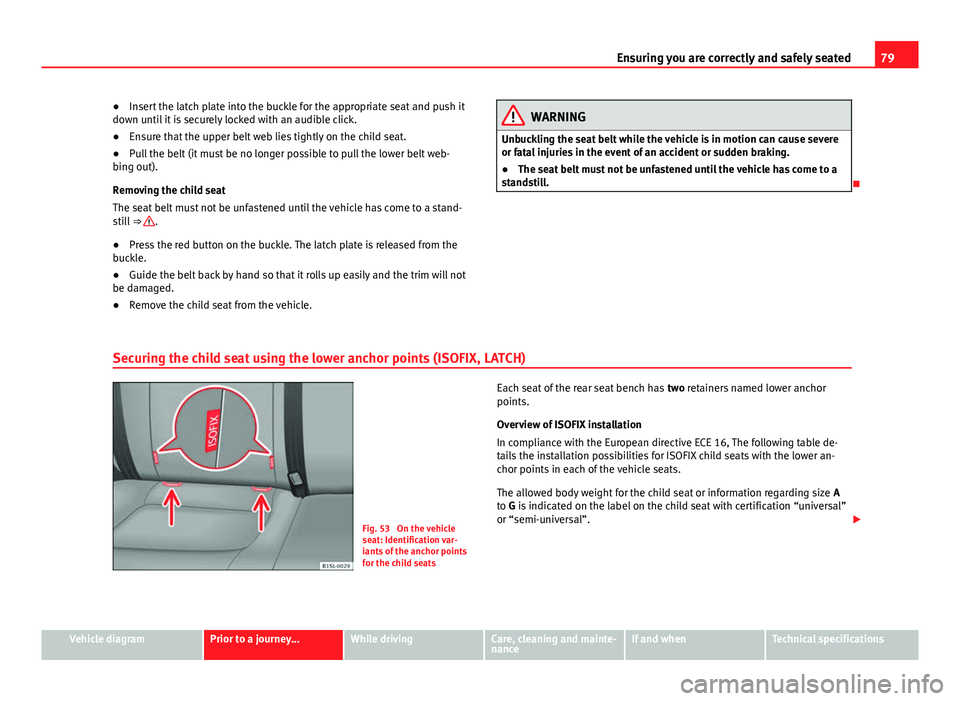
Securing the child seat using the lower anchor points (ISOFIX, LATCH)
Fig. 53 On the vehicle
seat: Identification var-
iants of the anchor points
for the child seats Each seat of the rear seat bench has
two retainers named lower anchor
points.
Overview of ISOFIX installation
In compliance with the European directive ECE 16, The following table de-
tails the installation possibilities for ISOFIX child seats with the lower an-
chor points in each of the vehicle seats.
The allowed body weight for the child seat or information regarding size A
to G is indicated on the label on the child seat with certification “universal”
or “semi-universal”.
Vehicle diagramPrior to a journey...While drivingCare, cleaning and mainte-
nanceIf and whenTechnical specifications
Page 83 of 306
81
Ensuring you are correctly and safely seated
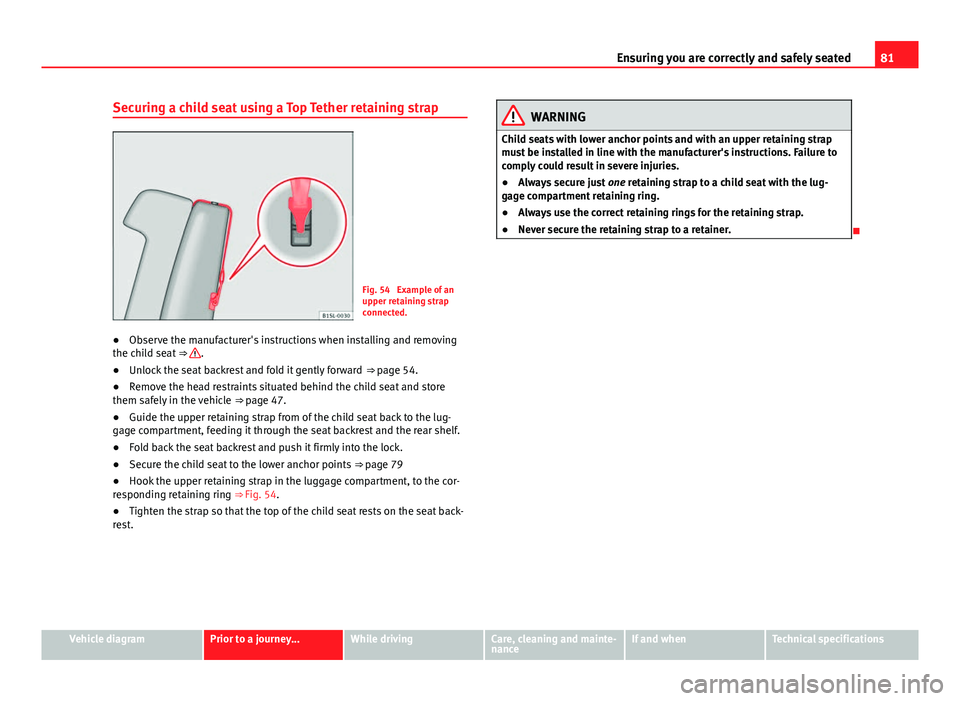
Securing a child seat using a Top Tether retaining strap
Fig. 54 Example of an
upper retaining strap
connected.
● Observe the manufacturer's instructions when installing and removing
the child seat ⇒
.
● Unlock the seat backrest and fold it gently forward
⇒ page 54.
● Remove the head restraints situated behind the child seat and store
them safely in the vehicle ⇒ page 47.
● Guide the upper retaining strap from of the child seat back to the lug-
gage compartment, feeding it through the seat backrest and the rear shelf.
● Fold back the seat backrest and push it firmly into the lock.
● Secure the child seat to the lower anchor points
⇒ page 79
● Hook the upper retaining strap in the luggage compartment, to the cor-
responding retaining ring ⇒ Fig. 54.
● Tighten the strap so that the top of the child seat rests on the seat back-
rest.
WARNING
Child seats with lower anchor points and with an upper retaining strap
must be installed in line with the manufacturer's instructions. Failure to
comply could result in severe injuries.
● Always secure just one retaining strap to a child seat with the lug-
gage compartment retaining ring.
● Always use the correct retaining rings for the retaining strap.
● Never secure the retaining strap to a retainer.
Vehicle diagramPrior to a journey...While drivingCare, cleaning and mainte-
nanceIf and whenTechnical specifications
Page 100 of 306
98Transporting
Loading luggage compartment
Introduction
Always transport heavy loads in the luggage compartment and place the
seat backs in a vertical position. Never overload the vehicle. Both the carry-
ing capacity as well as the distribution of the load in the vehicle have ef-
fects on the driving behaviour and braking ability ⇒
.
Additional information and warnings:
● Airbag system ⇒ page 65
● Light ⇒ page 82
● Transporting ⇒ page 95
● Wheels and tyres ⇒ page 210
WARNING
When the vehicle is not in use or being watched, always lock the doors
and the rear lid to reduce the risk of serious injury or death.
● Do not leave children unwatched, especially when the rear lid is open.
Children could climb into the luggage compartment, close the rear lid
from inside and be unable to escape themselves. This could lead to seri-
ous injury or death.
● Never allow children to play in or around the vehicle.
● Never transport people in the luggage compartment.
WARNING
Unsecured or incorrectly secured objects can cause serious injury in case
of a sudden manoeuvring or breaking or in case of an accident. This is es-
pecially true when objects are struck by a detonating airbag and fired
through the vehicle interior. To reduce the risks, please note the follow-
ing:
● Secure all objects in the vehicle. Always keep equipment and heavy
objects in the luggage compartment.
● Always secure objects with suitable rope or straps so that they can-
not enter the deployment areas around the frontal or side airbags in case
of sudden braking or an accident.
● While driving, always keep object compartments closed.
● Do not place hard, heavy or sharp objects inside the vehicle interior,
in open storage compartments, the rear shelf or on the dash panel.
● Remove hard, heavy and sharp objects from clothes and pockets in-
side the vehicle and store securely.
WARNING
The transport of heavy object changes vehicle handling and increases
braking distance. Heavy loads that have not been stored or secured cor-
rectly could cause loss of control and result in serious injury.
● The vehicle handling changes when transporting heavy objects due
to a change in the centre of gravity.
● Distribute the load as uniformly and as low down on the vehicle as
possible.
● Store heavy objects in the luggage compartment as far from the rear
axle as possible.
CAUTION
Hard objects on the rear shelf could chafe against the wires of the heating
element in the heated rear window and cause damage.
Page 101 of 306
99
Transporting
Note
The ventilating slits between the heated rear window and the rear shelf
must not be covered so that used air can escape from the vehicle.
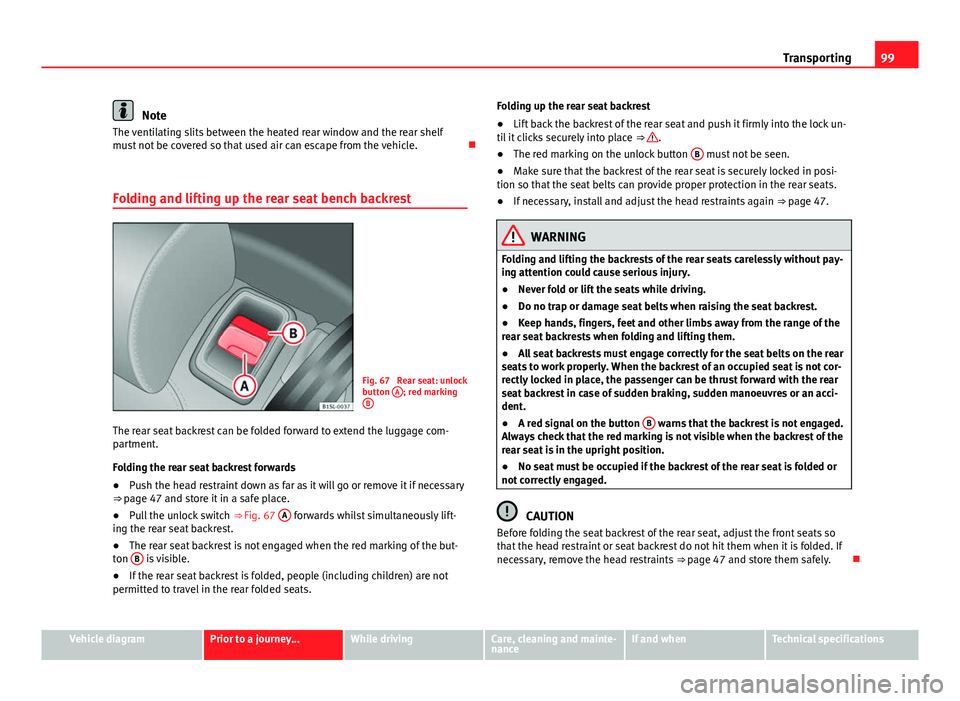
Folding and lifting up the rear seat bench backrest
Fig. 67 Rear seat: unlock
button A; red marking
B
The rear seat backrest can be folded forward to extend the luggage com-
partment.
Folding the rear seat backrest forwards
● Push the head restraint down as far as it will go or remove it if necessary
⇒ page 47 and store it in a safe place.
● Pull the unlock switch
⇒ Fig. 67 A
forwards whilst simultaneously lift-
ing the rear seat backrest.
● The rear seat backrest is not engaged when the red marking of the but-
ton B
is visible.
● If the rear seat backrest is folded, people (including children) are not
permitted to travel in the rear folded seats. Folding up the rear seat backrest
●
Lift back the backrest of the rear seat and push it firmly into the lock un-
til it clicks securely into place ⇒
.
● The red marking on the unlock button B must not be seen.
● Make sure that the backrest of the rear seat is securely locked in posi-
tion so that the seat belts can provide proper protection in the rear seats.
● If necessary, install and adjust the head restraints again ⇒ page 47.
WARNING
Folding and lifting the backrests of the rear seats carelessly without pay-
ing attention could cause serious injury.
● Never fold or lift the seats while driving.
● Do no trap or damage seat belts when raising the seat backrest.
● Keep hands, fingers, feet and other limbs away from the range of the
rear seat backrests when folding and lifting them.
● All seat backrests must engage correctly for the seat belts on the rear
seats to work properly. When the backrest of an occupied seat is not cor-
rectly locked in place, the passenger can be thrust forward with the rear
seat backrest in case of sudden braking, sudden manoeuvres or an acci-
dent.
● A red signal on the button B
warns that the backrest is not engaged.
Always check that the red marking is not visible when the backrest of the
rear seat is in the upright position.
● No seat must be occupied if the backrest of the rear seat is folded or
not correctly engaged.
CAUTION
Before folding the seat backrest of the rear seat, adjust the front seats so
that the head restraint or seat backrest do not hit them when it is folded. If
necessary, remove the head restraints ⇒ page 47 and store them safely.
Vehicle diagramPrior to a journey...While drivingCare, cleaning and mainte-
nanceIf and whenTechnical specifications
Page 123 of 306

121
Starting, changing gears, parking
WARNING
Unsuitable or careless use of the vehicle key could result in serious in-
jury.
● Always take all the keys with you whenever you leave the vehicle. The
engine could accidentally be started and electrical equipment such as
the windows could accidentally be operated resulting in serious injury.
● Never leave children or disabled people alone in the car. They could
be trapped in the car in an emergency and will not be able to get them-
selves to safety. For example, depending on the time of the year, temper-
atures inside a locked and closed vehicle can be extremely high or ex-
tremely low resulting in serious injuries and illness or even death, partic-
ularly for young children.
● Never remove the key from the ignition if the vehicle is in motion. The
steering may lock and it will not be possible to turn the steering wheel.
Note
● If the key is left in the ignition lock with the engine off for long periods,
the vehicle battery will run flat.
● In vehicles with automatic gearbox the ignition key can only be with-
drawn with the selector lever in position P. In this case, press and release
the selector lever locking button.
Starting the engine
Complete operations only in the sequence given.
1.Press the brake pedal and keep pressed until step 5 has been completed.
1 a.In vehicles with a manual gearbox: Press the clutch pedal all
the way and keep pressed until the engine starts.
Complete operations only in the sequence given.
2.Put the gearbox lever in neutral or the selector lever in posi- tion P or N.
3.Turn the key in the ignition lock to position ⇒ Fig. 86 2; do
not press the accelerator.
4.When the engine has started, release the key in the ignition lock.
5.If the engine does not start, stop the process and try again af-ter one minute.
6.Release the handbrake when you want to begin driving⇒ page 134.
WARNING
Never leave the vehicle unattended if the engine is running. The vehicle
could move off suddenly, especially if it is in gear, resulting in an acci-
dent and serious injury.
WARNING
Cold start sprays could explode or cause a sudden increase in the engine
speed.
● Never use start boosters.
CAUTION
● An attempt to start the engine while driving or starting the engine imme-
diately after turning it off can cause damage to the engine or starter motor.
● When the engine is cold, avoid high revs and heavy acceleration and do
not make the engine work hard.
● Do not push or tow start the engine. Unburnt fuel could damage the cat-
alytic converter.
Vehicle diagramPrior to a journey...While drivingCare, cleaning and mainte-
nanceIf and whenTechnical specifications
Page 136 of 306
134Starting, changing gears, parking
Braking, stopping and parking
Introduction
The assisted braking systems are the electronic distribution of the brake
force (EBV), the anti-lock brake system (ABS), the brake assist system (BAS),
the electronic differential lock (EDL), the traction control (TC), the traction
control system (ASR) and the electronic stability control (ESC*).
Additional information and warnings:
● Wheels and tyres ⇒ page 210
● Accessories, parts replacement, repairs and modifications ⇒ page 222
WARNING
Driving with worn brake pads or a faulty brake system may lead to seri-
ous accident.
● If you believe the brake pads to be worn or the brake system to be
faulty, immediately refer to a specialised workshop to check the brake
pads and replace the worn brake pads.
WARNING
Careless parking can cause serious injury.
● Never remove the key from the ignition if the vehicle is in motion. The
steering lock may engage and locked the steering wheel making the vehi-
cle impossible to control.
● Always park your vehicle so that no part of the exhaust system can
come in contact with flammable materials (such as wood, leaves, spilled
fuel, dried grass, etc).
WARNING (Continued)
● Always apply the handbrake when you leave your vehicle and when
you park.
● Never leave children or disabled people alone in the vehicle. They
could release the electronic parking brake, activate the selector lever or
gear stick and start the vehicle moving. This could result in a serious ac-
cident.
● Always take all the keys with you whenever you leave the vehicle. The
engine could accidentally be started and electrical equipment such as
the windows could accidentally be operated resulting in serious injury.
● Never leave children or disabled people alone in the car. They could
be trapped in the car in an emergency and will not be able to get them-
selves to safety. For example, depending on the time of the year, temper-
atures inside a locked and closed vehicle can be extremely high or ex-
tremely low resulting in serious injuries and illness or even death, partic-
ularly for young children.
CAUTION
● Special care should be taken when parking in areas with high kerbs or
fixed barriers. Objects protruding from the ground may damage the bumper
or other parts of the vehicle during manoeuvres. To avoid damage, stop be-
fore the wheels touched the barrier or kerb.
● Special attention is required when driving through entrances, over
ramps, kerbs or other objects. The vehicle underbody, bumpers, mudguards
and running gear, and the engine and exhaust system could be damaged as
you drive over these objects.
Page 139 of 306
137
Starting, changing gears, parking
To park the vehicle
Complete operations only in the sequence given.
● Park the vehicle on a suitable surface ⇒
.
● Press and hold the brake pedal until the vehicle comes to a standstill.
● Apply the handbrake firmly ⇒ page 136.
● For an automatic gearbox, move the selector lever to position P.
● Switch off the engine and release the brake pedal.
● Remove the key from the ignition.
● If necessary, turn the steering wheel slightly to lock the steering.
● With a manual gearbox, engage the 1st gear on flat ground and slopes,
or even the reverse gear on hills, and release the clutch pedal.
● Ensure that all passengers leave the vehicle, especially children.
● When leaving the vehicle, take all keys with you.
● Lock the vehicle.
Additional information for steep slopes and hills
Before switching off the engine, rotate the steering wheel so that if the vehi-
cle should move then it will be held by the kerb.
● On slopes, turn the front wheels so that they are against the edge of the
kerb.
● Uphill, turn the wheels towards the centre of the road.
WARNING
The components of the exhaust system reach very high temperatures.
This could cause a fire and considerable damage.
● Always park your vehicle so that no part of the exhaust system can
come in contact with flammable materials (such as wood, leaves, spilled
fuel, dried grass, etc).
CAUTION
● Special care should be taken when parking in areas with high kerbs or
fixed barriers. Objects protruding from the ground may damage the bumper
or other parts of the vehicle during manoeuvres. To avoid damage, stop be-
fore the wheels touched the barrier or kerb.
● Special attention is required when driving through entrances, over
ramps, kerbs or other objects. The vehicle underbody, bumpers, mudguards
and running gear, and the engine and exhaust system could be damaged as
you drive over these objects.
Information about the brakes
For the first 200 to 300 km (120 to 190 mph), the new brake pads have not
yet reached their maximum braking capacity, and need to be “run in” first
⇒
. The slightly reduced braking effect can be compensated for by in-
creasing pressure on the brake pedal. While running in, the full braking dis-
tance or emergency braking distance is larger then when the brake pads
have been run in. While running in, avoid full power braking or situations
requiring braking performance. For example, in heavy traffic.
The rate of wear of the brake pads depends to a great extent on the condi-
tions in which the vehicle is used and the way the vehicle is driven. If the
vehicle is used frequently in city traffic or for short trips or driven sport style,
visit a specialised workshop regularly, more frequently than advised in the
Maintenance Programme, to have the bake pads checked.
If you drive with wet brakes, for example, after crossing areas of water, in
heavy rainfall or even after washing the car, the effect of the brakes is less-
ened as the brake discs are wet or even frozen (in winter). At higher speed,
dry the brakes as quickly as possible by braking gently several times. Only
do this without endangering vehicles behind you or any other road users
⇒
.
Vehicle diagramPrior to a journey...While drivingCare, cleaning and mainte-
nanceIf and whenTechnical specifications
Page 183 of 306
181
In the engine compartment
WARNING (Continued)
● Never open the bonnet if you see steam or coolant escaping from the
engine compartment. Hot vapours and coolant can cause serious burns.
Always wait until you cannot see or hear the sound of steam or coolant
coming from the engine compartment.
● Always allow the engine to cool down before opening the bonnet.
● Contact with hot elements of the engine and the exhaust system can
cause burns.
● Once the engine has cooled, follow the instructions below before
opening the bonnet:
–Engage the handbrake and place the gear selector lever in P or the
gear stick in neutral.
– Remove the key from the ignition.
– Keep children away from the engine compartment and never leave
them unsupervised.
● When the engine is warm or hot, the cooling system is pressurised.
Do not unscrew the cap on the expansion tank when the engine is hot.
Otherwise, coolant may spray out under pressure causing burns and seri-
ous injury.
–After cooling, carefully and slowly unscrew the cap anticlockwise,
gently pressing down on it.
– Always protect your face, hands and arms from hot coolant and
steam using a large, thick cloth.
● When refilling liquids, avoid spilling them on parts of the engine and
the exhaust system. Spilled liquids could cause a fire.WARNING
The high voltages of the electrical system can give electric shocks as well
as causing burns and serious injury and possibly even death!
● Never cause short circuits in the electrical system. The battery could
explode.
● To minimise the risk of electric shock and serious consequences
while the engine is running or starting the engine, note the following:
–Never touch the electrical wiring of the ignition system.
WARNING
In the engine compartment, there are rotating parts that could cause se-
rious injury.
● Never place your hands directly on or near the radiator fan. Touching
the rotor blades could seriously harm you. The ventilator works accord-
ing to the engine temperature and could start suddenly even when the ig-
nition is turned off and the key is removed.
● If any work has to be performed when the engine is started or with
the engine running, there is an additional, potentially fatal, safety risk
from the rotating parts, such as the drive belts, alternator, radiator fan
etc as well as from the high-voltage ignition system. Always work with
the utmost caution.
–Always make sure that no parts of your body, jewellery, ties, loose
clothing and long hair can be trapped by the rotating parts of the en-
gine. Before any work, remove ties and jewellery ( necklaces, etc), tie
longhair back and tie all items of loose clothing to your body to make
sure that they cannot be trapped by engine components.
– Take extreme caution when operating the accelerator and remain
attentive. The vehicle could move, even if the handbrake is applied.
● Always make sure you have not left any objects, such as cloths or
tools, in the engine compartment. If any object is left in the engine com-
partment, this could cause malfunctions, engine faults and even a fire.
Vehicle diagramPrior to a journey...While drivingCare, cleaning and mainte-
nanceIf and whenTechnical specifications
Page 194 of 306
192In the engine compartment
WARNING
Hot vapours and coolant can cause serious burns.
● Never open the coolant expansion tank if steam or coolant is coming
from the engine compartment. Wait until you cannot see or hear any
steam or coolant escaping.
● Always wait until the engine has completely cooled before very care-
fully opening the expansion tank cap. Contact with hot elements of the
engine can cause skin burns.
● Once the engine has cooled, follow the instructions below before
opening the bonnet:
–Engage the handbrake and place the gear selector lever in P or the
gear stick in neutral.
– Remove the key from the ignition.
– Keep children away from the engine compartment and never leave
them unsupervised.
● When the engine is warm or hot, the cooling system is pressurised.
Do not unscrew the cap on the expansion tank when the engine is hot.
Otherwise, coolant may spray out under pressure causing burns and seri-
ous injury.
–Carefully and slowly unscrew the cap anticlockwise, gently press-
ing down on it.
– Always protect your face, hands and arms from hot coolant and
steam using a large, thick cloth.
● When refilling liquids, avoid spilling them on parts of the engine and
the exhaust system. Spilled liquids could cause a fire. Under specific cir-
cumstances, the ethylene glycol can catch fire.CAUTION
● Top up with distilled water only. Any other type of water may lead to con-
siderable rusting in the engine due to its chemical components. This could
consequently damage the engine. If you have not used distilled water but
another type of water to top up the coolant, a specialised workshop must
immediately replace all of the fluid in the engine cooling system.
● Only top up coolant to the top level of the marked area ⇒ Fig. 116. Oth-
erwise the excess coolant will be forced out of the cooling system when the
engine is hot, causing damage.
● If a lot of liquid coolant has been lost, wait for the engine to cool down
completely before adding coolant. Extensive coolant loss is an indication of
leaks in the engine cooling system. Have the engine cooling system inspec-
ted immediately by a specialised workshop. Otherwise engine damage may
occur.
● When refilling or changing service liquids, ensure that you put the liq-
uids into the right tank. Making a mistake when refilling could cause seri-
ous malfunctions and damage the engine!
Page 243 of 306
241
Practical information
In case of emergency
Introduction
Additional information and warnings:
● Braking, stopping and parking ⇒ page 134
● Emergency locking and unlocking ⇒ page 244
● Vehicle tools ⇒ page 247
● Change wheel ⇒ page 252
WARNING
A faulty vehicle in traffic represents a risk of accident for the driver and
for other road users.
● Stop the vehicle safely as soon as possible. Park the vehicle a safe
distance from surrounding traffic to lock all the doors in case of an emer-
gency. Turn on the hazard warning lights to warn other road users.
● Never leave children or disabled people alone in the vehicle if the
doors are to be locked. In case of an emergency, passengers will be trap-
ped inside the vehicle. Individuals locked in the vehicle can be exposed
to very high or very low temperatures.
Protecting yourself and securing the vehicle
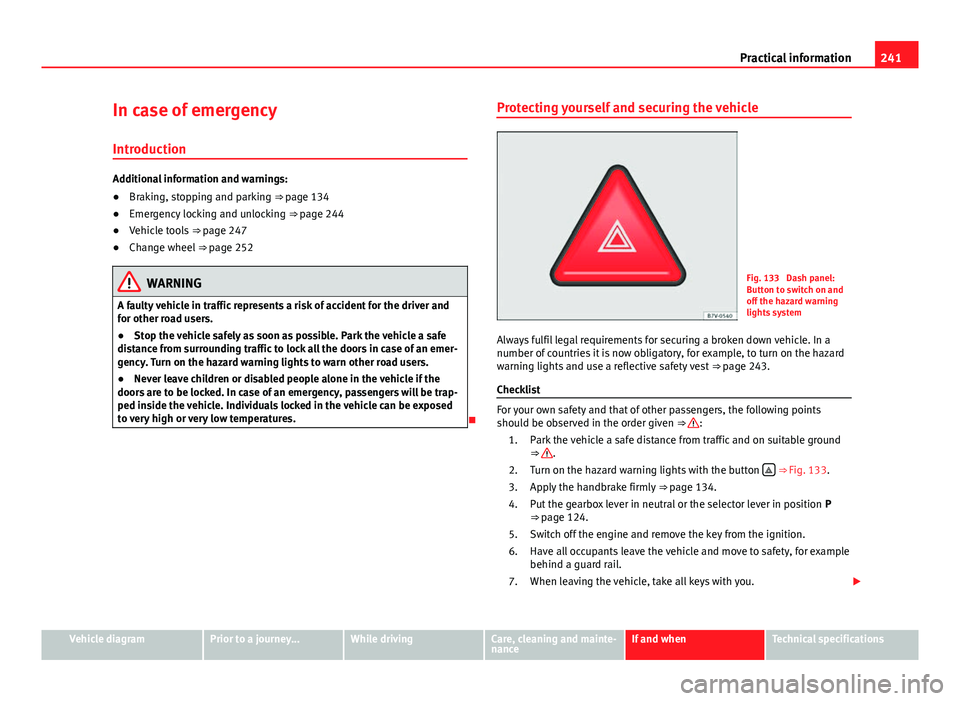
Fig. 133 Dash panel:
Button to switch on and
off the hazard warning
lights system
Always fulfil legal requirements for securing a broken down vehicle. In a
number of countries it is now obligatory, for example, to turn on the hazard
warning lights and use a reflective safety vest ⇒ page 243.
Checklist
For your own safety and that of other passengers, the following points
should be observed in the order given ⇒
:
1. Park the vehicle a safe distance from traffic and on suitable ground ⇒
.
2. Turn on the hazard warning lights with the button ⇒
Fig. 133.
3. Apply the handbrake firmly ⇒ page 134.
4. Put the gearbox lever in neutral or the selector lever in position P ⇒ page 124.
5. Switch off the engine and remove the key from the ignition.
6. Have all occupants leave the vehicle and move to safety, for example behind a guard rail.
7. When leaving the vehicle, take all keys with you.
Vehicle diagramPrior to a journey...While drivingCare, cleaning and mainte-
nanceIf and whenTechnical specifications