airbag Seat Mii 2013 Owner's Guide
[x] Cancel search | Manufacturer: SEAT, Model Year: 2013, Model line: Mii, Model: Seat Mii 2013Pages: 306, PDF Size: 4.3 MB
Page 71 of 306
69
Ensuring you are correctly and safely seated
● Optimised seat belts for all seats.
● Seat belt tension devices for driver and passenger.
● Seat belt force limiters for driver and passenger.
● Seat belt warning lamp
● Front airbags for driver and passenger.
● Side airbags for driver and passenger.
● Airbag control lamp .
● Control units and sensors.
● Head restraints optimised for rear-end collision.
● Adjustable steering column.
● If necessary, anchor points for child seats for the rear seats.
● Where applicable, mountings for the child seat upper retaining strap. Situations when the front and side airbags do not deploy:
●
If the ignition is switched off during the collision.
● In frontal collisions when the deceleration measured by the control unit
is too low.
● In minor side collisions.
● In rear collisions.
● In the event of the vehicle overturning.
● When the impact speed is lower than the reference value set in the con-
trol unit.
Vehicle diagramPrior to a journey...While drivingCare, cleaning and mainte-
nanceIf and whenTechnical specifications
Page 72 of 306
70Ensuring you are correctly and safely seated
Front airbags
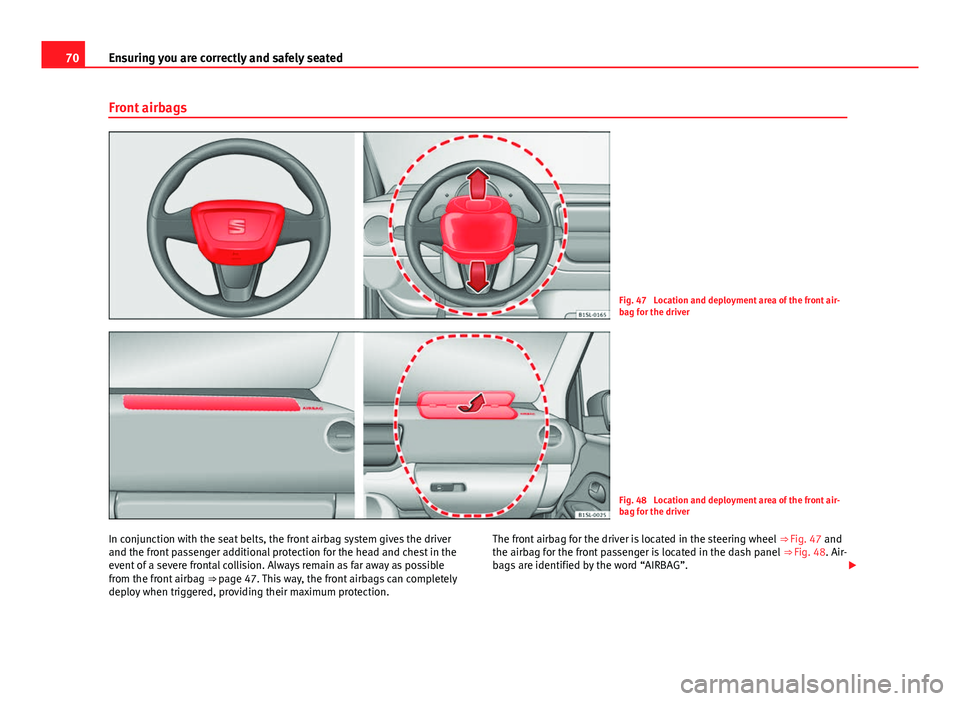
Fig. 47 Location and deployment area of the front air-
bag for the driver
Fig. 48 Location and deployment area of the front air-
bag for the driver
In conjunction with the seat belts, the front airbag system gives the driver
and the front passenger additional protection for the head and chest in the
event of a severe frontal collision. Always remain as far away as possible
from the front airbag ⇒ page 47. This way, the front airbags can completely
deploy when triggered, providing their maximum protection. The front airbag for the driver is located in the steering wheel
⇒ Fig. 47 and
the airbag for the front passenger is located in the dash panel ⇒ Fig. 48. Air-
bags are identified by the word “AIRBAG”.
Page 73 of 306
71
Ensuring you are correctly and safely seated
When the front airbags are triggered they fill the zones marked in
red ⇒ Fig. 47 and ⇒ Fig. 48 (radius of action). Therefore, objects should
never be placed or mounted in these areas ⇒
, Factory-fitted accessories
are outside the range of the front airbag for the driver and the front passen-
ger, e.g. the baseplate for the mobile phone support.
The airbag covers fold out of the steering wheel ⇒ Fig. 47 or dash panel
⇒ Fig. 48 when the driver and front passenger airbags are triggered. The air-
bag covers remain connected to the steering wheel or the dash panel.
WARNING
The airbag is deployed at high speed in fractions of a second.
● Always keep the deployment areas of the front airbags vacant.
● Never secure objects to the covers or in the deployment area of the
airbag modules, e.g. drink holders or phone supports.
● The deployment space between the front passengers and the airbags
must not in any case be occupied by other passenger, pets and objects.
● Never fix any object to the windscreen above the front airbag on the
front passenger side.
● Do not alter, cover or stick anything to the steering wheel hub or the
surface of the airbag module on the passenger side of the dash panel.
WARNING
Front airbags are deployed in front of the steering wheel ⇒ Fig. 47 and
the dash panel ⇒ Fig. 48.
● When driving, always hold the steering wheel on the outer edge of
the ring with both hands: 9 o'clock and 3 o'clock position.
WARNING (Continued)
● Adjust the driver seat so that there is a distance of at least 25 cm
(10 inches) between the centre of your chest and the hub of the steering
wheel. If you physical constitution prevents you from meeting these re-
quirements, make sure you contact a specialised workshop.
● Adjust the front passenger seat so there is as much distance as possi-
ble between the front passenger and the dash panel.
Deactivating and activating the front passenger front
airbag using the key switch
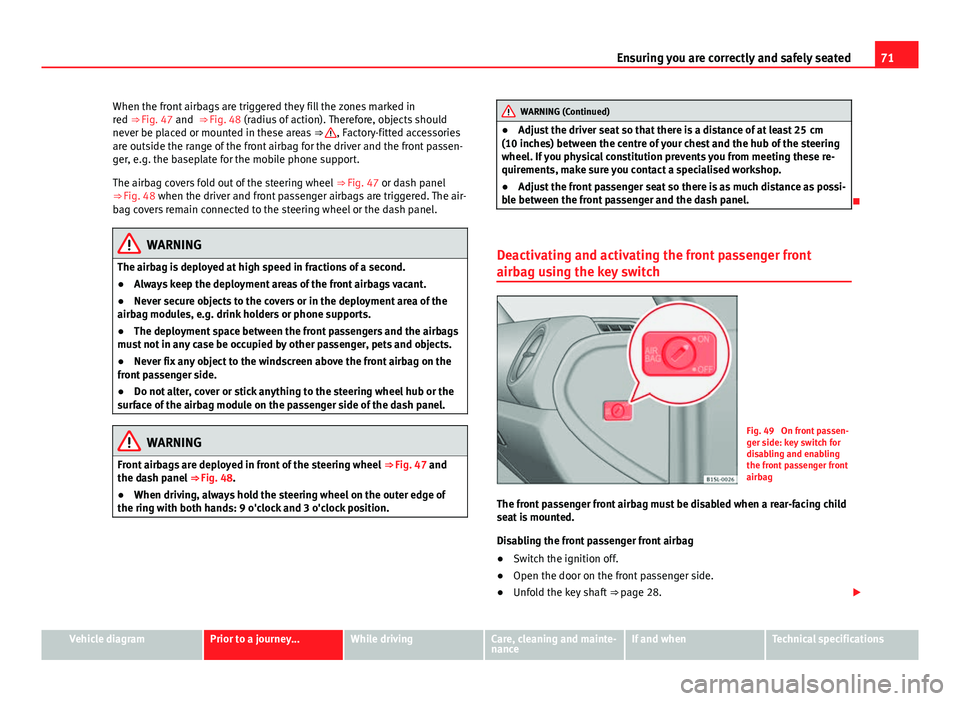
Fig. 49 On front passen-
ger side: key switch for
disabling and enabling
the front passenger front
airbag
The front passenger front airbag must be disabled when a rear-facing child
seat is mounted.
Disabling the front passenger front airbag
● Switch the ignition off.
● Open the door on the front passenger side.
● Unfold the key shaft ⇒ page 28.
Vehicle diagramPrior to a journey...While drivingCare, cleaning and mainte-
nanceIf and whenTechnical specifications
Page 74 of 306
72Ensuring you are correctly and safely seated
● Using the vehicle key, turn the key switch to OFF ⇒ Fig. 49.
● Close the door on the front passenger side.
● The PASSENGER AIR BAG control lamp on the dash panel will re-
main lit while the ignition is switched on ⇒ page 67.
Activating the front passenger front airbag
● Switch the ignition off.
● Open the door on the front passenger side.
● Unfold the key shaft ⇒ page 28.
● Using the vehicle key, turn the key switch to ON ⇒ Fig. 49.
● Close the door on the front passenger side.
● Check that the PASSENGER AIR BAG OFF control lamp on the dash
panel does not light up ⇒ page 67 while the ignition is switched on.
How to know whether the front passenger front airbag is disabled
Disabling of the front passenger airbag is only indicated by the PASSENGER
AIR BAG control lamp that remains lit on the dash panel ( re-
mains yellow) ⇒ page 67.
If the control lamp on the dash panel does not remain lit or is lit in
combination with the control lamp on the instrument panel, a child re-
straint system cannot be mounted on the front passenger seat for safety
reasons. The front passenger front airbag may deploy during an accident.
WARNING
The front passenger front airbag must only be disabled in special cases.
● Disable and activate the front passenger front airbag when the igni-
tion is switched off to avoid damage to the airbag system.
● It is the driver's responsibility to ensure that the key operated switch
is set to the correct position.
WARNING (Continued)
● Only disable the front passenger front airbag when a child seat is to
be mounted under exceptional circumstances.
● As soon as the child seat is no longer needed on the front passenger
seat, reconnect the front passenger front airbag.
Page 75 of 306
73
Ensuring you are correctly and safely seated
Side airbags
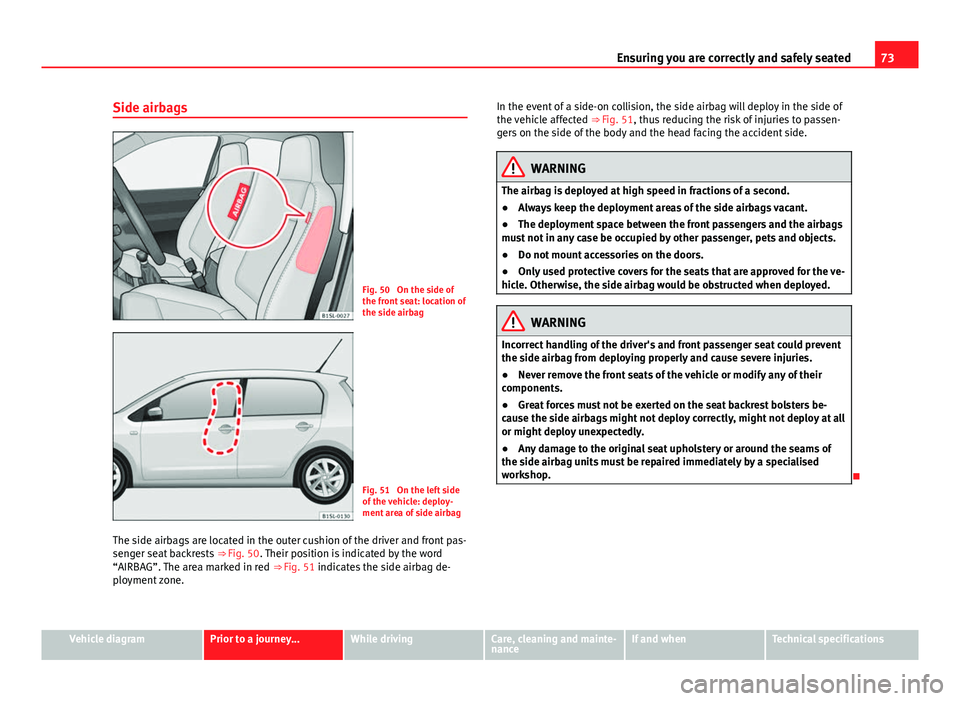
Fig. 50 On the side of
the front seat: location of
the side airbag
Fig. 51 On the left side
of the vehicle: deploy-
ment area of side airbag
The side airbags are located in the outer cushion of the driver and front pas-
senger seat backrests ⇒ Fig. 50. Their position is indicated by the word
“AIRBAG”. The area marked in red ⇒ Fig. 51 indicates the side airbag de-
ployment zone. In the event of a side-on collision, the side airbag will deploy in the side of
the vehicle affected
⇒ Fig. 51, thus reducing the risk of injuries to passen-
gers on the side of the body and the head facing the accident side.
WARNING
The airbag is deployed at high speed in fractions of a second.
● Always keep the deployment areas of the side airbags vacant.
● The deployment space between the front passengers and the airbags
must not in any case be occupied by other passenger, pets and objects.
● Do not mount accessories on the doors.
● Only used protective covers for the seats that are approved for the ve-
hicle. Otherwise, the side airbag would be obstructed when deployed.
WARNING
Incorrect handling of the driver's and front passenger seat could prevent
the side airbag from deploying properly and cause severe injuries.
● Never remove the front seats of the vehicle or modify any of their
components.
● Great forces must not be exerted on the seat backrest bolsters be-
cause the side airbags might not deploy correctly, might not deploy at all
or might deploy unexpectedly.
● Any damage to the original seat upholstery or around the seams of
the side airbag units must be repaired immediately by a specialised
workshop.
Vehicle diagramPrior to a journey...While drivingCare, cleaning and mainte-
nanceIf and whenTechnical specifications
Page 76 of 306
74Ensuring you are correctly and safely seated
Child seats (accessories)
Introduction
Before transporting babies and children in a child seat placed in the front
passenger seat, first completely read the information regarding the airbag
system.
This information is extremely important for driver and passenger safety, par-
ticularly that of babies and children.
SEAT recommends the use of child seats from the SEAT accessory pro-
gramme. These child seats have been designed and tested for use in SEAT
vehicles. You can purchase child seats with different mountings from a SEAT
dealership.
Additional information and warnings:
● Seat belts ⇒ page 56
● Airbag system ⇒ page 65
WARNING
Make sure children are properly belted in and correctly secured to avoid
severe or fatal injuries while the vehicle is in motion.
● Never use a rear-facing child seat in the front passenger seat if the
front passenger front airbag is enabled.
● Children up to 12 years old should always travel on the rear seat.
● Children must always be protected with an approved child restraint
system suited to their height and weight.
● Children must assume the proper sitting position and be properly bel-
ted in while travelling.
WARNING (Continued)
● Ensure the seat backrest is upright when a child seat is being used on
it.
● Do not allow the child's head or other part of his or her body to enter
the deployment area of the side airbags.
● Make sure the belt webbing is correctly positioned.
● Never hold children or babies on your lap or in your arms.
● Only one child may occupy a child seat.
● Please read and observe the child seat manufacturer's handling in-
structions.
WARNING
An empty or loose child seat could fly uncontrollably around the vehicle
interior and cause injuries in the event of an accident or sudden braking.
● When not in use while the vehicle is in motion, always safely secure
the child seat or store it in the luggage compartment.
Note
Replace the child seat after an accident, as it may have invisible damage.
Page 79 of 306
77
Ensuring you are correctly and safely seated
Specific mounting systems for each country
Attachment variants ⇒ Fig. 52:
Europe: ISOFIX retaining rings and upper retaining strap ⇒ page 79
and ⇒ page 81.
Three-point seat belt and upper retaining strap ⇒ page 78.
The systems include the child restraint system mounting with an upper re-
taining strap (Top Tether) and lower anchoring points on the seat.
Use of the child seat on the front passenger seat
Transporting children on the front passenger seat is not permitted in all
countries. Furthermore, not all child seats are approved for use on the front
passenger seat. Your SEAT dealership has an updated list of all approved
child seats. Only used child seats that are approved for each vehicle.
The front airbag on the front passenger side is highly dangerous for a child.
The front passenger seat is life-threatening to a child if he or she is trans-
ported in a rear-facing child seat.
If a rear-facing child seat is secured to the front passenger seat, an inflating
front airbag can strike it with such great force that severe or fatal injuries
may result ⇒
. Therefore, rear-facing child seats must never be used on
the front passenger seat when the front passenger front airbag is enabled.
Only use a rear-facing child seat on the front passenger seat if the front pas-
senger front airbag is disabled. When it is disabled, the yellow PASSENGER
AIR BAG ⇒ page 65 control lamp on the dash panel will be lit. If you
cannot disable the front passenger front airbag and it remains activated, it
is forbidden to transport children on the front passenger seat ⇒
.
A
B
Things to note if using a child seat on the front passenger seat:
●
The front passenger front airbag must be disabled when using a rear-
facing child seat ⇒ page 65.
● The seat backrest of the front passenger seat must be upright.
● The front passenger seat must be moved as far back as possible.
● The seat backrest of the front passenger seat must be upright.
Suitable child seats
The child seat must be authorised by the manufacturer especially for use on
a front passenger seat with a front or side airbag.
Universal seats for children can be fitted in the front passenger seat, in
groups 0, 0+, 1, 2 or 3 according to the ECE-R 44 regulation.
WARNING
If a child seat is mounted on the front passenger seat, the risk of the
child sustaining severe or fatal injuries in the event of an accident increa-
ses. Rear-facing child seats must never be mounted on the front passen-
ger seat when the front passenger front airbag is enabled. This is life-
threatening to the child should the front airbag deploy, as the child seat
would be struck by the inflated airbag and thrown against the seat back-
rest.
WARNING
If, in exceptional circumstances, a child must be transported in a rear-fac-
ing child seat on the front passenger seat, strictly observe the following:
● Always disable the front passenger front airbag and leave it disabled.
● The child seat must be approved by the manufacturer for use on a
front passenger seat with front and side airbag.
● Follow the installation instructions of the child seat manufacturer and
observe the warnings.
Vehicle diagramPrior to a journey...While drivingCare, cleaning and mainte-
nanceIf and whenTechnical specifications
Page 80 of 306
78Ensuring you are correctly and safely seated
WARNING (Continued)
● Move the front passenger seat as far back as possible and adjust it to
its highest position to keep as far away as possible from the front airbag.
● Move the seat backrest to the upright position.
● Children must always be protected with an approved child restraint
system suited to their height and weight.
Use of the child seat on the rear seat
If a child seat is mounted on the rear seat, adapt the position of the front
passenger seat so that the child has enough space. Therefore, adapt the
front passenger seat to the size of the child seat and the height of the child.
Ensure the passenger is in the correct position ⇒ page 47.
Suitable child seats
The manufacturer must authorise the child seat for use in the rear seats with
side airbags.
Universal seats for children can be fitted in the passenger seat, in groups 0,
0+, 1, 2 or 3 according to the ECE-R 44 regulation.
The rear seats are suitable for child seats with the ISOFIX system specially
designed for this type of vehicle in accordance with regulation ECE-R 44.
ISOFIX child seats approved for rear seats
ISOFIX child seats are divided into certified categories “universal”, “semi-
universal” or “specific categories for the vehicle”.
● If the ISOFIX child seat is certified “universal”, it must be supported by
the lower anchor points and the Top Tether retaining strap.
● If the ISOFIX child seat is certified “semi-universal” or “specific catego-
ries for the vehicle”, check that the child seat is certified for the vehicle be-
fore employing it. The child seat manufacturer supplies, in addition to the
ISOFIX child seat, a list of vehicles for which the corresponding ISOFIX child seat has been certified. If necessary, contact the child seat manufacturer for
an updated list of vehicles.
Securing child seats with the seat belt
The seat belt may be used to secure child seats with the universal marking
(on the orange label) to the vehicle seats marked with a u in the table be-
low.
CategoryFront passengerRear seatsGroup 0
Up to 10 kguu
Category 0+ Up to 13 kguu
Group 1
9 to 18 kguu
Group 2
15 to 25 kguu
Group 3
22 to 36 kguu
Securing the child seat using the seat belt
● Please read and observe the child seat manufacturer's handling instruc-
tions.
● Move the front passenger seat, or the rear seat bench back as far as pos-
sible and, in the case of an adjustable backrest, set it in the upright posi-
tion ⇒ page 47.
● Positioning the child seat on the seat according to the manufacturer's
instructions.
● Fasten the seat belt or pass it around the child seat structure in the man-
ner described in the manufacturer's instructions.
● Make sure the seat belt is not twisted.
Page 97 of 306
95
Transporting
Transporting
Driving tips Introduction
Always transport heavy loads in the luggage compartment and place the
seat backs in a vertical position. Never overload the vehicle. Both the carry-
ing capacity as well as the distribution of the load in the vehicle have ef-
fects on the driving behaviour and braking ability ⇒
.
Additional information and warnings:
● Rear lid ⇒ page 39
● To lower the front passenger seat back ⇒ page 54
● Light ⇒ page 82
● Luggage compartment ⇒ page 98
● Roof carrier ⇒ page 104
● Wheels and tyres ⇒ page 210
WARNING
Unsecured or incorrectly secured objects can cause serious injury in case
of a sudden manoeuvring or breaking or in case of an accident. This is es-
pecially true when objects are struck by a detonating airbag and fired
through the vehicle interior. To reduce the risks, please note the follow-
ing:
● Secure all objects in the vehicle. Always keep equipment and heavy
objects in the luggage compartment.
WARNING (Continued)
● Always secure objects with suitable rope or slings so that they cannot
enter the deployment areas around the frontal or side airbags in case of
sudden braking or an accident.
● Always ensure that objects inside the vehicle cannot move into the
deployment area of the bags while driving.
● While driving, always keep object compartments closed.
● Remove all objects from the front passenger seat when this is fol-
lowed down. When the seat backrest is folded down, it presses on small
and light objects and these are detected by the weight sensor on the
seat; this sends false information to the airbag control unit.
● While the backrest of the front passenger seat is folded, the frontal
airbag must remain disconnected and the PASSENGER AIRBAG OFF
light on.
● Objects secured in the vehicle should never be placed in such a way
as to make passengers sit in an incorrect position.
● If secured objects occupy a seat then this should not be occupied or
used by anybody.
WARNING
The driving behaviour and braking ability change when transporting
heavy and large objects.
● Adjust your speed and driving style to visibility, road, traffic and
weather conditions.
● Accelerate gently and carefully.
● Avoid sudden braking and manoeuvres.
● Brake early.
Vehicle diagramPrior to a journey...While drivingCare, cleaning and mainte-
nanceIf and whenTechnical specifications
Page 100 of 306
98Transporting
Loading luggage compartment
Introduction
Always transport heavy loads in the luggage compartment and place the
seat backs in a vertical position. Never overload the vehicle. Both the carry-
ing capacity as well as the distribution of the load in the vehicle have ef-
fects on the driving behaviour and braking ability ⇒
.
Additional information and warnings:
● Airbag system ⇒ page 65
● Light ⇒ page 82
● Transporting ⇒ page 95
● Wheels and tyres ⇒ page 210
WARNING
When the vehicle is not in use or being watched, always lock the doors
and the rear lid to reduce the risk of serious injury or death.
● Do not leave children unwatched, especially when the rear lid is open.
Children could climb into the luggage compartment, close the rear lid
from inside and be unable to escape themselves. This could lead to seri-
ous injury or death.
● Never allow children to play in or around the vehicle.
● Never transport people in the luggage compartment.
WARNING
Unsecured or incorrectly secured objects can cause serious injury in case
of a sudden manoeuvring or breaking or in case of an accident. This is es-
pecially true when objects are struck by a detonating airbag and fired
through the vehicle interior. To reduce the risks, please note the follow-
ing:
● Secure all objects in the vehicle. Always keep equipment and heavy
objects in the luggage compartment.
● Always secure objects with suitable rope or straps so that they can-
not enter the deployment areas around the frontal or side airbags in case
of sudden braking or an accident.
● While driving, always keep object compartments closed.
● Do not place hard, heavy or sharp objects inside the vehicle interior,
in open storage compartments, the rear shelf or on the dash panel.
● Remove hard, heavy and sharp objects from clothes and pockets in-
side the vehicle and store securely.
WARNING
The transport of heavy object changes vehicle handling and increases
braking distance. Heavy loads that have not been stored or secured cor-
rectly could cause loss of control and result in serious injury.
● The vehicle handling changes when transporting heavy objects due
to a change in the centre of gravity.
● Distribute the load as uniformly and as low down on the vehicle as
possible.
● Store heavy objects in the luggage compartment as far from the rear
axle as possible.
CAUTION
Hard objects on the rear shelf could chafe against the wires of the heating
element in the heated rear window and cause damage.