seats Seat Mii 2013 Owner's Guide
[x] Cancel search | Manufacturer: SEAT, Model Year: 2013, Model line: Mii, Model: Seat Mii 2013Pages: 306, PDF Size: 4.3 MB
Page 78 of 306
76Ensuring you are correctly and safely seated
Child seats approved under the ECE-R 44 regulation are fitted with the corre-
sponding approval symbol. The sign is an upper-case E in a circle with the
identification number below it.
WARNING
Not following the checklist prepared for your own safety could lead to ac-
cidents and severe injuries.
● Always follow the check list and perform the necessary operations.
WARNING
In general, the rear seat is always the safest place for children, who are
belted correctly, in the event of an accident.
● A suitable child seat that is correctly installed and used on one of the
rear seats offer the most protection possible for babies and children up
to 12 years in most accidents.
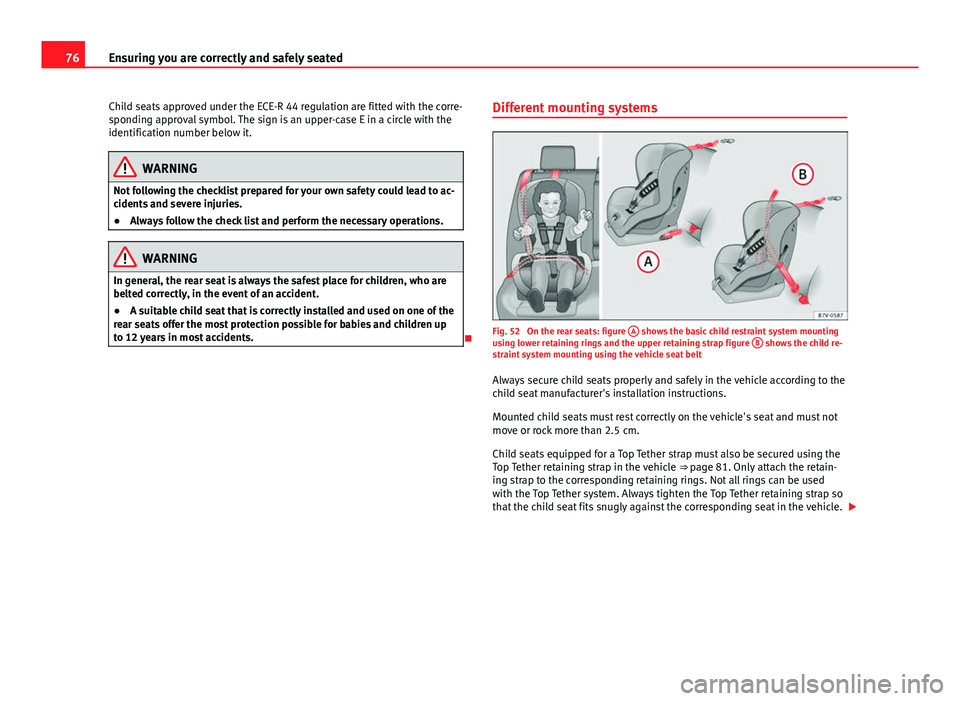
Different mounting systemsFig. 52 On the rear seats: figure
A shows the basic child restraint system mounting
using lower retaining rings and the upper retaining strap figure B shows the child re-
straint system mounting using the vehicle seat belt
Always secure child seats properly and safely in the vehicle according to the
child seat manufacturer's installation instructions.
Mounted child seats must rest correctly on the vehicle's seat and must not
move or rock more than 2.5 cm.
Child seats equipped for a Top Tether strap must also be secured using the
Top Tether retaining strap in the vehicle ⇒ page 81. Only attach the retain-
ing strap to the corresponding retaining rings. Not all rings can be used
with the Top Tether system. Always tighten the Top Tether retaining strap so
that the child seat fits snugly against the corresponding seat in the vehicle.
Page 79 of 306
77
Ensuring you are correctly and safely seated
Specific mounting systems for each country
Attachment variants ⇒ Fig. 52:
Europe: ISOFIX retaining rings and upper retaining strap ⇒ page 79
and ⇒ page 81.
Three-point seat belt and upper retaining strap ⇒ page 78.
The systems include the child restraint system mounting with an upper re-
taining strap (Top Tether) and lower anchoring points on the seat.
Use of the child seat on the front passenger seat
Transporting children on the front passenger seat is not permitted in all
countries. Furthermore, not all child seats are approved for use on the front
passenger seat. Your SEAT dealership has an updated list of all approved
child seats. Only used child seats that are approved for each vehicle.
The front airbag on the front passenger side is highly dangerous for a child.
The front passenger seat is life-threatening to a child if he or she is trans-
ported in a rear-facing child seat.
If a rear-facing child seat is secured to the front passenger seat, an inflating
front airbag can strike it with such great force that severe or fatal injuries
may result ⇒
. Therefore, rear-facing child seats must never be used on
the front passenger seat when the front passenger front airbag is enabled.
Only use a rear-facing child seat on the front passenger seat if the front pas-
senger front airbag is disabled. When it is disabled, the yellow PASSENGER
AIR BAG ⇒ page 65 control lamp on the dash panel will be lit. If you
cannot disable the front passenger front airbag and it remains activated, it
is forbidden to transport children on the front passenger seat ⇒
.
A
B
Things to note if using a child seat on the front passenger seat:
●
The front passenger front airbag must be disabled when using a rear-
facing child seat ⇒ page 65.
● The seat backrest of the front passenger seat must be upright.
● The front passenger seat must be moved as far back as possible.
● The seat backrest of the front passenger seat must be upright.
Suitable child seats
The child seat must be authorised by the manufacturer especially for use on
a front passenger seat with a front or side airbag.
Universal seats for children can be fitted in the front passenger seat, in
groups 0, 0+, 1, 2 or 3 according to the ECE-R 44 regulation.
WARNING
If a child seat is mounted on the front passenger seat, the risk of the
child sustaining severe or fatal injuries in the event of an accident increa-
ses. Rear-facing child seats must never be mounted on the front passen-
ger seat when the front passenger front airbag is enabled. This is life-
threatening to the child should the front airbag deploy, as the child seat
would be struck by the inflated airbag and thrown against the seat back-
rest.
WARNING
If, in exceptional circumstances, a child must be transported in a rear-fac-
ing child seat on the front passenger seat, strictly observe the following:
● Always disable the front passenger front airbag and leave it disabled.
● The child seat must be approved by the manufacturer for use on a
front passenger seat with front and side airbag.
● Follow the installation instructions of the child seat manufacturer and
observe the warnings.
Vehicle diagramPrior to a journey...While drivingCare, cleaning and mainte-
nanceIf and whenTechnical specifications
Page 80 of 306
78Ensuring you are correctly and safely seated
WARNING (Continued)
● Move the front passenger seat as far back as possible and adjust it to
its highest position to keep as far away as possible from the front airbag.
● Move the seat backrest to the upright position.
● Children must always be protected with an approved child restraint
system suited to their height and weight.
Use of the child seat on the rear seat
If a child seat is mounted on the rear seat, adapt the position of the front
passenger seat so that the child has enough space. Therefore, adapt the
front passenger seat to the size of the child seat and the height of the child.
Ensure the passenger is in the correct position ⇒ page 47.
Suitable child seats
The manufacturer must authorise the child seat for use in the rear seats with
side airbags.
Universal seats for children can be fitted in the passenger seat, in groups 0,
0+, 1, 2 or 3 according to the ECE-R 44 regulation.
The rear seats are suitable for child seats with the ISOFIX system specially
designed for this type of vehicle in accordance with regulation ECE-R 44.
ISOFIX child seats approved for rear seats
ISOFIX child seats are divided into certified categories “universal”, “semi-
universal” or “specific categories for the vehicle”.
● If the ISOFIX child seat is certified “universal”, it must be supported by
the lower anchor points and the Top Tether retaining strap.
● If the ISOFIX child seat is certified “semi-universal” or “specific catego-
ries for the vehicle”, check that the child seat is certified for the vehicle be-
fore employing it. The child seat manufacturer supplies, in addition to the
ISOFIX child seat, a list of vehicles for which the corresponding ISOFIX child seat has been certified. If necessary, contact the child seat manufacturer for
an updated list of vehicles.
Securing child seats with the seat belt
The seat belt may be used to secure child seats with the universal marking
(on the orange label) to the vehicle seats marked with a u in the table be-
low.
CategoryFront passengerRear seatsGroup 0
Up to 10 kguu
Category 0+ Up to 13 kguu
Group 1
9 to 18 kguu
Group 2
15 to 25 kguu
Group 3
22 to 36 kguu
Securing the child seat using the seat belt
● Please read and observe the child seat manufacturer's handling instruc-
tions.
● Move the front passenger seat, or the rear seat bench back as far as pos-
sible and, in the case of an adjustable backrest, set it in the upright posi-
tion ⇒ page 47.
● Positioning the child seat on the seat according to the manufacturer's
instructions.
● Fasten the seat belt or pass it around the child seat structure in the man-
ner described in the manufacturer's instructions.
● Make sure the seat belt is not twisted.
Page 81 of 306
79
Ensuring you are correctly and safely seated
● Insert the latch plate into the buckle for the appropriate seat and push it
down until it is securely locked with an audible click.
● Ensure that the upper belt web lies tightly on the child seat.
● Pull the belt (it must be no longer possible to pull the lower belt web-
bing out).
Removing the child seat
The seat belt must not be unfastened until the vehicle has come to a stand-
still ⇒
.
● Press the red button on the buckle. The latch plate is released from the
buckle.
● Guide the belt back by hand so that it rolls up easily and the trim will not
be damaged.
● Remove the child seat from the vehicle.
WARNING
Unbuckling the seat belt while the vehicle is in motion can cause severe
or fatal injuries in the event of an accident or sudden braking.
● The seat belt must not be unfastened until the vehicle has come to a
standstill.
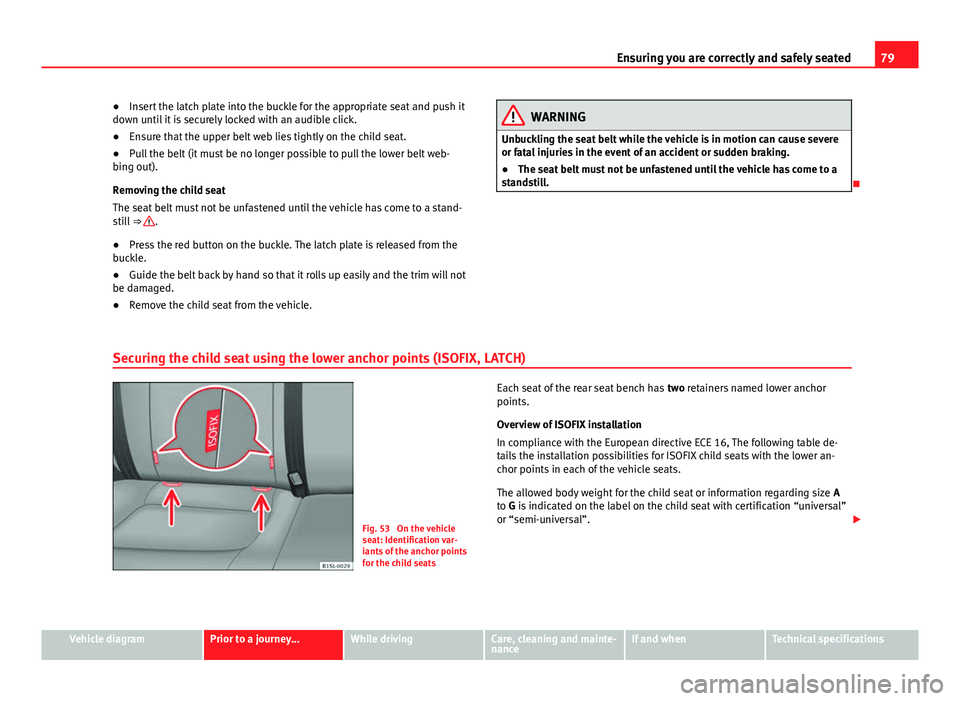
Securing the child seat using the lower anchor points (ISOFIX, LATCH)
Fig. 53 On the vehicle
seat: Identification var-
iants of the anchor points
for the child seats Each seat of the rear seat bench has
two retainers named lower anchor
points.
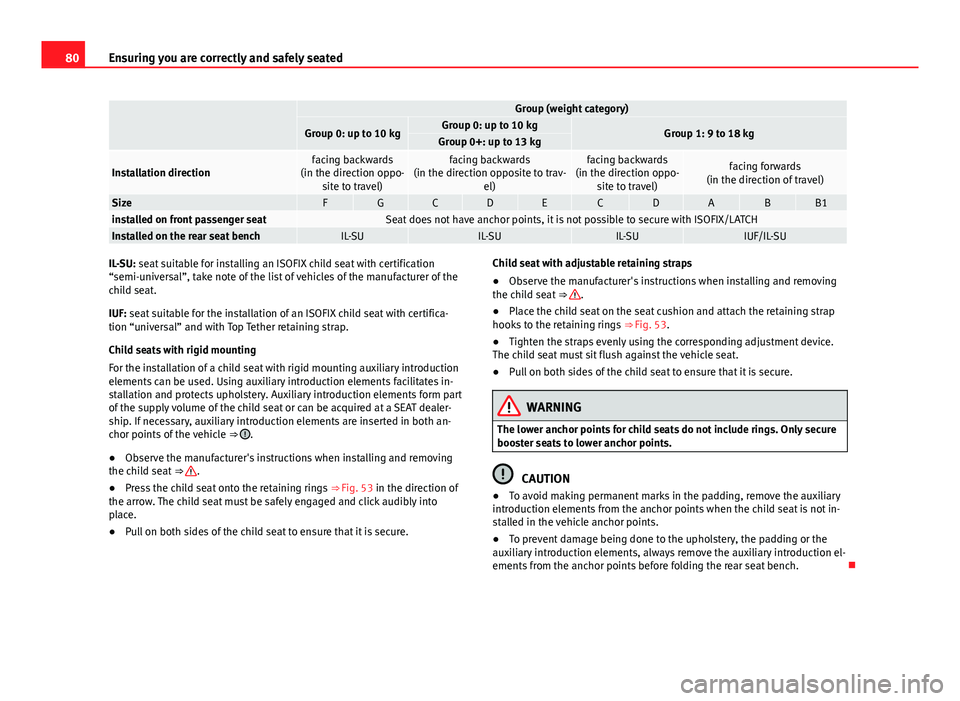
Overview of ISOFIX installation
In compliance with the European directive ECE 16, The following table de-
tails the installation possibilities for ISOFIX child seats with the lower an-
chor points in each of the vehicle seats.
The allowed body weight for the child seat or information regarding size A
to G is indicated on the label on the child seat with certification “universal”
or “semi-universal”.
Vehicle diagramPrior to a journey...While drivingCare, cleaning and mainte-
nanceIf and whenTechnical specifications
Page 82 of 306
80Ensuring you are correctly and safely seated
Group (weight category)
Group 0: up to 10 kgGroup 0: up to 10 kgGroup 1: 9 to 18 kgGroup 0+: up to 13 kg
Installation directionfacing backwards
(in the direction oppo- site to travel)facing backwards
(in the direction opposite to trav- el)facing backwards
(in the direction oppo- site to travel)facing forwards
(in the direction of travel)
SizeFGCDECDABB1installed on front passenger seatSeat does not have anchor points, it is not possible to secure with ISOFIX/LATCHInstalled on the rear seat benchIL-SUIL-SUIL-SUIUF/IL-SU
IL-SU: seat suitable for installing an ISOFIX child seat with certification
“semi-universal”, take note of the list of vehicles of the manufacturer of the
child seat.
IUF: seat suitable for the installation of an ISOFIX child seat with certifica-
tion “universal” and with Top Tether retaining strap.
Child seats with rigid mounting
For the installation of a child seat with rigid mounting auxiliary introduction
elements can be used. Using auxiliary introduction elements facilitates in-
stallation and protects upholstery. Auxiliary introduction elements form part
of the supply volume of the child seat or can be acquired at a SEAT dealer-
ship. If necessary, auxiliary introduction elements are inserted in both an-
chor points of the vehicle ⇒
.
● Observe the manufacturer's instructions when installing and removing
the child seat ⇒
.
● Press the child seat onto the retaining rings ⇒ Fig. 53 in the direction of
the arrow. The child seat must be safely engaged and click audibly into
place.
● Pull on both sides of the child seat to ensure that it is secure. Child seat with adjustable retaining straps
●
Observe the manufacturer's instructions when installing and removing
the child seat ⇒
.
● Place the child seat on the seat cushion and attach the retaining strap
hooks to the retaining rings ⇒ Fig. 53.
● Tighten the straps evenly using the corresponding adjustment device.
The child seat must sit flush against the vehicle seat.
● Pull on both sides of the child seat to ensure that it is secure.
WARNING
The lower anchor points for child seats do not include rings. Only secure
booster seats to lower anchor points.
CAUTION
● To avoid making permanent marks in the padding, remove the auxiliary
introduction elements from the anchor points when the child seat is not in-
stalled in the vehicle anchor points.
● To prevent damage being done to the upholstery, the padding or the
auxiliary introduction elements, always remove the auxiliary introduction el-
ements from the anchor points before folding the rear seat bench.
Page 83 of 306
81
Ensuring you are correctly and safely seated
Securing a child seat using a Top Tether retaining strap
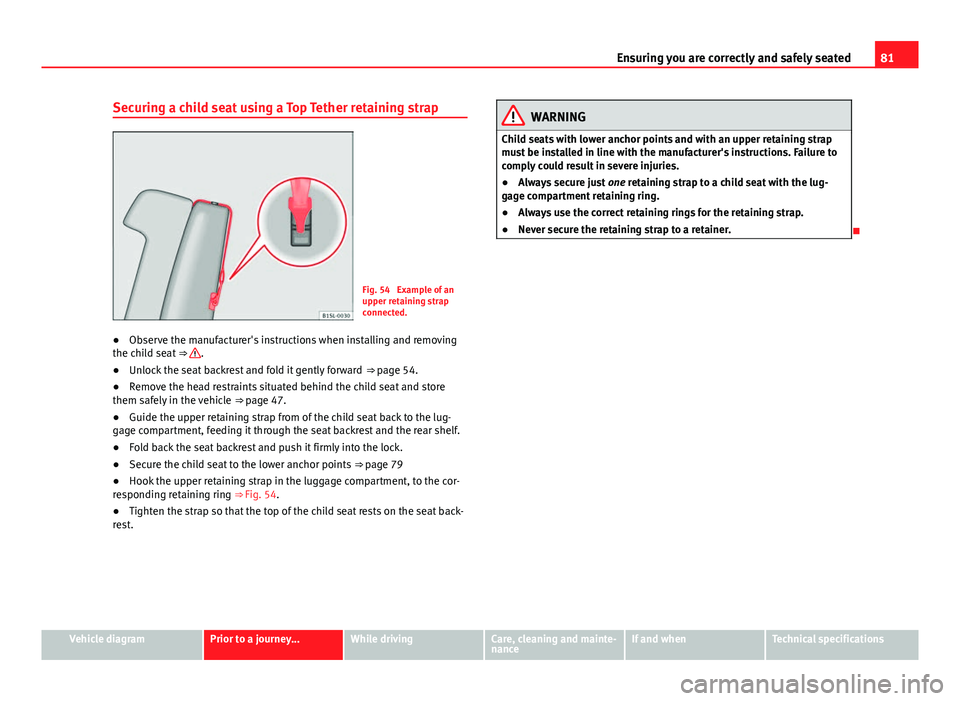
Fig. 54 Example of an
upper retaining strap
connected.
● Observe the manufacturer's instructions when installing and removing
the child seat ⇒
.
● Unlock the seat backrest and fold it gently forward
⇒ page 54.
● Remove the head restraints situated behind the child seat and store
them safely in the vehicle ⇒ page 47.
● Guide the upper retaining strap from of the child seat back to the lug-
gage compartment, feeding it through the seat backrest and the rear shelf.
● Fold back the seat backrest and push it firmly into the lock.
● Secure the child seat to the lower anchor points
⇒ page 79
● Hook the upper retaining strap in the luggage compartment, to the cor-
responding retaining ring ⇒ Fig. 54.
● Tighten the strap so that the top of the child seat rests on the seat back-
rest.
WARNING
Child seats with lower anchor points and with an upper retaining strap
must be installed in line with the manufacturer's instructions. Failure to
comply could result in severe injuries.
● Always secure just one retaining strap to a child seat with the lug-
gage compartment retaining ring.
● Always use the correct retaining rings for the retaining strap.
● Never secure the retaining strap to a retainer.
Vehicle diagramPrior to a journey...While drivingCare, cleaning and mainte-
nanceIf and whenTechnical specifications
Page 88 of 306
86Lights and visibility
Headlight range control, lighting of instruments and
controls
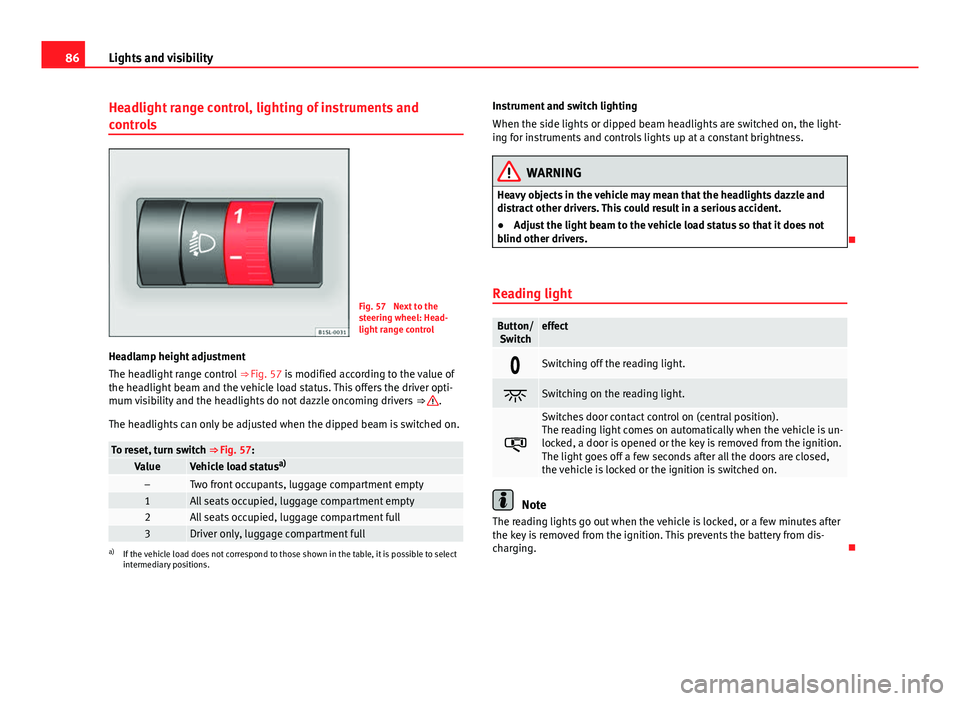
Fig. 57 Next to the
steering wheel: Head-
light range control
Headlamp height adjustment
The headlight range control ⇒ Fig. 57 is modified according to the value of
the headlight beam and the vehicle load status. This offers the driver opti-
mum visibility and the headlights do not dazzle oncoming drivers ⇒
.
The headlights can only be adjusted when the dipped beam is switched on.
To reset, turn switch ⇒ Fig. 57:ValueVehicle load status a)–Two front occupants, luggage compartment empty1All seats occupied, luggage compartment empty2All seats occupied, luggage compartment full3Driver only, luggage compartment fulla)
If the vehicle load does not correspond to those shown in the table, it is possible to select
intermediary positions. Instrument and switch lighting
When the side lights or dipped beam headlights are switched on, the light-
ing for instruments and controls lights up at a constant brightness.
WARNING
Heavy objects in the vehicle may mean that the headlights dazzle and
distract other drivers. This could result in a serious accident.
● Adjust the light beam to the vehicle load status so that it does not
blind other drivers.
Reading light
Button/ Switcheffect
Switching off the reading light.
Switching on the reading light.
Switches door contact control on (central position).
The reading light comes on automatically when the vehicle is un-
locked, a door is opened or the key is removed from the ignition.
The light goes off a few seconds after all the doors are closed,
the vehicle is locked or the ignition is switched on.
Note
The reading lights go out when the vehicle is locked, or a few minutes after
the key is removed from the ignition. This prevents the battery from dis-
charging.
Page 101 of 306
99
Transporting
Note
The ventilating slits between the heated rear window and the rear shelf
must not be covered so that used air can escape from the vehicle.
Folding and lifting up the rear seat bench backrest
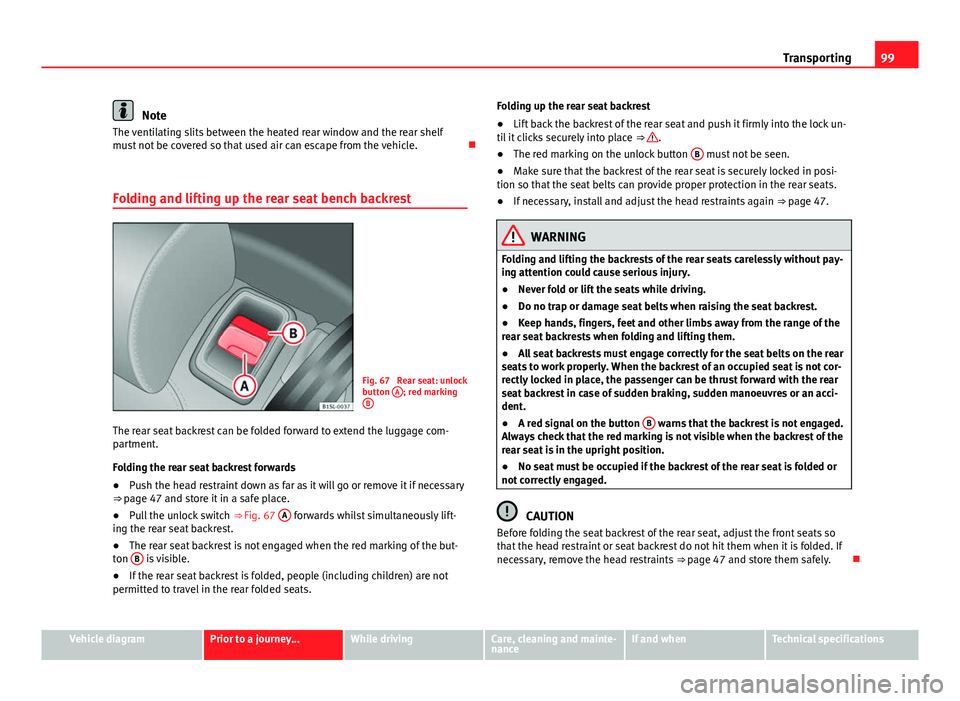
Fig. 67 Rear seat: unlock
button A; red marking
B
The rear seat backrest can be folded forward to extend the luggage com-
partment.
Folding the rear seat backrest forwards
● Push the head restraint down as far as it will go or remove it if necessary
⇒ page 47 and store it in a safe place.
● Pull the unlock switch
⇒ Fig. 67 A
forwards whilst simultaneously lift-
ing the rear seat backrest.
● The rear seat backrest is not engaged when the red marking of the but-
ton B
is visible.
● If the rear seat backrest is folded, people (including children) are not
permitted to travel in the rear folded seats. Folding up the rear seat backrest
●
Lift back the backrest of the rear seat and push it firmly into the lock un-
til it clicks securely into place ⇒
.
● The red marking on the unlock button B must not be seen.
● Make sure that the backrest of the rear seat is securely locked in posi-
tion so that the seat belts can provide proper protection in the rear seats.
● If necessary, install and adjust the head restraints again ⇒ page 47.
WARNING
Folding and lifting the backrests of the rear seats carelessly without pay-
ing attention could cause serious injury.
● Never fold or lift the seats while driving.
● Do no trap or damage seat belts when raising the seat backrest.
● Keep hands, fingers, feet and other limbs away from the range of the
rear seat backrests when folding and lifting them.
● All seat backrests must engage correctly for the seat belts on the rear
seats to work properly. When the backrest of an occupied seat is not cor-
rectly locked in place, the passenger can be thrust forward with the rear
seat backrest in case of sudden braking, sudden manoeuvres or an acci-
dent.
● A red signal on the button B
warns that the backrest is not engaged.
Always check that the red marking is not visible when the backrest of the
rear seat is in the upright position.
● No seat must be occupied if the backrest of the rear seat is folded or
not correctly engaged.
CAUTION
Before folding the seat backrest of the rear seat, adjust the front seats so
that the head restraint or seat backrest do not hit them when it is folded. If
necessary, remove the head restraints ⇒ page 47 and store them safely.
Vehicle diagramPrior to a journey...While drivingCare, cleaning and mainte-
nanceIf and whenTechnical specifications
Page 114 of 306
112Practical equipment
Other storage compartments
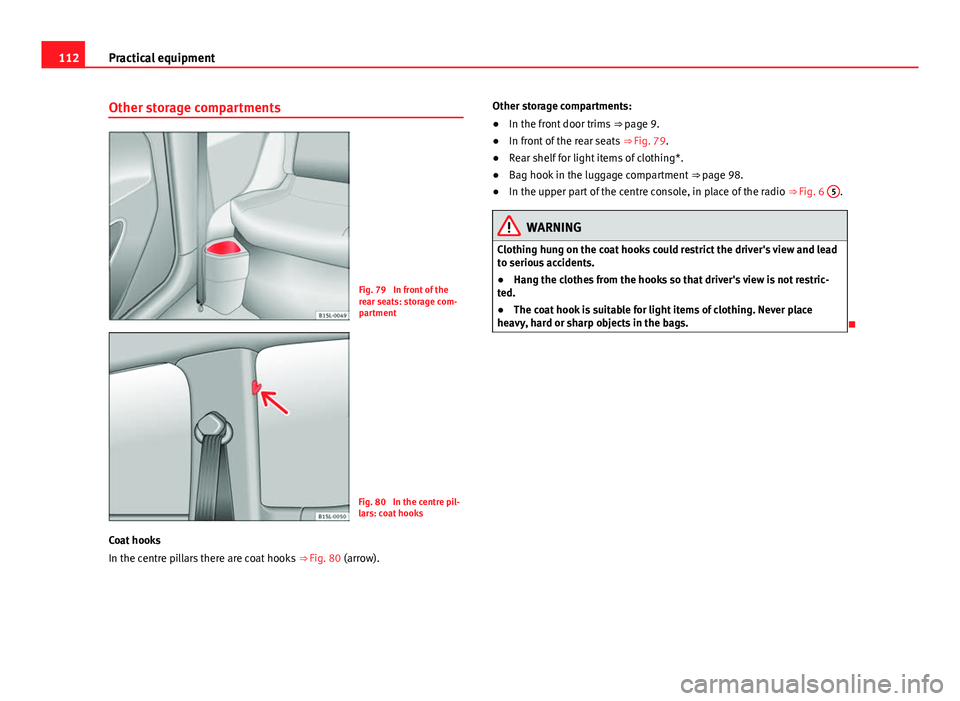
Fig. 79 In front of the
rear seats: storage com-
partment
Fig. 80 In the centre pil-
lars: coat hooks
Coat hooks
In the centre pillars there are coat hooks ⇒ Fig. 80 (arrow). Other storage compartments:
●
In the front door trims ⇒ page 9.
● In front of the rear seats ⇒ Fig. 79.
● Rear shelf for light items of clothing*.
● Bag hook in the luggage compartment ⇒ page 98.
● In the upper part of the centre console, in place of the radio ⇒ Fig. 6 5
.
WARNING
Clothing hung on the coat hooks could restrict the driver's view and lead
to serious accidents.
● Hang the clothes from the hooks so that driver's view is not restric-
ted.
● The coat hook is suitable for light items of clothing. Never place
heavy, hard or sharp objects in the bags.
Page 138 of 306
136Starting, changing gears, parking
WARNING (Continued)
your speed and drive carefully to a specialised workshop close by to
check the brake system. During the following journey, avoid sudden brak-
ing and manoeuvres.
● If the ABS warning lamp does not go out or if it lights while driv-
ing, the ABS is malfunctioning. The vehicle can only be stopped using
normal braking without ABS. The protection provided by the ABS is not
available. Visit a specialised workshop as soon as possible.
CAUTION
Failure to heed the warning lamps when they appear may result in faults in
the vehicle.
Handbrake
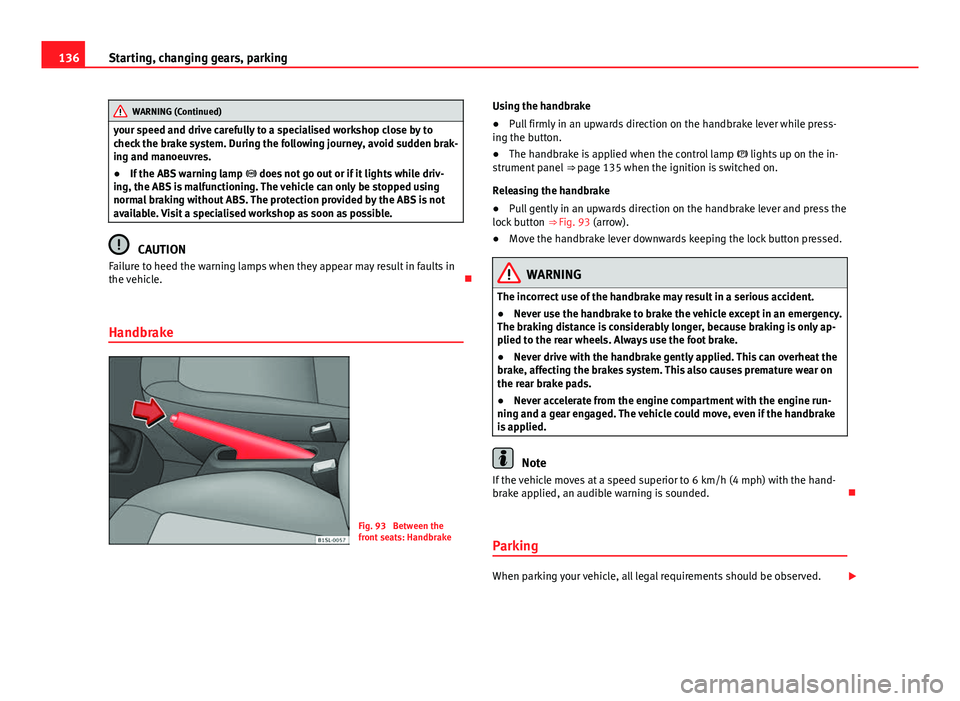
Fig. 93 Between the
front seats: Handbrake Using the handbrake
●
Pull firmly in an upwards direction on the handbrake lever while press-
ing the button.
● The handbrake is applied when the control lamp lights up on the in-
strument panel ⇒ page 135 when the ignition is switched on.
Releasing the handbrake
● Pull gently in an upwards direction on the handbrake lever and press the
lock button ⇒ Fig. 93 (arrow).
● Move the handbrake lever downwards keeping the lock button pressed.
WARNING
The incorrect use of the handbrake may result in a serious accident.
● Never use the handbrake to brake the vehicle except in an emergency.
The braking distance is considerably longer, because braking is only ap-
plied to the rear wheels. Always use the foot brake.
● Never drive with the handbrake gently applied. This can overheat the
brake, affecting the brakes system. This also causes premature wear on
the rear brake pads.
● Never accelerate from the engine compartment with the engine run-
ning and a gear engaged. The vehicle could move, even if the handbrake
is applied.
Note
If the vehicle moves at a speed superior to 6 km/h (4 mph) with the hand-
brake applied, an audible warning is sounded.
Parking
When parking your vehicle, all legal requirements should be observed.