airbag off Seat Mii 2013 Owner's manual
[x] Cancel search | Manufacturer: SEAT, Model Year: 2013, Model line: Mii, Model: Seat Mii 2013Pages: 306, PDF Size: 4.3 MB
Page 13 of 306
11
Vehicle interior
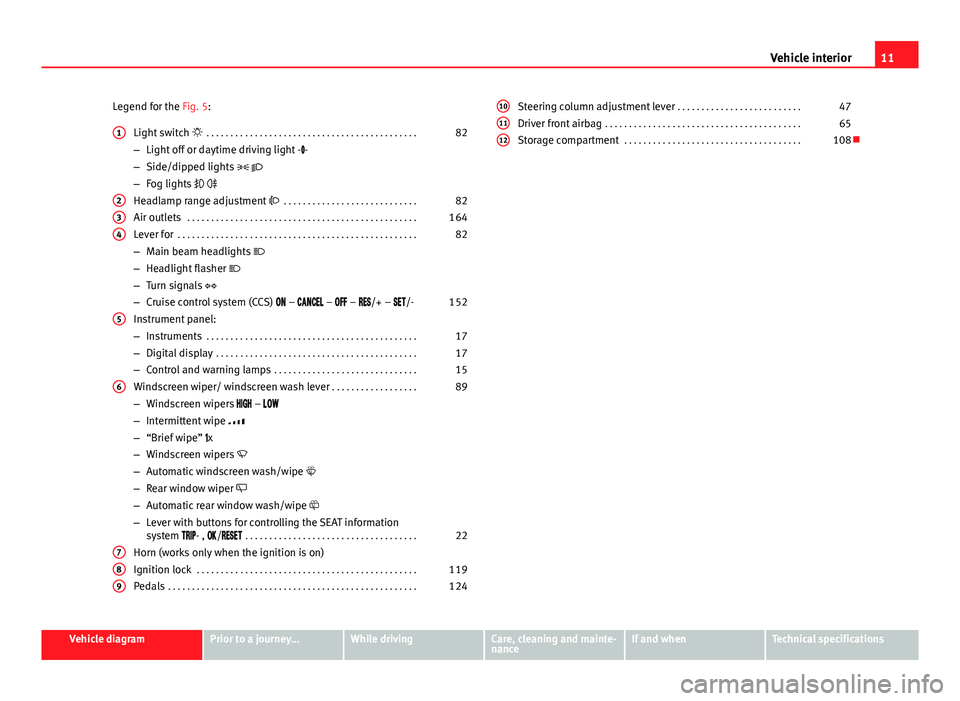
Legend for the Fig. 5: Light switch . . . . . . . . . . . . . . . . . . . . . . . . . . . . . . . . . . . . . . . . . . . . 82
– Light off or daytime driving light - -
– Side/dipped lights
– Fog lights
Headlamp range adjustment . . . . . . . . . . . . . . . . . . . . . . . . . . . . 82
Air outlets . . . . . . . . . . . . . . . . . . . . . . . . . . . . . . . . . . . . . . . . . . . . . . . . 164
Lever for . . . . . . . . . . . . . . . . . . . . . . . . . . . . . . . . . . . . . . . . . . . . . . . . . . 82
– Main beam headlights
– Headlight flasher
– Turn signals
– Cruise control system (CCS) – – – /+ – /- 152
Instrument panel:
– Instruments . . . . . . . . . . . . . . . . . . . . . . . . . . . . . . . . . . . . . . . . . . . . 17
– Digital display . . . . . . . . . . . . . . . . . . . . . . . . . . . . . . . . . . . . . . . . . . 17
– Control and warning lamps . . . . . . . . . . . . . . . . . . . . . . . . . . . . . . 15
Windscreen wiper/ windscreen wash lever . . . . . . . . . . . . . . . . . .89
– Windscreen wipers –
– Intermittent wipe
– “Brief wipe” x
– Windscreen wipers
– Automatic windscreen wash/wipe
– Rear window wiper
– Automatic rear window wash/wipe
– Lever with buttons for controlling the SEAT information
system - , / . . . . . . . . . . . . . . . . . . . . . . . . . . . . . . . . . . . . 22
Horn (works only when the ignition is on)
Ignition lock . . . . . . . . . . . . . . . . . . . . . . . . . . . . . . . . . . . . . . . . . . . . . . 119
Pedals . . . . . . . . . . . . . . . . . . . . . . . . . . . . . . . . . . . . . . . . . . . . . . . . . . . . 124
1
234
5
6
789
Steering column adjustment lever
. . . . . . . . . . . . . . . . . . . . . . . . . . 47
Driver front airbag . . . . . . . . . . . . . . . . . . . . . . . . . . . . . . . . . . . . . . . . . 65
Storage compartment . . . . . . . . . . . . . . . . . . . . . . . . . . . . . . . . . . . . . 108101112
Vehicle diagramPrior to a journey...While drivingCare, cleaning and mainte-
nanceIf and whenTechnical specifications
Page 14 of 306
12Vehicle interior
Overview of centre console
Top part of the centre console
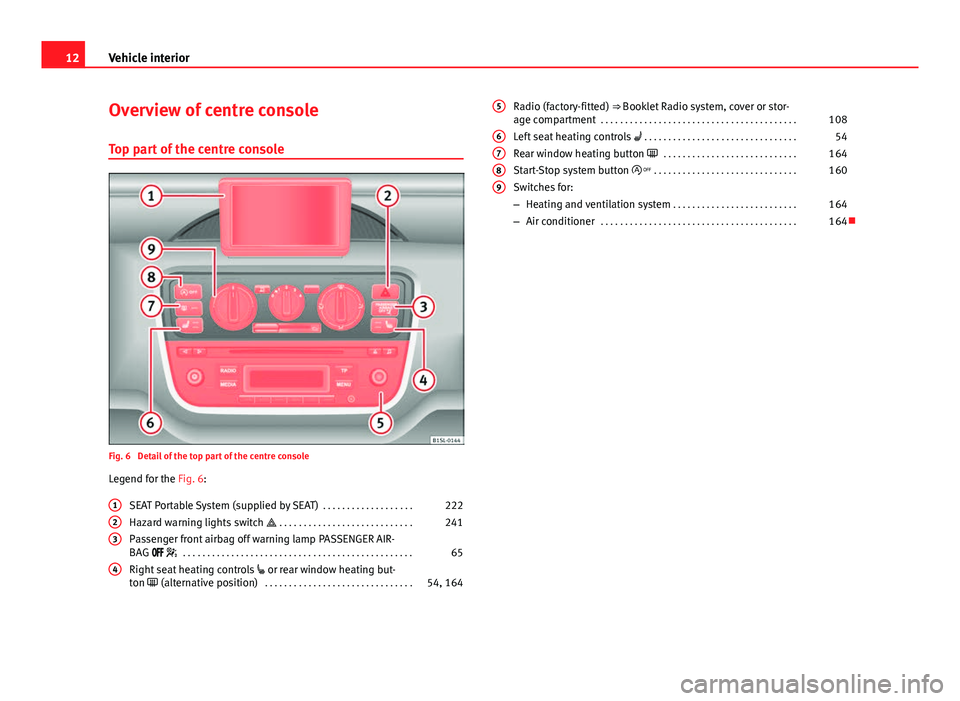
Fig. 6 Detail of the top part of the centre console
Legend for the Fig. 6:
SEAT Portable System (supplied by SEAT) . . . . . . . . . . . . . . . . . . .222
Hazard warning lights switch . . . . . . . . . . . . . . . . . . . . . . . . . . . . 241
Passenger front airbag off warning lamp PASSENGER AIR-
BAG . . . . . . . . . . . . . . . . . . . . . . . . . . . . . . . . . . . . . . . . . . . . . . . . 65
Right seat heating controls or rear window heating but-
ton (alternative position) . . . . . . . . . . . . . . . . . . . . . . . . . . . . . . . 54, 164
1
23
4
Radio (factory-fitted) ⇒ Booklet Radio system, cover or stor-
age compartment
. . . . . . . . . . . . . . . . . . . . . . . . . . . . . . . . . . . . . . . . . 108
Left seat heating controls . . . . . . . . . . . . . . . . . . . . . . . . . . . . . . . . 54
Rear window heating button . . . . . . . . . . . . . . . . . . . . . . . . . . . . 164
Start-Stop system button . . . . . . . . . . . . . . . . . . . . . . . . . . . . . . 160
Switches for:
– Heating and ventilation system . . . . . . . . . . . . . . . . . . . . . . . . . . 164
– Air conditioner . . . . . . . . . . . . . . . . . . . . . . . . . . . . . . . . . . . . . . . . . 1645
6789
Page 16 of 306
14Vehicle interior
Detail of the passenger seat
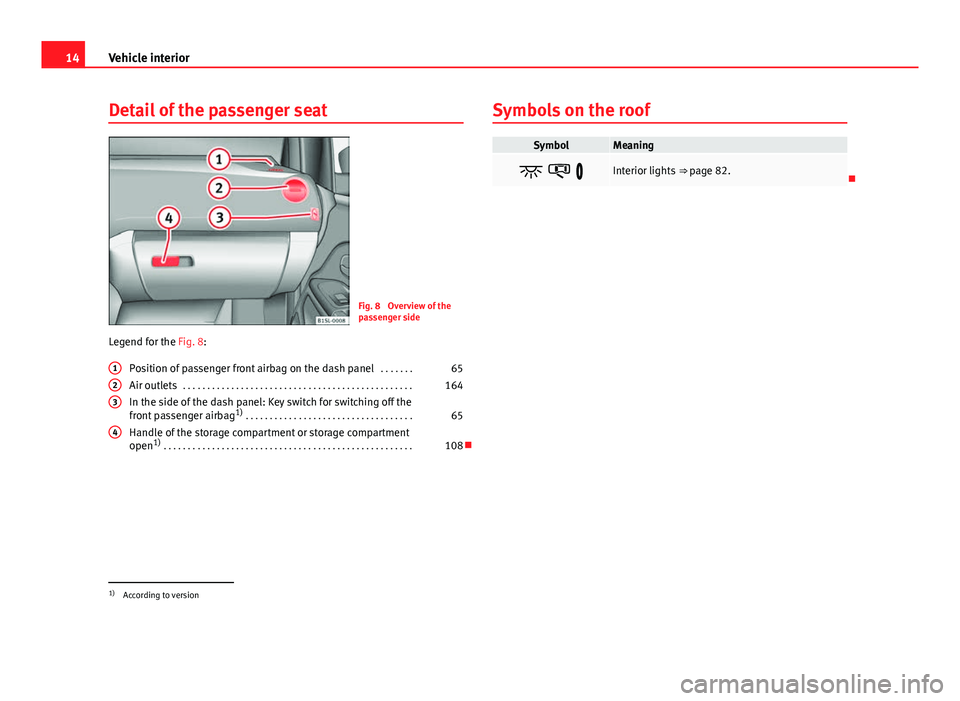
Fig. 8 Overview of the
passenger side
Legend for the Fig. 8:
Position of passenger front airbag on the dash panel . . . . . . .65
Air outlets . . . . . . . . . . . . . . . . . . . . . . . . . . . . . . . . . . . . . . . . . . . . . . . . 164
In the side of the dash panel: Key switch for switching off the
front passenger airbag 1)
. . . . . . . . . . . . . . . . . . . . . . . . . . . . . . . . . . . 65
Handle of the storage compartment or storage compartment
open 1)
. . . . . . . . . . . . . . . . . . . . . . . . . . . . . . . . . . . . . . . . . . . . . . . . . . . . 108
1
23
4
Symbols on the roof
SymbolMeaning
Interior lights
⇒ page 82.
1)
According to version
Page 18 of 306
16Instrument panel
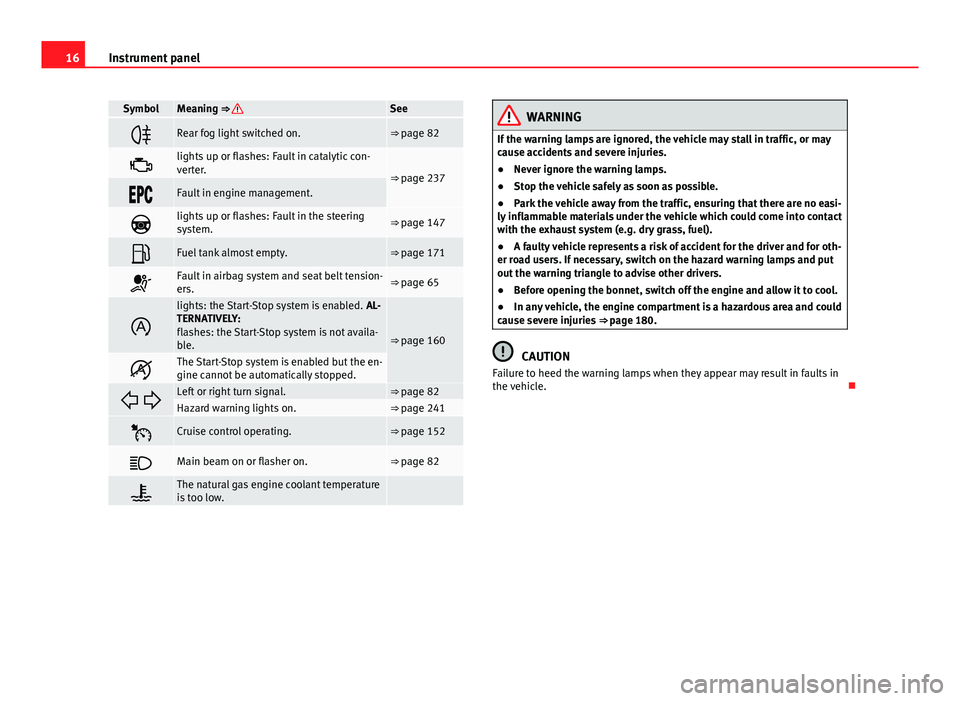
SymbolMeaning ⇒ See
Rear fog light switched on.⇒ page 82
lights up or flashes: Fault in catalytic con-
verter.
⇒ page 237
Fault in engine management.
lights up or flashes: Fault in the steering
system.⇒ page 147
Fuel tank almost empty.⇒ page 171
Fault in airbag system and seat belt tension-
ers.⇒ page 65
lights: the Start-Stop system is enabled. AL-
TERNATIVELY:
flashes: the Start-Stop system is not availa-
ble.
⇒ page 160
The Start-Stop system is enabled but the en-
gine cannot be automatically stopped.
Left or right turn signal.⇒ page 82Hazard warning lights on.⇒ page 241
Cruise control operating.⇒ page 152
Main beam on or flasher on.⇒ page 82
The natural gas engine coolant temperature
is too low.
WARNING
If the warning lamps are ignored, the vehicle may stall in traffic, or may
cause accidents and severe injuries.
● Never ignore the warning lamps.
● Stop the vehicle safely as soon as possible.
● Park the vehicle away from the traffic, ensuring that there are no easi-
ly inflammable materials under the vehicle which could come into contact
with the exhaust system (e.g. dry grass, fuel).
● A faulty vehicle represents a risk of accident for the driver and for oth-
er road users. If necessary, switch on the hazard warning lamps and put
out the warning triangle to advise other drivers.
● Before opening the bonnet, switch off the engine and allow it to cool.
● In any vehicle, the engine compartment is a hazardous area and could
cause severe injuries ⇒ page 180.
CAUTION
Failure to heed the warning lamps when they appear may result in faults in
the vehicle.
Page 49 of 306
47
Ensuring you are correctly and safely seated
Ensuring you are correctly and safely seated Adjusting the seat position
Introduction
Number of seats
The vehicle has a total of 4 seats: 2 front seats and 2 rear seats. Each seat is
equipped with a seat belt.
Additional information and warnings:
● Seat functions ⇒ page 54
● Seat belts ⇒ page 56
● Airbag system ⇒ page 65
● Child seats (accessories) ⇒ page 74
WARNING
An incorrect sitting position in the vehicle can lead to severe injuries or
death in the event of sudden braking or manoeuvres, collision or acci-
dents or if the airbag deploys.
● Before the vehicle moves, assume the proper sitting position and
maintain it throughout the trip. This also includes fastening the seat
belt.
● Never transport more people than there are seats with a seat belt
available in the vehicle.
WARNING (Continued)
● Children must always be protected with an approved child restraint
system suited to their height and weight ⇒ page 74, ⇒ page 65.
● Always keep your feet in the footwell while the vehicle is in motion.
Never, for example, put your feet on the surface of a seat or on the dash
panel and never put them out of a window. Otherwise the airbag and seat
belt offer insufficient protection and the risk of injury in the event of an
accident is increased.
WARNING
Before every trip, adjust the seat, the seat belt and the head restraints
and instruct your passengers to fasten their seat belts properly.
● Move the front passenger seat back as far as possible.
● Adjust the driver seat so that there is a distance of at least 25 cm be-
tween the centre of your chest and the hub of the steering wheel. Adjust
the driver seat so that you are able to press the accelerator, brake and
clutch pedals to the floor with your knees slightly angled and that the
distance between your knees and the dash panel is at least 10 cm. If your
physical constitution prevents you from meeting these requirements,
contact a specialised workshop to make any modifications required.
● Never drive with the seat backrest tilted far back. The further the seat
backrests are tilted to the rear, the greater the risk of injury due to incor-
rect positioning of the belt web or to the incorrect sitting position!
● Never drive with the seat backrest tilted forwards. Should a front air-
bag deploy, it could throw the seat backrest backwards and injure the
passengers of the rear seats.
● Sit as far away as possible from the steering wheel and the dash pan-
el.
Vehicle diagramPrior to a journey...While drivingCare, cleaning and mainte-
nanceIf and whenTechnical specifications
Page 50 of 306
48Ensuring you are correctly and safely seated
WARNING (Continued)
● Keep your back straight and resting completely against the seat back-
rest and the front seats correctly adjusted. Never place any part of your
body in the area of the airbag or very close to it.
● If passengers on the rear seats are not sitting in an upright position,
the risk of severe injury due to incorrect positioning of the belt web in-
creases.
WARNING
Incorrect seat adjustment may lead to accidents and severe injuries.
● Only adjust the seats when the vehicle is stationary, as the seats
could move unexpectedly while the vehicle is in motion and you could
lose control of the vehicle. Furthermore, an incorrect position is adopted
when adjusting the seat.
● Only adjust the height, seat backrest and forwards or backwards po-
sition of the seat when there is nobody in the seat adjustment area.
● There must be no objects blocking the front seat adjustment area.
Danger of injuries due to an incorrect sitting position
If the seat belts are worn incorrectly or not at all, the risk of severe injuries
increases. Seat belts can provide optimal protection only if the belt web is
properly worn. The seat belt cannot offer its full protection if the belt web is
not positioned correctly. This could result in severe and even fatal injuries.
The risk of severe or fatal injuries is especially increased when a deploying
airbag strikes a vehicle occupant who has assumed an incorrect sitting po-
sition. The driver is responsible for all passengers in the vehicle, particularly
children.
The following list shows just some examples of incorrect sitting positions
which can be dangerous to all vehicle occupants. When the vehicle is in motion:
●
Never stand in the vehicle.
● Never stand on the seats.
● Never kneel on the seats.
● Never tilt your seat backrest too far to the rear.
● Never lean against the dash panel.
● Never lie on the rear seats.
● Never sit on the front edge of a seat.
● Never sit sideways.
● Never lean out of a window.
● Never put your feet out of a window.
● Never put your feet on the dash panel.
● Never put your feet on the surface of a seat or seat backrest.
● Never travel in a footwell.
● Never travel on a seat without wearing the seat belt.
● Never carry any person in the luggage compartment.
WARNING
Every incorrect sitting position increases the risk of severe or fatal inju-
ries in the event of accidents or sudden braking or manoeuvres.
● All passengers must assume the proper sitting position and be prop-
erly belted in while travelling.
● Vehicle occupants in incorrect sitting positions, not wearing their
seat belt or too close to the airbag run the risk of suffering severe or fatal
injuries, particularly if the airbag deploys and hits an occupant sitting in
an incorrect position.
Page 56 of 306
54Ensuring you are correctly and safely seated
Seat functions
Introduction
Additional information and warnings:
● Adjust the seat position ⇒ page 47
● Seat belts ⇒ page 56
● Airbag system ⇒ page 65
● Child seats (accessories) ⇒ page 74
● Exterior mirrors ⇒ page 93
WARNING
Inappropriate use of the seat functions can cause severe injuries.
● Assume the proper sitting position before your trip and remain in it
throughout. This also applies to the other occupants.
● Keep hands, fingers, feet and other limbs away from the seat operat-
ing and adjustment radius.
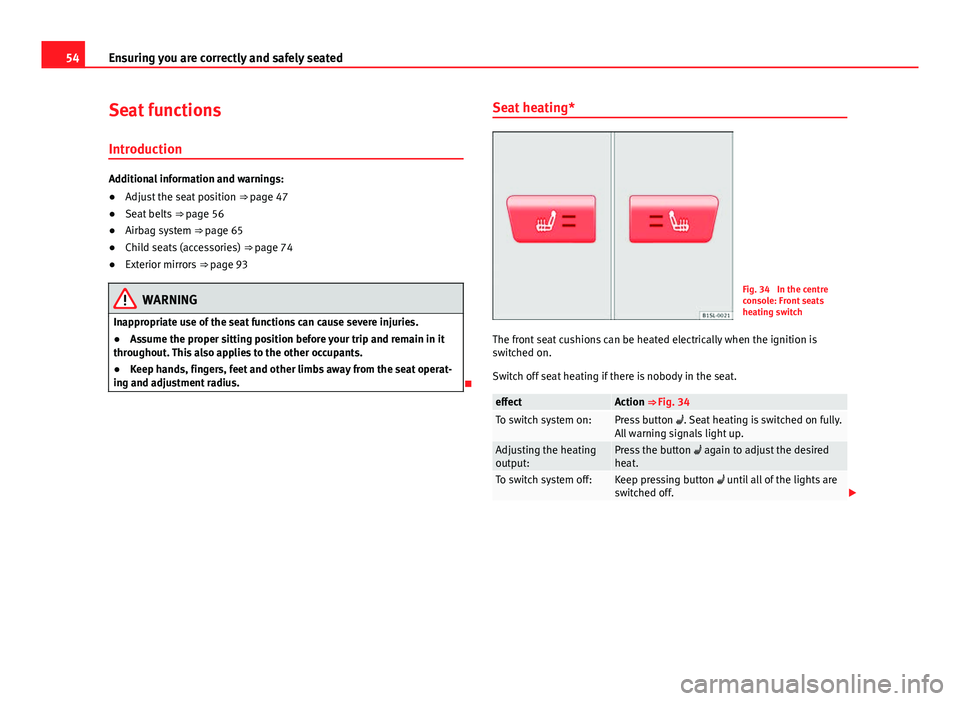
Seat heating*
Fig. 34 In the centre
console: Front seats
heating switch
The front seat cushions can be heated electrically when the ignition is
switched on.
Switch off seat heating if there is nobody in the seat.
effectAction ⇒ Fig. 34To switch system on:Press button . Seat heating is switched on fully.
All warning signals light up.
Adjusting the heating
output:Press the button again to adjust the desired
heat.
To switch system off:Keep pressing button until all of the lights are
switched off.
Page 58 of 306
56Ensuring you are correctly and safely seated
Seat belts
Introduction
Check the condition of all the seat belts at regular intervals. If you notice
that the belt webbing, fittings, retractor mechanism or buckle of any of the
belts is damaged, the belt must be replaced immediately by a specialised
workshop ⇒
. The specialised workshop must use the appropriate spare
parts corresponding to the vehicle, the equipment and the model year. SEAT
recommends visiting a Technical Service.
Additional information and warnings:
● Adjust the seat position ⇒ page 47
● Airbag system ⇒ page 65
● Child seats (accessories) ⇒ page 74
● Accessories, parts replacement, repairs and modifications ⇒ page 222
WARNING
Unbuckled or badly buckled seat belts increase the risk of severe or even
fatal injuries. The seat belt cannot offer its full protection if it is not fas-
tened and used correctly.
● Seats belts are the most effective ways of reducing the risk of sus-
taining severe or fatal injuries In the event of an accident. Seat belts
must be correctly fastened when the vehicle is in motion to protect the
driver and all vehicle occupants.
● Before each trip, every occupant in the vehicle occupants must sit
properly, correctly fasten the seat belt belonging to his or her seat and
keep it fastened throughout the trip. This also applies to other vehicle
occupants when driving in town.
WARNING (Continued)
● When travelling, children must be secured in the vehicle with a child
restraint system suitable for their weight and height and with the seat
belts correctly fastened ⇒ page 74.
● Instruct your passengers to fasten their seat belts properly before
driving off.
● Insert the latch plate into the buckle for the appropriate seat and en-
sure it is engaged. Using the latch plate in the buckle of another seat will
not protect you properly and may cause severe injuries.
● Do not allow liquids or foreign bodies to enter the buckle fastenings.
This could damage the buckles and seat belts.
● Never unbuckle your seat belt when the vehicle is moving.
● Never allow more than one passenger to share the same seat belt.
● Never hold children or babies on your lap sharing the same seat belt.
● Loose, bulky clothing (such as a jacket) impairs the proper fit and
function of the seat belt.
WARNING
It is extremely dangerous to drive using damaged seat belts and could re-
sult in serious injury or loss of life.
● Avoid damaging the seat belt by jamming it in the door or the seat
mechanism.
● If the fabric or other parts of the seat belt are damaged, the seat belts
could break in the event of an accident or sudden braking.
● Always have damaged seatbelts replaced immediately by seat belts
approved for the vehicle in question by SEAT. Seat belts which have been
worn in an accident and stretched must be replaced by a specialised
workshop. Renewal may be necessary even if there is no apparent dam-
age. The belt anchorage should also be checked.
● Never attempt to repair, modify or remove a seat belt yourself. All re-
pairs to seat belts, retractors and buckles must be carried out by a speci-
alised workshop.
Page 62 of 306
60Ensuring you are correctly and safely seated
It is also important for the rear passengers to wear seat belts properly, as
they could otherwise be thrown forward violently in an accident. Rear pas-
sengers who do not use seat belts endanger not only themselves but also
the driver and other vehicle occupants ⇒ Fig. 40.
Seat belt protection
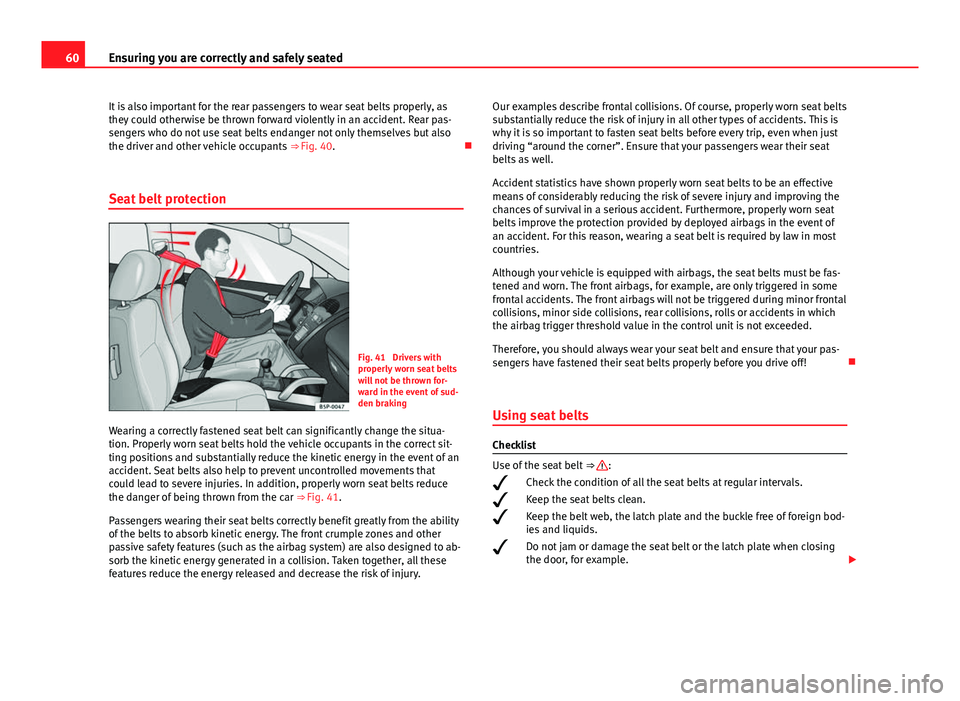
Fig. 41 Drivers with
properly worn seat belts
will not be thrown for-
ward in the event of sud-
den braking
Wearing a correctly fastened seat belt can significantly change the situa-
tion. Properly worn seat belts hold the vehicle occupants in the correct sit-
ting positions and substantially reduce the kinetic energy in the event of an
accident. Seat belts also help to prevent uncontrolled movements that
could lead to severe injuries. In addition, properly worn seat belts reduce
the danger of being thrown from the car ⇒ Fig. 41.
Passengers wearing their seat belts correctly benefit greatly from the ability
of the belts to absorb kinetic energy. The front crumple zones and other
passive safety features (such as the airbag system) are also designed to ab-
sorb the kinetic energy generated in a collision. Taken together, all these
features reduce the energy released and decrease the risk of injury. Our examples describe frontal collisions. Of course, properly worn seat belts
substantially reduce the risk of injury in all other types of accidents. This is
why it is so important to fasten seat belts before every trip, even when just
driving “around the corner”. Ensure that your passengers wear their seat
belts as well.
Accident statistics have shown properly worn seat belts to be an effective
means of considerably reducing the risk of severe injury and improving the
chances of survival in a serious accident. Furthermore, properly worn seat
belts improve the protection provided by deployed airbags in the event of
an accident. For this reason, wearing a seat belt is required by law in most
countries.
Although your vehicle is equipped with airbags, the seat belts must be fas-
tened and worn. The front airbags, for example, are only triggered in some
frontal accidents. The front airbags will not be triggered during minor frontal
collisions, minor side collisions, rear collisions, rolls or accidents in which
the airbag trigger threshold value in the control unit is not exceeded.
Therefore, you should always wear your seat belt and ensure that your pas-
sengers have fastened their seat belts properly before you drive off!
Using seat belts
Checklist
Use of the seat belt ⇒
:
Check the condition of all the seat belts at regular intervals.
Keep the seat belts clean.
Keep the belt web, the latch plate and the buckle free of foreign bod-
ies and liquids.
Do not jam or damage the seat belt or the latch plate when closing
the door, for example.
Page 65 of 306
63
Ensuring you are correctly and safely seated
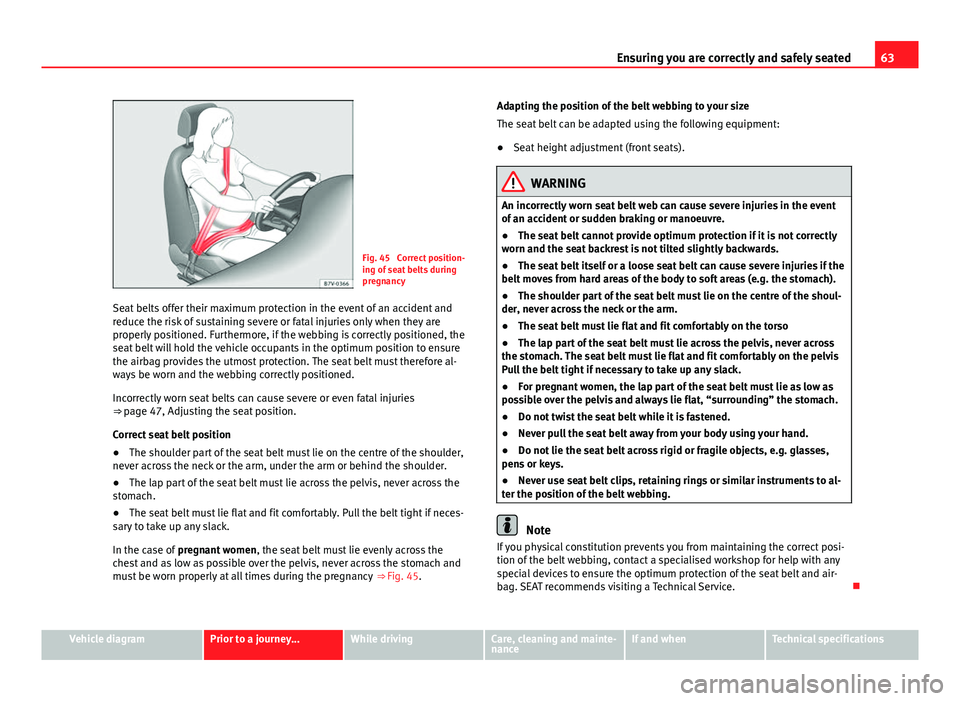
Fig. 45 Correct position-
ing of seat belts during
pregnancy
Seat belts offer their maximum protection in the event of an accident and
reduce the risk of sustaining severe or fatal injuries only when they are
properly positioned. Furthermore, if the webbing is correctly positioned, the
seat belt will hold the vehicle occupants in the optimum position to ensure
the airbag provides the utmost protection. The seat belt must therefore al-
ways be worn and the webbing correctly positioned.
Incorrectly worn seat belts can cause severe or even fatal injuries
⇒ page 47, Adjusting the seat position.
Correct seat belt position
● The shoulder part of the seat belt must lie on the centre of the shoulder,
never across the neck or the arm, under the arm or behind the shoulder.
● The lap part of the seat belt must lie across the pelvis, never across the
stomach.
● The seat belt must lie flat and fit comfortably. Pull the belt tight if neces-
sary to take up any slack.
In the case of pregnant women , the seat belt must lie evenly across the
chest and as low as possible over the pelvis, never across the stomach and
must be worn properly at all times during the pregnancy ⇒ Fig. 45. Adapting the position of the belt webbing to your size
The seat belt can be adapted using the following equipment:
●
Seat height adjustment (front seats).
WARNING
An incorrectly worn seat belt web can cause severe injuries in the event
of an accident or sudden braking or manoeuvre.
● The seat belt cannot provide optimum protection if it is not correctly
worn and the seat backrest is not tilted slightly backwards.
● The seat belt itself or a loose seat belt can cause severe injuries if the
belt moves from hard areas of the body to soft areas (e.g. the stomach).
● The shoulder part of the seat belt must lie on the centre of the shoul-
der, never across the neck or the arm.
● The seat belt must lie flat and fit comfortably on the torso
● The lap part of the seat belt must lie across the pelvis, never across
the stomach. The seat belt must lie flat and fit comfortably on the pelvis
Pull the belt tight if necessary to take up any slack.
● For pregnant women, the lap part of the seat belt must lie as low as
possible over the pelvis and always lie flat, “surrounding” the stomach.
● Do not twist the seat belt while it is fastened.
● Never pull the seat belt away from your body using your hand.
● Do not lie the seat belt across rigid or fragile objects, e.g. glasses,
pens or keys.
● Never use seat belt clips, retaining rings or similar instruments to al-
ter the position of the belt webbing.
Note
If you physical constitution prevents you from maintaining the correct posi-
tion of the belt webbing, contact a specialised workshop for help with any
special devices to ensure the optimum protection of the seat belt and air-
bag. SEAT recommends visiting a Technical Service.
Vehicle diagramPrior to a journey...While drivingCare, cleaning and mainte-
nanceIf and whenTechnical specifications