ABS Seat Mii 2014 User Guide
[x] Cancel search | Manufacturer: SEAT, Model Year: 2014, Model line: Mii, Model: Seat Mii 2014Pages: 219, PDF Size: 4.19 MB
Page 107 of 219

Driver assistance systems
and serious injury to the driver and passen-
gers.
●
Adjust your speed and driving style to visi-
bility, road, traffic and weather conditions.
Even though the brake assist systems, ABS,
BAS, EDL, ASR and ESC* provide more securi-
ty, do not take unnecessary risks while driv-
ing.
● Brake assist systems can not overcome the
laws of physics. Even with ESC* and other
systems, slippery and wet roads will always
be dangerous.
● Driving to quickly on wet ground can result
in the wheels losing contact with the ground
in an effect known as “aquaplaning”. Without
adherence, it is impossible to brake, steer or
control the vehicle.
● Brake assist systems cannot avoid acci-
dents if, for example, the driver does not re-
spect safety distances or drives to quickly in
difficult conditions.
● Even though brake assist systems are ex-
tremely effective and help control the vehicle
in difficult situations, remember that the ve-
hicle stability depends on tyre grip.
● When accelerating on a slippery surface,
for example on ice or snow, press the acceler-
ator carefully. The wheels can still slip even
with brake assist systems resulting in loss of
vehicle control. WARNING
The effectiveness of the ESC* can be consid-
erably reduced if other components and sys-
tems affecting driving dynamics are not main-
tained or are not functioning correctly. This
includes, among others, brakes, tyres and
other systems already mentioned.
● Remember that changing and fitting other
components to the vehicle can affect opera-
tion of the ABS, BAS, ASR TC, EDL and ESC*.
● Changes to the vehicle suspension or using
unapproved wheel/tyre combinations can af-
fect operation of the ABS, BAS, ASR, TC, EDL
and ESC* and their effectiveness.
● Likewise, the effectiveness of ESC* de-
pends on the use of suitable tyres
››› page 158. Note
● To ensure that the ESC*, ASR and TC work
properly, all four wheels must be fitted with
identical tyres. Any differences in the rolling
radius of the tyres can cause the system to
reduce engine power when this is not de-
sired.
● If a malfunction should occur in the ABS,
the ESC*, ASR, TC and EDL will also be affec-
ted.
● Noises may be heard while any of the
above systems are operating. Parking sensor system*
Introduction The parking sensor system assists the driver
when parking. If the rear of the vehicle is ap-
proaching an obstacle, an intermittent audi-
ble warning is emitted. The shorter the dis-
tance, the shorter the intervals between
tones. If the vehicle is too close to the obsta-
cle, the audible warning becomes constant.
If you continue to approach an obstacle when
the sound is continuous, this means the sys-
tem can no longer measure the distance.
Sensors situated on the rear bumper transmit
and receive ultrasound. Using the ultrasound
signal (transmission, reflection from the ob-
stacles and reception), this system continu-
ously calculates the distance between the
bumper and the obstacle.
WARNING
The parking distance warning system cannot
replace the driver's assessment of the situa-
tion.
● The sensors have blind spots in which ob-
stacles and people are not registered.
● Always observe the area around the vehi-
cle, as the sensors do not always detect
small children, animals or objects. » 105Technical specifications
Advice
Operation
Safety
Page 135 of 219

Care and maintenanceType of
stainCleaning the vehicle
Water-based
stains, e.g.
coffee or fruit
juice.– Use a sponge and wipe with a solu-
tion of water and wool wash.
– Dry with a dry, absorbent cloth.
Persistent
stains, e.g.
chocolate or
make-up.– Apply a washing paste
a)
directly to
the stain and allow it to work.
– Apply clean water using a sponge or
damp cloth to remove the cleaning
product deposits.
– Dry with a dry absorbent cloth.
Grease-based
stains, e.g. oil
or lipstick.– Apply neutral soap or cleaning
paste a)
and allow it to work.
– Remove dissolved grease or colour
particles with an absorbent cloth.
– Then apply clean water. Take care not
to soak the upholstery.
a) Bile soap can be used as a cleaning paste. CAUTION
● Brushes should only be used to clean the
mats and floor mat! Other surfaces may be
damaged if a brush is used.
● Do not use steam cleaning equipment, as
the dirt becomes more encrusted in the mate-
rial when steam is applied.
● Never use brushes for cleaning damp mate-
rial as they could damage the surface. Cleaning storage compartments,
drinks holders and ashtray
Fig. 98
In the front part of the centre console:
Storage compartment with cup holder. Fig. 99
Ashtray removed and open with area
to stub cigarettes Cleaning storage compartments and drinks
holders
● Use a clean, damp, lint-free cloth to clean
parts.
● If this does not provide satisfactory results,
we recommend using a special solvent-free
plastic cleaning product.
Cleaning the ashtray
● Extract the ashtray and empty it.
● Clean the ashtray with a dishcloth.
Use a toothpick or similar to remove ash from
the area where cigarettes are stubbed out
››› Fig. 99 .
C ar
e and cleaning of plastic parts,
wooden trim and the instrument
panel ●
Use a clean, damp, lint-free cloth to clean
parts.
● Clean plastic parts (inside and outside the
vehicle) and the dash panel with a special
solvent-free product for the care and clean-
in g of
plastic, approved by SEAT ››› .
● Wash wooden trims
w
ith a mi
ld soap and
water solution.
● Clean the Portable Navigation System hous-
ing (Supplied by SEAT) with a dry cloth only.
»
133
Technical specifications
Advice
Operation
Safety
Page 141 of 219

Checking and refilling levels
Filling the tank Introduction The fuel tank flap is on the rear right of the
vehicle.
WARNING
Refuelling or handling fuel carelessly can
cause an explosion or fire resulting in serious
burns and injuries.
● Always make sure that you correctly close
the fuel cap to avoid evaporation and fuel
spillage.
● Fuels are highly explosive and inflammable
substances that can cause serious burns and
injuries.
● Fuel could leak out or be spilt if the engine
is not switched off or if the filler fuel nozzle is
not fully inserted into the tank filler neck
when refuelling. This could lead to a fire, ex-
plosion and severe injuries.
● When refuelling, turn off the engine and
turn off the ignition for safety reasons.
● Always turn off mobile telephones, radio
apparatus and other radio wave emitting
equipment before refuelling. Electromagnetic
waves could cause sparks and lead to a fire.
● Never enter the vehicle while refuelling. If it
is absolutely necessary to enter, close the
door and touch a metal surface before touch- ing the filler nozzle again. This will prevent
the generation of static electricity. Sparks
could cause a fire when refuelling.
●
Never handle fuel close to flames, sparks or
objects with slow combustion (e.g. ciga-
rettes).
● Avoid static electricity and electro-magnet-
ic radiation when refuelling.
● Observe the safety regulations of the serv-
ice station.
● Never spill fuel on the vehicle or in the lug-
gage compartment. WARNING
For safety reasons, SEAT does not recommend
carrying a spare fuel canister in the vehicle.
Fuel could be spilled and catch fire, above all
in case of an accident and this applies to a
full container as well as empty containers.
This could lead to explosions, fires and inju-
ries.
● Observe the following if you exceptionally
have to carry fuel in a canister:
–Never place a fuel container, to fill it, in-
side the vehicle or on the vehicle, for ex-
ample, in the luggage compartment. Fill-
ing in these circumstances could create
an electrostatic charge and spark that
could ignite fuel fumes.
– Always place the canister on the ground
to fill it. –
Insert the fuel nozzle into the neck of the
canister as far as possible.
– If you are using a metal fuel canister, the
nozzle must always touch the canister
while it is being filled to avoid static elec-
tricity.
– Follow the legal requirements for the use,
storage and transport of spare fuel canis- ters.
– Insure that the fuel container complies
with manufacturing standards, for exam-
ple, ANSI or ASTM F852-86. CAUTION
● Always remove any fuel spilled anywhere
on the vehicle to avoid damage to the wheel
housing, the tyre and vehicle paintwork.
● Refuelling a petrol engine with diesel can
cause serious engine and fuel system dam-
age; the resulting malfunctions are not cov-
ered by the SEAT warranty. If you refuel with
the wrong type of fuel, never start the engine.
This applies to even the smallest amount of
the wrong fuel. Seek specialist assistance.
With the engine running, the composition of
the wrong fuel could significantly damage the
fuel system and the engine itself. For the sake of the environment
Fuels can contaminate the environment. Col-
lect any spilt service fluids and allow a pro-
fessional to dispose of them. 139Technical specifications
Advice
Operation
Safety
Page 155 of 219
Checking and refilling levels
In the course of time, the brake fluid absorbs
water from the ambient air. If there is too
much water in the brake fluid, the brake sys-
tem could be damaged. In addition, the boil-
ing point of the brake fluid is significantly
lowered. When the brake fluid contains too
much water and the brakes are subject to
considerable forces, bubbles of water vapour
can form in the system. These bubbles can
significantly reduce braking power, notably
increasing braking distance, and could even
result in the total failure of the brake system.
Ensuring that the brake system is always
functioning correctly is essential for your own
safety and the safety of other road users
››› .
Brake fluid specifications
SEAT have developed a special brake fluid
optimised for the brake systems of their vehi-
cles. To ensure the optimum working of the
brake system, SEAT recommends the use of
brake fluid in accordance with the VW 501 14
standard . If this brake fluid is not available or
another br ak
e fluid is used for different rea-
sons, use a brake fluid that complies with the
United States standard FMVSS 116 DOT 4 or
the German standard DIN ISO 4925 CLASS 4
››› .
Brake fluids conforming to the standard
VW 501 14, fulfil the American requirements
of the FMVSS 116 DOT 4 standard and the
German DIN ISO 4925 CLASS 4 standard. However, fluids that comply with the Ameri-
can FMVSS 116 DOT 4 standard or the Ger-
man DIN ISO 4925 CLASS 4 standard do not
necessarily comply with the VW 501 14
standard. Always check the information on
the brake fluid container and ensure that you
are using suitable brake fluid.
A suitable brake fluid can be obtained from
SEAT dealerships.
Brake fluid level
The level of the brake fluid should always be
between the MIN and MAX marks, or above
the MIN mark
››› .
It is not always possible to check the level of
the brake fluid, as in some models the en-
gine components make it difficult to see the
brake fluid reservoir. If you cannot read the
exact brake fluid level, consult a specialist.
The brake fluid level drops slightly when the
vehicle is being used due to wear of the
brake pads and the automatic readjustment
of the brake.
Changing the brake fluid
The brake fluid should be changed in accord-
ance with the instructions given in the Main-
tenance Programme. Have the brake fluid
changed by a specialised workshop. SEAT
recommends taking your car in for technical
service. This means that only brake fluid complying with the required specifications
will be used. WARNING
If the brake fluid level is low or unsuita-
ble/old brake fluid is used, the brake system
may fail or braking power may be reduced.
● Check the brake system and the brake fluid
level regularly!
● The brake fluid should be changed regular-
ly in accordance with the instructions given
in the Maintenance Programme.
● When the brake fluid is used and brakes
are subjected to extreme braking forces, bub-
bles of vapour form in the brake system.
These bubbles can significantly reduce brak-
ing power, notably increasing braking dis-
tance, and could result in the total failure of
the brake system.
● Always ensure that you use suitable brake
fluid. Only used brake fluid that conforms to
the VW 501 14 standard, FMVSS 116 DOT 4
standard or even the DIN ISO 4925 CLASS 4
standard. Other types of brake fluid could af-
fect brake operation and reduce braking pow-
er. Do not use a brake fluid if the container
does not specify compliance with the
VW 501 14, FMVSS 116 DOT 4 or
DIN ISO 4925 CLASS 4 standards.
● The replacement brake fluid must be new. WARNING
Brake fluid is poisonous. » 153
Technical specifications
Advice
Operation
Safety
Page 156 of 219
Advice
●
To reduce the risk of poisoning, do not keep
brake fluid in drinks bottles/containers or
similar. Other people could drink from these
recipients even if the contents are clearly
marked.
● Always keep brake fluid in the original con-
tainer; keep it correctly sealed and out of
reach of children. CAUTION
Brake fluid damages the vehicle paintwork.
Wipe off any brake fluid from the paintwork
immediately. For the sake of the environment
Brake fluid is an environmental pollutant.
Collect any spilt service fluids and allow a
professional to dispose of them. Checking and topping up the
windscreen washer reservoir with
water
Fig. 112
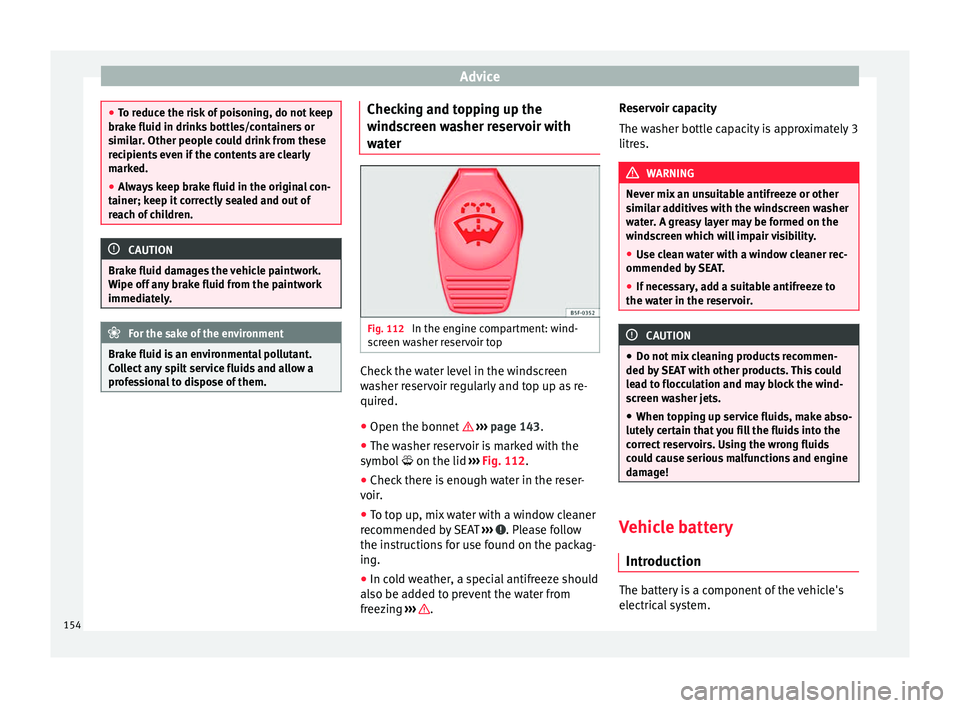
In the engine compartment: wind-
screen washer reservoir top Check the water level in the windscreen
washer reservoir regularly and top up as re-
quired.
● Open the bonnet ››› page 143.
● The washer reservoir is marked with the
symbol on the lid ››› Fig. 112 .
● Chec k
there is enough water in the reser-
voir.
● To top up, mix water with a window cleaner
recommended by SEAT ››› . Please follow
the instructions for use found on the packag-
ing.
● In cold weather, a special antifreeze should
also be added to prevent the water from
freezing ››› .Reservoir capacity
The washer bottle capacity is approximately 3
litres.
WARNING
Never mix an unsuitable antifreeze or other
similar additives with the windscreen washer
water. A greasy layer may be formed on the
windscreen which will impair visibility.
● Use clean water with a window cleaner rec-
ommended by SEAT.
● If necessary, add a suitable antifreeze to
the water in the reservoir. CAUTION
● Do not mix cleaning products recommen-
ded by SEAT with other products. This could
lead to flocculation and may block the wind-
screen washer jets.
● When topping up service fluids, make abso-
lutely certain that you fill the fluids into the
correct reservoirs. Using the wrong fluids
could cause serious malfunctions and engine
damage! Vehicle battery
Introduction The battery is a component of the vehicle's
electrical system.
154
Page 158 of 219

Advice
WARNING
Observe the safety warnings ››› in Control
and warning lamps on page 40. Checking the electrolyte level of the
vehicle battery
Fig. 113
In the engine compartment: Remove
the cover from the vehicle's battery. The battery's electrolyte level should be
checked regularly in high-mileage vehicles,
in hot countries and in older batteries. Other
batteries do not require maintenance.
Vehicles fitted with the Start-Stop system are
equipped with special batteries. For technical
reasons, the electrolyte level cannot be
checked in these batteries. Preparations
● Prepare the vehicle for work in the engine
compartment ››› page 143
● Open the bonnet ››› page 143.
● Press on the tabs ››› Fig. 113 (arrows) in the
dir ection of
the arrows and lift the battery
cover up.
Checking the battery electrolyte level
● Make sure there is sufficient lighting to
clearly recognise the colours. Never use
flames or shiny objects as a light source.
● Depending on the level of acid, the Magic
eye on the top of the battery will change col-
our.
Colour in-
dicatorNecessary operations
Light yellow
or colourlessThe electrolyte level of the vehicle's bat-
tery is too low. Have the battery checked
and, where applicable, replaced by a
specialised workshop.
BlackThe electrolyte level of the vehicle's bat-
tery is correct. WARNING
Working with the vehicle battery involves a
risk of corrosion, explosions and electric
shock. ●
Never tilt the vehicle battery. Battery acid
could spill out of the openings for the release
of gases and cause corrosion damage.
● Never open the vehicle battery.
● If battery acid splashes on you, immediate-
ly rinse your eyes and skin abundantly with
water for several minutes. Then seek medical
care immediately.
● If acid is swallowed by mistake, consult a
doctor immediately. Charging, replacing and connecting or
disconnecting the battery
Charging the battery
The vehicle battery should be charged by a
specialised workshop only, as batteries us-
ing special technology have been installed
and they must be charged in a controlled en-
vironment
››› . SEAT recommends taking
your car in for technical service.
Replacing a vehicle battery
The battery has been developed to suit the
conditions of its location and has special
safety features. If the battery must be re-
placed, consult a technical service for infor-
mation on electromagnetic compatibility, the
size and maintenance, performance and
safety requirements of the new battery in
your vehicle before you purchase one. SEAT
156
Page 186 of 219
Advice
CAUTION
● Carefully fit and remove the towline anchor-
age and its cover to avoid damage to the ve-
hicle (e.g. paintwork).
● When towing, fuel could enter the catalytic
converter and cause damage! Note
Fitting a towline anchorage to the rear bump-
er is not possible. The vehicle is not suitable
for towing other vehicles. Instructions for tow starting
In general, the vehicle should not be started
by towing. Jump-starting is much more pref-
erable
›
› ›
page 181.
For technical reasons, the following vehicles
can
not be tow started:
● Vehicles with an automatic gearbox.
● If the vehicle battery is flat, it is possible
that the engine control unit does not operate
correctly.
However, if your vehicle must absolutely be
tow-started (manual gearbox):
● Put it into second or third gear.
● Keep the clutch pressed down. ●
Switch on the ignition and the hazard warn-
ing lights.
● Release the clutch when both vehicles are
moving.
● As soon as the engine starts, press the
clutch and move the gear lever into neutral.
This helps to prevent a collision with the tow-
ing vehicle. CAUTION
When tow-starting, fuel could enter the cata-
lytic converter and damage it. Notes on towing
Tow rope or tow bar
When towing, the tow bar is the safest and
vehicle friendly way. You should only use a
tow rope if you do not have a tow bar.
A tow rope should be slightly elastic to avoid
damage to both vehicles. It is advisable to
use a tow rope made of synthetic fibre or sim-
ilarly elastic material.
Only secure the tow rope or tow bar to the
towline anchorage or specially designed fit-
ting.
Towing vehicles with an automatic gearbox
Note the following for a towed vehicle:●
Make sure the gear selector lever is in the N
position.
● Do not drive faster than 50 km/h (30 mph)
when towing a vehicle.
● Do not tow further than 50 km (30 miles).
● If a breakdown truck is used, the vehicle
must be towed with the front wheels raised.
Situations in which the vehicle should not be
towed
In the following cases, the vehicle should not
be towed but transported on a trailer or spe-
cial vehicle:
● If the vehicle gearbox does not contain lu-
bricant due to a fault.
● If the battery is flat and the steering cannot
be unlocked as a result, the electronic steer-
ing lock and electronic parking brake cannot
be disengaged.
● If the vehicle to be towed has an automatic
gearbox and the distance to be covered is
greater than 50 km (30 miles). Note
The vehicle can only be towed if the steering
lock electronic gearbox lock is deactivated. If
the vehicle has no power supply or there is
an electric system fault, the engine must be
started using jump leads to deactivate the
steering column electronic gearbox lock. 184
Page 187 of 219
Emergencies
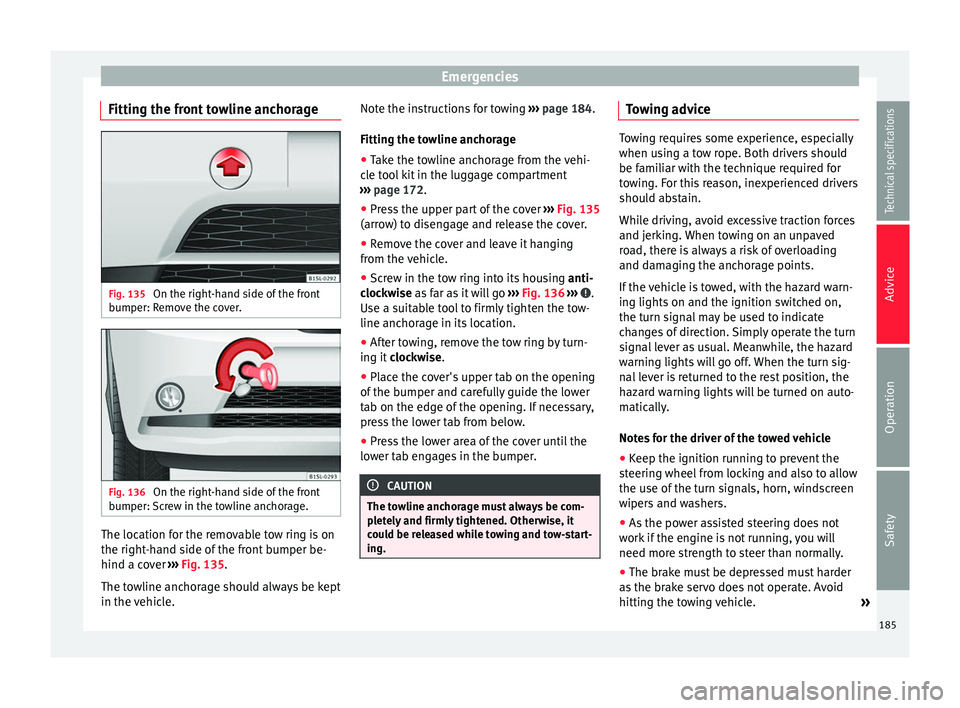
Fitting the front towline anchorage Fig. 135
On the right-hand side of the front
bumper: Remove the cover. Fig. 136
On the right-hand side of the front
bumper: Screw in the towline anchorage. The location for the removable tow ring is on
the right-hand side of the front bumper be-
hind a cover
››› Fig. 135 .
The t o
wline anchorage should always be kept
in the vehicle. Note the instructions for towing
››› page 184.
Fitting the towline anchorage
● Take the towline anchorage from the vehi-
cle tool kit in the luggage compartment
››› page 172.
● Pre
ss the upper part of the cover ››› Fig. 135
(arrow) to disengage and release the cover.
● Remove the cover and leave it hanging
from the vehicle.
● Screw in the tow ring into its housing anti-
clockwise as far as it will go ››
› Fig. 136 ››› .
Use a suitable tool to firmly tighten the tow-
line anchorage in its location.
● After towing, remove the tow ring by turn-
ing it clockwise .
● Plac
e the cover's upper tab on the opening
of the bumper and carefully guide the lower
tab on the edge of the opening. If necessary,
press the lower tab from below.
● Press the lower area of the cover until the
lower tab engages in the bumper. CAUTION
The towline anchorage must always be com-
pletely and firmly tightened. Otherwise, it
could be released while towing and tow-start-
ing. Towing advice
Towing requires some experience, especially
when using a tow rope. Both drivers should
be familiar with the technique required for
towing. For this reason, inexperienced drivers
should abstain.
While driving, avoid excessive traction forces
and jerking. When towing on an unpaved
road, there is always a risk of overloading
and damaging the anchorage points.
If the vehicle is towed, with the hazard warn-
ing lights on and the ignition switched on,
the turn signal may be used to indicate
changes of direction. Simply operate the turn
signal lever as usual. Meanwhile, the hazard
warning lights will go off. When the turn sig-
nal lever is returned to the rest position, the
hazard warning lights will be turned on auto-
matically.
Notes for the driver of the towed vehicle
●
Keep the ignition running to prevent the
steering wheel from locking and also to allow
the use of the turn signals, horn, windscreen
wipers and washers.
● As the power assisted steering does not
work if the engine is not running, you will
need more strength to steer than normally.
● The brake must be depressed must harder
as the brake servo does not operate. Avoid
hitting the towing vehicle. »
185
Technical specifications
Advice
Operation
Safety
Page 192 of 219
Advice
Note
Several components may run on a single
fuse. Vehicle fuses
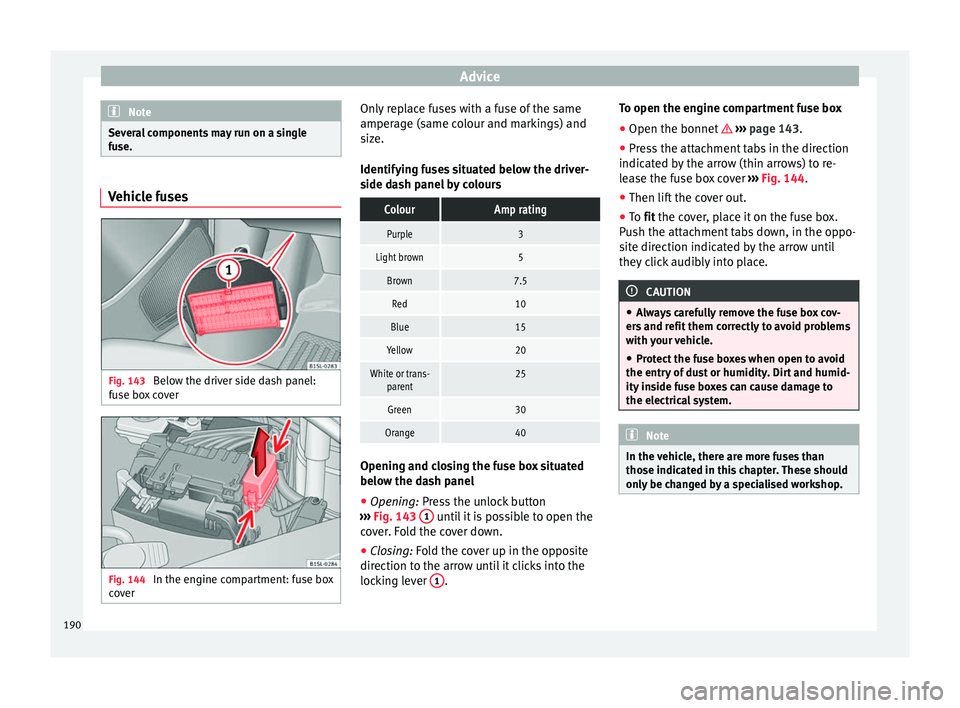
Fig. 143
Below the driver side dash panel:
fuse box cover Fig. 144
In the engine compartment: fuse box
cover Only replace fuses with a fuse of the same
amperage (same colour and markings) and
size.
Identifying fuses situated below the driver-
side dash panel by coloursColourAmp rating
Purple3
Light brown5
Brown7.5
Red10
Blue15
Yellow20
White or trans-
parent25
Green30
Orange40 Opening and closing the fuse box situated
below the dash panel
●
Opening: Press the unlock button
› ›
› Fig. 143 1 until it is possible to open the
cover. Fold the cover down.
● Closing: Fold the cover up in the opposite
dir ection t
o the arrow until it clicks into the
locking lever 1 .To open the engine compartment fuse box
●
Open the bonnet ››› page 143.
● Press the attachment tabs in the direction
indicated by the arrow (thin arrows) to re-
lease the fuse box cover ››› Fig. 144 .
● Then lif t
the cover out.
● To fit the cover, place it on the fuse box.
P
ush the attachment tabs down, in the oppo-
site direction indicated by the arrow until
they click audibly into place. CAUTION
● Always carefully remove the fuse box cov-
ers and refit them correctly to avoid problems
with your vehicle.
● Protect the fuse boxes when open to avoid
the entry of dust or humidity. Dirt and humid-
ity inside fuse boxes can cause damage to
the electrical system. Note
In the vehicle, there are more fuses than
those indicated in this chapter. These should
only be changed by a specialised workshop. 190
Page 194 of 219
Advice
CAUTION
● After changing a bulb, if the rubber covers
are not replaced correctly on the headlamp
framework, the electrical installation may be damaged, especially if water is allowed to en-
ter.
● Remove the ignition key before working on
the electric system. Otherwise, a short circuit could occur. ●
Switch off the lights and the parking light
before changing a bulb.
● Take good care to avoid damaging any com-
ponents. Replacing the bulbs in the headlights
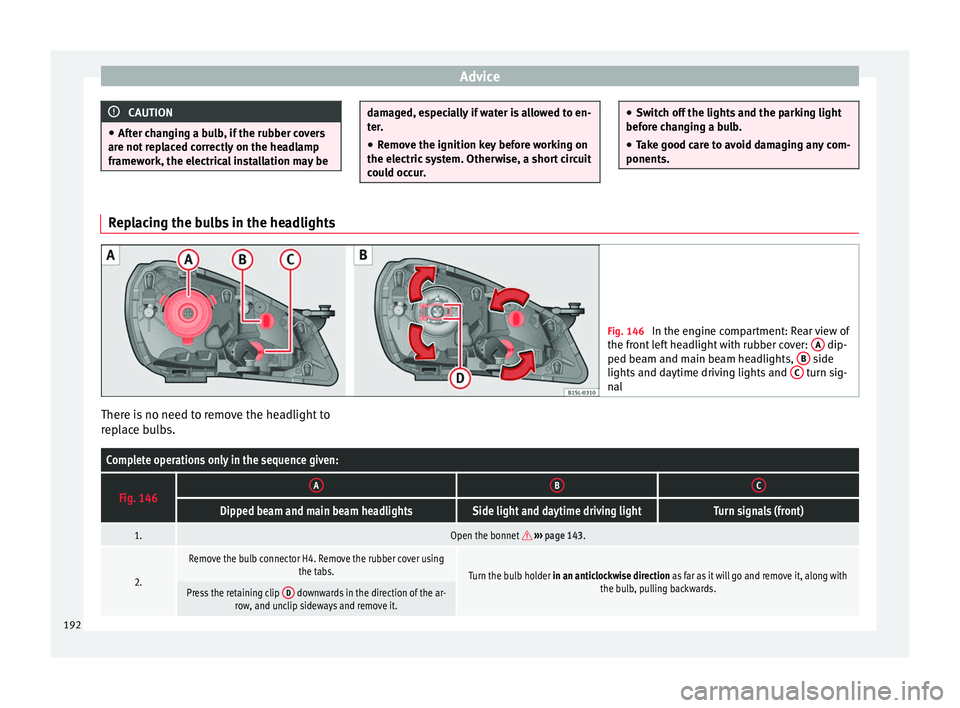
Fig. 146
In the engine compartment: Rear view of
the front left headlight with rubber cover: A dip-
ped beam and main beam headlights, B side
lights and daytime driving lights and C turn sig-
nal There is no need to remove the headlight to
replace bulbs.Complete operations only in the sequence given:
Fig. 146ABC
Dipped beam and main beam headlightsSide light and daytime driving lightTurn signals (front)
1.Open the bonnet
››› page 143.
2.
Remove the bulb connector H4. Remove the rubber cover using
the tabs.Turn the bulb holder in an anticlockwise direction as far as it will go and remove it, along with the bulb, pulling backwards.Press the retaining clip D downwards in the direction of the ar-
row, and unclip sideways and remove it. 192