ABS Seat Mii 2014 Owner's manual
[x] Cancel search | Manufacturer: SEAT, Model Year: 2014, Model line: Mii, Model: Seat Mii 2014Pages: 219, PDF Size: 4.19 MB
Page 15 of 219
Seat belts
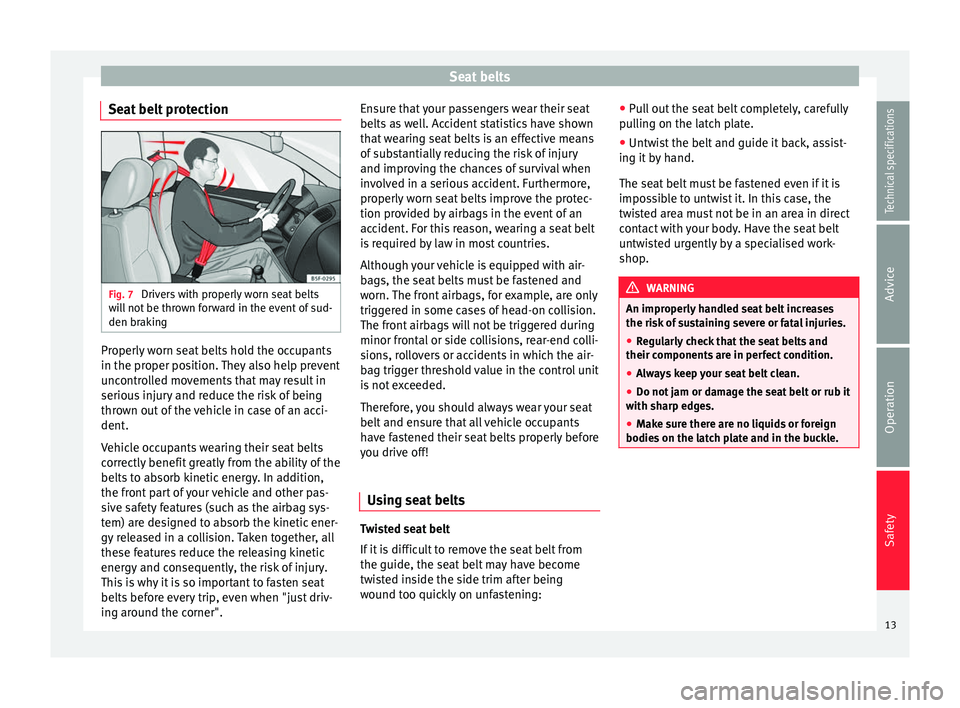
Seat belt protection Fig. 7
Drivers with properly worn seat belts
will not be thrown forward in the event of sud-
den braking Properly worn seat belts hold the occupants
in the proper position. They also help prevent
uncontrolled movements that may result in
serious injury and reduce the risk of being
thrown out of the vehicle in case of an acci-
dent.
Vehicle occupants wearing their seat belts
correctly benefit greatly from the ability of the
belts to absorb kinetic energy. In addition,
the front part of your vehicle and other pas-
sive safety features (such as the airbag sys-
tem) are designed to absorb the kinetic ener-
gy released in a collision. Taken together, all
these features reduce the releasing kinetic
energy and consequently, the risk of injury.
This is why it is so important to fasten seat
belts before every trip, even when "just driv-
ing around the corner". Ensure that your passengers wear their seat
belts as well. Accident statistics have shown
that wearing seat belts is an effective means
of substantially reducing the risk of injury
and improving the chances of survival when
involved in a serious accident. Furthermore,
properly worn seat belts improve the protec-
tion provided by airbags in the event of an
accident. For this reason, wearing a seat belt
is required by law in most countries.
Although your vehicle is equipped with air-
bags, the seat belts must be fastened and
worn. The front airbags, for example, are only
triggered in some cases of head-on collision.
The front airbags will not be triggered during
minor frontal or side collisions, rear-end colli-
sions, rollovers or accidents in which the air-
bag trigger threshold value in the control unit
is not exceeded.
Therefore, you should always wear your seat
belt and ensure that all vehicle occupants
have fastened their seat belts properly before
you drive off!
Using seat belts Twisted seat belt
If it is difficult to remove the seat belt from
the guide, the seat belt may have become
twisted inside the side trim after being
wound too quickly on unfastening:●
Pull out the seat belt completely, carefully
pulling on the latch plate.
● Untwist the belt and guide it back, assist-
ing it by hand.
The seat belt must be fastened even if it is
impossible to untwist it. In this case, the
twisted area must not be in an area in direct
contact with your body. Have the seat belt
untwisted urgently by a specialised work-
shop. WARNING
An improperly handled seat belt increases
the risk of sustaining severe or fatal injuries.
● Regularly check that the seat belts and
their components are in perfect condition.
● Always keep your seat belt clean.
● Do not jam or damage the seat belt or rub it
with sharp edges.
● Make sure there are no liquids or foreign
bodies on the latch plate and in the buckle. 13Technical specifications
Advice
Operation
Safety
Page 16 of 219
Safety
Head-on collisions and the laws of
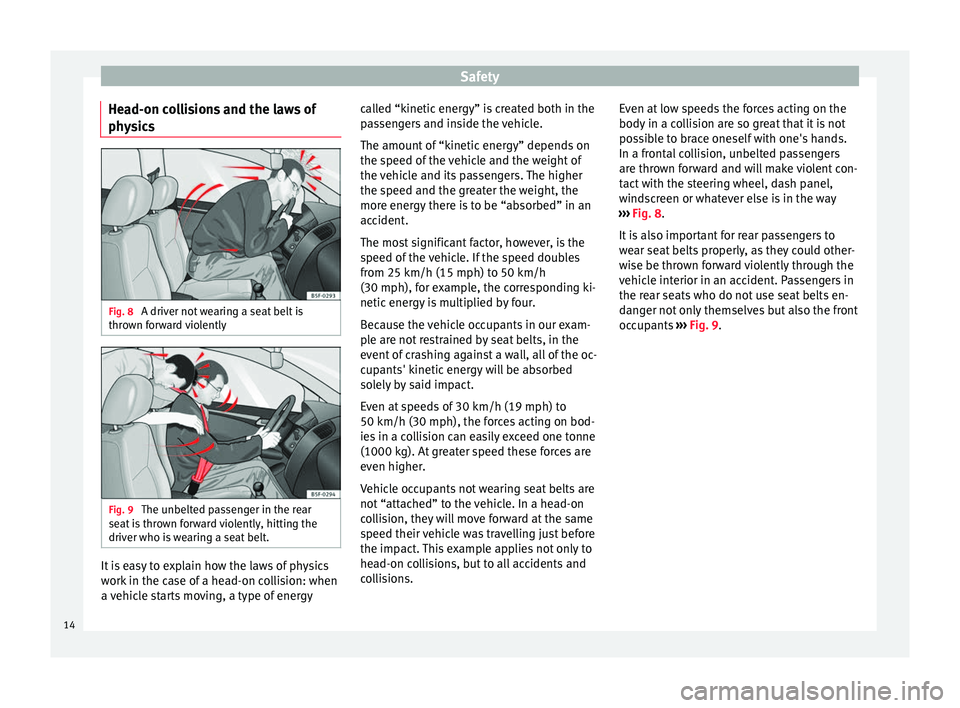
physics Fig. 8
A driver not wearing a seat belt is
thrown forward violently Fig. 9
The unbelted passenger in the rear
seat is thrown forward violently, hitting the
driver who is wearing a seat belt. It is easy to explain how the laws of physics
work in the case of a head-on collision: when
a vehicle starts moving, a type of energy called “kinetic energy” is created both in the
passengers and inside the vehicle.
The amount of “kinetic energy” depends on
the speed of the vehicle and the weight of
the vehicle and its passengers. The higher
the speed and the greater the weight, the
more energy there is to be “absorbed” in an
accident.
The most significant factor, however, is the
speed of the vehicle. If the speed doubles
from 25 km/h (15 mph) to 50 km/h
(30 mph), for example, the corresponding ki-
netic energy is multiplied by four.
Because the vehicle occupants in our exam-
ple are not restrained by seat belts, in the
event of crashing against a wall, all of the oc-
cupants' kinetic energy will be absorbed
solely by said impact.
Even at speeds of 30 km/h (19 mph) to
50 km/h (30 mph), the forces acting on bod-
ies in a collision can easily exceed one tonne
(1000 kg). At greater speed these forces are
even higher.
Vehicle occupants not wearing seat belts are
not “attached” to the vehicle. In a head-on
collision, they will move forward at the same
speed their vehicle was travelling just before
the impact. This example applies not only to
head-on collisions, but to all accidents and
collisions.
Even at low speeds the forces acting on the
body in a collision are so great that it is not
possible to brace oneself with one's hands.
In a frontal collision, unbelted passengers
are thrown forward and will make violent con-
tact with the steering wheel, dash panel,
windscreen or whatever else is in the way
››› Fig. 8 .
It i
s also important for rear passengers to
wear seat belts properly, as they could other-
wise be thrown forward violently through the
vehicle interior in an accident. Passengers in
the rear seats who do not use seat belts en-
danger not only themselves but also the front
occupants ››› Fig. 9.
14
Page 19 of 219
Airbag system
in the direction of the collision. The belt ten-
sioner works in combination with the airbag
system. The belt tensioner will not be trig-
gered in the event of the vehicle overturning
if the side airbags are not deployed.
If the belt tensioner is triggered, a fine dust is
produced. This is normal and it is not an indi-
cation of fire in the vehicle.
Belt tension limiter
The belt tension limiter reduces the force of
the seat belt on the body in the event of an
accident. Note
The relevant safety requirements must be ob-
served when the vehicle is dismantled or sys-
tem components are removed. These require-
ments are known to specialised workshops
››› page 17. Service and disposal of belt
tensioners
If you work on the belt tensioners or remove
and install other parts of the vehicle when
performing other repair work, the seat belt
may be damaged. The consequence may be
that, in the event of an accident, the belt ten-
sioners function incorrectly or not at all. So that the effectiveness of the belt tensioner
is not reduced and that removed parts do not
cause any injuries or environmental pollu-
tion, regulations must be observed. These re-
quirements are known to specialised work-
shops.
WARNING
Improper handling and homemade repairs of
seat belts, automatic belt retainers and ten-
sion devices increase the risk of sustaining
severe or fatal injuries. The belt tensioner
may fail to trigger or may trigger in the wrong
circumstances.
● Never attempt to repair, adjust or remove or
install parts of the belt tensioners or seat
belts. Any work must be performed by a spe-
cialised workshop only ››› page 118.
● Belt tensioners and automatic belt retain-
ers cannot be repaired and must be replaced. For the sake of the environment
Airbag modules and belt tensioners may con-
tain perchlorate. Observe the legal require-
ments for their disposal. Airbag system
Brief introduction Introduction Front airbags have been installed for both
driver and passenger. The front airbags can
also protect the chest and head of driver and
passenger if the seats, seat belts head re-
straints and, for the driver, the steering
wheel are correctly adjusted and used. Air-
bags are considered as additional safety
equipment. An airbag cannot replace the
seat belt, which must be worn at all times,
even in front seats where front airbags have
been installed.
The airbag can protect vehicle occupants in
the event of an accidents, cushioning the
movement of the occupants in the direction
of the collision in frontal and side accidents.
Deployed airbags fill with a propellant gas.
This causes the airbag covers to break and
the airbags to deploy extremely quickly in
their entire deployment space within frac-
tions of a second. When an occupant with the
seat belt properly fastened puts pressure on
the inflated airbag, the propellant gas es-
capes to absorb the force of the impact and
slow the movement. This reduces the risk of
severe or fatal injuries. Airbag deployment
does not mean that other types of injury such
»
17Technical specifications
Advice
Operation
Safety
Page 20 of 219
Safety
as swelling, bruising and skin injuries can be
ruled out. Upon deployment of the airbag,
friction can cause the generation of heat.
Airbags do not protect the arms or the lower
part of the body.
The most important factors for triggering the
airbag are the type of accident, the angle of
impact, the vehicle speed and the character-
istics of the object the vehicle hits. Therefore,
airbags are not triggered every time the vehi-
cle is visibly damaged.
The activation of the airbag system depends
on the magnitude of the deceleration of the
vehicle caused by a collision, which registers
through an electronic control unit. If the de-
celeration magnitude value is below the ref-
erence value programmed in the control unit,
the airbags will not deploy even though seri-
ous damage might be caused to the vehicle
as the result of an accident. Damage suffered
by the vehicle, reparation costs or absence of
damage suffered from the accident are not
indications of whether an airbag should have
been deployed. Due to the varying nature of
collision situations, it is impossible to define
a speed range of the vehicle and reference
values. For this reason, it is not possible to
cover all types of collisions and collision an-
gles resulting in the deployment of the air-
bag. Factors necessary for the airbag to be
deployed can be, the characteristics of the
object (hard or soft) against which the vehi- cle collides, the collision angle and the vehi-
cle speed.
Airbags act in conjunction with the three-
point seat belts in certain accident situa-
tions, when the vehicle deceleration rate is
severe enough to trigger the airbags. Airbags
only deploy once and only under certain cir-
cumstances. Seat belts remain present to of-
fer protection in situations where airbags are
not triggered or where they have already de-
ployed. For example, when a vehicle hits an-
other after an initial collision or is hit by an-
other vehicle.
The airbag system is an integral part of the
car's passive safety system. The airbag sys-
tem can only work effectively when the vehi-
cle occupants are wearing their seat belts
correctly and have adjusted the head re-
straints properly
››› page 6. WARNING
Never exclusively trust the airbag system as a
means of protection.
● Even when triggered, airbag protection is
only auxiliary.
● The airbags provide the best protection
when the seat belts are properly fastened,
thus reducing the risk of sustaining injuries
››› page 11, Using seat belts .
● Before each trip, every occupant must sit
properly, correctly fasten the seat belt be-
longing to his or her seat and keeping it fas- tened throughout the trip. This rule is valid
for all vehicle occupants.
WARNING
Occupants sitting in the front of the vehicle
must never carry any objects in the deploy-
ment space between them and the airbags,
as this increases the risk of sustaining inju-
ries if the airbag is triggered. This modifies
the airbag deployment space or the objects
may fly uncontrollably and hit your body.
● Never carry objects in your hand or on your
lap while the vehicle is in motion.
● Never transport objects on the front pas-
senger seat. In the event of sudden braking
and manoeuvres, the objects may end up in
the airbag deployment space and fly uncon-
trollably around the interior if the airbag is
activated.
● Occupants of the front and rear seats must
never carry any other people, pets or objects
in the deployment space between them and
the airbags. Make sure children and other
passengers also respect this recommenda-
tion. WARNING
The airbag system provides protection for
one accident only. If they have been de-
ployed, they must be replaced. 18
Page 41 of 219
Cockpit
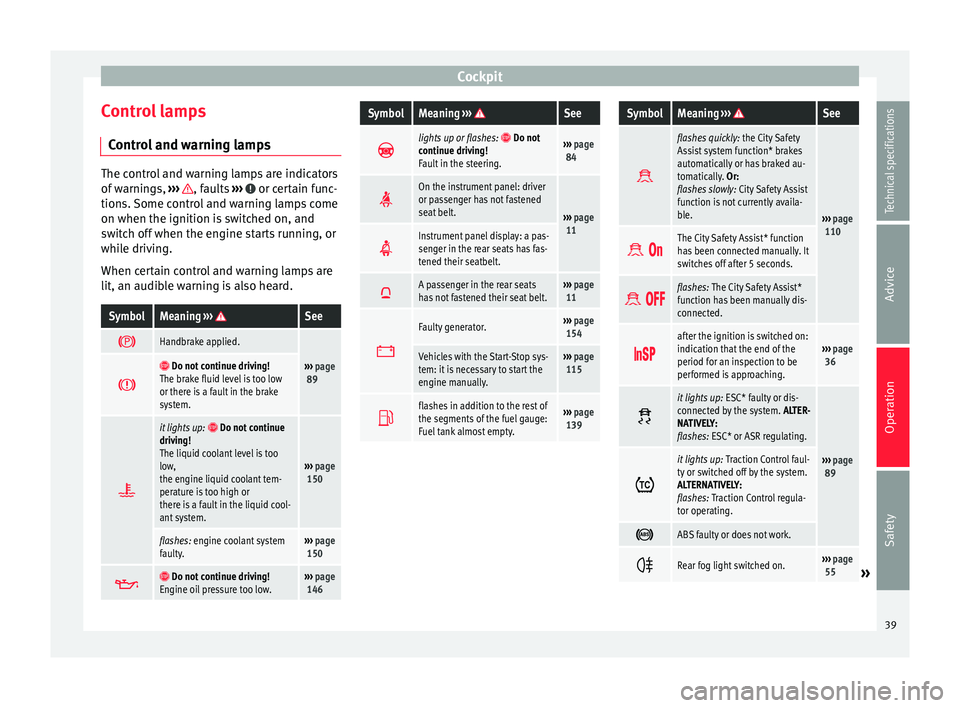
Control lamps Control and warning lamps The control and warning lamps are indicators
of warnings,
››› , faults
››› or certain func-
tions. Some control and warning lamps come
on when the ignition is switched on, and
switch off when the engine starts running, or
while driving.
When certain control and warning lamps are
lit, an audible warning is also heard.SymbolMeaning ››› See
Handbrake applied.
›››
page
89 Do not continue driving!
The brake fluid level is too low
or there is a fault in the brake
system.
it lights up:
Do not continue
driving!
The liquid coolant level is too
low,
the engine liquid coolant tem-
perature is too high or
there is a fault in the liquid cool-
ant system.
››› page
150
flashes: engine coolant system
faulty.››› page
150
Do not continue driving!
Engine oil pressure too low.››› page
146
SymbolMeaning ››› See
lights up or flashes:
Do not
continue driving!
Fault in the steering.››› page
84
On the instrument panel: driver
or passenger has not fastened
seat belt.
›››
page
11
Instrument panel display: a pas-
senger in the rear seats has fas-
tened their seatbelt.
A passenger in the rear seats
has not fastened their seat belt.›››
page
11
Faulty generator.›››
page
154
Vehicles with the Start-Stop sys-
tem: it is necessary to start the
engine manually.››› page
115
flashes in addition to the rest of
the segments of the fuel gauge:
Fuel tank almost empty.›››
page
139
SymbolMeaning ››› See
flashes quickly:
the City Safety
Assist system function* brakes
automatically or has braked au-
tomatically. Or:
flashes slowly: City Safety Assist
function is not currently availa-
ble.
››› page
110
The City Safety Assist* function
has been connected manually. It
switches off after 5 seconds.
flashes: The City Safety Assist*
function has been manually dis-
connected.
after the ignition is switched on:
indication that the end of the
period for an inspection to be
performed is approaching.››› page
36
it lights up:
ESC* faulty or dis-
connected by the system. ALTER-
NATIVELY:
flashes: ESC* or ASR regulating.
››› page
89 it lights up:
Traction Control faul-
ty or switched off by the system.
ALTERNATIVELY:
flashes: Traction Control regula-
tor operating.
ABS faulty or does not work.
Rear fog light switched on.›››
page
55» 39
Technical specifications
Advice
Operation
Safety
Page 75 of 219
Transport and practical equipment
switching the ignition on or off and before
starting the engine. WARNING
Improper use of the socket or electrical devi-
ces could lead to a fire and cause serious in-
juries.
● Never leave children unsupervised in the
vehicle. The socket and equipment connected
to it can be used when the ignition is switch-
ed on.
● Should a connected electrical device over-
heat, switch it off and unplug it immediately. CAUTION
● Always follow the operating instructions for
the appliances to be connected!
● Never exceed the maximum power rating as
this could damage the vehicle's general elec-
trical system.
● 12 volt power socket:
– Only use accessories with approved elec-
tromagnetic compatibility according to
current regulations.
– Never power the socket. CAUTION
● To avoid damage to the vehicle's electrical
system, never connect equipment that gener-
ates electrical current, such as solar panels
or battery chargers, to the 12 Volt power sockets in order to charge the vehicle's bat-
tery.
● Only use accessories with approved elec-
tromagnetic compatibility according to cur-
rent regulations.
● To avoid damage due to voltage variations,
switch off all devices connected to the 12 V
socket before switching the ignition on or off
and before starting the engine.
● Never connect an appliance to the 12 Volt
power socket that consumes more than the
power indicated in watts. Exceeding the max-
imum power absorption could damage the ve-
hicle's electrical system. For the sake of the environment
Do not leave the engine running when the ve-
hicle is at a standstill. Note
● Using devices with the engine stopped and
the ignition switched on will drain the bat-
tery.
● Unshielded equipment can cause interfer-
ence on the radio equipment and the vehi-
cle's electrical system.
● If electrical equipment is used near an aer-
ial, you may observe interference in the re-
ception of AM stations. Loading luggage compartment
Introduction Always transport heavy loads in the luggage
compartment and place the seat backs in a
vertical position. Never overload the vehicle.
Both the carrying capacity as well as the dis-
tribution of the load in the vehicle have ef-
fects on the driving behaviour and braking
ability
››› .
WARNING
When the vehicle is not in use or being
watched, always lock the doors and the rear
lid to reduce the risk of serious injury or
death.
● Do not leave children unwatched, especial-
ly when the boot is open. Children could
climb into the luggage compartment, close
the rear lid from inside and be unable to es-
cape themselves. This could lead to serious
injury or death.
● Never allow children to play in or around
the vehicle.
● Never transport people in the luggage com-
partment. WARNING
Unsecured or incorrectly secured objects can
cause serious injury in case of a sudden ma-
noeuvring or breaking or in case of an acci-
dent. This is especially true when objects are » 73Technical specifications
Advice
Operation
Safety
Page 91 of 219
Driving
Braking and parking Introduction The assisted braking systems
are the elec-
tr
onic distribution of the brake force (EBV),
the anti-lock brake system (ABS), the brake
assist system (BAS), the electronic differen-
tial lock (EDL), the traction control (TC), the
traction control system (ASR) and the elec-
tronic stability control (ESC*). WARNING
Driving with worn brake pads or a faulty
brake system may lead to serious accident.
● If you believe the brake pads to be worn or
the brake system to be faulty, immediately
refer to a specialised workshop to check the
brake pads and replace the worn ones. WARNING
Careless parking can cause serious injury.
● Never remove the key from the ignition if
the vehicle is in motion. The steering lock
may engage and lock the steering wheel mak-
ing the vehicle impossible to control.
● Always park your vehicle so that no part of
the exhaust system can come in contact with
flammable materials (such as wood, leaves,
dried grass, spilled fuel, etc.).
● Always apply the handbrake when you
leave your vehicle and when you park. ●
Never leave children or disabled people
alone in the vehicle. They could release the
electronic parking brake, activate the selec-
tor lever or gear stick and start the vehicle
moving. This could result in a serious acci-
dent.
● Always take all the keys with you whenever
you leave the vehicle. The engine could acci-
dentally be started and electrical equipment
such as the windows could accidentally be
operated resulting in serious injury.
● Never leave children or disabled people
alone in the car. They could be trapped in the
car in an emergency and will not be able to
get themselves to safety. For example, de-
pending on the time of the year, tempera-
tures inside a locked and closed vehicle can
be extremely high or extremely low resulting
in serious injuries and illness or even death,
particularly for young children. CAUTION
● Special care should be taken when parking
in areas with high kerbs or fixed barriers. Ob-
jects protruding from the ground may dam-
age the bumper or other parts of the vehicle
during manoeuvres. To avoid damage, stop
before the wheels touch the barrier or kerb.
● Special attention is required when driving
through entrances, over ramps, kerbs or oth-
er objects. The vehicle underbody, bumpers,
mudguards and running gear, and the engine
and exhaust system could be damaged as
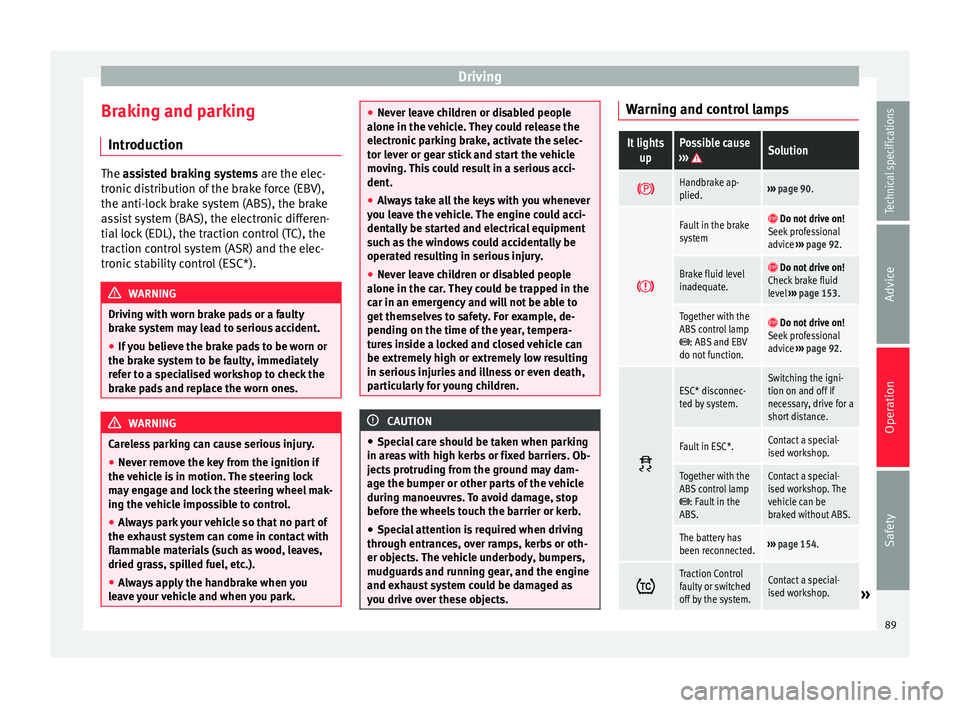
you drive over these objects. Warning and control lamps
It lights
upPossible cause
››› Solution
Handbrake ap-
plied.›››
page 90.
Fault in the brake
system Do not drive on!
Seek professional
advice ››› page 92.
Brake fluid level
inadequate. Do not drive on!
Check brake fluid
level ››› page 153.
Together with the
ABS control lamp
: ABS and EBV
do not function.
Do not drive on!
Seek professional
advice ››› page 92.
ESC* disconnec-
ted by system.Switching the igni-
tion on and off If
necessary, drive for a
short distance.
Fault in ESC*.Contact a special-
ised workshop.
Together with the
ABS control lamp
: Fault in the
ABS.
Contact a special-
ised workshop. The
vehicle can be
braked without ABS.
The battery has
been reconnected.››› page 154.
Traction Control
faulty or switched
off by the system.Contact a special-
ised workshop.»
89
Technical specifications
Advice
Operation
Safety
Page 92 of 219
OperationIt lights
upPossible cause
››› Solution
Together with the
ESC* control lamp
: Fault in the
ABS.
Contact a special-
ised workshop. The
vehicle can be
braked without ABS.
Together with the
warning lamp :
ABS and EBV do
not function. Do not drive on!
Seek professional
advice ››› page 92.
FlashesPossible causeSolution
ESC* or ASR regu-
lating.Take your foot off the
accelerator. Adjust
your driving style to
the road conditions.
Traction Control
regulator operat-
ing.Take your foot off the
accelerator. Adjust
your driving style to
the road conditions.
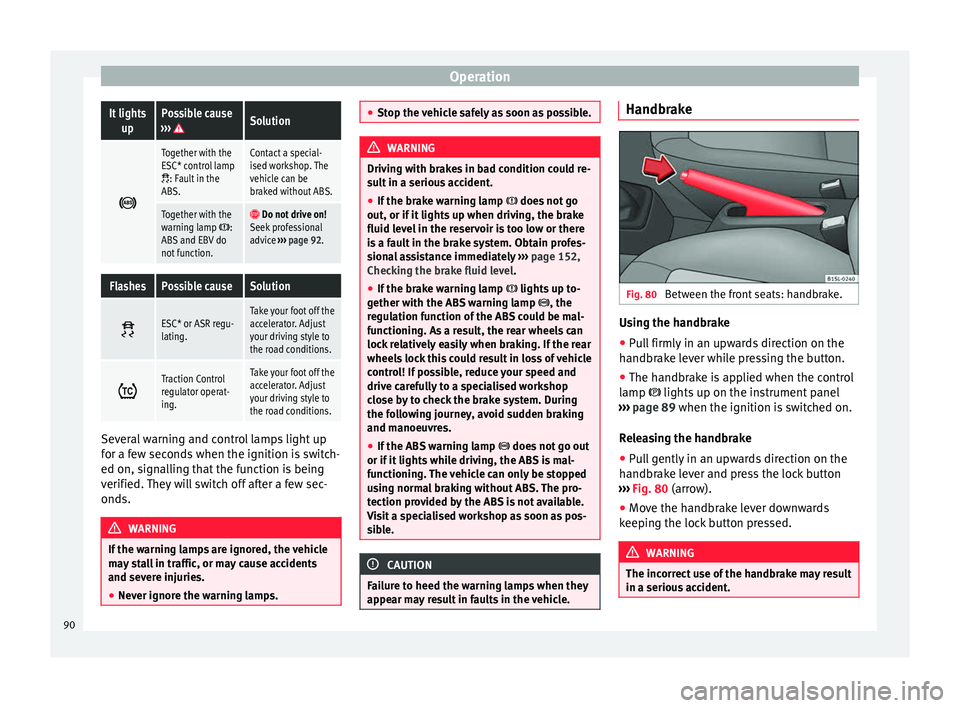
Several warning and control lamps light up
for a few seconds when the ignition is switch-
ed on, signalling that the function is being
verified. They will switch off after a few sec-
onds.
WARNING
If the warning lamps are ignored, the vehicle
may stall in traffic, or may cause accidents
and severe injuries.
● Never ignore the warning lamps. ●
Stop the vehicle safely as soon as possible. WARNING
Driving with brakes in bad condition could re-
sult in a serious accident.
● If the brake warning lamp does not go
out, or if it lights up when driving, the brake
fluid level in the reservoir is too low or there
is a fault in the brake system. Obtain profes-
sional assistance immediately ››› page 152,
Checking the brake fluid level.
● If the brake warning lamp lights up to-
gether with the ABS warning lamp , the
regulation function of the ABS could be mal-
functioning. As a result, the rear wheels can
lock relatively easily when braking. If the rear
wheels lock this could result in loss of vehicle
control! If possible, reduce your speed and
drive carefully to a specialised workshop
close by to check the brake system. During
the following journey, avoid sudden braking
and manoeuvres.
● If the ABS warning lamp does not go out
or if it lights while driving, the ABS is mal-
functioning. The vehicle can only be stopped
using normal braking without ABS. The pro-
tection provided by the ABS is not available.
Visit a specialised workshop as soon as pos-
sible. CAUTION
Failure to heed the warning lamps when they
appear may result in faults in the vehicle. Handbrake
Fig. 80
Between the front seats: handbrake. Using the handbrake
●
Pull firmly in an upwards direction on the
handbrake lever while pressing the button.
● The handbrake is applied when the control
lamp lights up on the instrument panel
››› page 89 when the ignition is switched on.
R el
easing the handbrake
● Pull gently in an upwards direction on the
handbrake lever and press the lock button
››› Fig. 80 (arrow).
● Mov
e the handbrake lever downwards
keeping the lock button pressed. WARNING
The incorrect use of the handbrake may result
in a serious accident. 90
Page 105 of 219

Driver assistance systems
● Will the navigation system fitted at the fac-
tory operate correctly in the destination coun-
try with the available navigation data?
● Are special tyres required in the destination
country? CAUTION
SEAT does not accept liability for any damage
to the vehicle due to the use of a lower quali-
ty fuel, an inadequate service or the non-
availability of genuine spare parts. Driving along flooded roadways
To prevent damage to the vehicle when driv-
ing through water, for example, along a floo-
ded road, please observe the following:
● Check the depth of the water before enter-
ing the flooded zone. The water should never
come above the lower edge of the bodywork
››› .
● Do not drive faster than a pedestrian.
● Do not stop in the water, use reverse gear
or switch off the engine.
● Oncoming traffic will cause waves which
raise the level of the water, making it difficult
to cross the water.
● Disconnect the Start-Stop system whenever
crossing water. WARNING
When driving through water, mud, melted
snow, etc., please remember that due to
damp or frozen brake discs and shoes in win-
ter, the braking effect may be delayed, there-
fore the required braking distance is greater.
● “Dry the brakes and remove ice” by braking
carefully. Ensure that you are not endanger-
ing other road-users or breaking traffic regu-
lations in the process.
● After driving through water, avoid sudden
sharp manoeuvres. CAUTION
● Driving through flooded areas may severely
damage vehicle components such as the en-
gine, transmission, drive train or electrical
system.
● Never drive through salt water as salt cau-
ses corrosion. Always rinse any parts of the
vehicle which have been in contact with salt
water. Driver assistance systems
Braking and stability systems Brake assist systems The assisted braking systems ESC*, ABS,
EBV, BAS, ASR, TC and EDL only operate when
the ignition is switched on. They contribute
significantly to increasing active safety.
Electronic stability control (ESC)*
ESC* reduces the risk of skidding and increa-
ses the vehicle stability by braking individual
wheels under specific driving conditions.
ESC* detects critical handling situations,
such as understeer, oversteer and wheelspin
on the driven wheels. The system stabilises
the vehicle by braking individual wheels or
by reducing the engine torque.
The ESC* has limits. It is important to realise
that ESC* is also subject to the laws of phys-
ics. ESC* will not be able to deal with all sit-
uations with which drivers may be faced. For
example, if the road surface changes sudden-
ly then ESC* will not be useful in all cases. If
the vehicle suddenly enters a section cov-
ered by water, mud or snow then ESC* will
not provide assistance in the same way as on
dry ground. If the vehicle loses its grip on the
ground and moves on a film of water (“aqua-
planing”), the ESC* will not be able to help
»
103Technical specifications
Advice
Operation
Safety
Page 106 of 219

Operation
the driver control the vehicle due to the loss
of adherence with the road surface prevent-
ing braking and steering. If the vehicle is
driven through series of bends at high
speed, the ESC* will not always be as effec-
tive: the vehicle reaction to aggressive driv-
ing is not the same as at reduced speeds.
Adjust your speed and driving style to suit
visibility, and weather, road and traffic condi-
tions. ESC* cannot push the limits of the laws
of physics; improve the transmission availa-
ble or maintain the vehicle on the road if a
lack of driver attention creates an inevitable
situation. Otherwise, ESC* assists in main-
taining vehicle control in extreme situations
and uses the movements of the steering
made by the driver to maintain the vehicle
moving in the desired direction. If the vehicle
is driven at such a speed that it will leave the
road before ESC* can intervene then the sys-
tem cannot provide assistance.
The ABS, BAS, ASR and EDL systems are in-
corporated into the ESC*. The ESC* is always
on 1)
.
Anti-lock brake system (ABS)
ABS can prevent the wheels from locking dur-
ing braking until just before the vehicle stops
thus helping the driver to steer the vehicle
and maintain control. This means that, even during full braking, the risk of skidding is re-
duced:
● Press and hold the brake pedal fully. Do not
remove your foot from the brake pedal or re-
duce braking force!
● Do not “pump” the brake pedal, or reduce
braking force!
● Maintain vehicle direction when braking
fully.
● When the brake pedal is released or when
the brake force is reduced, ABS is turned off.
ABS control can be observed by vibration of
the brake pedal and noise. You should never
e xpect
the ABS to reduce the braking dis-
tance under
any circumstances. This distance
will increase when driving on gravel, recent
snow or on icy or slippery ground.
Brake assist system (BAS)
The brake assist system may reduce the re-
quired braking distance. The brake assist
system boosts the braking force if you press
the brake pedal quickly in an emergency. As
a result, the braking pressure increases rap-
idly, the braking force is multiplied and the
braking distance is reduced. This enables the
ABS to be activated more quickly and effec-
tively. ¡Do not lift your foot off the brake pedal!
When the br
ake pedal is released or when
the brake force is reduced, braking assist au-
tomatically turns off the brake servo.
Traction control system (ASR) or Traction
Control (TC)
In the event of wheelspin, the traction control
system ASR or TC reduces the engine torque
to match the amount of grip available. The
ASR or TC makes some situations easier, for
example, when starting, accelerating or go-
ing uphill, even in unfavourable road condi-
tions.
Electronic differential lock system (EDL)
EDL is available when driving in straight lines
under normal conditions. When the EDL de-
tects wheelspin, it brakes the spinning wheel
and directs the power to the other one. To
prevent the disc brake of the braked wheel
from overheating, the EDL cuts out automati-
cally if subjected to excessive loads. The EDL
will switch on again automatically when the
brake has cooled down. WARNING
Driving at high speed on icy, slippery or wet
ground can result in loss of vehicle control 1)
Depending on the version.
104