brake light Seat Mii 2014 Owner's Guide
[x] Cancel search | Manufacturer: SEAT, Model Year: 2014, Model line: Mii, Model: Seat Mii 2014Pages: 219, PDF Size: 4.19 MB
Page 155 of 219
Checking and refilling levels
In the course of time, the brake fluid absorbs
water from the ambient air. If there is too
much water in the brake fluid, the brake sys-
tem could be damaged. In addition, the boil-
ing point of the brake fluid is significantly
lowered. When the brake fluid contains too
much water and the brakes are subject to
considerable forces, bubbles of water vapour
can form in the system. These bubbles can
significantly reduce braking power, notably
increasing braking distance, and could even
result in the total failure of the brake system.
Ensuring that the brake system is always
functioning correctly is essential for your own
safety and the safety of other road users
››› .
Brake fluid specifications
SEAT have developed a special brake fluid
optimised for the brake systems of their vehi-
cles. To ensure the optimum working of the
brake system, SEAT recommends the use of
brake fluid in accordance with the VW 501 14
standard . If this brake fluid is not available or
another br ak
e fluid is used for different rea-
sons, use a brake fluid that complies with the
United States standard FMVSS 116 DOT 4 or
the German standard DIN ISO 4925 CLASS 4
››› .
Brake fluids conforming to the standard
VW 501 14, fulfil the American requirements
of the FMVSS 116 DOT 4 standard and the
German DIN ISO 4925 CLASS 4 standard. However, fluids that comply with the Ameri-
can FMVSS 116 DOT 4 standard or the Ger-
man DIN ISO 4925 CLASS 4 standard do not
necessarily comply with the VW 501 14
standard. Always check the information on
the brake fluid container and ensure that you
are using suitable brake fluid.
A suitable brake fluid can be obtained from
SEAT dealerships.
Brake fluid level
The level of the brake fluid should always be
between the MIN and MAX marks, or above
the MIN mark
››› .
It is not always possible to check the level of
the brake fluid, as in some models the en-
gine components make it difficult to see the
brake fluid reservoir. If you cannot read the
exact brake fluid level, consult a specialist.
The brake fluid level drops slightly when the
vehicle is being used due to wear of the
brake pads and the automatic readjustment
of the brake.
Changing the brake fluid
The brake fluid should be changed in accord-
ance with the instructions given in the Main-
tenance Programme. Have the brake fluid
changed by a specialised workshop. SEAT
recommends taking your car in for technical
service. This means that only brake fluid complying with the required specifications
will be used. WARNING
If the brake fluid level is low or unsuita-
ble/old brake fluid is used, the brake system
may fail or braking power may be reduced.
● Check the brake system and the brake fluid
level regularly!
● The brake fluid should be changed regular-
ly in accordance with the instructions given
in the Maintenance Programme.
● When the brake fluid is used and brakes
are subjected to extreme braking forces, bub-
bles of vapour form in the brake system.
These bubbles can significantly reduce brak-
ing power, notably increasing braking dis-
tance, and could result in the total failure of
the brake system.
● Always ensure that you use suitable brake
fluid. Only used brake fluid that conforms to
the VW 501 14 standard, FMVSS 116 DOT 4
standard or even the DIN ISO 4925 CLASS 4
standard. Other types of brake fluid could af-
fect brake operation and reduce braking pow-
er. Do not use a brake fluid if the container
does not specify compliance with the
VW 501 14, FMVSS 116 DOT 4 or
DIN ISO 4925 CLASS 4 standards.
● The replacement brake fluid must be new. WARNING
Brake fluid is poisonous. » 153
Technical specifications
Advice
Operation
Safety
Page 160 of 219

Advice
CAUTION
● Never disconnect the battery if the ignition
is switched on or if the engine is running.
This could damage the electrical system or
electronic components.
● Never plug accessories that supply current,
such as solar panels or a battery charger, to
the 12-volt power socket or the cigarette
lighter. This could damage the vehicle's elec-
trical system. For the sake of the environment
Dispose of the battery in an environment-
friendly manner. Batteries contain toxic sub-
stances such as sulphuric acid and lead. For the sake of the environment
Battery acid can contaminate the environ-
ment. Collect any spilt service fluids and dis-
pose of them correctly. Wheels and tyres
Wheels Introduction SEAT recommend that all work on tyres and
wheels is carried out by a specialised work-
shop. These workshops have the necessary
special tools and replacement parts, trained
personnel and facilities for disposing of the
old tyres while respecting the environment.
SEAT recommends taking your car in for tech-
nical service.
WARNING
The vehicle cannot be totally controlled or
braked if the tyres (new or used) are worn or
damaged.
● Incorrect use of wheels and tyres could
make driving more dangerous and result in
serious accidents and damage.
● All four wheels must be fitted with radial
tyres of the same type, size (rolling circumfer-
ence) and the same tread pattern.
● New tyres do not give maximum grip and
will not have reached their maximum braking
capacity to start with, and therefore need
running in. To prevent accidents and major
damage, extreme caution should be taken for
the first 600 km. ●
Check tyre pressures regularly and ensure
they are maintained at the pressures indica-
ted. If the tyre pressure is too low, they could
overheat, resulting in tread detachment or
even burst tyres.
● Never drive on damaged (punctured, cut,
cracked or dented) or worn tyres. Driving on
damaged or worn tyres could result in burst
tyres, serious accidents or damage. Worn or
damaged tyres must be replaced immediate-
ly.
● Never exceed the maximum permitted
speed or loads specified for the type of tyre
fitted on your vehicle.
● The effectiveness of driver and brake assist
systems also depends on the grip of the
tyres.
● If you notice unusual vibration or if the ve-
hicle pulls to one side when driving, stop the
car immediately and check the tyres and
wheels for damage.
● To minimise the risk of losing control of the
vehicle or causing a serious accident, never
undo the bolted joints of beadlock wheels.
● Never mount used tyres or wheels if you are
not sure of their previous history. They may
be damaged, although the damage is not im-
mediately visible.
● Old tyres, even if they have never been
used, may lose air or burst unexpectedly
while driving, especially at high speeds, re-
sulting in serious accident and injury. If tyres
are over six years old, they should only be
used in an emergency and with extreme cau-
tion. 158
Page 173 of 219

Emergencies
Fire extinguisher
A fire extinguisher can be stored in a holder
in the passenger seat footwell.
The fire extinguisher must conform to legal
requirements, be ready for use and be
checked regularly. Check the certification
seal on the extinguisher. WARNING
Loose objects in the vehicle interior can be vi-
olently thrown in case of a sudden manoeu-
vre or braking and especially in accidents
causing serious injury.
● Secure or store fire extinguishers, first aid
kit, reflective vests and warning triangle se-
curely in the vehicle. Protecting yourself and securing the
vehicle
Fig. 121
Dash panel: Button for switching the
hazard lights warning system on and off. Always fulfil legal requirements for securing a
broken down vehicle. In a number of coun-
tries it is now obligatory, for example, to turn
on the hazard warning lights and use a re-
flective safety vest
››› page 170.
For your own safety and that of other passen-
gers, the following points should be ob-
served in the order given:
Park the vehicle a safe distance from
traffic and on suitable ground ››› .
Turn on the hazard warning lights with
the button
››› Fig. 121.
Apply the handbrake firmly ››› page 89.
Put the gearbox lever in neutral or the
selector lever in position N ››› page 93.
1.
2.
3.
4. Switch off the engine and remove the
key from the ignition.
Have all occupants leave the vehicle and
move to safety, for example behind a
guard rail.
When leaving the vehicle, take all keys
with you.
Place an emergency warning triangle to
indicate the position of your vehicle to
other road users.
Allow the engine to cool and check if a
specialist is required.
When being towed with the hazard warning
lights on, a change in direction or traffic lane
can be indicated as usual using the turn sig-
nal lever. The hazard lights will be interrup-
ted temporarily.
Examples of when to use the hazard warning
lights:
● If the vehicles ahead suddenly slow down
or reach the end of a traffic jam, to warn the
vehicles behind.
● In case of an emergency.
● If the vehicle breaks down.
● When tow-starting or towing.
Always comply with the applicable laws re-
garding the use of hazard warning lights.
If the hazard warning lights are not working,
you must use an alternative method of »
5.
6.
7.
8.
9.
171Technical specifications
Advice
Operation
Safety
Page 174 of 219
Advice
drawing attention to your vehicle. This meth-
od must comply with traffic legislation. WARNING
A faulty vehicle in traffic represents a risk of
accident for the driver and for other road
users.
● Stop the vehicle safely as soon as possible.
Park the vehicle a safe distance from sur-
rounding traffic to lock all the doors in case of
an emergency. Turn on the hazard warning
lights to warn other road users.
● Never leave children or disabled people
alone in the vehicle if the doors are to be
locked. In case of an emergency, passengers
will be trapped inside the vehicle. Individuals
locked in the vehicle can be exposed to very
high or very low temperatures. WARNING
The components of the exhaust system reach
very high temperatures. This could cause a
fire and considerable damage.
● Always park your vehicle so that no part of
the exhaust system can come in contact with
flammable materials (such as dried grass or
fuel). Note
● The vehicle battery will discharge and run
down if the hazard warning lights remain on
for too long (even with the ignition turned
off). ●
For some vehicles, the brake lights will
blink when braking suddenly at speeds of ap-
proximately 80 km/h (50 mph) to alert vehi-
cles to the rear. If braking continues, the haz-
ard warning lights system will automatically
be turned on at a speed of less than approxi-
mately 10 km/h (6 mph). The brake lights re-
main lit. Upon accelerating, the hazard warn-
ing lights will be automatically turned off. Vehicle tool kit*
Introduction When securing the vehicle in case of a break-
down, please note the legal requirements for
each country.
Vehicle tool kit
For vehicles with a factory-fitted spare wheel
or temporary spare wheel, in addition to win-
ter wheels, the luggage compartment may
contain additional vehicle tools
››› page 172. WARNING
When the vehicle tool kit, tire mobility set
and spare wheel are loose in the interior they
can be violently thrown in case of a sudden
manoeuvre or braking and especially in acci-
dents, causing serious injury.
● Ensure that the vehicle tool kit, the tire mo-
bility set and the spare wheel or temporary spare wheel are safely secured in the luggage
compartment.
WARNING
Unsuitable or damaged vehicle tools can
cause injury or accidents.
● Never work with inappropriate or damaged
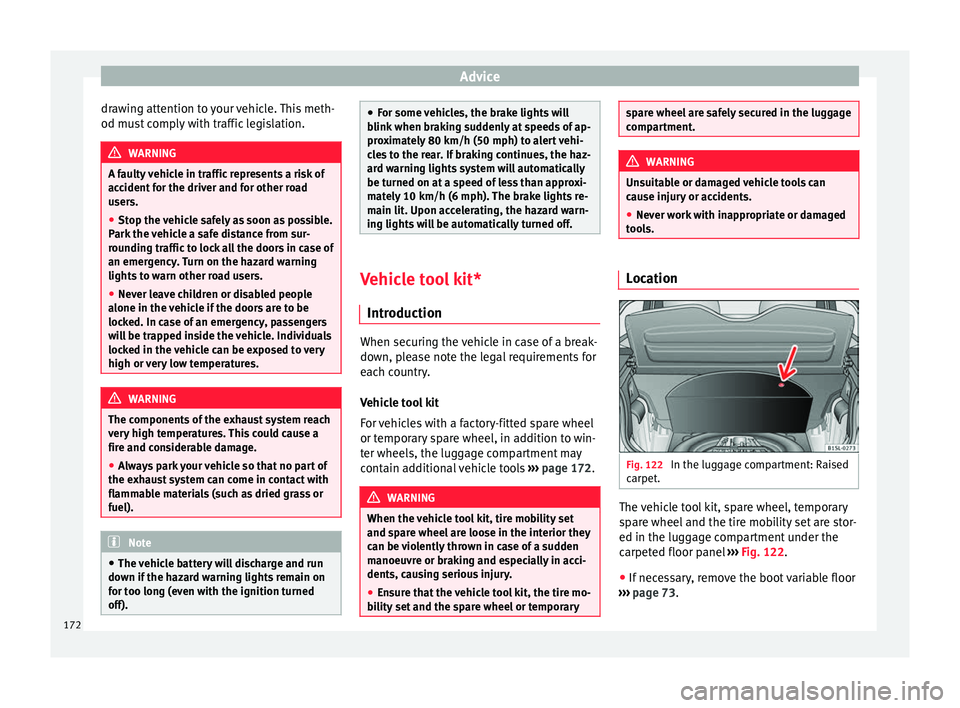
tools. Location
Fig. 122
In the luggage compartment: Raised
carpet. The vehicle tool kit, spare wheel, temporary
spare wheel and the tire mobility set are stor-
ed in the luggage compartment under the
carpeted floor panel
›››
Fig. 122 .
● If nec
essary, remove the boot variable floor
››› page 73.
172
Page 176 of 219

Advice
Changing a wheel Introduction Some vehicle versions and models do not
have a factory-fitted jack or box spanner. In
this case, we recommend consulting a Speci-
alised workshop to change the wheel.
You should only change the wheels yourself if
the vehicle is parked in a safe place, you are
familiar with the procedure and safety stand-
ards and you have all the necessary tools!
Otherwise, you should seek professional as-
sistance.
WARNING
Changing a wheel can be dangerous, espe-
cially on the hard shoulder. Please observe
the following rules to minimise the risk of in-
jury:
● Stop the vehicle safely as soon as possible.
Park at a safe distance from surrounding traf-
fic to change a wheel.
● When changing a wheel, keep all passen-
gers, and particularly children, a safe dis-
tance away from the work area.
● Turn on the hazard warning lights to warn
other road users.
● Ensure the ground on which you park is flat
and solid. If necessary, support the jack on a
wide solid base. ●
If you are changing a wheel yourself, you
should be familiar with the required proce-
dure. Otherwise, you should seek professio-
nal assistance.
● Only use suitable tools that are not dam-
aged when changing a wheel.
● Always stop the engine, apply the hand-
brake lever firmly and place the selector lever
in position P, or engage a gear for a manual
gearbox to reduce the risk of the vehicle mov-
ing accidentally.
● Have the tightening torque of the wheel
bolts checked as soon as possible with a reli-
able torque wrench. WARNING
If the wheel trims are not appropriate or not
fitted correctly, they could cause major acci-
dents or damage.
● Incorrectly mounted wheel trims may come
off while driving and endanger other road
users.
● Damaged trims must never be mounted on
the wheels.
● Always ensure that the brake ventilation
and cooling is not cut off or blocked. This is
also valid if hubcaps are fitted later. If there
is not enough air, you may require signifi-
cantly longer braking distances. CAUTION
Remove and remount wheel trims taking care
to avoid damage to the vehicle. Hubcaps
Fig. 124
Remove the hubcap of the steel
wheel trim In order to access the wheel bolts, first re-
move the hubcap.
Removing and fitting the hubcap
● To remove , take the vehicle tool kit wire
hook and att
ach it to the edge of the wheel
trim ››› Fig. 124
.
● Remove the trim by pulling it in the direc-
tion of the arrow.
● To replace the hubcap , press the hubcap
against the trim until it clicks into place.
174
Page 181 of 219

Emergencies
● In outside temperatures below -20 °C
(-4 °F).
● In the event of cuts or perforations in the
tyre greater than 4 mm.
● If you have been driving with very low pres-
sure or a completely flat tyre.
● If the sealant bottle has passed its use by
date. WARNING
Using the tyre mobility system can be dan-
gerous, especially when filling the tyre at the
roadside. Please observe the following rules
to minimise the risk of injury:
● Stop the vehicle safely as soon as possible.
Park it at a safe distance from surrounding
traffic to fill the tyre.
● Ensure the ground on which you park is flat
and solid.
● All passengers and particularly children
must keep a safe distance from the work area.
● Turn on the hazard warning lights to warn
other road users.
● Use the tyre mobility system only if you are
familiar with the necessary procedures. Oth-
erwise, you should seek professional assis-
tance.
● The tyre mobility set is intended for tempo-
rary emergency use only until you can reach
the nearest specialised workshop.
● Replace the repaired tyre with the tire mo-
bility set as soon as possible. ●
The sealant is a health hazard and must be
cleaned immediately if it comes into contact
with the skin.
● Always keep the tire mobility set out of the
reach of small children.
● Never use an equivalent jack, even if it has
been approved for your vehicle.
● Always stop the engine, apply the hand-
brake lever firmly and engage gear if using a
manual gearbox, in order to reduce the risk of
vehicle involuntary movement. WARNING
A tyre filled with sealant does not have the
same performance properties as a conven-
tional tyre.
● Never drive faster than 80 km/h (50 mph).
● Avoid heavy acceleration, hard braking and
fast cornering.
● Drive for only 10 minutes at a maximum
speed of 80 km/h (50 mph) and then check
the tyre. For the sake of the environment
Dispose of used or expired sealant observing
any legal requirements. Note
● A new bottle of sealant can be purchased at
SEAT dealerships. ●
Take into account the separate instruction
manual of the tyre mobility set* manufactur-
er. Contents of the tyre mobility system*
Fig. 132
Standard representation: Contents
of the tyre mobility system. The tyre mobility set is located underneath
the floor covering in the luggage compart-
ment. It includes the following components
››› Fig. 132 :
T y
re valve remover
Sticker indicating maximum speed “max.
80 km/h” or “max. 50 mph”
Filler tube with cap
Air compressor »
1 2
3
4
179
Technical specifications
Advice
Operation
Safety
Page 185 of 219

Emergencies
Connect the battery clamps so they have
good metal-to-metal contact with the battery
terminals.
If the engine fails to start, switch off the start-
er after about 10 seconds and try again after
about 1 minute. WARNING
● Please note the safety warnings referring to
working in the engine compartment
››› page 143.
● The b att
ery providing assistance must have
the same voltage as the flat battery (12V) and
approximately the same capacity (see imprint
on battery). Failure to comply could result in
an explosion.
● Never use jump leads when one of the bat-
teries is frozen. Danger of explosion! Even af-
ter the battery has thawed, battery acid could
leak and cause chemical burns. If a battery
freezes, it should be replaced.
● Keep sparks, flames and lighted cigarettes
away from batteries, danger of explosion.
Failure to comply could result in an explo-
sion.
● Observe the instructions provided by the
manufacturer of the jump leads.
● Do not connect the negative cable from the
other vehicle directly to the negative terminal
of the flat battery. The gas emitted from the
battery could be ignited by sparks. Danger of
explosion. ●
Do not attach the negative cable from the
other vehicle to parts of the fuel system or to
the brake line.
● The non-insulated parts of the battery
clamps must not be allowed to touch. The
jump lead attached to the positive battery
terminal must not touch metal parts of the ve-
hicle, this can cause a short circuit.
● Position the leads in such a way that they
cannot come into contact with any moving
parts in the engine compartment.
● Do not lean on the batteries. This could re-
sult in chemical burns. Note
The vehicles must not touch each other, oth-
erwise electricity could flow as soon as the
positive terminals are connected. Towing and tow starting
Introduction When towing or tow starting, respect the le-
gal requirements.
For technical reasons, it is not possible to
tow a vehicle if the battery is flat. WARNING
A vehicle with a flat battery should never be
towed.
● Never remove the key from the ignition
lock. Otherwise, the steering wheel lock
could suddenly lock. The vehicle would not
be controlled and a serious accident could
ensue. WARNING
When towing the vehicle, the handling and
braking efficiency change considerably.
Please observe the following instructions to
minimise the risk of serious accidents and in-
jury:
● As the driver of the vehicle being towed:
– The brake must be depressed must hard-
er as the brake servo does not operate.
Always remain aware to avoid collision
with the towing vehicle.
– More strength is required at the steering
wheel as the power steering does not op-
erate when the engine is switched off.
● As the driver of the towing vehicle:
– Accelerate gently and carefully.
– Avoid sudden braking and manoeuvres.
– Brake well in advance than usual and
brake gently.
» 183
Technical specifications
Advice
Operation
Safety
Page 186 of 219
Advice
CAUTION
● Carefully fit and remove the towline anchor-
age and its cover to avoid damage to the ve-
hicle (e.g. paintwork).
● When towing, fuel could enter the catalytic
converter and cause damage! Note
Fitting a towline anchorage to the rear bump-
er is not possible. The vehicle is not suitable
for towing other vehicles. Instructions for tow starting
In general, the vehicle should not be started
by towing. Jump-starting is much more pref-
erable
›
› ›
page 181.
For technical reasons, the following vehicles
can
not be tow started:
● Vehicles with an automatic gearbox.
● If the vehicle battery is flat, it is possible
that the engine control unit does not operate
correctly.
However, if your vehicle must absolutely be
tow-started (manual gearbox):
● Put it into second or third gear.
● Keep the clutch pressed down. ●
Switch on the ignition and the hazard warn-
ing lights.
● Release the clutch when both vehicles are
moving.
● As soon as the engine starts, press the
clutch and move the gear lever into neutral.
This helps to prevent a collision with the tow-
ing vehicle. CAUTION
When tow-starting, fuel could enter the cata-
lytic converter and damage it. Notes on towing
Tow rope or tow bar
When towing, the tow bar is the safest and
vehicle friendly way. You should only use a
tow rope if you do not have a tow bar.
A tow rope should be slightly elastic to avoid
damage to both vehicles. It is advisable to
use a tow rope made of synthetic fibre or sim-
ilarly elastic material.
Only secure the tow rope or tow bar to the
towline anchorage or specially designed fit-
ting.
Towing vehicles with an automatic gearbox
Note the following for a towed vehicle:●
Make sure the gear selector lever is in the N
position.
● Do not drive faster than 50 km/h (30 mph)
when towing a vehicle.
● Do not tow further than 50 km (30 miles).
● If a breakdown truck is used, the vehicle
must be towed with the front wheels raised.
Situations in which the vehicle should not be
towed
In the following cases, the vehicle should not
be towed but transported on a trailer or spe-
cial vehicle:
● If the vehicle gearbox does not contain lu-
bricant due to a fault.
● If the battery is flat and the steering cannot
be unlocked as a result, the electronic steer-
ing lock and electronic parking brake cannot
be disengaged.
● If the vehicle to be towed has an automatic
gearbox and the distance to be covered is
greater than 50 km (30 miles). Note
The vehicle can only be towed if the steering
lock electronic gearbox lock is deactivated. If
the vehicle has no power supply or there is
an electric system fault, the engine must be
started using jump leads to deactivate the
steering column electronic gearbox lock. 184
Page 187 of 219
Emergencies
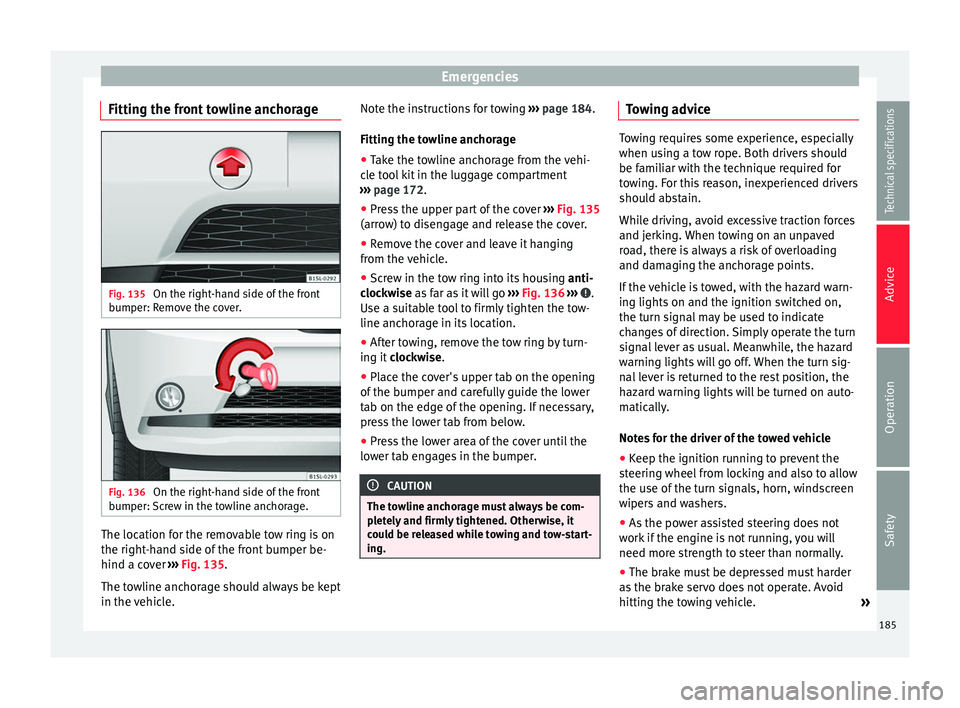
Fitting the front towline anchorage Fig. 135
On the right-hand side of the front
bumper: Remove the cover. Fig. 136
On the right-hand side of the front
bumper: Screw in the towline anchorage. The location for the removable tow ring is on
the right-hand side of the front bumper be-
hind a cover
››› Fig. 135 .
The t o
wline anchorage should always be kept
in the vehicle. Note the instructions for towing
››› page 184.
Fitting the towline anchorage
● Take the towline anchorage from the vehi-
cle tool kit in the luggage compartment
››› page 172.
● Pre
ss the upper part of the cover ››› Fig. 135
(arrow) to disengage and release the cover.
● Remove the cover and leave it hanging
from the vehicle.
● Screw in the tow ring into its housing anti-
clockwise as far as it will go ››
› Fig. 136 ››› .
Use a suitable tool to firmly tighten the tow-
line anchorage in its location.
● After towing, remove the tow ring by turn-
ing it clockwise .
● Plac
e the cover's upper tab on the opening
of the bumper and carefully guide the lower
tab on the edge of the opening. If necessary,
press the lower tab from below.
● Press the lower area of the cover until the
lower tab engages in the bumper. CAUTION
The towline anchorage must always be com-
pletely and firmly tightened. Otherwise, it
could be released while towing and tow-start-
ing. Towing advice
Towing requires some experience, especially
when using a tow rope. Both drivers should
be familiar with the technique required for
towing. For this reason, inexperienced drivers
should abstain.
While driving, avoid excessive traction forces
and jerking. When towing on an unpaved
road, there is always a risk of overloading
and damaging the anchorage points.
If the vehicle is towed, with the hazard warn-
ing lights on and the ignition switched on,
the turn signal may be used to indicate
changes of direction. Simply operate the turn
signal lever as usual. Meanwhile, the hazard
warning lights will go off. When the turn sig-
nal lever is returned to the rest position, the
hazard warning lights will be turned on auto-
matically.
Notes for the driver of the towed vehicle
●
Keep the ignition running to prevent the
steering wheel from locking and also to allow
the use of the turn signals, horn, windscreen
wipers and washers.
● As the power assisted steering does not
work if the engine is not running, you will
need more strength to steer than normally.
● The brake must be depressed must harder
as the brake servo does not operate. Avoid
hitting the towing vehicle. »
185
Technical specifications
Advice
Operation
Safety
Page 207 of 219

Index
Index
A
Abroad Extended stay abroad with your vehicle . . . . . 135
Sale of vehicle . . . . . . . . . . . . . . . . . . . . . . . . . 135
ABS See "Brake assist systems" . . . . . . . . . . . . . . . 104
Accessories . . . . . . . . . . . . . . . . . . . . . . . . . . . . . . 118
Additional equipment . . . . . . . . . . . . . . . . . . . . . 119
Adjust Headlight range . . . . . . . . . . . . . . . . . . . . . . . . . 58
Adjustment Correct sitting position . . . . . . . . . . . . . . . . . . . . . 6
Front seat . . . . . . . . . . . . . . . . . . . . . . . . . . . . . . 63
rear head restraints . . . . . . . . . . . . . . . . . . . . . . . 9
Steering wheel . . . . . . . . . . . . . . . . . . . . . . . . . . . 7
Aerial . . . . . . . . . . . . . . . . . . . . . . . . . . . . . . . . . . . 135
Airbags description . . . . . . . . . . . . . . . . . . . . . . . . . . . . . 19
Airbag system . . . . . . . . . . . . . . . . . . . . . . . . . . 17, 21 activation . . . . . . . . . . . . . . . . . . . . . . . . . . . . . . 20
Cleaning dash panel . . . . . . . . . . . . . . . . . . . . 133
Control lamp . . . . . . . . . . . . . . . . . . . . . . . . . . . . 23
Deactivating the front passenger front airbag . 24
Deactivating using the key switch . . . . . . . . . . . 24
Differences between front passenger front air-bag systems . . . . . . . . . . . . . . . . . . . . . . . . . . 22
Faults . . . . . . . . . . . . . . . . . . . . . . . . . . . . . . . . . 120
Front airbags . . . . . . . . . . . . . . . . . . . . . . . . . . . . 21
functioning . . . . . . . . . . . . . . . . . . . . . . . . . . . . . 20
Locking the vehicle after airbag deployment . . 46
Repairs . . . . . . . . . . . . . . . . . . . . . . . . . . . . . . . 120
Side airbags . . . . . . . . . . . . . . . . . . . . . . . . . . . . 22
Use of child seats . . . . . . . . . . . . . . . . . . . . . . . . 24
Vehicle care . . . . . . . . . . . . . . . . . . . . . . . . . . . . 133 Air conditioner
Air recirculation . . . . . . . . . . . . . . . . . . . . . . . . . 84
Air vents . . . . . . . . . . . . . . . . . . . . . . . . . . . . . . . 83
Faults . . . . . . . . . . . . . . . . . . . . . . . . . . . . . . . . . . 83
set . . . . . . . . . . . . . . . . . . . . . . . . . . . . . . . . . . . . 82
Things to note . . . . . . . . . . . . . . . . . . . . . . . . . . . 83
User instructions . . . . . . . . . . . . . . . . . . . . . . . . 82
Air conditioning system . . . . . . . . . . . . . . . . . . . . . 80 Controls . . . . . . . . . . . . . . . . . . . . . . . . . . . . . . . . 81
Air recirculation . . . . . . . . . . . . . . . . . . . . . . . . . . . 84 How it works . . . . . . . . . . . . . . . . . . . . . . . . . . . . 84
switch off . . . . . . . . . . . . . . . . . . . . . . . . . . . . . . . 84
temporarily switch off . . . . . . . . . . . . . . . . . . . . . 84
Air vents . . . . . . . . . . . . . . . . . . . . . . . . . . . . . . . . . 83
Alternator . . . . . . . . . . . . . . . . . . . . . . . . . . . . . . . 155
Aluminium care . . . . . . . . . . . . . . . . . . . . . . . . . . 129
Anodized surfaces . . . . . . . . . . . . . . . . . . . . . . . . 129
Anti-lock brake system (ABS) . . . . . . . . . . . . . . . 104
Anti-theft bolts . . . . . . . . . . . . . . . . . . . . . . . . . . . 173
Anti-theft locking bolts . . . . . . . . . . . . . . . . . . . . 174
Anti-theft wheel locking bolts . . . . . . . . . . . . . . . 175
Antifreeze . . . . . . . . . . . . . . . . . . . . . . . . . . . . . . . 150
Ashtray . . . . . . . . . . . . . . . . . . . . . . . . . . . . . . . . . . 71
Aspects to take into account before starting the vehicle . . . . . . . . . . . . . . . . . . . . . . . . . . . . . . . . . . 5
ASR see Brake assist systems . . . . . . . . . . . . . . . . . 104
Assistance systems Brake assist system (BAS) . . . . . . . . . . . . . . . . 104
Cruise control system (CCS) . . . . . . . . . . . . . . . 107
Electronic differential lock system (EDL) . . . . . 104
Electronic stability control (ESC) . . . . . . . . . . . 103
Optical parking system (OPS) . . . . . . . . . . . . . 107
Parking aid . . . . . . . . . . . . . . . . . . . . . . . . . . . . 106
Parking distance warning system . . . . . . . . . . 106
Safety Assist (City Safety Assist function) . . . . 110
Start-Stop . . . . . . . . . . . . . . . . . . . . . . . . . . . . . 115 Traction control system (ASR) . . . . . . . . . . . . . 104
Traction Control (TC) . . . . . . . . . . . . . . . . . . . . . 104
Assist systems Anti-lock brake system (ABS) . . . . . . . . . . . . . . 104
Audible warnings Control and warning lamps . . . . . . . . . . . . . . . . 39
Lights . . . . . . . . . . . . . . . . . . . . . . . . . . . . . . . . . 56
Seat belt not fastened . . . . . . . . . . . . . . . . . . . . 12
Speed . . . . . . . . . . . . . . . . . . . . . . . . . . . . . . . . . 42
Automatic belt retainer . . . . . . . . . . . . . . . . . . . . . 16
Automatic car wash . . . . . . . . . . . . . . . . . . . . . . . 126
Automatic device disconnection . . . . . . . . . . . . . 157
automatic gearbox . . . . . . . . . . . . . . . . . . . . . . . . . 93
Automatic gearbox . . . . . . . . . . . . . . . . . . . . . . . . . 95 driving . . . . . . . . . . . . . . . . . . . . . . . . . . . . . . . . . 96
Ignition key removal lock . . . . . . . . . . . . . . . . . . 87
Kickdown . . . . . . . . . . . . . . . . . . . . . . . . . . . . . . . 96
malfunction . . . . . . . . . . . . . . . . . . . . . . . . . . . . . 97
starting on a slope . . . . . . . . . . . . . . . . . . . . . . . 97
stopping on a slope . . . . . . . . . . . . . . . . . . . . . . 97
Axle loads . . . . . . . . . . . . . . . . . . . . . . . . . . . . . . . 198
B BAS see Brake assist systems . . . . . . . . . . . . . . . . . 104
Battery Change in the vehicle key . . . . . . . . . . . . . . . . . 44
Discharging . . . . . . . . . . . . . . . . . . . . . . . . . . . . 172
drains . . . . . . . . . . . . . . . . . . . . . . . . . . . . . . . . . 45
See Vehicle battery . . . . . . . . . . . . . . . . . . . . . . 154
Battery acid . . . . . . . . . . . . . . . . . . . . . . . . . . . . . . 156
Before starting the vehicle . . . . . . . . . . . . . . . . . . . 5
Belt tensioner . . . . . . . . . . . . . . . . . . . . . . . . . . . . . 16 Disposal . . . . . . . . . . . . . . . . . . . . . . . . . . . . . . . 17
Service and disposal . . . . . . . . . . . . . . . . . . . . . 17
Belt tension limiter . . . . . . . . . . . . . . . . . . . . . . . . . 16
Bench . . . . . . . . . . . . . . . . . . . . . . . . . . . . . . . . . . . 74
205