lock Seat Mii 2014 Owner's Guide
[x] Cancel search | Manufacturer: SEAT, Model Year: 2014, Model line: Mii, Model: Seat Mii 2014Pages: 219, PDF Size: 4.19 MB
Page 54 of 219
Operation
● The rear lid is also locked by a central lock-
ing.
● If the vehicle rear lid is locked or unlocked
using the button, when it is closed once
more it will lock automatically.
● A closed but not locked rear lid will lock au-
tomatically at a speed above about 9 km/h
(6 mph).
Locking the rear lid with the vehicle
mechanical key
Locking is only possible when the rear lid is
correctly and fully closed.
● Insert the vehicle key into the lock cylinder
of the driver door and turn the key in a clock-
wise direction
›
›› page 45. WARNING
Unsuitable or careless closing and locking of
the rear lid could cause serious injuries.
● Never allow children to play inside or
around the vehicle without supervision, espe-
cially if the rear lid is open. Children could
enter the luggage compartment, close the
rear lid and become trapped. A locked vehicle
can be subjected to extremely high and low
temperatures, depending on the time of year,
thus causing serious injuries/illness and
even death. Note
Before closing the rear lid, make sure that the
key has not been left inside the luggage com-
partment. Electric windows
Opening and closing the electric
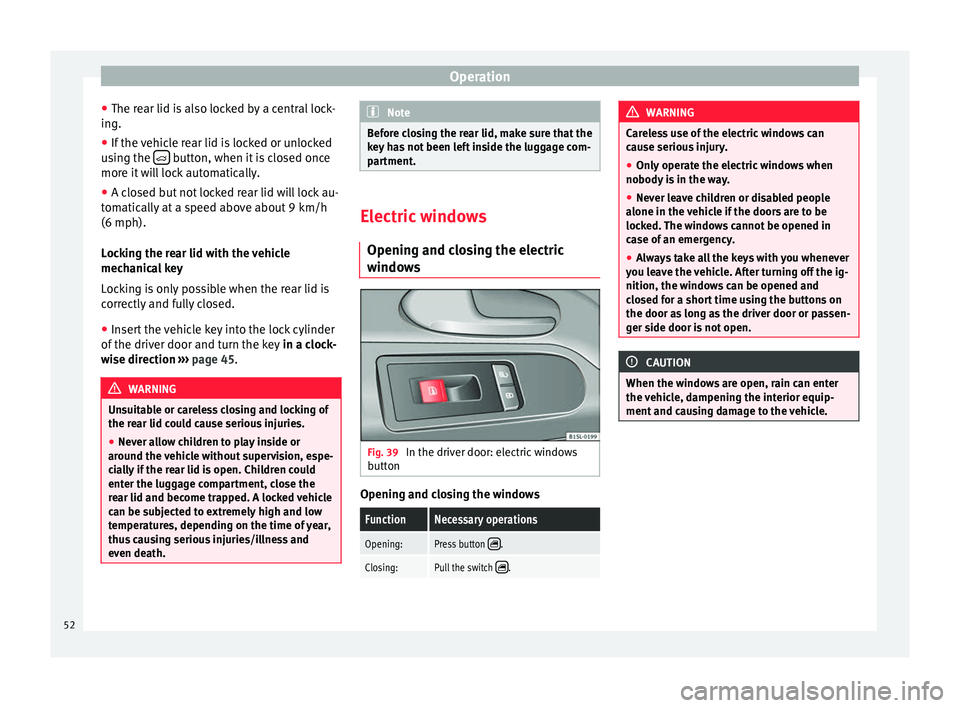
windows Fig. 39
In the driver door: electric windows
button Opening and closing the windows
FunctionNecessary operations
Opening:Press button .
Closing:Pull the switch . WARNING
Careless use of the electric windows can
cause serious injury.
● Only operate the electric windows when
nobody is in the way.
● Never leave children or disabled people
alone in the vehicle if the doors are to be
locked. The windows cannot be opened in
case of an emergency.
● Always take all the keys with you whenever
you leave the vehicle. After turning off the ig-
nition, the windows can be opened and
closed for a short time using the buttons on
the door as long as the driver door or passen-
ger side door is not open. CAUTION
When the windows are open, rain can enter
the vehicle, dampening the interior equip-
ment and causing damage to the vehicle. 52
Page 55 of 219
Opening and closing
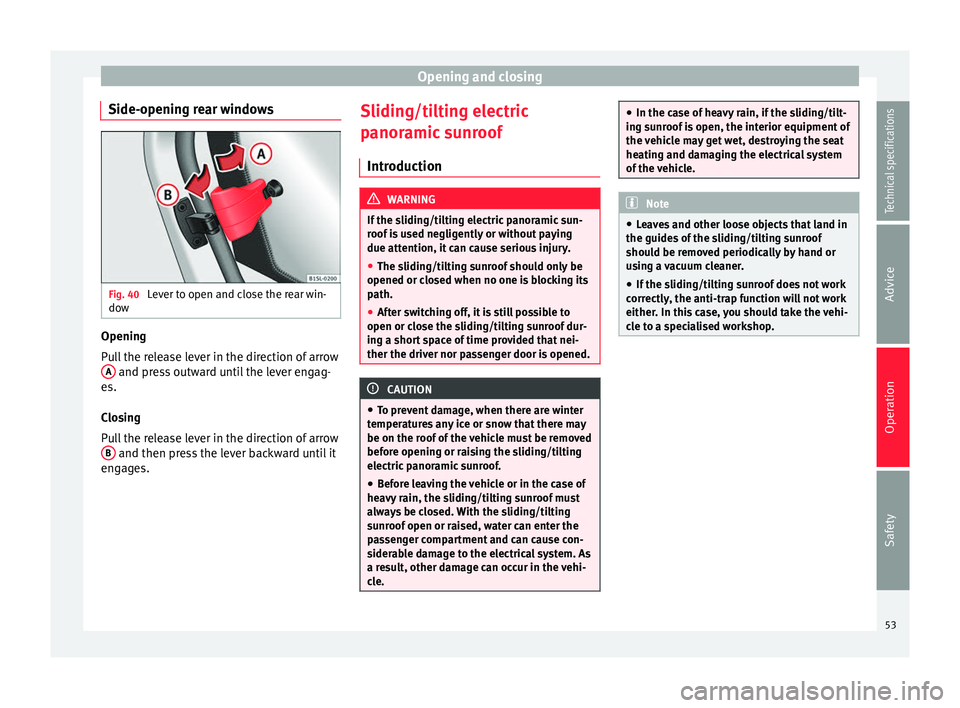
Side-opening rear windows Fig. 40
Lever to open and close the rear win-
dow Opening
Pull the release lever in the direction of arrow
A and press outward until the lever engag-
es.
Closing
Pull the release lever in the direction of arrow B and then press the lever backward until it
engages. Sliding/tilting electric
panoramic sunroof
Introduction WARNING
If the sliding/tilting electric panoramic sun-
roof is used negligently or without paying
due attention, it can cause serious injury.
● The sliding/tilting sunroof should only be
opened or closed when no one is blocking its
path.
● After switching off, it is still possible to
open or close the sliding/tilting sunroof dur-
ing a short space of time provided that nei-
ther the driver nor passenger door is opened. CAUTION
● To prevent damage, when there are winter
temperatures any ice or snow that there may
be on the roof of the vehicle must be removed
before opening or raising the sliding/tilting
electric panoramic sunroof.
● Before leaving the vehicle or in the case of
heavy rain, the sliding/tilting sunroof must
always be closed. With the sliding/tilting
sunroof open or raised, water can enter the
passenger compartment and can cause con-
siderable damage to the electrical system. As
a result, other damage can occur in the vehi-
cle. ●
In the case of heavy rain, if the sliding/tilt-
ing sunroof is open, the interior equipment of
the vehicle may get wet, destroying the seat
heating and damaging the electrical system
of the vehicle. Note
● Leaves and other loose objects that land in
the guides of the sliding/tilting sunroof
should be removed periodically by hand or
using a vacuum cleaner.
● If the sliding/tilting sunroof does not work
correctly, the anti-trap function will not work
either. In this case, you should take the vehi-
cle to a specialised workshop. 53Technical specifications
Advice
Operation
Safety
Page 61 of 219
Lights and visibilityBut-
ton/SwitchFunction
Switching on the reading light.
Switches door contact control on (cen-
tral position).
The reading light comes on automati-
cally when the vehicle is unlocked, a
door is opened or the key is removed
from the ignition.
The light goes off a few seconds after
all the doors are closed, the vehicle is
locked or the ignition is switched on.
Note
The reading lights go out when the vehicle is
locked, or a few minutes after the key is re-
moved from the ignition. This prevents the
vehicle's battery from discharging. Visibility
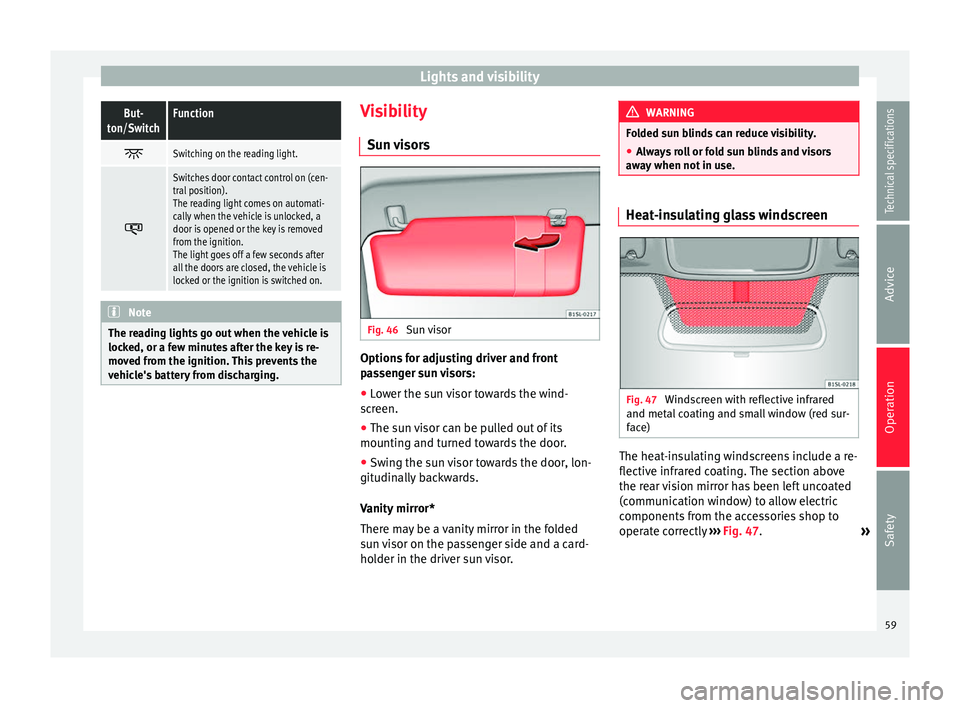
Sun visors Fig. 46
Sun visor Options for adjusting driver and front
passenger sun visors:
● Lower the sun visor towards the wind-
screen.
● The sun visor can be pulled out of its
mounting and turned towards the door.
● Swing the sun visor towards the door, lon-
gitudinally backwards.
Vanity mirror*
There may be a vanity mirror in the folded
sun visor on the passenger side and a card-
holder in the driver sun visor. WARNING
Folded sun blinds can reduce visibility.
● Always roll or fold sun blinds and visors
away when not in use. Heat-insulating glass windscreen
Fig. 47
Windscreen with reflective infrared
and metal coating and small window (red sur-
face) The heat-insulating windscreens include a re-
flective infrared coating. The section above
the rear vision mirror has been left uncoated
(communication window) to allow electric
components from the accessories shop to
operate correctly
›››
Fig. 47 .
»
59
Technical specifications
Advice
Operation
Safety
Page 63 of 219
Lights and visibility
Note
● The windscreen wipers will only work when
the ignition is switched on.
● The interval wipe speed varies according to
the vehicle speed. The faster the vehicle is
moving, the more often the windscreen is
cleaned.
● The rear wiper is automatically switched on
when the windscreen wiper is on and the car
is in reverse gear. Windscreen wiper functionsWindscreen wiper performance in different sit-
uations
If the vehicle is at a
standstillThe activated position provision-
ally changes to the previous posi-
tion.
For intermittent wip-
ersIntervals between wipes depend
on the vehicle's speed. The high-
er the vehicle speed the shorter
the intervals.
Note
The wiper will try to wipe away any obstacles
that are on the windscreen. The wiper will
stop moving if the obstacle blocks its path.
Remove the obstacle and switch the wiper
back on again. Windscreen wipers service position
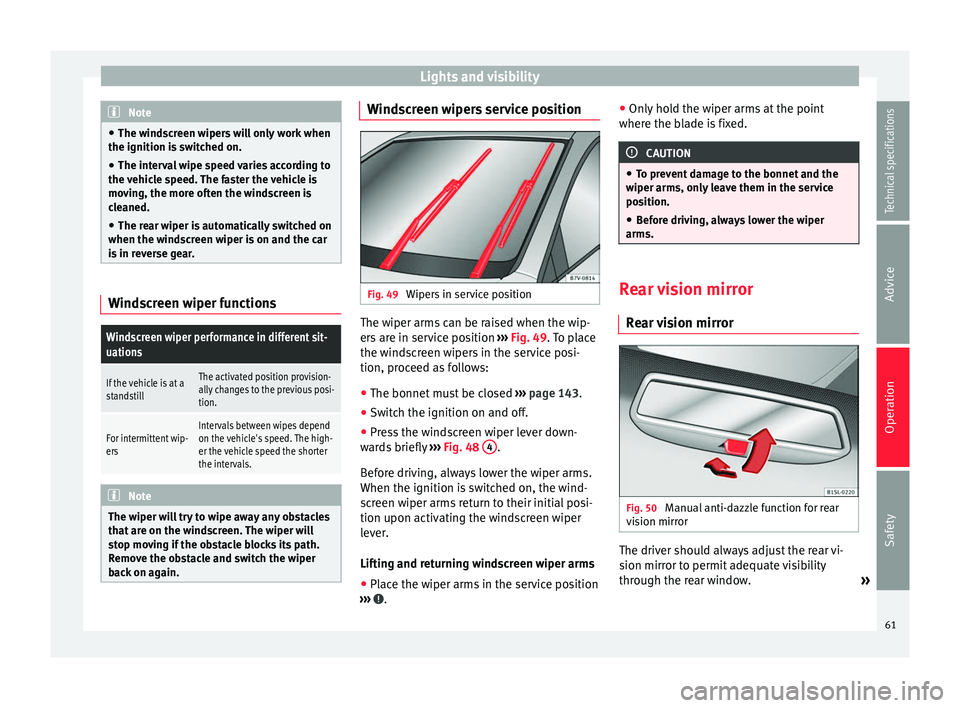
Fig. 49
Wipers in service position The wiper arms can be raised when the wip-
ers are in service position
››› Fig. 49 . To place
the w ind
screen wipers in the service posi-
tion, proceed as follows:
● The bonnet must be closed ››› page 143.
● Switch the ignition on and off.
● Press the windscreen wiper lever down-
wards briefly ››› Fig. 48 4 .
Before driving, always lower the wiper arms.
When the ignition is switched on, the wind-
screen wiper arms return to their initial posi-
tion upon activating the windscreen wiper
lever.
Lifting and returning windscreen wiper arms
● Place the wiper arms in the service position
››› .●
Only hold the wiper arms at the point
where the blade is fixed. CAUTION
● To prevent damage to the bonnet and the
wiper arms, only leave them in the service
position.
● Before driving, always lower the wiper
arms. Rear vision mirror
Rear vision mirror Fig. 50
Manual anti-dazzle function for rear
vision mirror The driver should always adjust the rear vi-
sion mirror to permit adequate visibility
through the rear window.
»
61
Technical specifications
Advice
Operation
Safety
Page 66 of 219
Operation
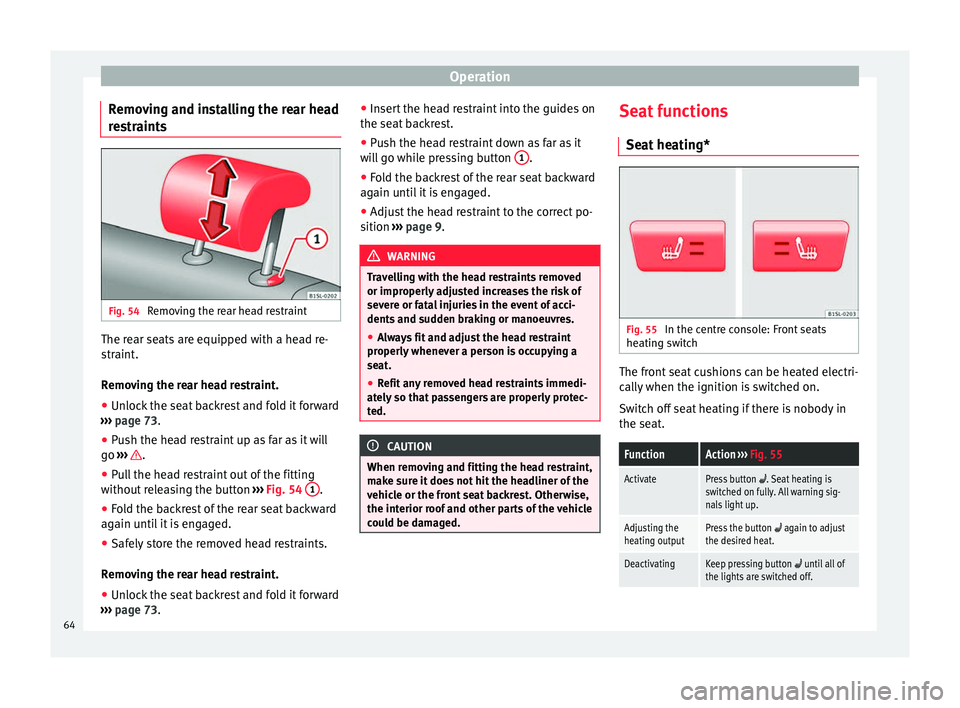
Removing and installing the rear head
restraints Fig. 54
Removing the rear head restraint The rear seats are equipped with a head re-
straint.
Removing the rear head restraint.
● Unlock the seat backrest and fold it forward
››› page 73 .
● Pu
sh the head restraint up as far as it will
go ››› .
● Pull the head restraint out of the fitting
without releasing the button ››› Fig. 54 1 .
● Fold the backrest of the rear seat backward
again until it is engaged.
● Safely store the removed head restraints.
Removing the rear head restraint.
● Unlock the seat backrest and fold it forward
››› page 73 . ●
Inser
t the head restraint into the guides on
the seat backrest.
● Push the head restraint down as far as it
will go while pressing button 1 .
● Fold the backrest of the rear seat backward
again until it is engaged.
● Adjust the head restraint to the correct po-
sition ››› page 9 . WARNING
Travelling with the head restraints removed
or improperly adjusted increases the risk of
severe or fatal injuries in the event of acci-
dents and sudden braking or manoeuvres.
● Always fit and adjust the head restraint
properly whenever a person is occupying a
seat.
● Refit any removed head restraints immedi-
ately so that passengers are properly protec-
ted. CAUTION
When removing and fitting the head restraint,
make sure it does not hit the headliner of the
vehicle or the front seat backrest. Otherwise,
the interior roof and other parts of the vehicle
could be damaged. Seat functions
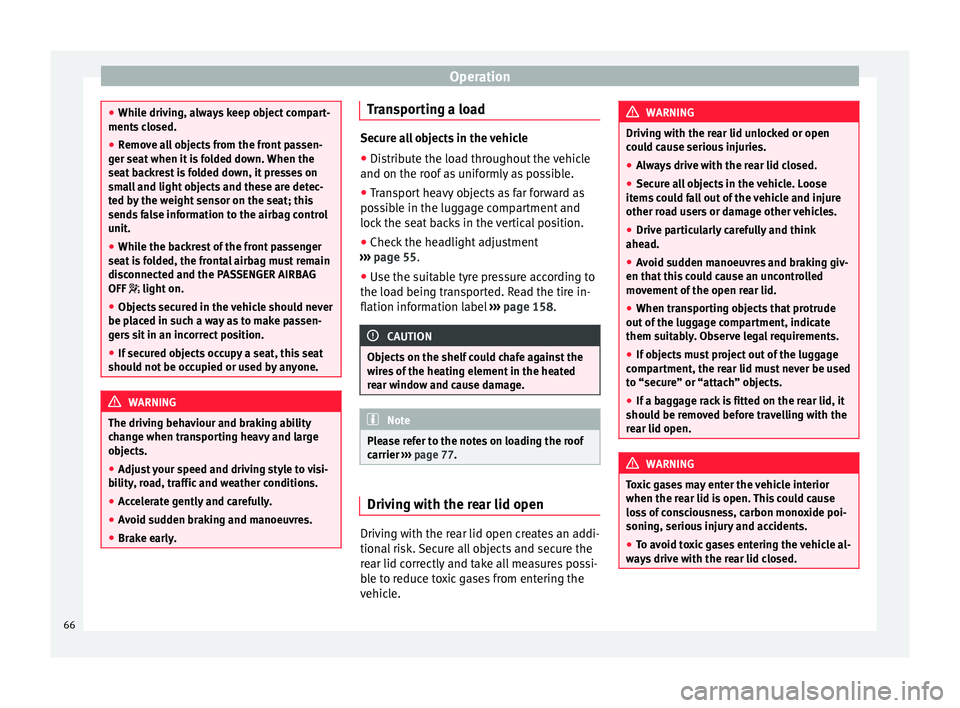
Seat heating* Fig. 55
In the centre console: Front seats
heating switch The front seat cushions can be heated electri-
cally when the ignition is switched on.
Switch off seat heating if there is nobody in
the seat.
FunctionAction
››› Fig. 55
ActivatePress button . Seat heating is
switched on fully. All warning sig-
nals light up.
Adjusting the
heating outputPress the button again to adjust
the desired heat.
DeactivatingKeep pressing button until all of
the lights are switched off. 64
Page 68 of 219
Operation
●
While driving, always keep object compart-
ments closed.
● Remove all objects from the front passen-
ger seat when it is folded down. When the
seat backrest is folded down, it presses on
small and light objects and these are detec-
ted by the weight sensor on the seat; this
sends false information to the airbag control
unit.
● While the backrest of the front passenger
seat is folded, the frontal airbag must remain
disconnected and the PASSENGER AIRBAG
OFF light on.
● Ob
jects secured in the vehicle should never
be placed in such a way as to make passen-
gers sit in an incorrect position.
● If secured objects occupy a seat, this seat
should not be occupied or used by anyone. WARNING
The driving behaviour and braking ability
change when transporting heavy and large
objects.
● Adjust your speed and driving style to visi-
bility, road, traffic and weather conditions.
● Accelerate gently and carefully.
● Avoid sudden braking and manoeuvres.
● Brake early. Transporting a load
Secure all objects in the vehicle
● Distribute the load throughout the vehicle
and on the roof as uniformly as possible.
● Transport heavy objects as far forward as
possible in the luggage compartment and
lock the seat backs in the vertical position.
● Check the headlight adjustment
››› page 55.
● Use the s
uitable tyre pressure according to
the load being transported. Read the tire in-
flation information label ›››
page 158. CAUTION
Objects on the shelf could chafe against the
wires of the heating element in the heated
rear window and cause damage. Note
Please refer to the notes on loading the roof
carrier ››› page 77. Driving with the rear lid open
Driving with the rear lid open creates an addi-
tional risk. Secure all objects and secure the
rear lid correctly and take all measures possi-
ble to reduce toxic gases from entering the
vehicle. WARNING
Driving with the rear lid unlocked or open
could cause serious injuries.
● Always drive with the rear lid closed.
● Secure all objects in the vehicle. Loose
items could fall out of the vehicle and injure
other road users or damage other vehicles.
● Drive particularly carefully and think
ahead.
● Avoid sudden manoeuvres and braking giv-
en that this could cause an uncontrolled
movement of the open rear lid.
● When transporting objects that protrude
out of the luggage compartment, indicate
them suitably. Observe legal requirements.
● If objects must project out of the luggage
compartment, the rear lid must never be used
to “secure” or “attach” objects.
● If a baggage rack is fitted on the rear lid, it
should be removed before travelling with the
rear lid open. WARNING
Toxic gases may enter the vehicle interior
when the rear lid is open. This could cause
loss of consciousness, carbon monoxide poi-
soning, serious injury and accidents.
● To avoid toxic gases entering the vehicle al-
ways drive with the rear lid closed. 66
Page 69 of 219
Transport and practical equipment
●
In exceptional circumstances, if you must
drive with the rear lid open, observe the fol-
lowing to reduce the entry of toxic gases
inside the vehicle:
–Close all windows.
– Disable air recirculation mode.
– Open all of the air outlets on the instru-
ment panel.
– Switch on the blower to maximum. CAUTION
An open boot hatch changes the length and
height of the vehicle. Driving a loaded vehicle
For the best handling when driving a loaded
vehicle, note the following:
● Secure all objects ››› page 66 .
● Ac
celerate gently and carefully.
● Avoid sudden braking and manoeuvres.
● Brake early.
● If necessary, read the instructions for driv-
ing with a roof carrier system ››› page 77. WARNING
A sliding load could considerably affect the
stability and safety of the vehicle resulting in
an accident with serious consequences. ●
Secure loads correctly so they do not move.
● When transporting heavy objects, use suit-
able ropes or straps.
● Lock the seat backs in vertical position. Practical equipment
Introduction Storage compartments must only be used to
store light or small objects.
WARNING
In the event of sudden braking movements or
turns, loose objects may be thrown around
the vehicle interior. This could cause serious
injuries to passengers and cause the driver to
lose control of the vehicle.
● Do not transport animals or place hard,
heavy or sharp objects inside the vehicle in:
open storage compartments, dash panel, rear
shelf, items of clothing or bags.
● While driving, always keep object compart-
ments closed. WARNING
Objects falling into the driver's footwell could
prevent use of the pedals. This could lead the
driver to lose control of the vehicle, increas-
ing the risk of a serious accident. ●
Make sure the pedals can be used at all
times, with no objects rolling underneath
them.
● The floor mat should always be secured to
the floor.
● Never place other mats or rugs on top of
the original mat supplied by the factory.
● Make sure that no objects can fall into the
driver's footwell while the vehicle is in mo-
tion. CAUTION
● Objects on the shelf could chafe against
the wires of the heating element in the heat-
ed rear window and cause damage.
● Do not keep temperature-sensitive objects,
food or medicines inside the vehicle. Heat
and cold could damage them or render them
useless.
● Light-transparent objects placed inside the
vehicle, such as lenses, magnifying glasses
or transparent suction caps on the windows,
may concentrate the sun's rays and cause
damage to the vehicle. Note
The ventilating slits between the heated rear
window and the rear shelf must not be cov-
ered so that used air can escape from the ve-
hicle. 67
Technical specifications
Advice
Operation
Safety
Page 75 of 219
Transport and practical equipment
switching the ignition on or off and before
starting the engine. WARNING
Improper use of the socket or electrical devi-
ces could lead to a fire and cause serious in-
juries.
● Never leave children unsupervised in the
vehicle. The socket and equipment connected
to it can be used when the ignition is switch-
ed on.
● Should a connected electrical device over-
heat, switch it off and unplug it immediately. CAUTION
● Always follow the operating instructions for
the appliances to be connected!
● Never exceed the maximum power rating as
this could damage the vehicle's general elec-
trical system.
● 12 volt power socket:
– Only use accessories with approved elec-
tromagnetic compatibility according to
current regulations.
– Never power the socket. CAUTION
● To avoid damage to the vehicle's electrical
system, never connect equipment that gener-
ates electrical current, such as solar panels
or battery chargers, to the 12 Volt power sockets in order to charge the vehicle's bat-
tery.
● Only use accessories with approved elec-
tromagnetic compatibility according to cur-
rent regulations.
● To avoid damage due to voltage variations,
switch off all devices connected to the 12 V
socket before switching the ignition on or off
and before starting the engine.
● Never connect an appliance to the 12 Volt
power socket that consumes more than the
power indicated in watts. Exceeding the max-
imum power absorption could damage the ve-
hicle's electrical system. For the sake of the environment
Do not leave the engine running when the ve-
hicle is at a standstill. Note
● Using devices with the engine stopped and
the ignition switched on will drain the bat-
tery.
● Unshielded equipment can cause interfer-
ence on the radio equipment and the vehi-
cle's electrical system.
● If electrical equipment is used near an aer-
ial, you may observe interference in the re-
ception of AM stations. Loading luggage compartment
Introduction Always transport heavy loads in the luggage
compartment and place the seat backs in a
vertical position. Never overload the vehicle.
Both the carrying capacity as well as the dis-
tribution of the load in the vehicle have ef-
fects on the driving behaviour and braking
ability
››› .
WARNING
When the vehicle is not in use or being
watched, always lock the doors and the rear
lid to reduce the risk of serious injury or
death.
● Do not leave children unwatched, especial-
ly when the boot is open. Children could
climb into the luggage compartment, close
the rear lid from inside and be unable to es-
cape themselves. This could lead to serious
injury or death.
● Never allow children to play in or around
the vehicle.
● Never transport people in the luggage com-
partment. WARNING
Unsecured or incorrectly secured objects can
cause serious injury in case of a sudden ma-
noeuvring or breaking or in case of an acci-
dent. This is especially true when objects are » 73Technical specifications
Advice
Operation
Safety
Page 76 of 219
Operation
struck by a detonating airbag and fired
through the vehicle interior. To reduce the
risks, please note the following:
●
Secure all objects in the vehicle. Always
place equipment and heavy objects in the
boot.
● Always secure objects to the fastening
rings with suitable rope or straps to prevent
them from being thrown around the interior
and moving to the airbag deployment area in
the event of sudden movements or accidents.
● While driving, always keep object compart-
ments closed.
● Do not place hard, heavy or sharp objects
inside the vehicle interior, in open storage
compartments, the rear shelf or on the dash
panel.
● Remove hard, heavy and sharp objects from
clothes and pockets inside the vehicle and
store securely. WARNING
The transport of heavy object changes vehi-
cle handling and increases braking distance.
Heavy loads that have not been stored or se-
cured correctly could cause loss of control
and result in serious injury.
● Vehicle handling changes when transport-
ing heavy objects due to a change in the cen-
tre of gravity.
● Distribute the load as uniformly and as low
down on the vehicle as possible. ●
Store heavy objects in the luggage com-
partment as far from the rear axle as possi-
ble. CAUTION
Hard objects on the rear shelf could chafe
against the wires of the heating element in
the heated rear window and cause damage. Note
The ventilating slits between the heated rear
window and the rear shelf must not be cov-
ered so that used air can escape from the ve-
hicle. Folding and lifting up the rear seat
bench backrest
Fig. 69
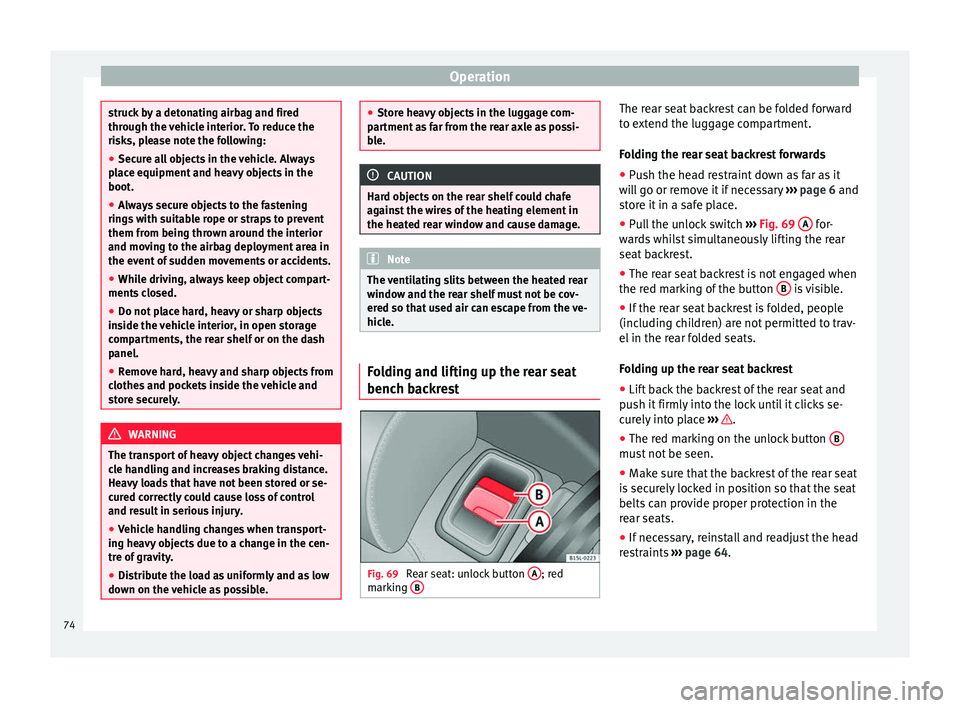
Rear seat: unlock button A ; red
marking B The rear seat backrest can be folded forward
to extend the luggage compartment.
Folding the rear seat backrest forwards
●
Push the head restraint down as far as it
will go or remove it if necessary ››› page 6 and
store it in a safe place.
● Pull the unlock switch ››› Fig. 69 A for-
wards whilst simultaneously lifting the rear
seat backrest.
● The rear seat backrest is not engaged when
the red marking of the button B is visible.
● If the rear seat backrest is folded, people
(including children) are not permitted to trav-
el in the rear folded seats.
Folding up the rear seat backrest
● Lift back the backrest of the rear seat and
push it firmly into the lock until it clicks se-
curely into place ››› .
● The red marking on the unlock button B must not be seen.
●
Make sure that the backrest of the rear seat
is securely locked in position so that the seat
belts can provide proper protection in the
rear seats.
● If necessary, reinstall and readjust the head
restraints ›››
page 64 .
74
Page 77 of 219
Transport and practical equipment
WARNING
Folding and lifting the backrests of the rear
seats carelessly without paying attention
could cause serious injury.
● Never fold or lift the seats while driving.
● Do no trap or damage seat belts when rais-
ing the seat backrest.
● Keep hands, fingers, feet and other limbs
away from the range of the rear seat backr-
ests when folding and lifting them.
● All seat backrests must engage correctly for
the seat belts on the rear seats to work prop-
erly. When the backrest of an occupied seat is
not correctly locked in place, the passenger
can be thrust forward with the rear seat back-
rest in case of sudden braking, sudden ma-
noeuvres or an accident.
● A red signal on the button B warns that
the backrest is not engaged. Always check to
make sure that the red mark is not visible
when the backrest of the rear seat is in the
upright position.
● No seat must be occupied if the backrest of
the rear seat is folded or not correctly engag-
ed. CAUTION
Before folding the rear seat backrest, adjust
the front seats so that neither the head re-
straint or backrest hit them when folded. If
necessary, remove the head restraints
››› page 64 and store them safely. Rear shelf*
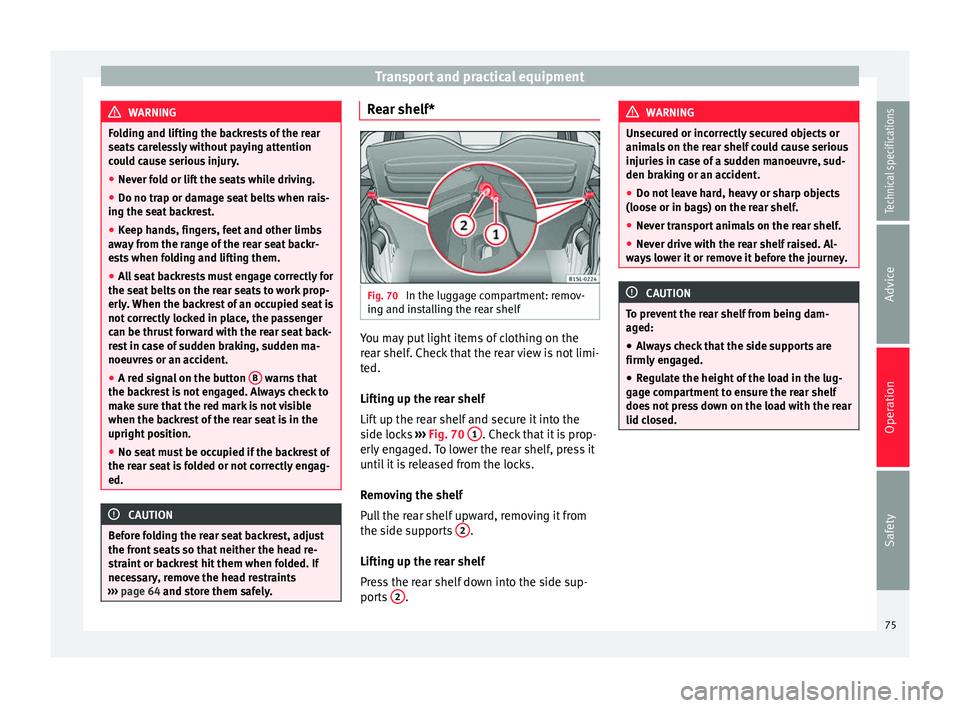
Fig. 70
In the luggage compartment: remov-
ing and installing the rear shelf You may put light items of clothing on the
rear shelf. Check that the rear view is not limi-
ted.
Lifting up the rear shelf
Lift up the rear shelf and secure it into the
side locks
›››
Fig. 70 1 . Check that it is prop-
erly engaged. To lower the rear shelf, press it
until it is released from the locks.
Removing the shelf
Pull the rear shelf upward, removing it from
the side supports 2 .
Lifting up the rear shelf
Press the rear shelf down into the side sup-
ports 2 . WARNING
Unsecured or incorrectly secured objects or
animals on the rear shelf could cause serious
injuries in case of a sudden manoeuvre, sud-
den braking or an accident.
● Do not leave hard, heavy or sharp objects
(loose or in bags) on the rear shelf.
● Never transport animals on the rear shelf.
● Never drive with the rear shelf raised. Al-
ways lower it or remove it before the journey. CAUTION
To prevent the rear shelf from being dam-
aged: ● Always check that the side supports are
firmly engaged.
● Regulate the height of the load in the lug-
gage compartment to ensure the rear shelf
does not press down on the load with the rear
lid closed. 75Technical specifications
Advice
Operation
Safety