height Seat Mii 2014 Owner's manual
[x] Cancel search | Manufacturer: SEAT, Model Year: 2014, Model line: Mii, Model: Seat Mii 2014Pages: 219, PDF Size: 4.19 MB
Page 7 of 219
Safe driving
Safety
Safe driving Safety first! WARNING
● This manual contains important informa-
tion about the operation of the vehicle, both
for the driver and the passengers. The other
sections of the on-board documentation also
contain further information that you should
be aware of for your own safety and for the
safety of your passengers.
● Ensure that the on-board documentation is
kept in the vehicle at all times. This is espe-
cially important when lending or selling the
vehicle to another person. WARNING
Driving under the influence of alcohol, drugs,
medication or narcotics may result in severe
accidents and even loss of life.
● Alcohol, drugs, medication and narcotics
may significantly alter perception, affect re-
action times and safety while driving, which
could result in the loss of control of the vehi-
cle. Tips for driving
Before starting every trip For your own safety and the safety of your
passengers, always note the following points
before every trip:
– Make sure that the vehicle's lights and turn
signals are working properly.
– Check tyre pressure.
– Ensure that all windows provide a clear and
good view of the surroundings.
– Make sure all luggage is secured
››› page 65.
– Make sure that no objects can interfere
with the pedals.
– Adjust front seat, head restraint and rear vi-
sion mirrors properly according to your
size.
– Ensure that the passengers in the rear
seats always have the head restraints in
the in-use position ›››
page 9.
– Instruct passengers to adjust the head re-
straints according to their height.
– Protect children with appropriate child
seats and properly applied seat belts
››› page 25 . –
As s ume the correct sitting position. Instruct
your passengers also to assume a proper
sitting position. ››› page 6.
– Fasten your seat belt securely. Instruct your
passengers also to fasten their seat belts
properly. ››› page 11.
What affects driving safety? As a driver, you are responsible for yourself
and your passengers. When your concentra-
tion or driving safety is affected by any cir-
cumstance, you endanger yourself as well as
others on the road
››› , for this reason:
– Always pay attention to traffic and do not
get distracted by passengers or telephone calls.
– Never drive when your driving ability is im-
paired (e.g. by medication, alcohol, drugs).
– Observe traffic laws and speed limits.
– Always reduce your speed as appropriate
for road, traffic and weather conditions.
– When travelling long distances, take
breaks regularly - at least every two hours.
– If possible, avoid driving when you are tired
or stressed.
»
5
Technical specifications
Advice
Operation
Safety
Page 8 of 219
Safety
WARNING
When driving safety is impaired during a trip,
the risk of injury and accidents increases. Safety equipment
Never put your safety or the safety of your
passengers in danger. In the event of an acci-
dent, the safety equipment may reduce the
risk of injury. The following list includes most
of the safety equipment in your SEAT:
● Three-point seat belts
● belt tension limiters for the front and rear
side seats,
● Belt tensioners for the front seats
● Belt height adjustment for the front seats
● Front airbags
● Side airbags in the front seat backrests
● Side airbags in the rear seat backrests*
● Head-protection airbags
● Active front head restraints*
● “ISOFIX” anchor points for child seats in
the rear side seats with the “ISOFIX” system,
● Height-adjustable front head restraints
● Rear head restraints with in-use position
and non-use position
● Adjustable steering column The safety equipment mentioned above
works together to provide you and your pas-
sengers with the best possible protection in
the event of an accident. However, these
safety systems can only be effective if you
and your passengers are sitting in a correct
position and use this equipment properly.
Safety is everyone's business!
Correct sitting position for
vehicle occupants
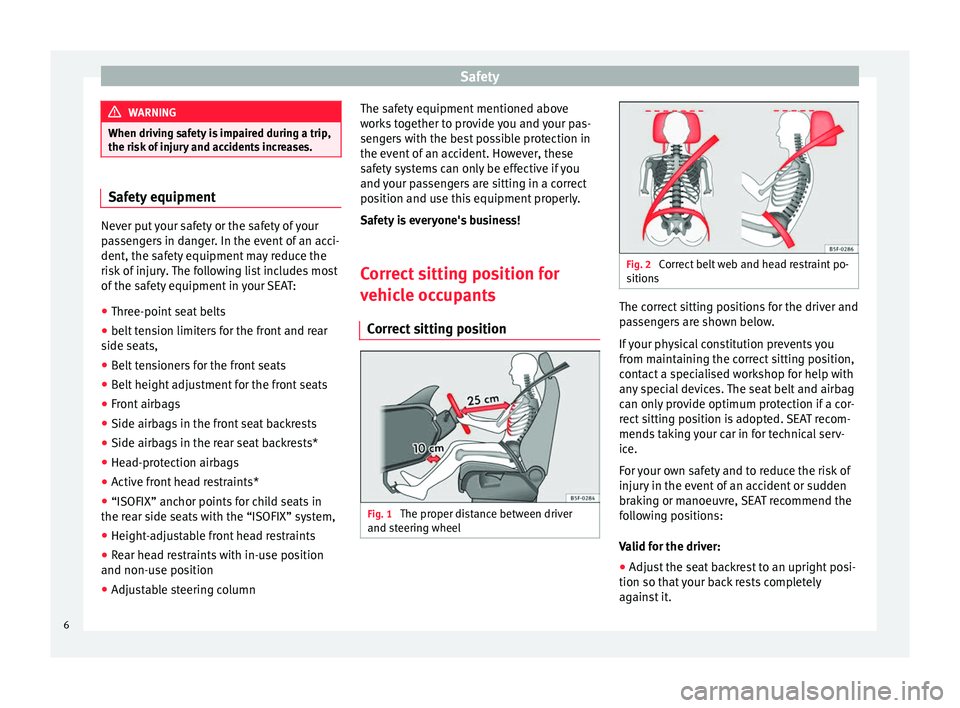
Correct sitting position Fig. 1
The proper distance between driver
and steering wheel Fig. 2
Correct belt web and head restraint po-
sitions The correct sitting positions for the driver and
passengers are shown below.
If your physical constitution prevents you
from maintaining the correct sitting position,
contact a specialised workshop for help with
any special devices. The seat belt and airbag
can only provide optimum protection if a cor-
rect sitting position is adopted. SEAT recom-
mends taking your car in for technical serv-
ice.
For your own safety and to reduce the risk of
injury in the event of an accident or sudden
braking or manoeuvre, SEAT recommend the
following positions:
Valid for the driver:
● Adjust the seat backrest to an upright posi-
tion so that your back rests completely
against it.
6
Page 9 of 219
Safe driving
● Adjust the seat so that there is a distance
of at least 25 cm between the steering wheel
and your chest ››› Fig. 1 and so that you can
ho l
d the steering wheel with both hands on
the outside of the ring at the 9 o'clock and 3
o'clock positions with your arms slightly
bent.
● The adjusted steering wheel must face your
chest and not your face.
● Adjust the driver seat forwards or back-
wards so that you are able to press the accel-
erator, brake and clutch pedals to the floor
with your knees slightly angled and the dis-
tance between your knees and the dash pan-
el is at least 10 cm ››› Fig. 1
.
● Adjust the height of the driver seat so that
you can easily reach the top of the steering
wheel.
● Keep both feet in the footwell so that you
have the vehicle under control at all times.
● Adjust and fasten your seat belt correctly
››› page 11.
Va
lid for the passenger:
● Adjust the seat backrest to an upright posi-
tion so that your back rests completely
against it.
● Move the front passenger seat back as far
as possible for optimum protection should
the airbag deploy.
● Always keep your feet in the footwell while
the vehicle is in motion. ●
Adjust and fasten your seat belt correctly
››› page 11.
Va
lid for the passengers in the rear section:
● Adjust the head restraint so that its upper
edge is at the same level as the top of your
head, or as close as possible to the same lev-
el as the top of your head and under no cir-
cumstances below eye level. Keep the back
of your neck as close as possible to the head
restraint ››› Fig. 1 and ››› Fig. 2
.
● Short people must lower the head restraint
to the first anchorage position, even if your
head is below its upper edge.
● Tall people must raise the head restraint
completely.
● Always keep your feet in the footwell while
the vehicle is in motion.
● Adjust and fasten your seat belt correctly
››› page 11
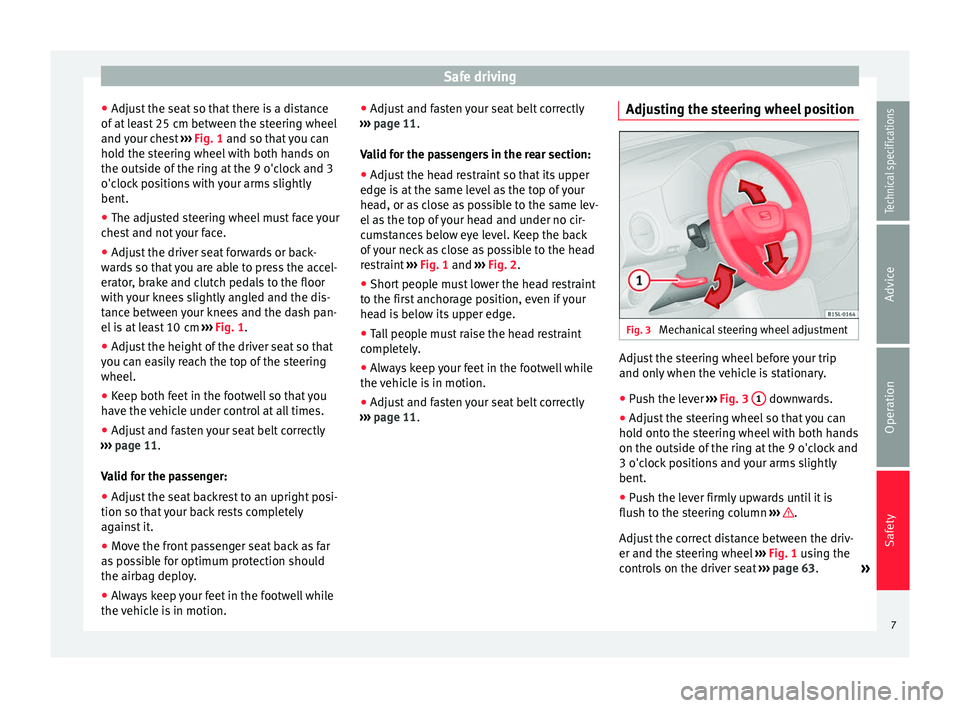
. Adjusting the steering wheel position Fig. 3
Mechanical steering wheel adjustment Adjust the steering wheel before your trip
and only when the vehicle is stationary.
●
Push the lever ››› Fig. 3 1 downwards.
● Adjust the steering wheel so that you can
hold onto the steering wheel with both hands
on the outside of the ring at the 9 o'clock and
3 o'clock positions and your arms slightly
bent.
● Push the lever firmly upwards until it is
flush to the steering column ››› .
Adjust the correct distance between the driv-
er and the steering wheel ››› Fig. 1 using the
c ontr
ols on the driver seat ››› page 63.
»
7
Technical specifications
Advice
Operation
Safety
Page 10 of 219
Safety
WARNING
Incorrect use of the steering wheel adjust-
ment function and an incorrect adjustment of
the steering wheel can result in severe or fa-
tal injury.
● After adjusting the steering column, push
the lever ››› Fig. 3 1 firmly upwards to en-
sure the steering wheel does not accidentally
change position while driving.
● Never adjust the steering wheel while the
vehicle is in motion. If you need to adjust the
steering wheel while the vehicle is in motion,
stop safely and make the proper adjustment.
● The adjusted steering wheel should be fac-
ing your chest and not your face so as not to
hinder the driver's front airbag protection in
the event of an accident.
● When driving, always hold the steering
wheel with both hands on the outside of the
ring at the 9 o'clock and 3 o'clock positions
to reduce injuries when the driver's front air-
bag deploys.
● Never hold the steering wheel at the 12
o'clock position or in any other manner (e.g.
in the centre of the steering wheel). In such
cases, if the driver's airbag deploys, you may
sustain injuries to your arms, hands and
head. Danger of injuries due to an incorrect
sitting position
Number of seats
The vehicle has a total of
4 seats: 2 front
se ats
and 2 rear seats. Each seat is equipped
with a seat belt.
If the seat belts are worn incorrectly or not at
all, the risk of severe injuries increases. Seat
belts can provide optimal protection only if
the belt web is properly worn. Being seated
in an incorrect position means the seat belt
cannot offer its full protection. This could re-
sult in severe and even fatal injuries. The risk
of severe or fatal injuries is especially height-
ened when a deploying airbag strikes a vehi-
cle occupant who has assumed an incorrect
sitting position. The driver is responsible for
all passengers in the vehicle, particularly
children.
The following list shows just some examples
of incorrect sitting positions which can be
dangerous to all vehicle occupants.
When the vehicle is in motion:
● Never stand in the vehicle.
● Never stand on the seats.
● Never kneel on the seats.
● Never tilt your seat backrest too far to the
rear.
● Never lean against the dash panel. ●
Never lie on the rear seats.
● Never sit on the front edge of a seat.
● Never sit sideways.
● Never lean out of a window.
● Never put your feet out of a window.
● Never put your feet on the dash panel.
● Never put your feet on the surface of a seat
or seat backrest.
● Never travel in a footwell.
● Never travel on a seat without wearing the
seat belt.
● Never carry any person in the luggage com-
partment. WARNING
An incorrect sitting position in the vehicle
can lead to severe injuries or death in the
event of sudden braking or manoeuvres, colli-
sion or accidents or if the airbag deploys.
● Before the vehicle moves, assume the prop-
er sitting position and maintain it throughout
the trip. This also includes fastening the seat
belt.
● Never transport more people than there are
seats with a seat belt available in the vehicle.
● Children must always be protected with an
approved child restraint system suited to
their height and weight ››› page 25,
››› page 17.8
Page 11 of 219
Safe driving
●
Always keep your feet in the footwell while
the vehicle is in motion. Never, for example,
put your feet on the surface of a seat or on
the dash panel and never put them out of a
window. Otherwise the airbag and seat belt
offer insufficient protection and the risk of in-
jury in the event of an accident is increased. WARNING
Before every trip, adjust the seat, the seat
belt and the head restraints and instruct your
passengers to fasten their seat belts proper-
ly.
● Move the front passenger seat back as far
as possible.
● Adjust the driver seat so that there is at
least 25 cm distance between your chest and
the hub of the steering wheel. Adjust the
driver seat so that you are able to press the
accelerator, brake and clutch pedals to the
floor with your knees slightly angled and that
the distance between your knees and the
dash panel is at least 10 cm. If your physical
constitution prevents you from meeting these
requirements, contact a specialised work-
shop to make any modifications required.
● Never drive with the seat backrest tilted far
back. The further the seat backrests are tilted
to the rear, the greater the risk of injury due
to incorrect positioning of the belt web or to
the incorrect sitting position!
● Never drive with the seat backrest tilted
forwards. Should a front airbag deploy, it could throw the seat backrest backwards and
injure the passengers of the rear seats.
●
Sit as far away as possible from the steer-
ing wheel and the dash panel.
● Keep your back straight and resting com-
pletely against the seat backrest and the
front seats correctly adjusted. Never place
any part of your body in the area of the airbag
or very close to it.
● If passengers on the rear seats are not sit-
ting in an upright position, the risk of severe
injury due to incorrect positioning of the belt
web increases. WARNING
Incorrect seat adjustment may lead to acci-
dents and severe injuries.
● Only adjust the seats when the vehicle is
stationary, as the seats could move unex-
pectedly while the vehicle is in motion and
you could lose control of the vehicle. Further-
more, an incorrect position is adopted when
adjusting the seat.
● Only adjust the height, seat backrest and
forwards or backwards position of the seat
when there is nobody in the seat adjustment
area.
● There must be no objects blocking the front
seat adjustment area. Adjust the rear head restraints
Fig. 4
Adjusting the rear head restraints All seats are equipped with a head restraint.
The front seat head restraints are integrated
in the backrests and adjusting them is not
possible.
Adjusting height
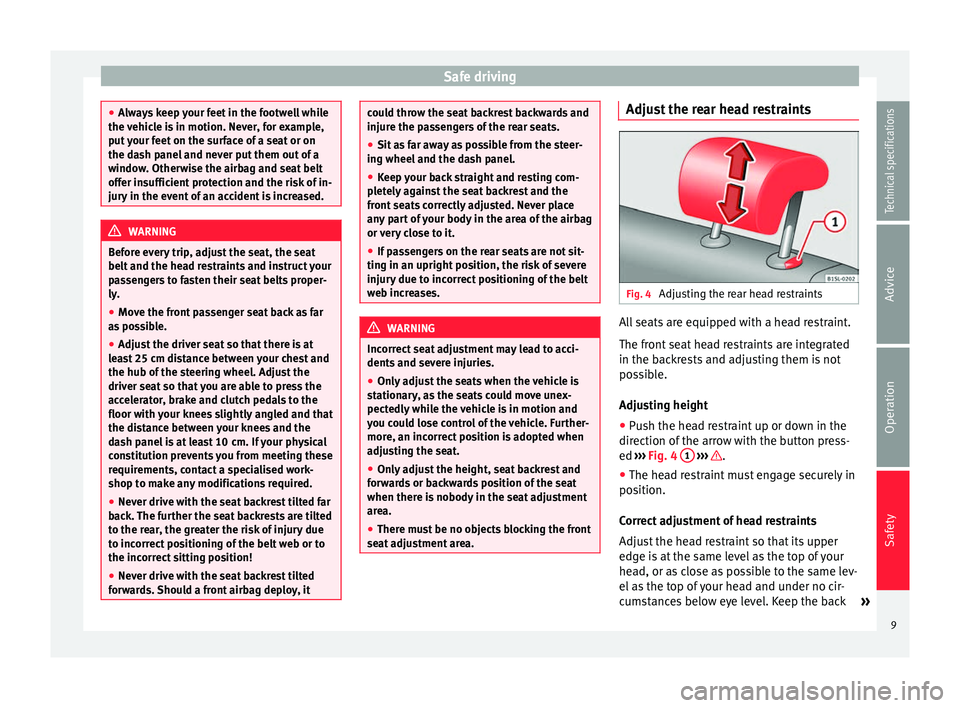
● Push the head restraint up or down in the
direction of the arrow with the button press-
ed ››› Fig. 4 1
››› .
● The head restraint must engage securely in
position.
Correct adjustment of head restraints
Adjust the head restraint so that its upper
edge is at the same level as the top of your
head, or as close as possible to the same lev-
el as the top of your head and under no cir-
cumstances below eye level. Keep the back »
9Technical specifications
Advice
Operation
Safety
Page 12 of 219
Safety
of your neck as close as possible to the head
restraint.
Adjusting the head restraint for short people
Set the head restraint in the first anchorage
position, even if your head is below its upper
edge. When the head restraint is at its low-
est, it is possible that a small gap remains
between it and the seat backrest.
Adjusting the head restraint for tall people
Raise the head restraint completely. WARNING
Travelling with the head restraints removed
or improperly adjusted increases the risk of
severe or fatal injuries in the event of acci-
dents and sudden braking or manoeuvres.
● Always fit and adjust the head restraint
properly whenever a person is occupying a
seat.
● All vehicle occupants must correctly adjust
the head restraint according to their height to
reduce the risk of back injuries in the event of
an accident. The upper edge of the head re-
straint must be as close as possible to the
same level as the top of your head and under
no circumstances below eye level. Keep the
back of your neck as close as possible to the
head restraint.
● Never adjust the head restraint while the
vehicle is in motion. Pedal area
Pedals Do not allow floor mats or other objects to
obstruct the free passage of the pedals.
Floor mats should leave the pedal area free
and unobstructed and be correctly secured in
the footwell zone.
In the event of failure of a brake circuit, the
brake pedal must be pressed harder than
normal to brake the vehicle.
WARNING
Objects falling into the driver's footwell could
prevent use of the pedals. This could lead the
driver to lose control of the vehicle, increas-
ing the risk of a serious accident.
● Make sure the pedals can be used at all
times, with no objects rolling underneath
them.
● Always secure the mat in the footwell.
● Never place other mats or rugs on top of
the original mat supplied by the factory.
● Ensure that no objects can fall into the driv-
er's footwell while the vehicle is in motion. CAUTION
The pedals must always have free and unob-
structed passage to the floor. For example, in
case of a fault in the brake circuit, the brake pedal will need to be pressed further to stop
the vehicle. To press the brake pedal down
further will require more force than usual.
10
Page 13 of 219
Seat belts
Seat belts
Using seat belts Introduction Check the condition of all the seat belts at
regular intervals. If you notice that the belt
webbing, fittings, retractor mechanism or
buckle of any of the belts is damaged, the
belt must be replaced immediately by a spe-
cialised workshop
››› . The specialised
workshop must use the appropriate spare
parts corresponding to the vehicle, the
equipment and the model year. SEAT recom-
mends taking your car in for technical serv-
ice. WARNING
Unbuckled or badly buckled seat belts in-
crease the risk of severe or even fatal inju-
ries. The seat belt cannot offer its full protec-
tion if it is not fastened and used correctly.
● Seat belts are the most effective way of re-
ducing the risk of sustaining severe or fatal
injuries in the event of an accident. Seat belts
must be correctly fastened when the vehicle
is in motion to protect the driver and all vehi-
cle occupants.
● Before each trip, every occupant in the ve-
hicle occupants must sit properly, correctly
fasten the seat belt belonging to his or her
seat and keep it fastened throughout the trip. This also applies to other vehicle occupants
when driving in town.
●
When travelling, children must be secured
in the vehicle with a child restraint system
suitable for their weight and height and with
the seat belts correctly fastened
››› page 25.
● Ins
truct your passengers to fasten their
seat belts properly before driving off.
● Insert the latch plate into the buckle for the
appropriate seat and ensure it is engaged.
Using the latch plate in the buckle of another
seat will not protect you properly and may
cause severe injuries.
● Do not allow liquids or foreign bodies to en-
ter the buckle fastenings. This could damage
the buckles and seat belts.
● Never unbuckle your seat belt when the ve-
hicle is moving.
● Never allow more than one passenger to
share the same seat belt.
● Never hold children or babies on your lap
sharing the same seat belt.
● Loose, bulky clothing (such as a jacket) im-
pairs the proper fit and function of the seat
belt. WARNING
It is extremely dangerous to drive using dam-
aged seat belts and could result in serious in-
jury or loss of life. ●
Avoid damaging the seat belt by jamming it
in the door or the seat mechanism.
● If the fabric or other parts of the seat belt
are damaged, the seat belts could break in
the event of an accident or sudden braking.
● Always have damaged seatbelts replaced
immediately by seat belts approved for the
vehicle in question by SEAT. Seat belts which
have been worn in an accident and stretched
must be replaced by a specialised workshop.
Renewal may be necessary even if there is no
apparent damage. The belt anchorage should
also be checked.
● Never attempt to repair, modify or remove a
seat belt yourself. All repairs to seat belts, re-
tractors and buckles must be carried out by a
specialised workshop. 11Technical specifications
Advice
Operation
Safety
Page 18 of 219

Safety
● The lap part of the seat belt must lie across
the pelvis, never across the stomach.
● The seat belt must lie flat and fit comforta-
bly. Pull the belt tight if necessary to take up
any slack.
In the case of pregnant women , the seat belt
must lie evenly across the chest and as low
as possible over the pelvis, never across the
stomach and must be worn properly at all
times during the pregnancy ››› Fig. 11 .
Ad aptin
g the position of the belt webbing to
your size
The seat belt can be adapted using the fol-
lowing equipment:
● Front seat height adjustment. WARNING
An incorrectly worn seat belt web can cause
severe or fatal injuries in the event of an acci-
dent.
● The seat belt cannot offer its full protection
unless the seat backrest is in an upright posi-
tion and the seat belt is worn correctly, ac-
cording to your size.
● Unbuckling your seat belt while the vehicle
is in motion can cause severe or fatal injuries
in the event of an accident or sudden braking.
● The seat belt itself or a loose seat belt can
cause severe injuries if the belt moves from hard areas of the body to soft areas (e.g. the
stomach).
●
The shoulder part of the seat belt must lie
on the centre of the shoulder, never across
the neck or the arm.
● The seat belt must lie flat and fit comforta-
bly on the torso
● The lap part of the seat belt must lie across
the pelvis, never across the stomach. The
seat belt must lie flat and fit comfortably on
the pelvis Pull the belt tight if necessary to
take up any slack.
● For pregnant women, the lap part of the
seat belt must lie as low as possible over the
pelvis and always lie flat, “surrounding” the
stomach.
● Do not twist the seat belt while it is fas-
tened.
● Never pull the seat belt away from your
body using your hand.
● Do not lie the seat belt across rigid or frag-
ile objects, e.g. glasses, pens or keys.
● Never use seat belt clips, retaining rings or
similar instruments to alter the position of
the belt webbing. Note
If your physical constitution prevents you
from maintaining the correct position of the
belt webbing, contact a specialised workshop
for help with any special devices to ensure
the optimum protection of the seat belt and airbag. SEAT recommends taking your car in
for technical service.
Seat belt tensioners
Automatic belt retainer, belt
tensioner, belt tension limiter Seat belts are part of the vehicle safety con-
cept
››› page 17 and consist of the follow-
in g impor
tant functions:
Automatic belt retainer
Every seat belt is equipped with an automatic
belt retainer on the shoulder belt. If the belt
is pulled slowly or during normal driving, the
system allows for total freedom of movement
on the shoulder belt. However, during sud-
den braking, during travel in mountains or
bends and during acceleration, the automat-
ic belt retainer on the seat belt is locked is
pulled quickly.
Belt tensioners
The seat belts for the occupants in the front
seats are equipped with belt tensioners.
Sensors trigger the belt tensioners during se-
vere head-on, lateral and rear collisions and
retract and tighten the seat belts. If the seat
belt is loose, it is retracted to reduce the for-
wards movement of occupants or movement
16
Page 27 of 219
Transporting children safely
Transporting children safely Child safety Introduction Before transporting babies and children in a
child seat placed in the front passenger seat,
first completely read the information regard-
ing the airbag system.
This information is extremely important for
driver and passenger safety, particularly that
of babies and children.
SEAT recommends the use of child seats from
the SEAT accessory programme. These child
seats have been designed and tested for use
in SEAT vehicles. You can purchase child
seats with different mountings from a SEAT
dealership.
WARNING
Make sure children are properly belted in and
correctly secured to avoid severe or fatal inju-
ries while the vehicle is in motion.
● Never use a rear-facing child seat in the
front passenger seat if the front passenger
front airbag is enabled.
● Children up to 12 years old should always
travel on the rear seat. ●
Children must always be protected with an
approved child restraint system suited to
their height and weight.
● Children must assume the proper sitting
position and be properly belted in while trav-
elling.
● Ensure the seat backrest is upright when a
child seat is being used on it.
● Do not allow the child's head or other part
of his or her body to enter the deployment
area of the side airbags.
● Make sure the belt webbing is correctly
positioned.
● Never hold children or babies on your lap or
in your arms.
● Only one child may occupy a child seat.
● Please read and observe the child seat
manufacturer's handling instructions. WARNING
An empty or loose child seat could fly uncon-
trollably around the vehicle interior and
cause injuries in the event of an accident or
sudden braking.
● When not in use while the vehicle is in mo-
tion, always safely secure the child seat or
store it in the luggage compartment. Note
Replace the child seat after an accident, as it
may have invisible damage. Important information regarding the
front passenger's airbag
Fig. 18
Passenger's side sun visor: airbag
sticker Fig. 19
On the rear frame of the passenger
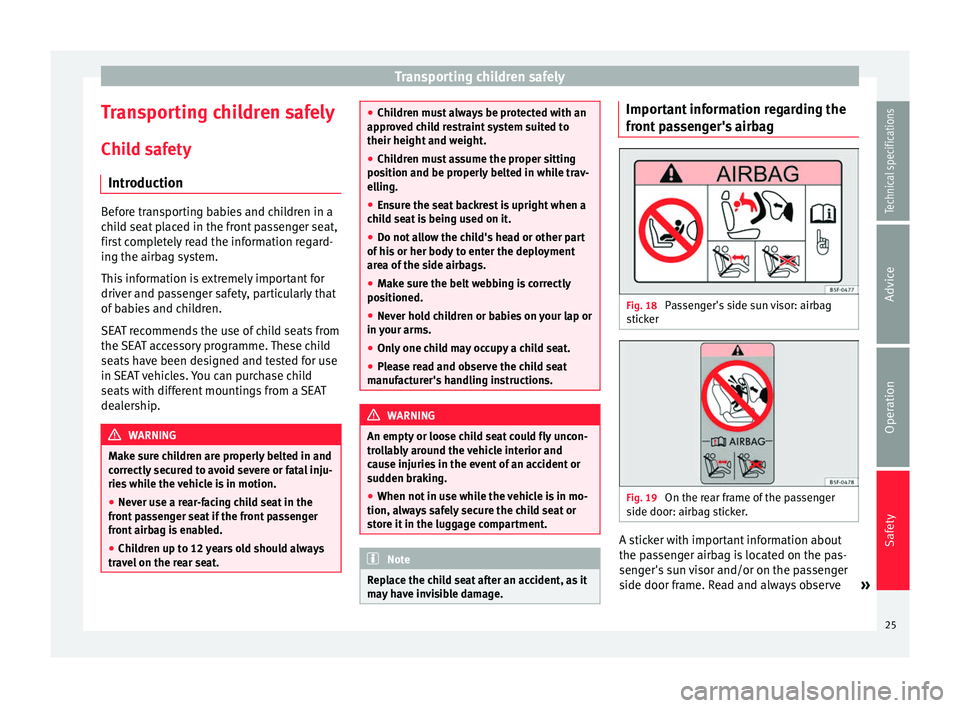
side door: airbag sticker. A sticker with important information about
the passenger airbag is located on the pas-
senger's sun visor and/or on the passenger
side door frame. Read and always observe
»
25Technical specifications
Advice
Operation
Safety
Page 29 of 219
Transporting children safely
General information on transporting
children in the vehicle Legal regulations and provisions will always
take priority over the descriptions of this in-
struction manual. There are different regula-
tions and provisions for the use of child seats
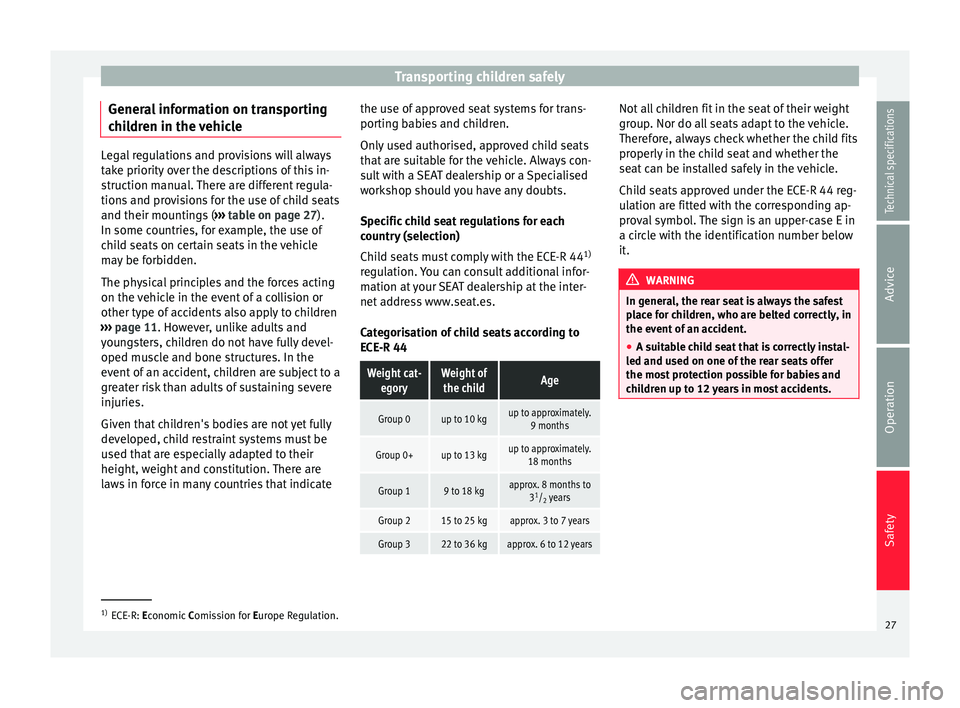
and their mountings (
››› table on page 27).
In some countries, for example, the use of
child seats on certain seats in the vehicle
may be forbidden.
The physical principles and the forces acting
on the vehicle in the event of a collision or
other type of accidents also apply to children
››› page 11
. However, unlike adults and
y ou
ngsters, children do not have fully devel-
oped muscle and bone structures. In the
event of an accident, children are subject to a
greater risk than adults of sustaining severe
injuries.
Given that children's bodies are not yet fully
developed, child restraint systems must be
used that are especially adapted to their
height, weight and constitution. There are
laws in force in many countries that indicate the use of approved seat systems for trans-
porting babies and children.
Only used authorised, approved child seats
that are suitable for the vehicle. Always con-
sult with a SEAT dealership or a Specialised
workshop should you have any doubts.
Specific child seat regulations for each
country (selection)
Child seats must comply with the ECE-R 44
1)
regulation. You can consult additional infor-
mation at your SEAT dealership at the inter-
net address www.seat.es.
Categorisation of child seats according to
ECE-R 44
Weight cat- egoryWeight ofthe childAge
Group 0up to 10 kgup to approximately. 9 months
Group 0+up to 13 kgup to approximately.18 months
Group 19 to 18 kgapprox. 8 months to 31
/ 2 years
Group 215 to 25 kgapprox. 3 to 7 years
Group 322 to 36 kgapprox. 6 to 12 years Not all children fit in the seat of their weight
group. Nor do all seats adapt to the vehicle.
Therefore, always check whether the child fits
properly in the child seat and whether the
seat can be installed safely in the vehicle.
Child seats approved under the ECE-R 44 reg-
ulation are fitted with the corresponding ap-
proval symbol. The sign is an upper-case E in
a circle with the identification number below
it.
WARNING
In general, the rear seat is always the safest
place for children, who are belted correctly, in
the event of an accident.
● A suitable child seat that is correctly instal-
led and used on one of the rear seats offer
the most protection possible for babies and
children up to 12 years in most accidents. 1)
ECE-R: E conomic C
omission for Europe Regulation.
27
Technical specifications
Advice
Operation
Safety