height Seat Mii 2014 User Guide
[x] Cancel search | Manufacturer: SEAT, Model Year: 2014, Model line: Mii, Model: Seat Mii 2014Pages: 219, PDF Size: 4.19 MB
Page 31 of 219
Transporting children safely
yellow
››› page 17 con-
trol lamp on the dash panel will be lit. If you
cannot disable the front passenger front air-
bag and it remains activated, it is forbidden
to transport children on the front passenger
seat
››› .
Things to note if using a child seat on the
front passenger seat:
● The front passenger front airbag must be
disabled
when using a rear-facing child
se
at ››› page 17.
● The seat
backrest of the front passenger
seat must be upright.
● The front passenger seat must be moved as
far back as possible.
● The seat backrest of the front passenger
seat must be upright.
Suitable child seats
The child seat must be authorised by the
manufacturer especially for use on a front
passenger seat with a front or side airbag.
Universal seats for children can be fitted in
the front passenger seat, in groups 0, 0+, 1,
2 or 3 according to the ECE-R 44 regulation. WARNING
If a child seat is mounted on the front passen-
ger seat, the risk of the child sustaining se-
vere or fatal injuries in the event of an acci- dent increases. Rear-facing child seats must
never be mounted on the front passenger
seat when the front passenger front airbag is
enabled. This is life-threatening to the child
should the front airbag deploy, as the child
seat would be struck by the inflated airbag
and thrown against the seat backrest.
WARNING
If, in exceptional circumstances, a child must
be transported in a rear-facing child seat on
the front passenger seat, strictly observe the
following:
● Always disable the front passenger front
airbag and leave it disabled.
● The child seat must be approved by the
manufacturer for use on a front passenger
seat with front and side airbag.
● Follow the installation instructions of the
child seat manufacturer and observe the
warnings.
● Move the front passenger seat as far back
as possible and adjust it to its highest posi-
tion to keep as far away as possible from the
front airbag.
● Move the seat backrest to the upright posi-
tion.
● Children must always be protected with an
approved child restraint system suited to
their height and weight. Use of the child seat on the rear seat
If a child seat is mounted on the rear seat,
adapt the position of the front passenger
seat so that the child has enough space.
Therefore, adapt the front passenger seat to
the size of the child seat and the height of
the child. Ensure the passenger is in the cor-
rect position
››› page 6.
Suitable child seats
The manufacturer must authorise the child
seat for use in the rear seats with side air-
bags.
Universal seats for children can be fitted in
the passenger seat, in groups 0, 0+, 1, 2 or 3
according to the ECE-R 44 regulation.
The rear seats are suitable for child seats
with the ISOFIX system spec
ially designed
for this type of vehicle in accordance with
regulation ECE-R 44.
ISOFIX child seats approved for rear seats
ISOFIX child seats are divided into the follow-
ing certified categories: “universal”, “semi-
universal” or “specific categories for the ve-
hicle”.
● If the ISOFIX child seat is certified “univer-
sal”, it must be supported by the lower an-
chor points and the Top Tether retaining
strap. »
29
Technical specifications
Advice
Operation
Safety
Page 60 of 219

Operation
Note
● The turn signal only works when the igni-
tion is switched on. The hazard warning
lights also work when the ignition is switch-
ed off ››› page 170.
● If an
y of both turn signals fails, the warning
lamp will start flashing twice faster than nor-
mal.
● The main beam headlights can only be
sw
itched on if the dipped beam headlights
are already on. Adjusting the headlights
In those countries where vehicles drive on
the other side of the road to the home coun-
try, the asymmetric dipped beam may dazzle
drivers of oncoming vehicles.
For this reason, stickers may be needed to
cover the headlights when driving abroad.
For further information, please refer to a spe-
cialised workshop. SEAT recommends visiting
a technical service.
Note
The use of stickers to cover headlights is only
permitted over a short period. To modify the
direction of the headlamps more permanent-
ly, please take the vehicle to a specialised
workshop. SEAT recommends taking your car
in for technical service. Headlight range control, lighting of
instruments and controls
Fig. 45
Next to the steering wheel: Headlight
range control Headlamp height adjustment
The headlight range control
››› Fig. 45 is
modified ac c
ording to the value of the head-
light beam and the vehicle load status. This
offers the driver optimum visibility and the
headlights do not dazzle oncoming drivers
››› .
The headlights can only be adjusted when
the dipped beam is switched on.
To reset, turn switch ››› Fig. 45:
ValueVehicle load status a)
–Two front occupants, luggage compart-
ment empty
To reset, turn switch
››› Fig. 45:
ValueVehicle load status a)
1All seats occupied, luggage compartment
empty
2All seats occupied, luggage compartment
full
3Driver only, luggage compartment full
a)
If the vehicle load does not correspond to those shown in the
table, it is possible to select intermediary positions.
Instrument and switch lighting
When the side lights or dipped beam head-
lights are switched on, the lighting for instru-
ments and controls lights up at a constant
brightness. WARNING
Heavy objects in the vehicle may mean that
the headlights dazzle and distract other driv-
ers. This could result in a serious accident.
● Adjust the light beam to the vehicle load
status so that it does not blind other drivers. Reading light
But-
ton/SwitchFunction
Switching off the reading light.
58
Page 65 of 219
Seats and head restraints
For the sake of the environment
The exterior mirror heating should be switch-
ed off when it is no longer needed. Other-
wise, it is an unnecessary fuel waste. Note
In the event of faults, the electric exterior
mirrors can be adjusted manually by pressing
the edge of the mirror surface. Seats and head restraints
Adjusting the seat and head
restraints
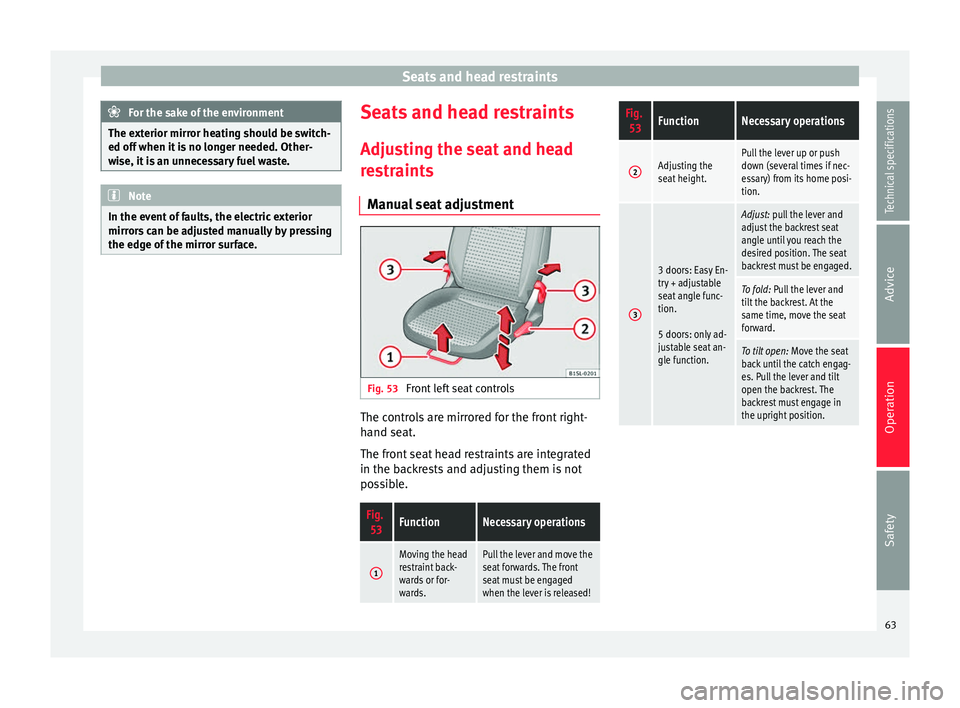
Manual seat adjustment Fig. 53
Front left seat controls The controls are mirrored for the front right-
hand seat.
The front seat head restraints are integrated
in the backrests and adjusting them is not
possible.Fig.
53FunctionNecessary operations
1
Moving the head
restraint back-
wards or for-
wards.Pull the lever and move the
seat forwards. The front
seat must be engaged
when the lever is released!
Fig. 53FunctionNecessary operations
2Adjusting the
seat height.Pull the lever up or push
down (several times if nec-
essary) from its home posi-
tion.
3
3 doors: Easy En-
try + adjustable
seat angle func-
tion.
5 doors: only ad-
justable seat an-
gle function.
Adjust: pull the lever and
adjust the backrest seat
angle until you reach the
desired position. The seat
backrest must be engaged.
To fold: Pull the lever and
tilt the backrest. At the
same time, move the seat
forward.
To tilt open: Move the seat
back until the catch engag-
es. Pull the lever and tilt
open the backrest. The
backrest must engage in
the upright position. 63
Technical specifications
Advice
Operation
Safety
Page 69 of 219
Transport and practical equipment
●
In exceptional circumstances, if you must
drive with the rear lid open, observe the fol-
lowing to reduce the entry of toxic gases
inside the vehicle:
–Close all windows.
– Disable air recirculation mode.
– Open all of the air outlets on the instru-
ment panel.
– Switch on the blower to maximum. CAUTION
An open boot hatch changes the length and
height of the vehicle. Driving a loaded vehicle
For the best handling when driving a loaded
vehicle, note the following:
● Secure all objects ››› page 66 .
● Ac
celerate gently and carefully.
● Avoid sudden braking and manoeuvres.
● Brake early.
● If necessary, read the instructions for driv-
ing with a roof carrier system ››› page 77. WARNING
A sliding load could considerably affect the
stability and safety of the vehicle resulting in
an accident with serious consequences. ●
Secure loads correctly so they do not move.
● When transporting heavy objects, use suit-
able ropes or straps.
● Lock the seat backs in vertical position. Practical equipment
Introduction Storage compartments must only be used to
store light or small objects.
WARNING
In the event of sudden braking movements or
turns, loose objects may be thrown around
the vehicle interior. This could cause serious
injuries to passengers and cause the driver to
lose control of the vehicle.
● Do not transport animals or place hard,
heavy or sharp objects inside the vehicle in:
open storage compartments, dash panel, rear
shelf, items of clothing or bags.
● While driving, always keep object compart-
ments closed. WARNING
Objects falling into the driver's footwell could
prevent use of the pedals. This could lead the
driver to lose control of the vehicle, increas-
ing the risk of a serious accident. ●
Make sure the pedals can be used at all
times, with no objects rolling underneath
them.
● The floor mat should always be secured to
the floor.
● Never place other mats or rugs on top of
the original mat supplied by the factory.
● Make sure that no objects can fall into the
driver's footwell while the vehicle is in mo-
tion. CAUTION
● Objects on the shelf could chafe against
the wires of the heating element in the heat-
ed rear window and cause damage.
● Do not keep temperature-sensitive objects,
food or medicines inside the vehicle. Heat
and cold could damage them or render them
useless.
● Light-transparent objects placed inside the
vehicle, such as lenses, magnifying glasses
or transparent suction caps on the windows,
may concentrate the sun's rays and cause
damage to the vehicle. Note
The ventilating slits between the heated rear
window and the rear shelf must not be cov-
ered so that used air can escape from the ve-
hicle. 67
Technical specifications
Advice
Operation
Safety
Page 77 of 219
Transport and practical equipment
WARNING
Folding and lifting the backrests of the rear
seats carelessly without paying attention
could cause serious injury.
● Never fold or lift the seats while driving.
● Do no trap or damage seat belts when rais-
ing the seat backrest.
● Keep hands, fingers, feet and other limbs
away from the range of the rear seat backr-
ests when folding and lifting them.
● All seat backrests must engage correctly for
the seat belts on the rear seats to work prop-
erly. When the backrest of an occupied seat is
not correctly locked in place, the passenger
can be thrust forward with the rear seat back-
rest in case of sudden braking, sudden ma-
noeuvres or an accident.
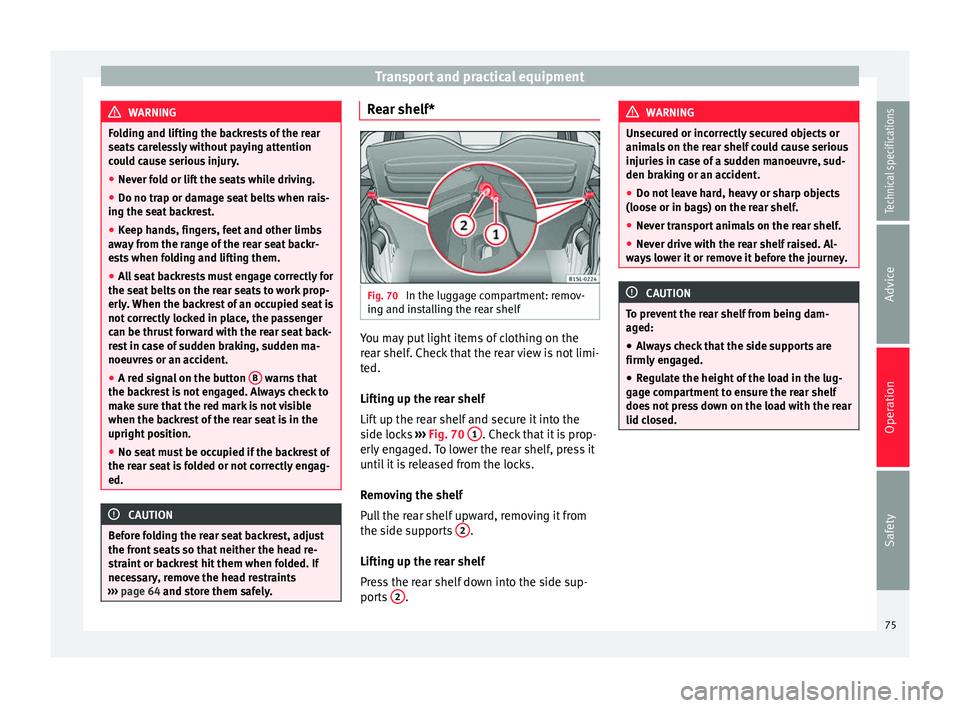
● A red signal on the button B warns that
the backrest is not engaged. Always check to
make sure that the red mark is not visible
when the backrest of the rear seat is in the
upright position.
● No seat must be occupied if the backrest of
the rear seat is folded or not correctly engag-
ed. CAUTION
Before folding the rear seat backrest, adjust
the front seats so that neither the head re-
straint or backrest hit them when folded. If
necessary, remove the head restraints
››› page 64 and store them safely. Rear shelf*
Fig. 70
In the luggage compartment: remov-
ing and installing the rear shelf You may put light items of clothing on the
rear shelf. Check that the rear view is not limi-
ted.
Lifting up the rear shelf
Lift up the rear shelf and secure it into the
side locks
›››
Fig. 70 1 . Check that it is prop-
erly engaged. To lower the rear shelf, press it
until it is released from the locks.
Removing the shelf
Pull the rear shelf upward, removing it from
the side supports 2 .
Lifting up the rear shelf
Press the rear shelf down into the side sup-
ports 2 . WARNING
Unsecured or incorrectly secured objects or
animals on the rear shelf could cause serious
injuries in case of a sudden manoeuvre, sud-
den braking or an accident.
● Do not leave hard, heavy or sharp objects
(loose or in bags) on the rear shelf.
● Never transport animals on the rear shelf.
● Never drive with the rear shelf raised. Al-
ways lower it or remove it before the journey. CAUTION
To prevent the rear shelf from being dam-
aged: ● Always check that the side supports are
firmly engaged.
● Regulate the height of the load in the lug-
gage compartment to ensure the rear shelf
does not press down on the load with the rear
lid closed. 75Technical specifications
Advice
Operation
Safety
Page 79 of 219
Transport and practical equipment
WARNING
If unsuitable or damaged belts or retaining
straps are used, they may break in the event
of braking or an accident. Objects could then
be launched across the passenger compart-
ment and cause serious or fatal injuries.
● It is important to always use belts or retain-
ing straps that are suitable and in a good
condition.
● Belts and retaining straps should be se-
curely fastened to the fastening rings.
● Objects in the luggage compartment that
are unsecured could move suddenly and mod-
ify the handling of the vehicle.
● Small light objects should also be fixed in
place.
● The maximum tensile load of the fastening
ring for securing objects should never be ex-
ceeded.
● A child seat should never be secured with
the fastening rings. Note
● The maximum tensile load that the fasten-
ing rings can support is 3.5 kN.
● Belts and securing systems for the appro-
priate load can be obtained from specialised
dealerships. SEAT recommends visiting a
SEAT dealership for this. Retaining hooks
Fig. 73
In the luggage compartment: retain-
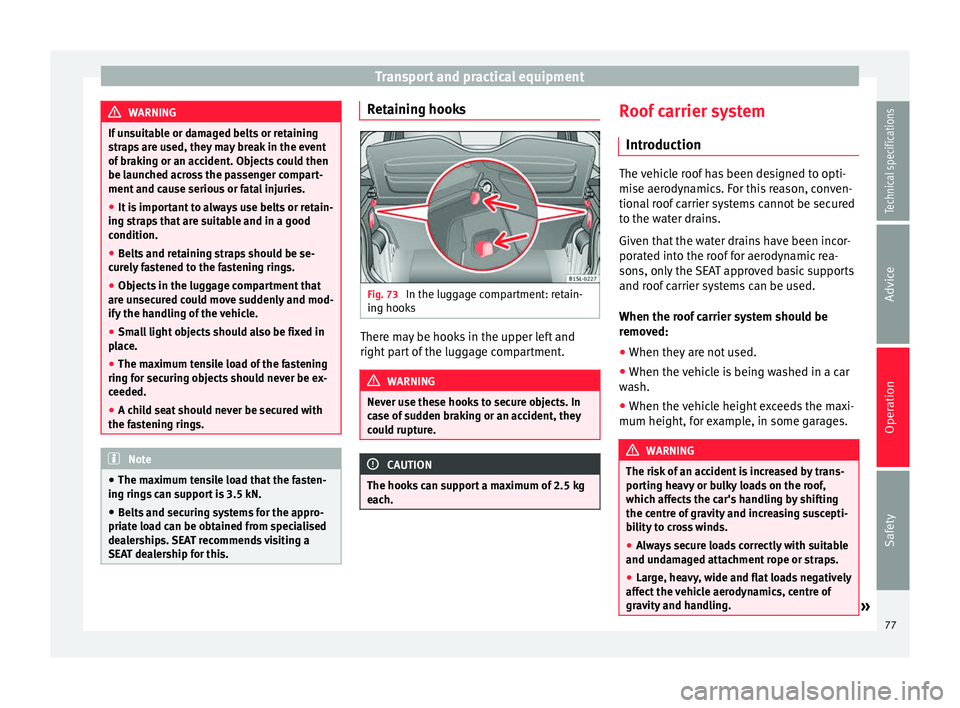
ing hooks There may be hooks in the upper left and
right part of the luggage compartment.
WARNING
Never use these hooks to secure objects. In
case of sudden braking or an accident, they
could rupture. CAUTION
The hooks can support a maximum of 2.5 kg
each. Roof carrier system
Introduction The vehicle roof has been designed to opti-
mise aerodynamics. For this reason, conven-
tional roof carrier systems cannot be secured
to the water drains.
Given that the water drains have been incor-
porated into the roof for aerodynamic rea-
sons, only the SEAT approved basic supports
and roof carrier systems can be used.
When the roof carrier system should be
removed:
●
When they are not used.
● When the vehicle is being washed in a car
wash.
● When the vehicle height exceeds the maxi-
mum height, for example, in some garages. WARNING
The risk of an accident is increased by trans-
porting heavy or bulky loads on the roof,
which affects the car's handling by shifting
the centre of gravity and increasing suscepti-
bility to cross winds.
● Always secure loads correctly with suitable
and undamaged attachment rope or straps.
● Large, heavy, wide and flat loads negatively
affect the vehicle aerodynamics, centre of
gravity and handling. » 77Technical specifications
Advice
Operation
Safety
Page 80 of 219
Operation
●
Avoid brusque manoeuvres and sudden
braking.
● Adjust your speed and driving style to visi-
bility, road, traffic and weather conditions. CAUTION
● Always remove the roof carrier system from
the roof before entering a car wash.
● The height of your vehicle is changed by
the installation of the roof carrier and the
load secured on it. Compare the vehicle
height with the passage height, for example
in underground car parks or for garage doors.
● The roof antenna and the range of the rear
lid should not be affected by the roof carrier
system or the load being transported.
● Take extra care not to let the hatch strike
the roof load when opening. For the sake of the environment
The vehicle uses more fuel when the roof car-
rier system is fitted. Securing the base supports and roof
carrier system
Fig. 74
Attachment points for the basic sup-
ports and the roof carrier system in two-door
vehicles. Fig. 75
Attachment points for the basic sup-
ports and the roof carrier system in four-door
vehicles. The mounts are the basis of a complete roof
carrier system. Special fixtures must be add-
ed in order to safely transport luggage, bicy-cles, skis, surf boards or boats on the roof.
The suitable accessories can be acquired at
SEAT dealerships.
Securing the base supports and roof carrier
system
The roof carrier system must always be instal-
led exactly according to the instructions pro-
vided.
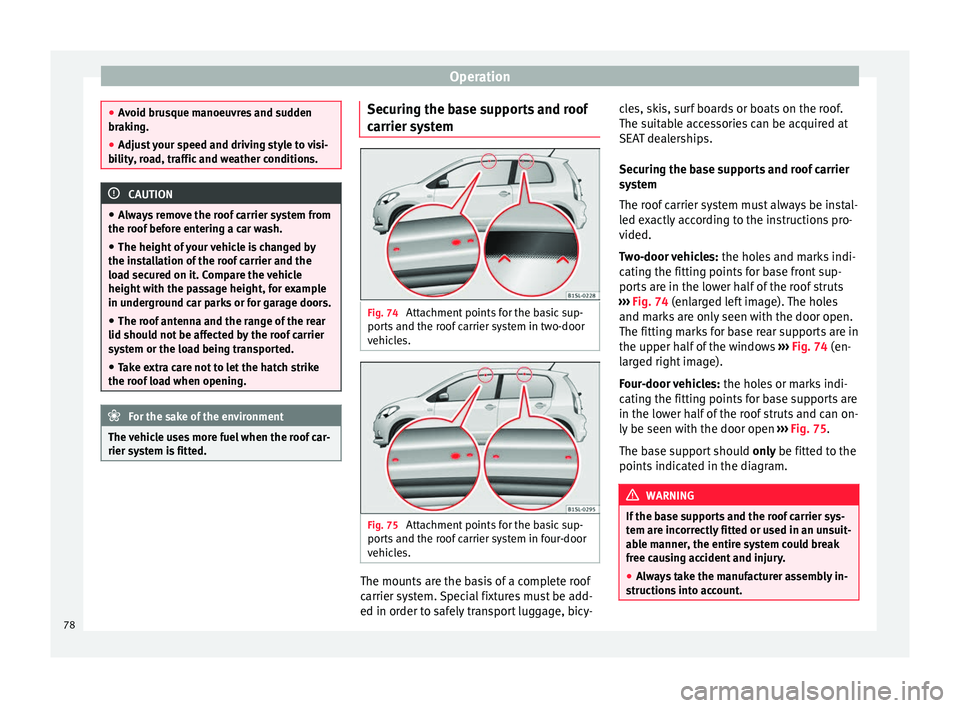
Two-door vehicles:
the holes and marks indi-
cating the fitting points for base front sup-
ports are in the lower half of the roof struts
››› Fig. 74
(enlarged left image). The holes
and m ark
s are only seen with the door open.
The fitting marks for base rear supports are in
the upper half of the windows ››› Fig. 74
(en-
larged right image).
Four-door vehicles: the holes or marks indi-
cating the fitting points for base supports are
in the lower half of the roof struts and can on-
ly be seen with the door open ››› Fig. 75.
The ba
se support should only
be fitted to the
points indicated in the diagram. WARNING
If the base supports and the roof carrier sys-
tem are incorrectly fitted or used in an unsuit-
able manner, the entire system could break
free causing accident and injury.
● Always take the manufacturer assembly in-
structions into account. 78
Page 122 of 219
Advice
●
All repairs and modifications to the vehicle
should only be performed by a specialised
workshop. Repair and faults in the airbag system
When performing repairs and technical mod-
ifications, SEAT's directives must be ob-
served!
››› Modifications and repairs to the front bump-
er, doors, front seats, and repairs to the roof
or chassis should only be carried out in a
specialised workshop. These components
may contain parts or sensors belonging to
the airbag system.
If work is carried out on the airbag system or
parts have to be removed and fitted on the
system when performing other repair work,
parts of the airbag system may be damaged.
The consequence may be that, in the event of
an accident, the airbag inflates incorrectly or
does not inflate at all.
So that the effectiveness of the airbag is not
reduced and that removed parts do not cause
any injuries or environmental pollution, regu-
lations must be observed. These require-
ments are known to specialised workshops.
Modifications to the vehicle suspension may
affect the operation of the airbag system in
the event of collision. For example, if wheel
and tyre combinations not approved by SEAT are used, or if the vehicle height is lowered,
the suspension is stiffened or the suspension
springs, telescopic arms, dampers, etc., are
modified, the results received by the airbag
sensors and sent to the control unit may not
be accurate. For example, some modifica-
tions to the suspension could increase the
force measured by the sensors and result in
the triggering of the airbag systems in colli-
sions. Under normal conditions, the meas-
ured values would be lower and the airbag
would not have been triggered. Other modifi-
cations may reduce the forces measured by
the sensors and prevent the airbags from be-
ing triggered when they should.
WARNING
Repairs or modifications which are not per-
formed correctly may result in damage or er-
rors in the vehicle operation, affecting the ef-
fectiveness of the airbag systems. This could
result in serious or fatal accidents.
● All repairs and modifications to the vehicle
should only be performed by a specialised
workshop.
● Airbag modules must never be repaired: if
damaged, they must be replaced.
● Never fit recycled or reused airbag compo-
nents in your vehicle. WARNING
Modifications to the vehicle suspension, in-
cluding the use of unauthorised wheel and tyre combinations, may affect the perform-
ance of the airbags and increase the risk of
serious or fatal injury in the event of acci-
dent.
●
Never fit suspension components which are
not identical to the original parts in the vehi-
cle.
● Never use wheel and tyre combinations not
approved by SEAT. Retro-fitting of two-way radios
An exterior aerial is required for the use of
two-way radios in the vehicle.
The retro-fitting of electrical or electronic ap-
pliances in the vehicle is subject to their ap-
proval for use in your vehicle. Under certain
circumstances, this could mean that your ve-
hicle registration documents are no longer
valid.
SEAT has approved your vehicle for use with
two-way radios providing the following condi-
tions are observed:
● The exterior aerial must be mounted pro-
fessionally.
● The maximum transmitting power is 10
watts.
The optimal reach of the equipment is only
achieved with an external aerial.
120
Page 129 of 219

Care and maintenance
SEAT recommends the use of car washes
without brushes.
To remove traces of wax on windows and to
prevent wiper blades from scratching, please
observe the following ››› page 128, Cleaning
windows and exterior mirrors .
Washing the car by hand
When washing the car by hand, use plenty of
water to soften the dirt first, and rinse off as
well as possible.
Then clean the vehicle with a soft sponge,
glove or
brush using only slight pressure.
Start at the roof and work downwards. Spe-
cial car shampoo should only be used for
ver
y persistent dirt.
Rinse the sponge or glove thoroughly and of-
ten.
Wheels, sills and similar should be cleaned
last. Use a second sponge for this. WARNING
Sharp components on the vehicle may cause
injury.
● Protect arms and hands from sharp edges
when cleaning the vehicle undercarriage or
the interior of the wheel hubs. WARNING
After the vehicle has been washed, the brak-
ing effect will be reduced (and the braking
distance increased) due to moisture (and ice
in winter) on the brakes.
● “Dry the brakes and remove ice” by braking
carefully. Ensure that you are not endanger-
ing other road-users or breaking traffic regu-
lations in the process. CAUTION
● The temperature of the water must not ex-
ceed +60 °C (+140 °F).
● To avoid damage to the paintwork, do not
wash the vehicle in full sun.
● Do not use rough sponges or similar which
could damage the surface to clean away the
traces of insects.
● Never wipe the headlights with a dry cloth
or sponge, always moisten first. It is best to
use soapy water.
● Washing the vehicle in low temperatures:
When washing the vehicle with a hose, do
not direct water into the lock cylinders or the
gaps around the doors or roof. Locks and
seals could freeze! CAUTION
To prevent damage to the vehicle, please ob-
serve the following before entering an auto-
matic car wash: ●
Compare the distance between the vehicle
wheels and the distance between the guide-
rails of the car wash to prevent damage to the
wheels and tyres!
● Switch off the rain sensor before taking the
vehicle to an automatic car wash.
● Compare the height and width of your vehi-
cle with the available height and width when
entering and driving through the car wash.
● Fold in exterior mirrors Electrically retracta-
ble exterior mirrors must not be folded in or
out by hand. Always use the electrical power
control.
● To avoid damaging the bonnet paintwork,
rest the windscreen wipers on the windscreen
after drying the wiper blades. Do not let them
fall!
● Lock the rear lid to prevent it from opening
unexpectedly while inside the car wash. Washing the vehicle with high
pressure cleaning apparatus
When cleaning the vehicle with a high-pres-
sure cleaner, always follow the operating in-
structions for the equipment. Pay special at-
tention to the required pressure of the jet
and the
distance
between the jet and the ve-
hic
le ››› .
Keep a suitable distance from soft materials,
such as rubber hoses or insulating material, »
127
Technical specifications
Advice
Operation
Safety
Page 148 of 219

Advice
Fig. 106
C: Bonnet securing rod in the bon-
net. D: Bonnet supported by the bonnet se-
curing rod Opening the bonnet
● Before opening the bonnet, make sure that
the windscreen wiper arms are in place
against the windscreen ››› .
● Pull the release lever 1 in the direction of
the arrow ›››
Fig. 105
A. The bonnet is re- leased from the lock carrier by a spring mech-
anism
››› .
● Lift the bonnet up slightly while pressing
the release lever 2
B
in the direction of the
arr
ow to completely open the bonnet.
● Take out the bonnet support rod from its
clip in the direction of the arrow 3
C
and
p
lace it in the corresponding open position
4
D
(arrow).
C
losing the bonnet
● Slightly lift the bonnet ››› .
● Take out the bonnet support rod from the
opening catch 4
D
and insert it into its clip
3
C
in the opening catch.
● L
et the bonnet fall from a height of 30 cm
into its clip; Do not
apply pressure!
If the bonnet is not correctly closed, open it
once again and close it correctly.
The bonnet is correctly closed when it is flush
with the corresponding parts on the body-
work. WARNING
If the bonnet is not correctly closed, it could
suddenly open while driving leaving the driv-
er without visibility. This could result in a se-
rious accident.
● After closing the bonnet, always check that
it is properly secured by the locking mecha-
nism in the lock carrier piece. The bonnet must be flush with the surrounding body pan-
els.
●
While driving, if you notice that the bonnet
is not correctly closed then stop immediately
and close it correctly.
● Only open and close the bonnet when there
is nobody within its range. CAUTION
● To avoid damage to the bonnet and to the
windscreen wiper arms, only open it when
the windscreen wipers are in place against
the windscreen.
● Before driving, always lower the wiper
arms. Engine oil
Introduction WARNING
Incorrectly handling engine oil can cause in-
jury and serious burns.
● Always protect your eyes when handling
engine oil.
● Oil is toxic and must be kept out of the
reach of children.
● Engine oil should only be kept in its origi-
nal packaging; the same goes for used oil un-
til it is disposed of. 146