heating Seat Mii 2015 User Guide
[x] Cancel search | Manufacturer: SEAT, Model Year: 2015, Model line: Mii, Model: Seat Mii 2015Pages: 232, PDF Size: 4.23 MB
Page 113 of 232

Transport and practical equipment
Transporting the load Secure all objects in the vehicle
● Distribute the load throughout the vehicle
and on the roof a
s uniformly as possible.
● Transport heavy objects as far forward as
poss
ible in the luggage compartment and
lock the seat backs in the vertical position.
● Check the headlight adjustment
›››
page 101.
● Use the suitable tyre pressure according to
the load bein
g transported. Read the tyre in-
flation information label ›››
page 197. CAUTION
Objects on the shelf could chafe against the
wir e
s of the heating element in the heated
rear window and cause damage. Note
Please refer to the notes on loading the roof
carrier ››
› page 122. Driving with the rear lid open
Driving with the rear lid open creates an addi-
tion
al
ri
sk. Secure all objects and secure the
rear lid correctly and take all measures possi-
ble to reduce toxic gases from entering the
vehicle. WARNING
Driving with the rear lid unlocked or open
cou l
d cause serious injuries.
● Always drive with the rear lid closed.
● Secure all objects in the vehicle. Loose
items c
ould fall out of the vehicle and injure
other road users or damage other vehicles.
● Drive particularly carefully and think
ahead.
● A
void sudden manoeuvres and braking giv-
en that thi
s could cause an uncontrolled
movement of the open rear lid.
● When transporting objects that protrude
out of the lug
gage compartment, indicate
them suitably. Observe legal requirements.
● If objects must project out of the luggage
compar
tment, the rear lid must never be used
to “secure” or “attach” objects.
● If a baggage rack is fitted on the rear lid, it
should be r
emoved before travelling with the
rear lid open. WARNING
Toxic gases may enter the vehicle interior
when the re ar lid i
s open. This could cause
loss of consciousness, carbon monoxide poi-
soning, serious injury and accidents.
● To avoid toxic gases entering the vehicle al-
way
s drive with the rear lid closed.
● In exceptional circumstances, if you must
drive with the r
ear lid open, observe the fol- lowing to reduce the entry of toxic gases in-
side the
v
ehicle:
– Close all windows.
– Disable air recirculation mode.
– Open all of the air outlets on the instru-
ment panel.
– Switch on the blower to maximum. CAUTION
An open boot hatch changes the length and
height of the
vehicle. Driving a loaded vehicle
For the best handling when driving a loaded
v
ehic
l
e, note the following:
● Secure all objects ›››
page 111.
● Accelerate gently and carefully.
● Avoid sudden braking and manoeuvres.
● Brake early.
● If necessary, read the instructions for driv-
ing with a r
oof carrier system ››› page 122. WARNING
A sliding load could considerably affect the
st ab
ility and safety of the vehicle resulting in
an accident with serious consequences.
● Secure loads correctly so they do not move. » 111
Technical data
Advice
Operation
Emergencies
Safety
Page 114 of 232
Operation
●
When tran s
porting heavy objects, use suit-
able ropes or straps.
● Lock the seat backs in vertical position. Practical equipment
Introduction Storage compartments must only be used to
st
or
e light or small objects. WARNING
In the event of sudden braking movements or
turn s, loo
se objects may be thrown around
the vehicle interior. This could cause serious
injuries to passengers and cause the driver to
lose control of the vehicle.
● Do not transport animals or place hard,
heavy or sh
arp objects inside the vehicle in:
open storage compartments, dash panel, rear
shelf, items of clothing or bags.
● While driving, always keep object compart-
ments c
losed. WARNING
Objects falling into the driver's footwell could
prev ent
use of the pedals. This could lead the
driver to lose control of the vehicle, increas-
ing the risk of a serious accident. ●
Mak e s
ure the pedals can be used at all
times, with no objects rolling underneath
them.
● The floor mat should always be secured to
the floor.
● Never p
lace other mats or rugs on top of
the original
mat supplied by the factory.
● Make sure that no objects can fall into the
driver's f
ootwell while the vehicle is in mo-
tion. CAUTION
● Obj
ects on the shelf could chafe against
the wires of the heating element in the heat-
ed rear window and cause damage.
● Do not keep temperature-sensitive objects,
food or medicine
s inside the vehicle. Heat
and cold could damage them or render them
useless.
● Light-transparent objects placed inside the
vehicl
e, such as lenses, magnifying glasses
or transparent suction caps on the windows,
may concentrate the sun's rays and cause
damage to the vehicle. Note
The ventilating slits between the heated rear
windo w and the r
ear shelf must not be cov-
ered so that used air can escape from the ve-
hicle. Storage compartment on the driver
s
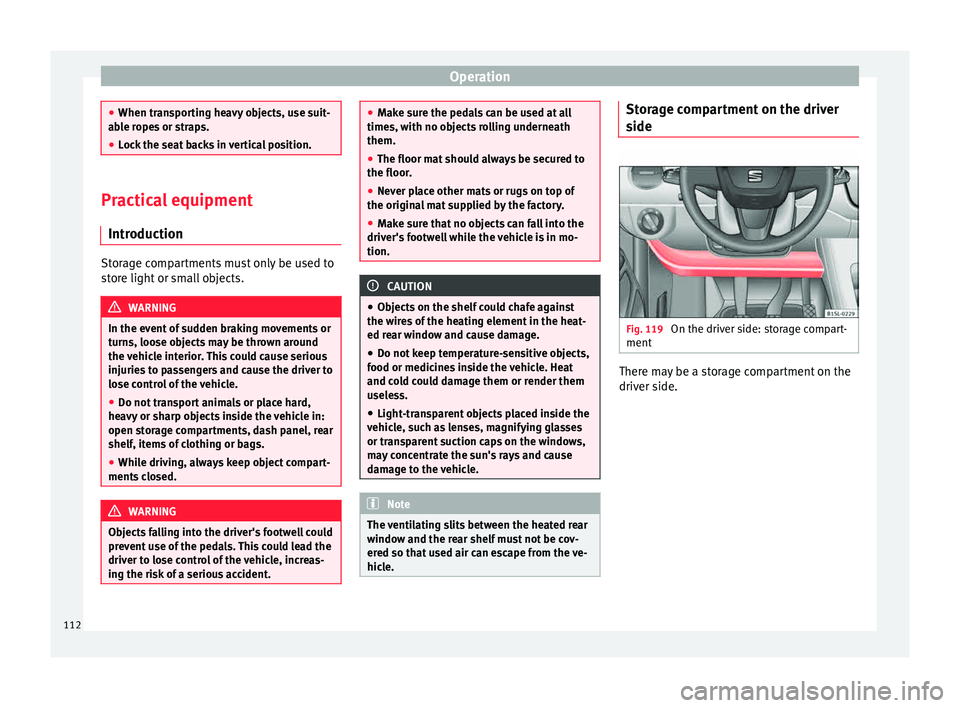
ide Fig. 119
On the driver side: storage compart-
ment There may be a storage compartment on the
driv
er s
ide.
112
Page 121 of 232

Transport and practical equipment
●
Stor e he
avy objects in the luggage com-
partment as far from the rear axle as possi-
ble. CAUTION
Hard objects on the rear shelf could chafe
ag ain s
t the wires of the heating element in
the heated rear window and cause damage. Note
The ventilating slits between the heated rear
windo w and the r
ear shelf must not be cov-
ered so that used air can escape from the ve-
hicle. Folding and lifting up the rear seat
benc
h b
ac
krestFig. 132
Rear seat: unlock button A ; red
m ark
in
g B The rear seat backrest can be folded forward
t
o e
xt
end the luggage compartment.
Folding the rear seat backrest forwards
● Push the head restraint down as far as it
wil
l go or remove it if necessary ››› page 47
and store it in a safe place.
● Pull the unlock switch ›››
Fig. 132 A for-
w ar
d
s whilst simultaneously lifting the rear
seat backrest.
● The rear seat backrest is not engaged when
the red mark
ing of the button B is visible.
● If the rear seat backrest is folded, people
(inc ludin
g c
hildren) are not permitted to trav-
el in the rear folded seats.
Folding up the rear seat backrest
● Lift back the backrest of the rear seat and
push it
firmly into the lock until it clicks se-
curely into place ››› .
● The red marking on the unlock button B must not be seen.
●
Make sure that the backrest of the rear seat
i s
sec
urely locked in position so that the seat
belts can provide proper protection in the
rear seats.
● If necessary, reinstall and readjust the head
res
traints ›››
page 108. WARNING
Folding and lifting the backrests of the rear
seat s
carelessly without paying attention
could cause serious injury.
● Never fold or lift the seats while driving.
● Do no trap or damage seat belts when rais-
ing the seat
backrest.
● Keep hands, fingers, feet and other limbs
awa
y from the range of the rear seat backr-
ests when folding and lifting them.
● All seat backrests must engage correctly for
the seat belt
s on the rear seats to work prop-
erly. When the backrest of an occupied seat is
not correctly locked in place, the passenger
can be thrust forward with the rear seat back-
rest in case of sudden braking, sudden ma-
noeuvres or an accident.
● A red signal on the button B warns that
the bac k
rest is not engaged. Always check to
make sure that the red mark is not visible
when the backrest of the rear seat is in the
upright position.
● No seat must be occupied if the backrest of
the rear se
at is folded or not correctly engag-
ed. CAUTION
Before folding the rear seat backrest, adjust
the front se
ats so that neither the head re-
straint or backrest hit them when folded. If
necessary, remove the head restraints
››› page 108 and store them safely. 119
Technical data
Advice
Operation
Emergencies
Safety
Page 127 of 232

Air conditioning
●
The max imum he
at output required to de-
frost windows as quickly as possible is only
available when the engine has reached its
normal running temperature. Only drive when
you have good visibility.
● Always ensure that you use the heating
syst
em, ventilation, air conditioner and the
heated rear window to maintain good visibili-
ty.
● Never leave the air recirculation on for a
long period of time. If
the cooling system is
switched off and air recirculation mode
switched on, the windows can mist over very
quickly, considerably limiting visibility.
● Switch air recirculation mode off when it is
not requir
ed. WARNING
Stuffy or used air will increase fatigue and re-
duce driv er c
oncentration possibly resulting
in a serious accident.
● Never leave the fresh air fan turned off or
use the air rec
irculation for long periods of
time; the air in the vehicle interior will not be
refreshed. CAUTION
● Swit c
h the air conditioner off if you think it
may be broken. This will avoid additional
damage. Have the air conditioner checked by
a specialised workshop.
● Repairs to the air conditioner require spe-
cia
list knowledge and special tools. SEAT rec-
ommends taking your car in for technical
service. Note
● When the coo lin
g system is turned off, air
coming from the outside will not be dried. To
avoid fogging up the windows, SEAT recom-
mends leaving the cooler (compressor) on. To
do this, press the A/C button. The button
lamp shou l
d light up.
● The maximum heat output required to de-
fros
t windows as quickly as possible is only
available when the engine has reached its
normal running temperature.
● Keep the air intake slots in front of the
winds
creen free of snow, ice and leaves to en-
sure heating and cooling are not impaired, and to prevent the windows from misting
ov
er
. 125
Technical data
Advice
Operation
Emergencies
Safety
Page 128 of 232
Operation
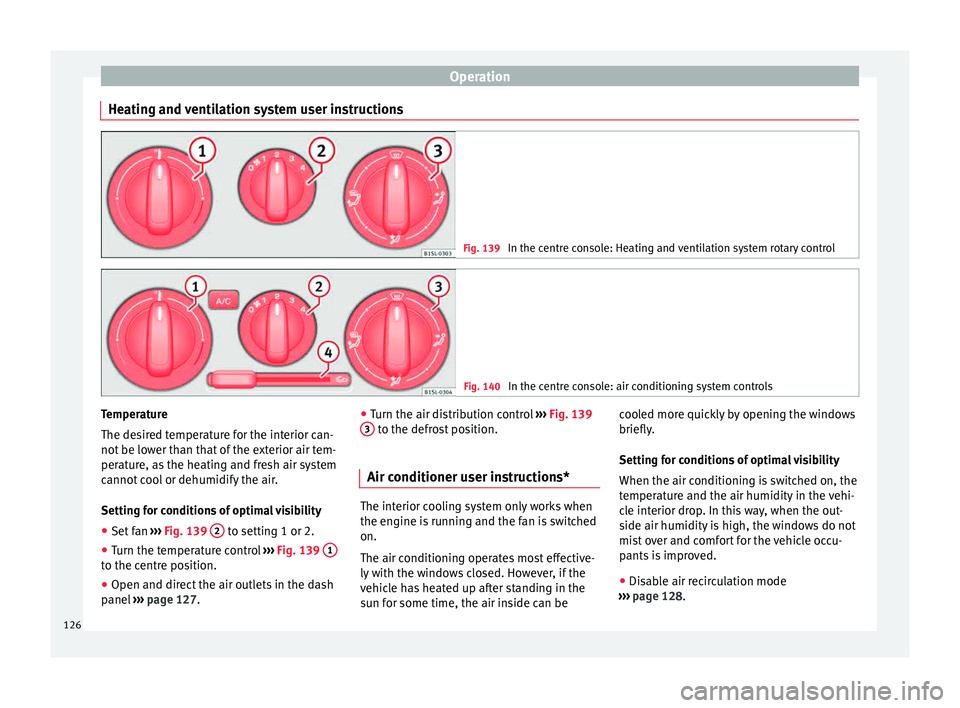
Heating and ventilation system user instructions Fig. 139
In the centre console: Heating and ventilation system rotary control Fig. 140
In the centre console: air conditioning system controls Temperature
The de
s
ir
ed temperature for the interior can-
not be lower than that of the exterior air tem-
perature, as the heating and fresh air system
cannot cool or dehumidify the air.
Setting for conditions of optimal visibility
● Set fan ››› Fig. 139 2 to setting 1 or 2.
● Turn the temperature control ››
›
Fig. 139 1 to the centre position.
●
Open and direct the air outlets in the dash
p anel
›
›› page 127. ●
Turn the air dis
tribution control ››› Fig. 139
3 to the defrost position.
Air conditioner user instructions* The interior cooling system only works when
the engine i
s
running and the fan is switched
on.
The air conditioning operates most effective-
ly with the windows closed. However, if the
vehicle has heated up after standing in the
sun for some time, the air inside can be cooled more quickly by opening the windows
briefly.
Settin
g f
or conditions of optimal visibility
When the air conditioning is switched on, the
temperature and the air humidity in the vehi-
cle interior drop. In this way, when the out-
side air humidity is high, the windows do not
mist over and comfort for the vehicle occu-
pants is improved.
● Disable air recirculation mode
›››
page 128.
126
Page 130 of 232
Operation
Air vents
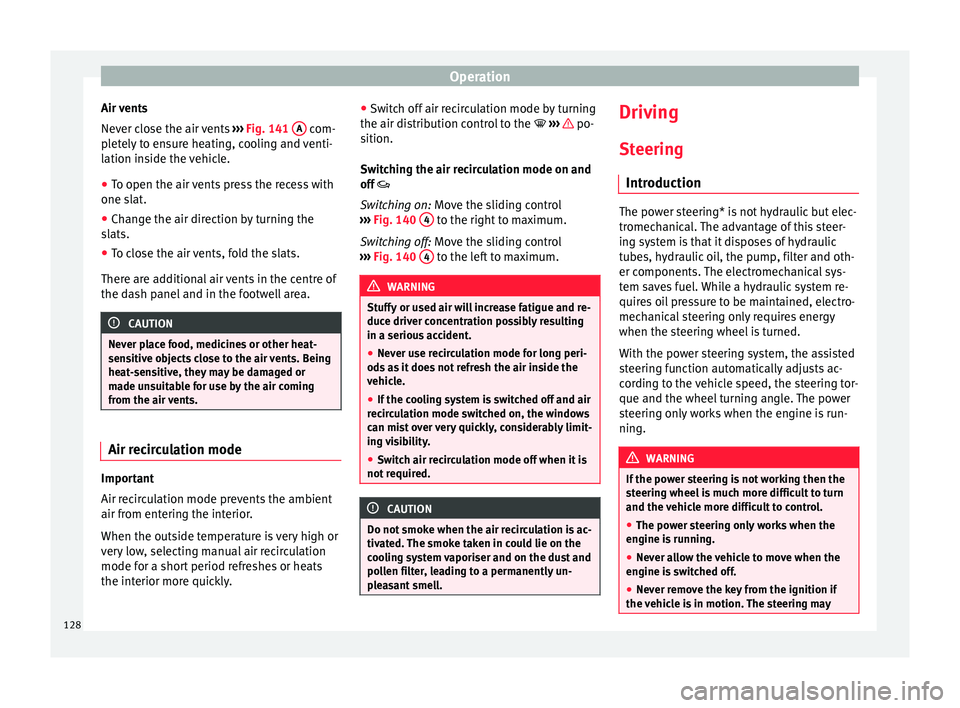
Nev er c
lo
se the air vents ››› Fig. 141 A com-
p l
et
ely to ensure heating, cooling and venti-
lation inside the vehicle.
● To open the air vents press the recess with
one slat
.
● Change the air direction by turning the
slats.
● T
o close the air vents, fold the slats.
There are a
dditional air vents in the centre of
the dash panel and in the footwell area. CAUTION
Never place food, medicines or other heat-
sens itiv
e objects close to the air vents. Being
heat-sensitive, they may be damaged or
made unsuitable for use by the air coming
from the air vents. Air recirculation mode
Important
Air r
ec
ir
culation mode prevents the ambient
air from entering the interior.
When the outside temperature is very high or
very low, selecting manual air recirculation
mode for a short period refreshes or heats
the interior more quickly. ●
Switc
h off air recirculation mode by turning
the air distribution control to the ››› po-
s ition.
Sw it
ching the air recirculation mode on and
off
Switching on: Move the sliding control
››› Fig. 140 4 to the right to maximum.
S wit
c
hing off: Move the sliding control
››› Fig. 140 4 to the left to maximum.
WARNING
Stuffy or used air will increase fatigue and re-
duce driv er c
oncentration possibly resulting
in a serious accident.
● Never use recirculation mode for long peri-
ods a
s it does not refresh the air inside the
vehicle.
● If the cooling system is switched off and air
recir
culation mode switched on, the windows
can mist over very quickly, considerably limit-
ing visibility.
● Switch air recirculation mode off when it is
not requir
ed. CAUTION
Do not smoke when the air recirculation is ac-
tivat ed.
The smoke taken in could lie on the
cooling system vaporiser and on the dust and
pollen filter, leading to a permanently un-
pleasant smell. Driving
St eerin
g
Intr
oduction The power steering* is not hydraulic but elec-
tromec
h
anical. The advantage of this steer-
ing system is that it disposes of hydraulic
tubes, hydraulic oil, the pump, filter and oth-
er components. The electromechanical sys-
tem saves fuel. While a hydraulic system re-
quires oil pressure to be maintained, electro-
mechanical steering only requires energy
when the steering wheel is turned.
With the power steering system, the assisted
steering function automatically adjusts ac-
cording to the vehicle speed, the steering tor-
que and the wheel turning angle. The power
steering only works when the engine is run-
ning. WARNING
If the power steering is not working then the
st eerin
g wheel is much more difficult to turn
and the vehicle more difficult to control.
● The power steering only works when the
engine is
running.
● Never allow the vehicle to move when the
engine is
switched off.
● Never remove the key from the ignition if
the vehic
le is in motion. The steering may128
Page 143 of 232

Driving
Automatic gearbox malfunction Back-up programme
When autom
atic
gearbox warning and indica-
tion lamps light up on the instrument panel,
there may be a system malfunction
››› page 137. In the event of some faults the
automatic gearbox functions using a backup
programme. When the programme is activa-
ted, it is possible to drive the vehicle, howev-
er, at low speeds and within a selected range
of gears.
With the manual gearbox, in some cases it is
not possible to drive with all the gears .
In all cases the automatic gearbox must be
checked at a specialised workshop.
Automatic gearbox overheating
The automatic gearbox can overheat with a
prolonged start up, or when stopping and
starting continuously. This overheating is dis-
played with a warning lamp in the instru-
ment panel. Additionally, an audible warning
can be heard. Stop and let the gearbox cool
››› .
The v
ehic
le moves forward or back despite
having selected a gear range
When the vehicle does not move in the re-
quired direction, the system may not have
the gear range correctly engaged. Press the
brake pedal and engage the gear range again. If the vehicle still does not move in the
required dir
ection, there is a system malfunc-
tion. Seek specialist assistance and have the
system checked. CAUTION
● When the ge arbo
x is displayed as overheat-
ing for the first time, the vehicle must be
parked safely or must be driven at a speed of
more than 20 km/h (12 mph).
● When the warning lamp lights up and the
audible w
arning is heard, the vehicle must be
parked safely and the engine switched off.
Let the gearbox cool down.
● To prevent damage to the gearbox, driving
must
only be continued when the warning
lamps are no longer lit up. While the gearbox
is overheated, starting up and driving, even
at a slow speed should be avoided. Recommended gear display
In some vehicles, the recommended gear for
r
educ
in
g fuel consumption is displayed on
the instrument panel:
DisplayMeaning
Optimum gear.
Recommendation to change up a gear.
Recommendation to change down a
gear. WARNING
The recommended gear display is intended as
a guideline only; it shou
ld never replace the
driver's attention to driving carefully.
● Responsibility for selecting the correct gear
for eac
h situation continues to lie with the
driver, for example when overtaking or climb-
ing a hill. For the sake of the environment
Selecting the most appropriate gear for the
sit uation w
ill help you to save fuel. Note
● The rec ommended g
ear display is switched
off when the clutch pedal is pressed.
● On the display of the Portable Navigation
Sys
tem (supplied by SEAT) ››› page 164 the
recommended gear can also be seen. Run-in and economical driving
R u
nnin
g in Please observe the instructions for running-in
new c
omponents.
R u
nning-in the engine
The engine needs to be run in over the first
1,500 km. During its first few hours of »
141
Technical data
Advice
Operation
Emergencies
Safety
Page 146 of 232

Operation
for the vehicle is not too different to the out-
s ide t
emper
ature. It is a good idea to air the
vehicle before starting your journey and to
drive a short distance with the windows
open. Then you can close the windows and
switch on the air conditioning. Keep windows
closed when travelling at high speeds. Driv-
ing with the windows open increases fuel
consumption.
● Switch off the seat heating when the seats
have w
armed up.
● Switch off the heated rear window when it
is not
moist or covered in ice.
Avoid short journeys
Fuel consumption is much higher when the
engine is cold, immediately after it has been
started. It takes a few kilometres of driving
for the engine to warm up and to normalise
consumption.
The engine and catalytic converter need to
reach their proper working temperature in or-
der to minimise fuel consumption and emis-
sions. The ambient temperature has a deci-
sive influence.
Fig. 147 shows the difference in consump-
tion for the same journey at +20 °C (+68 °F)
and at -10 °C (+14 °F).
Therefore, unnecessary short journeys
should be avoided. Try to combine trips. The vehicle uses more fuel in winter than in
summer, ev
en when other conditions are the
same.
The engine takes a long time to warm up
when it is idling. In addition, mechanical
wear and pollutant emissions are also espe-
cially high during this initial warm-up phase.
It is therefore best to drive off immediately af-
ter starting the engine. Doing this avoids run-
ning the engine at a high speed.
Adjusting type pressures.
Having the correct pressure in your tyres
helps to reduce rolling resistance and, as a
result reduces fuel consumption. Increasing
the tyre pressure slightly (+0.2
bar/+3 psi/+200 kPa) can help to save fuel.
When you buy new tyres, make sure they are
optimised for minimum rolling resistance.
Use low friction engine oil
The use of low viscosity totally synthetic oils,
known as low friction engine oil, helps to re-
duce fuel consumption. These oils reduce the
resistance caused by friction in the engine,
they flow around the engine more quickly
and efficiently, particularly in cold starts. The
effect is particularly noticeable in vehicles
frequently used for short journeys.
Always check the engine oil level and ob-
serve service intervals (engine oil change in-
tervals). When purchasing engine oil, always observe
leg
al requirements and ensure that the oil is
approved by SEAT.
Avoid carrying unnecessary loads
The lighter the vehicle, the more economical
and ecological the driving style. For example,
an additional weight of 100 kg will increase
fuel consumption up to 0.3 l/100 km.
Remove any unnecessary objects or loads
from the vehicle.
Remove optional equipment and unnecessa-
ry accessories
The more aerodynamic the vehicle, the lower
the fuel consumption. Optional equipment
and accessories (such as roof racks or bike
carriers) reduce the aerodynamic benefits of
the vehicle.
Therefore, we recommend you remove all op-
tional and unnecessary equipment and racks,
especially if you intend to drive at high
speeds.
Other factors which increase fuel consump-
tion (examples):
● Fault in engine management.
● Driving on hills.
144
Page 147 of 232

Driving
WARNING
Always adapt your speed and the distance to
the v ehic
les ahead in line with visibility,
weather conditions, the condition of the road
and the traffic situation. Engine management and ex-
hau
s
t gas purification system
Introduction WARNING
The components of the exhaust system reach
ver y
high temperatures. This could cause a
fire.
● Always park your vehicle so that no part of
the exhau
st system can come in contact with
flammable materials (such as dried grass).
● Never apply additional underseal or anti-
corro
sion coatings to the exhaust pipes, cata-
lytic converter or the heat shields on the ex-
haust system. Control and warning lamps
It lights up
Fault in engine
management
(Electronic Pow-
er Control).Take the vehicle to a specialised
workshop as soon as possible and
have the engine checked.
It lights up
Fault in catalytic
converter.You should reduce speed according-
ly. Drive carefully until you reach the
next specialised workshop. Have
the engine checked there.
Flashes
Combustion
fault which could
damage the cat-
alytic converter.You should reduce speed according-
ly. Drive carefully until you reach the
next specialised workshop. Have
the engine checked there.
Several warning and indication lamps light
up f
or a f
ew sec
onds when the ignition is
switched on, signalling that the function is
being verified. They will switch off after a few
seconds. CAUTION
Always pay attention to any lit control lamps
and to the c orr
esponding descriptions and in-
structions to avoid damage to the vehicle. Note
While the control lamps or r
emain lit,
the engine will have faults, there will be high-
er consumption of fuel and a loss of engine
power. Catalytic converter
The catalytic converter permits the subse-
quent tr
e
atment of the exhaust gases thus
reducing contaminating gas emissions. To
ensure a longer working life for the exhaust
system and catalytic converter in a petrol en-
gine:
● Always use unleaded petrol.
● Never run the fuel tank completely dry.
● Do not top up with too much engine oil
›› ›
page 186.
● Do not tow-start the vehicle; use the starter
cabl
es ›››
page 42.
If you should notice misfiring, uneven run-
ning or loss of power when the car is moving,
reduce speed immediately. Have the car in-
spected by a specialised workshop. If this
happens, unburnt fuel can enter the exhaust
system and escape into the atmosphere. The
catalytic converter can also be damaged by
overheating. »
145
Technical data
Advice
Operation
Emergencies
Safety
Page 150 of 232
Operation
ABS to be activated more quickly and
eff ectiv
ely
.
Do not lift your foot off the brake pedal!
When the brake pedal is released or when
the brake force is reduced, braking assist au-
tomatically turns off the brake servo.
Traction control system (ASR) or Traction
Control (TC)*
In the event of wheelspin, the traction control
system ASR or TC reduces the engine torque
to match the amount of grip available. The
ASR or TC makes some situations easier, for
example, when starting, accelerating or go-
ing uphill, even in unfavourable road condi-
tions.
Electronic differential lock (EDS)
EDL is available when driving in straight lines
under normal conditions. When the EDL de-
tects wheelspin, it brakes the spinning wheel
and directs the power to the other one. To
prevent the disc brake of the braked wheel
from overheating, the EDL cuts out automati-
cally if subjected to excessive loads. The EDL
will switch on again automatically when the
brake has cooled down. WARNING
Driving at high speed on icy, slippery or wet
grou nd c
an result in loss of vehicle control and serious injury to the driver and passen-
ger
s.
● Adju
st your speed and driving style to visi-
bility
, road, traffic and weather conditions.
Even though the brake assist systems, ABS,
BAS, EDL, ASR and ESC* provide more securi-
ty, do not take unnecessary risks while driv-
ing.
● Brake assist systems can not overcome the
law
s of physics. Even with ESC* and other
systems, slippery and wet roads will always
be dangerous.
● Driving to quickly on wet ground can result
in the wheels lo
sing contact with the ground
in an effect known as “aquaplaning”. Without
adherence, it is impossible to brake, steer or
control the vehicle.
● Brake assist systems cannot avoid acci-
dents if
, for example, the driver does not re-
spect safety distances or drives to quickly in
difficult conditions.
● Even though brake assist systems are ex-
tremely eff
ective and help control the vehicle
in difficult situations, remember that the ve-
hicle stability depends on tyre grip.
● When accelerating on a slippery surface,
for ex
ample on ice or snow, press the acceler-
ator carefully. The wheels can still slip even
with brake assist systems resulting in loss of
vehicle control. WARNING
The effectiveness of the ESC* can be consid-
erab ly
reduced if other components and sys-
tems affecting driving dynamics are not main-
tained or are not functioning correctly. This
includes, among others, brakes, tyres and
other systems already mentioned.
● Remember that changing and fitting other
components
to the vehicle can affect opera-
tion of the ABS, BAS, ASR TC, EDL and ESC*.
● Changes to the vehicle suspension or using
unap
proved wheel/tyre combinations can af-
fect operation of the ABS, BAS, ASR, TC, EDL
and ESC* and their effectiveness.
● Likewise, the effectiveness of ESC* de-
pends on the u
se of suitable tyres
››› page 197. Note
● To en s
ure that the ESC*, ASR and TC work
properly, all four wheels must be fitted with
identical tyres. Any differences in the rolling
radius of the tyres can cause the system to
reduce engine power when this is not de-
sired.
● If a malfunction should occur in the ABS,
the ESC*, ASR, T
C and EDL will also be affec-
ted.
● Noises may be heard while any of the
above sy
stems are operating.148