ECU Seat Mii 2015 Service Manual
[x] Cancel search | Manufacturer: SEAT, Model Year: 2015, Model line: Mii, Model: Seat Mii 2015Pages: 232, PDF Size: 4.23 MB
Page 167 of 232

Care and maintenance
● Sel ect
the r
equired chapter and press the
corresponding button.
Removing and fitting the navigator
● Securely support the navigator.
● Press the release button 1 until the device
i s
r
eleased from its holder.
● Take the navigator out and store it safely.
To fit the n
avigator, place it in the upper sup-
port and push the lower part inside the hold-
er until it engages with a click ››› .
R emo
v
ing and fitting the navigator holder
● Press the holder release button ›››
Fig. 157
(arrow).
● Remove the holder from the dash panel in
an upwar
ds direction.
● If necessary, close the opening with the
corre
sponding cover.
In order to fit the holder, place it on the open-
ing from above and press in a downwards di-
rection until it engages with a click. ››› .
WARNING
Any distraction may lead to an accident, with
the risk of
injury. Operating the navigator
could distract you from the traffic.
● Always stay alert and drive responsibly. ●
Select
volume settings that allow you to
easily hear signals from outside the vehicle
at all times (e.g. emergency service sirens).
● Setting the volume too high may cause
damag
e to your hearing. This also applies if
the device is set to high volumes for a short
period. WARNING
Journey instructions and traffic signals
sho wn on the n av
igation system may differ to
the current traffic situation.
● Traffic signals and driving regulations take
precedenc
e over journey instructions and in-
dications from the navigation system.
● Adjust your speed and driving style to visi-
bility
, road, traffic and weather conditions. WARNING
If the navigator is not securely fastened in
pos ition, it
could be sent flying around the
vehicle in the event of sharp braking, sudden
manoeuvres or accident, causing injury.
● Fit the navigator housing safely on the cor-
res
ponding opening on the dash panel.
● Always place the navigator securely in its
holder or s
tore it in the vehicle. CAUTION
An unsuitable gradient and angle of vision
setting c an d
amage the navigator. ●
When adju s
ting the navigation device,
move it with care and not beyond its limits. CAUTION
Excessively high or low outside temperatures
c an aff ect
the Portable Navigation System op-
eration or damage the device.
● Always take the Portable Navigation Sys-
tem with
you when you leave the vehicle to
protect it from excessively high or low tem-
peratures and intense sunlight. CAUTION
Humidity can damage the Portable Naviga-
tion S y
stem connections on the dash panel.
● Do not clean the holder for the navigation
device w
ith moist products. Use a dry cloth. Note
SEAT recommends taking the Portable Navi-
gation S
ystem with you when you leave the
vehicle to prevent it from being stolen. 165
Technical data
Advice
Operation
Emergencies
Safety
Page 188 of 232

Advice
WARNING
Refill liquids and certain materials can catch
fire e a
sily in the engine compartment, caus-
ing a fire and serious injury!
● Never smoke.
● Never work close to places exposed to
flames
or sparks.
● Never pour service fluids over the engine.
These fluid ma
y ignite hot engine parts and
cause injuries.
● If it is necessary to work on the fuel system
or the electrica
l system, please follow the in-
structions below:
–Always disconnect the vehicle battery.
– Never work close to heaters, heat sources
or places exposed to flames or sparks.
● Always keep a recently serviced and per-
fectly w
orking fire extinguisher close by.
● Never cover the engine with additional in-
sul
ating materials such as a blanket. Risk of
fire! WARNING
If the bonnet is not correctly closed, it could
sud den
ly open while driving leaving the driv-
er without visibility. This could result in a se-
rious accident.
● After closing the bonnet, always check that
it is
properly secured by the locking mecha-
nism in the lock carrier piece. The bonnet
must be flush with the surrounding body pan-
els. ●
Whil e driv
ing, if you notice that the bonnet
is not correctly closed then stop immediately
and close it correctly.
● Make sure the bonnet is opened and closed
safely
(when the engine is off, no smoke is
coming from the engine compartment, there
is enough space around the car, no people
are near, etc.). CAUTION
● When r efil
ling or changing service liquids,
ensure that you put the liquids into the right
tank. Making a mistake when refilling could
cause serious malfunctions and damage the
engine!
● To avoid damage to the bonnet and to the
winds
creen wiper arms, only open it when
the windscreen wipers are in place against
the windscreen.
● Before driving, always lower the wiper
arms. For the sake of the environment
Service fluids leaks are harmful to the envi-
ronment . F
or this reason you should make
regular checks on the ground underneath
your vehicle. Take the vehicle to a specialised
workshop to be checked if you see stains, oil
or other fluids on the ground. Collect any
spilt service fluids and allow a professional to
dispose of them. Engine oil
Intr oduction WARNING
Incorrectly handling engine oil can cause in-
jury and seriou
s burns.
● Always protect your eyes when handling
engine oil
.
● Oil is toxic and must be kept out of the
reac
h of children.
● Engine oil should only be kept in its origi-
nal
packaging; the same goes for used oil un-
til it is disposed of.
● Never store engine oil in empty food con-
tainers
or bottles as other people may acci-
dentally drink it.
● Regular contact with engine oil can be bad
for the skin. If
you come into contact with en-
gine oil, wash your skin with soap and water.
● With the engine running, the engine oil
gets
extremely hot and can cause severe skin
burns. Always wait until the engine has fully
cooled. For the sake of the environment
Similar to the other service liquids, spilled
engine oi l
can be bad for the environment.
Collect these liquids in suitable containers
and dispose of them while respecting the en-
vironment. 186
Page 198 of 232

Advice
Different control lamps may light up after
c onnectin
g the b
attery and switching the ig-
nition on. They will be turned off after a short
trip at a speed of between 15-20 km/h
(10-12 mph). If the warning indicators remain
lit, please visit a specialised workshop to
have the vehicle checked.
If the battery has been disconnected for a
long time, it is possible that the next service
date is not displayed or calculated correctly
››› page 86. Respect the maximum service in-
tervals permitted ››› Booklet Maintenance
Programme.
Automatic device disconnection
The intelligent vehicle electrical system auto-
matically implements a range of measures to
prevent the battery from discharging when
high demands are made on it:
● The idling speed is increased so that the al-
ternat
or provides more electricity.
● Where necessary, the power to the most
power
ful devices is reduced or even com-
pletely disconnected.
● On starting the engine, the power supply
from the 12-v
olt power sockets and the ciga-
rette lighter may be interrupted for a short
time.
The on-board management program cannot
always prevent the battery from running flat.
For example, if the ignition is left on for a long period with the engine off or if the side
lights or park
ing lights are left on while the
vehicle is stationary.
Why the battery runs flat:
● When stationary for a long time without
star
ting the engine, particularly if the ignition
is switched on.
● Use of electrical devices with the engine
switc
hed off. WARNING
Incorrectly securing the battery or using the
wron g b
attery can cause short-circuits, fire
and serious injuries.
● Always use only maintenance-free batter-
ies, prot
ected to prevent a leak, and whose
properties, specifications and size corre-
spond to the standard battery. WARNING
A highly explosive mixture of gases is re-
le a
sed when the battery is under charge.
● The batteries should be charged in a well-
ventil
ated room only.
● Never charge a frozen or recently thawed
batter
y. A flat battery can also freeze at tem-
peratures close to 0 °C (+32 °F).
● Always replace a battery which has frozen.
● Battery cables not correctly connected may
cause a shor
t circuit. Reconnect first the posi-
tive cable and then the negative cable. CAUTION
● Never di s
connect the battery if the ignition
is switched on or if the engine is running.
This could damage the electrical system or
electronic components.
● Never plug accessories that supply current,
such a
s solar panels or a battery charger, to
the 12-volt power socket or the cigarette
lighter. This could damage the vehicle's elec-
trical system. For the sake of the environment
Dispose of the battery in an environment-
friendly m anner
. Batteries contain toxic sub-
stances such as sulphuric acid and lead. For the sake of the environment
Battery acid can contaminate the environ-
ment. C o
llect any spilt service fluids and dis-
pose of them correctly. 196
Page 201 of 232
Wheels and tyres
WARNING
Aggressive fluids or substances could result
in v i
sible or invisible damage with the conse-
quent risks.
● Always ensure that tyres do not come into
contact
with chemical products, oil, grease,
fuel, brake fluid or other aggressive substan-
ces. WARNING
Old tyres, even if they have never been used,
ma y
lose air or burst unexpectedly while driv-
ing, resulting in serious accident or damage.
● If tyres are over six years old, they should
only be u
sed in an emergency and with ex-
treme caution. For the sake of the environment
Old tyres must be disposed of by qualified
personnel ac
cording to the laws in the coun-
try concerned. Wheels
The design of wheel bolts is matched to the
rims. If
diff
er
ent rims are fitted, the correct
wheel bolts with the right length and correct-
ly shaped bolt heads must be used. This en-
sures that wheels are fitted securely and that
the brake system functions correctly
››› page 71. For technical reasons, it is not generally pos-
sibl
e to use the wheels from other vehicles.
In some cases, this may also be true for the
same model of wheel.
The tyres and rims approved by SEAT are spe-
cially matched to the characteristics of the
vehicle and are critical to good road holding
and safe handling.
Note for Italy: A SEAT Service Centre should
be consulted whether different sized wheels
or tyres to those originally fitted by SEAT may
be fitted, as well as the combinations al-
lowed between the front axle (axle 1) and
back axle (axle 2).
Wheel bolts
Wheel bolts must be tightened to the correct
torque ››› page 71.
Beadlock wheel rims
Beadlock wheel rims have various compo-
nents. These are joined together by special
bolts using a special procedure. This ensures
good performance, a better seal, improved
safety and wheel run out. Therefore, worn
rims should always be replaced and must on-
ly be repaired in a specialised workshop.
SEAT recommends visiting a technical service
››› .Wheel rims with bolted trims
Wheel
rims
m
ay be fitted with interchangea-
ble trim parts which are attached to the rim
using self-locking bolts. Worn trims should
only be replaced at a specialised workshop.
SEAT recommends visiting a technical service
››› .
WARNING
The use of worn or damaged wheel rims could
mak e driv
ing more dangerous and result in
serious accidents and damage.
● Only wheel rims which have been approved
for use w
ith your vehicle should be used.
● Inspect wheel rims regularly for damage
and repl
ace as required. WARNING
If the bolted joints of wheel rims with bolted
ring trims ar
e not correctly tightened or loos-
ened, this could result in serious accident.
● Never loosen the bolted joints of wheel
rims with bo
lted ring trims.
● Any work relating to wheel rims with bolted
rims shoul
d be carried out at specialised
workshop. SEAT recommends taking your car
in for technical service. 199
Technical data
Advice
Operation
Emergencies
Safety
Page 206 of 232
Advice
Spare wheel or temporary spare
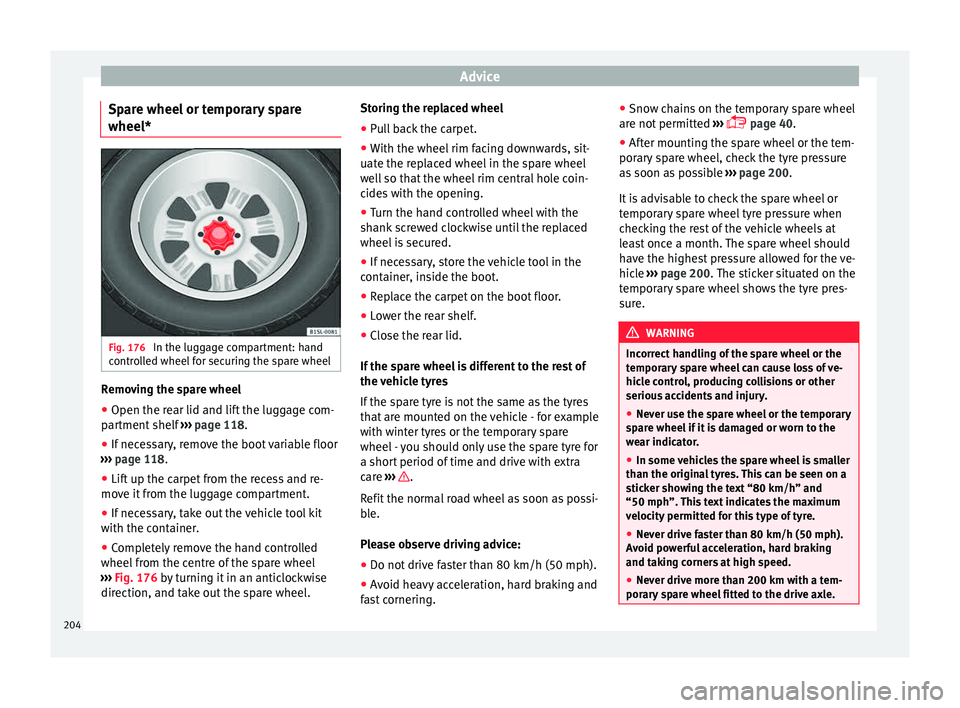
wheel* Fig. 176
In the luggage compartment: hand
c ontr
o
lled wheel for securing the spare wheel Removing the spare wheel
● Open the rear lid and lift the luggage com-
p ar
tment
shelf ››› page 118.
● If necessary, remove the boot variable floor
›››
page 118.
● Lift up the carpet from the recess and re-
move it
from the luggage compartment.
● If necessary, take out the vehicle tool kit
with the cont
ainer.
● Completely remove the hand controlled
wheel from the c
entre of the spare wheel
››› Fig. 176 by turning it in an anticlockwise
direction, and take out the spare wheel. Storing the replaced wheel
● Pull back the carpet.
● With the wheel rim facing downwards, sit-
uate the rep
laced wheel in the spare wheel
well so that the wheel rim central hole coin-
cides with the opening.
● Turn the hand controlled wheel with the
shank s
crewed clockwise until the replaced
wheel is secured.
● If necessary, store the vehicle tool in the
container
, inside the boot.
● Replace the carpet on the boot floor.
● Lower the rear shelf.
● Close the rear lid.
If the sp
are wheel is different to the rest of
the vehicle tyres
If the spare tyre is not the same as the tyres
that are mounted on the vehicle - for example
with winter tyres or the temporary spare
wheel - you should only use the spare tyre for
a short period of time and drive with extra
care ››› .
R efit
the norm
al road wheel as soon as possi-
ble.
Please observe driving advice:
● Do not drive faster than 80 km/h (50 mph).
● Avoid heavy acceleration, hard braking and
fas
t cornering. ●
Snow ch
ains on the temporary spare wheel
are not permitted ›››
page 40.
● After mounting the spare wheel or the tem-
porary
spare wheel, check the tyre pressure
as soon as possible ››› page 200.
It is advisable to check the spare wheel or
temporary spare wheel tyre pressure when
checking the rest of the vehicle wheels at
least once a month. The spare wheel should
have the highest pressure allowed for the ve-
hicle ››› page 200. The sticker situated on the
temporary spare wheel shows the tyre pres-
sure. WARNING
Incorrect handling of the spare wheel or the
tempor ar
y spare wheel can cause loss of ve-
hicle control, producing collisions or other
serious accidents and injury.
● Never use the spare wheel or the temporary
spar
e wheel if it is damaged or worn to the
wear indicator.
● In some vehicles the spare wheel is smaller
than the origina
l tyres. This can be seen on a
sticker showing the text “80 km/h” and
“50 mph”. This text indicates the maximum
velocity permitted for this type of tyre.
● Never drive faster than 80 km/h (50 mph).
Avoid po
werful acceleration, hard braking
and taking corners at high speed.
● Never drive more than 200 km with a tem-
porary
spare wheel fitted to the drive axle.204
Page 207 of 232

Wheels and tyres
●
Rep l
ace the temporary spare wheel for a
normal wheel as soon as possible. The com-
pact temporary spare wheel is only intended
for temporary use over short distances.
● The temporary spare wheel must always be
secured w
ith the factory supplied wheel
bolts.
● You should never use more than one tem-
porary
spare wheel. ●
Aft er mou
nting the temporary spare wheel,
check the tyre pressure as soon as possible
››› page 200.
● Snow chains on the temporary spare wheel
are not permitt
ed. Note
Wherever possible, secure the spare wheel,
t empor ar
y spare wheel or the replaced wheel
safely in the luggage compartment. In vehi- cles with anti-puncture kit, it is not possible
to sec
ur
e the defective wheel. Tyre code
Fig. 177
Universal code on tyres Radial
Rim di
amet
er c
ode
Load index & speed rating
DOT tyre identification number
Severe snow conditions
Tyre ply composition and materials used
Max. load rating
Treadwear, traction and temperature
grades
Max. permissible inflation pressure
Passenger car tyre
Nominal width of tyre in millimetres
Ratio of height to width (aspect ratio) »
1 2
3
4
5
6
7
8
9
10
11
12
205
Technical data
Advice
Operation
Emergencies
Safety
Page 219 of 232

Index
Index
A
Abr o
a
d
extended stay abroad with your vehicle . . . . . 176
sale of vehicle . . . . . . . . . . . . . . . . . . . . . . . . . . 176
ABS see Anti-lock brake system . . . . . . . . . . . . . . . 147
Accessories . . . . . . . . . . . . . . . . . . . . . . . . . . . . . . 159
Acoustic alarm seatbelt unfastened . . . . . . . . . . . . . . . . . . . . . . 53
Adjusting front seat . . . . . . . . . . . . . . . . . . . . . . . . . . . . . . 108
lights . . . . . . . . . . . . . . . . . . . . . . . . . . . . . . . . . 104
rear head restraints . . . . . . . . . . . . . . . . . . . . . 108
Rear head restraints . . . . . . . . . . . . . . . . . . . . . . 50
seats . . . . . . . . . . . . . . . . . . . . . . . . . . . . . . . . . . 47
Adjusting the head restraints rear head restraints . . . . . . . . . . . . . . . . . . . . . 108
Advice for driving spare wheel or temporary spare wheel . . . . . . 204
Airbag covers . . . . . . . . . . . . . . . . . . . . . . . . . . . . . 14
Airbags . . . . . . . . . . . . . . . . . . . . . . . . . . . . . . . . . . 58
Airbag system . . . . . . . . . . . . . . . . . . . . . . . . . . 14, 58 activation . . . . . . . . . . . . . . . . . . . . . . . . . . . . . . 60
cleaning dash panel . . . . . . . . . . . . . . . . . . . . . 174
control lamp . . . . . . . . . . . . . . . . . . . . . . . . . . . . 62
description . . . . . . . . . . . . . . . . . . . . . . . . . . . . . 59
front airbags . . . . . . . . . . . . . . . . . . . . . . . . . 14, 61
functioning . . . . . . . . . . . . . . . . . . . . . . . . . . . . . 60
locking the vehicle after deployment . . . . . . . . 93
repairs . . . . . . . . . . . . . . . . . . . . . . . . . . . . . . . . 161
Side airbags . . . . . . . . . . . . . . . . . . . . . . . . . . . . 16
use of child seats . . . . . . . . . . . . . . . . . . . . . . . . 15
vehicle care . . . . . . . . . . . . . . . . . . . . . . . . . . . . 174 Air conditioning . . . . . . . . . . . . . . . . . . . . . . . . . . 124
climatr onic . . . . . . . . . . . . . . . . . . . . . . . . 28, 124
controls . . . . . . . . . . . . . . . . . . . . . . . . . . . . . . . . 28
special features . . . . . . . . . . . . . . . . . . . . . . . . 127
user instructions . . . . . . . . . . . . . . . . . . . . . . . . 126
Air outlets . . . . . . . . . . . . . . . . . . . . . . . . . . . . . . . 127
Air recirculation . . . . . . . . . . . . . . . . . . . . . . . . . . 128
Antenna . . . . . . . . . . . . . . . . . . . . . . . . . . . 161, 176
Anti-freeze . . . . . . . . . . . . . . . . . . . . . . . . . . . . . . . 31
Anti-lock brake system . . . . . . . . . . . . . . . . . . . . . 147
Anti-lock system . . . . . . . . . . . . . . . . . . . . . . . . . . 147
Anti-puncture kit . . . . . . . . . . . . . . . . . . . . . . . . 34, 71 Check after 10 minutes . . . . . . . . . . . . . . . . . . . 73
Anti-theft security system . . . . . . . . . . . . . . . . . . . 95
Ashtray . . . . . . . . . . . . . . . . . . . . . . . . . . . . . . . . . 116
Aspects to take into account before starting the vehicle . . . . . . . . . . . . . . . . . . . . . . . . . . . . . . . . . 46
ASR see Traction control system . . . . . . . . . . . . . . . 147
Assistance systems brake assist system (BAS) . . . . . . . . . . . . . . . . 147
cruise control . . . . . . . . . . . . . . . . . . . . . . . . . . 151
electronic differential lock (EDS) . . . . . . . . . . . 148
optical parking system (OPS) . . . . . . . . . . . . . 150
parking aid . . . . . . . . . . . . . . . . . . . . . . . . . . . . 149
parking distance warning system . . . . . . . . . . 149
safety Assist . . . . . . . . . . . . . . . . . . . . . . . . . . . 152
Assisted starting . . . . . . . . . . . . . . . . . . . . . . . . . . 42
Assist systems traction control (ASR) . . . . . . . . . . . . . . . . . . . . 148
traction control (TC) . . . . . . . . . . . . . . . . . . . . . 148
Audible warnings Control and warning lamps . . . . . . . . . . . . . . . . 25
lights . . . . . . . . . . . . . . . . . . . . . . . . . . . . . . . . . 102
speed . . . . . . . . . . . . . . . . . . . . . . . . . . . . . . . . . 24
Automatic belt retractor . . . . . . . . . . . . . . . . . . . . . 57
Automatic device disconnection battery . . . . . . . . . . . . . . . . . . . . . . . . . . . . . . . . 196 Automatic gearbox
driving tip s . . . . . . . . . . . . . . . . . . . . . . . . . . . . 140
ignition key removal lock . . . . . . . . . . . . . . . . . 131
kick-down . . . . . . . . . . . . . . . . . . . . . . . . . . . . . 140
malfunction . . . . . . . . . . . . . . . . . . . . . . . . . . . . 141
starting on a slope . . . . . . . . . . . . . . . . . . . . . . 140
stopping on a slope . . . . . . . . . . . . . . . . . . . . . 140
Automatic gear change . . . . . . . . . . . . . . . . . . . . 139
Axle loads . . . . . . . . . . . . . . . . . . . . . . . . . . . . . . . 210
B Bag support . . . . . . . . . . . . . . . . . . . . . . . . . . . . . 114
BAS see Brake assist systems . . . . . . . . . . . . . . . . . 147
Battery changing in the vehicle key . . . . . . . . . . . . . . . . 91
Battery acid . . . . . . . . . . . . . . . . . . . . . . . . . . . . . . 195
Before starting the vehicle . . . . . . . . . . . . . . . . . . 46
Belt tension device service and disposal . . . . . . . . . . . . . . . . . . . . . 57
Belt tensioner . . . . . . . . . . . . . . . . . . . . . . . . . . . . . 57
Belt tension limiter . . . . . . . . . . . . . . . . . . . . . . . . . 57
Belt tightening . . . . . . . . . . . . . . . . . . . . . . . . . . . . 57
Bonnet . . . . . . . . . . . . . . . . . . . . . . . . . . . . . 10, 184
Boot hatch emergency locking and unlocking . . . . . . . . . . . 10
Brake assist system . . . . . . . . . . . . . . . . . . . . . . . 147
Brake fluid . . . . . . . . . . . . . . . . . . . . . . . . . . . . . . . 32 specification . . . . . . . . . . . . . . . . . . . . . . . . . . . 192
Brakes . . . . . . . . . . . . . . . . . . . . . . . . . . . . . . . . . . 132 brake assist systems . . . . . . . . . . . . . . . . . . . . 147
brake fluid . . . . . . . . . . . . . . . . . . . . . . . . . . . . . 191
brake fluid level . . . . . . . . . . . . . . . . . . . . . . . . 192
brake pads . . . . . . . . . . . . . . . . . . . . . . . . . . . . 135
brake servo . . . . . . . . . . . . . . . . . . . . . . . . . . . . 136
changing the brake fluid . . . . . . . . . . . . . . . . . 192
217
Page 220 of 232
Index
control and warning lamps . . . . . . . . . . . . . . . 133
ru nnin
g in new br
ake pads . . . . . . . . . . . . . . . 135
Brake servo . . . . . . . . . . . . . . . . . . . . . . . . . 136, 147
Brake system . . . . . . . . . . . . . . . . . . . . . . . . . . . . 147 fault . . . . . . . . . . . . . . . . . . . . . . . . . . . . . . . . . . 135
Braking brake assist system . . . . . . . . . . . . . . . . . . . . . 147
Bulb fault see Changing bulbs . . . . . . . . . . . . . . . . . . . . . . 78
C Capacities . . . . . . . . . . . . . . . . . . . . . . . . . . . . . . . . 30 natural gas tank . . . . . . . . . . . . . . . . . . . . . . . . 183
windscreen washer liquid reservoir . . . . . . . . 193
Caring for paintwork . . . . . . . . . . . . . . . . . . . . . . . 170
Caring for the vehicle exterior . . . . . . . . . . . . . . . . . . . . . . . . . . 166, 167
interior . . . . . . . . . . . . . . . . . . . . . . . . . . . . . . . . 172
Catalytic converter . . . . . . . . . . . . . . . . . . . . . . . . 145 control and warning lamps . . . . . . . . . . . . . . . 145
malfunctions . . . . . . . . . . . . . . . . . . . . . . . . . . . 145
CCS see cruise control . . . . . . . . . . . . . . . . . . . . . . . . 25
Central locking system . . . . . . . . . . . . . . . . . . . . . . 92 after airbag deployment . . . . . . . . . . . . . . . . . . 93
description . . . . . . . . . . . . . . . . . . . . . . . . . . . . . 93
emergency locking . . . . . . . . . . . . . . . . . . . . . . . . 9
opening doors individually . . . . . . . . . . . . . . . . 93
remote control key . . . . . . . . . . . . . . . . . . . . . . . 93
Changes . . . . . . . . . . . . . . . . . . . . . . . . . . . . . . . . 160
Changing a wheel . . . . . . . . . . . . . . . . . . . . . . 35, 71 subsequent tasks . . . . . . . . . . . . . . . . . . . . . . . . 40
wheel bolts . . . . . . . . . . . . . . . . . . . . . . . . . . . . . 37
Changing bulbs . . . . . . . . . . . . . . . . . . . . . . . . . . . 78 front bumper . . . . . . . . . . . . . . . . . . . . . . . . . . . . 80
headlights . . . . . . . . . . . . . . . . . . . . . . . . . . . . . . 79
number plate light . . . . . . . . . . . . . . . . . . . . . . . 82 rear lights . . . . . . . . . . . . . . . . . . . . . . . . . . . . . . 81
side turn s
ignal . . . . . . . . . . . . . . . . . . . . . . . . . . 83
Changing gear . . . . . . . . . . . . . . . . . . . . . . . . . . . 137 automatic gear change . . . . . . . . . . . . . . . . . . 139
Control and warning lamps . . . . . . . . . . . . . . . 137
engaging the gears (automatic gearbox) . . . . 139
tiptronic . . . . . . . . . . . . . . . . . . . . . . . . . . . . . . . 139
Changing the blades . . . . . . . . . . . . . . . . . . . . . . . 74
Changing the wiper blades . . . . . . . . . . . . . . . . . . 44
Charging the battery . . . . . . . . . . . . . . . . . . . . . . . 42
Child safety seat Securing with the seat belt . . . . . . . . . . . . . . . . 18
Child seats . . . . . . . . . . . . . . . . . . . . . . . . . . . . 16, 65 Disabling the front passenger front airbag . . . . 15
ISOFIX system . . . . . . . . . . . . . . . . . . . . . . . . 19, 67
mounting child seats . . . . . . . . . . . . . . . . . . . . . 17
mounting systems . . . . . . . . . . . . . . . . . . . . . . . 17
on the front passenger seat . . . . . . . . . . . . . . . . 66
on the rear seats . . . . . . . . . . . . . . . . . . . . . . . . . 67
regulations . . . . . . . . . . . . . . . . . . . . . . . . . . . . . 66
safety instructions . . . . . . . . . . . . . . . . . . . . 16, 64
Top Tether system . . . . . . . . . . . . . . . . . . . . . . . . 20
transporting children in the vehicle . . . . . . . . . 66
weight categories . . . . . . . . . . . . . . . . . . . . . . . . 66
Cigarette lighter . . . . . . . . . . . . . . . . . . . . . . . . . . 116
City Safety Assist function . . . . . . . . . . . . . . . . . . 152 control and warning lamps . . . . . . . . . . . . . . . 153
function . . . . . . . . . . . . . . . . . . . . . . . . . . . . . . . 154
sensor . . . . . . . . . . . . . . . . . . . . . . . . . . . . . . . . 153
Special driving situations . . . . . . . . . . . . . . . . 155
Cleaning . . . . . . . . . . . . . . . . . . . . . . . . . . . . . . . . 166 compartments . . . . . . . . . . . . . . . . . . . . . . . . . 174
dash panel . . . . . . . . . . . . . . . . . . . . . . . . . . . . 174
engine compartment . . . . . . . . . . . . . . . . . . . . 172
fabrics . . . . . . . . . . . . . . . . . . . . . . . . . . . . . . . . 173
padding . . . . . . . . . . . . . . . . . . . . . . . . . . . . . . . 173
seat belts . . . . . . . . . . . . . . . . . . . . . . . . . . . . . 175 textile covers . . . . . . . . . . . . . . . . . . . . . . . . . . . 173
washin
g the vehicle . . . . . . . . . . . . . . . . . . . . . 167
Washing the vehicle with high pressure clean- ers . . . . . . . . . . . . . . . . . . . . . . . . . . . . . . . . . 168
wheels . . . . . . . . . . . . . . . . . . . . . . . . . . . . . . . . 171
windows . . . . . . . . . . . . . . . . . . . . . . . . . . . . . . 169
Cleaning the vehicle high pressure cleaners . . . . . . . . . . . . . . . . . . . 168
Climate control Faults . . . . . . . . . . . . . . . . . . . . . . . . . . . . . . . . . 127
Close . . . . . . . . . . . . . . . . . . . . . . . . . . . . . . . . . . . . 90
Closing . . . . . . . . . . . . . . . . . . . . . . . . . . . . . . . . . . 90 bonnet . . . . . . . . . . . . . . . . . . . . . . . . . . . . . . . . . 10
electric windows . . . . . . . . . . . . . . . . . . . . . . . . . 11
luggage compartment . . . . . . . . . . . . . . . . . . . . 98
panoramic sunroof . . . . . . . . . . . . . . . . . . . . . . . 11
windows . . . . . . . . . . . . . . . . . . . . . . . . . . . . . . . 99
Clothes hook . . . . . . . . . . . . . . . . . . . . . . . . . . . . 115
Code number . . . . . . . . . . . . . . . . . . . . . . . . . . . . . 70
Compartments . . . . . . . . . . . . . . . . . . . . . . . . . . . 112 centre console . . . . . . . . . . . . . . . . . . . . . . . . . 113
glove compartment . . . . . . . . . . . . . . . . 113, 114
passenger side . . . . . . . . . . . . . . . . . . . . 113, 114
Sunglasses storage compartment . . . . . . . . . . 113
Conformity certification . . . . . . . . . . . . . . . . . . . . 177
Consumption information . . . . . . . . . . . . . . . . . . . . . . . . . . . . 210
Control and warning lamps Airbag system . . . . . . . . . . . . . . . . . . . . . . . . . . . 62
brake system . . . . . . . . . . . . . . . . . . . . . . . . . . . 133
catalytic converter . . . . . . . . . . . . . . . . . . . . . . 145
Changing gear . . . . . . . . . . . . . . . . . . . . . . . . . 137
City Safety Assist function . . . . . . . . . . . . . . . . 153
coolant . . . . . . . . . . . . . . . . . . . . . . . . . . . . . . . 189
cruise control . . . . . . . . . . . . . . . . . . . . . . . . . . 151
Emission control system . . . . . . . . . . . . . . . . . 145
engine management . . . . . . . . . . . . . . . . . . . . 145
ESC . . . . . . . . . . . . . . . . . . . . . . . . . . . . . . . . . . 133
218