ECU Seat Mii 2016 User Guide
[x] Cancel search | Manufacturer: SEAT, Model Year: 2016, Model line: Mii, Model: Seat Mii 2016Pages: 232, PDF Size: 4.9 MB
Page 53 of 232
Safe driving
●
Sit a s
far away as possible from the steer-
ing wheel and the dash panel.
● Keep your back straight and resting com-
plet
ely against the seat backrest and the
front seats correctly adjusted. Never place
any part of your body in the area of the airbag
or very close to it.
● If passengers on the rear seats are not sit-
ting in an upright po
sition, the risk of severe
injury due to incorrect positioning of the belt
web increases. WARNING
Incorrect seat adjustment may lead to acci-
dents and sev
ere injuries.
● Only adjust the seats when the vehicle is
station
ary, as the seats could move unex-
pectedly while the vehicle is in motion and
you could lose control of the vehicle. Further-
more, an incorrect position is adopted when
adjusting the seat.
● Only adjust the height, seat backrest and
forw
ards or backwards position of the seat
when there is nobody in the seat adjustment
area.
● There must be no objects blocking the front
seat a
djustment area. Adjusting the rear head restraints
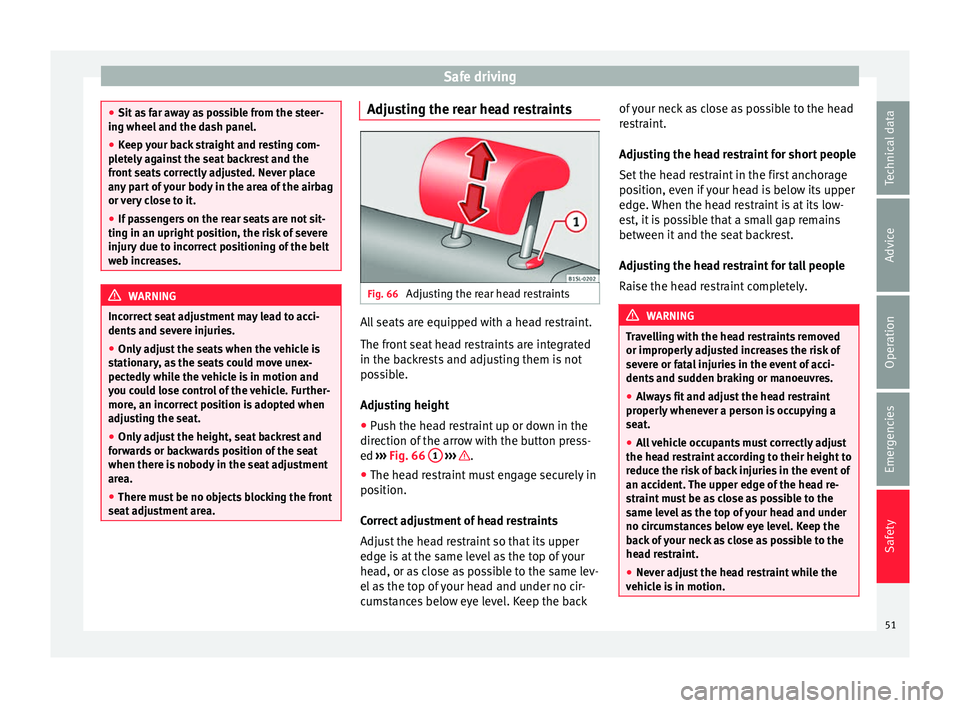
Fig. 66
Adjusting the rear head restraints All seats are equipped with a head restraint.
The fr
ont
se
at head restraints are integrated
in the backrests and adjusting them is not
possible.
Adjusting height
● Push the head restraint up or down in the
direction of the arr
ow with the button press-
ed ››› Fig. 66 1
› ›
› .
● The head restraint must engage securely in
po s
ition.
C
orrect adjustment of head restraints
Adjust the head restraint so that its upper
edge is at the same level as the top of your
head, or as close as possible to the same lev-
el as the top of your head and under no cir-
cumstances below eye level. Keep the back of your neck as close as possible to the head
res
traint.
Adjusting the head restraint for short people
Set the head restraint in the first anchorage
position, even if your head is below its upper
edge. When the head restraint is at its low-
est, it is possible that a small gap remains
between it and the seat backrest.
Adjusting the head restraint for tall people
Raise the head restraint completely. WARNING
Travelling with the head restraints removed
or improperly a
djusted increases the risk of
severe or fatal injuries in the event of acci-
dents and sudden braking or manoeuvres.
● Always fit and adjust the head restraint
properly whenev
er a person is occupying a
seat.
● All vehicle occupants must correctly adjust
the head r
estraint according to their height to
reduce the risk of back injuries in the event of
an accident. The upper edge of the head re-
straint must be as close as possible to the
same level as the top of your head and under
no circumstances below eye level. Keep the
back of your neck as close as possible to the
head restraint.
● Never adjust the head restraint while the
vehicl
e is in motion. 51
Technical data
Advice
Operation
Emergencies
Safety
Page 54 of 232
Safety
Pedal area P ed
a
ls Do not allow floor mats or other objects to
ob
s
truct the free passage of the pedals.
Floor mats should leave the pedal area free
and unobstructed and be correctly secured in
the footwell zone.
In the event of failure of a brake circuit, the
brake pedal must be pressed harder than
normal to brake the vehicle. WARNING
Objects falling into the driver's footwell could
prev ent
use of the pedals. This could lead the
driver to lose control of the vehicle, increas-
ing the risk of a serious accident.
● Make sure the pedals can be used at all
times, with no o
bjects rolling underneath
them.
● Always secure the mat in the footwell.
● Never place other mats or rugs on top of
the original
mat supplied by the factory.
● Ensure that no objects can fall into the driv-
er's footw
ell while the vehicle is in motion. CAUTION
The pedals must always have free and unob-
struct ed p
assage to the floor. For example, in
case of a fault in the brake circuit, the brake pedal will need to be pressed further to stop
the v
ehic
le. To press the brake pedal down
further will require more force than usual. Seat belts
Wh y
w
ear a seat belt?
Introduction Check the condition of all the seat belts at
re
gu
lar intervals. If you notice that the belt
webbing, fittings, retractor mechanism or
buckle of any of the belts is damaged, the
belt must be replaced immediately by a spe-
cialised workshop ››› . The specialised
w ork
shop mu
st use the appropriate spare
parts corresponding to the vehicle, the
equipment and the model year. SEAT recom-
mends taking your car in for technical serv-
ice. WARNING
Unbuckled or badly buckled seat belts in-
cr e
ase the risk of severe or even fatal inju-
ries. The seat belt cannot offer its full protec-
tion if it is not fastened and used correctly.
● Seat belts are the most effective way of re-
ducing the ri
sk of sustaining severe or fatal
injuries in the event of an accident. Seat belts
must be correctly fastened when the vehicle
is in motion to protect the driver and all vehi-
cle occupants.
● Before each trip, every occupant in the ve-
hicle oc
cupants must sit properly, correctly
fasten the seat belt belonging to his or her
seat and keep it fastened throughout the trip. 52
Page 55 of 232
Seat belts
This also applies to other vehicle occupants
when drivin
g in t
own.
● When travelling, children must be secured
in the vehic
le with a child restraint system
suitable for their weight and height and with
the seat belts correctly fastened
››› page 64.
● Instruct your passengers to fasten their
seat belt
s properly before driving off.
● Insert the latch plate into the buckle for the
appropri
ate seat and ensure it is engaged.
Using the latch plate in the buckle of another
seat will not protect you properly and may
cause severe injuries.
● Do not allow liquids or foreign bodies to en-
ter the buc
kle fastenings. This could damage
the buckles and seat belts.
● Never unbuckle your seat belt when the ve-
hicle i
s moving.
● Never allow more than one passenger to
share the s
ame seat belt.
● Never hold children or babies on your lap
sharing the s
ame seat belt.
● Loose, bulky clothing (such as a jacket) im-
pairs
the proper fit and function of the seat
belt. WARNING
It is extremely dangerous to drive using dam-
aged se at
belts and could result in serious in-
jury or loss of life. ●
Av oid d
amaging the seat belt by jamming it
in the door or the seat mechanism.
● If the fabric or other parts of the seat belt
are dam
aged, the seat belts could break in
the event of an accident or sudden braking.
● Always have damaged seatbelts replaced
immediately
by seat belts approved for the
vehicle in question by SEAT. Seat belts which
have been worn in an accident and stretched
must be replaced by a specialised workshop.
Renewal may be necessary even if there is no
apparent damage. The belt anchorage should
also be checked.
● Never attempt to repair, modify or remove a
seat belt
yourself. All repairs to seat belts, re-
tractors and buckles must be carried out by a
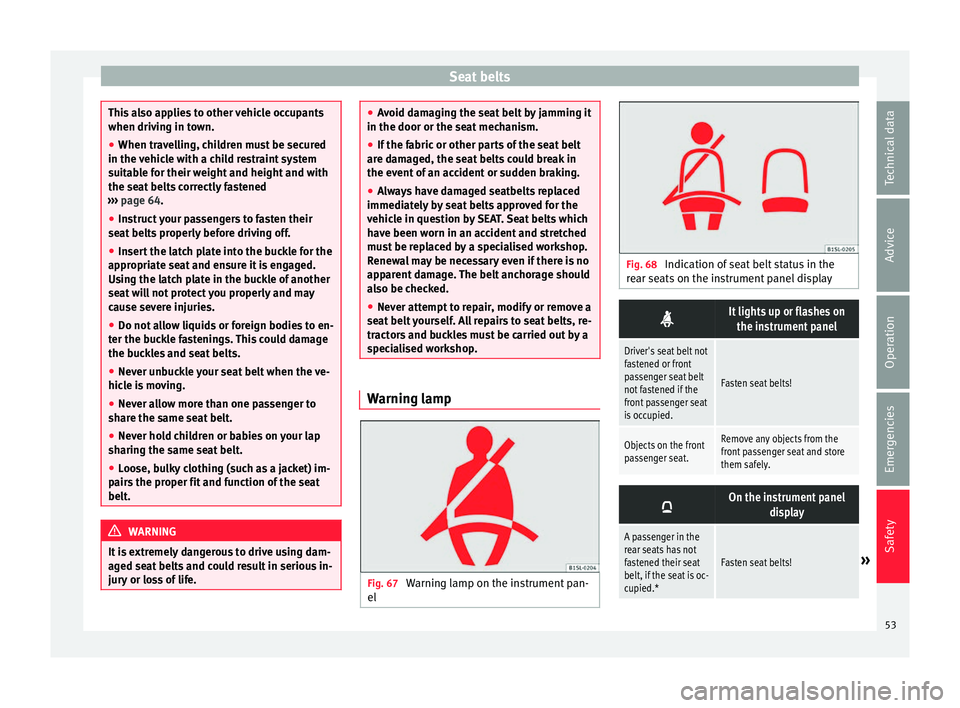
specialised workshop. Warning lamp
Fig. 67
Warning lamp on the instrument pan-
el Fig. 68
Indication of seat belt status in the
re ar se
ats on the instrument panel display
It lights up or flashes on
the instrument panel
Driver's seat belt not
fastened or front
passenger seat belt
not fastened if the
front passenger seat
is occupied.
Fasten seat belts!
Objects on the front
passenger seat.Remove any objects from the
front passenger seat and store
them safely.
On the instrument panel
display
A passenger in the
rear seats has not
fastened their seat
belt, if the seat is oc-
cupied.*
Fasten seat belts!» 53
Technical data
Advice
Operation
Emergencies
Safety
Page 59 of 232
Seat belts
● Pu
l
l the belt to ensure that the latch plate is
securely engaged in the buckle.
Unfastening the seat belt
The seat belt must not be unfastened until
the vehicle has come to a standstill ››› .
● Press the red button on the buckle
› ›
›
Fig. 72 B. The latch plate is released from
the buckle.
● Guide the belt back by hand so that it rolls
up eas
ily and the trim will not be damaged.
Correct seat belt position
Seat belts offer their maximum protection in
the event of an accident and reduce the risk
of sustaining severe or fatal injuries only
when they are properly positioned. Further-
more, if the webbing is correctly positioned,
the seat belt will hold the vehicle occupants
in the optimum position to ensure the airbag
provides the maximum protection. The seat
belt must therefore always be worn and the
webbing correctly positioned.
Incorrectly worn seat belts can cause severe
or even fatal injuries ››› page 48, Correct po-
sition of the vehicle occupants .
● The shoulder part of the seat belt must lie
on the centre of
the shoulder, never across
the neck or the arm, under the arm or behind
the shoulder. ●
The lap par
t of the seat belt must lie across
the pelvis, never across the stomach.
● The seat belt must lie flat and fit comforta-
bly. P
ull the belt tight if necessary to take up
any slack.
In the case of pregnant women , the seat belt
must lie evenly across the chest and as low
as possible over the pelvis, never across the
stomach and must be worn properly at all
times during the pregnancy ››› Fig. 73.
Adapting the position of the belt webbing to
your size
The seat belt can be adapted using the fol-
lowing equipment:
● Front seat height adjustment. WARNING
An incorrectly worn seat belt web can cause
sever e or f
atal injuries in the event of an acci-
dent.
● The seat belt cannot offer its full protection
unl
ess the seat backrest is in an upright posi-
tion and the seat belt is worn correctly, ac-
cording to your size.
● Unbuckling your seat belt while the vehicle
is in motion c
an cause severe or fatal injuries
in the event of an accident or sudden braking.
● The seat belt itself or a loose seat belt can
cause sev
ere injuries if the belt moves from hard areas of the body to soft areas (e.g. the
st
om
ach).
● The shoulder part of the seat belt must lie
on the centre of
the shoulder, never across
the neck or the arm.
● The seat belt must lie flat and fit comforta-
bly on the t
orso
● The lap part of the seat belt must lie across
the pelvis, nev
er across the stomach. The
seat belt must lie flat and fit comfortably on
the pelvis Pull the belt tight if necessary to
take up any slack.
● For pregnant women, the lap part of the
seat belt
must lie as low as possible over the
pelvis and always lie flat, “surrounding” the
stomach.
● Do not twist the seat belt while it is fas-
tened.
● Never p
ull the seat belt away from your
body us
ing your hand.
● Do not lie the seat belt across rigid or frag-
ile o
bjects, e.g. glasses, pens or keys.
● Never use seat belt clips, retaining rings or
simil
ar instruments to alter the position of
the belt webbing. Note
If your physical constitution prevents you
from m aint
aining the correct position of the
belt webbing, contact a specialised workshop
for help with any special devices to ensure
the optimum protection of the seat belt and » 57
Technical data
Advice
Operation
Emergencies
Safety
Page 64 of 232
Safety
● the f uel
s
upply to the engine is cut.
Airbag safety instructions Front airb
agsRead the additional information carefully
›› ›
page 14. WARNING
The airbag is deployed at high speed in frac-
tions of
a second.
● Always keep the deployment areas of the
front airb
ags vacant.
● Never secure objects to the covers or in the
deployment
area of the airbag modules, e.g.
drink holders or phone supports.
● The deployment space between the front
pas
sengers and the airbags must not in any
case be occupied by other passenger, pets
and objects.
● Never fix any object to the windscreen
above the fr
ont airbag on the front passenger
side.
● Do not alter, cover or stick anything to the
steerin
g wheel hub or the surface of the air-
bag module on the passenger side of the
dash panel. WARNING
Front airbags are deployed in front of the
st eerin
g wheel and the instrument panel.
● When driving, always hold the steering
wheel on the outer edg
e of the ring with both
hands: 9 o'clock and 3 o'clock position.
● Adjust the driver seat so that there is a dis-
tance of
at least 25 cm (10 inches) between
the centre of your chest and the hub of the
steering wheel. If your physical constitution
prevents you from meeting these require-
ments, make sure you contact a specialised
workshop.
● Adjust the front passenger seat so there is
as muc
h distance as possible between the
front passenger and the dash panel. Side airbags*
Read the additional information carefully
› ›
›
page 16. WARNING
The airbag is deployed at high speed in frac-
tions of
a second.
● Always keep the deployment areas of the
side airbag
s vacant.
● The deployment space between the front
pas
sengers and the airbags must not in any
case be occupied by other passenger, pets
and objects. ●
Do not mou nt
accessories on the doors.
● Only used protective covers for the seats
that ar
e approved for the vehicle. Otherwise,
the side airbag would be obstructed when de-
ployed. WARNING
Incorrect handling of the driver's and front
p as
senger seat could prevent the side airbag
from deploying properly and cause severe in-
juries.
● Never remove the front seats of the vehicle
or modify an
y of their components.
● Great forces must not be exerted on the
seat b
ackrest bolsters because the side air-
bags might not deploy correctly, might not
deploy at all or might deploy unexpectedly.
● Any damage to the original seat upholstery
or around the se
ams of the side airbag units
must be repaired immediately by a special-
ised workshop. 62
Page 66 of 232
Safety
How to know whether the front passenger
fr ont
airb
ag is disabled
The only indication of the front passenger air-
bag being disabled is that the
control lamp on the dash panel re-
mains lit ( stays yellow) ››› page 63.
If the control lamp on the dash panel
does not remain lit or is lit in combination
with the control lamp on the instrument
panel, a child restraint system cannot be
mounted on the front passenger seat for
safety reasons. The front passenger front air-
bag may deploy during an accident. WARNING
The front passenger front airbag must only be
dis ab
led in special cases.
● Disable and activate the front passenger
front airb
ag when the ignition is switched off
to avoid damage to the airbag system.
● It is the driver's responsibility to ensure
that the k
ey operated switch is set to the cor-
rect position.
● Only disable the front passenger front air-
bag when a chi
ld seat is to be mounted under
exceptional circumstances.
● As soon as the child seat is no longer nee-
ded on the front p
assenger seat, reconnect
the front passenger front airbag. Transporting children safely
Saf ety
f
or children
Introduction Before transporting babies and children in a
chi
l
d seat placed in the front passenger seat,
first completely read the information regard-
ing the airbag system.
This information is extremely important for
driver and passenger safety, particularly that
of babies and children.
SEAT recommends the use of child seats from
the SEAT accessory programme. These child
seats have been designed and tested for use
in SEAT vehicles. You can purchase child
seats with different mountings from a SEAT
dealership. WARNING
Make sure children are properly belted in and
corr ectly
secured to avoid severe or fatal inju-
ries while the vehicle is in motion.
● Never use a rear-facing child seat in the
front p
assenger seat if the front passenger
front airbag is enabled.
● Children up to 12 years old should always
travel
on the rear seat. ●
Chil dr
en must always be protected with an
approved child restraint system suited to
their height and weight.
● Children must assume the proper sitting
position and be pr
operly belted in while trav-
elling.
● Ensure the seat backrest is upright when a
chil
d seat is being used on it.
● Do not allow the child's head or other part
of his
or her body to enter the deployment
area of the side airbags.
● Make sure the belt webbing is correctly
positioned.
● Nev
er hold children or babies on your lap or
in your arms.
● On
ly one child may occupy a child seat.
● Please read and observe the child seat
manufact
urer's handling instructions. WARNING
An empty or loose child seat could fly uncon-
tro l
lably around the vehicle interior and
cause injuries in the event of an accident or
sudden braking.
● When not in use while the vehicle is in mo-
tion, alwa
ys safely secure the child seat or
store it in the luggage compartment. Note
Replace the child seat after an accident, as it
ma y
have invisible damage.64
Page 67 of 232
Transporting children safely
Important information regarding the
fr ont
p
assenger's airbag Read the additional information carefully
›› ›
page 16.
Read and always observe the safety informa-
tion included in the following chapters: ● Safety distance with respect to the passen-
ger airbag ›
›› in Introduction on page 59.
● Objects between the passenger and the
pa s
senger side airbag ››› in Front airbags
on p ag
e 62
.
The passenger side front airbag, when ena-
bled, is a serious risk for a child that is facing
backward since the airbag can strike the seat
with such force that it can cause serious or
fatal injuries. Children up to 12 years old
should always travel on the rear seat.
Therefore we strongly recommend you to
transport children on the rear seats. This is
the safest location in the vehicle. Alternative-
ly, the front passenger airbag can be disa-
bled with a key-operated switch ›››
page 63.
When transporting children, use a child seat
suitable for the age and size of each child
››› page 67. WARNING
● If a c hi
ld seat is secured to the front pas-
senger seat, the risk to the child of sustain- ing critical or fatal injuries in the event of an
acc
ident
increases.
● An inflating front passenger airbag can
strike the r
ear-facing child seat and project it
with great force against the door, the roof or
the backrest.
● Never install a child seat facing backwards
on the front p
assenger seat unless the front
passenger front airbag has been disabled.
Risk of potentially fatal injuries to the child!
However, if it is necessary, in exceptional ca-
ses, to transport a child in the front passen-
ger seat, the front passenger front airbag
must always be disabled ››› page 63. If the
passenger seat has a height adjustment op-
tion, move it to the highest, most upright po-
sition. If you have a fixed seat, do not install
any child restraint system in this location.
● For those vehicles that do not include a key
lock sw
itch to deactivate the airbag, the vehi-
cle must be taken to a technical service.
● All vehicle occupants, especially children,
must
assume the proper sitting position and
be properly belted in while travelling.
● Never hold children or babies on your lap,
this c
an result in potentially fatal injuries to
the child!
● Never allow a child to be transported in a
vehicl
e without being properly secured, or to
stand up or kneel on a seat while travelling.
In an accident, the child could be flung
through the vehicle, causing possibly fatal in-
juries to themselves and to the other vehicle
occupants. ●
If c hi
ldren assume an improper sitting posi-
tion when the vehicle is moving, they expose
themselves to greater risk of injury in the
event of a sudden braking manoeuvre or in an
accident. This is particularly important if the
child is travelling on the front passenger seat
and the airbag system is triggered in an acci-
dent; as this could cause serious injury or
even death.
● A suitable child seat can protect your child!
● Never leave a child alone in the child seat
or inside the
vehicle because depending on
the season, very high temperatures may be
reached inside a parked vehicle, which could
be fatal.
● Children who are less than 1.5 metres tall
must
not wear a normal seat belt without a
child seat, as this could cause injuries to the
abdominal and neck areas during a sudden
braking manoeuvre or in an accident.
● Do not allow the seat belt to become twis-
ted and the seat
belt should be properly in
place ››› page 52.
● Only one child may occupy a child seat
›››
page 67.
● When a child seat is mounted in the rear
seats, the door c
hild-proof lock should be ac-
tivated ››› page 98. 65
Technical data
Advice
Operation
Emergencies
Safety
Page 68 of 232
Safety
Child seats Saf ety
in
structionsRead the additional information carefully
›› ›
page 16. WARNING
The lower anchor points for child seats do not
include rin g
s. Only secure booster seats to
lower anchor points. WARNING
Child seats with lower anchor points and with
an upper r et
aining strap must be installed in
line with the manufacturer's instructions.
Failure to comply could result in severe inju-
ries.
● Always secure just one r
etaining strap to a
child seat with the luggage compartment re-
taining ring.
● Always use the correct retaining rings for
the retainin
g strap.
● Never secure the retaining strap to a retain-
er. WARNING
In general, the rear seat is always the safest
pl ac
e for children, who are belted correctly, in
the event of an accident.
● A suitable child seat that is correctly instal-
led and used on one of
the rear seats offer the most protection possible for babies and
chi
l
dren up to 12 years in most accidents. WARNING
Unbuckling the seat belt while the vehicle is
in motion c an cau
se severe or fatal injuries in
the event of an accident or sudden braking.
● The seat belt must not be unfastened until
the vehic
le has come to a standstill. CAUTION
● To av oid m
aking permanent marks in the
padding, remove the auxiliary introduction
elements from the anchor points when the
child seat is not installed in the vehicle an-
chor points.
● To prevent damage being done to the up-
hols
tery, the padding or the auxiliary intro-
duction elements, always remove the auxili-
ary introduction elements from the anchor
points before folding the rear seat bench. 66
Page 70 of 232
Safety
Use of the child seat on the front pas-
sen g
er se
at1) Transporting children on the front passenger
seat
i
s not permitted in all countries. Further-
more, not all child seats are approved for use
on the front passenger seat. Your SEAT deal-
ership has an updated list of all approved
child seats. Only used child seats that are ap-
proved for each vehicle.
The front airbag on the front passenger side
is highly dangerous for a child. The front pas-
senger seat is life-threatening to a child if he
or she is transported in a rear-facing child
seat.
If a rear-facing child seat is secured to the
front passenger seat, an inflating front airbag
can strike it with such great force that severe
or fatal injuries may result ››› . Therefore,
r e
ar
-facing child seats must never be placed
on the front passenger seat when the front
passenger front airbag is enabled.
Only use a rear-facing child seat on the front
passenger seat if the front passenger front
airbag is disabled. When it is disabled, the
yellow ›››
page 59 con-
trol lamp on the dash panel will be lit. If you
cannot disable the front passenger front air- bag and it remains activated, it is forbidden
to tran
sport children on the front passenger
seat ››› .
Thin g
s
to note if using a child seat on the
front passenger seat:
● The front passenger front airbag must
be
disabled when using a rear-facing child
seat ››› page 59.
● The seat backrest of the front passenger
seat mu
st be upright.
● The front passenger seat must be moved as
far bac
k as possible.
● The seat backrest of the front passenger
seat mu
st be upright.
Suitable child seats
The child seat must be authorised by the
manufacturer especially for use on a front
passenger seat with a front or side airbag.
Universal seats for children can be fitted in
the front passenger seat, in groups 0, 0+, 1,
2 or 3 according to the ECE-R 44 regulation. WARNING
If a child seat is mounted on the front passen-
ger se at, the ri
sk of the child sustaining se- vere or fatal injuries in the event of an acci-
dent inc
r
eases. Rear-facing child seats must
never be mounted on the front passenger
seat when the front passenger front airbag is
enabled. This is life-threatening to the child
should the front airbag deploy, as the child
seat would be struck by the inflated airbag
and thrown against the seat backrest. WARNING
If, in exceptional circumstances, a child must
be tr ans
ported in a rear-facing child seat on
the front passenger seat, strictly observe the
following:
● Always disable the front passenger front
airbag and le
ave it disabled.
● The child seat must be approved by the
manufact
urer for use on a front passenger
seat with front and side airbag.
● Follow the installation instructions of the
chil
d seat manufacturer and observe the
warnings.
● Move the front passenger seat as far back
as po
ssible and adjust it to its highest posi-
tion to keep as far away as possible from the
front airbag.
● Move the seat backrest to the upright posi-
tion. 1)
Compliance with current national legislation and
the manuf act
urer's instructions is required when us-
ing or installing child seats.
68
Page 72 of 232
Emergencies
Emergencies
Self -help
In c a
se of emergency
First aid kit, warning triangle and fire
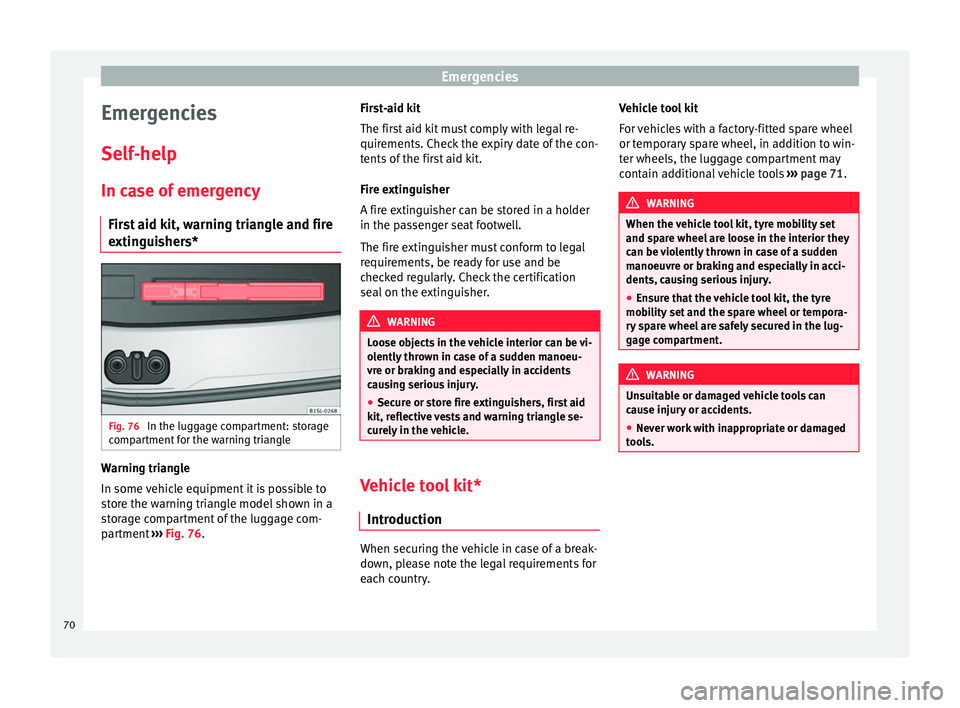
extinguishers* Fig. 76
In the luggage compartment: storage
c omp
ar
tment for the warning triangle Warning triangle
In some
v
ehic
le equipment it is possible to
store the warning triangle model shown in a
storage compartment of the luggage com-
partment ››› Fig. 76. First-aid kit
The first
aid kit must comply with legal re-
quirements. Check the expiry date of the con-
tents of the first aid kit.
Fire extinguisher
A fire extinguisher can be stored in a holder
in the passenger seat footwell.
The fire extinguisher must conform to legal
requirements, be ready for use and be
checked regularly. Check the certification
seal on the extinguisher. WARNING
Loose objects in the vehicle interior can be vi-
ol ently
thrown in case of a sudden manoeu-
vre or braking and especially in accidents
causing serious injury.
● Secure or store fire extinguishers, first aid
kit, refl
ective vests and warning triangle se-
curely in the vehicle. Vehicle tool kit*
Intr oduction When securing the vehicle in case of a break-
do
wn, p
l
ease note the legal requirements for
each country. Vehicle tool kit
For v
ehicles with a factory-fitted spare wheel
or temporary spare wheel, in addition to win-
ter wheels, the luggage compartment may
contain additional vehicle tools ››› page 71. WARNING
When the vehicle tool kit, tyre mobility set
and sp ar
e wheel are loose in the interior they
can be violently thrown in case of a sudden
manoeuvre or braking and especially in acci-
dents, causing serious injury.
● Ensure that the vehicle tool kit, the tyre
mobi
lity set and the spare wheel or tempora-
ry spare wheel are safely secured in the lug-
gage compartment. WARNING
Unsuitable or damaged vehicle tools can
cau se injur
y or accidents.
● Never work with inappropriate or damaged
tool
s. 70