child restraint Seat Mii 2016 User Guide
[x] Cancel search | Manufacturer: SEAT, Model Year: 2016, Model line: Mii, Model: Seat Mii 2016Pages: 232, PDF Size: 4.9 MB
Page 67 of 232
Transporting children safely
Important information regarding the
fr ont
p
assenger's airbag Read the additional information carefully
›› ›
page 16.
Read and always observe the safety informa-
tion included in the following chapters: ● Safety distance with respect to the passen-
ger airbag ›
›› in Introduction on page 59.
● Objects between the passenger and the
pa s
senger side airbag ››› in Front airbags
on p ag
e 62
.
The passenger side front airbag, when ena-
bled, is a serious risk for a child that is facing
backward since the airbag can strike the seat
with such force that it can cause serious or
fatal injuries. Children up to 12 years old
should always travel on the rear seat.
Therefore we strongly recommend you to
transport children on the rear seats. This is
the safest location in the vehicle. Alternative-
ly, the front passenger airbag can be disa-
bled with a key-operated switch ›››
page 63.
When transporting children, use a child seat
suitable for the age and size of each child
››› page 67. WARNING
● If a c hi
ld seat is secured to the front pas-
senger seat, the risk to the child of sustain- ing critical or fatal injuries in the event of an
acc
ident
increases.
● An inflating front passenger airbag can
strike the r
ear-facing child seat and project it
with great force against the door, the roof or
the backrest.
● Never install a child seat facing backwards
on the front p
assenger seat unless the front
passenger front airbag has been disabled.
Risk of potentially fatal injuries to the child!
However, if it is necessary, in exceptional ca-
ses, to transport a child in the front passen-
ger seat, the front passenger front airbag
must always be disabled ››› page 63. If the
passenger seat has a height adjustment op-
tion, move it to the highest, most upright po-
sition. If you have a fixed seat, do not install
any child restraint system in this location.
● For those vehicles that do not include a key
lock sw
itch to deactivate the airbag, the vehi-
cle must be taken to a technical service.
● All vehicle occupants, especially children,
must
assume the proper sitting position and
be properly belted in while travelling.
● Never hold children or babies on your lap,
this c
an result in potentially fatal injuries to
the child!
● Never allow a child to be transported in a
vehicl
e without being properly secured, or to
stand up or kneel on a seat while travelling.
In an accident, the child could be flung
through the vehicle, causing possibly fatal in-
juries to themselves and to the other vehicle
occupants. ●
If c hi
ldren assume an improper sitting posi-
tion when the vehicle is moving, they expose
themselves to greater risk of injury in the
event of a sudden braking manoeuvre or in an
accident. This is particularly important if the
child is travelling on the front passenger seat
and the airbag system is triggered in an acci-
dent; as this could cause serious injury or
even death.
● A suitable child seat can protect your child!
● Never leave a child alone in the child seat
or inside the
vehicle because depending on
the season, very high temperatures may be
reached inside a parked vehicle, which could
be fatal.
● Children who are less than 1.5 metres tall
must
not wear a normal seat belt without a
child seat, as this could cause injuries to the
abdominal and neck areas during a sudden
braking manoeuvre or in an accident.
● Do not allow the seat belt to become twis-
ted and the seat
belt should be properly in
place ››› page 52.
● Only one child may occupy a child seat
›››
page 67.
● When a child seat is mounted in the rear
seats, the door c
hild-proof lock should be ac-
tivated ››› page 98. 65
Technical data
Advice
Operation
Emergencies
Safety
Page 69 of 232
Transporting children safely
General information on transporting
c hi
l
dren in the vehicle Read the additional information carefully
›› ›
page 17.
Legal regulations and provisions will always
take priority over the descriptions of this in-
struction manual. There are different regula-
tions and provisions for the use of child seats
and their mountings ( ››› table on page 67).
In some countries, for example, the use of
child seats on certain seats in the vehicle
may be forbidden.
The physical principles and the forces acting
on the vehicle in the event of a collision or
other type of accidents also apply to children
››› page 52. However, unlike adults and
youngsters, children do not have fully devel-
oped muscle and bone structures. In the
event of an accident, children are subject to a
greater risk than adults of sustaining severe
injuries.
Given that children's bodies are not yet fully
developed, child restraint systems must be
used that are especially adapted to their
height, weight and constitution. There are
laws in force in many countries that indicate the use of approved seat systems for trans-
portin
g b
abies and children.
Only used authorised, approved child seats
that are suitable for the vehicle. Always con-
sult with a SEAT dealership or a Specialised
workshop should you have any doubts.
Specific child seat regulations for each coun-
try (selection)
Child seats must comply with the ECE-R 44 1)
regulation. You can get additional informa-
tion by consulting your SEAT dealership or at
the internet address www.seat.es. Categorisation of child seats according to
ECE
-R 44
Weight cat-egoryWeight ofthe childAge
Group 0up to 10 kgup to approximately. 9 months
Group 0+up to 13 kgup to approximately.18 months
Group 19 to 18 kgapprox. 8 months to 3 1/ 2 years
Group 215 to 25 kgapprox. 3 to 7 years
Group 322 to 36 kgapprox. 6 to 12 years Not all children fit in the seat of their weight
gr
oup
. Nor do al
l seats adapt to the vehicle.
Therefore, always check whether the child fits
properly in the child seat and whether the
seat can be installed safely in the vehicle.
Child seats approved under the ECE-R 44 reg-
ulation are fitted with the corresponding ap-
proval symbol. The sign is an upper-case E in
a circle with the identification number below
it. 1)
ECE-R: Economic Comi
ssion for Europe Regulation.
67
Technical data
Advice
Operation
Emergencies
Safety
Page 71 of 232
Transporting children safely
●
Chil dr
en must always be protected with an
approved child restraint system suited to
their height and weight. Use of the child seat on the rear seat
If a child seat is mounted on the rear seat,
ad
apt
the position of the front passenger
seat so that the child has enough space.
Therefore, adapt the front passenger seat to
the size of the child seat and the height of
the child. Ensure the passenger is in the cor-
rect position ››› page 48.
Suitable child seats
The manufacturer must authorise the child
seat for use in the rear seats with side air-
bags.
Universal seats for children can be fitted in
the passenger seat, in groups 0, 0+, 1, 2 or 3
according to the ECE-R 44 regulation.
The rear seats are suitable for child seats
with the ISOFIX system specially designed
for this type of vehicle in accordance with
regulation ECE-R 44.
ISOFIX child seats approved for rear seats
ISOFIX child seats are divided into the follow-
ing certified categories: “universal”, “semi-
universal” or “specific categories for the ve-
hicle”. ●
If the ISOFIX c
hild seat is certified “univer-
sal”, it must be supported by the lower an-
chor points and the Top Tether retaining
strap.
● If the ISOFIX child seat is certified “semi-
univer
sal” or “specific categories for the ve-
hicle”, check that the child seat is certified
for the vehicle before employing it. The child
seat manufacturer supplies, in addition to
the ISOFIX child seat, a list of vehicles for
which the corresponding ISOFIX child seat
has been certified. If necessary, contact the
child seat manufacturer for an updated list of
vehicles.
69Technical data
Advice
Operation
Emergencies
Safety
Page 115 of 232
Seats and head restraints
● Inser
t
the head restraint into the guides on
the seat backrest.
● Push the head restraint down as far as it
wil
l go while pressing button 1 .
● Fold the backrest of the rear seat backward
ag ain u
nti
l it is engaged.
● Adjust the head restraint to the correct po-
sition ››
› page 51. WARNING
Travelling with the head restraints removed
or improperly a
djusted increases the risk of
severe or fatal injuries in the event of acci-
dents and sudden braking or manoeuvres.
● Always fit and adjust the head restraint
properly whenev
er a person is occupying a
seat.
● Refit any removed head restraints immedi-
ately so th
at passengers are properly protec-
ted. CAUTION
When removing and fitting the head restraint,
mak e s
ure it does not hit the headliner of the
vehicle or the front seat backrest. Otherwise,
the interior roof and other parts of the vehicle
could be damaged. Seat functions
Se at
he
ating* Fig. 120
In the centre console: Front seats
he atin
g sw
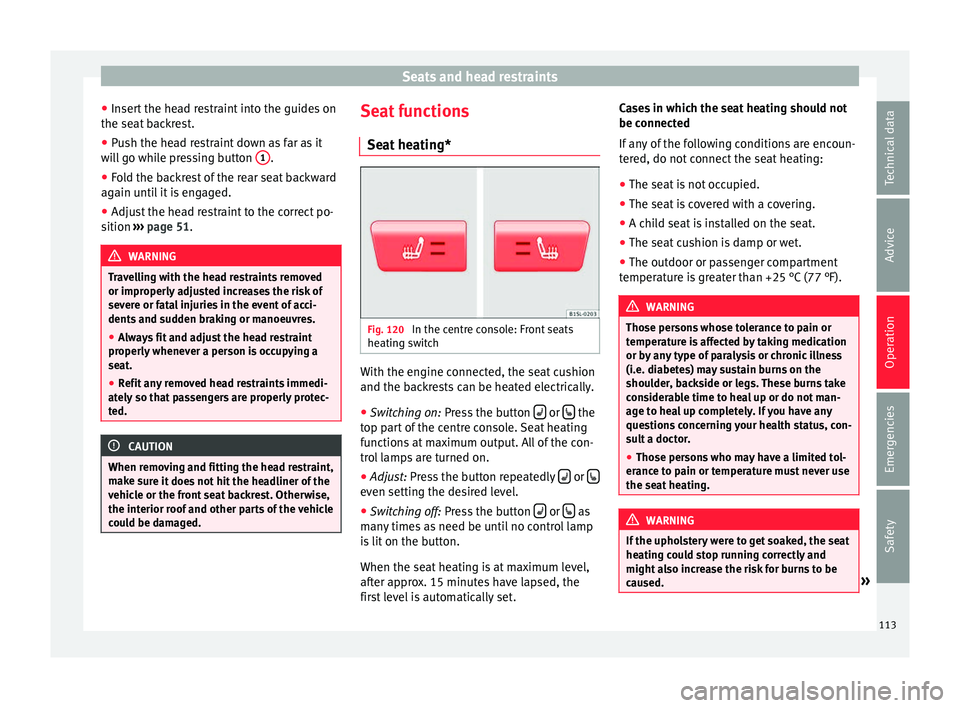
itch With the engine connected, the seat cushion
and the b
ac
k
rests can be heated electrically.
● Switching on: Pres
s the button or
the
t op p
ar
t of the centre console. Seat heating
functions at maximum output. All of the con-
trol lamps are turned on.
● Adjust: Press the button repeatedly or
even setting the desired level.
●
Switching off: Pr e
s
s the button or
as
m an
y
times as need be until no control lamp
is lit on the button.
When the seat heating is at maximum level,
after approx. 15 minutes have lapsed, the
first level is automatically set. Cases in which the seat heating should not
be connected
If
any of the following conditions are encoun-
tered, do not connect the seat heating:
● The seat is not occupied.
● The seat is covered with a covering.
● A child seat is installed on the seat.
● The seat cushion is damp or wet.
● The outdoor or passenger compartment
temperat
ure is greater than +25 °C (77 °F). WARNING
Those persons whose tolerance to pain or
temper at
ure is affected by taking medication
or by any type of paralysis or chronic illness
(i.e. diabetes) may sustain burns on the
shoulder, backside or legs. These burns take
considerable time to heal up or do not man-
age to heal up completely. If you have any
questions concerning your health status, con-
sult a doctor.
● Those persons who may have a limited tol-
erance t
o pain or temperature must never use
the seat heating. WARNING
If the upholstery were to get soaked, the seat
heatin g c
ould stop running correctly and
might also increase the risk for burns to be
caused. » 113
Technical data
Advice
Operation
Emergencies
Safety
Page 219 of 232
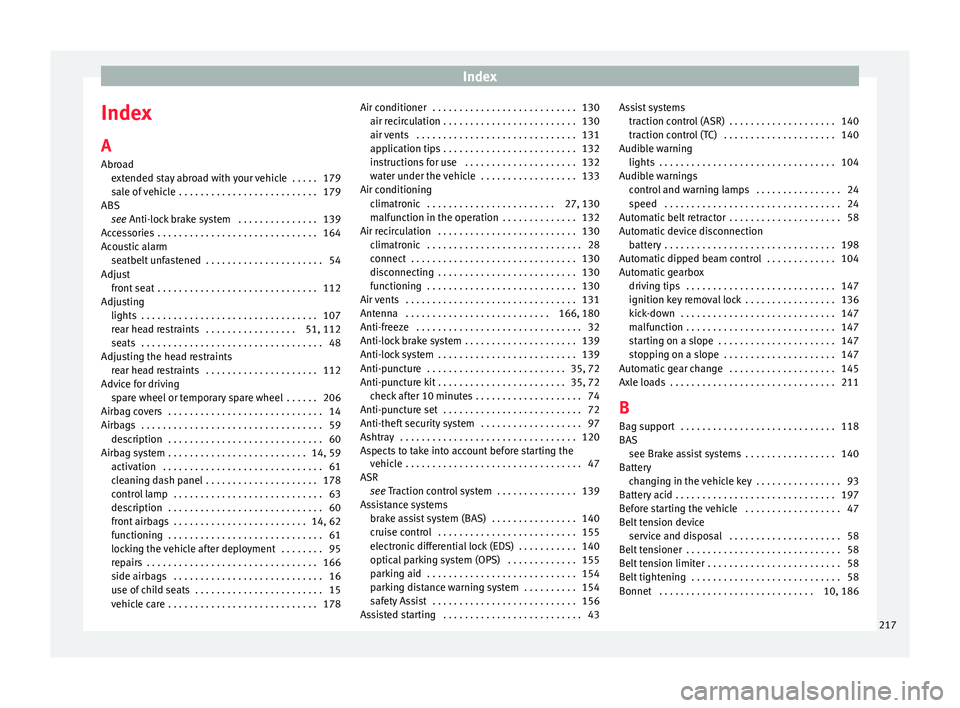
Index
Index
A
Abr o
a
d
extended stay abroad with your vehicle . . . . . 179
sale of vehicle . . . . . . . . . . . . . . . . . . . . . . . . . . 179
ABS see Anti-lock brake system . . . . . . . . . . . . . . . 139
Accessories . . . . . . . . . . . . . . . . . . . . . . . . . . . . . . 164
Acoustic alarm seatbelt unfastened . . . . . . . . . . . . . . . . . . . . . . 54
Adjust front seat . . . . . . . . . . . . . . . . . . . . . . . . . . . . . . 112
Adjusting lights . . . . . . . . . . . . . . . . . . . . . . . . . . . . . . . . . 107
rear head restraints . . . . . . . . . . . . . . . . . 51, 112
seats . . . . . . . . . . . . . . . . . . . . . . . . . . . . . . . . . . 48
Adjusting the head restraints rear head restraints . . . . . . . . . . . . . . . . . . . . . 112
Advice for driving spare wheel or temporary spare wheel . . . . . . 206
Airbag covers . . . . . . . . . . . . . . . . . . . . . . . . . . . . . 14
Airbags . . . . . . . . . . . . . . . . . . . . . . . . . . . . . . . . . . 59 description . . . . . . . . . . . . . . . . . . . . . . . . . . . . . 60
Airbag system . . . . . . . . . . . . . . . . . . . . . . . . . . 14, 59 activation . . . . . . . . . . . . . . . . . . . . . . . . . . . . . . 61
cleaning dash panel . . . . . . . . . . . . . . . . . . . . . 178
control lamp . . . . . . . . . . . . . . . . . . . . . . . . . . . . 63
description . . . . . . . . . . . . . . . . . . . . . . . . . . . . . 60
front airbags . . . . . . . . . . . . . . . . . . . . . . . . . 14, 62
functioning . . . . . . . . . . . . . . . . . . . . . . . . . . . . . 61
locking the vehicle after deployment . . . . . . . . 95
repairs . . . . . . . . . . . . . . . . . . . . . . . . . . . . . . . . 166
side airbags . . . . . . . . . . . . . . . . . . . . . . . . . . . . 16
use of child seats . . . . . . . . . . . . . . . . . . . . . . . . 15
vehicle care . . . . . . . . . . . . . . . . . . . . . . . . . . . . 178 Air conditioner . . . . . . . . . . . . . . . . . . . . . . . . . . . 130
air recir culation . . . . . . . . . . . . . . . . . . . . . . . . . 130
air vents . . . . . . . . . . . . . . . . . . . . . . . . . . . . . . 131
application tips . . . . . . . . . . . . . . . . . . . . . . . . . 132
instructions for use . . . . . . . . . . . . . . . . . . . . . 132
water under the vehicle . . . . . . . . . . . . . . . . . . 133
Air conditioning climatronic . . . . . . . . . . . . . . . . . . . . . . . . 27, 130
malfunction in the operation . . . . . . . . . . . . . . 132
Air recirculation . . . . . . . . . . . . . . . . . . . . . . . . . . 130 climatronic . . . . . . . . . . . . . . . . . . . . . . . . . . . . . 28
connect . . . . . . . . . . . . . . . . . . . . . . . . . . . . . . . 130
disconnecting . . . . . . . . . . . . . . . . . . . . . . . . . . 130
functioning . . . . . . . . . . . . . . . . . . . . . . . . . . . . 130
Air vents . . . . . . . . . . . . . . . . . . . . . . . . . . . . . . . . 131
Antenna . . . . . . . . . . . . . . . . . . . . . . . . . . . 166, 180
Anti-freeze . . . . . . . . . . . . . . . . . . . . . . . . . . . . . . . 32
Anti-lock brake system . . . . . . . . . . . . . . . . . . . . . 139
Anti-lock system . . . . . . . . . . . . . . . . . . . . . . . . . . 139
Anti-puncture . . . . . . . . . . . . . . . . . . . . . . . . . . 35, 72
Anti-puncture kit . . . . . . . . . . . . . . . . . . . . . . . . 35, 72 check after 10 minutes . . . . . . . . . . . . . . . . . . . . 74
Anti-puncture set . . . . . . . . . . . . . . . . . . . . . . . . . . 72
Anti-theft security system . . . . . . . . . . . . . . . . . . . 97
Ashtray . . . . . . . . . . . . . . . . . . . . . . . . . . . . . . . . . 120
Aspects to take into account before starting the vehicle . . . . . . . . . . . . . . . . . . . . . . . . . . . . . . . . . 47
ASR see Traction control system . . . . . . . . . . . . . . . 139
Assistance systems brake assist system (BAS) . . . . . . . . . . . . . . . . 140
cruise control . . . . . . . . . . . . . . . . . . . . . . . . . . 155
electronic differential lock (EDS) . . . . . . . . . . . 140
optical parking system (OPS) . . . . . . . . . . . . . 155
parking aid . . . . . . . . . . . . . . . . . . . . . . . . . . . . 154
parking distance warning system . . . . . . . . . . 154
safety Assist . . . . . . . . . . . . . . . . . . . . . . . . . . . 156
Assisted starting . . . . . . . . . . . . . . . . . . . . . . . . . . 43 Assist systems
traction contr ol (ASR) . . . . . . . . . . . . . . . . . . . . 140
traction control (TC) . . . . . . . . . . . . . . . . . . . . . 140
Audible warning lights . . . . . . . . . . . . . . . . . . . . . . . . . . . . . . . . . 104
Audible warnings control and warning lamps . . . . . . . . . . . . . . . . 24
speed . . . . . . . . . . . . . . . . . . . . . . . . . . . . . . . . . 24
Automatic belt retractor . . . . . . . . . . . . . . . . . . . . . 58
Automatic device disconnection battery . . . . . . . . . . . . . . . . . . . . . . . . . . . . . . . . 198
Automatic dipped beam control . . . . . . . . . . . . . 104
Automatic gearbox driving tips . . . . . . . . . . . . . . . . . . . . . . . . . . . . 147
ignition key removal lock . . . . . . . . . . . . . . . . . 136
kick-down . . . . . . . . . . . . . . . . . . . . . . . . . . . . . 147
malfunction . . . . . . . . . . . . . . . . . . . . . . . . . . . . 147
starting on a slope . . . . . . . . . . . . . . . . . . . . . . 147
stopping on a slope . . . . . . . . . . . . . . . . . . . . . 147
Automatic gear change . . . . . . . . . . . . . . . . . . . . 145
Axle loads . . . . . . . . . . . . . . . . . . . . . . . . . . . . . . . 211
B Bag support . . . . . . . . . . . . . . . . . . . . . . . . . . . . . 118
BAS see Brake assist systems . . . . . . . . . . . . . . . . . 140
Battery changing in the vehicle key . . . . . . . . . . . . . . . . 93
Battery acid . . . . . . . . . . . . . . . . . . . . . . . . . . . . . . 197
Before starting the vehicle . . . . . . . . . . . . . . . . . . 47
Belt tension device service and disposal . . . . . . . . . . . . . . . . . . . . . 58
Belt tensioner . . . . . . . . . . . . . . . . . . . . . . . . . . . . . 58
Belt tension limiter . . . . . . . . . . . . . . . . . . . . . . . . . 58
Belt tightening . . . . . . . . . . . . . . . . . . . . . . . . . . . . 58
Bonnet . . . . . . . . . . . . . . . . . . . . . . . . . . . . . 10, 186
217